Seasonal Variation in Intestinal Protozoan Infection Rates: Environmental Drivers, Research Methods, and Clinical Implications
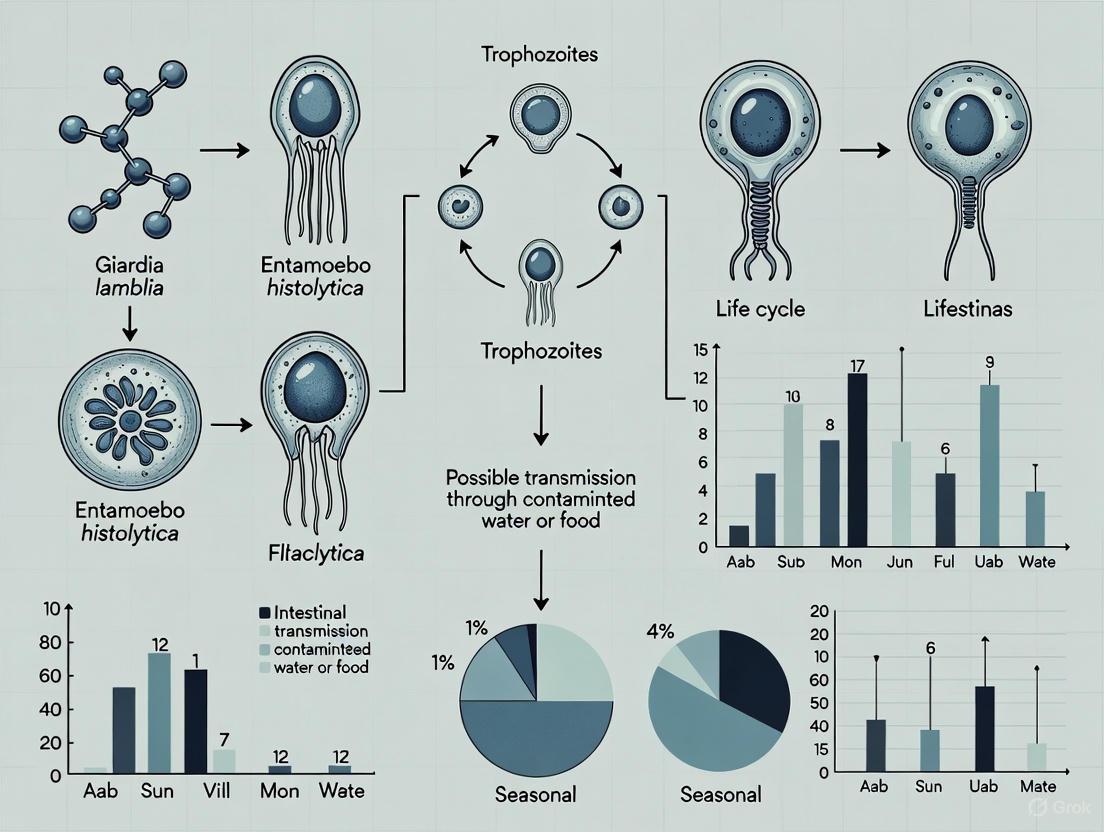
This comprehensive review examines the complex interplay between seasonal environmental factors and intestinal protozoan infection dynamics, addressing critical knowledge gaps for researchers and drug development professionals.
Seasonal Variation in Intestinal Protozoan Infection Rates: Environmental Drivers, Research Methods, and Clinical Implications
Abstract
This comprehensive review examines the complex interplay between seasonal environmental factors and intestinal protozoan infection dynamics, addressing critical knowledge gaps for researchers and drug development professionals. We synthesize recent global epidemiological data revealing significant regional variations in seasonal patterns for pathogens like Giardia, Cryptosporidium, and Eimeria. The article details advanced methodological approaches for detecting and analyzing seasonal trends, while exploring the implications of environmental persistence on disease control strategies and therapeutic development. By integrating foundational concepts with troubleshooting guidance and validation frameworks, this resource provides essential insights for optimizing surveillance systems, timing interventions, and designing climate-resilient public health policies.
Environmental Drivers and Global Patterns of Seasonal Protozoan Transmission
The Impact of Temperature and Humidity on Protozoan Survival and Infectivity
The survival, development, and transmission success of protozoan parasites are profoundly influenced by environmental conditions, with temperature and humidity serving as critical determinants. Within the broader context of research on seasonal variation in intestinal protozoan infection rates, understanding these abiotic factors provides essential insights into predictable epidemiological patterns observed across human and animal populations. Temperature governs metabolic rates and developmental speed of free-living stages, while humidity directly affects desiccation stress and survival duration in the environment [1]. These parameters collectively influence the temporal and spatial distribution of protozoan diseases, creating windows of transmission risk that align with specific climatic conditions.
The interplay between these factors and seasonal infection patterns is particularly relevant for disease forecasting and targeted control interventions. Research across diverse ecosystems demonstrates that parasitic infections often peak during specific seasons characterized by optimal temperature and moisture conditions. For instance, in farmed mouflons, most studied protozoans exhibited significantly greater prevalence in spring and summer months (May to September) when temperature and precipitation conditions were favorable [2]. Similarly, in human populations, climate-sensitive infectious diseases including diarrheal diseases caused by protozoan pathogens show strong seasonal associations with weather patterns [3]. This technical guide synthesizes current experimental evidence and mechanistic insights regarding thermal and humidity effects on protozoan biology, providing researchers and drug development professionals with a foundation for predicting transmission dynamics and developing climate-informed control strategies.
Thermal Biology of Protozoan Parasites
Fundamental Temperature Effects on Development and Survival
Protozoan parasites, like other ectotherms, exhibit non-linear responses to temperature variations, with performance metrics typically following unimodal curves across a thermal gradient. The concept of the Thermal Performance Curve (TPC) provides a valuable framework for understanding these relationships, characterized by several critical thresholds: the minimum critical temperature (CTmin) below which development ceases, the optimal temperature (Topt) where performance peaks, and the critical thermal maximum (CTmax) where lethal effects occur [1]. These thermal boundaries vary substantially among protozoan species and strains, contributing to their distinct geographical distributions and seasonal transmission patterns.
Experimental evidence demonstrates that temperature governs key physiological processes in protozoans through its effects on enzyme kinetics, membrane fluidity, and protein stability. For the monarch butterfly protozoan parasite Ophryocystis elektroscirrha (OE), spore viability decreases significantly in response to warmer temperatures over moderate-to-long time scales, with heat dramatically shortening the transmission window [4]. Similarly, development of Arctic nematode larvae in intermediate hosts occurs only above a specific lower threshold temperature (T₀), below which development to infective stages does not proceed [5]. These temperature-dependent developmental processes directly influence transmission potential by determining the duration required for parasites to reach infectivity under natural conditions.
Table 1: Thermal Tolerance Parameters of Selected Protozoan Parasites
| Parasite Species | Host System | Lower Threshold (°C) | Optimal Range (°C) | Upper Limit (°C) | Key Effects |
|---|---|---|---|---|---|
| Eimeria spp. | Mouflon | Not reported | Spring/Summer conditions | Not reported | Higher prevalence in warmer seasons [2] |
| Ophryocystis elektroscirrha | Monarch butterfly | Not reported | Not reported | >30°C (reduced viability) | Spore viability decreases at warmer temperatures [4] |
| Varestrongylus eleguneniensis (L1 to L3) | Gastropod-Musox | 9.54°C | 8.5-24°C | Not reported | No development below threshold [5] |
Temperature-Driven Developmental Models
The relationship between temperature and protozoan development can be quantified using degree-day models, which accumulate thermal units above a specific threshold required for completion of developmental stages. For the Arctic lungworm Varestrongylus eleguneniensis, the lower threshold temperature (T₀) below which larvae do not develop to infective third-stage larvae (L3) is approximately 9.54°C, with development requiring 171.25 degree-days [5]. This model successfully predicts the parasite's geographical distribution and transmission windows, with regions and seasons accumulating sufficient thermal units supporting complete development.
Temperature effects extend beyond developmental rates to influence survival extremes. Arctic nematodes Umingmakstrongylus pallikuukensis and Varestrongylus eleguneniensis demonstrate remarkable freeze tolerance, with more than 80% of first-stage larvae (L1) surviving temperatures from -10°C to -80°C for up to 180 days [5]. This exceptional cryotolerance enables overwintering survival and early spring transmission in extreme environments. At the opposite thermal extreme, the protozoan Ophryocystis elektroscirrha experiences significantly reduced spore viability when exposed to consistently warm conditions, although the thick, amber-colored spore wall provides some protection against environmental stressors [4].
Diagram 1: Thermal performance curve framework for protozoan parasites, showing key thresholds and their relationship to infectivity.
Humidity and Desiccation Stress Effects
Humidity as a Determinant of Environmental Persistence
Humidity profoundly influences protozoan survival through its effects on desiccation stress, particularly for transmission stages exposed to atmospheric conditions between hosts. The relationship between temperature and humidity is fundamentally interconnected, as warmer air can hold more moisture, creating complex interactions that determine actual dehydration risk. Higher humidity typically correlates with extended environmental persistence of protozoan transmission stages, though the specific sensitivity varies among species and developmental stages [1]. This relationship explains the frequent association between rainfall events and outbreaks of protozoan diseases such as cryptosporidiosis and giardiasis.
Research across multiple host systems demonstrates these humidity-dependent survival patterns. In farmed mouflons, precipitation was found to be positively correlated with infection intensity of most protozoans studied [2]. Similarly, in human populations in Bangladesh, higher humidity correlated significantly with increased incidence of diarrheal diseases often caused by protozoan pathogens [3]. The protective effect of high humidity appears particularly important for protozoans with direct transmission pathways where environmental stages must remain viable between hosts, though the optimal humidity range varies substantially among species.
Interactive Effects of Temperature and Humidity
The combined influence of temperature and humidity on protozoan survival creates complex, often non-additive effects that can challenge predictive models. The water vapor pressure deficit, which integrates both temperature and humidity into a measure of atmospheric evaporative power, may provide a more accurate predictor of protozoan environmental survival than either variable alone [1]. At higher temperatures, the desiccating effect of low humidity becomes particularly pronounced, creating conditions that rapidly inactivate moisture-sensitive transmission stages.
Experimental studies with mosquito vectors have demonstrated that failing to account for humidity-temperature interactions leads to overestimation of thermal optima under dry conditions [1]. While similar controlled experiments for protozoan parasites are less abundant, observational evidence suggests parallel mechanisms likely operate. For instance, the synergistic negative effects of high temperature and low humidity may explain the sharply reduced environmental persistence of some protozoan species during hot, dry seasons, even when temperatures remain within the theoretical tolerance range.
Table 2: Documented Humidity and Temperature Interactions in Parasite Systems
| Parasite/System | Humidity Effect | Temperature Interaction | Experimental Evidence |
|---|---|---|---|
| Mouflon protozoans [2] | Positive correlation with precipitation | Temperature and precipitation positively correlated with protozoan infection intensity | Field observational study |
| Gastrointestinal infections in humans [3] | Higher humidity correlated with diarrhea incidence | Positive correlation with temperature for diarrhea | Hospital admission data analysis |
| Mosquito vectors [1] | Humidity shapes thermal performance ranges | Combined effects better predicted by vapor pressure deficit | Laboratory and field studies |
Experimental Methodologies and Assessment Techniques
Temperature-Dependent Development Protocols
The investigation of thermal effects on protozoan development requires controlled laboratory systems that isolate temperature from confounding variables. The temperature-dependent development of Varestrongylus eleguneniensis provides an exemplary methodology: gastropod intermediate hosts (Deroceras laeve) were experimentally infected with first-stage larvae (L1) and maintained at constant temperature treatments ranging from 8.5°C to 24°C [5]. This approach established the fundamental thermal thresholds for development by tracking progression to infective third-stage larvae (L3) under stable conditions, eliminating the complicating effects of diurnal fluctuations.
Critical methodological considerations for thermal development studies include:
- Acclimation periods for hosts and parasites prior to experimentation
- Precise temperature control using environmental chambers with minimal fluctuation (±0.5°C)
- Regular monitoring of larval development through microscopic examination of slug tissues
- Statistical modeling of development rates using degree-day accumulation models
- Verification of infectivity through experimental challenge of susceptible hosts
These standardized protocols enable cross-species comparisons and development of predictive models for field conditions.
Environmental Persistence and Viability Assays
Determining the combined effects of temperature and humidity on protozoan survival requires experimental designs that manipulate both variables across ecologically relevant ranges. The study of Ophryocystis elektroscirrha (OE) monarch butterfly parasites exemplifies this approach: spores were exposed to a gradient of ecologically relevant temperatures for varying durations (2, 35, or 93 weeks), with viability subsequently tested by feeding controlled spore doses to susceptible monarch larvae [4]. This direct infectivity-based assessment provides the most biologically relevant measure of persistence under different environmental conditions.
For freezing survival studies, as conducted with Arctic nematodes, methodologies involve holding freshly collected L1 larvae in water at subzero temperatures (from -10°C to -80°C) with survival counts at predetermined intervals (2, 7, 30, 90, and 180 days) [5]. These extreme temperature investigations reveal remarkable adaptations in certain polar species but also inform understanding of temperate species overwintering capacity.
Diagram 2: Experimental workflow for assessing temperature and humidity effects on protozoan survival and infectivity.
The Researcher's Toolkit: Essential Reagents and Methodologies
Table 3: Key Research Reagent Solutions for Protozoan Environmental Studies
| Reagent/Material | Application | Specific Function | Example Use |
|---|---|---|---|
| Modified Baermann technique [5] | Larval isolation | Separates active larvae from fecal debris | Recovery of first-stage larvae from muskox feces |
| Potassium dichromate (K₂Cr₂O₇) [2] | Oocyst culture | Prevents mould growth in moist cultures | Maintenance of Eimeria oocysts for sporulation studies |
| Willis-Schlaf and McMaster methods [2] | Fecal egg/oocyst quantification | Standardized counting of parasite stages | Determination of infection intensity in mouflons |
| Mini-FLOTAC technique [6] | Fecal parasite detection | Quantitative examination of parasitic elements | Gastrointestinal parasite screening in wild rodents |
| Fuelleborn, Heine and ZnSO₄ flotation [7] [8] | Protozoan concentration | Floatation of parasitic elements for microscopy | Detection of Giardia, Cryptosporidium, and Eimeria in calves |
| PCR and molecular protocols [5] | Species identification | Genetic confirmation of parasite species | Differentiation of closely related nematode species |
The survival and infectivity of protozoan parasites are intimately linked to temperature and humidity conditions through multiple mechanistic pathways. Understanding these relationships provides critical insights into the seasonal patterns of infection rates observed in both human and animal populations. From a research perspective, integrating controlled laboratory studies with field validation remains essential for developing predictive models of parasite transmission under changing environmental conditions. For drug development professionals, these environmental influences on transmission dynamics offer opportunities for targeting interventions to specific seasonal windows when infection risk is highest. Future research directions should prioritize multifactorial experiments that simultaneously manipulate temperature, humidity, and host immunity to better reflect natural transmission conditions and inform climate-responsive control strategies for protozoan diseases of medical and veterinary importance.
Rainfall Patterns and Waterborne Transmission of Giardia and Cryptosporidium
The waterborne protozoan parasites Giardia duodenalis and Cryptosporidium spp. represent significant global public health challenges, causing the gastrointestinal diseases giardiasis and cryptosporidiosis. These pathogens are renowned for their low infectious dose, prolonged environmental survival, and resistance to conventional water disinfection methods like chlorination [9] [10]. Within the broader research on seasonal variation of intestinal protozoan infections, the influence of rainfall patterns emerges as a critical environmental driver of disease transmission. Climate-related conditions, including precipitation, are intricately linked to the survival, distribution, and overall transmission success of these parasites [11] [12] [13]. This technical guide synthesizes current evidence on the complex relationships between rainfall and the transmission dynamics of Giardia and Cryptosporidium, providing structured data and methodologies to inform future research and public health intervention strategies.
The Impact of Rainfall on Transmission Dynamics
Mechanisms of Hydrology and Pathogen Mobilization
Rainfall influences the transport and concentration of Giardia and Cryptosporidium (oo)cysts in water systems through several physical and environmental mechanisms. Precipitation, particularly heavy rainfall, facilitates the mobilization and runoff of parasites from contaminated land surfaces (especially agricultural and pastoral lands with livestock feces) into rivers, streams, and reservoirs [12] [9]. This process is often characterized by a positive association between rainfall events and the detection of these pathogens in surface water sources [14] [9] [15].
A study in Northern Greece over a two-year period found that river water samples were frequently contaminated, with higher (oo)cyst detection rates during winter and spring, seasons typically associated with increased precipitation [9]. Furthermore, research from Pennsylvania, USA (2010-2019) confirmed a positive association between weekly rainfall and counts of giardiasis cases [14]. The relationship is modulated by factors such as rainfall intensity, land use, soil characteristics, and the timing of preceding precipitation events, which collectively determine the saturation level of watersheds and their susceptibility to contamination [14] [12].
Lag Periods and the Role of Prior Wetness
The temporal relationship between a rainfall event and a measurable increase in disease incidence is not always immediate. Significant lag periods exist, reflecting the time required for hydrologic transport, pathogen exposure, and the incubation period within the human host. A multi-decade study in Colorado revealed that the relationship between precipitation extremes and protozoan disease risk involved long lags of more than 8 months, suggesting a complex interaction with environmental reservoirs that standard short-term epidemiological analyses might miss [13].
Beyond immediate rainfall, the prior wetness condition of the environment, often quantified by indices like the Palmer Drought Severity Index (PDSI), is a critical factor. In Pennsylvania, an increase in prior wetness was significantly associated with increased incidence rates of cryptosporidiosis [14]. A pre-saturated environment from previous rainfall may have reduced capacity to absorb new precipitation, leading to more extensive runoff and pathogen mobilization into water bodies.
Variable and Context-Dependent Associations
The impact of rainfall is not universally positive and can vary considerably based on local context, including climate zone, ecosystem type, land use, water management infrastructure, and the specific parasite species. A review of the literature shows that identified relationships between rainfall and disease incidence are not consistent across different studies and locations [11] [12]. For instance, a study in the Democratic Republic of Congo found no statistically valid association between season and the overall prevalence of intestinal parasitosis, which included protozoan infections, suggesting that in some tropical climates, other transmission pathways may dominate [16]. Similarly, a study in Australia reported a negative association between rainfall at lags of 0–1 week and cryptosporidiosis incidence [12]. These contradictions underscore the necessity for localized, context-specific risk assessments.
Table 1: Documented Associations Between Rainfall and Giardia/Cryptosporidium in Various Studies
| Location | Study Period | Parasite | Association with Rainfall | Key Findings | Source |
|---|---|---|---|---|---|
| Pennsylvania, USA | 2010-2019 | Giardia | Positive | A positive association was found between rain and counts of giardiasis. | [14] |
| Colorado, USA | 1997-2017 | Cryptosporidium & Giardia | Complex (Long Lag) | Risk showed prominent long-term (>8 month) lags following precipitation extremes. | [13] |
| Antioquia, Colombia | 2019-2020 | Giardia & Cryptosporidium | Seasonal Pattern | Higher contamination in surface waters during the wet season. | [15] |
| Northern Greece | 2 Years | Giardia & Cryptosporidium | Seasonal Pattern | Higher river water contamination during winter and spring. | [9] |
| Australia | 1996-2004 | Cryptosporidium | Negative | A negative association between rainfall at lags of 0–1 week and incidence. | [12] |
| D.R. Congo | 2020-2021 | Intestinal Parasitosis | No Association | No statistically valid association found between season and prevalence. | [16] |
Table 2: Key Environmental Factors Influencing Rainfall-Mediated Transmission
| Factor Category | Specific Factor | Influence on (Oo)Cyst Transmission |
|---|---|---|
| Climatic Conditions | Rainfall Intensity & Duration | Determines volume and force of runoff, mobilizing (oo)cysts from soil and feces. |
| Prior Wetness (PDSI) | Saturated watersheds from previous rain increase runoff potential for new events. | |
| Temperature | Affects survival and infectivity of (oo)cysts in the environment; higher temperatures can decrease survival. | |
| Land & Water Characteristics | Land Use (Agriculture, Livestock) | Presence of infected animals determines the source load of (oo)cysts available for runoff. |
| Soil Type & Porosity | Influences infiltration capacity versus surface runoff. | |
| Water Turbidity & Flow Rate | High turbidity and flow can resuspend and carry (oo)cysts; low flow can increase concentration. | |
| Infrastructure & Sanitation | Drinking Water Source & Treatment | Efficacy of filtration and disinfection barriers determines if contamination leads to exposure. |
| Presence of Combined Sewer Overflows | Heavy rain can cause sewer overflows, releasing raw sewage containing (oo)cysts into water bodies. |
Experimental and Methodological Approaches
Key Experimental Protocols for Water Monitoring
Monitoring water matrices for the presence and concentration of Giardia and Cryptosporidium is fundamental to establishing transmission links. The following provides a detailed methodology for sampling and analysis.
Protocol 1: Water Sample Collection and Processing for (Oo)Cyst Detection
Sample Collection:
- Volume: Collect large-volume water samples (typically 10-50 liters) depending on the expected (oo)cyst concentration and water quality.
- Method: Filter water through a compressed foam filter or cartridge filter (e.g., Filta-Max) using a portable pump. Sampling should follow guidelines such as ISO 5667-5 (drinking water) and ISO 5667-6 (rivers and streams) [15].
- Field Data: Concurrently record physicochemical parameters (turbidity, pH, conductivity, temperature) and meteorological data (recent rainfall).
Elution and Concentration:
- Mechanically wash the filter to elute captured particles.
- Centrifuge the eluate to pellet the solids, concentrating the sample to a manageable volume (e.g., 10 mL).
Immunomagnetic Separation (IMS):
- Use parasite-specific antibodies conjugated to magnetic beads to selectively isolate (oo)cysts from the concentrate. This step reduces background debris and improves detection sensitivity, as stipulated in the US EPA Method 1623 [15].
Detection and Enumeration:
- Stain the IMS-isolated (oo)cysts with fluorescently labeled monoclonal antibodies (e.g., FITC-Conjugate) for easy visualization.
- Counterstain with 4',6-diamidino-2-phenylindole (DAPI) to assess nuclear morphology.
- Examine slides under an epifluorescence microscope. (Oo)cysts are identified based on specific antibody fluorescence, size (Cryptosporidium: 4-6 μm; Giardia: 8-14 μm), and shape.
- Report results as (oo)cysts per liter of original sample.
Protocol 2: Molecular Characterization for Source Tracking
DNA Extraction:
- Extract genomic DNA from purified (oo)cyst samples or from human/animal fecal samples using commercial kits (e.g., E.Z.N.A. Stool DNA Kit) [17].
Nested Polymerase Chain Reaction (PCR):
- Amplify specific genetic loci to determine the species, genotype, and subtype.
- For Cryptosporidium, common targets include the small subunit ribosomal RNA (SSU rRNA) gene for species identification and the 60-kDa glycoprotein (gp60) gene for subtyping [17].
- For Giardia, a multilocus genotyping (MLG) scheme is recommended, targeting genes like triosephosphate isomerase (tpi), glutamate dehydrogenase (gdh), and β-giardin (bg) [17].
DNA Sequencing and Analysis:
- Purify PCR products and sequence them in both directions.
- Analyze the resulting chromatograms and align sequences with reference sequences from public databases (e.g., GenBank) using software like ClustalX to confirm genotype and subtype identity [17].
Data Analysis: Modeling Climate-Disease Relationships
Advanced statistical models are required to decipher the complex, non-linear relationships between weather variables and disease incidence.
- Time Series Regression Models: Techniques such as Seasonal Auto-Regressive Integrated Moving Average (SARIMA) models are used to account for seasonal trends and autocorrelation in case data while assessing the impact of climatic variables like temperature and precipitation [12].
- Distributed-Lag Nonlinear Models (DLNM): This approach is particularly powerful for investigating the complex, non-linear exposure-response relationships and delayed effects (lag periods). A multi-decade study in Colorado used a conditional Poisson DLNM to estimate the lagged association (0-12 months) between extreme temperature/precipitation and disease risk [13].
- Machine Learning (ML) for Risk Prediction: ML models can integrate biological, physicochemical, and meteorological factors to predict contamination intensity. One study developed models that predicted contamination with Cryptosporidium and Giardia with 75% and 69% accuracy, respectively, highlighting the potential of ML to augment risk-based sampling plans [9].
Essential Research Tools and Visualizations
The Scientist's Toolkit: Key Research Reagents
Table 3: Essential Reagents and Materials for Giardia and Cryptosporidium Research
| Research Reagent / Kit | Primary Function | Application Example |
|---|---|---|
| Fluorescently Labelled Monoclonal Antibodies (FITC) | Specific detection and visualization of (oo)cysts under microscopy. | Immunofluorescence staining for (oo)cyst enumeration in water concentrates (EPA Method 1623) [15]. |
| Immunomagnetic Separation (IMS) Kits | Selective isolation of (oo)cysts from complex water sample concentrates. | Purification step to reduce debris and improve molecular detection sensitivity [15]. |
| Commercial DNA Extraction Kits | Isolation of high-quality genomic DNA from (oo)cysts or fecal samples. | Preparation of template DNA for subsequent PCR-based genotyping (e.g., E.Z.N.A. Stool DNA Kit) [17]. |
| PCR Master Mixes & Specific Primer Sets | Amplification of parasite-specific DNA sequences. | Genotyping (e.g., SSU rRNA for Cryptosporidium) and subtyping (e.g., gp60 for C. parvum) [17]. |
| Agarose Gels & Electrophoresis Systems | Size separation and visualization of PCR amplicons. | Confirmation of successful PCR amplification before sequencing. |
Conceptual and Experimental Workflow Diagrams
The following diagram illustrates the core conceptual model of how rainfall patterns drive the waterborne transmission of these parasites, integrating key environmental and infrastructural factors.
Rainfall-Driven Transmission Pathway
The experimental workflow for detecting and genetically characterizing parasites from water and environmental samples involves a multi-step process, as outlined below.
Experimental Workflow for Pathogen Analysis
The body of evidence confirms that rainfall patterns are a fundamental determinant in the waterborne transmission of Giardia and Cryptosporidium. The relationship is complex, modulated by factors such as rainfall intensity, prior environmental wetness, long lag periods, and local socio-ecological conditions. Moving forward, research must prioritize the development of predictive models that integrate high-resolution meteorological data with land use and water infrastructure variables to forecast outbreak risks. Furthermore, enhancing molecular subtyping techniques for precise source attribution and advocating for the implementation of advanced water treatment barriers, such as UV irradiation or ozone, which are more effective against chlorine-resistant (oo)cysts, are critical steps toward mitigating the public health burden of these persistent waterborne pathogens.
This whitepaper investigates the distinct seasonal dynamics of intestinal protozoan infections across contrasting climatic zones, a subject of critical importance for global disease surveillance and therapeutic development. Intestinal parasitic infections (IPIs) pose a significant global health burden, affecting over one billion people worldwide, with intestinal protozoa such as Giardia lamblia and Entamoeba histolytica representing a major cause of morbidity [18]. The life cycles, transmission pathways, and environmental persistence of these pathogens are profoundly influenced by climatic factors, leading to marked temporal and spatial variations in infection rates. Framed within a broader thesis on seasonal variation in intestinal protozoan infection rates, this analysis contrasts the driving environmental variables and seasonal peaks in tropical and temperate regions, providing a foundational context for the development of targeted public health interventions, seasonally-adjusted treatment protocols, and climate-resilient drug development strategies.
Comparative Analysis of Seasonal Protozoan Prevalence
Table 1: Quantitative summary of intestinal protozoan prevalence across tropical and temperate regional case studies.
| Region (Climate) | Protozoan Species | Prevalence (%) | Seasonal Peak | Key Climatic Driver |
|---|---|---|---|---|
| Northwest Ethiopia (Tropical) [19] | Entamoeba histolytica/dispar | 18.5% | Summer | Temperature, Humidity |
| Giardia lamblia | 12.2% | Autumn | Steadily increased from 9.6% to 15.3% over 6 years | |
| DR Congo (Tropical) [16] | Entamoeba histolytica/dispar | 55.1% | No significant association found | Overall high prevalence in tropical climate |
| Giardia lamblia | 6.2% | No significant association found | ||
| Farmed Mouflons, Poland (Temperate) [2] | Eimeria spp. | 74.9% (Total) | Spring-Summer (May-Sept) | Temperature, Precipitation |
| Colombian Fragmented Forest (Tropical) [20] | Various Protozoans | 72.9% (Total) | Higher richness in Dry Season | Rainfall (Dry vs. Rainy season) |
Table 2: Contrasting environmental drivers and research implications in tropical and temperate climates.
| Factor | Tropical Climate | Temperate Climate |
|---|---|---|
| Primary Seasonal Driver | Rainfall (Dry vs. Rainy seasons) [20] [21] | Temperature (Summer vs. Winter) [2] |
| Key Influencing Variables | Humidity, Sanitation, Water Contamination [18] | Air Temperature, Precipitation Amount [2] |
| Typical Protozoan Peak | Varies by species (e.g., Summer E. histolytica, Autumn G. lamblia) [19] | Consistently warmer months (Spring-Summer) [2] |
| Research Focus | Hygiene, Access to clean water, Sanitation infrastructure | Temperature-dependent parasite development, Seasonal transmission windows |
| Drug Development Consideration | Year-round transmission necessitates robust prevention | Potential for targeted seasonal prophylaxis |
Experimental Methodologies for Field Research
Stool Sample Collection and Direct Microscopy
The foundational methodology for field-based studies on intestinal protozoa involves the collection and direct microscopic examination of stool samples. Detailed protocols from the cited studies share common, critical steps to ensure diagnostic accuracy [19] [16].
- Sample Collection: Patients or study subjects are provided with clean, sterile containers. They are instructed to collect approximately 10-20 grams of fresh stool (5-6 mL if liquid), avoiding contamination with urine or water [16].
- Direct Wet Mount Preparation: Approximately 1 gram of stool is mixed with a drop of saline solution (0.85%) on a microscope slide. An alternative preparation uses a 1% iodine solution for better visualization of cellular structures. The homogenized sample is covered with a coverslip [19] [20] [16].
- Microscopic Examination: The prepared slides are examined under an optical microscope using 10x and 40x objectives. Technicians identify protozoan trophozoites, cysts, and helminth eggs based on morphology, size, and motility [16]. The Centers for Disease Control and Prevention (CDC) recommends examining three stool samples collected over several days to increase sensitivity [18].
Molecular and Advanced Diagnostic Techniques
While direct microscopy is a cornerstone, advanced techniques provide higher specificity and sensitivity, crucial for distinguishing between pathogenic and non-pathogenic species.
- Molecular Assays: DNA is extracted from fecal samples, and polymerase chain reaction (PCR) is used to amplify species-specific genetic markers. For example, sequencing can confirm the presence of Blastocystis hominis and differentiate Entamoeba histolytica from the non-pathogenic Entamoeba dispar, which are morphologically identical under a microscope [20] [18].
- Immunoassays: Enzyme immunoassay (EIA) and rapid immunochromatographic cartridge assays detect parasite-specific antigens in stool samples. These methods offer high sensitivity (>90%) and specificity (100%) for Giardia lamblia and are less operator-dependent than microscopy [18].
- Oocyst Culture: For coccidian protozoa like Eimeria, oocyst cultures can be performed in a moist chamber at 24-26°C with a 2.5% potassium dichromate solution to prevent mould growth. This facilitates sporulation and allows for species identification based on oocyst morphology [2].
Figure 1: Experimental workflow for studying seasonal intestinal protozoan infections.
The Scientist's Toolkit: Essential Research Reagents & Materials
Table 3: Key research reagents and materials for intestinal protozoan studies.
| Reagent/Material | Function/Application | Example Use Case |
|---|---|---|
| Saline Solution (0.85%) | Preparation of direct wet mounts for microscopic examination; maintains protozoan morphology. | Standard protocol in clinical lab studies [19] [16]. |
| Iodine Solution (1%) | Stains glycogen and nuclei of protozoan cysts, enhancing visualization for identification. | Used alongside saline for differential staining [20]. |
| Potassium Dichromate (2.5%) | Preservative for oocyst cultures; prevents bacterial and fungal overgrowth. | Culture of Eimeria oocysts from mouflon feces [2]. |
| Fixatives (e.g., Formalin, SAF) | Preserves stool samples for longer-term storage and concentration procedures. | Implied in sample processing workflows for later analysis. |
| DNA Extraction Kits | Isolates parasitic genomic DNA from fecal samples for molecular assays. | Identification of Blastocystis hominis in primate samples [20]. |
| PCR Master Mixes & Primers | Amplifies species-specific DNA sequences for sensitive and specific pathogen detection. | Differentiating Entamoeba histolytica from E. dispar [18]. |
| Antigen Detection Kits (EIA/Cartridge) | Rapid, high-throughput detection of specific parasite antigens in stool samples. | Diagnosis of Giardia lamblia and Cryptosporidium spp. [18]. |
Mechanistic Drivers of Seasonal Variation
The seasonal patterns observed in intestinal protozoan infections are not arbitrary but are driven by a complex interplay of environmental effects on the parasites themselves, their transmission pathways, and host behavior. The following diagram synthesizes these key mechanistic relationships.
Figure 2: Mechanisms linking climate to seasonal infection peaks.
This comparative analysis underscores a fundamental divergence in the seasonal drivers of intestinal protozoan infections between tropical and temperate climates. Temperate regions exhibit a more predictable, temperature-dependent seasonality, with transmission peaking in warmer months. In contrast, tropical regions, while subject to seasonal rainfall patterns, often exhibit high year-round transmission pressures, with species-specific peaks that can be masked by the pervasive background of environmental contamination. For researchers and drug development professionals, these distinctions are not merely academic. They inform the timing of public health interventions, the design of clinical trials for anti-protozoal drugs—which must account for seasonal fluctuations in baseline incidence—and the development of climate-sensitive transmission models. Future research must integrate long-term parasitological surveillance with high-resolution climatic data to build predictive models capable of projecting parasite responses to anthropogenic climate change, thereby safeguarding global health against an evolving pathogenic landscape.
Critical Environmental Factors Affecting Oocyst and Cyst Viability Across Seasons
The seasonal variation in rates of intestinal protozoan infections, particularly those caused by Cryptosporidium and Giardia, is a well-documented phenomenon in epidemiological studies, with clear peaks often observed during rainy seasons [22]. The viability of the environmental transmission stages of these parasites—oocysts and cysts—is profoundly influenced by a complex interplay of environmental factors that fluctuate with the seasons. This whitepaper synthesizes current research to provide an in-depth analysis of these critical environmental factors, experimental methodologies for assessing viability, and the subsequent implications for public health and disease control. Understanding these dynamics is crucial for developing targeted interventions within a One Health framework, which recognizes the interconnectedness of human, animal, and environmental health [23].
Key Environmental Factors and Seasonal Impacts
The persistence and inactivation of oocysts and cysts in the environment are governed by abiotic factors that exhibit strong seasonal patterns. The following table summarizes the core environmental factors and their seasonal mechanisms of action.
Table 1: Critical Environmental Factors Affecting Oocyst and Cyst Viability
| Environmental Factor | Impact on Viability | Seasonal Variation & Mechanism of Action |
|---|---|---|
| Temperature | Primary driver of inactivation; higher temperatures accelerate decay. | Summer: Significantly higher inactivation rates observed. A study on C. parvum in manure found a decay rate (k) of -0.01379 day⁻¹ in summer versus -0.00405 day⁻¹ in winter [24]. Kinetic energy increases biochemical reaction rates, denaturing proteins and disrupting cell membranes. |
| Substrate/Matrix | Modifies the microclimate and protects against environmental extremes. | Viability differs between soil, water, and manure [24]. Manure may provide a nutrient-rich but competitive microbial environment, while soil texture affects water retention and microbial activity. The interaction between substrate and season is statistically significant (p < 0.05) [24]. |
| Humidity & Precipitation | Governs moisture availability, which is critical for osmotic stability. | Rainy Seasons: Increase surface water runoff, facilitating the transport of oocysts/cysts into water bodies and increasing contamination risk [22]. High humidity can prolong viability by preventing desiccation. |
| Sunlight (UV Radiation) | Causes direct DNA damage and generates reactive oxygen species. | Longer, sunnier days in spring/summer increase photoinactivation. Oocysts are susceptible to UV light, but turbidity in water or being embedded in soil/manure can provide significant protection. |
A key experimental study utilizing a Long Short-Term Memory (LSTM) deep learning model to simulate seasonal diurnal cycles provided quantitative evidence of these effects. The research demonstrated that Cryptosporidium parvum oocysts in manure microenvironments inactivated 3.4 times faster under simulated summer conditions (21–42 °C) compared to winter conditions (1–18 °C) [24]. This highlights the paramount importance of temperature-driven inactivation kinetics.
The following diagram illustrates the logical relationship between seasonal changes, the resulting environmental factors, and their direct impacts on oocyst and cyst viability.
Experimental Protocols for Assessing Viability
Robust assessment of oocyst and cyst viability under different environmental conditions relies on a combination of well-established and advanced techniques. The following workflow details a comprehensive experimental approach, drawing from validated methodologies.
Table 2: Key Experimental Reagents and Materials
| Research Reagent / Material | Function in Experimental Protocol |
|---|---|
| Potassium Dichromate Solution (2.5%) | Preservative for oocysts/cysts post-collection to maintain viability prior to experimentation [23]. |
| Modified Ziehl-Neelsen (MZN) Stain | Differential staining for microscopic identification and enumeration of Cryptosporidium oocysts [23]. |
| Lugol's Iodine Solution | Staining agent for microscopic visualization of Giardia cysts and other protozoan structures [23]. |
| Nitrocellulose Membrane Filters (0.45µm) | Concentration of oocysts/cysts from large-volume water samples for environmental surveillance [23]. |
| Propidium Iodide (PI) / FITC | Viability staining; PI penetrates compromised membranes (non-viable), while FITC-labeled antibodies label total parasites [24]. |
| QIAamp DNA Stool Mini Kit | Commercial kit for extracting genomic DNA from fecal and environmental samples for molecular analysis [23]. |
Detailed Methodological Description
Step 1: Sample Collection and Stabilization: Fresh fecal samples (e.g., from cattle, a major reservoir) or environmental samples (soil, water) are collected in clean, labeled containers [23]. For water sampling, large volumes (e.g., 20L) are filtered through nitrocellulose membranes (0.45µm pore size) to concentrate oocysts/cysts [23]. Samples are immediately stabilized in 2.5% potassium dichromate and transported on ice to the laboratory to preserve viability before the experiment.
Step 2: Laboratory Processing and Purification: Fecal samples are filtered through gauze and examined microscopically using stains like Modified Ziehl-Neelsen (MZN) for Cryptosporidium oocysts and Lugol's Iodine for Giardia cysts for initial confirmation and quantification [23]. Oocysts and cysts are then purified from the sample matrix using techniques such as immunomagnetic separation (IMS) or sucrose flotation to obtain a clean suspension for experimental inoculation.
Step 3: Controlled Viability Assay: Purified oocysts/cysts are inoculated into defined microenvironments such as soil, manure, or water in controlled laboratory settings. A critical advancement is the use of Long Short-Term Memory (LSTM) deep learning models to simulate realistic diurnal temperature and humidity cycles based on historical climate data for summer and winter conditions [24]. Samples are incubated in growth chambers programmed with these LSTM-predicted cycles. At regular time points, sub-samples are taken for viability assessment.
Step 4: Viability and Data Analysis: Viability is assessed using a combination of:
- Vital Staining: Using dyes like Propidium Iodide (PI) which penetrates only membranes of non-viable oocysts, in conjunction with FITC-labeled antibodies to determine the ratio of live-to-dead parasites [24].
- In Vitro Excystation: Measuring the ability of oocysts/cysts to excyst under favorable conditions, a direct indicator of viability.
- Molecular Methods: qPCR assays can quantify parasite DNA, but alone do not distinguish viability. Reverse Transcription-qPCR (RT-qPCR) targeting messenger RNA (mRNA) can be a more accurate indicator of live parasites. Data on viable counts over time are fitted to first-order decay kinetic models (e.g., ( Nt = N0 e^{-kt} )) to determine the inactivation rate constant (( k )) [24]. Statistical analyses like ANOVA and Generalized Additive Models (GAM) are then used to determine the significance of factors like temperature, substrate, and their interactions on the decay rate [24] [7].
Implications for Public Health and Future Research
The seasonal dynamics of oocyst and cyst viability have direct and profound implications for public health policy, disease surveillance, and pharmaceutical development.
Informing Public Health Interventions: Understanding that pathogen viability and environmental load peak in specific seasons allows for the strategic timing of public health interventions. For example, health education on water safety and hygiene can be intensified before and during the rainy season in endemic regions [22]. Furthermore, water treatment policies can mandate enhanced filtration and disinfection protocols during high-risk periods to mitigate the threat of waterborne outbreaks.
Guiding Epidemiological Sampling and Drug Development: The clear seasonality in pathogen prevalence and environmental contamination should directly inform the design of epidemiological studies and clinical trials for prophylactic or therapeutic agents [22]. Sampling cycles for longitudinal studies must be aligned with seasonal peaks (rainy season) and troughs (dry season) to accurately capture the true prevalence and diversity of circulating pathogens [22]. For the pharmaceutical industry, clinical trials for anti-protozoal drugs could be optimally timed to recruit patients during high-transmission seasons, ensuring adequate enrollment and a more robust assessment of drug efficacy.
The Role of Surrogate Parasites in Research: Conducting environmental research on human-pathogenic protozoa like Cryptosporidium and Giardia is constrained by safety requirements, cost, and ethical considerations. The use of surrogate parasites is a critical tool for advancing the field. Non-pathogenic species of Eimeria, which are closely related coccidian parasites with similar oocyst structure and environmental persistence, are increasingly recognized as promising surrogates for studying the transport, removal, and inactivation of human-pathogenic coccidia like Cyclospora cayetanensis and Toxoplasma gondii [25]. This approach enables more extensive and logistically feasible environmental studies.
The viability of protozoan oocysts and cysts in the environment is not a static property but a dynamic variable governed by a critical set of environmental factors—primarily temperature, substrate, and humidity—that exhibit strong seasonal fluctuations. Quantitative evidence demonstrates that inactivation rates can be several times higher in summer than in winter, with the environmental matrix playing a significant modifying role [24]. A sophisticated understanding of these relationships, gained through advanced experimental protocols including LSTM-based environmental modeling and integrated viability assays, is indispensable. Integrating this environmental knowledge with epidemiological data through a One Health approach is paramount for developing effective, seasonally-targeted surveillance systems, public health interventions, and strategic research initiatives to reduce the global burden of these pervasive parasitic diseases.
Demographic and Host-Specific Susceptibility to Seasonal Infection Variation
The predictable seasonality of infectious diseases represents a fundamental yet incompletely understood phenomenon in epidemiology. For intestinal protozoan infections, which constitute a significant global health burden, understanding the drivers of seasonal variation is critical for developing effective public health interventions and therapeutic strategies. This technical guide examines the complex interplay between demographic factors, host-specific susceptibility, and environmental drivers that modulate the temporal incidence of these infections. Framed within a broader thesis on seasonal variation in intestinal protozoan infection rates, this review synthesizes current evidence to provide researchers, scientists, and drug development professionals with a comprehensive analytical framework for investigating these patterns. The oscillation of infection rates across seasons reflects not merely environmental changes but a sophisticated biological dialogue between host immunity, pathogen characteristics, and demographic variables. Recent research has begun to unravel how host physiology responds to seasonal cues, potentially altering susceptibility to specific pathogens in predictable ways [26] [27]. Simultaneously, demographic characteristics including age, geographic location, and socioeconomic status appear to modify individual and population-level risk throughout the year. For drug development professionals, these patterns offer insights into optimal timing for prophylactic interventions and reveal potential targets for novel therapeutic approaches aimed at modulating seasonal susceptibility factors. This review systematically examines the evidence supporting these concepts, with particular emphasis on intestinal protozoans, and provides methodological guidance for continued investigation in this evolving field.
Background and Significance
Global Burden of Intestinal Protozoan Infections
Intestinal protozoan infections represent a substantial global health challenge, particularly in developing nations where they contribute significantly to morbidity and mortality. Current estimates indicate that approximately 450 million people worldwide suffer from severe illness due to intestinal parasites, with over 50% being school-aged children [16]. The global prevalence of intestinal protozoan infections stands at 35.8% of the world population, with disastrous health, social, and economic consequences for more than one billion people [16]. These infections cause a spectrum of clinical manifestations from asymptomatic carriage to severe diarrheal disease, and are associated with long-term sequelae including growth retardation, cognitive impairment, and nutritional deficiencies [28] [29].
From a drug development perspective, the therapeutic landscape for protozoan diseases remains limited, with many available drugs discovered over 50 years ago [28]. Factors constraining utility include high cost, poor compliance, emerging drug resistance, low efficacy, and suboptimal safety profiles [28]. The economic burden of these diseases extends beyond healthcare costs to encompass significant productivity losses, particularly in agricultural and resource-poor settings where zoonotic transmission from livestock constitutes an additional public health concern [8].
The Concept of Seasonal Variation in Infectious Diseases
The systematic fluctuation of infectious disease incidence according to season represents one of the most consistent observations in epidemiology. Traditional explanations for these patterns have focused predominantly on environmental factors such as temperature, humidity, and rainfall, or on changes in human behavior that might facilitate transmission [27]. However, an alternative hypothesis proposes that regular annual variations in host susceptibility may underlie many seasonal infection patterns [26] [27].
This hypothesis of endogenous seasonal susceptibility is supported by several observations that are difficult to reconcile with purely environmental or behavioral explanations: the simultaneous appearance of outbreaks across widespread geographic regions of the same latitude; the detection of pathogens in the off-season without epidemic spread; and the consistency of seasonal changes despite wide variations in weather and human behavior [27]. For intestinal protozoans, understanding these patterns requires consideration of both environmental factors affecting pathogen survival and host factors affecting susceptibility.
Table 1: Major Intestinal Protozoans of Public Health Concern
| Pathogen | Global Burden | Seasonal Patterns | At-Risk Populations |
|---|---|---|---|
| Giardia duodenalis | ~280 million infections annually | Varies by region; often increased in rainy seasons | Children, travelers, immunocompromised |
| Entamoeba histolytica | ~50 million symptomatic cases | Conflicting data; some studies show rainy season peaks | All age groups in endemic areas |
| Cryptosporidium spp. | ~10% in developing countries | Often peak during warm, rainy seasons | Children, HIV+ individuals |
| Blastocystis hominis | Most common human protozoan (5-30% prevalence) | Limited consistent data | All populations, higher in low-sanitation areas |
Demographic Determinants of Susceptibility
Age-Related Susceptibility Patterns
Age represents one of the most significant demographic determinants of susceptibility to intestinal protozoan infections, with dynamic patterns observed across the lifespan. Pediatric populations consistently demonstrate higher prevalence rates across multiple protozoan species, with one study in Lebanon reporting an overall parasitic infection prevalence of 85% among schoolchildren, with Blastocystis spp. (63%) and Dientamoeba fragilis (60.6%) being most prevalent [29]. This elevated susceptibility in children reflects both immunological and behavioral factors, including developing immune systems and frequent hand-to-mouth behaviors.
Interesting patterns of age-dependent susceptibility have also been observed in veterinary studies of intestinal protozoa, which may inform human research. A comprehensive study of calves in Kazakhstan found that Cryptosporidium spp. infections were highly concentrated in the youngest animals (1-30 days), with prevalence of 49.2%, while Eimeria spp. prevalence increased significantly with age from 2.0% in the youngest group to much higher rates in older calves [8]. This demonstrates that even within pediatric populations, fine-scale age differences can dramatically affect susceptibility to specific pathogens.
The concept of "immune imprinting," whereby early childhood infections establish long-lasting immune responses that shape future susceptibility, has been well-documented for influenza [30] and may have parallels in protozoan infections. Birth cohort effects appear to influence susceptibility throughout life, suggesting that the timing of initial exposure to specific pathogens may establish immune patterns that persist for decades.
Geographic and Socioeconomic Factors
Geographic location and associated socioeconomic conditions profoundly influence both the prevalence and seasonality of intestinal protozoan infections. Tropical climates, such as that found in the D.R. Congo, provide parasites with an environment conducive to year-round proliferation, potentially dampening seasonal fluctuations [16]. A study in the D.R. Congo found a staggering 75.4% prevalence of intestinal parasitosis among symptomatic patients, with E. histolytica/dispar being most common (55.08%), though no significant association with season was observed [16].
Socioeconomic factors including sanitation infrastructure, access to clean water, and housing conditions modify transmission dynamics and may interact with seasonal factors. In developing regions, seasonal rains may overwhelm inadequate sanitation systems, facilitating fecal-oral transmission of protozoan pathogens during specific periods. Conversely, in industrialized settings with robust public health infrastructure, these seasonal patterns may be attenuated.
Table 2: Comparative Prevalence of Intestinal Protozoans Across Geographic Settings
| Location | Population | Overall Prevalence | Most Prevalent Protozoan | Seasonal Association |
|---|---|---|---|---|
| D.R. Congo [16] | Symptomatic patients | 75.4% | E. histolytica/dispar (55.08%) | No significant association |
| Lebanon [29] | Schoolchildren | 85.0% | Blastocystis spp. (63.0%) | Not assessed |
| Saudi Arabia [31] | Food handlers | 52.7% | B. hominis (86.4%) | Not assessed |
| Kazakhstan [8] | Calves (veterinary) | Variable by age | Age-dependent | No significant variation |
Host-Specific Factors in Seasonal Susceptibility
Physiological and Immunological Rhythms
A compelling hypothesis proposes that seasonal variation in host susceptibility may be driven by endogenous physiological rhythms synchronized to the annual light/dark cycle through melatonin secretion [26] [27]. This photoperiodic regulation of immunity represents a potentially crucial mechanism underlying seasonal infection patterns that has been largely overlooked in favor of environmental explanations.
Ample evidence indicates that photoperiod-driven physiologic changes are typical in mammalian species, including potentially humans [27]. These seasonal physiological changes involve not just reproductive cycles but also immune function. For instance, Siberian hamsters exposed to short-day photoperiod demonstrate increased natural killer-cell activity and lymphocyte blastogenesis but decreased phagocytosis and oxidative burst activity by granulocytes [27]. In humans, seasonal variations have been documented in multiple immune parameters, though the evidence remains less comprehensive than for animal models.
The potential mechanisms linking photoperiod to immune function include:
- Melatonin-mediated regulation of lymphocyte proliferation and cytokine production
- Seasonal variations in vitamin D levels affecting innate immunity
- Circadian regulation of immune cell trafficking and function
- Hormonal fluctuations across seasons modulating inflammatory responses
These physiological rhythms might establish periods of enhanced susceptibility to specific pathogens at the population level, potentially explaining the synchronized onset of outbreaks across geographically dispersed regions [27].
Immune Imprinting and Early Life Exposures
The concept of immune imprinting, whereby early childhood infections establish long-lasting effects on immune responses to antigenically related pathogens, has gained substantial support in recent years. While most extensively studied for influenza [30], similar mechanisms may operate for protozoan pathogens. Early exposures appear to shape the immune repertoire in ways that affect future susceptibility, severity, and response to vaccination.
Research on influenza has demonstrated that primary infection reduces the risk of medically attended infection with that subtype throughout life, with this effect being stronger for H1N1 compared to H3N2 [30]. Additionally, vaccine effectiveness varies with both age and birth year, suggesting that immune responses to vaccination are sensitive to early exposures [30]. This phenomenon of "original antigenic sin" has implications for both natural immunity and vaccine development for protozoan diseases.
For intestinal protozoans, the timing of initial exposure may similarly establish immune patterns that affect future susceptibility, though research in this area remains limited. The high prevalence of protozoan infections in childhood [29] suggests that early immune imprinting could significantly impact adult susceptibility patterns, potentially in a seasonally modulated manner.
Methodological Approaches for Seasonal Infection Research
Epidemiological Study Designs
Investigating demographic and host-specific susceptibility to seasonal infections requires specialized epidemiological approaches that can capture temporal patterns while accounting for confounding variables. Cross-sectional surveys with repeated measures across seasons provide valuable data on prevalence fluctuations, as demonstrated in a study of intestinal parasitosis in the D.R. Congo that collected data from January 2020 to December 2021 [16]. However, such designs cannot establish causality or distinguish between environmental forcing and endogenous susceptibility cycles.
Longitudinal cohort studies offer superior ability to track individual-level susceptibility changes over time while controlling for host-specific factors. The Marshfield Epidemiologic Study Area (MESA) research on influenza, which followed community cohorts across multiple seasons [30], provides a methodological model that could be adapted for protozoan studies. Such designs allow for analysis of how early-life exposures affect future susceptibility, enabling tests of immune imprinting hypotheses.
Time-series analysis techniques are particularly valuable for disentangling seasonal patterns from long-term trends and random fluctuations. These approaches can quantify the relative contribution of demographic, environmental, and host factors to seasonal variation in infection incidence. Advanced statistical models including generalized additive models (GAMs) can capture nonlinear relationships between variables and seasonal outcomes [8].
Laboratory Diagnostic Methods
Accurate detection and quantification of intestinal protozoan infections are fundamental to seasonal susceptibility research. Traditional microscopy-based methods, such as direct stool examination employed in the D.R. Congo study [16], remain widely used but have limitations in sensitivity and specificity, particularly for low-intensity infections.
Modern approaches increasingly combine multiple diagnostic modalities to enhance detection capabilities. A study in Saudi Arabia compared microscopy, rapid diagnostic tests (RDTs), and real-time PCR for detection of intestinal protozoa [31]. While microscopy and RDTs showed no statistical difference in detecting pathogenic protozoa compared to molecular methods, PCR-based approaches offer advantages in speciating organisms and detecting mixed infections.
Recommended diagnostic workflow for seasonal protozoan research:
- Macroscopic examination of stool samples (color, consistency, presence of blood/mucus)
- Direct wet mount examination with saline and iodine
- Concentration techniques (formal-ether sedimentation, flotation)
- Permanent staining (Trichrome, Kinyoun's modified acid-fast)
- Immunological detection (RDTs for specific pathogens)
- Molecular confirmation and speciation (PCR, real-time PCR)
The following diagram illustrates a comprehensive diagnostic workflow for intestinal protozoan infection studies:
Molecular Epidemiological Tools
Molecular techniques have revolutionized the study of intestinal protozoan infections by enabling precise species identification, detection of mixed infections, and tracking of transmission pathways. A study in Lebanon utilized PCR to identify species and genotypes of Cryptosporidium, subtypes of Blastocystis, and assemblages of Giardia [29], providing insights into transmission patterns that would be impossible with microscopy alone.
Key molecular applications in seasonal susceptibility research include:
- Genotyping to distinguish between pathogenic and non-pathogenic strains
- Detection of mixed infections with multiple species/subtypes
- Identification of zoonotic transmission through comparison of human and animal isolates
- Investigation of strain-specific seasonal patterns
- Analysis of genetic factors affecting host susceptibility
For drug development professionals, molecular tools enable tracking of resistance markers and identification of potential vaccine targets that might exhibit seasonal variation in expression. Integration of molecular data with seasonal incidence patterns can reveal important biological insights about pathogen population dynamics throughout the year.
Data Analysis and Interpretation
Statistical Modeling of Seasonal Patterns
Appropriate statistical approaches are essential for robust analysis of seasonal infection data. Common methods include:
- Circular statistics: For testing significance of seasonal peaks
- Time-series decomposition: Separating seasonal, trend, and residual components
- Generalized additive models (GAMs): For capturing nonlinear seasonal effects, as used in the Kazakhstan calf study [8]
- Harmonic regression: Modeling sinusoidal seasonal patterns
- Spatio-temporal modeling: Accounting for both geographic and temporal variation
The Kazakhstan study employed logistic regression to estimate odds ratios and 95% confidence intervals for age-associated infection risk, using the youngest calves as the reference group [8]. Similar approaches can be adapted for human studies examining demographic risk factors for seasonal protozoan infections.
When analyzing seasonal health data, researchers must consider appropriate temporal units (weeks, months, or seasons), control for long-term trends, account for autocorrelation, and adjust for multiple comparisons when testing multiple pathogens or demographic subgroups.
Integration of Multidisciplinary Data
Comprehensive understanding of seasonal variation in intestinal protozoan infections requires integration of diverse data types:
- Epidemiological data: Infection incidence, demographic characteristics
- Clinical data: Symptom profiles, severity outcomes
- Environmental data: Temperature, precipitation, humidity
- Microbiological data: Pathogen species, genotypes, virulence factors
- Immunological data: Host immune parameters, biomarker levels
- Behavioral data: Hygiene practices, water source, food consumption
Multidisciplinary integration enables development of synthetic models that can identify complex interactions between demographic, environmental, and host factors. For example, the relationship between rainfall and protozoan infection rates might be modified by age-specific water exposure behaviors or by socioeconomic factors affecting sanitation infrastructure.
Research Reagents and Methodological Toolkit
Table 3: Essential Research Reagents for Intestinal Protozoan Studies
| Reagent/Equipment | Application | Specific Examples | Function in Research |
|---|---|---|---|
| Microscopy Reagents | Routine detection & morphological analysis | Saline (0.9%), iodine solution, trichrome stain, modified Kinyoun's stain [31] | Enables visualization of parasitic stages in stool samples |
| Concentration Solutions | Parasite enrichment from stool samples | Formalin (10%), ethyl acetate, zinc sulfate (ZnSO4) [31] [8] | Increases detection sensitivity by concentrating parasitic forms |
| Rapid Diagnostic Tests | Specific antigen detection | CerTest Crypto+Giardia combo card, Operon E. histolytica test [31] | Rapid, point-of-care detection of specific pathogens |
| Molecular Biology Kits | Species identification & genotyping | DNA extraction kits, PCR master mixes, real-time PCR reagents [31] [29] | Enables precise speciation and detection of genetic diversity |
| Sample Collection Materials | Proper specimen preservation | Clean wide-mouth containers, formalin vials, cold chain equipment [16] [31] | Maintains parasite morphology and nucleic acid integrity |
Implications for Drug and Vaccine Development
Chronotherapeutic Approaches
Understanding seasonal patterns of susceptibility has direct implications for optimizing treatment timing and developing chronotherapeutic approaches for intestinal protozoan infections. If host susceptibility exhibits predictable seasonal variation, drug efficacy might be enhanced by aligning treatment protocols with biological rhythms that affect drug metabolism, immune function, or parasite susceptibility.
Potential chronotherapeutic strategies include:
- Timing drug administration to coincide with daily or seasonal peaks in host metabolic activity
- Aligning treatment courses with periods of enhanced immune responsiveness
- Scheduling mass drug administration campaigns to precede seasonal outbreak peaks
- Adjusting drug formulations for seasonal variations in transmission intensity
For drug development professionals, identification of seasonal susceptibility mechanisms might reveal novel drug targets related to host rhythmic processes that could be modulated to enhance treatment efficacy.
Vaccine Development Considerations
The demonstrated effect of immune imprinting on seasonal influenza susceptibility [30] suggests similar considerations might apply to protozoan vaccine development. If early childhood exposures establish long-lasting immune patterns that affect future susceptibility, vaccination strategies might need to account for:
- Optimal timing of primary vaccination in pediatric schedules
- Potential benefits of maternal immunization to transfer seasonal protection
- Antigen selection that addresses seasonal strain variation
- Booster scheduling aligned with seasonal risk periods
Additionally, if endogenous seasonal susceptibility rhythms affect immune responses, vaccine efficacy might vary based on time of administration, suggesting potential optimization through seasonal vaccination timing.
Demographic and host-specific factors significantly modulate seasonal susceptibility to intestinal protozoan infections through complex mechanisms that span from molecular to population levels. Age represents a consistent determinant of infection risk, with pediatric populations bearing the greatest burden, while geographic and socioeconomic factors modify both baseline risk and seasonal patterns. Evidence from multiple pathogen systems supports the role of immune imprinting and potentially photoperiod-driven physiological rhythms in establishing seasonal susceptibility windows.
Future research priorities should include:
- Longitudinal birth cohort studies tracking protozoan infection incidence in relation to early-life exposures
- Investigation of photoperiod effects on anti-protozoan immunity in relevant animal models
- Integration of molecular epidemiology with seasonal incidence patterns to identify strain-specific seasonality
- Development of multidisciplinary models that incorporate demographic, environmental, and host biological factors
- Clinical trials exploring chronotherapeutic approaches to anti-protozoan treatment
For drug development professionals, these findings highlight the importance of considering demographic and seasonal factors in clinical trial design, drug formulation, and treatment guidelines. The expanding toolkit of molecular diagnostics, immunological assays, and statistical models provides unprecedented opportunity to unravel the complex interplay between host biology and infection seasonality, potentially leading to more effective, strategically timed interventions against intestinal protozoan diseases.
Research Methods and Analytical Approaches for Seasonal Infection Studies
The study of seasonal variation is a critical component in understanding the epidemiology of infectious diseases, particularly for intestinal protozoan infections such as cryptosporidiosis and giardiasis. These diseases exhibit fluctuating patterns influenced by a complex interplay of environmental factors, host behaviors, and pathogen characteristics [32]. For researchers and drug development professionals investigating these patterns, the choice of study design fundamentally shapes the validity, reliability, and interpretability of the findings. This technical guide provides an in-depth analysis of two primary methodological approaches—longitudinal and cross-sectional designs—for capturing seasonal effects, framed within the specific context of intestinal protozoan research. We evaluate the capacity of each design to establish causal temporal relationships, quantify the magnitude and timing of seasonal peaks, and inform the development of targeted public health interventions and chemoprevention strategies [33].
Core Concepts and Epidemiological Significance
Defining Seasonality in Infectious Diseases
Seasonality in infectious diseases refers to systematic, periodic fluctuations in disease incidence that are synchronized with seasonal changes in the environment [32]. These patterns are driven by three primary categories of factors:
- Environmental Factors: Climate variables such as temperature, humidity, and rainfall can directly affect pathogen survival in the environment. For example, studies have shown that lower temperatures can correlate with increased human contact patterns, potentially driving respiratory virus seasonality [34].
- Host Behavior: Seasonal changes in human contact patterns, such as increased indoor proximity during colder months, can significantly elevate transmission risk for directly transmitted pathogens [34].
- Host Susceptibility: Seasonal variations in host immune function, potentially influenced by factors like vitamin D levels, can alter population susceptibility to infection.
For intestinal protozoa, transmission is often closely linked to water quality and availability, which are strongly subject to seasonal rainfall and temperature variations.
The Public Health Imperative for Studying Seasonal Variation
Accurately characterizing seasonal trends is not merely an academic exercise; it is a fundamental prerequisite for effective public health action. Understanding seasonal dynamics enables:
- Optimized Resource Allocation: Allows health systems to anticipate demand for diagnostic tests, treatments, and hospital beds, ensuring preparedness for peak infection periods.
- Targeted Intervention Campaigns: Facilitates the strategic timing of public health messages on hygiene, water sanitation, and prophylactic measures.
- Accurate Disease Modeling: Informs mathematical models used to predict outbreak trajectories and assess the potential impact of control strategies, including novel therapeutics and vaccines [32]. Drug development professionals rely on these models to plan clinical trials and project the real-world effectiveness of new compounds across different seasonal contexts.
Study Design Frameworks: A Comparative Analysis
The choice between longitudinal and cross-sectional designs represents a fundamental trade-off between temporal resolution and practical feasibility.
Cross-Sectional Study Design
The cross-sectional approach involves assessing a population at a single point in time to determine the prevalence of infection and its associated factors.
- Methodology: Researchers collect data and biological samples (e.g., stool samples for protozoan identification) from a representative sample of the target population during a specific period. For instance, a study in Bolivia utilized a cross-sectional design to establish a snapshot of intestinal parasite prevalence among school-age children [35]. Similarly, a large-scale study in Kazakhstan employed a cross-sectional survey of 1,586 calves across 12 farms to establish baseline prevalence of Giardia, Cryptosporidium, and Eimeria [7].
- Data Analysis: Analysis focuses on calculating prevalence ratios and using logistic regression to identify associations between infections and covariates like age, location, or hygiene practices. More advanced analyses may use sinusoidal functions or generalized additive models to infer seasonality from data collected across different times of the year [33].
Table 1: Key Characteristics of Cross-Sectional Studies
| Feature | Description | Example from Literature |
|---|---|---|
| Temporal Scope | Single time point or short period | Sampling 275 children in Bolivia during 2019 [35] |
| Primary Measure | Prevalence (existing cases) | Overall protozoa prevalence of 80% in Bolivian study [35] |
| Inference | Associations, not causality | Linking access to potable water with lower infection odds [35] |
| Key Strength | Logistically simpler, faster results | Sampling 1,586 calves across multiple farms [7] |
| Major Limitation | Cannot establish temporal sequence | Cannot determine if risk factor preceded infection |
Longitudinal Study Design
The longitudinal approach involves repeatedly observing and sampling the same individuals or population over time, tracking changes in infection status.
- Methodology: A cohort of participants is enrolled and followed through multiple time points, which should be strategically aligned with anticipated seasonal transitions. A study on rodent parasites exemplifies this by sampling the same host individuals at the onset and end of the reproductive season to track dynamic changes in parasite community composition [36].
- Data Analysis: This design supports sophisticated time-series analyses, mathematical modeling of transmission dynamics, and calculation of incidence rates. It directly allows for the modeling of seasonal transmission rates, often represented in compartmental models as a time-dependent parameter, β(t) [32].
Table 2: Key Characteristics of Longitudinal Studies
| Feature | Description | Example from Literature |
|---|---|---|
| Temporal Scope | Multiple time points over a period | Sampling gerbil hosts and their parasites in two distinct seasons [36] |
| Primary Measure | Incidence (new cases) | Tracking new infections and parasite composition changes in hosts over time [36] |
| Inference | Stronger evidence for causality | Determining that host characteristics shape parasite community over time [36] |
| Key Strength | Directly captures temporal dynamics | Revealing that Cryptosporidium risk in calves drops dramatically with age [7] |
| Major Limitation | Resource-intensive, risk of attrition | Requires significant effort in tracking and recapturing hosts [36] |
Direct Comparison and Complementary Use
The two designs offer contrasting yet potentially complementary insights. A comparative path analysis of rodent parasites revealed that while cross-sectional and longitudinal analyses agreed on the predominant role of host characteristics in shaping parasite communities, they provided different nuances. The study concluded that the two methods are complementary rather than interchangeable [36]. Cross-sectional surveys are powerful for generating initial hypotheses and estimating disease burden across a population, whereas longitudinal studies are essential for testing those hypotheses related to causality and direct observation of seasonal dynamics.
Diagram: A decision workflow for selecting a study design to investigate seasonal variation, highlighting the strengths, limitations, and primary uses of cross-sectional and longitudinal approaches. The complementary nature of both designs for providing a complete epidemiological picture is emphasized.
Methodological Protocols for Intestinal Protozoan Research
Standardized Laboratory Protocol for Protozoan Detection
Accurate diagnosis is the foundation of reliable surveillance. The following protocol synthesizes standard methods used in contemporary studies [7] [35] [37].
Title: Microscopic Identification of Intestinal Protozoa in Stool Samples Objective: To identify and confirm the presence of Cryptosporidium spp., Giardia lamblia, and Entamoeba histolytica in human or animal stool samples. Materials: Fresh stool sample, sterile saline (0.85% NaCl), Lugol's iodine, 10% formalin, diethyl ether, centrifuge, microscope slides and coverslips, centrifuge tubes, and disposable pipettes.
Procedure:
- Sample Collection and Preparation: Collect fresh stool sample in a clean, dry, leak-proof container. Label clearly. For solid stools, emulsify 1-2 g in 10% formalin. For liquid stools, proceed directly to direct smear for trophozoite detection.
- Direct Wet Mount (for Trophozoites):
- Place a drop of saline and a drop of Lugol's iodine on a slide.
- With an applicator stick, add a small amount of fresh stool to each drop and mix.
- Apply coverslips and examine under microscope (10x and 40x objectives).
- Saline mount allows observation of motile trophozoites; iodine mount stains cysts for easier identification of internal structures.
- Formalin-Ether Concentration (for Cysts/Oocysts):
- Filter 1 mL of formalin-fixed stool suspension through a sieve into a 15 mL centrifuge tube.
- Add 7 mL of 10% formalin and mix thoroughly.
- Add 3 mL of diethyl ether, stopper the tube, and shake vigorously for 30 seconds.
- Centrifuge at 3,000 rpm for 5 minutes. Four layers will form.
- Loosen the plug and carefully decant the top three layers (ether, plug, formalin).
- Transfer the remaining sediment to a slide, add iodine, apply a coverslip, and examine microscopically.
- Interpretation: Identify protozoa based on morphological characteristics:
- Giardia lamblia: Cysts are oval, contain 2-4 nuclei, and have longitudinal axonemes. Trophozoites are pear-shaped with two nuclei and flagella.
- Cryptosporidium spp.: Oocysts are spherical, 4-6 μm in diameter, and appear as bright pink to red structures against a green background when using modified acid-fast staining (not detailed here).
- Entamoeba histolytica: Cysts are spherical, 10-20 μm, with 1-4 nuclei and chromatoidal bars with rounded ends. Trophozoites may contain ingested red blood cells.
Modeling Seasonal Transmission Dynamics
For longitudinal data, mathematical models are indispensable for quantifying seasonal forcing.
Title: Incorporating Seasonality into an SIR Model for Protozoan Infections Objective: To model the transmission dynamics of an intestinal protozoan infection with seasonal variation. Model Formulation (Deterministic SIR with Seasonality): The classic Susceptible-Infectious-Recovered (SIR) model is modified with a time-dependent transmission rate [32] [38]:
Where:
- S, I, R: Number of susceptible, infectious, and recovered individuals.
- N: Total population size (S + I + R).
- γ: Recovery rate (1/duration of infectiousness).
- β(t): Seasonal transmission rate, a positive, periodic function with period ω (e.g., one year).
Modeling β(t): Several mathematical approaches can capture the seasonal pattern of β(t):
- Sinusoidal Function:
β(t) = β₀ * (1 + α * cos(2πt/ω - φ))where β₀ is the baseline transmission rate, α is the amplitude of seasonal forcing, and φ is the phase shift to align peaks with specific seasons. - Periodic Piecewise Linear Function: Useful for capturing abrupt seasonal changes, such as the start of the rainy season.
- Data-Driven Function: The functional form of β(t) can be estimated directly from longitudinal incidence data using statistical fitting procedures.
Outcome Measures:
- Instantaneous Reproduction Number, R(t):
R(t) = β(t) * S(t) / (γ * N). This measures the average number of secondary cases from one infected individual at time t. It varies seasonally with β(t). - Seasonal Peak Timing and Magnitude: The model output identifies the time of year when incidence is highest and the relative height of the peak, which is critical for planning interventions.
The Scientist's Toolkit: Essential Research Reagents and Materials
Successful field and laboratory research into seasonal protozoan infections requires a suite of reliable reagents and materials. The following table details key solutions used in the studies cited in this guide.
Table 3: Key Research Reagent Solutions for Intestinal Protozoan Studies
| Reagent/Material | Function | Application Example |
|---|---|---|
| 10% Formalin Solution | Preservative that fixes stool specimens, preventing microbial overgrowth and preserving protozoan morphology for weeks. | Used in the formalin-ether concentration technique in studies in Iraq and Kazakhstan [7] [37]. |
| Diethyl Ether | Organic solvent used in concentration techniques to separate debris from parasite elements in the fecal suspension. | Critical component of the formalin-ether concentration method for enhancing detection sensitivity [37]. |
| Lugol's Iodine Solution | Staining reagent that accentuates the internal structures of protozoan cysts (nuclei, glycogen masses) for microscopic identification. | Used for staining cysts in direct smear and concentration methods in multiple studies [35] [37]. |
| Kato-Katz Reagents | Glycerin and malachite green used to prepare thick smears for the microscopic quantification of helminth eggs. | Employed in the Bolivian study to quantify soil-transmitted helminth co-infections and intensity [35]. |
| Polymerase Chain Reaction (PCR) Kits | Molecular biology reagents for amplifying parasite-specific DNA sequences, allowing for species-level genotyping. | Used in a Bolivian study for molecular characterization of Blastocystis subtypes [35]. |
| Fuelleborn Flotation Solution | High-specific-gravity solution (e.g., Zinc Sulfate) used in flotation techniques to float parasite cysts/oocysts for easier collection. | One of several flotation techniques used for oocyst identification in the calf study in Kazakhstan [7]. |
The accurate capture of seasonal variation in intestinal protozoan infection rates is a complex but achievable epidemiological goal. The choice between a cross-sectional and longitudinal study design must be a strategic one, informed by the specific research question, available resources, and the intended use of the findings. Cross-sectional studies provide a rapid, cost-effective means to establish disease prevalence and generate hypotheses across broad populations. In contrast, longitudinal studies, though resource-intensive, are unparalleled in their ability to delineate causal pathways, directly observe dynamic changes, and parameterize mathematical models that can predict seasonal outbreaks. As evidenced by recent research, these designs are not mutually exclusive but are most powerful when used in a complementary fashion [36]. For drug development professionals and public health policymakers, investing in robust longitudinal data is often essential for designing seasonally optimized intervention strategies that can effectively reduce the substantial burden of intestinal protozoan diseases worldwide.
Advanced Laboratory Techniques for Protozoan Detection and Quantification in Environmental Samples
The study of seasonal variations in intestinal protozoan infection rates represents a significant area of research within public health and epidemiology. A thorough understanding of these temporal patterns relies heavily on advanced laboratory techniques capable of precise detection and quantification of protozoan pathogens in environmental samples. Intestinal parasitic infections, including those caused by protozoa, remain a serious global health burden, affecting over one billion people worldwide and causing significant morbidity and mortality, particularly in disadvantaged populations [18] [39]. The transmission of these pathogens is profoundly influenced by environmental factors and seasonal conditions, which affect their survival, distribution, and eventual human exposure through contaminated water, soil, or food.
Traditional methods for detecting waterborne pathogens, while considered the "Gold Standard," are often time-consuming, costly, and reliant on centralized laboratories with specialized expertise, making them impractical for large-scale environmental monitoring and rapid public health response [40]. The emergence of molecular techniques has revolutionized this field, enabling researchers to precisely identify and quantify protozoan pathogens such as Giardia intestinalis, Cryptosporidium spp., Entamoeba histolytica, and Cyclospora cayetanensis in complex environmental matrices. These advances are particularly crucial for investigating seasonal prevalence patterns, as demonstrated by studies in northern Jordan showing significantly higher infection rates (62%) during summer months compared to winter (16%) [41], and in the D.R. Congo, where specific prevalence rates for protozoa like E. histolytica/dispar (55.08%) and G. lamblia (6.24%) have been documented [16]. This technical guide explores the current state-of-the-art laboratory techniques for protozoan detection and quantification in environmental samples, with particular emphasis on their application to seasonal variation research.
Established and Emerging Detection Platforms
The evolution of detection technologies has moved from traditional microscopy and culture-based methods to sophisticated molecular platforms that offer enhanced sensitivity, specificity, and throughput. These advancements are critical for capturing the dynamic changes in pathogen prevalence and concentration across different seasons.
High-Throughput Quantitative PCR (HT-qPCR)
The development of HT-qPCR assays represents a significant advancement for the simultaneous detection and quantification of multiple protozoan pathogens in environmental samples. A recently developed HT-qPCR assay targets 19 waterborne protozoa and 3 waterborne helminths, demonstrating a limit of detection (LOD) of 5×10² copies/μL DNA with excellent repeatability (coefficient of variation of 1.0%–4.6% and 1.2%–6.4% at concentrations of 1×10⁵ and 1×10⁴ copies/μL, respectively) [42]. The assay's performance was validated across various environmental media, including drinking water sources, sludge from municipal wastewater treatment plants, and livestock manure samples, with 17 of 22 targets successfully detected. Notably, Acanthamoeba genus (50.0%), Acanthamoeba castellanii (11.8%), and Enterocytozoon bieneusi (11.8%) showed particularly high prevalence in tested samples [42]. This multi-target capacity makes HT-qPCR exceptionally valuable for comprehensive environmental monitoring across seasonal transitions when pathogen profiles may shift significantly.
Isothermal Amplification Methods
For field-based applications and point-of-care testing, isothermal amplification techniques have emerged as powerful alternatives to PCR-based methods. Loop-mediated isothermal amplification (LAMP) has gained particular prominence as a reliable, rapid, and accessible tool for on-site diagnostics and surveillance [40]. Unlike conventional PCR and qPCR that require thermal cycling, LAMP operates at a constant temperature (60-65°C), thereby eliminating the need for sophisticated thermal cyclers and making it suitable for resource-limited settings. The technique provides results within 15-60 minutes with sensitivity and specificity comparable to PCR methods. Other isothermal methods include recombinase polymerase amplification (RPA), nucleic acid sequence-based amplification (NASBA), and helicase-dependent amplification, all of which amplify nucleic acids at constant temperatures [40]. These techniques are particularly valuable for seasonal studies as they enable rapid, high-frequency sampling at the point of application, allowing researchers to capture short-term fluctuations in environmental contamination that might be missed with laboratory-centric approaches.
Next-Generation Sequencing (NGS) and Metabarcoding
The application of next-generation sequencing for detection of protozoan pathogens represents a paradigm shift from targeted to untargeted detection approaches. A novel metabarcoding assay targeting the 18S rRNA gene followed by NGS has been developed for simultaneous detection of Cryptosporidium spp., Giardia spp., and Toxoplasma gondii in complex sample matrices like shellfish [43]. This approach utilizes a bioinformatic pipeline to process and analyze 18S rRNA data for protozoan classification. While background amplification of host and other eukaryotic DNA can compete with target protozoan sequences for obtained reads, the method demonstrates exceptional promise as a screening tool for monitoring protozoan contamination as it can detect numerous known and potentially unknown protozoan pathogens simultaneously [43]. For seasonal variation studies, this comprehensive profiling capability is invaluable for identifying shifts in pathogen biodiversity and the emergence of unexpected pathogens during different climatic conditions.
Table 1: Comparison of Major Molecular Detection Platforms for Environmental Protozoan Analysis
| Technique | Key Features | Sensitivity | Throughput | Best Applications in Seasonal Research |
|---|---|---|---|---|
| HT-qPCR | Multiparallel quantification; Standard curves for absolute quantification | LOD: 5×10² copies/μL DNA [42] | High (up to 22 targets simultaneously) | Baseline contamination levels; Tracking specific pathogens across seasons |
| LAMP | Isothermal amplification; Rapid results; Equipment-free potential | Comparable to PCR [40] | Moderate to High | Rapid field deployment during seasonal peaks; Resource-limited settings |
| NGS/Metabarcoding | Untargeted approach; Detection of known and unknown pathogens | Dependent on sequencing depth and bioinformatics | Very High | Comprehensive seasonal biodiversity studies; Emerging pathogen discovery |
| Conventional PCR | Standard molecular detection; Qualitative/semi-quantitative | Variable; generally lower than qPCR | Low to Moderate | Cost-effective screening; Presence/absence in seasonal sampling |
Experimental Protocols for Environmental Sample Analysis
Standardized protocols are essential for generating comparable data across different sampling timepoints and geographical locations in seasonal studies. The following section details methodologies for processing various environmental sample types.
Soil and Dust Sample Processing Protocol
Soil represents a significant environmental reservoir for many protozoan parasites, with infectious stages capable of surviving for extended periods—from months to years—depending on soil characteristics, climate, and shade [44]. The following protocol has been successfully applied across multiple studies in Latin American countries for detecting zoonotic parasites in soil and dust samples:
- Sample Collection: Collect approximately 50-100 grams of surface soil (0-2 cm depth) from predetermined sampling points using sterile spoons or corers. For dust samples, use sterile electrostatic wipes or vacuum sampling methods with appropriate collection filters.
- Sample Transportation: Transfer samples to sterile 50mL conical tubes and store at 4°C during transport to the laboratory. Process samples within 24 hours of collection.
- DNA Extraction: Employ a commercial soil DNA extraction kit with modifications to enhance protozoan DNA recovery. Include a bead-beating step (0.5mm glass beads) for 3 minutes at 3000 oscillations/minute to ensure efficient cyst/oocyst disruption.
- Inhibition Removal: Pass extracted DNA through an inhibitor removal matrix specifically designed for environmental samples to remove humic acids and other PCR inhibitors that are common in soil and dust extracts.
- Quality Assessment: Verify DNA quality and quantity using spectrophotometry (A260/A280 ratio of 1.8-2.0 indicates pure DNA) and confirm absence of inhibitors through spiked amplification controls.
- Molecular Analysis: Proceed with HT-qPCR, LAMP, or other molecular detection methods as required by the research objectives.
This protocol has been successfully used to map the spatial epidemiology of multiple enteric parasites within communities, providing information on potentially important sites of transmission for a range of different protozoal parasites across different seasons [44].
Water Sample Concentration and Analysis Protocol
Waterborne transmission represents a major route for protozoan pathogens, with studies detecting parasites like G. intestinalis, Blastocystis, Cryptosporidium, and Schistosoma mansoni in various water sources [44]. The following protocol is adapted from recent advances in waterborne pathogen detection:
- Sample Collection: Collect large-volume water samples (10-100L, depending on expected contamination levels) from targeted water sources. Use sterile containers and maintain chain of custody documentation.
- Concentration: Process samples through a hollow-fiber ultrafiltration system or cartridge filters to concentrate pathogens from large volumes of water. Alternatively, for smaller volumes, use centrifugation at 2500 × g for 30 minutes.
- Elution: Elute captured pathogens from filters using an elution buffer containing 0.01% Tween 80, 0.01% sodium polyphosphate, and 0.001% Antifoam Y-30 in 0.1M phosphate buffered saline.
- Secondary Concentration: Further concentrate the eluate by centrifugation at 2500 × g for 30 minutes. Resuspend the pellet in 1-2mL of PBS.
- DNA Extraction: Use a commercial stool DNA extraction kit with modifications including a 95°C heating step for 10 minutes prior to the standard extraction protocol to enhance cyst/oocyst disruption.
- Inhibition Testing: Test for PCR inhibitors through dilution series or internal amplification controls. Dilute samples 1:10 if inhibition is detected.
- Molecular Detection: Apply appropriate molecular detection methods (HT-qPCR, LAMP, etc.) for target protozoan pathogens.
This protocol has been validated in studies that found simultaneous presence of Cryptosporidium spp., Enterocytozoon bieneusi, and Cyclospora cayetanensis in all three environmental sample types (drinking water sources, MWTP sludge, and livestock manure) [42], highlighting the interconnectedness of transmission pathways that may vary seasonally.
Protocol Validation and Quality Control
Robust quality control measures are essential for generating reliable data in environmental parasitology, particularly when tracking subtle seasonal variations:
- Positive Controls: Include known quantities of target DNA in each assay run to verify amplification efficiency and generate standard curves for quantification.
- Negative Controls: Process blank samples (sterile water) through entire extraction and amplification procedures to monitor for cross-contamination.
- Inhibition Assessment: Include an internal amplification control in each reaction to identify samples containing PCR inhibitors.
- Process Efficiency Monitors: Spike samples with a non-human parasite (e.g., Paramecium) prior to DNA extraction to monitor recovery efficiency through the entire process.
- Replication: Perform all analyses in triplicate to account for methodological variability and ensure result reliability.
Data Visualization and Workflow Integration
Understanding the complete workflow from sample collection to data interpretation is crucial for effective seasonal studies of protozoan pathogens in environmental samples. The following diagram illustrates the integrated process:
Diagram Title: Environmental Protozoan Detection Workflow
This workflow demonstrates the integration of environmental monitoring with public health outcomes, which is particularly important for understanding how seasonal variations in pathogen detection in the environment correlate with human infection rates. Studies in Algeria have shown increasing trends of protozoan infection during hot seasons in symptomatic populations [39], while research in Jordan demonstrated significantly higher parasite prevalence in summer months (62%) compared to winter (16%) [41]. These correlations highlight the importance of integrated approaches for predicting and managing seasonal outbreaks of protozoan infections.
Essential Research Reagents and Materials
Successful detection and quantification of protozoan pathogens in environmental samples requires carefully selected reagents and materials optimized for challenging sample matrices. The following table outlines key solutions and their applications:
Table 2: Essential Research Reagent Solutions for Environmental Protozoan Detection
| Reagent/Material | Function | Application Notes |
|---|---|---|
| Soil DNA Extraction Kits | Nucleic acid purification from complex matrices | Must include bead-beating step for cyst/oocyst disruption; inhibitor removal critical |
| Inhibitor Removal Resins | Removal of humic substances, polyphenolics | Essential for reliable PCR amplification from environmental samples |
| PCR Master Mixes | Amplification of target sequences | Should include uracil-DNA glycosylase (UDG) for carryover contamination prevention |
| Positive Control Plasmids | Quantification standards and assay validation | Contain target gene sequences for each protozoan pathogen of interest |
| Probe-Based Detection Chemistry | Specific target quantification in qPCR | TaqMan probes provide highest specificity for environmental samples |
| Isothermal Amplification Kits | Nucleic acid amplification at constant temperature | Essential for LAMP, RPA, and other point-of-care applicable methods |
| Metabarcoding Primers | Amplification of target regions for NGS | 18S rRNA gene targets provide broad protozoan detection capability |
The advancement of laboratory techniques for protozoan detection and quantification in environmental samples has created unprecedented opportunities for understanding seasonal variations in infection risks. Molecular methods like HT-qPCR, isothermal amplification, and NGS-based metabarcoding provide the sensitivity, specificity, and throughput necessary to capture the dynamic nature of pathogen occurrence in the environment across different seasons. When integrated with epidemiological data, these advanced detection methods enable researchers to identify critical exposure pathways, pinpoint seasonal risk factors, and develop targeted intervention strategies. The implementation of standardized protocols and quality control measures across different research groups will further enhance our ability to compare findings across geographical regions and climatic conditions, ultimately contributing to improved public health outcomes through evidence-based prevention and control programs for intestinal protozoan infections.
Statistical Models for Analyzing Cyclical Patterns and Predicting Seasonal Outbreaks
Seasonal variations significantly influence the transmission dynamics of infectious diseases, driven by factors such as climate changes, social behaviors, and ecological interactions that affect host susceptibility and transmission rates [32]. For intestinal protozoan infections, understanding these cyclical patterns is crucial for developing effective public health interventions, optimizing resource allocation, and advancing pharmaceutical development. These infections, caused by pathogens such as Giardia lamblia, Cryptosporidium spp., and Entamoeba histolytica, exhibit distinct seasonal trends that can be quantified and predicted through sophisticated statistical modeling approaches [41]. The accurate capture of these temporal patterns enables researchers and public health professionals to anticipate outbreak trajectories, assess intervention impact, and ultimately reduce the disease burden in vulnerable populations.
The integration of seasonal parameters into mathematical models of infectious diseases is essential for enhancing their predictive power and supporting the development of successful control strategies [32]. This technical guide provides a comprehensive overview of statistical methodologies for analyzing cyclical patterns in intestinal protozoan infection rates, with specific application to empirical data and research protocols. By bridging theoretical models with practical applications, this resource aims to equip researchers, scientists, and drug development professionals with advanced analytical tools for tackling the challenges posed by seasonally variable parasitic diseases.
Theoretical Foundations of Seasonal Disease Modeling
Compartmental Models with Seasonal Forcing
The Susceptible-Infectious-Recovered (SIR) model serves as a foundational framework for modeling infectious disease dynamics, including intestinal protozoan infections. When extended to incorporate seasonal variation, this model introduces time-dependent parameters that capture cyclical fluctuations in transmission rates. The deterministic seasonal ODE SIR model with a total population size of N is represented by [32]:
$$ \begin{aligned} \frac{dS}{dt} &= -\beta(t)\dfrac{SI}{N}, \ \frac{dI}{dt} &= \beta(t)\dfrac{SI}{N} - \gamma I, \ \frac{dR}{dt} &= \gamma I. \end{aligned} $$
In this system, seasonality is incorporated through the transmission rate β(t), which is defined as a positive, time-dependent, periodic function with period ω > 0 [32]:
$$ \beta(t) = \beta(t + \omega), \quad t \in (-\infty, \infty). $$
The seasonally forced SIR model can be extended to include healthcare capacity thresholds and waning immunity, which significantly influence outbreak dynamics and synchronization with seasonal cycles [45]. These extensions are particularly relevant for intestinal protozoan infections, where transmission is influenced by environmental factors and host immunity dynamics.
Stochastic Formulations
Stochastic models capture the inherent randomness in disease transmission dynamics, especially valuable when dealing with small population sizes or the early stages of outbreaks. The Continuous-Time Markov Chain (CTMC) SIR model extends the deterministic framework by representing state variables as discrete random variables [32]:
$$ S(t), I(t), R(t) \in {0,1,2,3,\ldots,N}, \quad t \in [0,\infty). $$
For a small time interval Δt, the infinitesimal transition probability is defined as [32]:
$$ p_{(s,i),(j,k)}(t,t+\Delta t) = P\left(S(t+\Delta t),I(t+\Delta t)) = (j,k)|(S(t),I(t)) = (s,i)\right). $$
This approach enables researchers to quantify probabilities of outbreak occurrence and extinction, providing a more comprehensive risk assessment framework for seasonal protozoan infections.
Modeling Approaches for Seasonal Transmission
Mathematical Functions for Seasonal Forcing
Several mathematical approaches can be employed to represent seasonal transmission rates in epidemic models, each with distinct advantages and limitations [32]:
Sinusoidal functions provide a smooth, continuous representation of seasonal variation and are mathematically tractable for analysis. The basic form is represented as:
$$ \beta(t) = \beta_0 \left(1 + \alpha \cos(2\pi t / \omega + \phi)\right), $$
where β₀ is the baseline transmission rate, α is the amplitude of seasonal variation, ω is the period (typically one year), and φ is the phase shift.
Periodic piecewise constant functions offer flexibility in capturing abrupt seasonal transitions, such as those driven by school terms or pronounced dry/wet seasons [46]. These functions partition the year into distinct intervals with constant transmission rates:
$$ \beta(t) = \begin{cases} \beta1 & \text{for } t1 \leq t < t2 \ \beta2 & \text{for } t2 \leq t < t3 \ \vdots & \ \betan & \text{for } tn \leq t < t_1 + \omega \end{cases}. $$
Fourier series expansions can capture complex seasonal patterns with multiple peaks throughout the year [32]:
$$ \beta(t) = a0 + \sum{k=1}^m \left[ak \cos(2\pi k t / \omega) + bk \sin(2\pi k t / \omega)\right]. $$
Gaussian functions are effective for modeling seasonal windows with a pronounced peak and rapid decline [32]:
$$ \beta(t) = \beta0 + \beta1 \exp\left(-\frac{(t - \mu)^2}{2\sigma^2}\right). $$
Table 1: Comparison of Seasonal Modeling Approaches
| Approach | Flexibility | Complexity | Best-suited Patterns | Limitations |
|---|---|---|---|---|
| Sinusoidal | Low | Low | Simple, smooth seasonality | Cannot capture multiple peaks |
| Piecewise Constant | Medium | Low | Abrupt seasonal changes | Discontinuous transitions |
| Fourier Series | High | High | Complex multi-peak patterns | Parameter identifiability challenges |
| Gaussian | Medium | Medium | Pronounced seasonal windows | Symmetric shape limitation |
| Data-driven | Very High | Very High | Irregular, data-rich scenarios | Requires extensive data |
Seasonal Variation Patterns and Outbreak Dynamics
The specific pattern of seasonal variation significantly influences outbreak characteristics, including their timing, magnitude, and synchronisation [46]. Research has demonstrated that not only the intensity of seasonality but also its temporal variation pattern profoundly influences outbreak patterns. Comparative analyses between sinusoidal and square wave forcing functions reveal distinct outbreak behaviors, with square wave functions often generating more pronounced and synchronized epidemics [46].
For intestinal protozoan infections, the temporal variation pattern of seasonal forcing can determine whether outbreaks occur annually, biannually, or in multi-year cycles. The interaction between seasonal forcing, waning immunity, and population susceptibility creates complex dynamics that can be explored through bifurcation analysis, revealing regions of chaotic behavior, quasiperiodicity, and bistability [45].
Analytical Framework for Intestinal Protozoan Infections
Quantifying Seasonal Effects
The analysis of seasonal patterns in intestinal protozoan infections begins with the quantification of temporal effects from surveillance data. The following statistical measures are essential for characterizing seasonality:
Seasonal Relative Risk (SRR) compares incidence during peak transmission seasons to baseline periods:
$$ SRR = \frac{I{peak}}{I{baseline}}, $$
where Iₚₑₐₖ represents incidence during high-transmission months and Iբₐₛₑₗᵢₙₑ represents incidence during low-transmission months.
Amplitude of Seasonality measures the magnitude of seasonal fluctuation, typically calculated as the difference between maximum and minimum monthly incidence rates divided by the average annual incidence.
Phase Synchronization assesses the consistency of seasonal peaks across multiple years, which is crucial for validating the predictive power of seasonal models.
Model Selection and Validation
Selecting appropriate models for seasonal analysis requires careful consideration of data characteristics and research objectives. The following framework guides model selection:
Data Quality Assessment: Evaluate the temporal resolution, duration, and completeness of surveillance data.
Exploratory Analysis: Visualize temporal patterns using autocorrelation functions and periodograms to identify dominant seasonal frequencies.
Model Fitting: Implement multiple candidate models with different seasonal forcing functions.
Model Comparison: Use information criteria (AIC, BIC) and cross-validation techniques to compare model performance.
Predictive Validation: Assess out-of-sample predictive accuracy to ensure model robustness.
For intestinal protozoan infections, models should explicitly account for environmental factors such as temperature, precipitation, and humidity, which directly influence protozoan survival and transmission [47].
Experimental Protocols for Seasonal Studies
Longitudinal Study Design
Comprehensive analysis of seasonal patterns in intestinal protozoan infections requires well-designed longitudinal studies. The following protocol outlines key methodological considerations:
Population Sampling:
- Implement stratified random sampling to ensure representative coverage of target populations [8].
- Establish clear inclusion criteria based on demographic characteristics, symptom status, and risk factors.
- Calculate sample sizes sufficient to detect seasonal effect sizes with appropriate statistical power.
Data Collection Timeline:
- Schedule data collection points to capture intra-annual variation, with intensified sampling during suspected high-transmission seasons.
- Maintain consistent collection methods across all time points to minimize methodological artifacts.
- Continue surveillance for multiple years (typically 2-4) to distinguish consistent seasonal patterns from annual anomalies [41].
Laboratory Methods:
- Employ standardized microscopic examination techniques, including direct saline smears and iodine-stained preparations [48] [41].
- Enhance detection sensitivity through concentration methods such as formalin-ethyl acetate sedimentation and zinc sulfate floatation [48].
- Implement molecular diagnostics (PCR, qPCR) for species-specific identification and increased detection sensitivity [48].
Table 2: Key Research Reagent Solutions for Intestinal Protozoan Studies
| Reagent | Composition | Primary Function | Application Notes |
|---|---|---|---|
| D'Antoni's Iodine | 1% (w/v) KI, 1.5% (w/v) I₂ in distilled water | Staining of protozoan cysts for microscopic identification | Enhances visibility of internal structures; requires fresh preparation [48] |
| Formalin-Ethyl Acetate | 10% formalin preservative, ethyl acetate | Parasite concentration through sedimentation | Preserves morphology; enables detection of low-intensity infections [48] |
| Zinc Sulfate Flotation | ZnSO₄ solution (specific gravity 1.18-1.20) | Parasite concentration through floatation | Optimal recovery of protozoan cysts; requires specific gravity adjustment [48] |
| Nucleospin Soil Kit | Commercial DNA extraction reagents | Genomic DNA extraction from fecal samples | Includes bead-beating step for efficient cyst disruption [48] |
| PCR Master Mix | Primers, dNTPs, buffer, polymerase | Amplification of parasite-specific DNA sequences | Enables species differentiation and detection of low-level infections [48] |
Statistical Analysis Workflow
The analytical workflow for seasonal protozoan infection studies involves multiple stages, each with specific methodological considerations. The following diagram illustrates the complete experimental and analytical pathway for seasonal studies of intestinal protozoan infections:
Study Workflow for Seasonal Analysis
Case Studies and Empirical Data
Seasonal Patterns in Intestinal Protozoan Infections
Empirical evidence demonstrates pronounced seasonal variation in intestinal protozoan infections across diverse geographical settings. A comprehensive study in northern Jordan examining 21,906 stool samples over four years revealed an overall parasitic infection prevalence of 44%, with distinct seasonal patterns [41]. The summer months (June-September) showed significantly higher infection rates (62%) compared to winter months (16%), with Giardia lamblia (41%) and Entamoeba histolytica (31%) as the predominant pathogens [41].
Similar patterns were observed in Iran, where research conducted in Baghmalek city found an overall parasitic infection prevalence of 13.35%, with significantly higher rates in summer (18.53%) compared to other seasons [49]. Giardia lamblia was again the most prevalent parasite (11.67%), particularly affecting children under 15 years [49].
Table 3: Seasonal Variation in Intestinal Protozoan Infections Across Geographic Regions
| Location | Study Period | Sample Size | Overall Prevalence | High-Season Prevalence | Low-Season Prevalence | Dominant Pathogens |
|---|---|---|---|---|---|---|
| Northern Jordan [41] | 2009-2013 | 21,906 | 44% | 62% (Summer) | 16% (Winter) | G. lamblia (41%), E. histolytica (31%) |
| Baghmalek, Iran [49] | 2013-2014 | 8,469 | 13.35% | 18.53% (Summer) | 11.57% (Autumn) | G. lamblia (11.67%), E. histolytica/dispar (0.78%) |
| D.R. Congo [16] | 2020-2021 | 187 | 75.40% | No significant association | No significant association | E. histolytica/dispar (55.08%), A. lumbricoide (27.81%) |
| Palestine [48] | 2015-2016 | 102 | 48% | Not specified | Not specified | G. lamblia (37%), H. nana (9%) |
Modeling Seasonal Outbreaks
The application of seasonal models to intestinal protozoan infections enables the prediction of outbreak timing and magnitude, supporting targeted public health interventions. The following diagram illustrates the dynamic interplay of factors influencing seasonal outbreak patterns:
Seasonal Outbreak Dynamics
Advanced Modeling Techniques
Branching Process Approximation
For assessing outbreak risk in seasonal settings, branching process approximations (BPA) of Markov chains provide valuable analytical tools. When applied to the time-nonhomogeneous CTMC SIR model with seasonal transmission, BPA enables estimation of disease extinction probabilities and outbreak risks [32]. This approach is particularly useful for protozoan infections in settings with strong seasonal drivers, where the probability of pathogen introduction during high-transmission seasons may determine outbreak occurrence.
The instantaneous reproduction number Rₜ(t) serves as a critical metric for time-varying transmission potential [32]:
$$ R_t(t) = \frac{\beta(t) S(t)}{\gamma N}. $$
This time-dependent measure more accurately captures seasonal transmission dynamics than the basic reproduction number R₀, which assumes constant transmission conditions.
Healthcare Capacity and Seasonality
Integrating healthcare capacity thresholds with seasonal models enhances their practical utility for public health planning. Recent research has explored models combining seasonal transmission with healthcare limitations, revealing that the interaction between seasonal forcing and treatment capacity can produce complex dynamics including bistability and abrupt shifts in disease prevalence [45]. These findings have direct implications for resource allocation in seasonal protozoan infection control, highlighting the importance of aligning healthcare capacity with anticipated seasonal demands.
Statistical models for analyzing cyclical patterns and predicting seasonal outbreaks of intestinal protozoan infections represent powerful tools for public health planning and pharmaceutical development. By integrating compartmental models with seasonal forcing functions, stochastic formulations, and empirical validation frameworks, researchers can accurately characterize and forecast the temporal dynamics of these economically and clinically significant infections.
The case studies presented demonstrate consistent seasonal patterns across diverse geographic settings, with peak transmission typically occurring during summer months. This temporal predictability enables proactive intervention strategies, optimized resource allocation, and targeted surveillance activities. Future directions in seasonal modeling of intestinal protozoan infections should focus on integrating multiple data streams, refining environmental drivers, and developing adaptive forecasting systems that can accommodate changing climatic conditions.
For researchers and drug development professionals, the methodologies outlined in this technical guide provide a robust foundation for investigating seasonal patterns in intestinal protozoan infections, ultimately supporting evidence-based decision-making and effective disease control strategies.
Geospatial Analysis and Mapping of Seasonally-Driven Infection Hotspots
The application of geospatial analysis in public health has evolved significantly since John Snow's pioneering 1854 cholera map, transforming into a sophisticated discipline that integrates geographic information science, systems, and software (collectively known as GIS) to understand and combat infectious diseases [50]. For intestinal protozoan infections, which demonstrate pronounced seasonal patterns and geographical heterogeneity, GIS technology provides an indispensable framework for identifying transmission hotspots, optimizing intervention strategies, and ultimately reducing the substantial health burden these parasites impose, particularly in vulnerable populations [51] [7]. The core strength of geospatial analysis lies in its ability to process spatial relationships between environmental variables, human demographics, and disease incidence, thereby revealing patterns that are not apparent in non-spatial statistical analyses [52] [50].
Within the context of a broader thesis on seasonal variation in intestinal protozoan infection rates, this technical guide establishes the critical role of geospatial methodologies. These infections, including those caused by Giardia spp., Cryptosporidium spp., and Eimeria spp., exhibit complex transmission dynamics that are acutely sensitive to climatic and seasonal factors [7]. Understanding these dynamics through a geospatial lens is fundamental to developing targeted, cost-effective, and timely public health interventions. This document provides researchers, scientists, and drug development professionals with a comprehensive technical framework for planning, executing, and interpreting geospatial studies of seasonally-driven infection hotspots.
Theoretical Foundation: Hotspots and Seasonal Variation
Defining and Characterizing Infection Hotspots
A geospatial hotspot is defined as a specific geographical area characterized by a significantly higher rate of a particular condition, such as disease prevalence, compared to surrounding areas or the general population [53]. In epidemiological terms, an intestinal protozoan hotspot would be a region where infection incidence or prevalence consistently exceeds a predetermined policy-relevant threshold, necessitating targeted intervention [54]. The identification of these hotspots has moved beyond simple prevalence mapping. The modern approach aligns with the comprehensive UNAIDS 95-95-95 targets framework, emphasizing not just infection burden but also diagnostic coverage, treatment access, and successful viral suppression—a paradigm that can be adapted to protozoan infections by focusing on diagnosis, treatment, and transmission interruption [53].
Hotspots can be categorized as either static or legacy hotspots, which are persistent high-prevalence areas shaped by historical transmission dynamics and early epidemic conditions, or dynamic/seasonal hotspots, which emerge, shift, or intensify in response to cyclical environmental and climatic drivers [53]. The persistence of legacy hotspots is often attributable to entrenched socio-economic factors, structural transmission networks, and the chronic nature of infections, whereby individuals who contracted the infection during the initial formation of a hotspot continue to contribute to the local prevalence pool [53]. For intestinal protozoans, a confluence of factors creates a favorable environment for hotspot emergence, including climatic conditions (temperature, rainfall), environmental factors (water quality, sanitation), cultural norms, healthcare access, and economic conditions [53] [51].
Seasonal Drivers of Intestinal Protozoan Infections
Intestinal protozoan infections demonstrate robust seasonal patterns driven primarily by temperature fluctuations, precipitation cycles, and human behavioral adaptations to climate. The survival, maturation, and environmental dispersal of protozoan cysts and oocysts are highly dependent on ambient conditions [7]. For instance, Cryptosporidium spp. and Giardia spp. transmission often peaks during rainy seasons due to the wash-off of feces into water sources, leading to waterborne outbreaks [51]. Conversely, dry seasons can concentrate pathogens in limited water bodies, increasing transmission risk among populations relying on these sources.
Furthermore, climate change is altering global disease profiles, potentially expanding the geographical range of certain parasites and exacerbating the intensity and duration of seasonal transmission windows [55]. These modifications to disease patterns underscore the necessity of dynamic, spatially-informed surveillance systems. Research from Kazakhstan on calves, for instance, while not showing significant seasonal variation for some protozoa, highlighted that age was a critical risk factor, with Cryptosporidium spp. infections highly concentrated in the youngest calves (1-30 days, 49.2% prevalence) [7]. This indicates that seasonal drivers may interact with population-specific demographic and immune factors to determine the final infection landscape.
Table 1: Key Seasonal Drivers and Their Impact on Intestinal Protozoa
| Seasonal Driver | Impact on Transmission Cycle | Example Parasites |
|---|---|---|
| Increased Rainfall/Flooding | Contamination of water sources with surface runoff; overflow of sanitation systems. | Giardia spp., Cryptosporidium spp. [55] [51] |
| High Temperature | Accelerated oocyst maturation and desiccation in the environment; influences host behavior (water contact). | Eimeria spp. [7] |
| Dry Season | Concentration of pathogens in limited water bodies; increased human proximity to water points. | Giardia spp., Cryptosporidium spp. [51] |
| Agricultural Cycles | Increased use of wastewater for irrigation; labor migration patterns. | Soil-transmitted helminths and protozoa [51] |
Geospatial Data Acquisition and Management
A robust geospatial study integrates multiple data types within a GIS. Spatial data represents the location, shape, and geographic extent of features, while non-spatial (attribute) data describes the characteristics of those features [50]. For hotspot analysis, the following data layers are crucial:
- Epidemiological Data: Case data from health facilities, active surveillance surveys, and laboratory reports, including the patient's residential address or GPS coordinates at the time of diagnosis [52]. For a meta-analysis in Ghana, data was systematically retrieved from databases like PubMed/MEDLINE and Google Scholar, with prevalence figures for parasites like Hookworm (14%) and Giardia intestinalis (12%) serving as key attributes for mapping [51].
- Environmental and Climatological Data: Remotely sensed or ground-collected data on land surface temperature, rainfall, vegetation indices (NDVI), soil moisture, and proximity to water bodies are vital for modeling seasonal drivers [50] [54].
- Socio-demographic Data: Population counts, age structure, poverty indices, and data on housing conditions sourced from national censuses (e.g., US Census Bureau data) or demographic and health surveys provide context for vulnerability and exposure [52].
- Infrastructure Data: Locations of healthcare facilities, roads, water sources, and sanitation infrastructure are essential for assessing access and modeling transmission pathways [52].
Data Collection and Geocoding
Primary field data collection must be planned meticulously. The field team should determine the preferred method for collecting geographic coordinates, as standardized address data may be unreliable or unavailable, especially in remote locations [52]. The use of handheld Global Positioning System (GPS) devices to collect the latitude and longitude of each household or sample location is often more accurate than relying on address data alone [52]. For example, during the Ebola virus disease epidemic, field investigators used GPS devices to collect household locations, which enabled critical spatiotemporal analysis of transmission risk factors that would not have been possible otherwise [52].
The process of converting addresses into map coordinates is known as geocoding [52]. It is crucial to collect address information in a standardized format to maximize geocoding accuracy. However, location data is not limited to points. Spatial data can also be collected as lines (e.g., rivers, roads) or polygons (e.g., catchment areas, land use plots), and can even represent abstract concepts like "activity space"—the places an individual frequents, such as work, worship, or food sources [52].
Spatial Analysis Techniques for Hotspot Detection
A variety of spatial analysis techniques are available within GIS software to identify and analyze infection hotspots. The most commonly used techniques, as identified in a systematic review of Indian health research, include geospatial interpolation, hotspot analysis, and spatial autocorrelation [50].
Core Spatial Analysis Methods
- Spatial Autocorrelation Analysis (Global Moran's I): This technique tests whether the observed spatial pattern of cases (clustered, dispersed, or random) is statistically significant. The Global Moran's I statistic provides a single value for the entire study area, indicating the overall level of clustering [50].
- Hotspot Analysis (Getis-Ord Gi*): This local statistic identifies the locations of statistically significant clusters of high values (hotspots) and low values (cold spots). Unlike Moran's I, it pinpoints the exact geographical locations of these clusters, making it exceptionally valuable for targeted interventions [50]. This method was used in 11 out of 58 studies reviewed in the Indian health research context [50].
- Geospatial Interpolation (Inverse Distance Weighting - IDW): Used to create a continuous surface of infection prevalence from point-based sample data. IDW estimates values for unsampled locations based on the principle of spatial autocorrelation, giving more weight to nearby sample points than those farther away [50]. This was the most common technique found in the review, used in 13 of 58 studies [50].
- Overlay Analysis: This foundational GIS technique combines different spatial data layers (e.g., parasite prevalence, rainfall maps, population density) to create a composite map that reveals areas of overlap and interaction between multiple risk factors [50].
Table 2: Summary of Key Spatial Analysis Techniques
| Technique | Primary Function | Common Software | Application in Protozoan Studies |
|---|---|---|---|
| Getis-Ord Gi* (Hotspot Analysis) | Identifies statistically significant clusters of high/low values. | ArcGIS, GeoDa, QGIS [50] | Delineate specific villages or districts as transmission hotspots for targeted deworming [51]. |
| Spatial Autocorrelation (Moran's I) | Measures whether a spatial pattern is clustered, dispersed, or random. | ArcGIS, GeoDa, R [50] | Confirm significant spatial clustering of giardiasis cases before deploying resources. |
| Inverse Distance Weighting (IDW) | Predicts values at unmeasured locations to create a continuous surface. | ArcGIS, QGIS [50] | Generate a smooth prevalence map from point-based stool sample survey data. |
| Kernel Density Estimation | Calculates the magnitude per unit area from point features. | ArcGIS, QGIS | Visualize the intensity of case reports across a region. |
Advanced Sampling and Analytical Approaches
Beyond these core techniques, advanced sampling frameworks can dramatically improve the efficiency of hotspot detection. Adaptive spatial sampling is an innovative approach that incorporates ideas from Bayesian optimization to sequentially select survey locations based on data from previous sampling batches [54]. This method is optimized to identify locations where prevalence exceeds a critical threshold.
Simulation studies comparing adaptive sampling (AS) with random sampling (RS) for diseases like schistosomiasis and lymphatic filariasis have demonstrated the clear superiority of the adaptive approach. AS consistently achieved higher accuracy, sensitivity, and positive predictive value (PPV) in classifying hotspots [54]. Perhaps more importantly, AS was substantially more efficient, achieving the same level of accuracy as RS with only 7-50% of the sample size, depending on the scenario and batch size [54]. This has profound implications for resource allocation in field studies.
Figure 1: Adaptive Spatial Sampling Workflow. This diagram illustrates the iterative process of using model predictions to guide subsequent data collection for efficient hotspot identification [54].
Technical Implementation: A Proposed Workflow
Pre-Fieldwork Preparation and Software Selection
Step 1: Situational Awareness and Boundary Definition. Fieldwork begins with the creation of general reference maps using sources like Google Maps, OpenStreetMap, or county geographic files to familiarize the team with the investigation area, including road networks, water bodies, and population centers [52]. These maps are also instrumental in defining the precise boundaries of the study area, from which specific GIS data files (shapefiles) are created [52].
Step 2: Software and Capacity Building. Selecting appropriate GIS software is a critical early decision. Both commercial (e.g., ArcGIS) and open-source (e.g., QGIS) packages offer powerful analytical capabilities [52] [50]. Engaging a GIS subject matter expert (SME) at this stage is highly recommended to advise on pertinent maps, data, analysis plans, and to build internal GIS capacity within the research team [52].
Field Data Collection and Case Identification
Step 3: Standardized Geo-Data Collection. As cases are identified, collecting high-quality location data is paramount. The gold standard is to collect GPS coordinates at the household or individual level, in addition to any standard address information [52]. This is especially critical in international or remote settings where standardized addressing may be nonexistent. The data collection instruments (e.g., ODK, SurveyCTO) should be configured to automatically capture GPS coordinates where possible.
Step 4: Incorporating Activity Space. Moving beyond a single point on a map, investigators should consider collecting data on participants' activity spaces—locations of employment, water collection points, food purchase locations, and recreational areas—to build a more comprehensive model of exposure risk [52].
Analysis and Hotspot Validation
Step 5: Execute Spatial Analyses. Using the collected point data, researchers should sequentially apply the spatial analysis techniques described in Section 4. This typically begins with spatial autocorrelation to confirm clustering, followed by hotspot analysis (Getis-Ord Gi*) to pinpoint the exact locations of hotspots and cold spots, and finally, interpolation (IDW) to create a continuous prevalence surface for visualization and further modeling.
Step 6: Model and Validate. The identified hotspots should be validated against known environmental and seasonal drivers using overlay analysis and statistical models like logistic regression. The performance of the hotspot map should be assessed using metrics such as accuracy, sensitivity, and positive predictive value against a hold-out validation dataset or through subsequent ground-truthing [54].
Visualization and Accessibility
Creating Effective and Accessible Maps
The visualization of geospatial data is not merely a final presentation step; it is an integral part of the analytical process. Effective maps communicate complex spatial relationships intuitively. Adherence to accessibility standards is ethically imperative and expands the reach and utility of the research.
- Color Contrast and Palettes: The Web Content Accessibility Guidelines (WCAG) 2.1 stipulate that graphics elements should achieve a minimum 3:1 contrast ratio with their neighboring elements [56]. This ensures that individuals with color vision deficiencies (affecting 1 in 12 men) can interpret the maps. Using professionally designed, colorblind-friendly palettes is crucial. Furthermore, dark themes for maps can offer an accessibility advantage, providing a wider array of color shades that achieve the required contrast ratio [56].
- Dual Encodings: WCAG guidelines require the use of something other than color alone to convey meaning [56]. Instead of relying solely on color to differentiate categories on a map, integrate patterns, icons, or direct text labels. A highly effective strategy is the use of small multiples—breaking a single complex chart into a series of smaller, comparable maps—which improves clarity and completely removes reliance on color for some comparisons [56].
Table 3: Research Reagent and Computational Solutions
| Category | Item/Software | Function/Purpose |
|---|---|---|
| GIS Software | ArcGIS [50] | Commercial standard for advanced spatial analysis and modeling. |
| QGIS [50] | Powerful open-source alternative to ArcGIS. | |
| GeoDa [50] | Specialized for exploratory spatial data analysis (ESDA). | |
| Spatial Analysis | SaTScan [50] | Software for space-time scan statistics and cluster detection. |
| R (gstat, spdep) [51] | Statistical programming environment with extensive spatial packages. | |
| Field Data Collection | Handheld GPS Device [52] | Accurate collection of latitude/longitude coordinates in the field. |
| Mobile Data Collection Apps (e.g., ODK) | Digital forms for standardized data and integrated GPS capture. | |
| Laboratory Diagnostics | ZnSO4 flotation microscopic technique [7] | Standard parasitological method for identifying protozoan cysts/oocysts. |
| Fuelleborn and Heine flotation [7] | Additional microscopic techniques for parasite concentration and ID. |
Figure 2: Accessible Map Creation Workflow. A checklist-based process for ensuring geospatial visualizations meet accessibility standards [56].
Geospatial analysis provides an indispensable toolkit for moving beyond static, aggregate-level understandings of intestinal protozoan infections toward a dynamic, spatially-explicit, and seasonally-aware model of transmission. By integrating high-resolution epidemiological data with environmental and climatic variables through techniques like hotspot analysis and adaptive sampling, public health researchers and drug development professionals can identify transmission hotspots with unprecedented precision and efficiency. The rigorous methodologies outlined in this guide—from field data collection and advanced spatial statistics to accessible visualization—provide a technical framework for crafting targeted interventions. These data-driven strategies are essential for mitigating the burden of seasonally-driven parasitic diseases and advancing the goals of disease control and elimination in a rapidly changing global climate.
Integrating Meteorological Data with Parasitological Surveillance Systems
The transmission dynamics of intestinal protozoan infections are profoundly influenced by environmental and climatic conditions. Factors such as temperature, rainfall, and humidity directly affect protozoan survival rates, development, and transmission potential in the environment [22] [57]. Recent research from Tanzania's Great Lakes region has demonstrated clear seasonal variations in gastrointestinal infections, with peaks consistently occurring during rainy seasons and declines in dry seasons, highlighting the critical relationship between climate and disease burden [22]. This established seasonality provides a scientific basis for developing targeted surveillance systems that can predict and respond to infection peaks.
Integrating meteorological data with parasitological surveillance represents a paradigm shift from reactive to proactive public health management. Such integrated systems enable researchers and public health professionals to identify environmental drivers of transmission, predict outbreak risks, and optimize the timing of interventions [58]. The concept of Integrated Malaria Molecular Surveillance (iMMS) demonstrates how unified approaches that bring together molecular, genomic, and environmental data can create a comprehensive understanding of disease transmission dynamics [59]. This whitepaper provides a technical framework for applying similar integrated surveillance principles to intestinal protozoan infections, with particular emphasis on protocol standardization, data integration methodologies, and analytical approaches tailored for researchers and drug development professionals.
Evidence Base: Climate-Parasite Interactions and Seasonal Variation
Documented Seasonal Patterns in Parasitic Infections
Strong empirical evidence supports the integration of meteorological and parasitological data. A comprehensive 5-year study in Tanzania's Great Lakes region analyzed 1,511,623 gastrointestinal infection cases between 2018-2022, revealing that 84.4% were diarrheal diseases with distinct seasonal patterns: cases increased significantly from September to December (rainy season) and decreased from January to August (dry season) [22]. This pattern was statistically significant (Z-value: -3.6, P = 0.0003), providing robust evidence of climate-disease interaction.
Similar seasonal patterns have been observed in veterinary parasitology. Research from Kazakhstan's dairy farms found that age significantly influenced protozoan infection dynamics in calves, with Cryptosporidium spp. infections highly concentrated in the youngest calves (49.2% prevalence in 1-30 day group) while Eimeria spp. prevalence significantly increased with age [7]. Although this particular study found no significant seasonal variation in infection rates, it highlighted how host factors interact with environmental conditions in complex ways. Conversely, a study in Portugal's Azores archipelago documented clear seasonal variation in parasite intensity in dogs and cats, with hookworm fecal egg counts higher in autumn for both species, demonstrating the broader applicability of seasonal parasitism concepts [60].
Table 1: Documented Seasonal Patterns of Parasitic Infections
| Location | Host | Parasite | Seasonal Pattern | Climatic Correlation |
|---|---|---|---|---|
| Tanzania's Great Lakes [22] | Human | Gastrointestinal infections | Peaks: Sept-Dec (rainy season); Decline: Jan-Aug (dry season) | Rainfall patterns |
| Azores Archipelago, Portugal [60] | Dogs & Cats | Hookworms (Ancylostomatidae) | Higher fecal egg counts in Autumn | Correlation with rainfall |
| Azores Archipelago, Portugal [60] | Dogs & Cats | Toxocaridae | Higher prevalence in Summer (21-23%) | Correlation with temperature |
| Southern Sweden [61] | Blue tits | Avian malaria parasites (Haemoproteus majoris) | Increased prevalence from 47% (1996) to 92% (2021) | Warmer temperatures during host nestling period |
Climate Change Impacts on Parasite Transmission
Climate change is altering the transmission dynamics of parasitic diseases worldwide. A 26-year study of avian malaria in wild blue tits in Sweden demonstrated a significant increase in malaria parasite prevalence correlated with warming temperatures, with Haemoproteus majoris prevalence increasing from 47% in 1996 to 92% in 2021 [61]. Climate window analyses revealed that elevated temperatures between May 9th and June 24th—overlapping with the host nestling period—were strongly positively correlated with parasite transmission [61]. This long-term dataset provides compelling evidence that climate warming directly impacts parasite transmission dynamics, with potential implications for human vector-borne diseases as well.
For intestinal protozoa specifically, climate change impacts diarrheal disease outcomes through multiple pathways, including increased ambient and sea temperatures, changes in precipitation patterns, extreme weather events, and alterations in water salinity [57]. The effects appear to be regional- and pathogen-specific, with increased temperatures likely to increase diarrheal diseases from bacterial and protozoal pathogens, but not necessarily viral pathogens [57]. This specificity underscores the need for pathogen-focused surveillance approaches that can detect these differential impacts.
System Design: Architectural Framework for Integrated Surveillance
Core Components and Data Flow
An effective integrated surveillance system requires the seamless combination of multiple data streams with standardized protocols for data collection, management, and analysis. The system architecture must accommodate both temporal and spatial dimensions to effectively capture the dynamics of parasite-climate interactions.
Table 2: Essential Components of an Integrated Surveillance System
| Component | Data Requirements | Collection Methods | Frequency |
|---|---|---|---|
| Parasitological Data | Pathogen incidence/prevalence, genetic sequencing data, antimicrobial resistance markers | DHIS2 reporting [22], molecular diagnostics [7], cross-sectional surveys | Monthly/quarterly with intensified sampling during seasonal transitions |
| Meteorological Data | Temperature, rainfall, humidity, vegetation indices (NDVI) | Weather stations, satellite remote sensing | Daily with aggregation to relevant temporal windows |
| Host Data | Population demographics, immune status, behavioral factors | Health facilities, household surveys, animal husbandry records | Variable based on host cycles and study design |
| Geospatial Data | Coordinates, elevation, water sources, land use | GPS, GIS mapping, satellite imagery | Updated as environmental changes occur |
Spatial Considerations and Sampling Design
The integrated surveillance system must account for significant spatial heterogeneity in parasite-host associations. Research in Brazil demonstrated that fine-scale geographic data is essential for accurate surveillance, as parasite distributions vary considerably across different biomes [62]. This finding emphasizes the importance of stratified sampling designs that capture environmental gradients and ecological variations.
Sampling should be structured to align with both seasonal cycles and spatial heterogeneity. The Tanzanian study established two primary sampling cycles—dry and rainy seasons—within which pathogen characteristics and diversity were elucidated [22]. This approach facilitates the detection of seasonal variations while controlling for spatial confounding factors. Molecular analysis of samples collected through such structured sampling can provide insights into antimicrobial resistance patterns and genetic diversity of pathogens across seasons and locations [22].
Methodological Protocols: Standardized Procedures for Data Collection
Parasitological Surveillance Methods
Cross-sectional surveys with standardized laboratory diagnostics form the foundation of parasitological surveillance. A study in Kazakhstan employed a robust protocol where 1,586 fecal samples were individually collected from calves of varying ages and breeds across 12 industrialized farms [7]. Samples were processed using Fuelleborn, Heine and ZnSO4 flotation microscopic techniques for parasite identification [7]. This systematic approach enabled researchers to evaluate age-associated risks of infection with Giardia spp., Cryptosporidium spp., and Eimeria spp.
For molecular surveillance, the Integrated Malaria Molecular Surveillance (iMMS) framework provides a valuable model. iMMS strategically integrates various molecular and genomic research initiatives into a unified system focused on understanding the intricate relationships between parasites, vectors, human hosts, and associated microbes [59]. The approach uses molecular tools to anticipate challenges like drug resistance before they become widespread issues, representing a shift from reactive to proactive surveillance [59].
Meteorological Data Collection and Integration
Meteorological parameters must be collected with consideration of biologically relevant temporal windows. Research on avian malaria in Sweden demonstrated that temperature during specific periods (May 9th to June 24th) was critically important for parasite transmission, rather than annual or seasonal averages [61]. This finding highlights the importance of analyzing climate data at appropriate temporal resolutions aligned with parasite life cycles and host susceptibility periods.
The Normalized Difference Vegetation Index (NDVI) serves as a valuable proxy for environmental conditions conducive to parasite transmission. Mathematical modeling of malaria transmission found that NDVI values between 0.4-0.6 created conditions conducive to transmission, as this index reflects vegetation density that often correlates with rainfall patterns and suitable breeding sites for vectors [63]. Incorporating such remotely sensed environmental indices enhances the predictive capacity of surveillance systems.
Analytical Approaches: Modeling and Data Integration Techniques
Statistical Analysis Framework
Advanced statistical models are essential for quantifying relationships between meteorological variables and parasitological outcomes. Research on gastrointestinal and pulmonary parasitism in pets used correlation analysis to demonstrate how climatic factors influence parasite prevalence, finding that rainfall correlated with Ancylostomatidae and Cystoisospora spp., while temperature favored the shedding of Trichuris vulpis and Toxocara cati eggs [60].
Logistic regression models and generalized additive models (GAMs) effectively capture both linear and non-linear relationships between environmental factors and infection risk. A study of protozoan infections in calves used logistic regression to estimate odds ratios and 95% confidence intervals across age groups, with a generalized additive logistic model to examine the effects of age and time of year on the likelihood of parasitic infection [7]. This approach allowed for flexible modeling of complex temporal patterns while controlling for host factors.
Mathematical Modeling of Climate-Parasite Interactions
Mathematical models provide a powerful tool for understanding and predicting climate-parasite dynamics. A host-mosquito mathematical model developed for malaria transmission incorporated temperature, rainfall, and vegetation index as key parameters influencing transmission dynamics [63]. The model used non-linear ordinary differential equations to simulate interactions between human and mosquito populations, with the reproduction number (R₀) serving as a quantitative measure to predict the impact of environmental variables on transmission [63].
Table 3: Key Parameters for Modeling Climate-Parasite Interactions
| Parameter | Biological Significance | Measurement Approach | Example Values |
|---|---|---|---|
| Temperature | Affects parasite development rates, vector survival | Daily mean/min/max from weather stations | 20-25°C optimal for malaria transmission [63] |
| Rainfall | Creates breeding sites, affects parasite survival in environment | Daily accumulation, number of rainy days | Correlation with hookworm transmission [60] |
| NDVI | Indicator of vegetation density, correlates with moisture availability | Satellite remote sensing | 0.4-0.6 range associated with malaria transmission [63] |
| Reproduction Number (R₀) | Measure of transmission intensity | Calculated from mathematical models | >1 indicates increasing transmission [63] |
Implementation Guide: Technical Protocols for Integrated Surveillance
Field Collection and Laboratory Protocols
Implementing an integrated surveillance system requires standardized protocols across all stages of data collection and analysis. For intestinal protozoan surveillance, the cross-sectional survey approach used in Kazakhstan provides a validated methodology [7]:
- Stratified random sampling across target populations ensures representative coverage of different age groups and risk categories
- Standardized fecal sample collection with proper preservation for subsequent molecular analysis
- Multiple diagnostic techniques including flotation methods and molecular assays for comprehensive parasite detection
- Age-stratified analysis to account for developmental changes in susceptibility and infection patterns
Molecular surveillance should incorporate protocols from the iMMS framework, which emphasizes integration of various molecular and genomic research initiatives into a unified system [59]. This includes standardizing sample processing, DNA extraction methods, sequencing protocols, and bioinformatic analyses to ensure comparability across different study sites and timepoints.
The Scientist's Toolkit: Essential Research Reagents and Materials
Table 4: Essential Research Reagents for Integrated Parasitological Surveillance
| Reagent/Equipment | Application | Technical Specification | Implementation Notes |
|---|---|---|---|
| DNA Extraction Kits | Molecular characterization of pathogens | Commercial kits with pathogen-specific protocols | Essential for genetic diversity and AMR studies [22] |
| Flotation Solutions (ZnSO4, Sheather's sugar) | Parasite concentration and microscopic identification | Specific gravity 1.18-1.20 for protozoan cysts | Used in cross-sectional surveys [7] |
| Mini-FLOTAC Apparatus | Quantitative assessment of parasite burden | Standardized counting chambers | Enables intensity measurements [60] |
| PCR Reagents | Species-specific identification, genotyping | Multiplex protocols for simultaneous pathogen detection | Critical for molecular surveillance [59] |
| Next-Generation Sequencing Kits | Genomic surveillance, resistance marker identification | Whole genome or targeted amplicon sequencing | Identifies AMR pathogens [22] |
| Environmental DNA Extraction Kits | Detection of pathogens in water and soil samples | Optimized for inhibitor-rich environmental samples | Links environmental presence with clinical cases |
Application to Intestinal Protozoan Research
Seasonal Sampling Strategies for Intestinal Protozoa
Research on gastrointestinal infections in Tanzania confirmed two distinct sampling cycles within a year: dry and rainy seasons [22]. This seasonal framework provides the foundation for targeted surveillance of intestinal protozoa, with intensified sampling during seasonal transitions to capture dynamic changes in transmission patterns. The study analyzed data from the District Health Information System 2 (DHIS2), demonstrating how routine health facility data can be leveraged for surveillance when combined with meteorological records [22].
For intestinal protozoa specifically, the global prevalence in diarrheal cases is approximately 7.5%, with Giardia and Cryptosporidium identified as the most common pathogens [64]. This prevalence varies significantly by region, with highest rates reported in the Americas and Africa [64]. These geographic patterns highlight the importance of region-specific surveillance approaches that account for local climatic conditions and their interaction with parasite transmission dynamics.
Data Management and Analysis Platforms
Robust data management platforms are essential for handling the complex datasets generated by integrated surveillance systems. The District Health Information System 2 (DHIS2) platform used in Tanzania provides a model for managing routine health facility data with integration of meteorological parameters [22]. Data analysis typically requires specialized statistical software such as STATA or R for managing complex longitudinal datasets and performing time-series analyses [22].
The Brazilian Mammal Parasite Occurrence Database (BMPO) demonstrates the value of integrating databases for spatial analysis of parasite-host associations [62]. This approach combines data from multiple sources, including the NCBI Nucleotide database and the Global Biodiversity Information Facility (GBIF), to create comprehensive datasets for analyzing spatial patterns of parasite distribution [62]. Similar integrated databases could be developed specifically for intestinal protozoan infections, incorporating both clinical and environmental surveillance data.
Integrating meteorological data with parasitological surveillance systems represents a transformative approach to understanding and controlling intestinal protozoan infections. The technical framework outlined in this whitepaper provides researchers and public health professionals with standardized methodologies for collecting, integrating, and analyzing heterogeneous datasets to elucidate the complex relationships between climate variables and parasite transmission dynamics.
As climate change continues to alter transmission patterns for many infectious diseases [61] [57], these integrated surveillance systems will become increasingly vital for public health planning and intervention targeting. The progression from reactive to proactive surveillance—exemplified by the Integrated Malaria Molecular Surveillance approach [59]—offers a paradigm for more effective control of intestinal protozoan infections through evidence-based, temporally optimized interventions.
Challenges and Solutions in Seasonal Protozoan Research and Control
In epidemiological studies of intestinal protozoan infections, a primary methodological challenge is the accurate separation of seasonal effects from age-related infection patterns. This distinction is critical for developing effective, targeted public health interventions and for the accurate interpretation of disease transmission dynamics. Seasonality can act as a confounding factor when it fulfills the three primary criteria for confounding: it must be associated with both the disease outcome and the exposure of interest without being an intermediate step in the causal pathway [33]. In parasitic epidemiology, this often manifests when seasonal peaks of environmental exposure (e.g., temperature, rainfall) coincide with population-level demographic shifts, particularly in age structure.
The complexity of this confounding relationship is exemplified in research on intestinal protozoa like Giardia spp., Cryptosporidium spp., and Eimeria spp., where both age and season independently influence infection risk through different biological and environmental mechanisms. Failure to properly account for these intertwined factors can lead to spurious associations and misallocated resources in control programs. This technical guide examines methodological approaches to disentangle these effects, with specific application to intestinal protozoan infection research.
Case Study: Age and Seasonal Patterns in Bovine Protozoan Infections
A 2025 study of gastrointestinal protozoa in Kazakh dairy calves provides a compelling case example of age-related infection patterns that could potentially be mistaken for seasonal effects if not properly analyzed [65] [8] [7]. The research examined 1,586 calves across 12 industrialized farms, with systematic sampling across age groups and seasons enabling detailed analysis of both variables.
Age-Specific Infection Patterns
The study revealed striking age-dependent infection dynamics that would have been obscured by purely seasonal analysis:
Table 1: Age-Related Prevalence of Intestinal Protozoa in Calves (Kazakhstan Study)
| Parasite Species | 1-30 days (%) | 31-90 days (%) | 91-120 days (%) | >120 days (%) | Age Association |
|---|---|---|---|---|---|
| Cryptosporidium spp. | 49.2 | 12.1 | 4.3 | 2.8 | Dramatic decrease with age (p<0.001) |
| Eimeria spp. | 2.0 | 34.6 | 41.2 | 38.5 | Significant increase with age (p<0.001) |
| Giardia spp. | 5.2 | 6.8 | 5.1 | 4.9 | No significant variation |
For Cryptosporidium spp., calves aged 1-30 days had substantially higher infection rates (49.2%) compared to older age groups, with odds ratios showing a dramatic decline in risk as calves aged [65]. In contrast, Eimeria spp. infections demonstrated an opposite pattern, with prevalence increasing significantly from 2.0% in the youngest calves to 34.6% in the 31-90 day group – representing a 27.3-fold higher odds of infection (95% CI: 17.07-45.35, p<0.001) [7]. Giardia spp. showed no statistically significant variation across age groups, suggesting different transmission dynamics.
Seasonal Analysis Results
When examining seasonal variation, the same study found no significant seasonal pattern for any of the three protozoan species investigated [65] [7]. This finding was particularly noteworthy given the extreme climatic conditions in the study region (winter temperatures down to -57.2°C and summer temperatures up to +42°C) [8]. The researchers concluded that under the conditions of intensive dairy farming in central and northern Kazakhstan, "age-targeted parasite control strategies may be more effective than seasonal approaches for managing parasitic infections' control in calves" [7].
This case study illustrates how failing to account for age distribution could lead to misinterpretation of infection patterns. If researchers had only examined seasonal variation without controlling for age structure, the high Cryptosporidium prevalence in young calves might have been incorrectly attributed to seasonal factors if births were clustered in specific months.
Experimental Protocols for Disentangling Age and Season Effects
Cross-Sectional Survey Design with Stratified Sampling
The Kazakhstan study employed a cross-sectional survey design with stratified random sampling to ensure adequate representation across all age groups and seasons [8] [7]. The methodological approach included:
- Population Categorization: Calves were categorized into four age groups (1-30, 31-90, 91-120, and >120 days) to evaluate age-associated infection risk
- Sampling Strategy: Collection of 1,586 fecal samples from 12 industrialized farms across 11 districts, with sampling representation exceeding 10% within each age group
- Temporal Distribution: Sampling conducted across multiple years (2018-2019 and 2021-2024) to account for inter-annual variation
- Laboratory Diagnostics: Parasite identification using Fuelleborn, Heine and ZnSO4 flotation microscopic techniques with consistent methodology across all samples
Statistical Modeling Approaches
To simultaneously assess age and seasonal effects, the researchers employed multiple statistical approaches:
- Logistic Regression: Used to estimate odds ratios (ORs) and 95% confidence intervals (CIs) for infection risk across age groups, using the youngest calves (1-30 days) as the reference group [65]
- ANOVA: Applied to examine the effects of age and time of year on the likelihood of parasitic infection
- Generalized Additive Models (GAM): Implemented to capture potential nonlinear relationships between temporal variables and infection risk while controlling for age effects [7]
This multi-model approach provided robustness to the findings and allowed for different types of relationships to be detected between the variables of interest.
Analytical Framework: Statistical Methods for Disentangling Effects
Methodological Approaches for Controlling Confounding
Different study designs offer varying approaches to address confounding by age and season in epidemiological studies:
Table 2: Analytical Approaches for Addressing Age-Season Confounding
| Study Design | Key Features for Controlling Confounding | Applications in Parasite Studies |
|---|---|---|
| Time-Stratified Case-Crossover | Cases serve as their own controls; control periods selected within same month to adjust for slowly varying confounders | Useful for acute exposure-outcome relationships; may require modification for seasonal conception patterns [66] |
| Time-Series Analysis | Uses spline functions on time to control for unmeasured seasonally varying confounders; can incorporate population-at-risk offsets | Appropriate for population-level analyses; can model seasonal baseline infection rates [66] [33] |
| Pair-Matched Case-Control | Gestational exposure window matched between cases and controls; inherently controls for seasonality of conception | Effective when detailed timing data available; computationally efficient for large datasets [66] |
| Time-to-Event Analysis | Models multiple time-varying exposures while incorporating different probability of event at different time points | Comprehensive but computationally intensive; ideal for modelling infection risk across age and season [66] |
Advanced Modeling Techniques
For more sophisticated analyses, several advanced statistical methods can be employed:
Generalized Additive Models (GAMs): These allow for flexible modeling of nonlinear seasonal patterns while adjusting for age effects through parametric terms [7]. The Kazakhstan study successfully used GAMs to examine effects of age and time of year on parasitic infection likelihood.
Sine Curve Modeling: Seasonal patterns can be quantified by modeling the intensity using sine curves, providing estimates of the magnitude and timing of seasonal peaks and valleys [33]. This approach offers the advantage of calculating useful metrics like the peak-to-low ratio.
Multivariable Regression with Interaction Terms: Including interaction terms between age and season variables allows testing for effect modification, where seasonal patterns may differ across age groups.
The choice among analytical approaches should ideally reflect the specific research question and available data structure [33]. Simple methods are compelling but may overlook important seasonal peaks that more advanced methods would identify.
Research Reagent Solutions for Parasitological Studies
Table 3: Essential Research Reagents for Intestinal Protozoa Studies
| Reagent/Technique | Application | Technical Considerations |
|---|---|---|
| ZnSO4 Flotation | Concentration of protozoan cysts and oocysts from fecal samples | Specific gravity optimization crucial for different parasites; used in Kazakhstan study [7] |
| Formol-Ether Concentration | Sample preservation and parasite concentration | Maintains parasite morphology; used in Brazilian community survey [67] |
| Kato-Katz Technique | Quantitative assessment of helminth infections | Standardized for soil-transmitted helminths; less suitable for protozoa [67] |
| Richie's Method | Concentration technique for intestinal parasites | Modified formol-ethyl acetate version used in Ethiopian study [68] |
| Saline/Iodine Wet Mounts | Direct microscopic examination of fresh samples | Requires immediate processing; used in Ethiopian and Somaliland studies [68] [69] |
| Real-Time PCR | Molecular confirmation and genotyping of parasites | Used in Brazilian study for Giardia duodenalis assemblage typing [67] |
| Multilocus Sequence Typing | Genetic characterization of parasite strains | gdh and bg genes used for Giardia genotyping in Brazil [67] |
Methodological Decision Pathway
The following diagram illustrates the key methodological considerations for designing studies to distinguish seasonal from age-related infection patterns:
Properly distinguishing seasonal from age-related infection patterns has profound implications for both research methodology and public health interventions. The Kazakhstan calf study demonstrates that when age emerges as the dominant factor, as was the case with Cryptosporidium and Eimeria infections, control strategies should prioritize age-targeted interventions rather than seasonal approaches [65] [7]. This finding challenges assumptions about seasonal transmission patterns that might otherwise guide intervention timing.
For human intestinal protozoan infections, studies in Ethiopia, Ghana, and Brazil have shown varied patterns of seasonal and age dependence, emphasizing the need for context-specific analyses [19] [70] [68]. Future research should employ the methodological frameworks outlined in this guide to better elucidate the complex interplay between age and season, leading to more effective and efficient infection control programs for both human and veterinary public health.
Optimizing Sampling Strategies Across Seasons and Geographic Regions
The accurate surveillance of intestinal protozoan infections is fundamentally dependent on robust spatiotemporal sampling strategies. In the context of epidemiological research, a well-designed sampling approach is the cornerstone for drawing meaningful conclusions about the distribution, dynamics, and risk factors of infections within a target population over a specific study period [71]. The core challenge lies in capturing essential spatial and temporal variations in infection prevalence and intensity within the constraints of finite logistical and financial resources. For intestinal protozoa such as Cryptosporidium spp., Giardia spp., and Eimeria spp., whose transmission is influenced by a complex interplay of host, environment, and management factors, a carefully chosen strategy is not merely beneficial but essential [8] [72]. This guide provides a technical framework for designing such strategies, with a specific focus on understanding seasonal variation in intestinal protozoan infection rates.
The necessity of this optimized approach is underscored by recent field research. A study on calves in Kazakhstan, for instance, investigated the age and seasonal dynamics of Giardia spp., Cryptosporidium spp., and Eimeria spp., examining 1,586 fecal samples from 12 industrialized farms [8]. Interestingly, while age was a significant factor influencing infection risk, no significant seasonal variation was found in that particular intensive farming context. This finding highlights that the relative importance of seasonal versus other factors (like host age or management practices) can be context-dependent, reinforcing the need for preliminary data to guide strategy. Conversely, a study on canine parasitism in the United States demonstrated clear and significant effects of regional and seasonal interactions on the prevalence of parasites like Ancylostoma spp. and Toxocara canis [72]. These contrasting findings from different host-parasite systems illustrate the complexity of host-parasite-environment interactions and the critical role of a tailored sampling design.
Foundational Sampling Concepts and Approaches
Defining the Spatiotemporal Framework
The first step in any sampling design is to explicitly define the spatial and temporal domains of the study.
- Spatial Domain (D): This is the confined geographical area of interest, which can be treated as continuous or discrete. A continuous spatial domain treats every location within the study area as a potential sampling unit, which is often the case when mapping infection density. In practice, for computational and logistical efficiency, this domain is often discretized into a finite set of units (D={u1,…,uN}) using a regular grid, administrative polygons, or predefined locations like specific farms or households [71]. For intestinal protozoa, a discrete domain might consist of all dairy farms in a region [8].
- Temporal Domain (T): This is the study period, represented as T=[tmin, tmax]. This period is partitioned into temporal units (e.g., weekly, monthly, seasonally) based on the dynamics of the parasite and logistical constraints. The life cycle and environmental persistence of protozoa should inform this choice; for example, sampling might be intensified during rainy seasons if oocyst transmission is water-borne [71].
A spatiotemporal sampling design with an effort of n is then represented as a set of space-time pairs: S={(u1,t1),…,(un,tn)} [71].
Design-Based vs. Model-Based Sampling Approaches
The critical decision in sampling strategy lies in choosing between two main statistical inference approaches, each with distinct advantages and applications.
Table 1: Comparison of Design-Based and Model-Based Sampling Approaches
| Feature | Design-Based Approach | Model-Based Approach |
|---|---|---|
| Core Principle | Relies on a known random mechanism to select sample units from the population. | Employs a statistical model to describe the underlying spatiotemporal process generating the data. |
| Primary Target | Provides unbiased estimates of the population mean (e.g., overall prevalence). | Targets both the expected values and the stochasticity (variation) of the process. |
| Key Assumption | Sample is selected randomly with a known probability. | A correct model specification for the spatial and/or temporal correlation. |
| Key Advantage | Unbiased inference without requiring a model; robust and simple to implement. | Can provide more precise estimates if the model is correct; allows for prediction at unsampled locations/times. |
| Key Disadvantage | May be less precise if strong spatial/temporal structure exists; inference is limited to the sampled population. | Inference is dependent on the correctness of the model; can be computationally complex. |
| Ideal Use Case | Estimating overall prevalence or total burden in a well-defined population [8]. | Creating continuous risk maps or forecasting future outbreak dynamics. |
Each approach serves a different purpose. The design-based approach is often used for obtaining representative prevalence estimates, as seen in the cross-sectional survey of calves in Kazakhstan, which used stratified random sampling to ensure representation across age groups [8]. The model-based approach is more powerful for understanding and predicting complex spatiotemporal patterns, such as how seasonal climatic variations interact with regional geography to influence parasite abundance [71] [72].
Implementing Sampling Strategies for Intestinal Protozoa
Key Considerations for Protozoan Infection Surveillance
Designing a sampling strategy for intestinal protozoa requires accounting for several parasite- and host-specific factors:
- Host Age Dynamics: Infection patterns can change dramatically with host age. The Kazakhstan calf study found that Cryptosporidium spp. infections were highly concentrated in the youngest calves (1-30 days, 49.2% prevalence), while Eimeria spp. prevalence started low (2.0% in 1-month group) and significantly increased with age [8]. This necessitates stratified sampling by age groups to avoid biased estimates and to understand age-related risk.
- Regional and Seasonal Interaction: Environmental factors vary by region and season, creating complex interactions. The U.S. canine study found a significant interaction between region and season for the prevalence of overall parasites, Ancylostoma spp., and T. canis, meaning the effect of season was not the same in all regions [72]. A sampling strategy must therefore be replicated across multiple regions and seasons to disentangle these effects.
- Zoonotic Potential: As many intestinal protozoa in livestock (e.g., Cryptosporidium parvum, Giardia intestinalis) are zoonotic, sampling strategies in animal reservoirs should be aligned with public health surveillance efforts to enable source attribution and assess the total human disease burden [8].
Practical Sampling Workflows and Data Analysis
The following diagram illustrates a generalized workflow for developing and executing a spatiotemporal sampling strategy for intestinal protozoan research.
The subsequent data analysis should employ appropriate statistical methods to account for the sampling design and to test for spatiotemporal effects. The Kazakhstan study used logistic regression to estimate odds ratios (ORs) for infection across different age groups, using the youngest calves as a reference [8]. To examine the effects of age and time of year, they employed ANOVA and a generalized additive logistic model (GAM). For studies investigating regional and seasonal interactions, a statistical model that includes region, season, and their interaction term is necessary to detect the complex effects demonstrated in the canine study [72].
Table 2: Example Quantitative Data Structure from a Spatiotemporal Sampling Study
| Region | Season | Host Age Group | Samples Collected (n) | Cryptosporidium spp. Positive (n) | Prevalence % (95% CI) | Eimeria spp. Positive (n) | Prevalence % (95% CI) |
|---|---|---|---|---|---|---|---|
| Region A | Spring | 1-30 days | 150 | 74 | 49.3 (41.4-57.3) | 3 | 2.0 (0.5-5.8) |
| Region A | Spring | 31-90 days | 145 | 25 | 17.2 (11.7-24.3) | 40 | 27.6 (20.7-35.6) |
| Region A | Summer | 1-30 days | 155 | 76 | 49.0 (41.1-57.0) | 3 | 1.9 (0.5-5.6) |
| Region B | Spring | 1-30 days | 148 | 73 | 49.3 (41.2-57.5) | 4 | 2.7 (0.9-6.8) |
| Region B | Summer | 31-90 days | 142 | 22 | 15.5 (10.2-22.4) | 45 | 31.7 (24.3-40.0) |
Note: This table structure allows for the analysis of prevalence by region, season, and host age, both individually and in interaction. Data values are illustrative, based on patterns reported in [8].
Essential Methodologies and Research Toolkit
Laboratory Diagnostic Protocols
Accurate detection and identification of protozoan parasites are critical. The following protocols, adapted from recent research, provide reliable methods.
Protocol 1: Routine Microscopic Detection of Protozoan Oocysts This protocol is optimized for the detection of cysts and oocysts in fecal samples and is based on an extended microscopy method that increases detection sensitivity [73].
- Sample Fixation: Preserve fecal samples in Sodium Acetate-Acetic Acid-Formalin (SAF)-fixative immediately after collection. This preserves morphological detail and enables subsequent molecular analysis [73].
- Concentration: Process the fixed sample using a formalin ethyl-acetate concentration technique. This step separates and concentrates parasitic elements from fecal debris.
- Slide Preparation:
- Prepare a wet mount from the concentrated sample for initial examination and to detect motile trophozoites.
- Prepare a permanent stain (e.g., Trichrome or Iron-Hematoxylin) for detailed morphological study.
- Special Staining: For suspected Cryptosporidium spp. infection, perform a modified Ziehl-Neelsen stain on a separate smear to acid-fast oocysts [73].
- Microscopic Examination: Systematically examine slides under 400x magnification, using oil immersion (1000x) for confirmation. Identify parasites based on size, shape, and staining characteristics.
Protocol 2: Molecular Detection via Real-Time PCR with Melt Curve Analysis (qPCR MCA) This method offers high sensitivity and specificity and can be applied to DNA extracted from SAF-fixed samples [73] [74].
- DNA Extraction: Recover genomic DNA from the SAF-fixed fecal sample or from oocysts isolated from the sample. Commercial DNA extraction kits are commonly used.
- Primer/Probe Design: Use primers and probes targeting genus- or species-specific genetic markers for Giardia intestinalis, Cryptosporidium spp., Entamoeba histolytica, etc. [73].
- qPCR Amplification: Perform real-time PCR in a thermocycler with a fluorescent detection system. The cycle threshold (Ct) value indicates the relative abundance of the target DNA.
- Melt Curve Analysis (MCA): After amplification, slowly increase the temperature while monitoring fluorescence. The specific temperature at which the double-stranded DNA product denatures (the melting temperature, Tm) provides a second identifier for the amplified product, confirming the target and distinguishing it from non-specific amplification [74].
- Validation: Compare qPCR results with microscopy findings for validation. The detection rate with qPCR in SAF-fixed samples has been shown to be equal to that in unpreserved samples [73].
The Researcher's Toolkit: Key Reagents and Materials
Table 3: Essential Research Reagents and Materials for Protozoan Sampling and Analysis
| Item | Function/Application | Technical Notes |
|---|---|---|
| SAF-Fixative | Preservation of fecal samples for both morphological and molecular analysis. | Superior to formalin for subsequent DNA recovery. Allows for detection of trophozoites and cysts [73]. |
| Formalin-Ethyl Acetate | Reagents for fecal concentration procedures. | Standard method for concentrating parasitic elements for microscopic examination [73]. |
| Ziehl-Neelsen Stain | Specific staining of Cryptosporidium oocysts. | Acid-fast oocysts stain red against a blue or green background, aiding identification [73]. |
| Glycine Buffer | Wash buffer for eluting oocysts from produce or environmental samples. | Effective for oocyst recovery from certain sample types like blueberries [74]. |
| qPCR Master Mix | Pre-mixed solution containing DNA polymerase, dNTPs, and buffer for molecular detection. | Essential for consistent and sensitive real-time PCR performance [73] [74]. |
| Genus/Species-Specific Primers & Probes | Oligonucleotides for targeted amplification of parasite DNA in qPCR assays. | Critical for the specificity of molecular detection; must be carefully designed and validated [74]. |
| Digital Accessibility Tools | Software to ensure data visualizations are interpretable by all audiences. | Tools like Viz Palette and WebAIM Contrast Checker help test color choices for color vision deficiencies [75] [76]. |
Data Visualization and Reporting
Effective communication of spatiotemporal data requires clear and accessible visualizations. Adherence to the following principles is mandatory for professional scientific reporting.
- Color and Contrast: Do not rely on color alone to convey meaning. Use a combination of color, patterns, and direct labels. Ensure a minimum contrast ratio of 4.5:1 for text against its background and 3:1 between adjacent data elements in graphs. Use tools like the WebAIM Contrast Checker to verify ratios [75]. High-contrast, colorblind-friendly palettes often use opposing colors on the color wheel (e.g., blue-orange) with variations in saturation and lightness [76].
- Labels and Descriptions: All charts must have clear titles, and axes must be explicitly labeled. Use "direct labeling" where possible, positioning labels adjacent to data points instead of relying on a separate legend. For complex figures, provide a detailed description or a supplemental data table to ensure the information is accessible [75].
The following diagram summarizes the interconnected factors that must be considered when designing a sampling strategy for intestinal protozoa, highlighting the relationships that drive infection dynamics.
Overcoming Limitations in Environmental Persistence Testing and Data Interpretation
Environmental persistence—the propensity of a pathogen to remain viable in the environment before being transformed by chemical or biological processes—serves as a fundamental determinant in the dynamics of infectious diseases [77]. For intestinal protozoans, the ability to form environmentally resistant transmission stages (cysts or oocysts) enables extended survival outside the host, creating a critical reservoir for future infections. Understanding and accurately measuring this persistence is paramount for predicting infection risk, particularly in the context of seasonal variations that dramatically alter environmental conditions and subsequent transmission patterns [78] [79]. Traditional persistence assessment methods, developed decades ago for soluble, nonvolatile, single-constituent chemicals, often fail to adequately capture the complex environmental fate of protozoan pathogens [77]. This whitepaper examines the critical limitations plaguing current environmental persistence testing frameworks and presents advanced methodologies to overcome these challenges, with specific application to research on seasonal variation in intestinal protozoan infection rates.
Key Limitations in Current Persistence Assessment Methods
Current approaches for evaluating pathogen persistence face significant scientific, methodological, and practical challenges that can compromise the accuracy and real-world relevance of the data generated.
Methodological and Scientific Challenges
Inoculum Variability and Relevance: Biodegradation tests rely on microbial inocula whose composition, diversity, and abundance directly impact test outcomes [77]. Substantial inter- and intra-laboratory variability exists because standard inocula may lack the specific microbial communities or rare degraders necessary to reflect actual environmental conditions. For protozoan cyst persistence, this means the microbial antagonism present in natural soil or water may be poorly simulated, leading to overestimates of environmental survival.
Non-Representative Test Conditions: Laboratory screening tests (e.g., OECD ready biodegradability tests) were designed to identify substances undergoing rapid degradation, not to precisely quantify persistence half-lives under environmentally relevant conditions [77] [80]. These tests often employ conditions that do not reflect the spatial and temporal heterogeneity of natural environments. For instance, they may not account for fluctuating temperatures, UV exposure, or moisture levels that characterize seasonal transitions and directly impact protozoan survival [78] [81].
Bioavailability and Mass Transfer Limitations: Test systems may introduce artifacts related to the bioavailability of the pathogen or chemical substance. The ratio of test material to microbial biomass in laboratory systems often diverges significantly from real-world exposure scenarios [80]. Furthermore, difficulties in dosing challenging substances and maintaining non-inhibitory yet analytically quantifiable test concentrations present persistent obstacles.
Technical and Financial Constraints
Complexity and Cost of Simulation Tests: While more environmentally realistic than screening tests, simulation tests (e.g., OECD 307, 308, 309) are complex, costly, and difficult to execute successfully [77] [80]. Procuring high-quality radiolabeled test materials has become increasingly difficult due to industry consolidation. These practical constraints can deter researchers and regulators from pursuing the most definitive persistence data.
Uncertainty in Regulatory Acceptance: Uncertainty about whether results from scientifically sound but non-prescribed tests will be accepted by regulatory agencies creates a disincentive for developing and implementing improved methodologies [80]. This is compounded by variability in how different regulators interpret existing data, particularly concerning bound residues and metabolite formation.
Table 1: Key Limitations in Persistence Assessment and Their Implications for Protozoan Research
| Limitation Category | Specific Challenge | Impact on Protozoan Infection Research |
|---|---|---|
| Methodological | Inoculum variability between tests | Inconsistent estimates of cyst/oocyst decay rates across studies |
| Non-representative environmental conditions | Poor prediction of actual seasonal survival in soil/water | |
| Bioavailability and dosing issues | Overestimation of infectious potential in environmental samples | |
| Technical | High cost and complexity of simulation tests | Limited data on pathogen persistence under controlled conditions |
| Difficulty tracking pathogen-specific decay | Challenges in distinguishing viable vs. non-viable pathogens | |
| Interpretive | Regulatory acceptance of novel methods | Slow adoption of molecular and modeling approaches |
| Extrapolation from lab to field | Uncertain predictions of infection risk in seasonal models |
Advanced Methodologies for Enhanced Persistence Evaluation
Emerging scientific advancements provide powerful tools to overcome traditional limitations and generate more accurate, environmentally relevant persistence data.
Molecular and Analytical Advancements
Advanced Analytical Techniques: Modern analytical methods enable quantification of parent pathogens and their metabolites at environmentally relevant concentrations, providing crucial information on bioavailability, biochemical pathways, and rates of primary versus overall degradation [77]. For intestinal protozoans, molecular methods like qPCR have demonstrated crucial utility, increasing detection rates approximately three-fold compared to conventional microscopy and enabling more accurate tracking of pathogen decay [48]. These methods overcome underestimation and misdiagnosis common with conventional approaches.
Robust Microbial Characterization: Methods providing deeper understanding of microbial composition, diversity, and abundance now help ensure consistency and interpret variability between tests [77]. By characterizing the microbial community involved in pathogen degradation, researchers can better evaluate whether test inocula adequately represent environmental conditions relevant to seasonal variations.
Modeling and Benchmarking Tools
Modeling Tools: Computational approaches that predict the likelihood of microbial biotransformation and biochemical pathways are increasingly valuable [77]. Modeling also allows derivation of more generally applicable biotransformation rate constants by accounting for physical/chemical processes and test system design when evaluating experimental data. For example, mechanistic models have been used to determine that protozoan spores must remain viable for a minimum of 3 weeks to increase prevalence during a breeding season, and for 11+ weeks to match wild infection levels [78].
Benchmarking and Reference Substances: Using reference substances with well-quantified degradation profiles helps calibrate persistence evaluations and improve comparability across studies [77]. This approach is particularly valuable for contextualizing new findings on protozoan environmental survival.
Table 2: Advanced Methods for Improved Persistence Assessment
| Method Category | Specific Technique | Application to Protozoan Research |
|---|---|---|
| Molecular Analytics | Quantitative PCR (qPCR) | Sensitive tracking of pathogen load and viability [48] |
| Metabolite detection | Identification of degradation products and pathways | |
| Microbial community sequencing | Characterization of degradative microorganisms in environment | |
| Modeling Approaches | Biotransformation prediction | Forecasting pathogen decay under varying seasonal conditions |
| Mechanistic dynamic models | Linking persistence to infection prevalence patterns [78] | |
| Extrapolation tools | Translating lab half-lives to field-relevant estimates | |
| Reference Systems | Benchmark substances | Calibrating persistence measurements across laboratories |
| Control materials | Quality assurance for complex environmental testing |
Integrated Experimental Protocols
To assess protozoan persistence under seasonal conditions, the following integrated protocol incorporates both conventional and advanced approaches:
Protocol: Assessing Temperature and pH Effects on Protozoan Survival Adapted from Mesanophrys sp. survival studies [81]
Parasite Source and Preparation: Isolate protozoan cysts/oocysts from clinical samples or maintain in vitro cultures. For intestinal protozoans like Giardia lamblia, cysts can be purified from fecal samples using sucrose gradient centrifugation.
Environmental Exposure Setup:
- Prepare aliquots of purified cysts in appropriate suspension media.
- Expose replicates to different temperature gradients (e.g., 4°C, 12°C, 20°C, 26°C) reflecting seasonal variations.
- Similarly, expose replicates to pH gradients (e.g., 3.5, 5.5, 7.5, 8.5, 9.5) representing different environmental conditions.
Viability Assessment Over Time:
- Sample at regular intervals (0, 7, 14, 21, 28 days).
- Assess viability using multiple methods: microscopy with vital stains, excystation assays, and qPCR with viability markers (e.g., propidium monoazide treatment).
Data Analysis:
- Calculate decay rates using exponential decay models.
- Determine correlation between environmental parameters and survival half-lives.
- Integrate data into seasonal risk models.
The Scientist's Toolkit: Essential Research Reagents and Materials
Table 3: Essential Research Reagents for Environmental Persistence Studies
| Reagent/Material | Function in Persistence Research | Application Example |
|---|---|---|
| Nucleospin Soil DNA Kit | Extraction of inhibitor-free DNA from complex environmental samples | DNA extraction from stool or water samples for protozoan detection [48] |
| Quantitative PCR Reagents | Sensitive detection and quantification of pathogen load | Tracking Giardia lamblia cyst decay in water samples [48] |
| Propidium Monoazide (PMA) | Differentiation between viable and non-viable pathogens | Selective detection of intact protozoan cysts in viability-PCR assays |
| Fetal Bovine Serum (FBS) | Supplement for culture media maintaining pathogen viability | In vitro culture of parasitic ciliates for survival assays [81] |
| Sucrose Gradient Media | Purification of cysts/oocysts from complex matrices | Isolation of Giardia cysts from fecal samples for controlled studies |
| Environmental Chambers | Precise control of temperature, humidity, and light cycles | Simulating seasonal conditions for persistence experiments [81] |
| Microbial Community DNA | Characterization of degradative microorganisms | Analysis of environmental factors affecting cyst survival |
Interpreting Persistence Data in Context of Seasonal Infection Dynamics
Accurate interpretation of persistence data requires careful consideration of how environmental factors fluctuate seasonally and influence pathogen survival and transmission potential.
Integrating Abiotic Factors into Persistence Models
Environmental parameters significantly influence pathogen survival, yet different protozoan species exhibit distinct sensitivities:
Temperature Effects: Research on the parasitic ciliate Mesanophrys sp. demonstrated optimal survival at 12°C, with significant decreases at higher temperatures (16-26°C) [81]. Similarly, seasonal temperature fluctuations directly impact the environmental decay rates of intestinal protozoans, contributing to the typical prevalence patterns observed across different seasons.
pH Influence: The same study found optimal protozoan survival at pH 8.0, with significant inhibition at pH levels below 4.5 or above 9.5 [81]. This highlights how environmental acidification or alkalization, which can occur seasonally, might dramatically alter pathogen persistence.
Salinity Impact: For marine and estuarine systems, salinity exerts strong selective pressure on pathogen survival, with Mesanophrys sp. showing optimal survival at 20‰ and reduced viability at lower (0-10‰) and higher (40-60‰) salinities [81].
Addressing Taxon-Specific and Habitat-Specific Patterns
Meta-analyses of seasonal infection dynamics reveal that no universal pattern governs all host-parasite systems [79]. Instead, taxon-specific and habitat-specific patterns predominate, with some parasite taxa showing distinct infection peaks in summer or dry seasons, while others show no seasonal changes. This underscores the importance of pathogen-specific persistence data rather than broad generalizations.
Accurately assessing the environmental persistence of intestinal protozoans requires moving beyond traditional testing limitations through integrated approaches combining advanced analytical methods, environmentally realistic test conditions, and sophisticated modeling frameworks. By implementing the methodologies outlined in this whitepaper—including molecular detection techniques, well-characterized environmental simulations, and taxon-specific persistence modeling—researchers can generate substantially improved data on pathogen survival under varying seasonal conditions. This enhanced understanding of how environmental persistence drives infection dynamics is fundamental to predicting and mitigating seasonal outbreaks of protozoan diseases, ultimately informing more effective public health interventions and treatment strategies. The scientific tools now exist to overcome historical limitations in persistence testing; their systematic application promises to revolutionize our understanding of the environmental component of parasitic disease transmission.
Adapting Control Strategies to Regional Seasonal Patterns and Resource Constraints
The study of intestinal protozoan infections represents a significant challenge to both veterinary and human public health, with pathogens such as Giardia spp., Cryptosporidium spp., and Eimeria spp. causing substantial morbidity and economic loss worldwide. Understanding the temporal dynamics of these pathogens is not merely an academic exercise but a fundamental prerequisite for designing effective surveillance and control programs. These parasitic infections demonstrate complex patterns of transmission that are intimately influenced by a confluence of factors, including environmental conditions, host age and immune status, and regional resource constraints that affect both pathogen ecology and intervention capabilities.
Climate change is progressively altering environmental conditions worldwide, with significant implications for the incidence and global distribution of infectious diseases [55]. These climate-related shifts modify disease profiles and subsequently affect pharmaceutical usage patterns, necessitating adaptive control strategies that can respond to evolving epidemiological landscapes. The World Health Organization has recognized that climate change constitutes one of the biggest global health threats of the 21st century, highlighting the urgency of developing responsive control mechanisms [55]. This technical guide explores the integration of seasonal variation data and resource-aware methodologies into control strategy design, providing researchers and drug development professionals with a framework for creating more effective, context-appropriate interventions against intestinal protozoan infections.
Seasonal and Age-Stratified Infection Patterns: Quantitative Profiling
Age as a Deterministic Factor in Infection Risk
Comprehensive epidemiological studies reveal that host age serves as a primary determinant of infection risk for intestinal protozoa, often exhibiting stronger predictive power than seasonal factors alone. A large-scale study conducted across 12 industrialized dairy farms in Kazakhstan, which analyzed 1,586 calf fecal samples, demonstrated profound age-dependent stratification in protozoan infection patterns [7].
Table 1: Age-Stratified Prevalence of Intestinal Protozoa in Calves
| Age Group (days) | Cryptosporidium spp. Prevalence | Eimeria spp. Prevalence | Giardia spp. Prevalence |
|---|---|---|---|
| 1-30 | 49.2% | 2.0% | 5.2% |
| 31-90 | Significant decrease (p<0.001) | 27.3 times higher odds | No significant variation |
| 91-120 | Continued decrease (p<0.001) | Elevated odds persist | No significant variation |
| >120 | Remains low | Elevated odds persist | No significant variation |
The data reveals that Cryptosporidium infections are highly concentrated in the youngest calves, with prevalence reaching 49.2% in the 1-30 day cohort, then dropping dramatically with age (p<0.001) [7]. In contrast, Eimeria spp. demonstrates an opposing pattern, with only 2.0% prevalence in the youngest group but dramatically increasing in older calves, who showed 27.3 times higher odds of infection (95% CI: 17.07-45.35, p<0.001) compared to the reference group [7]. Giardia spp. presented a more uniform distribution across age groups, with no statistically significant variation observed, suggesting different transmission dynamics or immune interaction mechanisms [7].
Seasonal Variation in Infection Pressure
While age often constitutes the dominant risk factor, seasonal environmental changes create conditions that modulate transmission opportunities and pathogen survival. Research on the intestinal microbiota of Schizothorax nukiangensis fish in the Nujiang River demonstrates how microbial communities shift composition seasonally, with Firmicutes predominating in autumn and Proteobacteria becoming more abundant in spring and summer [82]. Although this study examined commensal and potentially pathogenic bacteria rather than protozoa, it illustrates the profound impact seasonal factors exert on intestinal ecosystem composition.
The same environmental parameters that affect bacterial communities—temperature, precipitation, and resource availability—also influence protozoan survival and transmission. Climate models predict more rain in high latitudes leading to flooding, more forceful tropical cyclones, and poleward shifts in storm tracks, all of which alter wind, precipitation, and temperature patterns [55]. These changes directly affect the environmental persistence and dispersal of protozoan transmission stages (oocysts, cysts), with implications for infection seasonality.
Table 2: Climate-Related Environmental Changes and Potential Impact on Protozoan Transmission
| Environmental Change | Potential Impact on Protozoan Transmission |
|---|---|
| Increased temperature | Enhanced oocyst/cyst survival in certain ranges; altered seasonality |
| Heavy precipitation events | Waterborne contamination through runoff; flooding facilitating dissemination |
| Extended drought periods | Water scarcity leading to concentrated contamination; reduced hygiene |
| Altered wind patterns | Potential aerosolization and dispersal of infectious stages |
Adaptive Control Framework for Protozoan Infections
Theoretical Foundations of Adaptive Control
Adaptive control represents a methodological approach wherein the control law must adapt to a controlled system with parameters that vary or are initially uncertain [83]. Unlike robust control, which maintains a fixed control law effective within predetermined parameter bounds, adaptive control modifies the control law itself in response to changing conditions without requiring a priori information about variation bounds [83]. This paradigm is particularly suited to managing protozoan infections where transmission dynamics fluctuate seasonally and regional resources constrain intervention options.
The foundation of adaptive control is parameter estimation, typically implemented through methods such as recursive least squares and gradient descent, with Lyapunov stability used to derive update laws and demonstrate convergence criteria [83]. In the context of parasitic disease control, these technical principles translate to continuous monitoring of infection parameters and adjustment of interventions based on evolving epidemiological data.
Diagram 1: Adaptive Control Framework
Classification of Adaptive Control Strategies
Adaptive control methodologies can be categorized along several dimensions, each with distinct implications for parasitic disease management:
Direct vs. Indirect Methods: Direct methods use estimated parameters immediately in the adaptive controller, while indirect methods employ estimated parameters to calculate required controller parameters [83]. In disease control, this translates to either directly implementing interventions based on surveillance data (direct) or using data to model optimal intervention parameters (indirect).
Model Reference Adaptive Control (MRAC): Incorporates a reference model defining desired closed-loop performance [83]. For protozoan infections, this would establish target infection prevalence thresholds triggering intervention adjustments.
Multiple Model Adaptive Control: Utilizes numerous models distributed across the region of uncertainty, selecting the model most closely matching observed system behavior at each time point [83]. This approach benefits heterogeneous regions with varying seasonal patterns.
The integration of fuzzy logic and neural networks with adaptive control has created new paradigms such as fuzzy adaptive control, which may prove valuable when managing protozoan infections with imprecise seasonal parameters or limited surveillance data [83].
Experimental Methodologies for Seasonal Infection Dynamics
Cross-Sectional Survey Design with Temporal Stratification
Elucidating seasonal patterns of intestinal protozoan infections requires methodologically rigorous survey designs capable of capturing temporal trends while controlling for confounding variables. The Kazakhstan calf study employed a robust cross-sectional approach with systematic temporal and age stratification [7].
Protocol Implementation:
- Sampling Framework: Stratified random sampling across 12 industrialized farms in 11 districts of Akmola and Northern Kazakhstan Regions [7]
- Temporal Design: Data collection spanning multiple seasonal cycles (2018-2019 and 2021-2024) to account for interannual variation [7]
- Age Stratification: Categorization into four age cohorts (1-30, 31-90, 91-120, and >120 days) with sampling representation exceeding 10% within each group [7]
- Diagnostic Methodology: Parasite identification using Fuelleborn, Heine and ZnSO4 flotation microscopic techniques performed at the Parasitological Laboratory named after Professor Kadyrov [7]
- Statistical Analysis: Logistic regression to estimate odds ratios with 95% confidence intervals, using calves aged 1-30 days as reference group; ANOVA and generalized additive logistic model (GAM) to examine age and seasonal effects [7]
Diagram 2: Experimental Workflow
Metagenomic Approaches for Microbiome-Infection Dynamics
Advanced metagenomic technologies enable comprehensive characterization of intestinal microbial communities and their interactions with protozoan pathogens across seasons. The study of Schizothorax nukiangensis fish provides a methodological template for such approaches [82].
Technical Protocol:
- Sample Collection: Intestinal content collection during multiple seasons (autumn, spring, summer) with immediate preservation at -80°C [82]
- DNA Extraction: PowerSoil DNA Isolation Kit with quality assessment via agarose gel electrophoresis, NanoPhotometer spectrophotometer, and Qubit dsDNA Assay Kit [82]
- Library Preparation and Sequencing: NEBNext Ultra DNA Library Prep Kit with fragmentation to 350bp, followed by sequencing on Illumina NovaSeq platform [82]
- Bioinformatic Processing:
- Data preprocessing with FastUniq (v1.1) and Trimmomatic (v0.39) for duplicate removal and quality filtering [82]
- Contaminant removal using KneadData (v0.10.0) to eliminate host-derived sequences [82]
- Assembly using MEGAHIT (v1.2.9) with contigs ≥500bp used for ORF prediction via Prodigal (v2.6.3) [82]
- Composition annotation via BLAST against NR database using DIAMOND with LCA algorithm [82]
- Functional annotation using KEGG database [82]
The Scientist's Toolkit: Research Reagent Solutions
Table 3: Essential Research Reagents for Seasonal Protozoan Infection Studies
| Reagent/Kit | Application | Technical Specification | Considerations for Seasonal Studies |
|---|---|---|---|
| PowerSoil DNA Isolation Kit | Nucleic acid extraction from complex samples | Effective for diverse sample types; includes inhibitor removal | Consistent performance across seasonal variations in diet/composition [82] |
| NEBNext Ultra DNA Library Prep Kit | Metagenomic library preparation | Fragmentation to ~350bp; compatible with Illumina platforms | Maintain consistent fragment size across batches for cross-season comparability [82] |
| Fuelleborn, Heine, ZnSO4 flotation techniques | Protozoan cyst/oocyst concentration and identification | Differential flotation for various parasite stages | Account for seasonal variations in oocyst density; adjust centrifugation parameters [7] |
| Trichrome staining reagents | Microscopic identification of protozoa | Differential staining of internal structures | Standardize staining times across seasons to ensure comparability [7] |
| ELISA-based detection kits | High-throughput protozoan antigen detection | Target-specific antibodies; quantitative results | Monitor kit lot variations during longitudinal studies [7] |
| PCR/RTPCR master mixes | Molecular detection and quantification | Target-specific primers/probes; quantitative capability | Include appropriate controls for inhibition detection across sample types [82] |
Resource-Constrained Adaptive Implementation
Prioritization Frameworks for Limited Resource Settings
Resource constraints often dictate practical implementation of control strategies, necessitating prioritization frameworks that maximize efficacy under limitations. The Kazakhstan calf study demonstrated that age-targeted interventions may be more effective than seasonal approaches for managing parasitic infections, offering resource-efficient control opportunities [7].
Implementation Strategy:
- Risk-Based Prioritization: Focus interventions on highest-risk age groups based on documented infection patterns rather than blanket approaches
- Temporal Targeting: Concentrate resources during periods of maximal transmission risk identified through seasonal surveillance
- Diagnostic Stewardship: Employ cost-effective diagnostic algorithms stratified by age and season to optimize resource utilization
- Pharmaceutical Rotation: Adapt treatment protocols based on seasonal efficacy patterns and resistance development risks
Data-Driven Resource Allocation
Adaptive control systems for integrated energy management provide analogous frameworks for optimizing resource allocation under constraints. Research on predictive adaptive control for building energy systems demonstrates how reinforcement learning-based strategies can minimize operational costs while meeting demand under resource limitations [84]. Similarly, energy management strategies for hybrid electric vehicles utilizing improved dynamic programming algorithms offer models for optimizing resource use in constrained environments [85].
These technical approaches can be translated to parasitic disease control through:
- Model Predictive Control: Using seasonal forecasts to pre-position interventional resources
- Reinforcement Learning: Adapting control strategies based on cumulative effectiveness metrics
- Dynamic Programming: Optimizing sequential decision-making across seasonal transitions
Adaptive control strategies that respond to regional seasonal patterns and resource constraints represent a paradigm shift in managing intestinal protozoan infections. The integration of continuous surveillance data, dynamic risk assessment, and flexible intervention protocols enables more efficient and effective disease control compared to static approaches.
Future developments in this field will likely include:
- Advanced predictive modeling incorporating climate projection data
- Point-of-care diagnostic technologies enabling real-time adaptive control
- Integrated One Health approaches addressing human, animal, and environmental transmission dynamics
- Novel pharmaceutical formulations with seasonally-optimized delivery systems
As climate change continues to alter disease patterns and pharmaceutical needs [55], the importance of adaptive, resource-aware control strategies will only intensify. The methodologies and frameworks presented in this technical guide provide a foundation for developing such approaches, potentially enhancing control program efficacy while optimizing resource utilization in varied epidemiological contexts.
Methodological Pitfalls in Seasonal Analysis and Approaches for Mitigation
The investigation of seasonal variation in intestinal protozoan infection rates represents a critical area of epidemiological research with significant implications for public health interventions, resource allocation, and drug development. Despite the recognized importance of temporal patterns, methodological challenges frequently compromise the validity and reliability of findings. This technical guide examines common pitfalls in seasonal analysis of protozoan infections and provides evidence-based mitigation strategies, with a specific focus on infections caused by Cryptosporidium spp., Giardia lamblia, and Entamoeba histolytica.
Common Methodological Pitfalls in Seasonal Analysis
Diagnostic Consistency and Specificity
A fundamental challenge in seasonal analysis involves inconsistent diagnostic methods across studies or within longitudinal research. Microscopy-based techniques, while widely available, lack the specificity of molecular methods, particularly for differentiating pathogenic from non-pathogenic species.
- Microscopic Misidentification: Conventional microscopy often fails to distinguish E. histolytica from non-pathogenic E. dispar, potentially inflating infection rates and obscuring true seasonal patterns of the pathogenic species [48]. One study demonstrated that molecular methods increased Giardia lamblia detection approximately three-fold compared to conventional microscopy [48].
- Variable Sensitivity Across Seasons: Diagnostic sensitivity may fluctuate seasonally due to factors such as intermittent parasite shedding or sample preservation challenges in extreme temperatures [86].
Environmental Confounding Factors
Research on Cryptosporidium parvum oocyst inactivation demonstrates significantly different decay rates in manure under summer conditions (k = -0.01379 day⁻¹) compared to winter (k = -0.00405 day⁻¹) [24]. However, many studies fail to account for critical environmental mediators that influence observed infection rates.
Table 1: Key Environmental Confounders in Protozoan Seasonal Studies
| Confounding Factor | Impact on Seasonal Interpretation | Documented Evidence |
|---|---|---|
| Temperature-mediated pathogen survival | Summer temperatures accelerate oocyst inactivation in soil and manure [24] | Alters infectivity potential independent of transmission dynamics |
| Precipitation patterns | Heavy rainfall may facilitate dissemination or dilution of pathogens [86] | Creates complex, non-linear relationships with infection rates |
| Agricultural practices | Seasonal manure application creates episodic exposure risks [24] | May be misattributed to climatic seasons |
| Human behavioral adaptations | Seasonal changes in water consumption, outdoor activities, and food sources [49] | Alters exposure patterns independent of true pathogen seasonality |
Sampling and Statistical Limitations
Many studies exhibit inadequate sampling frameworks that undermine seasonal interpretations. A study in the D.R. Congo found no association between season and intestinal parasitosis prevalence, but this negative finding may reflect methodological limitations rather than absence of true seasonality [16].
- Cross-Sectional Design Limitations: Brief sampling periods capture temporal snapshots that may misrepresent sustained seasonal patterns [16] [49].
- Insufficient Sample Size: Few studies conduct power calculations specifically for detecting seasonal effects, leading to potentially underpowered analyses [87].
- Inappropriate Statistical Modeling: Many studies apply simple statistical tests (e.g., basic chi-square) that fail to account for complex temporal autocorrelation, nonlinear relationships, and multiple confounding variables [16].
Heterogeneous Population Dynamics
Research among calves in Kazakhstan demonstrated that age-associated risk factors can confound seasonal patterns if not properly controlled. Cryptosporidium spp. infections were highly concentrated in the youngest calves (1-30 days), with prevalence of 49.2%, while Eimeria spp. prevalence increased with age [8]. Similar age-dependent patterns exist in human populations, with children under 15 years showing significantly higher susceptibility to intestinal protozoal infections [87] [49].
Mitigation Approaches and Methodological Solutions
Standardized Diagnostic Approaches
To enhance comparability across seasonal studies, researchers should implement standardized diagnostic protocols with adequate specificity:
- Molecular Verification: PCR-based methods should be employed to differentiate species, particularly for Entamoeba complex and Cryptosporidium species [48].
- Parallel Testing: Utilize complementary diagnostic techniques (microscopy, antigen detection, and PCR) to address limitations of individual methods [48].
- Quality Control Measures: Implement blinded duplicate sample analysis and external quality assessment to maintain diagnostic consistency across seasons [87].
Advanced Modeling Techniques
Modern statistical approaches can better elucidate complex seasonal relationships:
- Time Series Analysis: Autoregressive integrated moving average (ARIMA) models can distinguish seasonal patterns from random fluctuations and long-term trends.
- Generalized Additive Models (GAMs): These flexible models can capture nonlinear relationships between environmental variables and infection rates, as demonstrated in veterinary parasitology studies [8].
- Long Short-Term Memory (LSTM) Networks: Deep learning approaches successfully simulated diurnal temperature and humidity cycles to predict Cryptosporidium parvum oocyst inactivation under varying seasonal conditions [24].
Integrated Environmental Monitoring
Comprehensive seasonal analysis should incorporate environmental parameter quantification:
- Pathogen Survival Studies: Evaluate temperature-specific decay rates of protozoan transmission stages in relevant matrices (water, soil, manure) [24].
- Water Quality Monitoring: Measure turbidity, temperature, and chemical parameters that influence protozoan persistence in water sources [88].
- Climate Data Integration: Incorporate high-resolution meteorological data (temperature, precipitation, humidity) at appropriate temporal scales [24] [86].
Robust Study Design Considerations
Table 2: Recommended Sampling Framework for Seasonal Studies
| Design Element | Minimum Standard | Enhanced Approach |
|---|---|---|
| Study duration | 12 months to capture complete annual cycle | 24+ months to assess inter-annual variability |
| Sampling frequency | Quarterly sampling | Monthly or bimonthly sampling to capture transition periods |
| Population selection | Stratified random sampling | Longitudinal cohort with repeated measures |
| Confounder control | Basic demographic data | Environmental, behavioral, and immunological measures |
| Sample size | Power calculation for main effects | Power calculation for interaction terms (season × age, season × location) |
Experimental Protocols for Seasonal Analysis
Protocol 1: Longitudinal Cohort Study with Environmental Sampling
This integrated protocol addresses multiple methodological pitfalls through comprehensive data collection:
Participant Recruitment and Sampling
- Enroll stratified cohort (by age, sex, socioeconomic status) with minimum 200 participants per stratum
- Collect stool samples monthly for 24 months
- Administer standardized questionnaire on water sources, sanitation, and seasonal behaviors
Laboratory Analysis
- Process samples using parallel microscopy (direct smear, concentration methods) and molecular detection (multiplex PCR for major protozoa)
- Preserve aliquots at -80°C for batch analysis to minimize inter-assay variability
- Implement blinded quality control for 10% of samples
Environmental Monitoring
- Collect water samples from community sources monthly
- Measure temperature, pH, turbidity, and dissolved oxygen immediately
- Process water samples for protozoan detection using EPA-approved methods
- Obtain local meteorological data for temperature, precipitation, and humidity
Data Analysis
- Apply time series decomposition to identify seasonal components
- Use generalized estimating equations (GEE) to account for repeated measures
- Conduct mediation analysis to evaluate environmental pathways
Protocol 2: Pathogen Environmental Persistence Study
This protocol specifically addresses the pitfall of neglecting seasonal variations in pathogen survival:
Experimental Setup
- Prepare oocysts/cysts of target protozoa (Cryptosporidium parvum, Giardia lamblia)
- Inoculate into relevant environmental matrices (soil, manure, water) in controlled microcosms
Seasonal Simulation
- Program environmental chambers to simulate diurnal temperature and humidity cycles for different seasons based on historical climate data [24]
- Summer conditions: 21-42°C; 34-96% RH
- Winter conditions: 1-18°C; 50-90% RH
Viability Assessment
- Sample microcosms at regular intervals (0, 7, 14, 21, 30 days)
- Assess viability using vital stains (propidium iodide, FITC) and infectivity assays
- Model decay kinetics using first-order models
Data Integration
- Compare inactivation rates across seasonal conditions
- Incorporate results into transmission models to adjust for environmental persistence
Research Reagent Solutions
Table 3: Essential Research Reagents for Seasonal Protozoan Studies
| Reagent/Category | Specific Examples | Research Application |
|---|---|---|
| DNA Extraction Kits | Nucleospin Soil (Machery Nagel) [48] | Efficient DNA extraction from complex stool matrices and environmental samples |
| Molecular Detection | Multiplex PCR primers for 18S rRNA gene [48], qPCR assays | Specific detection and differentiation of protozoan species |
| Viability Markers | Propidium iodide, FITC-labeled antibodies [24] | Differentiation of viable versus non-viable transmission stages in environmental samples |
| Microscopy Reagents | Lugol's iodine, formalin-ethyl acetate concentration reagents [16] [48] | Conventional parasitological examination for quality control and comparison |
| Environmental Sensors | Temperature loggers, turbidity meters, dissolved oxygen probes [88] | Monitoring of seasonal environmental parameters in field studies |
| Culture Media | In vitro excystation media, cell culture systems for Cryptosporidium | Assessment of infectivity and environmental viability |
Visualizing Research Approaches
The following workflow diagram illustrates an integrated approach to seasonal analysis that addresses common methodological pitfalls:
Integrated Approach to Mitigate Methodological Pitfalls in Seasonal Analysis
Robust analysis of seasonal patterns in intestinal protozoan infections requires meticulous attention to methodological challenges. Key advances include implementing standardized molecular diagnostics, employing longitudinal designs with adequate sampling frequency, integrating environmental monitoring, and applying appropriate statistical models that account for complex temporal relationships. By addressing these methodological pitfalls through the approaches outlined in this guide, researchers can generate more reliable evidence to inform targeted public health interventions and drug development initiatives aimed at reducing the burden of intestinal protozoal infections.
Evidence Synthesis and Comparative Analysis of Seasonal Protozoan Dynamics
Systematic Review of Recent Evidence on Seasonal Protozoan Infection Patterns
Intestinal protozoan infections constitute a significant global public health burden, particularly in developing regions with limited access to clean water and sanitation facilities. Understanding the temporal dynamics of these infections is crucial for developing effective surveillance and control strategies. This systematic review synthesizes recent evidence (2019-2025) on seasonal patterns of major intestinal protozoan infections, examining the climatic, environmental, and behavioral factors that drive temporal transmission dynamics. The findings presented herein form a critical component of a broader thesis investigating seasonal variation in intestinal protozoan infection rates, providing researchers, scientists, and drug development professionals with comprehensive methodological frameworks and current epidemiological patterns to inform future study design and intervention development.
The World Health Organization estimates that intestinal parasitic infections affect over 1.5 billion people globally, with protozoan pathogens such as Giardia duodenalis, Cryptosporidium spp., and Entamoeba histolytica representing a substantial proportion of this burden [18]. These infections disproportionately affect vulnerable populations in tropical and subtropical regions where environmental conditions favor parasite persistence and transmission. Despite advances in diagnostic technologies and treatment regimens, temporal patterns of infection remain inadequately characterized in many endemic regions, hindering the optimal timing of public health interventions.
Methodology
Search Strategy and Selection Criteria
This review employed a systematic approach to identify relevant studies published between January 2019 and October 2025. Electronic databases including PubMed, Scopus, Web of Science, and Science Direct were searched using combinations of keywords related to "intestinal protozoa," "seasonal variation," "temporal patterns," "incidence," and "prevalence." The search was restricted to studies published in English that provided quantitative data on seasonal infection patterns of human intestinal protozoan diseases.
Studies were included if they: (1) reported original research on human intestinal protozoan infections; (2) provided data on seasonal or monthly prevalence/incidence; (3) employed validated diagnostic methods; and (4) included sample sizes of at least 100 participants. Case reports, reviews, and studies focusing exclusively on animal models or helminth infections were excluded. The initial search yielded 87 potentially relevant studies, of which 15 met all inclusion criteria after full-text review.
Data Extraction and Synthesis
Data were extracted using a standardized form capturing information on study location, period, population characteristics, diagnostic methods, protozoan species identified, and seasonal prevalence rates. Where possible, raw data were used to calculate prevalence ratios comparing high-transmission versus low-transmission seasons. Meta-analysis was not feasible due to methodological heterogeneity across studies; therefore, a narrative synthesis approach was adopted.
Methodological Quality Assessment
The quality of included studies was assessed using a modified version of the Joanna Briggs Institute Critical Appraisal Checklist for Studies Reporting Prevalence Data. Studies were evaluated based on sampling strategy, sample size justification, diagnostic validity, statistical analysis, and response rate. All included studies demonstrated moderate to high methodological quality, with cross-sectional designs being most prevalent.
Results
Global Seasonal Patterns of Major Intestinal Protozoa
The reviewed studies demonstrated consistent seasonal patterns for major intestinal protozoan pathogens across diverse geographical settings. The table below summarizes key findings from recent studies investigating seasonal protozoan infection patterns.
Table 1: Seasonal patterns of major intestinal protozoan infections based on recent evidence
| Protozoan Species | Geographical Region | High-Prevalence Season | Low-Prevalence Season | Peak Prevalence (%) | Key Associated Factors |
|---|---|---|---|---|---|
| Giardia duodenalis | Northern Jordan [41] | Summer (June-September) | Winter (November-February) | 62% overall parasitic infections | High temperature, poor sanitation |
| Giardia duodenalis | Palestine [48] | Not specified | Not specified | 37% (annual) | Contaminated water, poor hygiene |
| Entamoeba histolytica | Northern Jordan [41] | Summer | Winter | 31% of positive cases | Temperature, humidity |
| Entamoeba histolytica | D.R. Congo [16] | No significant association | No significant association | 55.1% (annual) | Endemic transmission |
| Cryptosporidium spp. | Peru (HIV patients) [89] | Not specified | Not specified | 25.7% (annual) | Immunosuppression, fecal-oral exposure |
| Cryptosporidium spp. | Kazakhstan (calves) [8] | No significant variation | No significant variation | 49.2% (1-30 day calves) | Age-dependent susceptibility |
The data reveal pronounced seasonal variation for certain protozoa like Giardia duodenalis and Entamoeba histolytica in specific regions, while other pathogens like Cryptosporidium spp. and Entamoeba histolytica in different geographical contexts show more stable transmission patterns throughout the year.
Regional Variation in Seasonal Patterns
Middle Eastern Context
In Northern Jordan, a comprehensive 4-year study analyzing 21,906 stool samples found a strongly seasonal pattern of intestinal protozoan infections, with the highest incidence occurring during summer months (June-September) at 62%, compared to just 16% during winter months (November-February) [41]. Giardia duodenalis was the most prevalent parasite (41% of positive cases), followed by Entamoeba histolytica (31%). The summer peak coincided with higher temperatures and increased outdoor activities, potentially facilitating fecal-oral transmission through contaminated water sources.
African Context
In the Democratic Republic of Congo, a 2025 study reported a high overall prevalence of intestinal parasitosis (75.4%) among symptomatic patients, with Entamoeba histolytica/dispar being the most common protozoan (55.1%) [16]. Contrary to findings from Jordan, this study found no statistically significant association between season and overall prevalence of intestinal parasitosis, suggesting year-round stable transmission in this tropical climate. Similarly, a 5-year analysis of gastrointestinal infections in Tanzania's Great Lakes region revealed clear seasonal variations, with peaks during the rainy season and declines in the dry season [90], though this study did not specifically differentiate protozoan from other gastrointestinal pathogens.
Special Populations
A 2025 study conducted in Peru focused on people living with HIV found a high prevalence of intestinal protozoa (51.4%), with Cryptosporidium spp. being particularly common (25.7%) [89]. While seasonal patterns were not explicitly analyzed, the authors noted ongoing fecal-oral exposure throughout the year, with homosexual practices identified as a significant risk factor. This highlights the importance of host factors in protozoan infection dynamics, which may override seasonal influences in vulnerable populations.
Diagnostic Methodologies in Seasonal Studies
Conventional Diagnostic Techniques
The accurate detection of intestinal protozoa is fundamental to establishing valid seasonal patterns. The studies reviewed employed a range of diagnostic approaches with varying sensitivities and specificities:
Table 2: Diagnostic methods for intestinal protozoa in seasonal studies
| Method Category | Specific Techniques | Target Protozoa | Advantages | Limitations |
|---|---|---|---|---|
| Microscopy | Direct saline smear with iodine [16] [48] | All intestinal protozoa | Low cost, rapid results | Low sensitivity, requires experienced technician |
| Concentration Methods | Zinc sulfate floatation [48] [41]; Formalin-ethyl acetate sedimentation [48] | Mainly protozoan cysts | Increases detection sensitivity | May distort morphology |
| Staining Techniques | Modified Ziehl-Neelsen [89]; Trichrome staining [18] | Cryptosporidium spp.; differential identification | Allows species differentiation | Variable quality, interpretation challenges |
| Immunoassays | Immunochromatography [89]; Direct fluorescent antibody [18] | Giardia, Cryptosporidium | High specificity | Limited to specific pathogens |
| Molecular Methods | Conventional PCR [48] [91]; Real-time PCR [48] | Multiple species simultaneously | Highest sensitivity and specificity | Higher cost, technical expertise required |
Impact of Diagnostic Methods on Seasonal Detection
The choice of diagnostic methodology significantly influences the observed prevalence and apparent seasonal patterns of intestinal protozoa. A study in marginalized rural communities in Palestine demonstrated that molecular methods substantially increased detection rates for Giardia duodenalis approximately three-fold compared to conventional microscopy (37% by qPCR versus 13% by conventional methods) [48]. This diagnostic sensitivity gap has important implications for seasonal studies, as lower-sensitivity methods may fail to detect true infections during low-transmission seasons, potentially exaggerating seasonal differences.
The evolution of diagnostic technologies also complicates historical comparisons of seasonal patterns. Earlier studies relying exclusively on microscopy likely underestimated true prevalence, particularly during seasons when parasite burdens might be lower. The incorporation of molecular methods in recent studies enables more accurate characterization of seasonal fluctuations, particularly for subclinical infections that may serve as reservoirs for ongoing transmission.
Diagram: Diagnostic workflow for intestinal protozoan detection in seasonal studies. Conventional methods (blue) typically serve as initial screening, with advanced techniques (red) providing confirmatory testing.
Environmental and Behavioral Drivers of Seasonal Patterns
Climatic Factors
Temperature and precipitation emerged as primary determinants of seasonal protozoan transmission patterns across multiple studies. The Jordanian study documented a four-fold higher incidence of intestinal parasitic infections during summer compared to winter months, with average temperatures ranging from 32°C in summer to 8°C in winter [41]. High temperatures may enhance protozoan survival in the environment while simultaneously increasing human water consumption and recreational water contact, potentially facilitating transmission.
Rainfall patterns demonstrated complex relationships with protozoan transmission. In Tanzania, gastrointestinal infections peaked during rainy seasons [90], possibly due to contamination of water sources via runoff. Conversely, in some arid regions, protozoan transmission may peak during dry seasons when water scarcity leads to consumption from lower-quality sources. These contrasting patterns highlight the importance of regional hydrology and water management practices in modulating climate-parasite relationships.
Agricultural Practices
Agricultural activities exhibited strong associations with protozoan transmission dynamics in several studies. In West Africa, the expansion of irrigated agriculture in countries including Mali, Burkina Faso, and Nigeria has created optimal habitats for waterborne parasites, with rice paddies and irrigation canals providing breeding grounds for intermediate hosts [92]. A study in Mali found significantly higher schistosomiasis prevalence in populations near irrigated areas compared to non-irrigated regions [92]. The use of untreated animal manure and human waste as fertilizer in smallholder farming systems in Ghana and Senegal further contributed to the propagation of fecal-oral transmission cycles [92].
Socio-behavioral Factors
Human behavioral adaptations to seasonal climatic variations consistently influenced protozoan transmission patterns. During summer months in Jordan, increased outdoor activities and recreational water use likely elevated exposure to contaminated water sources [41]. Similarly, seasonal agricultural labor patterns in West Africa influenced human-parasite contact rates, with certain farming activities associated with higher exposure risk [92]. In the Democratic Republic of Congo, consistently poor sanitary conditions and limited access to clean water throughout the year resulted in minimal seasonal variation [16], underscoring how pervasive infrastructure deficiencies can override climatic influences.
Research Reagents and Materials
The experimental protocols cited in this review employed various specialized reagents and materials essential for protozoan detection and characterization. The following table summarizes key research solutions used across studies:
Table 3: Essential research reagents and materials for intestinal protozoan studies
| Reagent/Material | Application | Specific Use | Example Study |
|---|---|---|---|
| Lugol's Iodine Solution | Microscopy | Staining protozoan cysts for visualization | [48] [41] |
| Zinc Sulfate Solution | Concentration | Floatation medium for parasite concentration | [48] [41] |
| Formalin (10%) | Sample Preservation | Fixation and preservation of stool specimens | [48] |
| Modified Ziehl-Neelsen Stain | Staining | Detection of Cryptosporidium oocysts | [89] |
| QIAamp DNA Stool Mini Kit | DNA Extraction | Nucleic acid purification from fecal samples | [91] |
| Nucleospin Soil Kit | DNA Extraction | Genomic DNA extraction with modifications | [48] |
| Immunochromatographic Cartridges | Rapid Detection | Giardia/Cryptosporidium antigen detection | [18] |
| Primer Sets (SSU rRNA, TPI gene) | Molecular Detection | Amplification of parasite-specific genes | [91] |
| Artifical Digestive Fluid | Food Testing | Recovery of parasites from aquatic products | [91] |
Discussion
Interpretation of Key Findings
This systematic review identifies considerable geographical heterogeneity in seasonal patterns of intestinal protozoan infections. While studies from Jordan and Tanzania demonstrated pronounced seasonality linked to climatic factors [41] [90], research from the Democratic Republic of Congo reported minimal seasonal variation [16]. These discrepancies likely reflect complex interactions between environmental conditions, sanitation infrastructure, and human behaviors that collectively determine transmission dynamics.
The strong summer predominance of giardiasis and amoebiasis in Northern Jordan aligns with patterns observed for other diarrheal diseases in temperate climates [41]. High summer temperatures may simultaneously enhance protozoan survival in the environment and increase human water consumption and recreational water contact. Conversely, the lack of seasonal association in the D.R. Congo study [16] suggests year-round stable transmission in settings with consistently inadequate sanitation and limited climate variation.
Implications for Public Health Interventions
The distinct seasonal patterns identified in several regions highlight opportunities for optimizing the timing of public health interventions. In regions with strong seasonal variation, such as Northern Jordan, targeted interventions immediately before peak transmission seasons could maximize impact. These might include enhanced water treatment, public health education campaigns, and targeted screening in high-risk populations. Preemptive chemoprophylaxis might even be justified in certain high-risk populations before anticipated transmission peaks.
In contrast, regions with stable year-round transmission, such as the D.R. Congo, require continuous control strategies rather than seasonal campaigns [16]. In these settings, infrastructure improvements addressing fundamental sanitation deficiencies and consistent access to clean water would likely yield greater benefits than temporally-targeted interventions. The high prevalence of protozoan infections among immunocompromised populations [89] further underscores the need for targeted approaches addressing specific vulnerabilities.
Methodological Considerations and Research Gaps
Substantial variation in diagnostic approaches across studies represents a significant challenge for comparing seasonal patterns. The superior sensitivity of molecular methods like PCR [48] suggests that earlier studies relying exclusively on microscopy may have underestimated prevalence, particularly during low-transmission seasons. Future research would benefit from standardized diagnostic approaches incorporating molecular confirmation to enable more valid cross-study and cross-regional comparisons.
Significant geographical gaps persist in the current literature on seasonal protozoan patterns. While some regions like the Middle East and parts of Africa are reasonably represented, other endemic areas including South Asia and Latin America are underrepresented in recent literature. Furthermore, studies specifically examining how climate change might alter established seasonal patterns of protozoan transmission are notably absent, representing a critical research priority given accelerating global environmental change.
This systematic review demonstrates that intestinal protozoan infections exhibit distinct seasonal patterns in many geographical regions, primarily driven by climatic factors, agricultural practices, and human behavioral adaptations. However, these patterns display considerable regional heterogeneity, influenced by local environmental conditions, sanitation infrastructure, and diagnostic approaches. The findings underscore the importance of developing region-specific intervention strategies that account for local seasonal transmission dynamics where they exist.
For researchers and public health professionals, this review highlights several priority areas. First, standardized diagnostic protocols incorporating molecular methods would enhance the validity of future seasonal comparisons. Second, expanded geographical coverage of seasonal studies is needed, particularly in currently underrepresented endemic regions. Third, integrated approaches that simultaneously monitor environmental contamination, climatic variables, and human infection rates would provide deeper insights into the complex mechanisms driving seasonal transmission patterns.
From a drug development perspective, understanding seasonal patterns is crucial for optimizing clinical trial timing and intervention strategies. Trial periods should encompass peak transmission seasons to adequately assess efficacy, while chemoprophylaxis approaches might be most efficient when timed before anticipated seasonal peaks. Ultimately, effectively addressing the substantial global burden of intestinal protozoan infections will require interventions tailored to local epidemiological contexts, including their distinctive seasonal patterns where present.
Comparative Analysis of Giardia, Cryptosporidium, and Eimeria Seasonal Dynamics
Seasonal variation is a critical factor influencing the epidemiology of intestinal protozoan infections, with significant implications for disease surveillance, control strategies, and drug development. This whitepaper provides a comprehensive technical analysis of the seasonal dynamics of three clinically and economically significant protozoan genera: Giardia, Cryptosporidium, and Eimeria. These parasites represent a substantial global health burden, affecting human populations, livestock, and companion animals worldwide. Understanding their distinct temporal patterns is essential for developing targeted intervention programs and optimizing resource allocation in both public health and veterinary sectors.
The complex life cycles of these protozoa, which often involve environmental stages, make them particularly sensitive to meteorological factors such as temperature, precipitation, and humidity. Furthermore, host-specific factors, including age and immune status, interact with environmental conditions to shape the observed seasonal patterns of infection. This analysis synthesizes current research findings across different host species, geographical regions, and climatic conditions to elucidate the commonalities and divergences in the seasonal behavior of these phylogenetically related but epidemiologically distinct parasites.
Comparative Seasonal Patterns Across Protozoa
The seasonal dynamics of Giardia, Cryptosporidium, and Eimeria vary significantly based on parasite biology, geographic location, climate, and host factors. The table below summarizes key seasonal patterns and associated factors for each genus.
Table 1: Comparative Seasonal Dynamics of Intestinal Protozoa
| Protozoan Genus | Reported Seasonal Peaks | Key Influencing Factors | Host-Specific Observations | Geographic/Climate Context |
|---|---|---|---|---|
| Giardia | Humans: Late summer/early fall (Aug-Sept) [93].Dogs in Thailand: Rainy season [94]. | Temperature, precipitation, water contamination, recreational water use, zoonotic transmission potential [94] [93]. | Disparate patterns between humans and dogs in the US suggest different epidemiological drivers or limited zoonotic transmission [93]. | Temperate (US): Human summer peak [93]. Tropical (Thailand): Canine rainy season peak [94]. |
| Cryptosporidium | Tropical Climates: Warm, rainy season [95].Temperate Climates: Spring and fall [95]. | Precipitation (strong driver in tropics), temperature (strong driver in mid-latitude/temperate zones) [95]. | In the elderly along the Ohio River, GI illness peaks preceded peak streamflow, suggesting complex environmental pathways [96]. | Varies significantly with climate zone. Meta-analysis confirms temperature and precipitation are predictive [95]. |
| Eimeria | Poultry in Kashmir: Highest in autumn (86.7%) and summer (66.7%) [97].Beef Cattle in Brazil: Higher prevalence or oocyst load in rainy season on one farm; no significant seasonal difference on another [98]. | Humidity, rainfall, animal density, management practices, age of host [97] [98]. | Poultry: High prevalence in younger birds (3-4 weeks) [97].Calves in Kazakhstan: No significant seasonal variation found; age was a much stronger risk factor [65]. | Seasonal patterns are inconsistent and appear highly dependent on local farming practices and specific husbandry conditions. |
Experimental Methodologies for Seasonal Dynamics Research
Investigating the seasonal dynamics of protozoan parasites requires standardized protocols for sample collection, processing, and analysis. The following section details common methodological approaches used in the cited studies.
Field Sampling and Diagnostic Procedures
1. Sample Collection and Storage:
- Human and Animal Fecal Samples: Fresh stool samples (approximately 1-10 grams) are collected in clean, sterile containers without preservatives for immediate processing [16] [94]. For molecular studies, samples may be stored at -20°C until DNA extraction.
- Longitudinal Study Design: Studies often employ a cross-sectional or longitudinal design with repeated sampling from the same population or herds over different seasons to track temporal changes in infection rates and oocyst excretion [97] [98].
2. Parasitological Diagnostic Techniques:
- Microscopy-Based Methods:
- Direct Smear Examination: A small amount of feces is mixed with a drop of saline (0.9% NaCl) or Lugol's iodine on a microscope slide and examined under optical microscopy (10x and 40x objectives) for cysts, oocysts, or trophozoites [16].
- Fecal Flotation: This concentration technique is a mainstay for detecting parasite forms. The ZnSO4 centrifugal flotation method (specific gravity 1.18-1.20) is commonly used for Giardia and Cryptosporidium [94] [93]. The Mini-FLOTAC technique is a more recent, standardized method that provides quantitative oocyst counts (oocysts per gram, OPG) and shows high correlation with traditional McMaster methods for Eimeria [98].
- Immunofluorescent Assay (IFA): Considered a gold standard for Giardia and Cryptosporidium, IFA uses fluorescently labeled antibodies to specifically stain cysts and oocysts, enhancing detection sensitivity and specificity [94].
3. Molecular Characterization and Genotyping:
- DNA Extraction and PCR Amplification: Genomic DNA is extracted from fecal samples or purified cysts/oocysts. Multi-locus genotyping is often employed for precise species and assemblage identification.
- Giardia: Commonly targeted genes include glutamate dehydrogenase (gdh), beta-giardin (bg), and triosephosphate isomerase (tpi) [94].
- Cryptosporidium: Commonly targeted genes include the small subunit ribosomal RNA (SSU-rRNA) and 70 kDa heat shock protein (hsp70) genes [94].
- Eimeria: The Internal Transcribed Spacer 1 (ITS1) region of the rRNA gene is frequently sequenced for species identification and phylogenetic analysis [97].
- DNA Sequencing and Phylogenetic Analysis: PCR products are sequenced, and the resulting sequences are compared to reference databases (e.g., NCBI GenBank). Phylogenetic trees are constructed to determine evolutionary relationships and genetic diversity [97].
Data Analysis and Modeling
1. Statistical Analysis:
- Prevalence and Correlation: Infection rates are calculated, and associations with risk factors (age, sex, season, management) are tested using statistical tests like chi-square, Fisher's exact test, and logistic regression to calculate odds ratios (ORs) and confidence intervals (CIs) [65] [16] [94].
- Time-Series Analysis: Advanced statistical models are used to decompose temporal data and identify trends and seasonality.
- Seasonal-Trend Decomposition using LOESS (STL): Decomposes a time series into seasonal, trend, and remainder components to visualize underlying patterns [93].
- Seasonal Autoregressive Integrated Moving-Average (SARIMA) Models: A robust method for modeling and forecasting time series data with a seasonal component, allowing for the quantification of seasonal peaks and trends [93].
2. Meta-Analysis Framework:
- For global-scale analyses, a linear mixed-effects model can be applied to relate normalized monthly incidence data from multiple studies with normalized location-specific temperature and precipitation data, adjusting for confounders like distance from the equator [95].
The following diagram illustrates the typical workflow for a study investigating protozoan seasonal dynamics, from study design to data analysis.
The Scientist's Toolkit: Key Research Reagents and Materials
A range of specialized reagents and materials is essential for conducting high-quality research on protozoan seasonal dynamics. The table below details critical components of the research toolkit.
Table 2: Essential Research Reagents and Materials
| Reagent/Material | Primary Function | Application Context |
|---|---|---|
| Fecal Flotation Solutions (e.g., ZnSO₄, Sheather's sugar) | Concentration of parasite cysts/oocysts from fecal samples based on specific gravity. | Routine parasitological diagnosis; used for initial detection and quantification of Giardia, Cryptosporidium, and Eimeria [94] [93]. |
| Immunofluorescent Antibody (IFA) Kits | Specific staining and detection of Giardia cysts and Cryptosporidium oocysts using fluorescently-labeled antibodies. | Gold-standard detection method; increases sensitivity and specificity for these specific genera in diagnostic and research settings [94]. |
| DNA Extraction Kits | Isolation of high-quality genomic DNA from complex fecal samples for downstream molecular applications. | Essential first step for all PCR-based genotyping and identification of protozoan species and assemblages [97] [94]. |
| PCR Master Mixes & Primers | Amplification of genus- and species-specific genetic markers for identification and genotyping. | Critical for determining the species, assemblages (e.g., Giardia A-H), or subtypes present, which is key for understanding transmission dynamics [94]. |
| Mini-FLOTAC Chambers | Standardized and quantitative enumeration of parasite eggs/oocysts per gram (OPG) of feces. | Provides reliable quantitative data on parasite load, crucial for monitoring infection intensity and seasonal fluctuations, especially for Eimeria [98]. |
The comparative analysis of Giardia, Cryptosporidium, and Eimeria reveals distinct and complex seasonal dynamics driven by a multifactorial interplay of environmental conditions, host characteristics, and parasite biology. While Giardia and Cryptosporidium in human populations often show pronounced seasonality linked to temperature and precipitation, the patterns for Eimeria in livestock are more variable and heavily influenced by management practices. The discrepancy in seasonal patterns between humans and companion animals for Giardia suggests that zoonotic transmission may be less common than sometimes assumed, directing focus toward human-specific transmission pathways. The development of targeted intervention strategies, such as seasonal prophylaxis, water safety measures, or farm management adjustments, must be informed by local, longitudinal surveillance data that accounts for these specific ecological and epidemiological contexts. Future research should prioritize multi-year, multi-location studies that integrate high-resolution environmental data with molecular typing of isolates to further elucidate the drivers of seasonality and their implications for global disease control and drug development efforts.
Validating Predictive Models Against Real-World Epidemiological Data
The escalating global burden of intestinal protozoan infections, affecting billions worldwide, necessitates the development of robust predictive models for public health intervention. This technical guide provides a comprehensive framework for validating these epidemiological models against real-world data. Framed within research on seasonal variation in intestinal protozoan infection rates, this whitepaper details rigorous validation methodologies, performance metrics, and experimental protocols essential for researchers, scientists, and drug development professionals. By integrating traditional statistical methods with advanced machine learning and deep learning approaches, we outline a pathway to enhance model reliability, interpretability, and translational utility in diverse epidemiological settings, ultimately aiming to improve the timing and targeting of parasitic disease control strategies.
Predictive modeling has emerged as a transformative tool in epidemiology, particularly for understanding the complex spatiotemporal dynamics of intestinal protozoan infections such as Giardia intestinalis and Entamoeba histolytica. The primary goal of validation is to assess how well a model's predictions generalize to independent, real-world data not used during model development. This process is crucial for determining whether a model is reliable for informing public health decisions, such as resource allocation and preemptive interventions. In the context of intestinal protozoans, which exhibit distinct seasonal patterns and geographic variations, validation ensures that models can accurately capture the influence of environmental drivers, host factors, and transmission pathways on infection rates.
The fundamental challenge in validation arises from the inherent noise and complexity of epidemiological data. For instance, a study in Somaliland revealed slight fluctuations in protozoan prevalence over a four-year period, with the highest cases reported in 2024 [69]. Without rigorous validation, models risk overfitting to these temporal peculiarities or regional specifics, limiting their broader applicability. Furthermore, the choice of validation approach must align with the model's intended use—whether for short-term outbreak forecasting or long-term trend projection—as each demands different performance standards and testing protocols.
Core Principles of Model Validation
Validation of epidemiological predictive models rests on several foundational principles that ensure their scientific rigor and practical utility. Discriminative Ability refers to a model's power to distinguish between different outcome states, such as infected versus non-infected individuals. This is typically measured using the Area Under the Receiver Operating Characteristic Curve (AUROC), where a value of 1 represents perfect discrimination and 0.5 indicates performance no better than chance. For example, machine learning models predicting intestinal parasitic infections in Ethiopian schoolchildren achieved AUROC values around 0.72, demonstrating modest but meaningful discriminative capability [99].
Calibration assesses the agreement between predicted probabilities and observed outcomes. A well-calibrated model predicting a 20% risk of Giardia outbreak in a specific season should correspond to an observed incidence in approximately 20% of the population. Poor calibration, even with good discrimination, can lead to substantial over- or under-estimation of disease burden. Generalizability examines how model performance transfers across different populations, geographic regions, or time periods. A model validated in one setting may perform poorly in another due to differences in underlying risk factors, diagnostic practices, or environmental conditions, as seen in the varying prevalence of protozoan infections between urban and rural settings [69] [99].
Face Validity ensures the model's assumptions and output align with established epidemiological knowledge, while cross-validation techniques systematically assess performance on data subsets not used in training. Together, these principles form a comprehensive framework for establishing model credibility before deployment in public health practice.
Performance Metrics for Validation
A multifaceted approach to performance assessment is essential, as no single metric fully captures a model's predictive utility. The selection of metrics should reflect the model's specific application context and the relative costs of different types of prediction errors.
Table 1: Key Performance Metrics for Predictive Model Validation
| Metric Category | Specific Metric | Definition | Interpretation in Protozoan Infection Context |
|---|---|---|---|
| Discrimination | AUROC | Area Under Receiver Operating Characteristic Curve | Ability to distinguish between infected and non-infected individuals |
| Precision | Proportion of true positives among all predicted positives | Accuracy in identifying true outbreaks when predicting high risk | |
| Sensitivity (Recall) | Proportion of actual positives correctly identified | Ability to detect actual infection hotspots | |
| Calibration | Brier Score | Mean squared difference between predicted probabilities and actual outcomes | Overall accuracy of risk projections for seasonal outbreaks |
| Calibration Slope | Slope of logistic regression of observed on predicted probabilities | Degree of forecast over-optimism (>1) or pessimism (<1) | |
| Overall Performance | F1-Score | Harmonic mean of precision and sensitivity | Balanced measure for imbalanced infection datasets |
| Accuracy | Proportion of correct predictions among all predictions | Overall correctness in classification tasks |
For intestinal protozoan infection prediction, different metrics may be prioritized depending on the application. In a deep-learning-based stool examination system, models achieved precision of 84.52% and sensitivity of 78.00% for parasite identification [100]. When predicting extreme longevity as a demonstration of epidemiological modeling, machine learning approaches achieved AUROC values of 0.72, outperforming traditional logistic regression (AUROC: 0.69) [101]. These metrics provide a quantitative basis for comparing competing models and tracking performance improvements during model refinement.
Validation Methodologies and Experimental Protocols
Prospective vs. Retrospective Validation
The temporal relationship between model development and data collection defines two fundamental validation approaches. Prospective validation involves comparing model predictions with outcomes that occur after the model is developed, representing the most rigorous test of real-world utility. For instance, an analysis of Dynamic Causal Models for COVID-19 completed a series of annual reports comparing predictions with subsequent outcomes reported a year later [102]. This approach tests the model's ability to forecast future epidemiological patterns, which is essential for seasonal protozoan infections where interventions must be timed before transmission peaks.
Retrospective validation examines predictions against historical data already available at the time of model development. This approach is more cost-effective and enables rapid iteration during model development. The same COVID-19 modeling study complemented prospective analysis with retrospective validation by examining predictions at various points during the pandemic in relation to actual outcomes at three, six, and twelve months after predictions were evaluated [102]. For protozoan infections with multi-year seasonal patterns, retrospective validation across multiple years can reveal how well models capture cyclical trends and responses to environmental drivers.
Temporal Validation
Temporal validation assesses model performance across different time periods, which is particularly relevant for infectious diseases with seasonal patterns. This approach tests whether relationships learned from historical data remain stable over time. A key finding from epidemiological forecasting indicates that predictive accuracy varies significantly across different phases of an epidemic [102]. Models may maintain accuracy within 10% of observed outcomes during initial phases and toward the end of an outbreak, but performance often degrades during intermediate periods of rapid change.
For intestinal protozoans influenced by seasonal factors, temporal validation should specifically test performance across different seasons and years. Research on canine parasitism revealed significant monthly differences in prevalence, with regional and seasonal interactions significantly affecting infection patterns [72]. Similarly, studies of marine fish parasites found that warmer spring temperatures resulted in a forward shift and extension in peak prevalence [103]. These findings highlight the importance of validating protozoan infection models against multi-year data that captures both seasonal cycles and interannual variability.
External Validation
External validation tests model performance on populations or settings completely separate from those used in model development. This represents the strongest test of generalizability and is essential before implementing models in new regions or healthcare systems. The process involves transporting a developed model to an entirely independent cohort, ideally with different demographic characteristics, diagnostic protocols, and environmental conditions.
A prediction model for acute kidney injury demonstrated the importance and challenge of external validation, showing that transported models maintained good but reduced discrimination (AUCs: 0.74-0.85) across five geographically distinct hospitals compared to internal validation (AUC: 0.85) [104]. For intestinal protozoans, a model developed in one region should be validated in others with different climatic conditions, sanitation infrastructure, and population demographics. The significant association between cattle density and protozoan infections in the U.S. elderly highlights how risk factors may vary across populations [105], necessitating external validation to ensure broad applicability.
Protocol for Validating a Seasonal Protozoan Infection Model
Data Partitioning: Split available epidemiological data into temporal subsets: training (60%), validation (20%), and testing (20%) sets, ensuring each contains complete seasonal cycles.
Baseline Model Establishment: Implement simple seasonal models (e.g., autoregressive terms based on historical averages) as benchmark comparators.
Prospective Testing: For each season in the test period, generate forecasts 2-4 months before the expected seasonal peak and compare with subsequently observed incidence.
Performance Quantification: Calculate discrimination, calibration, and overall performance metrics separately for each season and demographic subgroup.
Error Analysis: Investigate periods of poor performance to identify missing predictors or structural model limitations, such as inability to capture unusually early seasonal peaks.
Case Studies in Epidemiological Model Validation
Dynamic Causal Modeling for Infectious Diseases
Dynamic Causal Models (DCMs) represent a sophisticated approach to modeling infectious disease transmission that incorporates underlying mechanistic processes. A comprehensive validation of DCMs for COVID-19 in the UK demonstrated that with sufficiently expressive models, three-, six-, and twelve-month projections could be remarkably accurate (within 10% of observed outcomes) at certain epidemic phases [102]. Specifically, accuracy was highest during the initial phase before the emergence of highly transmissible variants and toward the end of the pandemic when slow fluctuations in transmissibility and virulence could be estimated more precisely.
However, the study also revealed important limitations: predictive accuracy was compromised during intervening periods of rapid change, with some forecasts remaining within their Bayesian credible intervals for only three months [102]. This finding has direct implications for modeling seasonal protozoan infections, which likely exhibit similar patterns of predictable baseline seasonality interrupted by periods of unexpected variation due to environmental conditions or public health interventions.
Machine Learning for Intestinal Parasitic Infection Prediction
Machine learning (ML) approaches offer distinct advantages for modeling complex, non-linear relationships in epidemiological data. A study in Ethiopia demonstrated that ML techniques could identify novel risk factors and achieve higher predictive accuracy for intestinal parasitic infections compared to traditional logistic regression [99]. Using a dataset of 954 schoolchildren with 54 different risk factors, researchers found that ML methods could handle the high dimensionality and complex interactions more effectively than conventional approaches.
The validation process revealed that combining socioeconomic, health, and hematological characteristics improved infection prediction, with eXtreme Gradient Boosting (XGBoost) achieving an AUROC of 0.72 compared to 0.69 for logistic regression [99]. This demonstrates how ML approaches can enhance prediction of protozoan infections by capturing complex relationships between environmental, host, and socioeconomic factors that traditional methods might miss.
Deep Learning for Diagnostic Validation
Deep learning models for intestinal parasite identification in stool samples have been rigorously validated against human expert performance. In one study, DINOv2-large achieved an accuracy of 98.93%, precision of 84.52%, sensitivity of 78.00%, specificity of 99.57%, and F1 score of 81.13% [100]. The validation process employed multiple approaches, including confusion matrices, ROC curves, precision-recall curves, Cohen's Kappa, and Bland-Altman analyses.
Notably, all models obtained a Kappa score >0.90, indicating strong agreement with medical technologists [106]. The validation also revealed that helminthic eggs and larvae were detected with higher precision and sensitivity due to their more distinct morphology compared to protozoan cysts [100]. This differential performance highlights the importance of validating diagnostic models separately for different parasite types, including intestinal protozoans.
Table 2: Performance Comparison of Deep Learning Models in Parasite Identification
| Model | Accuracy | Precision | Sensitivity | Specificity | F1 Score | AUROC |
|---|---|---|---|---|---|---|
| DINOv2-large | 98.93% | 84.52% | 78.00% | 99.57% | 81.13% | 0.97 |
| YOLOv8-m | 97.59% | 62.02% | 46.78% | 99.13% | 53.33% | 0.755 |
| ResNet-50 | Not Reported | Not Reported | Not Reported | Not Reported | Not Reported | Not Reported |
Special Considerations for Seasonal Protozoan Infections
Validating predictive models for intestinal protozoan infections presents unique challenges that require specialized approaches. The strong seasonal patterns of parasites like Giardia intestinalis and Cryptosporidium spp. necessitate careful consideration of temporal validation strategies. Research has demonstrated distinct seasonal peaks for protozoan infections, with cryptosporidiosis peaking in late October in areas of high cattle density [105]. Models must therefore be validated across multiple seasons to ensure they capture these recurring patterns rather than fitting to idiosyncratic single-year anomalies.
Environmental factors introduce additional complexity to validation. Studies have shown that warmer spring temperatures can shift and extend peak prevalence periods for trematodes [103]. Similarly, seasonal and regional interactions significantly affect parasitic infections in canines, with Ancylostoma and Toxocara particularly sensitive to climatic variations [72]. These findings highlight the need to validate protozoan infection models under different climatic conditions and to assess sensitivity to environmental covariates.
Demographic heterogeneity further complicates validation. A four-year retrospective study in Somaliland found that males showed significantly higher infection rates for G. intestinalis and E. histolytica/E. dispar, and the 15-22-year age group had the highest prevalence [69]. Models must therefore be validated across relevant demographic subgroups to ensure they don't perpetuate or amplify health disparities. Stratified validation by age, sex, and geographic location is essential before deploying models to guide public health interventions.
The Researcher's Toolkit: Essential Reagents and Materials
Table 3: Research Reagent Solutions for Protozoan Infection Studies
| Reagent/Equipment | Application in Validation | Technical Considerations |
|---|---|---|
| Formalin-Ether Concentration Technique (FECT) | Concentration of stool samples for parasite identification | Considered gold standard; improves detection of low-level infections; may vary between analysts [100] |
| Merthiolate-Iodine-Formalin (MIF) | Fixation and staining of protozoan cysts for microscopy | Effective fixation with easy preparation; suitable for field surveys; may distort trophozoite morphology [106] |
| Deep Learning Models (DINOv2, YOLOv8) | Automated identification of parasites in stool samples | High accuracy (>98%) in validation studies; requires extensive training datasets; strong agreement with human experts [100] [106] |
| Machine Learning Algorithms (XGBoost, LASSO) | Predictive modeling of infection risk factors | Handles complex, non-linear relationships; requires careful hyperparameter tuning; superior to logistic regression for complex datasets [101] [99] |
| Dynamic Causal Modeling (DCM) Framework | Mechanistic modeling of transmission dynamics | Incorporates underlying biological processes; enables long-term forecasting; accuracy varies by epidemic phase [102] |
Workflow Diagrams for Validation Processes
Core Validation Workflow
Diagram 1: Model Validation Workflow
Analytical Validation Approaches
Diagram 2: Analytical Validation Framework
Validating predictive models against real-world epidemiological data represents a critical step in translating computational advances into effective public health interventions for intestinal protozoan infections. Through rigorous application of discrimination metrics, calibration assessments, and comprehensive validation across temporal, geographic, and demographic dimensions, researchers can establish model reliability and identify limitations. The integration of traditional statistical methods with emerging machine learning and deep learning approaches offers promising pathways for enhancing predictive accuracy while maintaining interpretability.
As the field advances, validation frameworks must evolve to address the unique challenges of seasonal protozoan infections, including their environmental dependencies, demographic variations, and complex transmission dynamics. By adhering to the principles and methodologies outlined in this technical guide, researchers and public health professionals can develop validated predictive models that genuinely enhance our ability to anticipate, prevent, and control intestinal protozoan infections in diverse global contexts.
Seasonal variations in infectious disease dynamics represent a critical interface between climate, ecology, and host-pathogen interactions. This review synthesizes current evidence on seasonal infection patterns across human, livestock, and wildlife populations, with particular focus on intestinal protozoan infections. Understanding these cross-species temporal dynamics is essential for developing targeted surveillance and control strategies, especially in the context of global climate change. The complex interplay of environmental factors, host behavior, and pathogen biology creates distinctive seasonal signatures that vary across ecosystems, host species, and transmission pathways.
The study of disease seasonality dates back to the Hippocratic era, yet remains an actively evolving field as new analytical methods and comprehensive datasets emerge [107]. Seasonal weather variations influence disease dynamics by altering host-pathogen interactions, which subsequently affects key epidemiological parameters such as reproduction numbers [108]. For intestinal protozoans specifically, transmission is often linked to environmental conditions that affect parasite survival in soil and water, host behavioral patterns, and agricultural practices that influence exposure risks.
Theoretical Framework for Seasonal Disease Dynamics
Conceptual Model of Seasonal Drivers
Seasonal fluctuations in infectious diseases are driven by interconnected factors that operate across environmental, host, and pathogen dimensions. The conceptual framework below illustrates the primary drivers and their interactions in shaping seasonal infection patterns across species:
Mathematical Modeling Approaches
Mathematical models provide powerful tools for quantifying seasonal transmission dynamics and projecting intervention impacts. For brucellosis, a zoonotic disease with demonstrated seasonality, researchers have incorporated seasonal weather variations using periodic functions for transmission parameters [108]. These models typically employ Susceptible-Infectious-Recovered (SIR) frameworks modified to account for environmental transmission and multiple host species.
The force of infection in such models often includes terms for both direct (host-to-host) and indirect (environmentally-mediated) transmission. For instance, seasonal transmission parameters may be represented as β(t) = b(1 + asinωt), where b is the baseline transmission rate, a is the amplitude of seasonal variation (0 < a < 1), and ω corresponds to the period of seasonal fluctuation [108]. Similarly, pathogen shedding rates and environmental decay rates can be modeled as periodic functions to capture their dependence on seasonal weather conditions.
Advanced statistical approaches for detecting and quantifying seasonality include:
- Generalized linear models with periodic terms
- Time-series analysis methods (ARIMA, Fourier analysis)
- Wavelet analysis for detecting evolving periodicities
- Generalized additive models (GAMs) for flexible smoothing of seasonal patterns [8] [107] [7]
Cross-Species Epidemiological Patterns
Comparative Prevalence Across Host Species
Table 1: Seasonal Prevalence of Gastrointestinal Pathogens Across Host Species
| Pathogen | Human Prevalence | Livestock Prevalence | Wildlife Indicators | Seasonal Peak | Key Drivers |
|---|---|---|---|---|---|
| Cryptosporidium spp. | 4.3% (developed) to 10.4% (developing) [8] | 49.2% in calves (1-30 days) [8] | Limited data; potential zoonotic reservoir [8] | Variable by region; often wet seasons | Temperature, precipitation, host age, sanitation |
| Giardia spp. | Up to 33% in developing countries [8] | 5.2% in young calves, evenly distributed [8] | Potential zoonotic transmission [8] | Less pronounced seasonality | Water contamination, animal movements |
| Eimeria spp. | Not typically human pathogens | 2.0% (1-month calves) to >50% in older calves [8] | High prevalence in various wild species | Varies by host species | Management practices, housing conditions |
| Brucella spp. | >500,000 annual cases globally [108] | 1-30% seroprevalence in cattle [108] | Maintenance in wild reservoirs [108] | Wet season (animal abortions) [108] | Parturition timing, temperature, animal movements |
Age-Stratified Infection Patterns
Host age represents a critical determinant of infection risk that often interacts with seasonal factors. In bovine populations, dramatic age-structured patterns have been documented for gastrointestinal protozoa:
Table 2: Age-Stratified Prevalence of Protozoal Infections in Calves [8] [7]
| Age Group (days) | Cryptosporidium spp. | Eimeria spp. | Giardia spp. |
|---|---|---|---|
| 1-30 | 49.2% | 2.0% | 5.2% |
| 31-90 | Significantly decreased (p<0.001) | 27.3x higher odds (95% CI: 17.07-45.35) | No significant variation |
| 91-120 | Further decrease | Elevated odds persist (p<0.001) | No significant variation |
| >120 | Low prevalence | High prevalence maintained | No significant variation |
The concentration of Cryptosporidium infections in neonatal calves contrasts with the increasing prevalence of Eimeria with age, suggesting different transmission dynamics and immunity development patterns. This age-structured variation has important implications for seasonal outbreak patterns, as the population age structure itself may vary seasonally due to breeding practices.
Geographical and Management Influences
Geographical location and animal management systems significantly modulate seasonal infection patterns. A study of equine gastrointestinal parasites in Xinjiang, China, demonstrated pronounced geographical variation, with Ili showing higher prevalence (74.2%) compared to Urumqi (42.9%) [109]. Management practices exerted even stronger effects, with pasture-managed herds exhibiting markedly higher infection rates (94.1%) than stable-based systems (50.0%) [109].
The interaction between management and season is particularly important in seasonal climates. In Northern Tanzania, pastoralists move livestock during dry seasons to access water and grazing (83.1% of cattle owners), increasing contact between domestic and wild animals and potentially amplifying transmission at the wildlife-livestock interface [108]. Such seasonal movements create dynamic contact networks that drive disease transmission in predictable temporal patterns.
Methodological Approaches for Seasonal Analysis
Field Sampling and Diagnostic Protocols
The following workflow illustrates standardized protocols for cross-sectional studies of gastrointestinal parasites across multiple host species:
Diagnostic Techniques for Protozoan Detection
Multiple diagnostic approaches are available for detecting intestinal protozoan infections, each with distinct advantages and limitations:
Table 3: Diagnostic Methods for Intestinal Protozoan Infections
| Method | Sensitivity | Specificity | Throughput | Cost | Best Applications |
|---|---|---|---|---|---|
| Microscopy | Moderate | Variable | High | Low | Large-scale screening, resource-limited settings |
| Immunoassays | Moderate to High | High | Medium | Medium | Clinical diagnostics, specific pathogen detection |
| PCR | High | High | Low to Medium | High | Species differentiation, outbreak investigation |
| qPCR | Very High | Very High | Medium | High | Quantification, multiplex detection |
| Metabarcoding | High | High | Low | Very High | Community analysis, novel pathogen discovery |
Microscopic techniques including Fuelleborn, Heine, and ZnSO4 flotation methods remain widely used in field studies of animal populations [8] [7]. The modified McMaster technique is specifically employed for fecal egg counts in veterinary parasitology, providing quantification of infection intensity [109]. Molecular methods offer superior sensitivity and specificity, with multiplex PCR approaches enabling efficient screening for multiple pathogens simultaneously.
The Scientist's Toolkit: Essential Research Reagents
Table 4: Key Reagents and Materials for Seasonal Infection Studies
| Reagent/Material | Application | Function | Example Protocols |
|---|---|---|---|
| Saturated Saline Solution | Fecal flotation | Separates parasite eggs/cysts based on density | Modified McMaster technique [109] |
| Microscopy Stains | Pathogen identification | Enhances contrast for morphological identification | ZnSO4 flotation microscopic techniques [8] |
| DNA Extraction Kits | Molecular detection | Isolates pathogen genetic material | PCR-based detection of Cryptosporidium [110] |
| Species-Specific Primers | Pathogen differentiation | Amplifies target sequences for identification | Real-time PCR for E. histolytica [110] |
| Enzyme Immunoassays | Antigen detection | Identifies pathogen-specific proteins | Giardia lamblia antigen detection [110] |
| Transport Media | Sample preservation | Maintains pathogen viability during transport | 4°C refrigeration for fecal samples [109] |
Case Studies in Seasonal Dynamics
Brucellosis Transmission in Tropical Systems
Brucellosis exemplifies the complex interplay of seasonal factors in zoonotic disease transmission. In Northern Tanzania, seasonal weather variations significantly impact transmission dynamics through multiple pathways [108]. Wet seasons are associated with synchronized animal breeding and parturition, leading to contamination of pastures with birth fluids and tissues from infected animals. The cold weather during wet seasons favors environmental survival of Brucella pathogens compared to hot dry seasons [108].
Conversely, dry seasons alter host behavior and contact patterns, with 83.1% of cattle owners in Northern Tanzania moving their animals to access water and grazing [108]. These seasonal movements increase contact between domestic and wild animals, potentially facilitating cross-species transmission. Mathematical models incorporating these seasonal parameters demonstrate how control measures must be timed to specific seasonal risk factors to optimize efficacy [108].
Gastrointestinal Protozoa in Intensive Dairy Systems
Studies in centralized and northern Kazakhstan illustrate how management systems can override or modulate seasonal patterns. Research across 12 industrialized dairy farms found no significant seasonal variation in infections caused by Cryptosporidium spp., Giardia spp., or Eimeria spp. despite the region's extreme seasonal climate (winter temperatures to -57°C, summer to +42°C) [8] [7].
The intensive production systems with closed reproduction cycles, automated milking, mechanized feeding, and controlled waste management appear to buffer seasonal environmental influences [8]. Instead, age emerged as the dominant risk factor, with Cryptosporidium infections highly concentrated in the youngest calves (49.2% prevalence in 1-30 day group), while Eimeria prevalence increased with age [7]. This suggests that in controlled environments, host factors may outweigh seasonal environmental influences in determining infection risk.
Human Intestinal Parasitosis in Tropical Settings
A two-year study in the Democratic Republic of Congo found high overall prevalence of intestinal parasitosis (75.4%) but no significant association with seasonal variations [16]. The tropical climate with consistent temperatures and the perennial nature of transmission may explain the lack of pronounced seasonality. The most prevalent pathogens were E. histolytica/dispar (55.08%), A. lumbricoide (27.81%), and P. hominis (9.09%) [16].
The absence of seasonal variation in this context suggests that in endemic settings with poor sanitation and consistent climate, transmission may occur year-round without distinct seasonal peaks. This contrasts with more temperate regions where pronounced temperature and precipitation variations create stronger seasonal signatures in disease incidence.
Implications for Control Strategies
Understanding cross-species seasonal infection patterns enables more targeted and efficient control strategies. The case studies above demonstrate that the relative importance of seasonal factors varies across ecosystems and management contexts. In intensive livestock systems, age-targeted interventions may be more effective than seasonal approaches [8] [7]. In contrast, for diseases like brucellosis in pastoral systems, seasonal timing of vaccinations or other interventions to align with high-risk periods could significantly enhance efficacy [108].
Integrated One Health approaches that simultaneously address human, livestock, and wildlife interfaces are particularly promising for managing zoonotic diseases with seasonal transmission patterns. The wildlife-livestock-human interface represents a critical point for cross-species transmission, and understanding how seasonal factors affect these interfaces is essential for predicting and preventing emergence events [111].
Future research should prioritize longitudinal studies that simultaneously track infection patterns across multiple host species, employ molecular tools to elucidate transmission pathways, and integrate environmental monitoring to fully capture the complex ecosystem dynamics driving seasonal infection patterns.
Meta-Analysis of Intervention Effectiveness Across Different Seasonal Contexts
This technical guide examines the critical role of seasonal context in evaluating interventions against intestinal protozoan infections. Through systematic analysis of current research, we demonstrate how temporal variations influence intervention efficacy and provide methodological frameworks for conducting seasonally-stratified meta-analyses. Our findings reveal that while seasonal factors significantly impact transmission dynamics, the effectiveness of targeted interventions often depends more on specific environmental and host factors than broad seasonal patterns alone. This whitepaper offers comprehensive protocols for researchers and drug development professionals to account for seasonal variability in experimental design and data synthesis, ultimately supporting more effective public health strategies for protozoan disease control.
Intestinal protozoan infections, including giardiasis, cryptosporidiosis, and amoebiasis, represent a significant global health burden with distinct epidemiological patterns that fluctuate according to seasonal variations [110]. The meta-analysis of interventions targeting these pathogens must account for seasonal context to accurately determine efficacy and optimize public health implementation. Understanding these temporal dynamics is particularly crucial for drug development professionals who must consider how seasonal variations in transmission might impact treatment effectiveness and deployment strategies.
The rationale for examining seasonal context in intervention meta-analyses stems from the complex interplay between environmental factors, host susceptibility, and pathogen survival. Protozoan pathogens exhibit varying survival rates in different environmental conditions, while human behaviors that influence exposure also shift seasonally [16]. Consequently, interventions that demonstrate efficacy in one seasonal context may prove less effective in another, creating critical challenges for year-round disease control programs. This whitepaper, framed within broader thesis research on seasonal variation in intestinal protozoan infection rates, aims to provide methodological guidance for accounting for these factors in systematic reviews and meta-analyses.
Previous research has established substantial geographical and temporal variations in intestinal protozoan prevalence. In Ghana, for instance, significant regional variations have been documented in intestinal parasitic infections among children, with pooled prevalence rates ranging from 9% in Greater Accra to 40% in Brong Ahafo/Upper East regions [51] [70]. Similarly, a study in the D.R. Congo found a 75.4% prevalence of intestinal parasitosis but surprisingly identified no significant association between season and overall prevalence [16]. These geographical and temporal patterns underscore the necessity of accounting for seasonal context when analyzing intervention effectiveness.
Methodological Framework for Seasonal Meta-Analysis
PRISMA Guidelines Adaptation for Seasonal Stratification
The Preferred Reporting Items for Systematic Reviews and Meta-Analyses (PRISMA) framework provides an essential foundation for conducting seasonally-stratified meta-analyses [51] [70]. To adapt this framework for seasonal context analysis, researchers should incorporate specific seasonal parameters at each stage of the review process, from search strategy development to data synthesis. The literature search should include season-specific terms and explicitly target studies that report seasonal distribution of data collection or outcomes.
For the identification of relevant studies, search strategies should incorporate both broad seasonal terms ("rainy season," "dry season," "winter," "summer") and specific monthly ranges to capture studies conducted during particular seasonal windows. The screening process should specifically assess whether included studies provide adequate seasonal information to allow for stratification in analysis. During eligibility assessment, researchers should prioritize studies that explicitly report seasonal parameters of data collection or provide sufficient geographical and temporal context to infer seasonal conditions.
Data extraction forms for seasonally-stratified meta-analysis should capture:
- Temporal parameters: Specific months or seasons of data collection, year(s) of study, and correspondence with local seasonal patterns
- Environmental context: Rainfall, temperature, and humidity data corresponding to study periods
- Population factors: Seasonal migration patterns, agricultural cycles, or other temporal behaviors affecting exposure
- Intervention timing: Specific seasonal implementation of interventions and duration relative to seasonal patterns
Quality Assessment and Risk of Bias for Seasonal Data
The Newcastle-Ottawa quality assessment scale for cross-sectional and cohort studies can be adapted to evaluate the quality of seasonal reporting in included studies [51]. Additional criteria should assess whether studies adequately account for seasonal confounders in their design and analysis. Studies should be evaluated based on their representation of seasonal variations in sampling, measurement of seasonal covariates, and statistical adjustment for seasonal effects.
Risk of bias assessment should specifically consider:
- Whether sampling strategies account for seasonal population movements
- If outcome measurements are consistently applied across seasons
- Whether statistical models adjust for seasonal confounding factors
- If intervention effects are examined across seasonal strata
Figure 1: Methodological workflow for conducting seasonal meta-analysis of interventions against intestinal protozoan infections
Statistical Approaches for Seasonal Analysis
Random-effects models should be employed to account for heterogeneity across studies conducted in different seasonal contexts [51] [70]. The inverse variance method provides appropriate weighting for studies with varying seasonal sampling frames. Subgroup analysis should be conducted based on seasonal parameters, with formal tests for interaction to determine if intervention effects differ significantly across seasons.
Meta-regression techniques enable quantification of the association between seasonal covariates (temperature, precipitation, humidity) and intervention effect sizes. These models can help determine whether seasonal factors modify intervention effectiveness. Sensitivity analyses should assess the robustness of findings to different seasonal classifications and examine whether results are driven by studies from particular seasonal contexts.
For assessing heterogeneity in seasonally-stratified analyses, the I² statistic should be interpreted within seasonal subgroups and across seasons [51]. Considerable heterogeneity (I² >75%) often indicates important seasonal effect modification that requires further investigation. Publication bias assessment should consider whether studies from certain seasonal contexts are underrepresented in the literature.
Current Evidence Synthesis: Seasonal Patterns in Protozoan Infections
Documented Seasonal Variations in Infection Rates
Research across diverse geographical contexts reveals complex patterns of seasonal variation in intestinal protozoan infections. A comprehensive study in the D.R. Congo found no statistically significant association between season and overall prevalence of intestinal parasitosis, despite a tropical climate with distinct rainy and dry seasons [16]. This suggests that factors beyond simple seasonal classification may drive transmission dynamics for many protozoan species.
In contrast, studies of captive wild mammals in mainland China demonstrated distinct seasonal patterns, with the highest infection rates occurring in summer (61.8%) and winter (61.6%) [112]. This bimodal pattern may reflect both environmental factors affecting parasite survival and seasonal changes in host density and behavior. The summer peak coincides with warm, moist conditions favorable for protozoan transmission, while the winter peak may relate to confined housing conditions and increased host density.
Research from Kazakhstan's dairy farms revealed different seasonal patterns for specific protozoan pathogens in calves. While no significant seasonal variation was found overall, distinct age-related patterns emerged that may interact with seasonal factors [8] [7] [65]. Cryptosporidium spp. infections were highly concentrated in the youngest calves (1-30 days), with prevalence of 49.2% in this age group, while Eimeria spp. prevalence increased significantly with age [7]. These findings suggest that host factors may sometimes outweigh seasonal influences for certain protozoan pathogens.
Table 1: Documented Seasonal Patterns of Intestinal Protozoan Infections Across Different Contexts
| Geographical Context | Parasite Species | Seasonal Pattern | Prevalence Range | Key Influencing Factors |
|---|---|---|---|---|
| D.R. Congo [16] | Mixed intestinal parasitosis | No significant seasonal association | 75.4% overall | Hygiene, sanitation, tropical climate |
| Kazakhstan dairy farms [7] [65] | Cryptosporidium spp. | No significant seasonal variation | 49.2% (calves 1-30 days) | Age of host, farming practices |
| Kazakhstan dairy farms [7] [65] | Eimeria spp. | No significant seasonal variation | 2.0%-68.1% (age-dependent) | Age of host, immune development |
| Kazakhstan dairy farms [7] [65] | Giardia spp. | No significant seasonal variation | 5.2%-12.8% | Even distribution across age groups |
| Captive wild mammals, China [112] | Mixed gastrointestinal parasites | Bimodal (summer & winter peaks) | 19.9%-66.5% (by species) | Host density, confinement, temperature |
Regional and Climatic Variations
The impact of seasonality on intestinal protozoan infections varies substantially across climatic regions and ecosystems. In tropical regions like the D.R. Congo, where seasonal variation primarily involves changes in precipitation rather than temperature, the lack of significant seasonal association with overall parasitosis prevalence [16] suggests continuous transmission pressure throughout the year. In such contexts, interventions may need to be implemented consistently rather than being targeted to specific seasons.
In temperate regions like Kazakhstan, the absence of significant seasonal variation in calf protozoan infections [8] [7] may reflect the controlled environments of industrialized dairy farming, where management practices potentially buffer seasonal effects. This has important implications for intervention timing, suggesting that in agricultural settings, animal-specific factors like age may be more critical than seasonal timing.
The bimodal seasonal pattern observed in Chinese captive wild mammals [112] illustrates how complex interactions between environmental factors and host behavior can create unexpected seasonal patterns. The summer peak aligns with theoretical expectations of increased transmission in warm, moist conditions, while the winter peak may reflect behavioral factors like increased confinement and higher population density during colder months.
Experimental Protocols for Seasonal Intervention Studies
Methodologies for Seasonally-Stratified Clinical Trials
Well-designed clinical trials investigating interventions against intestinal protozoan infections should incorporate seasonal stratification in their design. The cross-sectional study methodology employed in recent protozoan infection research provides a foundation for such approaches [8] [16] [7]. Studies should be designed to enroll participants or implement interventions across multiple seasons to enable within-study seasonal comparisons.
For interventional trials, the following methodological considerations are critical:
- Recruitment timing: Participants should be recruited across different seasonal periods to account for seasonal variations in baseline infection risk
- Stratified randomization: Randomization should be stratified by season of enrollment to ensure balanced seasonal distribution across intervention arms
- Season-specific power calculations: Sample size calculations should account for potential effect modification by season, potentially requiring larger samples to detect season-specific effects
- Standardized outcome measurement: Outcome assessment must be consistent across seasons, with careful attention to potential seasonal variations in detection sensitivity
The cross-sectional survey approach used in Kazakhstan calf studies [7], which categorized animals into age groups and collected fecal samples across different time points, provides a methodological template for longitudinal assessment of seasonal effects. Similar approaches can be adapted for human studies, with repeated sampling across seasons to assess both seasonal variations in baseline prevalence and seasonal differences in intervention effectiveness.
Laboratory Diagnostic Methods for Protozoan Detection
Accurate detection and quantification of intestinal protozoan infections are essential for evaluating intervention effectiveness. Current research employs multiple diagnostic approaches with varying sensitivity and seasonal applicability:
- Microscopic techniques: Flotation methods including Fuelleborn, Heine and ZnSO4 flotation techniques have been widely used in recent studies [8] [7] [65]. These methods may be subject to seasonal variations in operator performance or specimen quality.
- Direct stool examination: Saline preparation and microscopic examination, as used in D.R. Congo studies [16], provides rapid assessment but with variable sensitivity across operator experience levels.
- Concentration techniques: Formol-ether concentration methods, referenced in the Ghana meta-analysis [51], improve detection sensitivity for low-intensity infections that may vary seasonally.
- Molecular techniques: While not explicitly detailed in the available studies, molecular methods are referenced as emerging approaches in systematic review protocols [110] and offer potentially higher sensitivity unaffected by seasonal factors.
Figure 2: Diagnostic methodologies for detecting intestinal protozoan infections in intervention studies
Data Collection Protocols for Seasonal Covariates
Comprehensive seasonal meta-analysis requires systematic collection of environmental and contextual data alongside infection outcomes. Based on methodologies from recent studies [8] [16] [7], the following seasonal covariates should be recorded:
- Meteorological data: Daily temperature, precipitation, and humidity measurements from local weather stations
- Environmental samples: Water source testing for protozoan contamination across seasons
- Behavioral data: Seasonal variations in water source use, sanitation practices, and outdoor activities
- Agricultural cycles: Planting and harvesting seasons that may influence labor patterns and exposure risk
- Demographic factors: Seasonal migration patterns that may affect population density and age distribution
In agricultural settings like the Kazakhstan dairy farms [7], additional husbandry-specific factors should be documented:
- Housing conditions (confinement vs. pasture access)
- Feeding practices and seasonal variations in diet
- Manure management practices
- Animal density and grouping patterns
Table 2: Research Reagent Solutions for Intestinal Protozoan Studies
| Reagent/Category | Specific Examples | Primary Function | Seasonal Considerations |
|---|---|---|---|
| Fecal Preservation Solutions | 10% Formalin, SAF, PVA | Preserve parasite morphology for microscopy | Viscosity may vary with temperature; evaporation rates differ by season |
| Flotation Solutions | ZnSO4, Sheather's sugar, NaCl | Separate protozoan cysts based on density | Solution density sensitive to temperature; requires seasonal calibration |
| Staining Reagents | Trichrome, Iron-hematoxylin, Modified Ziehl-Neelsen | Enhance visualization of parasitic structures | Staining intensity may vary with ambient temperature and humidity |
| Molecular Extraction Kits | DNA/RNA extraction kits | Nucleic acid isolation for PCR-based detection | Storage conditions critical; transport may be affected by seasonal temperatures |
| Immunoassay Reagents | ELISA kits, Rapid lateral flow tests | Detect parasite-specific antigens | Shelf life may be temperature-dependent; seasonal storage conditions important |
| Microscopy Supplies | Slides, coverslips, immersion oil | Support microscopic examination | Fungal contamination risk higher in humid seasons; dust accumulation in dry seasons |
Analytical Approaches for Seasonal Meta-Analysis
Statistical Models for Seasonal Effect Modification
Meta-analysis of interventions across seasonal contexts requires specialized statistical approaches to account for effect modification by season. The random-effects framework employing inverse variance method, as described in recent parasitic infection meta-analyses [51] [70], provides a foundation that can be extended to incorporate seasonal parameters.
Seasonal effect modification can be assessed through:
- Subgroup analysis: Stratifying studies by season of implementation and comparing pooled effect sizes across seasonal strata
- Meta-regression: Modeling intervention effect size as a function of seasonal covariates (temperature, precipitation)
- Interaction tests: Formal statistical tests for differences in effect sizes across seasonal categories
For continuous seasonal variables like temperature or precipitation, meta-regression models can quantify the relationship between seasonal intensity and intervention effectiveness. These models should account for non-linear relationships using polynomial terms or restricted cubic splines, as the relationship between environmental factors and transmission potential is often non-linear.
The high heterogeneity observed in many parasitic infection meta-analyses (I² >98% in the Ghana study [51]) suggests that unexplained effect modification is common. Seasonal factors may account for a portion of this heterogeneity, and variance components can be partitioned between seasonal and non-seasonal sources using multilevel meta-analysis models.
Handling of Seasonal Data Gaps and Reporting Limitations
A significant challenge in seasonal meta-analysis is the incomplete reporting of seasonal parameters in primary studies. Several approaches can address this limitation:
- Geographic imputation: For studies reporting location but not specific seasonal parameters, climate data can be used to infer typical seasonal patterns
- Sensitivity analysis: Assessing how robust findings are to different assumptions about missing seasonal data
- Correspondence with authors: When possible, contacting original investigators to obtain missing seasonal information
- Multiple imputation: Creating several complete datasets with different plausible seasonal classifications and combining results
The finding from the D.R. Congo study [16] that season was not significantly associated with prevalence highlights the importance of considering alternative explanations for temporal variation. Meta-analyses should examine whether apparent seasonal patterns might be confounded by other temporally-varying factors like public health campaigns, agricultural cycles, or economic factors.
Implications for Intervention Strategy and Drug Development
Seasonally-Targeted Intervention Approaches
The synthesis of current evidence suggests several principles for seasonally-targeted interventions against intestinal protozoan infections:
- Age-targeted vs. season-targeted strategies: Research in Kazakh calves demonstrated that age was a stronger predictor of infection risk than season for Cryptosporidium spp. and Eimeria spp. [7] [65]. This suggests that for some protozoan pathogens, host factors may be more important than seasonal timing for intervention targeting.
- Consistent implementation in tropical regions: The lack of significant seasonal association in the D.R. Congo study [16] suggests that in tropical climates with continuous transmission, interventions should be implemented consistently throughout the year rather than being seasonally targeted.
- Agricultural management practices: In farm settings, management factors like housing conditions and manure handling [7] may have greater impact on protozoan transmission than seasonal factors, suggesting that intervention efforts should focus on these modifiable practices.
Drug Development Considerations
The seasonal meta-analysis perspective offers important insights for drug development targeting intestinal protozoan infections:
- Clinical trial timing: Phase III trials should enroll participants across multiple seasons to ensure that efficacy estimates represent average year-round effectiveness rather than seasonal-specific effects
- Dosing considerations: Seasonal variations in hydration status or diet might affect drug absorption and metabolism, potentially requiring seasonal adjustment of dosing regimens
- Combination approaches: The complex seasonal patterns observed in some settings [112] suggest that combination interventions addressing multiple transmission pathways may be more resilient to seasonal variation than single-modality approaches
For vaccine development, seasonal factors may influence both immune response to vaccination and subsequent protection. Vaccine trials should assess whether immunogenicity or efficacy varies by season of administration, particularly for orally-administered vaccines that might be affected by seasonal variations in gut microbiota or concomitant infections.
Meta-analysis of intervention effectiveness across different seasonal contexts reveals complex patterns that challenge simplistic assumptions about seasonal targeting of intestinal protozoan control measures. While seasonal factors undoubtedly influence transmission dynamics, the current evidence base suggests that host factors, management practices, and consistent implementation may often outweigh seasonal timing in determining intervention success.
Future research should prioritize standardized reporting of seasonal parameters in primary studies, longitudinal designs that enable within-study assessment of seasonal effects, and more sophisticated analytical approaches that account for both seasonal and non-seasonal sources of heterogeneity. Drug development professionals should incorporate seasonal considerations throughout the clinical development process, from Phase II dose-finding studies through post-marketing surveillance, to ensure that anti-protozoan interventions remain effective across diverse seasonal contexts.
The integration of seasonal meta-analysis perspectives into intestinal protozoan research represents a promising approach for optimizing intervention strategies and ultimately reducing the global burden of these infections. By accounting for the complex interplay between environmental factors, host characteristics, and pathogen biology, researchers and product developers can create more effective, resilient approaches to protozoan disease control.
Conclusion
The evidence synthesized demonstrates that seasonal variation in intestinal protozoan infections is governed by complex interactions between environmental factors, parasite biology, and host determinants. While temperature and precipitation consistently emerge as critical drivers, their effects manifest differently across pathogens and geographic regions. The finding that some intensive farming systems show minimal seasonal variation, instead highlighting age-dependent patterns, underscores the importance of context-specific control strategies. For researchers and drug development professionals, these insights emphasize the need for: (1) climate-responsive surveillance systems that account for local seasonal patterns, (2) therapeutic approaches that consider seasonal fluctuations in transmission intensity, and (3) integrated intervention strategies timed to pre-empt seasonal outbreaks. Future research should prioritize longitudinal multi-year studies, standardized methodological approaches for seasonal analysis, and development of predictive models that incorporate climate change projections to anticipate shifting infection patterns. Addressing these priorities will be essential for developing effective, seasonally-informed control measures against these significant global health threats.
References
- 1. Humidity – The overlooked variable in the thermal biology of ... [https://pmc.ncbi.nlm.nih.gov/articles/PMC10299817/]
- 2. The Effect of Season and Meteorological Conditions on ... [https://pmc.ncbi.nlm.nih.gov/articles/PMC8808193/]
- 3. The association between temperature, rainfall and humidity ... [https://journals.plos.org/plosone/article?id=10.1371/journal.pone.0199579]
- 4. Thermal tolerance and environmental persistence of a ... [https://www.sciencedirect.com/science/article/abs/pii/S0022201121000112]
- 5. Temperature-dependent development and freezing survival of ... [https://pmc.ncbi.nlm.nih.gov/articles/PMC6038258/]
- 6. Seasonal and biological drivers of gastrointestinal ... [https://link.springer.com/article/10.1186/s12917-025-05129-5]
- 7. Prevalence and infestation dynamics of intestinal protozoa ... [https://pmc.ncbi.nlm.nih.gov/articles/PMC12533579/]
- 8. Prevalence and infestation dynamics of intestinal protozoa ... [https://www.frontiersin.org/journals/veterinary-science/articles/10.3389/fvets.2025.1635456/full]
- 9. Cryptosporidium and Giardia in surface water and drinking ... [https://www.sciencedirect.com/science/article/abs/pii/S026974912030676X]
- 10. Cryptosporidium and waterborne outbreaks – A mini review [https://pmc.ncbi.nlm.nih.gov/articles/PMC8213114/]
- 11. Influence of weather and climate on cryptosporidiosis-A ... [https://pubmed.ncbi.nlm.nih.gov/33225635/]
- 12. Environmental Factors Associated with Cryptosporidium and ... [https://pmc.ncbi.nlm.nih.gov/articles/PMC10056321/]
- 13. A multi-decade study using distributed-lag nonlinear models [https://www.sciencedirect.com/science/article/abs/pii/S1438463924000841]
- 14. The effects of rain and drought on incidence of enteric ... [https://www.sciencedirect.com/science/article/pii/S0013935124025453]
- 15. Seasonal and Spatial Variations in the Presence of Giardia ... [https://link.springer.com/article/10.1007/s11270-022-05760-0]
- 16. Impact of the season and prevalence of intestinal parasitosis ... [https://pmc.ncbi.nlm.nih.gov/articles/PMC12511850/]
- 17. Genotyping and subtyping Cryptosporidium parvum and ... [https://parasitesandvectors.biomedcentral.com/articles/10.1186/1756-3305-7-190]
- 18. Intestinal Parasitic Infections in 2023 - PMC - PubMed Central [https://pmc.ncbi.nlm.nih.gov/articles/PMC10284646/]
- 19. Trends and seasonal patterns in intestinal parasites ... [https://pubmed.ncbi.nlm.nih.gov/32614798/]
- 20. Seasonality, richness and prevalence of intestinal ... [https://www.sciencedirect.com/science/article/pii/S2213224417300482]
- 21. Are sleeping site ecology and season linked to intestinal ... [https://bmcecol.biomedcentral.com/articles/10.1186/s12898-018-0178-8]
- 22. Trends and seasonal variation in gastrointestinal infections in ... [https://pmc.ncbi.nlm.nih.gov/articles/PMC12275855/]
- 23. Coprological and molecular prevalence of Cryptosporidium ... [https://www.nature.com/articles/s41598-025-10552-7]
- 24. Seasonal Inactivation of Cryptosporidium parvum Oocysts ... [https://www.sciencedirect.com/science/article/pii/S0362028X25001693]
- 25. Surrogates of foodborne and waterborne protozoan parasites [https://pmc.ncbi.nlm.nih.gov/articles/PMC10661733/]
- 26. Seasonal variation in host susceptibility and cycles of ... [https://pmc.ncbi.nlm.nih.gov/articles/PMC2631809/]
- 27. Seasonal Variation in Host Susceptibility and Cycles of ... [https://wwwnc.cdc.gov/eid/article/7/3/01-7301_article]
- 28. Drug Development to Protozoan Diseases - PMC [https://pmc.ncbi.nlm.nih.gov/articles/PMC3103878/]
- 29. Prevalence and Risk Factors for Intestinal Protozoan ... [https://journals.plos.org/plosntds/article?id=10.1371/journal.pntd.0004496]
- 30. Earliest infections predict the age distribution of seasonal ... [https://elifesciences.org/articles/50060]
- 31. Prevalence, type of infections and comparative analysis of ... [https://pmc.ncbi.nlm.nih.gov/articles/PMC9375965/]
- 32. An Exploration of Modeling Approaches for Capturing ... [https://arxiv.org/html/2410.16664v1]
- 33. Methods to assess seasonal effects in epidemiological ... [https://www.sciencedirect.com/science/article/pii/S1198743X14610934]
- 34. Evaluating Seasonal Variations in Human Contact Patterns ... [https://pmc.ncbi.nlm.nih.gov/articles/PMC11087848/]
- 35. Cross-sectional study on intestinal parasite infections in ... [https://pmc.ncbi.nlm.nih.gov/articles/PMC8203811/]
- 36. Path analyses of cross-sectional and longitudinal data ... [https://pmc.ncbi.nlm.nih.gov/articles/PMC4545369/]
- 37. Epidemiological Study of Intestinal Protozoan Infections [https://pmc.ncbi.nlm.nih.gov/articles/PMC11682516/]
- 38. An exploration of modeling approaches for capturing ... [https://www.aimspress.com/article/doi/10.3934/mbe.2025013?viewType=HTML]
- 39. Prevalence and risk factors of intestinal protozoan infection ... [https://bmcinfectdis.biomedcentral.com/articles/10.1186/s12879-021-06615-5]
- 40. Advances in point-of-care and molecular techniques to ... [https://www.nature.com/articles/s41545-024-00368-9]
- 41. Prevalence and seasonal variation of human intestinal ... [https://www.emro.who.int/emhj-volume-22-2016/volume-22-issue-10/prevalence-and-seasonal-variation-of-human-intestinal-parasites-in-patients-attending-hospital-with-abdominal-symptoms-in-northern-jordan.html]
- 42. Development of a High-Throughput qPCR Assay for ... [https://weekly.chinacdc.cn/en/article/doi/10.46234/ccdcw2025.016]
- 43. Application of next generation sequencing for detection ... [https://www.sciencedirect.com/science/article/pii/S2405676620300251]
- 44. Molecular Testing of Environmental Samples as a Potential ... [https://www.mdpi.com/2414-6366/9/10/226]
- 45. Seasonal synchronization and unpredictability in epidemic ... [https://www.nature.com/articles/s41598-025-01467-4]
- 46. Effects of seasonal variation patterns on recurrent ... [https://pubmed.ncbi.nlm.nih.gov/23041433/]
- 47. The calendar of epidemics: Seasonal cycles of infectious ... [https://pmc.ncbi.nlm.nih.gov/articles/PMC6224126/]
- 48. Prevalence of selected intestinal protozoan infections in ... [https://bmcpublichealth.biomedcentral.com/articles/10.1186/s12889-019-8024-2]
- 49. Prevalence of Intestinal Parasitic Infections Among People ... [https://brieflands.com/journals/jjcmb/articles/21845]
- 50. Applications of geographical information system and spatial ... [https://bmchealthservres.biomedcentral.com/articles/10.1186/s12913-024-11837-9]
- 51. burden and regional variations of intestinal parasitic infections ... [https://pmc.ncbi.nlm.nih.gov/articles/PMC12576992/]
- 52. Geographic Information System Data | Field Epi Manual [https://www.cdc.gov/field-epi-manual/php/chapters/gis-data.html]
- 53. Moving beyond hotspots of HIV prevalence to geospatial ... [https://pmc.ncbi.nlm.nih.gov/articles/PMC11913395/]
- 54. Finding hotspots: development of an adaptive spatial ... [https://www.nature.com/articles/s41598-020-67666-3]
- 55. Potential Changes in Disease Patterns and Pharmaceutical ... [https://pmc.ncbi.nlm.nih.gov/articles/PMC3756629/]
- 56. How Accessibility Standards Can Empower Better Chart ... [https://www.smashingmagazine.com/2024/02/accessibility-standards-empower-better-chart-visual-design/]
- 57. Conceptualizing the impact of climate change on diarrheal ... [https://www.sciencedirect.com/science/article/pii/S2212096325000804]
- 58. Construction and application of surveillance and response ... [https://pmc.ncbi.nlm.nih.gov/articles/PMC7220163/]
- 59. Integrated Malaria Molecular Surveillance: A unified approach ... [https://news.asu.edu/b/20241029-integrated-malaria-molecular-surveillance-unified-approach-malaria-control]
- 60. Assessing the effects of seasonal variation and climatic ... [https://www.sciencedirect.com/science/article/pii/S1383576925001503]
- 61. Climate‐Driven Increase in Transmission of a Wildlife ... [https://pmc.ncbi.nlm.nih.gov/articles/PMC12536333/]
- 62. Integrating databases for spatial analysis of parasite-host ... [https://www.nature.com/articles/s41597-023-02636-8]
- 63. Mathematical Modelling of Malaria Integrating Temperature ... [https://link.springer.com/article/10.1007/s10440-025-00740-y]
- 64. A Systematic Review and Meta-Analysis, 1999-2024 [https://pubmed.ncbi.nlm.nih.gov/41049918/]
- 65. Prevalence and infestation dynamics of intestinal protozoa ... [https://pubmed.ncbi.nlm.nih.gov/41112151/]
- 66. Confounding by Conception Seasonality in Studies of ... [https://pmc.ncbi.nlm.nih.gov/articles/PMC10993929/]
- 67. Prevalence of intestinal parasites, with emphasis on the ... [https://parasitesandvectors.biomedcentral.com/articles/10.1186/s13071-018-3054-7]
- 68. Intestinal protozoa infections and associated factors among ... [https://www.sciencedirect.com/science/article/pii/S2405673125000017]
- 69. Prevalence and species distribution of intestinal parasites [https://pmc.ncbi.nlm.nih.gov/articles/PMC12551221/]
- 70. burden and regional variations of intestinal parasitic infections ... [https://bmcinfectdis.biomedcentral.com/articles/10.1186/s12879-025-11939-7]
- 71. A brief review and guidance on the spatiotemporal sampling ... [https://pmc.ncbi.nlm.nih.gov/articles/PMC11402159/]
- 72. Regional and seasonal variability in canine parasitism ... [https://www.sciencedirect.com/science/article/pii/S0304401725001906]
- 73. Optimization of routine microscopic and molecular ... [https://pubmed.ncbi.nlm.nih.gov/31656115/]
- 74. Optimization and validation of methods for isolation ... [https://www.sciencedirect.com/science/article/pii/S2405676615300299]
- 75. Data Visualizations, Charts, and Graphs - Digital Accessibility [https://accessibility.huit.harvard.edu/data-viz-charts-graphs]
- 76. Best Color Palettes for Scientific Figures and Data ... [https://www.simplifiedsciencepublishing.com/resources/best-color-palettes-for-scientific-figures-and-data-visualizations]
- 77. Scientific concepts and methods for moving persistence ... [https://pmc.ncbi.nlm.nih.gov/articles/PMC9790601/]
- 78. Environmental Persistence Influences Infection Dynamics for a ... [https://pmc.ncbi.nlm.nih.gov/articles/PMC5242512/]
- 79. Meta-analysis of seasonal dynamics of parasite infections ... [https://www.sciencedirect.com/science/article/abs/pii/S0020751920300941]
- 80. Challenges with assessing degradation and persistence [https://www.ecetoc.org/workshop-report-24/appendix-b-presentations/introduction-and-stakeholder-perspectives-of-persistence-2/challenges-with-assessing-degradation-and-persistence/]
- 81. Effect of environmental factors on survival and population ... [https://pmc.ncbi.nlm.nih.gov/articles/PMC11010202/]
- 82. Seasonal and Regional Dynamics of the Intestinal Microbiota ... [https://pmc.ncbi.nlm.nih.gov/articles/PMC11988069/]
- 83. Adaptive control [https://en.wikipedia.org/wiki/Adaptive_control]
- 84. A predictive and adaptive control strategy to optimize the ... [https://www.sciencedirect.com/science/article/pii/S2352484721014979]
- 85. Research on energy-saving adaptive optimization of hybrid ... [https://www.nature.com/articles/s41598-025-25431-4]
- 86. Correlation between CD4 counts of HIV patients and enteric protozoan ... [https://bmcgastroenterol.biomedcentral.com/articles/10.1186/1471-230X-8-36]
- 87. Prevalence and risk factors of intestinal protozoal infections ... [https://journals.plos.org/plosone/article?id=10.1371/journal.pone.0332218]
- 88. Protozoan communities serve as a strong indicator of water ... [https://www.nature.com/articles/s41598-024-66583-z]
- 89. Trop. Med. Infect. Dis., Volume 10, Issue 11 (November 2025) [https://www.mdpi.com/2414-6366/10/11]
- 90. Trends and seasonal variation in gastrointestinal infections ... [https://www.sciencedirect.com/science/article/pii/S2772707625000967]
- 91. Prevalence of foodborne parasitic infections in market-sold ... [https://bmcinfectdis.biomedcentral.com/articles/10.1186/s12879-025-11203-y]
- 92. Navigating the Parasitic Landscape: Insights into Infection ... [https://pmc.ncbi.nlm.nih.gov/articles/PMC12116141/]
- 93. Temporal patterns of human and canine Giardia infection in ... [https://pmc.ncbi.nlm.nih.gov/articles/PMC11307260/]
- 94. Seasonal distributions and other risk factors for Giardia ... [https://www.sciencedirect.com/science/article/abs/pii/S0167587718307189]
- 95. Seasonality of Cryptosporidiosis: A Meta-Analysis Approach [https://pmc.ncbi.nlm.nih.gov/articles/PMC2732192/]
- 96. Seasonal Patterns of Gastrointestinal Illness and ... [https://pmc.ncbi.nlm.nih.gov/articles/PMC3386587/]
- 97. Molecular phylogenetic analysis and seasonal dynamics of ... [https://link.springer.com/article/10.1007/s00436-024-08343-6]
- 98. Eimeria spp. in naturally infected beef cattle: Dynamics of ... [https://pubmed.ncbi.nlm.nih.gov/34333412/]
- 99. Machine learning-based risk factor analysis and prevalence ... [https://journals.plos.org/plosntds/article?id=10.1371/journal.pntd.0010517]
- 100. Performance validation of deep-learning-based approach ... [https://pubmed.ncbi.nlm.nih.gov/40751198/]
- 101. Machine learning in epidemiology: An introduction ... [https://www.sciencedirect.com/science/article/pii/S1047279725001735]
- 102. Dynamic causal models in infectious disease epidemiology ... [https://pubmed.ncbi.nlm.nih.gov/40385629/]
- 103. Seasonal variation in parasite infection patterns of marine ... [https://www.sciencedirect.com/science/article/abs/pii/S1385110115300393]
- 104. Development and validation of a real-time prediction model ... [https://www.nature.com/articles/s41467-024-55629-5]
- 105. Patterns of protozoan infections: spatiotemporal associations ... [https://pubmed.ncbi.nlm.nih.gov/20229128/]
- 106. Performance validation of deep-learning-based approach in ... [https://parasitesandvectors.biomedcentral.com/articles/10.1186/s13071-025-06878-w]
- 107. Seasonality and mycobacterial infectious diseases in animals ... [https://idpjournal.biomedcentral.com/articles/10.1186/s40249-025-01319-3]
- 108. Modeling the Impact of Seasonal Weather Variations on the ... [https://pmc.ncbi.nlm.nih.gov/articles/PMC7586161/]
- 109. Epidemiological Patterns of Gastrointestinal Parasitic ... [https://www.mdpi.com/2306-7381/12/7/644]
- 110. Epidemiological Characteristics of Intestinal Protozoal ... [https://www.researchprotocols.org/2025/1/e66350]
- 111. Urbanization and Disease Emergence: Dynamics at the ... [https://www.sciencedirect.com/science/article/pii/S0169534716301847]
- 112. The Occurrence and Meta-Analysis of Investigations on ... [https://www.mdpi.com/2306-7381/12/2/182]