Parasite Egg Morphology and Life Cycle Stages: A Foundational Guide for Research and Drug Development
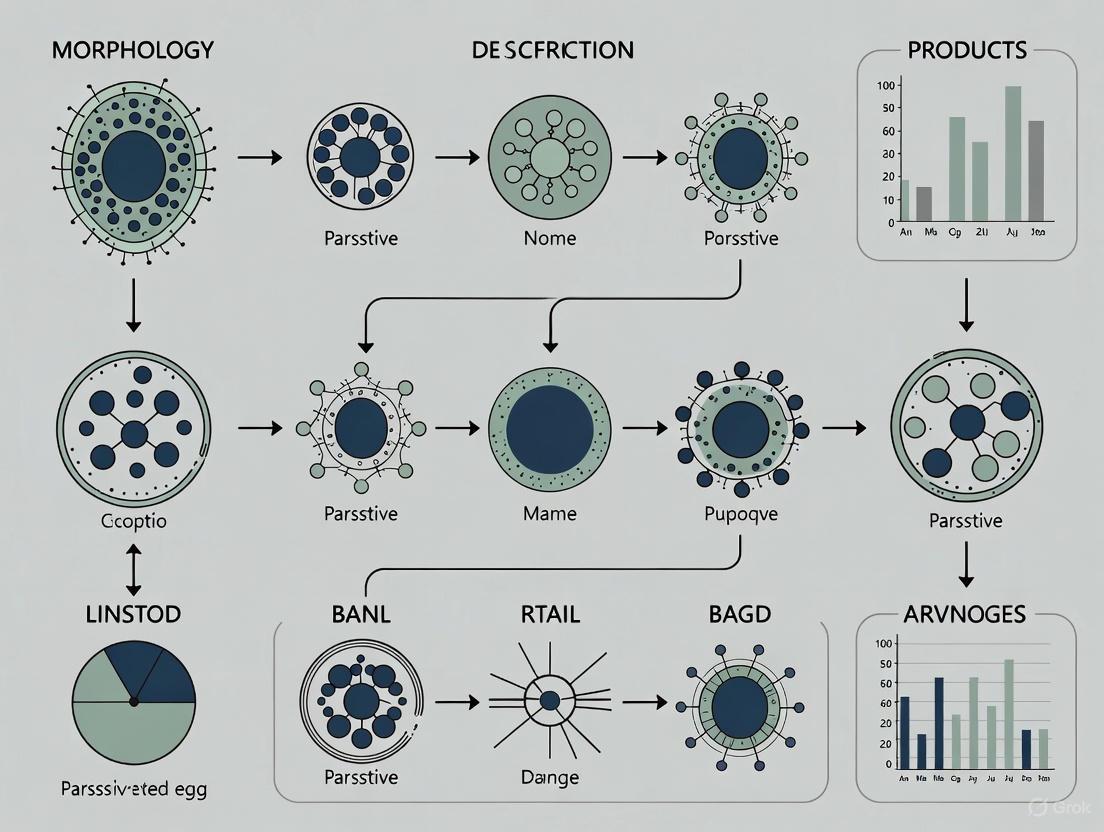
This article provides a comprehensive resource for researchers, scientists, and drug development professionals on the critical intersection of parasite egg morphology and life cycle stages.
Parasite Egg Morphology and Life Cycle Stages: A Foundational Guide for Research and Drug Development
Abstract
This article provides a comprehensive resource for researchers, scientists, and drug development professionals on the critical intersection of parasite egg morphology and life cycle stages. It covers foundational taxonomic principles for egg identification, details advanced methodologies for life cycle stage analysis, and addresses common challenges in parasite cultivation and isolation. By integrating morphological data with an understanding of complex life cycles—including direct (monoxenous) and indirect (heteroxenous) pathways—the content establishes a framework for validating findings and informs target selection for novel therapeutic and diagnostic interventions. The synthesis of this information is intended to accelerate basic research and the development of anti-parasitic strategies.
Decoding the Blueprint: Fundamental Principles of Parasite Egg Morphology and Life Cycle Diversity
Defining Direct (Monoxenous) vs. Indirect (Heteroxenous) Life Cycles
The study of parasite life cycles is fundamental to understanding the epidemiology, pathogenesis, and control of parasitic diseases. Life cycles are broadly categorized as either direct (monoxenous), requiring only a single host species, or indirect (heteroxenous), requiring multiple host species to complete development [1] [2]. This distinction is not merely taxonomic; it is intrinsically linked to parasite morphology, transmission dynamics, and the evolutionary strategies parasites employ to survive and propagate. For researchers focused on parasite egg morphology and life cycle stages, appreciating this dichotomy is critical. The life cycle strategy dictates the selective pressures acting on egg structure, larval development, and the mechanisms of host infection. Within the context of a broader thesis on parasite egg morphology, this guide provides a technical framework for differentiating these life cycles, supported by quantitative data, experimental protocols, and visualizations tailored for scientists and drug development professionals.
Core Definitions and Comparative Analysis
Direct (Monoxenous) Life Cycles
A direct life cycle is characterized by a parasite's ability to complete its entire life history using a single species of host [1] [3]. Transmission from one host to the next typically occurs through the ingestion of infective eggs or larval stages from the environment, often via the fecal-oral route [2]. The parasite undergoes growth and development through a series of developmental stages within the one host species [4].
A quintessential example is the human roundworm, Ascaris lumbricoides. Adult worms reside in the human small intestine, where females release fertilized eggs that are passed into the environment with the host's feces [5] [2]. These eggs embryonate and become infective over a period of 18 days to several weeks in the soil [5]. Upon ingestion by a human, the larvae hatch, invade the intestinal mucosa, and embark on a complex tissue migration through the liver and lungs before ascending the bronchial tree, being swallowed, and returning to the small intestine to mature into adults [5] [2]. The entire cycle, from egg ingestion to oviposition by the adult female, takes between 2 to 3 months and involves only the human host [5].
Indirect (Heteroxenous) Life Cycles
An indirect life cycle is defined by the parasite's requirement for two or more different host species to progress through its ontogenetic stages [1]. The parasite is transmitted indirectly from one host to the next, usually via a vector or an intermediate host of another species [1]. In these cycles, sexual reproduction is typically restricted to the definitive host, while growth and development (but not reproduction) occur in one or more intermediate hosts [2]. Some life cycles may also involve paratenic hosts, where the parasite does not develop but remains alive and infective, serving as a transport vehicle to the next host [2].
The blood flukes of the genus Schistosoma provide a classic example of a two-host indirect life cycle [2]. Eggs are released from the human definitive host into water via feces or urine. The ciliated miracidium that hatches from the egg must infect a specific species of snail intermediate host [6]. Within the snail, the parasite undergoes asexual reproduction through sporocyst and redia stages, ultimately producing numerous free-swimming cercariae [7] [6]. The cercariae emerge from the snail and actively penetrate the skin of a human to establish infection, migrating to the blood vessels to mature into adults [7]. The complexity of this cycle is further exemplified by trematodes like Euhaplorchis californiensis, which possesses a three-host life cycle involving a bird definitive host, a snail first intermediate host, and a killifish second intermediate host [2].
Table 1: Comparative Analysis of Direct vs. Indirect Parasite Life Cycles
| Feature | Direct (Monoxenous) Life Cycle | Indirect (Heteroxenous) Life Cycle |
|---|---|---|
| Number of Host Species | One [1] [2] | Two or more [1] [2] |
| Transmission Mode | Direct, often fecal-oral; no intermediate host [2] [3] | Indirect, requires a vector or intermediate host [1] |
| Reproduction Site | All within the single host species | Sexual reproduction in definitive host; asexual replication may occur in intermediate hosts [7] [6] |
| Life Cycle Length | Generally shorter and simpler | Longer and more complex [2] |
| Evolutionary Strategy | High rate of direct transmission | Utilizes predator-prey relationships (trophic transmission) and host ecology to ensure transmission [2] |
| Example Organisms | Ascaris lumbricoides (roundworm) [5] [2] | Schistosoma japonicum (blood fluke) [1] [2] |
Table 2: Developmental Timelines for Exemplar Parasites
| Parasite & Life Cycle Type | Key Developmental Stage | Timeline / Duration | Host / Location |
|---|---|---|---|
| Ascaris lumbricoides(Direct) | Egg development to infectivity | 18 days to several weeks [5] | External environment (soil) |
| Larval migration & maturation to adult | 2 to 3 months (pre-patent period) [5] | Human host | |
| Adult worm lifespan | 1 to 2 years [5] | Human small intestine | |
| Schistosoma spp.(Indirect) | Miracidium to cercariae production | Several weeks (species and temperature-dependent) | Snail intermediate host |
| Cercariae lifespan | ~48 hours (must find host quickly) [6] | Water | |
| Adult worm lifespan | Several years | Human definitive host |
The Scientist's Toolkit: Research Reagent Solutions
The following table details key reagents and materials essential for researching parasite life cycles and egg morphology.
Table 3: Essential Research Reagents and Materials for Parasitology Investigations
| Reagent / Material | Primary Function in Research | Example Application |
|---|---|---|
| Formalin-Ethyl Acetate Sedimentation Solution | Preservation and concentration of parasite eggs from stool specimens [5] | Standard method for microscopic identification of helminth eggs for life cycle staging and morphological analysis [5] |
| Iron Haematoxylin & Trichrome Stains | Staining of permanent smears for enhanced morphological detail [8] | Differentiation of protozoan cysts and helminth eggs in stool samples; detailed study of internal structures [8] |
| PCR Master Mixes & Specific Primer Pairs | Amplification of parasite-specific DNA sequences [9] | Species-specific identification and detection of parasites in host tissues or environmental samples, bypassing morphological limitations [9] [8] |
| Loop-Mediated Isothermal Amplification (LAMP) Kits | Isothermal nucleic acid amplification for field-deployable diagnostics [9] | Rapid, sensitive detection of parasite DNA in resource-limited settings for field studies of transmission [9] |
| CRISPR-Cas Reagents (e.g., SHERLOCK) | Highly specific nucleic acid detection based on Cas enzyme activity [9] | Ultrasensitive and specific identification of parasite strains and detection of drug resistance markers [9] |
| Monoclonal Antibodies for Target Antigens | Detection of parasite-specific antigens or host antibodies in immunoassays [8] | Used in ELISA, Lateral Flow Immunoassays (LFIA), and Immunofluorescent Antibody (IFA) tests for seroprevalence studies and current infection status [8] |
| Inductively Coupled Plasma Mass Spectrometry (ICP-MS) | Simultaneous quantification of multiple elements within a sample [10] | Analysis of within-host resource dynamics and parasite elemental composition to model host-parasite resource competition [10] |
Experimental Protocols for Life Cycle Stage Investigation
Classical Morphological Identification of Eggs and Larvae
Principle: The gold standard for diagnosing many parasitic infections involves the direct visualization and morphological identification of life cycle stages, particularly eggs, from clinical or environmental samples [5] [8]. This protocol is foundational for research linking egg morphology to life cycle type.
Detailed Methodology:
- Sample Collection and Fixation: Collect a fresh stool specimen. To preserve morphological integrity, immediately mix a portion of the specimen with 10% neutral buffered formalin (a 1:3 ratio of sample to formalin is typical) [5].
- Concentration by Sedimentation: a. Filter the formalin-fixed sample through gauze into a conical tube. b. Add ethyl acetate to the filtrate, cap the tube, and shake vigorously to emulsify the mixture. c. Centrifuge the tube at 500 x g for 10 minutes. This creates four layers: ethyl acetate (top), a plug of debris, formalin, and sediment (bottom) containing the parasite eggs [5]. d. Carefully detach the debris plug by ringing the tube with an applicator stick and decant the top three layers. e. Resuspend the sediment in the remaining formalin or a small volume of saline.
- Microscopic Examination: a. Prepare a wet mount by placing a drop of the sediment on a microscope slide and adding a coverslip. b. Systematically examine the entire coverslip area under low (10x) and high (40x) magnification. c. Identify eggs based on key morphological characteristics: size (e.g., Ascaris fertile eggs: 45-75 µm), shape (oval, spherical), shell thickness, presence of operculum (lid), and internal structures (embryo, larvae) [5].
- Staining for Enhanced Detail: For permanent records and detailed study, prepare a fixed smear of the sediment and stain it using the Wheatley's trichrome stain or iron haematoxylin, following standard histological protocols [8].
Molecular Detection of Parasite DNA from Environmental Samples
Principle: Molecular techniques like Polymerase Chain Reaction (PCR) offer high sensitivity and specificity for detecting parasite DNA, overcoming limitations of morphological methods, particularly for low-intensity infections or degraded samples [9] [8].
Detailed Methodology:
- Nucleic Acid Extraction: a. Concentrate parasite eggs or cysts from water or soil samples via continuous-flow centrifugation or flotation. b. Lyse the concentrated material using a commercial kit designed for tough-to-lyse organisms, often involving mechanical bead-beating followed by chemical lysis. c. Purify the DNA using spin-column-based kits to remove inhibitors that can affect downstream PCR.
- Polymerase Chain Reaction (PCR) Amplification: a. Prepare a PCR master mix containing: - Taq DNA polymerase buffer - Deoxynucleoside triphosphates (dNTPs) - Forward and reverse primers specific to the target parasite (e.g., primers for the Schistosoma 18S rRNA gene) - Taq DNA polymerase b. Add the purified template DNA to the master mix. c. Run the PCR in a thermal cycler with a protocol tailored to the primer set, typically involving an initial denaturation (e.g., 95°C for 5 min), followed by 35-40 cycles of denaturation (95°C for 30s), annealing (primer-specific temperature for 30s), and extension (72°C for 1 min), with a final extension (72°C for 7 min).
- Analysis of Amplified Products: a. Separate the PCR products by agarose gel electrophoresis. b. Visualize the DNA bands under UV light after staining with ethidium bromide or a safer alternative. c. Confirm the identity of the amplified product by Sanger sequencing.
Diagram 1: Molecular detection workflow.
Implications for Parasite Egg Morphology and Research
The type of life cycle a parasite employs exerts a profound selective pressure on the morphology of its eggs. Eggs from parasites with direct life cycles, like Ascaris, must be robust enough to survive harsh environmental conditions until ingested by a new host. This often results in a thick, proteinaceous, mammillated outer layer that provides protection against desiccation and UV radiation [5]. In contrast, the eggs of many parasites with indirect life cycles are adapted for infection of an intermediate host rather than prolonged environmental persistence. The eggs of trematodes like Schistosoma are non-operculated and often possess spines or hooks, which are morphological adaptations that aid in tissue anchorage and evasion of the host immune response within the definitive host, rather than for environmental durability [7]. Furthermore, the miracidium within a trematode egg must hatch upon reaching water or upon ingestion by the specific molluscan intermediate host, requiring different physiological and morphological triggers compared to the eggs of direct-life-cycle nematodes, which hatch after ingestion by the definitive host [6]. Therefore, a detailed morphological analysis of parasite eggs can yield critical inferences about the parasite's life cycle strategy, transmission dynamics, and ecological niche.
Diagram 2: Direct vs. indirect life cycle pathways.
Advanced Diagnostic and Research Frontiers
The field of parasitology diagnostics is rapidly evolving beyond microscopy. Immunodiagnostics, such as Enzyme-Linked Immunosorbent Assays (ELISA) and Lateral Flow Immunoassays (LFIA), detect parasite-specific antigens or host antibodies, providing a serological history of infection [8]. Multiplexed PCR panels are now capable of simultaneously detecting multiple viral, bacterial, and parasitic pathogens from a single stool sample, revolutionizing the diagnosis of gastrointestinal syndromes, though their parasitic target range remains limited to common agents like Giardia, Cryptosporidium, and Entamoeba histolytica [8].
Cutting-edge research is leveraging nanotechnology to develop highly sensitive biosensors and CRISPR-Cas systems for precise nucleic acid detection in field-deployable formats [9]. Furthermore, metagenomic next-generation sequencing (NGS) allows for the culture-free detection of entire parasite communities and the discovery of novel pathogens, providing an unbiased view of parasitic diversity in a sample [8]. The integration of multi-omics (genomics, proteomics, metabolomics) and artificial intelligence (AI) for image recognition is poised to further transform the field, enabling deeper understanding of host-parasite interactions at a molecular level and automating the identification of parasite stages in clinical samples [9] [8]. Techniques like Inductively Coupled Plasma Mass Spectrometry (ICP-MS) are being used to quantify within-host resource dynamics, opening new avenues for modeling the ecology of infection [10]. These advancements provide researchers and drug developers with an unprecedented toolkit for dissecting the complexities of parasite life cycles and identifying novel therapeutic targets.
The precise identification of parasite eggs through morphological analysis is a cornerstone of parasitology research and diagnostics. This whitepaper provides a comprehensive technical guide to the essential taxonomic features—size, shape, shell structures, and opercula—of common human parasitic helminths. We synthesize contemporary research, including geometric morphometric analyses and deep learning-based recognition platforms, to present a standardized framework for egg classification. Furthermore, we detail experimental protocols for egg handling and drug sensitivity testing, providing a resource to support research activities in parasite biology and anthelminthic drug development.
The egg stage of parasitic helminths is not only critical for transmission and diagnosis but also presents a unique set of morphological characteristics that are essential for taxonomic classification. Accurate identification is fundamental to epidemiological studies, patient management, and the development of novel control strategies [11] [12]. Traditional diagnosis relies on copro-microscopic methods, which remain the gold standard in many settings despite being time-consuming and dependent on expert skill [12]. The morphological features of eggs, including their size, shape, shell ultrastructure, and the presence or nature of an operculum (a specialized cap for larval emergence), provide a blueprint for species identification [13] [14]. Recent advancements, such as geometric morphometrics (GM) and artificial intelligence (AI), are refining our understanding of these features and enhancing our ability to discriminate between species with high precision [11] [15] [12]. This guide consolidates the current understanding of these features and the methodologies used to study them within the broader context of parasite life cycle research.
Core Taxonomic Features of Selected Helminth Eggs
The following section provides a detailed overview of the key morphological features used to identify common human parasitic helminths. The data presented builds upon foundational morphological knowledge and incorporates findings from recent geometric morphometric and AI-based studies [11] [12] [16].
Table 1: Essential Morphological Features of Common Human Parasite Eggs
| Parasite Species | Size (in micrometers) | Shape Description | Shell Structure & Key Features | Operculum |
|---|---|---|---|---|
| Ascaris lumbricoides | Oval or Elliptical [12] | Thick, mammillated coat (outer albuminous layer) [16] | Absent [16] | |
| Trichuris trichiura | Elongated, Barrel-shaped [12] | Smooth, thick-shelled; prominent bipolar plugs [16] | Present (bipolar mucus plugs) [16] | |
| Enterobius vermicularis | 50-60 x 20-30 [17] | Asymmetrical (flattened on one side), Elliptical [12] [17] | Thin, clear, bi-layered shell [17] | Present [16] |
| Hookworm spp. (Ancylostoma duodenale & Necator americanus) | Oval [12] | Thin, transparent shell [16] | Absent [16] | |
| Clonorchis sinensis | Small, Ovoid [16] | Operculated, shouldered; miracidium visible inside [16] | Present [16] | |
| Paragonimus westermani | Large, Ovoid [16] | Thick-shelled, operculated (often flattened at abopercular end) [16] | Present [16] | |
| Schistosoma japonicum | Spherical or Oval [12] [16] | Non-operculated; possesses a lateral spine or knob [16] | Absent [16] | |
| Fasciola spp. | Very Large, Ovoid [16] | Operculated; undeveloped miracidium inside [16] | Present [16] | |
| Taenia spp. | 31-43 [12] | Spherical [12] | Thick, radially striated shell (embryophore); contains oncosphere with 6 hooks [16] | Absent [16] |
| Hymenolepis nana | Spherical or Ellipsoidal [12] [16] | Thin shell; polar filaments present inside the egg [16] | Absent [16] |
It is crucial to note that while size is a traditional diagnostic feature, geometric morphometric studies have demonstrated that egg shape is a more reliable characteristic for species discrimination. One study achieved an overall classification accuracy of 84.29% based on shape alone, compared to only 30.18% when using size [12]. Furthermore, the viability of eggs can influence their metric properties; non-viable eggs often exhibit greater variance in size and shape, which can slightly compromise species recognition accuracy if not accounted for in analyses [18].
Advanced Analytical Techniques and Protocols
Geometric Morphometric Analysis of Egg Shape
Geometric morphometrics (GM) is a powerful quantitative technique that separates size and shape variables, allowing for highly precise discrimination between species based on outline morphology [12]. This method is particularly valuable for distinguishing between eggs of species that are morphologically similar using traditional microscopy.
Table 2: Research Reagent Solutions for Parasite Egg Analysis
| Reagent/Material | Function/Application | Example Protocol/Usage |
|---|---|---|
| Formalin-Ether Concentration Technique (FECT) | Stool processing and egg concentration for microscopy [12] | Standard parasitological diagnostic procedure. |
| Geometric Morphometric (GM) Software | Quantitative shape analysis of parasite eggs [12] | Outline-based analysis of digital egg images for species classification. |
| Block-Matching and 3D Filtering (BM3D) | Digital image denoising to enhance microscopic image clarity [15] | Pre-processing step for AI-based segmentation and classification. |
| Contrast-Limited Adaptive Histogram Equalization (CLAHE) | Digital image contrast enhancement [15] | Improves contrast between eggs and background in microscopic images. |
| Brain Heart Infusion (BHI) Media | Culture medium for bacteria used in egg-hatching assays [19] | Used to grow E. coli or other hatching-inducer bacteria. |
| Roswell Park Memorial Institute (RPMI) 1640 Media | Base hatching medium for in vitro assays [19] | Supplemented with antibiotics and serum for egg-hatching experiments. |
Experimental Workflow for Outline-Based GM Analysis [12]:
- Sample Collection and Preparation: Obtain helminth eggs from human stool samples via concentration techniques such as the Formalin-Ether Concentration Technique (FECT).
- Digital Imaging: Capture high-quality micrographs of individual eggs under a light microscope.
- Data Digitization: Manually or automatically digitize the complete two-dimensional outline of each egg.
- Statistical Analysis: Use specialized GM software to perform statistical analyses, such as calculating Mahalanobis distances between species based on shape variables. A significant Mahalanobis distance indicates that the egg shapes of two species are statistically distinct.
- Validation: Validate the classification power of the model by calculating the percentage of correct species assignments based on shape data.
The following diagram illustrates the logical workflow of this analytical process:
In Vitro Egg-Hatching Assay for Anthelminthic Screening
Egg-hatching assays are crucial for studying the infectious life stage of parasites and for screening the efficacy of potential anthelminthic drugs. The following protocol is adapted for Trichuris muris, a model organism for human T. trichiura [19].
Detailed Experimental Protocol [19]:
- Parasite Egg Isolation and Embryonation: Isolate unembryonated eggs from the feces of infected laboratory mice (e.g., C57BL/6NRj strain). Filter and centrifuge the feces to purify the eggs. Store the eggs in purified water in the dark at room temperature for a minimum of three months to allow for complete embryonation.
- Bacterial Culture for Hatching Induction: Culture hatching-inducer bacteria, such as Escherichia coli, in Luria Broth (LB) or Brain Heart Infusion (BHI) media. Bacterial growth is a critical prerequisite, as Trichuris eggs require microbial cues to hatch.
- Drug Preparation: Prepare stock solutions of anthelminthic compounds (e.g., 10 mM in DMSO). Serially dilute these stocks in the appropriate hatching medium to achieve the desired test concentrations.
- Assay Setup:
- Wash embryonated eggs three times with pre-warmed hatching media (e.g., RPMI 1640 supplemented with antibiotics and fetal calf serum).
- Distribute the eggs into a multi-well plate.
- Add the drug solutions or vehicle control (DMSO) to the wells.
- Finally, add the cultured bacteria to induce hatching.
- Incubation and Analysis: Incubate the plates under suitable conditions (e.g., 37°C). After a designated period (e.g., 24-48 hours), examine each well under an inverted microscope and count the number of hatched and unhatched eggs. Calculate the half-maximal effective concentration (EC₅₀) of the test drug to determine its potency in inhibiting hatching.
The workflow for this drug sensitivity assay is summarized below:
Discussion and Future Perspectives
The integration of traditional morphological taxonomy with advanced quantitative techniques like geometric morphometrics and deep learning is revolutionizing parasite egg identification [11] [15] [12]. AI models, particularly those based on the YOLO (You Only Look Once) architecture, have demonstrated remarkable accuracy—in some cases up to 100% for species like Clonorchis sinensis and Schistosoma japonicum—in automating the detection and classification process from digital images [11] [17]. These technologies not only reduce reliance on specialized expertise but also pave the way for high-throughput screening of clinical and environmental samples.
Future research should focus on expanding and diversifying the image datasets used to train AI models to improve their robustness in real-world, complex diagnostic scenarios [11]. Furthermore, a deeper understanding of the molecular and biochemical basis of eggshell formation and hatching, informed by the revised hexalaminar anatomical model [13], could reveal novel targets for next-generation anthelminthics and intervention strategies, ultimately contributing to the global control of parasitic diseases.
Within the realm of parasitology, a detailed understanding of helminth development is fundamental to advancing research in disease pathogenesis, diagnostics, and anthelmintic drug discovery. The morphological and physiological transitions from egg and larval stages to adult parasite represent critical vulnerabilities that can be targeted for therapeutic intervention. This guide provides an in-depth technical overview of these developmental pathways within the major helminth groups—Platyhelminthes (flatworms) and Nematoda (roundworms). Focusing on the core stages of miracidium, cercaria, and the larval stages L1-L4, this document serves as a resource for researchers and drug development professionals, framing this biological data within the context of experimental morphology and life cycle research.
Helminths, or parasitic worms, infecting humans are primarily classified into two phyla: the Platyhelminthes (flatworms) and the Nematoda (roundworms) [7]. The platyhelminths are further subdivided into two clinically relevant classes: the Trematoda (flukes) and the Cestoda (tapeworms) [7]. A third class, Turbellaria, comprises mostly free-living flatworms and is often used in regeneration research but is of minor medical importance [20] [21].
The developmental complexity of these parasites varies significantly between groups. Trematodes exhibit indirect life cycles requiring one or more intermediate hosts, with their development featuring a series of distinct larval stages such as miracidium, sporocyst, redia, and cercaria [6] [22]. Cestodes also have indirect life cycles, with larval forms like the cysticercus or hydatid cyst developing in intermediate hosts before maturing into adults in the definitive host [7]. In contrast, nematodes may have direct or indirect life cycles, and their development is characterized by a more linear progression through four larval stages, designated L1 to L4, before reaching sexual maturity as adults [5] [14]. The following section provides a detailed, stage-by-stage analysis of these developmental pathways.
Detailed Analysis of Developmental Stages
The Egg Stage: Morphology and Embryonation
The egg stage is often the only life-cycle stage that can be readily sampled from patients and the environment, making it a critical focus for diagnosis and research [14].
- Trematode Eggs: With the exception of schistosomes, trematode eggs are typically operculated (possessing a lid) [7]. The eggs of blood flukes (schistosomes) are non-operculated and possess a characteristic spine, the location of which is species-dependent [7]. Eggs are usually expelled from the definitive host in feces, urine, or sputum and may be either embryonated (ready to hatch) or unembryonated when passed, depending on the species [6].
- Cestode Eggs: Tapeworm eggs exhibit significant variation. Pseudophyllidean tapeworms (e.g., Diphyllobothrium latum) have operculated eggs, while cyclophyllidean tapeworms (e.g., Taenia species, Hymenolepis nana), which include most human parasites, have non-operculated eggs [7]. A key feature is the oncosphere, the first larval stage enclosed within the egg, which is armed with hooks for penetrating the host's intestinal wall [7].
- Nematode Eggs: The morphology of nematode eggs is highly diverse and is a primary diagnostic characteristic. For example, Ascaris lumbricoides fertilized eggs are rounded, have a thick, mammillated shell often stained brown by bile, and range from 45 to 75 µm in length [5]. Unfertilized eggs are elongated, larger (up to 90 µm), and have a thinner shell with a more variable mammillated layer [5]. The process of embryonation, where the egg develops into an infective larva, is crucial and highly dependent on environmental conditions such as temperature and moisture [5] [14].
Table 1: Comparative Morphology of Key Helminth Eggs
| Parasite Group | Example Species | Egg Size | Key Morphological Features | State when Passed |
|---|---|---|---|---|
| Trematode | Fasciola hepatica | Varies by species | Operculated [7] | Unembryonated [22] |
| Trematode | Schistosoma mansoni | ~ 150 µm | Non-operculated, lateral spine [7] | Contains miracidium [22] |
| Cestode (Cyclophyllidean) | Taenia saginata | 30-40 µm | Non-operculated, radially striated shell, contains oncosphere [7] | Infective to intermediate host |
| Nematode | Ascaris lumbricoides | 45-75 µm (fertile) | Thick, mammillated shell [5] | Unembryonated (requires 18+ days in soil) [5] |
Larval Stages of Platyhelminthes (Flatworms)
Miracidium
The miracidium is a ciliated, free-swimming larva that hatches from a trematode egg upon contact with water [6] [22]. Its primary function is to locate and penetrate a specific snail intermediate host within a short timeframe (e.g., 24 hours), as it cannot feed and relies on stored energy reserves [22]. It possesses secretory glands for penetration and may have eye spots for phototaxis [22]. Upon entering the snail, the miracidium transforms into the next stage.
Sporocyst and Redia
These are asexual reproductive stages that develop within the snail intermediate host.
- Sporocyst: The miracidium metamorphoses into a sac-like sporocyst [6]. This stage lacks a mouth and digestive system, absorbing nutrients directly from the host tissues. Germinal cells within the sporocyst develop asexually into either daughter sporocysts or the next larval stage, the redia [6] [22].
- Redia: The redia is a more developed larval form that possesses a rudimentary pharynx and gut, allowing it to actively feed on snail tissue [6] [22]. This gives it a competitive advantage. Rediae can produce more rediae or give rise to the next larval stage, the cercaria [22]. Not all trematode species have a redial stage; some produce cercariae directly from sporocysts [6].
Cercaria
The cercaria is a larval form that develops from germinal cells within the sporocyst or redia [6] [22]. It has a body and typically a tail for swimming. Cercariae emerge from the snail in response to environmental stimuli like light and must locate a host to continue development [22]. Their fate varies by species: they can directly penetrate the definitive host's skin (e.g., schistosomes), encyst as metacercariae on vegetation, or invade a second intermediate host [6] [7] [22].
Metacercaria and Adult Fluke
The metacercaria is the encysted, resting stage of the trematode, found on vegetation or in the tissues of a second intermediate host [6]. It is the stage infective to the definitive host. Upon ingestion, the metacercaria excysts in the small intestine, and the juvenile fluke (sometimes called a marita) migrates to its target organ (e.g., liver, bile ducts, lungs) where it matures into an adult [22]. Adult flukes are leaf-shaped, possess oral and ventral suckers, and are hermaphroditic (except blood flukes, which are dioecious) [7].
Figure 1: Generalized Life Cycle of a Digenetic Trematode
Larval Stages of Nematodes (Roundworms)
Nematode development is characterized by four pre-adult larval stages, labeled L1 to L4, each separated by a molt (shedding of the cuticle).
- L1 (First-Stage Larva): This stage often hatches from the egg, either externally in the environment or within the host, depending on the species. For Ascaris lumbricoides, the L1 larva develops inside the egg in the soil over several weeks, molting to become an L2 before the egg becomes infective [5].
- L2 (Second-Stage Larva): In many soil-transmitted nematodes like Ascaris, the L2 is the infective stage within the egg. When the infective egg is ingested, the L2 larva hatches in the small intestine [5].
- L3 (Third-Stage Larva): The L3 is often the infective stage for many nematodes and is critical for completing the life cycle. In Ascaris, the L2 hatches from the egg and then penetrates the intestinal mucosa to embark on a complex migratory pathway. It is carried via the portal circulation and systemic circulation to the lungs [5]. In the lungs, the L2 larvae molt to become L3 larvae [5]. The L3 larvae then break into the alveolar spaces, ascend the bronchial tree to the throat, and are swallowed back into the intestine.
- L4 (Fourth-Stage Larva) and Adult: Upon returning to the small intestine, the L3 larvae molt to become L4 larvae [5]. The L4 stage undergoes a final molt to develop into a sexually mature adult worm. The entire process from ingestion of the infective egg to oviposition by the adult female takes approximately 2 to 3 months for Ascaris [5]. Adult worms can live for 1 to 2 years in the host [5].
Table 2: Key Developmental Stages of Ascaris lumbricoides
| Stage | Location | Key Biological Events | Duration/Infectivity |
|---|---|---|---|
| Egg (unembryonated) | Feces / Soil | Embryonation begins; development to L1 inside egg [5]. | Not infective. |
| Egg (embryonated w/ L2) | Soil | Contains L2 larva; infective stage [5]. | Requires 18 days to several weeks in environment [5]. |
| L2 Larva | Host Small Intestine & Liver | Hatches from egg; penetrates intestinal mucosa; migrates to liver [5]. | Not a discrete stage in migration. |
| L3 Larva | Host Lungs | Develops from L2 in lungs; penetrates alveoli; ascends to throat [5]. | Lives in lungs for 10-14 days [5]. |
| L4 Larva & Adult | Host Small Intestine | L3 molts to L4, then to adult in intestine; sexual reproduction [5]. | 2-3 months to adulthood; adult lives 1-2 years [5]. |
Experimental Protocols for Key Developmental Studies
Protocol 1: Diagnosing Intestinal Ascariasis and Recovering Eggs
This standard parasitological diagnostic procedure allows for the isolation and morphological identification of nematode eggs from patient samples [5].
- Sample Collection: Collect a fresh stool specimen from the patient.
- Fixation: Preserve a portion of the specimen in 10% formalin or another appropriate fixative to halt development and preserve morphology.
- Concentration (Formalin-Ethyl Acetate Sedimentation): a. Emulsify the fixed stool sample in formalin and strain through a sieve or gauze to remove large debris. b. Combine the filtrate with ethyl acetate in a centrifuge tube and shake vigorously. c. Centrifuge the tube at a standard speed (e.g., 500 x g for 10 minutes). This creates four layers: ethyl acetate, a plug of debris, formalin, and sedimented eggs in the bottom layer. d. Decant the top three layers, and the sediment containing the eggs is used for examination.
- Microscopy: Prepare a wet mount of the sediment on a glass slide and examine under a microscope using 100x and 400x magnification. Identify eggs based on size, shape, and specific features (e.g., mammillated coat for Ascaris) [5].
- Alternative for Heavy Infections: For moderate to heavy infections, a direct wet mount examination of unfixed stool can be sufficient for detection [5].
Protocol 2: Inducing and Observing Nematode Egg Hatching
Understanding the triggers of hatching is crucial for maintaining life cycles in vitro and for research on early infection [14].
- Egg Isolation and Purification: Isolate eggs from host feces using saturated salt or sucrose flotation methods or via sieving. Wash eggs thoroughly in sterile buffer (e.g., PBS or distilled water).
- Embryonation: For species requiring it (e.g., Ascaris), incubate purified eggs in a shallow layer of water or a dilute salt solution at an appropriate temperature (e.g., 22-28°C) for the required duration, with aeration if possible.
- Hatching Induction: The hatching triggers are species-specific and must be determined empirically [14]. Common stimuli include:
- Temperature Shift: A shift to host body temperature (37°C).
- CO₂ Exposure: Gassing the culture with 5% CO₂ to simulate the host's gut environment.
- Oxidative Stress: Exposure to low concentrations of hypochlorite or other oxidizing agents.
- Bile Salts: For intestinal nematodes, the addition of host-specific bile salts to the medium is a potent hatching stimulus.
- Microbial Cues: Co-culture with specific gut microbiota or their metabolites.
- Observation and Analysis: Incubate embryonated eggs in the chosen hatching medium. Monitor the culture regularly under an inverted microscope for the emergence of larvae. Quantify the hatching rate over time.
Protocol 3: Investigating Planarian (Turbellarian) Regeneration
The remarkable regenerative capacity of free-living flatworms like planarians provides a model for studying stem cell biology and developmental patterning [23] [21].
- Animal Maintenance: Maintain a colony of planarians (e.g., Dugesia species) in purified water at a constant, cool temperature (e.g., 18-20°C). Feed weekly with organic liver puree or blended bovine heart.
- Amputation and Fragment Preparation: Select healthy, well-fed planarians. Under a dissecting microscope, use a sterile scalpel or razor blade to perform amputations. Standardized transverse amputations are used to create head, trunk, and tail fragments.
- Observation of Regeneration: a. Place the fragments in a fresh culture dish with clean water. b. Change the water daily to prevent microbial overgrowth. c. Document the regeneration process daily using a microscope with a camera system. Key stages to observe include wound closure (within hours), formation of a blastema (a mass of undifferentiated cells at the wound site within 2-3 days), and the progressive differentiation of new tissues (eyes, pharynx) over 1-2 weeks.
- Inhibition/Modulation Studies (Advanced): To study the mechanism, regeneration can be modulated by:
- Irradiation: Exposing planarians to X-rays to ablate the regenerative stem cells (neoblasts).
- RNA Interference (RNAi): Injecting double-stranded RNA or soaking worms in RNAi solution to knock down the expression of specific genes.
- Small Molecule Inhibitors: Adding pharmacological inhibitors of specific signaling pathways to the culture water.
Visualization of Developmental Pathways and Workflows
Figure 2: Core Experimental Workflows in Parasite Research
The Scientist's Toolkit: Essential Research Reagents and Materials
Table 3: Key Research Reagent Solutions for Helminth Developmental Studies
| Reagent/Material | Function/Application | Example Use Case |
|---|---|---|
| Formalin (10%) | Fixative for stool specimens; preserves egg morphology for diagnosis and long-term storage [5]. | Protocol 1: Concentration and microscopic identification of helminth eggs. |
| Ethyl Acetate | Solvent used in fecal concentration techniques to separate debris from parasite eggs [5]. | Protocol 1: Formal-ethyl acetate sedimentation method. |
| Sodium Bicarbonate (NaHCO₃) & Bile Salts | Components of hatching medium to simulate the physicochemical environment of the definitive host's upper intestine [14]. | Protocol 2: Inducing exsheathment and hatching in nematode larvae. |
| Penicillin-Streptomycin Solution | Antibiotic mixture used in cell culture and parasite maintenance media to prevent bacterial contamination. | Protocol 3: Aseptic culture of planarians during regeneration studies. |
| Neoblast Markers | Molecular tools (e.g., antibodies for piwi-like genes) to identify and study pluripotent stem cells in flatworms [23]. | Protocol 3: Investigating the cellular basis of planarian regeneration via immunohistochemistry. |
| RNAi Reagents | Double-stranded RNA (dsRNA) for targeted gene silencing via RNA interference to determine gene function [23]. | Protocol 3: Knocking down specific genes to assess their role in flatworm development and regeneration. |
In parasitology, a host is defined as a larger organism that harbors a smaller organism, providing nourishment and shelter [24]. The precise classification of hosts is not merely academic; it is fundamental to understanding parasite transmission, epidemiology, and the development of effective control strategies. Within the context of research on parasite egg morphology and life cycle stages, identifying the correct host type is a critical first step. It allows researchers to predict transmission pathways, identify potential targets for drug intervention, and understand the ecological niches a parasite occupies [4]. The relationship between host and parasite is a cornerstone of symbiology, which encompasses parasitism (where the host is harmed), mutualism (where both benefit), and commensalism (where one benefits without harming the other) [24] [25].
This guide provides an in-depth technical framework for differentiating between definitive, intermediate, and reservoir hosts, with a specific focus on its application in life cycle stage research.
Defining Core Host Types
The following table delineates the core host types, their roles, and representative parasites to illustrate these roles in a research context.
Table 1: Core Host Types in Parasite Life Cycles
| Host Type | Primary Role in Parasite Life Cycle | Key Research Significance | Representative Parasite & Stage |
|---|---|---|---|
| Definitive (Primary) Host | The organism in which the parasite reaches sexual maturity and reproduces sexually, if applicable [24] [25]. | Source of genetically diverse progeny (e.g., eggs, oocysts); critical for studying sexual reproduction genetics and diagnosing infections via egg morphology [7] [5]. | Taenia solium (Adult tapeworm in human intestine) [26]. |
| Intermediate (Secondary) Host | The organism required for the parasite to undergo asexual development or larval stages, but where it does not reach sexual maturity [24] [25]. Often acts as a vector [24]. | Host for larval proliferation and asexual amplification; essential for understanding pre-adult morphology and transmission mechanics [7] [6]. | Schistosoma mansoni (Larval stages in snail) [7] [6]. |
| Reservoir Host | An organism that harbors a pathogen and suffers no ill effects, serving as a persistent source of infection for susceptible species [24] [26]. | Maintains the parasite in the environment; a key consideration in epidemiology and disease eradication campaigns [24]. | Leishmania spp. (Asymptomatic infection in dogs) [25]. |
Additional Host Classifications
Beyond the core three, other host classifications are vital for a complete understanding of parasite ecology.
- Paratenic (Transport) Host: An organism in which a larval parasite survives without undergoing any further development. This host is not essential for the life cycle but may facilitate transmission to the definitive host by accumulating larval stages [24]. For example, the trematode Alaria americana can use snakes as paratenic hosts; the mesocercariae accumulate in the snake but do not develop until the snake is eaten by a definitive canine host [24].
- Dead-End (Incidental) Host: An organism that becomes infected but does not allow transmission of the parasite to the definitive host, thereby preventing the parasite from completing its life cycle [24]. Humans are dead-end hosts for West Nile virus, as the virus titer in human blood is insufficient to infect biting mosquitoes [24].
Experimental Protocols for Host Identification
Resolving a parasite's life cycle and assigning host roles requires a multidisciplinary approach. The following protocols are standard in the field.
Protocol 1: Life Cycle Resolution through Morphological and Genetic Staging
This protocol is used to definitively identify the stages of a parasite and link them across different host species [27].
Sample Collection:
- Collect parasite specimens from multiple organ sites (e.g., intestinal lumen for coelozoic parasites, muscle tissue for histozoic parasites) across a broad taxonomic range of potential host species [4].
- Preserve samples for both morphological (e.g., in formalin) and molecular (e.g., in ethanol or frozen) analysis [5].
Morphological Identification:
- For eggs/larvae: Concentrate specimens from feces, blood, or tissues using methods like formalin-ethyl acetate sedimentation. Examine wet mounts microscopically for characteristic morphological features (e.g., opercula, mammillated layers, size) [5].
- For adults: Identify species based on external and internal morphology (e.g., suckers, reproductive organs, cuticle structure) [7].
Genetic Matching:
- Extract DNA from different life stages (eggs, larvae, adults) found in different host species [27].
- Amplify and sequence standard genetic markers (e.g., ribosomal RNA genes, mitochondrial DNA).
- Genetically match larval stages from intermediate hosts to adult worms from definitive hosts to confirm transmission pathways and life cycle sequences [27].
Protocol 2: Differentiating Host Types in a Novel Parasite
This workflow is applied when a new parasite is discovered, or the life cycle of a known parasite is unresolved.
Identify Site of Sexual Reproduction: The host in which sexually mature adults or evidence of sexual reproduction (e.g., fertilized eggs) is found is the Definitive Host. This is often determined via necropsy and microscopic examination of reproductive organs [7].
Track Larval Development: Hosts that harbor sexually immature larval stages (e.g., miracidia, cercariae, metacestodes) that are necessary for development are Intermediate Hosts [7] [6]. Experimental infections can confirm if development proceeds in a suspected host.
Assess Parasite Vitality and Transmission Potential: A host that carries the parasite asymptomatically and can infect a vector or another susceptible host is a Reservoir Host. This is confirmed through longitudinal studies and transmission experiments [24].
The logical workflow for this diagnostic process is outlined below.
The Scientist's Toolkit: Essential Research Reagents and Materials
Table 2: Key Reagents and Materials for Host-Parasite Research
| Reagent/Material | Primary Function | Application Example |
|---|---|---|
| Formalin (10%) | Fixative for preserving parasite eggs, larvae, and adults for morphological study. | Preservation of stool samples for microscopic diagnosis of helminth eggs (e.g., Ascaris) [5]. |
| Polyvinyl Alcohol (PVA) | Fixative and adhesive for preserving protozoan trophozoites and cysts in stool samples. | Preparation of permanent stained slides for identifying intestinal protozoa like Entamoeba histolytica [26]. |
| Formalin-Ethyl Acetate Sedimentation Kit | Concentration of parasite eggs and cysts from stool specimens for improved detection. | Standard protocol for diagnosing intestinal parasites like Ascaris lumbricoides [5]. |
| DNA Extraction Kits | Isolation of high-quality genomic DNA from parasite samples (eggs, larvae, adults). | Genetic matching of larval stages from intermediate hosts to adults from definitive hosts [27]. |
| PCR Master Mix & Specific Primers | Amplification of parasite DNA for species identification and phylogenetic analysis. | Molecular detection of Strongyloides stercoralis in human stool or Plasmodium in blood [26]. |
| SYBR Green / TaqMan Probes | Fluorescent detection of amplified DNA in real-time PCR assays for quantification and specific detection. | Multiplex real-time PCR to distinguish between Entamoeba histolytica and E. dispar [26]. |
Host-Parasite Specificity and Broader Research Context
The concept of host specificity—the range of host species a parasite can infect—is a critical extension of host roles. Parasites can be classified as:
- Oioxenous: Specific to a single host species.
- Stenoxenous: Infecting closely related hosts.
- Euryxenous: Capable of infecting unrelated hosts [4].
Research indicates that the degree of specificity varies by parasite taxonomy. On average, bacteria and arthropods tend to be the most generalist, protozoa the most specialist, and viruses and helminths exhibit intermediate generalism [28]. Furthermore, transmission mode is a key determinant; for instance, close-contact transmission is strongly associated with phylogenetic specialism, while other modes allow for broader host ranges [28].
This specificity has a direct impact on research into egg morphology and life cycles. A stenoxenous parasite's eggs may be found in a very limited set of host species, simplifying life cycle resolution. In contrast, a euryxenous parasite's eggs might appear in a wide range of hosts, complicating the identification of the true definitive host and requiring extensive genetic matching to unravel complex transmission pathways [27] [4]. Understanding these dynamics is essential for predicting disease emergence, targeting control measures, and designing accurate diagnostic tools.
The Role of Environmental Conditions in Egg Embryonation and Larval Development
Within the broader study of parasite egg morphology and life cycle stages, understanding the environmental modulators of development is paramount. For parasitic organisms, the stages of egg embryonation and larval development outside a host are critically dependent on external environmental conditions. These periods often represent the most vulnerable phases in the parasite life cycle, yet they are also key to its transmission success. This whitepaper synthesizes current research on how abiotic factors, primarily temperature and humidity, govern the developmental trajectory, survival, and infectivity of parasitic stages in the environment. For researchers and drug development professionals, targeting these extrinsic phases presents a strategic opportunity to disrupt transmission chains. The precise data and methodologies consolidated herein aim to support the development of environmental intervention strategies and predictive models for disease control.
Quantitative Impact of Temperature on Development
Temperature is the primary environmental driver of developmental rates in parasite eggs and larvae. Its effects are observed on the timing of embryonation, viability, and the establishment of developmental thresholds.
Temperature-Dependent Embryonation Rates
The following table summarizes the effects of temperature on the embryonation of the raccoon roundworm, Baylisascaris procyonis, illustrating clear thermal limits and optimal ranges [29].
Table 1: Embryonation of Baylisascaris procyonis to the L1 Larval Stage at Different Temperatures
| Temperature (°C) | Outcome and Time to L1 Larval Stage (if applicable) |
|---|---|
| 5°C | No L1 larvae developed even after 11 months of incubation. |
| 10°C | Development proceeded successfully; specific timing not provided. |
| 15°C | Development proceeded successfully; specific timing not provided. |
| 20°C | Development proceeded successfully; specific timing not provided. |
| 25°C | Development proceeded successfully; specific timing not provided. |
| 30°C | Development proceeded successfully; specific timing not provided. |
| 35°C | Complete degeneration of eggs before reaching L1 stage. |
| 38°C | Complete degeneration of eggs before reaching L1 stage. |
This study demonstrated that the thermal limits for complete embryogenesis lie between 10°C and 30°C, with a general trend of increasing temperature leading to a reduction in development time [29].
Impact on Larval Metabolic Phenotype
Temperature similarly exerts a strong influence on the development and physiology of larval fish, which can serve as models for parasitic larval stages or as hosts. Research on Totoaba macdonaldi larvae showed significant physiological responses to different rearing temperatures [30].
Table 2: Growth and Physiological Response of Totoaba macdonaldi Larvae to Rearing Temperature
| Temperature (°C) | Total Length (TL) & Body Weight (BW) | Survival Rate | Histological Condition (Gills & Liver) | Metabolic Rate |
|---|---|---|---|---|
| 20°C | Lower growth; isometric growth pattern. | Not the highest | Signs of inflammation. | Significantly higher metabolic rates in early development. |
| 24°C | Lower growth than 26°C; negative allometric growth. | Not the highest | Information not specified. | Information not specified. |
| 26°C | Highest TL and BW; negative allometric growth. | Reduced due to increased cannibalism. | Better structural organization. | Information not specified. |
| 28°C | Lower growth than 26°C; negative allometric growth. | Highest survival rate. | Signs of inflammation. | Information not specified. |
The optimal rearing temperature for T. macdonaldi was determined to be 26°C, based on a combination of physiological and metabolic indicators [30]. This highlights how species-specific temperature optima are critical for development and survival.
Experimental Protocols for Investigating Environmental Effects
To generate robust data on environmental effects, standardized and controlled experimental protocols are essential. The following sections detail methodologies from key studies.
Protocol: Temperature-Dependent Embryonation Assay
This protocol is adapted from research on Baylisascaris procyonis to provide a generalizable method for studying egg embryonation [29].
- 1. Egg Collection and Preparation:
- Obtain live, adult parasites from the host intestine.
- Incubate adults in a suitable culture medium and collect freshly laid, single-celled eggs.
- Optional: Decorticate (remove the outer protein layer of) the eggs to facilitate observation, if required by the experimental design.
- 2. Experimental Incubation:
- Distribute eggs into groups and incubate at a range of constant temperatures (e.g., 5°C, 10°C, 15°C, 20°C, 25°C, 30°C, 35°C). Use precision incubators with ± 0.3°C accuracy.
- Maintain high relative humidity in all environments to prevent desiccation.
- 3. Monitoring and Documentation:
- At regular intervals (e.g., every 24 hours), sample eggs from each temperature group.
- Using a compound microscope with a camera, photograph a representative sample of eggs to document morphological changes and track developmental stages (e.g., 1-cell, morula, tadpole, pre-larva, L1 larva).
- Continue monitoring until development ceases, eggs degenerate, or the L1 stage is reached in all viable groups.
- 4. Data Analysis:
- Calculate the rate of development to each stage and the total time to reach the infective L1 stage for each temperature.
- Determine the upper and lower thermal limits for successful embryonation.
Protocol: Microclimate Temperature Profiling for Transmission Risk
This protocol, derived from malaria studies, details how to measure environmental temperatures experienced by parasites and vectors in field settings [31].
- 1. Site Selection:
- Identify key microhabitats relevant to the parasite's or vector's life cycle (e.g., indoor and outdoor resting sites for mosquitoes, such as thatched, asbestos, and concrete structures).
- Obtain necessary consent for placement of data loggers in selected dwellings.
- 2. Data Logger Deployment:
- Calibrate and launch temperature and relative humidity data loggers (e.g., Onset HOBO U10-003) using proprietary software (e.g., HOBOWare).
- Place data loggers in selected microhabitats, ensuring they are positioned away from direct heat sources or vents (e.g., 1-2 feet down from the roof indoors and outdoors). Use multiple replicates per habitat type.
- Record GPS coordinates and habitat characteristics for each logger.
- 3. Data Collection and Processing:
- Download data from the loggers at regular intervals (e.g., fortnightly) to ensure continuous recording and monitor battery levels.
- Compile data over a meaningful period (e.g., one full year) to capture seasonal variation.
- Categorize data by season and calculate mean temperatures and daily temperature ranges (DTR) for each microhabitat.
- 4. Application to Biological Processes:
- Use the recorded temperature data to drive models of parasite development. For example, calculate the Extrinsic Incubation Period (EIP)—the time required for a parasite to develop within its vector—using established degree-day models or other temperature-dependent functions.
The workflow for this experimental approach is outlined below.
The Scientist's Toolkit: Essential Research Reagents and Materials
Successful research in this field relies on a suite of specialized reagents and equipment. The following table details key items and their functions based on the cited experimental approaches [29] [31] [32].
Table 3: Research Reagent Solutions for Environmental Development Studies
| Item | Function/Application |
|---|---|
| Precision Incubators | Maintains constant, specific temperatures (± 0.3°C) for in vitro embryonation assays and larval rearing studies [29] [30]. |
| Temperature/Relative Humidity Data Loggers (e.g., HOBO U10-003) | Records microclimate temperature and humidity data in field settings with high resolution and accuracy [31]. |
| Compound Microscope with Digital Camera | Enables high-magnification observation, morphological staging, and photographic documentation of egg and larval development [29]. |
| Live Parasite Cultures (Adult worms) | Source for obtaining freshly laid, single-celled eggs for experimental embryonation studies [29]. |
| Specialized Culture Media | Supports the in vitro incubation and maintenance of adult parasites for egg collection [29]. |
| Data Logging Software (e.g., HOBOWare) | Used to launch, configure, and download data from environmental loggers [31]. |
| Experimental Heating Mats | For experimentally manipulating temperature in semi-field settings (e.g., nest boxes) to assess impact on parasite abundance [32]. |
Signaling and Regulatory Pathways Modulated by Environment
While the exact molecular pathways are still being elucidated for many parasites, environmental cues like temperature are sensed and transduced into developmental changes through conserved regulatory systems. The following diagram synthesizes a general conceptual model of how temperature fluctuation may influence parasite development, from external signal to phenotypic outcome, which is a key focus for drug and intervention targeting.
The pathway illustrates a proposed mechanism where an external temperature signal is detected by molecular sensors, triggering intracellular signal transduction. This leads to a gene regulatory response, which orchestrates the production of effector molecules that ultimately determine the developmental phenotype, such as the rate of embryonation or the success of larval development [31] [29] [33].
The role of environmental conditions in egg embryonation and larval development is a critical determinant in the life cycle of parasites. Quantitative data unequivocally demonstrates that temperature defines developmental thresholds and rates, while humidity and other factors modify these outcomes. The experimental protocols and research tools detailed in this whitepaper provide a framework for systematically investigating these relationships. For the research and drug development community, a deep understanding of these environmental modulators is not merely academic. It is essential for forecasting transmission dynamics in a changing climate, identifying vulnerabilities in the parasite's life cycle, and devising novel environmental management strategies to complement chemotherapeutic and vaccine-based interventions. Future research should focus on elucidating the precise molecular mechanisms that transduce environmental signals into developmental commands, offering new targets for sophisticated control measures.
From Lab to Lead: Advanced Techniques for Stage-Specific Analysis and Target Identification
Within the broader research on parasite egg morphology and life cycle stages, the accurate isolation and identification of parasite eggs from fecal material constitute a critical first step. This technical guide details two core laboratory techniques—sedimentation and flotation—which are indispensable for researchers, scientists, and drug development professionals working in parasitology. These procedures leverage the physical properties of parasite eggs, primarily their specific gravity (density), to separate them from fecal debris. Sedimentation techniques are particularly effective for recovering heavier eggs, such as those from trematodes (flukes), which do not float reliably in standard flotation solutions [34]. In contrast, flotation techniques, especially centrifugal flotation, are highly sensitive for isolating a wide range of nematode and cestode eggs, making them a cornerstone of routine diagnostic and research workflows [35] [36]. The selection of an appropriate method is fundamental to the efficacy of subsequent morphological analysis and life cycle studies.
Comparative Technique Analysis
The choice between sedimentation and flotation, and the specific variant of each, is determined by the target parasite and research objectives. The table below provides a quantitative comparison of the primary methods.
Table 1: Comparative Analysis of Sedimentation and Flotation Techniques
| Feature | Formalin-Ethyl Acetate Sedimentation | Simple (Passive) Flotation | Centrifugal Flotation |
|---|---|---|---|
| Principle | Uses gravity and lower specific gravity solutions to concentrate eggs in the sediment [37]. | Relies on buoyancy; eggs with lower specific gravity than the solution float to the surface [36]. | Combines buoyancy with centripetal force to drive eggs to the surface more effectively [35] [36]. |
| Primary Use | Recovery of operculated and heavy eggs (e.g., Fasciola hepatica, Taenia spp.) [37] [34]. | General screening for common nematode and cestode eggs (e.g., Toxocara, Ancylostoma) [35]. | High-sensitivity detection of most common parasite eggs and oocysts; considered a best practice [36]. |
| Specific Gravity of Solution | Water or 10% formalin (SG ~1.0) [34]; the process does not rely on a high-SG solution. | Varies by solution: Sodium Nitrate (SG 1.20) [35], Zinc Sulfate (SG ~1.18-1.20) [37]. | Same as passive flotation, but the centrifugal force enhances recovery [36]. |
| Relative Sensitivity | High for target trematodes and some cestodes [37]. | Moderate; less effective for heavier eggs like Trichuris [36]. | High to very high; significantly improves recovery of most parasites, including heavier eggs [36]. |
| Key Advantage | Recovers eggs that do not float in standard flotation solutions [37] [34]. | Low cost, simple procedure, requires no specialized equipment [35]. | Highest sensitivity; cleaner preparations with less debris [37] [36]. |
| Key Disadvantage | Can concentrate more fecal debris, potentially obscuring eggs [37]. | Lower sensitivity can lead to false negatives, especially with low parasite burdens [36]. | Requires a centrifuge, increasing cost and procedural complexity [35]. |
Detailed Experimental Protocols
Formalin-Ethyl Acetate Sedimentation Concentration
This method, used by the CDC, is a diphasic sedimentation technique ideal for concentrating a wide variety of parasites from formalin-preserved specimens [37].
Protocol:
- Mix and Strain: Thoroughly mix the specimen. Strain approximately 5 ml of the fecal suspension through wetted gauze into a 15 ml conical centrifuge tube [37].
- Dilute and Centrifuge: Add 0.85% saline or 10% formalin through the debris on the gauze to fill the tube to 15 ml. Centrifuge at 500 × g for 10 minutes [37].
- Decant and Fix: Decant the supernatant. Add 10 ml of 10% formalin to the sediment and mix thoroughly [37].
- Add Solvent and Mix: Add 4 ml of ethyl acetate, stopper the tube, and shake vigorously for 30 seconds. Carefully remove the stopper [37].
- Final Centrifugation: Centrifuge again at 500 × g for 10 minutes. Four layers will form: a plug of debris at the top, a layer of ethyl acetate, a layer of formalin, and the sediment at the bottom [37].
- Harvest Sediment: Free the debris plug with an applicator stick and decant the top three layers. Use a cotton-tipped applicator to remove debris from the tube walls. The final sediment contains the concentrated parasites and is ready for examination [37].
Centrifugal Fecal Flotation
This is a two-step process that includes a "wash" to reduce debris, enhancing the clarity and sensitivity of the final preparation [35].
Protocol:
- Prepare Suspension: Mix a few grams (∼½ thumb-size) of feces with a small quantity of water to create a well-mixed fluid suspension [35].
- Strain and Centrifuge: Strain the suspension through a tea strainer into a clean container. Pour the filtrate into a centrifuge tube, counterbalance it, and centrifuge at 2000 rpm for at least 2 minutes [35].
- Wash Pellet: Pour off the supernatant and replace it with a few milliliters (∼5 ml) of flotation solution (e.g., ZnSO₄, NaCl, sugar). Mix well with an applicator stick to resuspend the pellet [35].
- Final Flotation Centrifugation: Fill the tube with more flotation solution to form a slightly positive meniscus, counterbalance, and centrifuge at 2000 rpm for at least 3 minutes [35].
- Sample Surface Film: After centrifugation, gently touch a sterile wire loop to the surface of the fluid to collect a drop containing the floated eggs. Transfer the drop to a microscope slide, cover with a coverslip, and examine [35].
Diagram 1: Parasite Egg Isolation Workflow
The Scientist's Toolkit: Essential Research Reagents and Materials
Successful isolation of parasite eggs requires specific reagents and equipment, each serving a distinct function in the preparation process.
Table 2: Key Research Reagent Solutions and Materials
| Item | Function / Principle |
|---|---|
| Flotation Solutions | Sodium Nitrate (NaNO₃, SG 1.20): Floats most common eggs and oocysts but may distort Giardia cysts [35]. Zinc Sulfate (ZnSO₄, SG ~1.18-1.20): Good overall yield and better preservation of delicate cysts [37] [35]. Sheather's Sugar Solution (SG ~1.25-1.27): Excellent flotation but is viscous and can distort some parasite stages [37] [35]. |
| Sedimentation Solutions | 10% Formalin: Preserves parasite morphology and is used in formalin-ethyl acetate sedimentation [37]. Water or Saline: Used in simple sedimentation techniques to suspend the sample and allow eggs to settle by gravity [34]. |
| Chemical Additives | Ethyl Acetate: Used as a solvent in the formalin-ethyl acetate method to extract fat and debris, forming a plug that is later discarded [37]. Methylene Blue: A stain added to the final sediment in some protocols to stain the background, improving contrast for egg identification [34]. |
| Key Laboratory Equipment | Centrifuge (Swinging Bucket or Fixed-Angle): Essential for centrifugal flotation and sedimentation protocols; forces separation of particles [36]. Gauze or Tea Strainer: Used to remove large, coarse fecal debris from the sample suspension [37] [35]. Hydrometer: Critical for periodically checking and maintaining the specific gravity of flotation solutions to ensure diagnostic accuracy [35]. |
Sedimentation and flotation are complementary techniques that form the bedrock of diagnostic parasitology and research into parasite biology. The selection of a method must be guided by the target parasite species, as their egg morphology and specific gravity directly influence the efficacy of isolation. For comprehensive studies on parasite egg morphology and life cycle stages, employing both methods in parallel may be necessary to ensure the broadest possible recovery. Furthermore, adherence to standardized protocols, particularly the use of centrifugal flotation as a best practice for most applications, is crucial for generating reliable, reproducible data essential for drug development and advanced scientific research.
Imaging and Morphometric Analysis for High-Fidelity Egg Identification
High-fidelity egg identification is a critical component in life sciences research, with particular importance in parasitology. The accurate differentiation of parasite egg species and life cycle stages is fundamental to drug development, disease surveillance, and understanding host-pathogen interactions. Traditional microscopic examination remains the diagnostic standard in many contexts but is limited by subjective interpretation, operator fatigue, and insufficient throughput for large-scale studies [38] [39].
Advanced imaging technologies coupled with morphometric analysis are revolutionizing this field by enabling precise, quantitative, and automated egg identification. These approaches leverage distinct morphological signatures—including size, shape, texture, and color—to classify eggs with reliability that often surpasses human visual assessment [40] [41]. This technical guide explores the integrated imaging and analysis methodologies that are establishing new standards for accuracy in parasite egg morphology research.
Core Imaging Modalities
Hyperspectral Imaging
Hyperspectral imaging (HSI) integrates conventional imaging and spectroscopy to simultaneously capture spatial and spectral information from samples. This technology has demonstrated exceptional capability in detecting subtle physiological changes during early embryonic development, which can be adapted for parasite viability studies.
Experimental Protocol: A representative HSI setup for egg analysis involves:
- Image Acquisition: A hyperspectral imaging unit comprising a CCD camera and imaging spectrometer with effective wavelengths ranging from 400-1000 nm [40].
- Sample Preparation: Eggs are vertically placed on a sample holder and conveyed through the system for scanning. For transmittance mode imaging, a DC tunable light source (e.g., 150 W halogen tungsten lamp) illuminates eggs from one side while the camera captures transmitted light [40].
- Image Correction: Raw images (Ro) are corrected using dark (Rd) and white reference (Rt) images to account for sensor noise and illumination irregularities using the equation: R = (Ro - Rd)/(Rt - R_d) [40].
- Data Extraction: Regions of interest (ROI) are selected for spectral feature extraction. Principal Component Analysis (PCA) can identify optimal wavelengths for classification—for example, 822 nm for detecting embryo development in avian eggs [40].
Digital Microscopy and Whole-Slide Imaging
Portable whole-slide scanners are enabling digital pathology applications in field settings, which is particularly valuable for soil-transmitted helminth (STH) research in endemic areas.
Experimental Protocol:
- Sample Preparation: Stool samples are prepared using standard Kato-Katz thick smear methodology or formalin-ethyl acetate concentration technique (FECT) [38] [39].
- Digitization: Slides are scanned using portable digital scanners (e.g., Philips Ultrafocus, Olympus CXRFA) at 40x magnification to create whole-slide images [38].
- Image Analysis: Deep learning algorithms process digitized samples to detect and classify parasite eggs based on morphological features [38].
Table 1: Performance Comparison of Egg Detection Methods
| Methodology | Target | Sensitivity | Specificity | Remarks |
|---|---|---|---|---|
| Manual Microscopy (Kato-Katz) | Soil-transmitted helminths | 31.2-77.8% [38] | >97% [38] | Affected by light infection intensity |
| Autonomous AI (Digital) | Soil-transmitted helminths | 84.4-87.4% [38] | >97% [38] | Improved sensitivity for light infections |
| Expert-verified AI (Digital) | Soil-transmitted helminths | 92.2-100% [38] | >97% [38] | Maintains high specificity |
| Hyperspectral Imaging (Morphological) | Avian embryo development | 97-100% [40] | N/R | By day 3-4 of incubation |
| Convolutional Neural Network (CNN) | Egg fertility | 98.4% [42] | N/R | Five- to seven-day embryos |
N/R = Not Reported
Morphometric Analysis Frameworks
Traditional Morphometrics
Egg identification has historically relied on key morphometric parameters, which remain valuable features for machine learning algorithms:
- Size Dimensions: Length, width, and their derivatives (e.g., shape index, eccentricity)
- Shell Characteristics: Thickness at equator, sharp pole, and blunt end [43]
- Color Metrics: Pigmentation patterns quantified in L*a*b* color space [44]
- Texture Features: Surface patterns and irregularities
Research on songbird eggs demonstrates significant thickness variations across different regions of the same egg, with Ash-throated Flycatchers showing 5.6% thicker shells at the equator compared to the sharp pole, while Tree Swallows exhibited 3.5% thinner equatorial regions [43]. These regional differences highlight the importance of standardized measurement protocols.
Deep Learning Approaches
Convolutional Neural Networks (CNNs) have demonstrated remarkable performance in egg identification tasks by automatically learning discriminative features from images.
Experimental Protocol for Mask R-CNN-based Egg Identification:
- Image Acquisition: Position eggs with backlighting using power LEDs (e.g., 10W white light) below transparent trays. Capture images with a camera (1024 × 768 pixel resolution) mounted above samples [42].
- Data Preparation: Split images into training (80%) and testing (20%) datasets. Apply data augmentation techniques to increase dataset diversity [42].
- Model Training: Implement Mask R-CNN with transfer learning using pre-trained weights. The network simultaneously performs detection, classification, and segmentation [42].
- Performance Evaluation: Use Average Precision (AP) metrics with Intersection over Union (IoU) threshold of 0.7 for evaluation [42].
Table 2: Deep Learning Architectures for Egg Identification
| Model | Application | Accuracy | Advantages | Reference |
|---|---|---|---|---|
| Mask R-CNN | Egg fertility detection | 100% (day 3) | Simultaneous detection, classification & segmentation | [42] |
| YOLOv8-m | Intestinal parasite identification | 97.59% | High speed; suitable for real-time detection | [39] |
| DINOv2-large | Intestinal parasite identification | 98.93% | Self-supervised learning; high accuracy with limited labels | [39] |
| ResNet-50 | Intestinal parasite identification | N/R | Effective feature extraction for classification | [39] |
| EBI Model (ResNeXt) | Individual egg identification | 99.96% | Excellent for eggshell biometric recognition | [41] |
Experimental Workflows
The integration of imaging technologies with analytical algorithms follows structured workflows to ensure reproducible high-fidelity identification.
Diagram 1: Egg Imaging and Analysis Workflow (Width: 760px)
The Scientist's Toolkit: Research Reagent Solutions
Table 3: Essential Research Materials for Egg Identification Studies
| Item | Function | Application Notes |
|---|---|---|
| Hall-effect thickness gauge | Precisely measures eggshell thickness (accuracy to 0.001 mm) | Enables measurement of small eggs without destruction; allows multiple measurement locations [43] |
| Portable whole-slide scanner | Digitizes microscope slides for AI analysis | Enables remote diagnosis and creates datasets for algorithm training [38] |
| Hyperspectral imaging system | Captures spatial and spectral data simultaneously | Requires specialized illumination and sensors (400-1000 nm range) [40] |
| Spectrophotometer | Quantifies eggshell color in Lab* space | Objective color measurement vs. subjective fan scoring [44] |
| YOLO (You Only Look Once) models | Real-time object detection of parasite eggs | YOLOv4-tiny achieved 96.25% precision for parasite recognition [39] |
| DINOv2 models | Self-supervised learning for egg identification | Effective with limited labeled data; ViT-L achieved 99.0% accuracy [39] |
| Kato-Katz materials | Standardized stool smear preparation | WHO-recommended for soil-transmitted helminth diagnosis [38] |
| Formalin-ethyl acetate | Stool sample preservation and concentration | Improves detection of low-intensity infections [39] |
Advanced Analysis: From Images to Insights
Data Processing Pipelines
Transforming raw images into actionable identification requires sophisticated processing pipelines. The following diagram details the analytical pathway from image acquisition to final classification.
Diagram 2: Image Analysis Pipeline (Width: 760px)
Validation Methodologies
Rigorous validation is essential for implementing imaging-based identification in research and clinical settings:
- Cross-Validation: 5-fold cross-validation assesses model generalizability [42]
- Composite Reference Standards: Combine expert-verified digital and physical smear examination to establish ground truth [38]
- Statistical Measures: Cohen's Kappa evaluates agreement between AI and human experts; Bland-Altman analysis visualizes bias [39]
- Performance Metrics: Precision, recall, F1-score, and area under ROC curve (AUROC) provide comprehensive assessment [39]
For parasite egg identification, recent studies demonstrate that expert-verified AI achieves significantly higher sensitivity than manual microscopy (100% vs. 50% for A. lumbricoides; 93.8% vs. 31.2% for T. trichiura) while maintaining specificity exceeding 97% [38]. This enhanced detection is particularly valuable for light-intensity infections, which comprised 96.7% of positive cases in a recent Kenyan study [38].
Integrated imaging and morphometric analysis represents a paradigm shift in high-fidelity egg identification. The methodologies outlined in this technical guide provide researchers with robust frameworks for advancing parasite life cycle studies and drug development initiatives. As these technologies continue to evolve, they promise to enhance the precision, throughput, and accessibility of egg identification across diverse research applications, from basic parasitology to clinical trials of novel anthelmintic compounds.
Molecular Tools for Species Confirmation and Life Cycle Tracing
The precise identification of parasite eggs and the delineation of complex life cycles are foundational to parasitology research and drug development. While classical morphology, as detailed in diagnostic guides for parasites like Ascaris lumbricoides, provides crucial initial characterization [5], it often lacks the resolution for distinguishing between cryptic species or elucidating intricate developmental pathways. Molecular tools have therefore become indispensable, enabling researchers to confirm species identity with high certainty and trace the flow of genetic information through each life cycle stage. This technical guide outlines the core molecular methodologies and reagents used for these purposes, framing them within the context of advanced parasite life cycle research.
Core Molecular Techniques for Species Confirmation
Species confirmation often begins with the isolation of genetic material from a specific life cycle stage, such as eggs recovered from stool samples [5]. The following techniques form the cornerstone of molecular species identification.
PCR-Based Methods
Polymerase Chain Reaction (PCR) methods amplify specific regions of DNA, allowing for detailed analysis even from minimal starting material.
- Conventional PCR: This method targets and amplifies specific genomic regions, such as the internal transcribed spacer (ITS) of ribosomal DNA or the cytochrome c oxidase subunit 1 (cox1) gene. The resulting amplicons are visualized via gel electrophoresis, providing a preliminary confirmation of presence or absence of a target sequence.
- Multiplex PCR: This variant allows for the simultaneous amplification of multiple targets in a single reaction. It is particularly valuable for differentiating between co-infecting helminth species (e.g., Ascaris lumbricoides and Ascaris suum) whose eggs may be morphologically similar [5], or for detecting several life cycle stages from an environmental sample.
- Quantitative PCR (qPCR): qPCR enables not only the detection but also the quantification of parasite DNA. By monitoring the amplification in real-time using fluorescent probes or dyes, researchers can determine the intensity of an infection or the relative abundance of different species in a sample, providing critical data for epidemiological studies and treatment efficacy trials.
Sequencing and Phylogenetic Analysis
For definitive species confirmation and discovery, sequencing is the gold standard.
- Methodology: Following PCR amplification, the DNA product is purified and sequenced using the Sanger method. The resulting sequence is then compared to curated databases (e.g., GenBank, BOLD) using algorithms like BLAST (Basic Local Alignment Search Tool).
- Application: This process allows for the precise identification of species and the construction of phylogenetic trees, which reveal evolutionary relationships between different parasite lineages and can resolve taxonomic uncertainties, such as the species status of Ascaris from humans and pigs [5].
In Situ Hybridization (ISH)
ISH provides spatial context to molecular data by using labeled nucleic acid probes to detect specific DNA or RNA sequences within intact cells or tissue sections.
- Application in Life Cycle Tracing: This technique is powerful for localizing specific life cycle stages within host tissues. For example, a probe targeting a stage-specific gene transcript can visually identify a larval form embedded in host muscle or liver, directly linking molecular identity to morphological form and histological location [7].
Table 1: Molecular Techniques for Species Confirmation and Life Cycle Analysis
| Technique | Primary Function | Key Output | Applicable Life Cycle Stages |
|---|---|---|---|
| Conventional PCR | Target amplification | Presence/Absence of a DNA sequence | Eggs, Larvae, Adults [5] [7] |
| Multiplex PCR | Simultaneous multi-target amplification | Differentiation of co-infecting species | Eggs, Larvae [5] |
| Quantitative PCR (qPCR) | Target amplification & quantification | Parasite load / Gene expression level | Any stage, including from environmental samples |
| DNA Sequencing | Nucleotide determination | Definitive species identification / Phylogeny | Any stage [5] |
| In Situ Hybridization | Spatial localization of nucleic acids | Tissue-specific presence of a parasite stage | Larvae in tissue, Adult worms [7] |
Molecular Tools for Life Cycle Tracing
Understanding the full life cycle of a parasite—from egg to adult and through various intermediate hosts—is critical for disrupting transmission. Molecular tools offer a powerful way to connect these stages.
Genetic Markers for Stage Identification
The development of a parasite involves significant transcriptional changes. Researchers can identify genes that are uniquely expressed or highly upregulated in specific stages (e.g., miracidia, cercariae, or adults) [6]. By developing PCR assays or probes for these stage-specific markers, one can definitively identify a particular larval form isolated from an intermediate host or the environment, even in the absence of distinguishing morphological features.
Population Genetics and Transmission Tracking
Molecular tools can trace the flow of parasites through host populations.
- Methodology: Using high-resolution genetic markers like microsatellites or single nucleotide polymorphisms (SNPs), researchers can genotype parasites from different hosts and geographical locations.
- Application: This allows scientists to determine if infections in a human population originate from a human-specific parasite reservoir or are zoonotic, spilling over from animal populations—a key question for parasites like Ascaris [5]. This information is vital for designing targeted control programs.
The Meiosis Genetic Toolkit
Evidence of genetic recombination confirmed by molecular markers indicates that sexual processes are occurring within a life cycle [45]. The discovery of genes homologous to a core meiotic toolkit (e.g., for synaptonemal complex formation, recombination, and chromosome segregation) in free-living protists suggests sex is an ancestral feature of eukaryotes [45]. Investigating the expression of these genes in parasitic lineages can reveal cryptic sexual cycles and help understand how genetic diversity is generated in parasite populations, which has implications for drug resistance and virulence.
Experimental Protocols for Key Analyses
Protocol 1: Species Confirmation from an Egg or Larval Sample
This protocol details the steps for genetically identifying a parasite stage, such as an Ascaris egg [5] or a trematode cercaria [6].
Detailed Methodology:
Sample Disruption and DNA Extraction:
- For robust stages like helminth eggs, use a bead-beating homogenizer in the presence of a lysis buffer to mechanically break down the chitinous shell.
- Employ a commercial DNA extraction kit designed for stool samples or tough tissues. These kits efficiently isolate DNA while removing PCR inhibitors commonly found in these sample types.
- Quantify the extracted DNA using a spectrophotometer (e.g., Nanodrop) or fluorometer (e.g., Qubit). Store at -20°C.
PCR Amplification:
- Primer Design: Select primers to amplify a standardized genetic barcode region, such as the cox1 (mitochondrial) gene or the ITS (ribosomal) region.
- Reaction Setup: Prepare a 25 µL reaction mixture containing:
- 1X PCR Buffer
- 1.5 mM MgCl₂
- 0.2 mM each dNTP
- 0.2 µM each forward and reverse primer
- 1.0 unit of DNA polymerase
- 2 µL of template DNA (10-50 ng)
- Thermocycling Conditions:
- Initial Denaturation: 95°C for 5 min
- 35 Cycles of:
- Denaturation: 95°C for 30 sec
- Annealing: 50-60°C (primer-specific) for 30 sec
- Extension: 72°C for 1 min/kb
- Final Extension: 72°C for 7 min
Analysis and Sequencing:
- Analyze 5 µL of the PCR product by gel electrophoresis (1.5% agarose) to confirm a single amplicon of the expected size.
- Purify the remaining PCR product using a commercial cleanup kit.
- Submit the purified product for Sanger sequencing in both directions using the original PCR primers.
Bioinformatic Analysis:
- Assemble the forward and reverse sequence reads.
- Perform a BLAST search against the GenBank nucleotide database.
- A sequence identity of ≥97-99% to a reference sequence is typically considered confirmation of species.
Protocol 2: Gene Expression Analysis of a Life Cycle Stage
This protocol uses qPCR to quantify the expression of a stage-specific gene, helping to molecularly define a particular life cycle stage.
Detailed Methodology:
RNA Extraction and cDNA Synthesis:
- Homogenize a purified sample of the target life cycle stage (e.g., isolated cercariae [6]) in a guanidinium-thiocyanate-based lysis buffer.
- Extract total RNA using a commercial kit, ensuring on-column DNase I digestion to remove genomic DNA contamination.
- Quantify RNA and check for integrity via agarose gel electrophoresis or a bioanalyzer.
- Reverse transcribe 1 µg of total RNA into cDNA using a reverse transcriptase enzyme and oligo(dT) or random hexamer primers.
Quantitative PCR (qPCR):
- Design primers and a fluorescent probe (e.g., TaqMan) specific to the target gene and to a reference housekeeping gene (e.g., β-actin, GAPDH).
- Prepare reactions in triplicate for each sample. A 20 µL reaction contains:
- 1X TaqMan Universal Master Mix
- 900 nM each forward and reverse primer
- 250 nM probe
- 2 µL of diluted cDNA
- Run the plate on a real-time PCR instrument with the following conditions:
- Enzyme Activation: 95°C for 10 min
- 40 Cycles of:
- Denaturation: 95°C for 15 sec
- Annealing/Extension: 60°C for 1 min
- Use the comparative Cq (ΔΔCq) method to analyze the data. Normalize the Cq values of the target gene to the reference gene in each sample, and then compare these normalized values to a calibrator sample (e.g., a different life cycle stage) to determine the relative fold-change in expression.
Visualization of Molecular Workflows
The following diagram illustrates the integrated experimental pipeline for molecular species confirmation and life cycle stage analysis, from sample collection to data interpretation.
Molecular Analysis of Parasite Life Stages
The Scientist's Toolkit: Essential Research Reagents
Table 2: Essential Reagents and Kits for Molecular Parasitology
| Research Reagent / Kit | Function | Specific Application Example |
|---|---|---|
| Commercial DNA Extraction Kit | Isolates high-quality genomic DNA from complex samples. | Extraction of PCR-ready DNA from thick-shelled helminth eggs or larval cysts [5] [7]. |
| PCR Master Mix | Pre-mixed solution containing buffer, dNTPs, and thermostable DNA polymerase. | Amplification of genetic barcodes (e.g., cox1, ITS) for species identification from minute quantities of DNA. |
| Sanger Sequencing Kit | Determines the precise nucleotide sequence of a DNA fragment. | Definitive confirmation of parasite species by sequencing PCR amplicons and comparing to databases [5]. |
| qPCR Probe Assay | Fluorescently-labeled probes and primers for real-time PCR. | Quantifying parasite load in a host tissue or measuring expression of stage-specific genes [6]. |
| In Situ Hybridization Kit | Reagents for labeling and detecting nucleic acid probes in tissue. | Localizing and identifying an unknown larval stage within a host tissue section by targeting a species-specific RNA sequence [7]. |
| Next-Generation Sequencing (NGS) Library Prep Kit | Prepares DNA or RNA libraries for massive parallel sequencing. | Whole-genome sequencing of parasite isolates for population genetics or transcriptomics (RNA-seq) to discover stage-specific markers. |
The integration of molecular tools has fundamentally transformed parasitology research, moving beyond reliance on morphological characteristics alone. Techniques such as PCR, sequencing, and gene expression analysis provide a powerful, DNA-based framework for unequivocal species confirmation and for tracing the complex developmental pathways that define parasite life cycles. For researchers focused on parasite egg morphology and life cycle stages, these molecular methods offer the resolution needed to address critical questions in taxonomy, epidemiology, and the basic biology of parasitism, ultimately informing the development of novel therapeutic and control strategies.
Linking Life Cycle Vulnerabilities to Anti-Parasitic Drug Development
The developmental complexity of parasitic organisms, characterized by distinct morphological and metabolic stages across multiple hosts, presents a unique set of challenges and opportunities for therapeutic intervention. A profound understanding of parasite life cycles is not merely academic; it is a foundational pillar of rational antiparasitic drug design. By pinpointing critical, vulnerable junctures in a parasite's development—particularly those stages responsible for pathogenesis, transmission, or reproduction—researchers can devise targeted strategies to disrupt the parasitic life cycle with precision. This whitepaper provides an in-depth technical guide on leveraging life cycle vulnerabilities, with a specific focus on parasite egg morphology, for the development of novel anti-parasitic agents. It synthesizes current research, detailed experimental methodologies, and emerging technologies to frame a cohesive strategy for researchers and drug development professionals working to combat these pervasive pathogens.
Parasite Life Cycles: A Framework for Identifying Therapeutic Targets
Classification and Clinical Significance
Parasite life cycles are fundamentally categorized as either direct (monoxenous) or indirect (heteroxenous), a distinction that critically informs transmission dynamics and control strategies [46].
- Direct (Monoxenous) Life Cycles: These parasites, including Cryptosporidium and many nematodes like Ascaris lumbricoides, complete their entire life cycle within a single host species. Their progeny are transmitted directly to a new host, often through a free-living stage in the environment. The therapeutic focus for these parasites often centers on disrupting the adult parasitic stage within the primary host or neutralizing the resilient environmental stages [46].
- Indirect (Heteroxenous) Life Cycles: Characterized by two or more obligate host stages, these parasites require a definitive host (where sexual reproduction occurs) and one or more intermediate hosts (where larval development takes place) [46]. Prominent examples include Plasmodium (malaria) and Schistosoma spp. This complexity introduces multiple potential points of attack, from the vectors, like mosquitoes, that transmit immature parasites, to the distinct larval forms within intermediate hosts [46]. From an evolutionary ecology perspective, this complexity is thought to be favored by selection when it significantly enhances transmission efficiency, such as when intermediate hosts are more abundant or facilitate dispersal to the definitive host [47].
Life Cycle Vulnerabilities and Corresponding Drug Action
The following table summarizes key life cycle stages for major parasitic groups and the established drugs that exploit vulnerabilities at these specific points.
Table 1: Linking Parasite Life Cycle Stages to Anti-Parasitic Drug Action
| Parasite Group | Key Life Cycle Stage | Stage-Specific Vulnerability | Exemplar Drug(s) | Postulated Mechanism of Stage-Specific Action |
|---|---|---|---|---|
| Plasmodium spp. (Malaria) | Hepatic Schizogony [48] | Pre-erythrocytic replication | Atovaquone-Proguanil [48] | Disruption of mitochondrial electron transport (Atovaquone) & inhibition of folate metabolism (Proguanil) in developing exo-erythrocytic forms. |
| Erythrocytic Schizogony [48] | Asexual replication in RBCs | Artemether-Lumefantrine [48] | Generation of free radicals damaging parasitic proteins (Artemether) and interference with hemozoin detoxification (Lumefantrine). | |
| Filarial Nematodes (e.g., Onchocerca volvulus) | Microfilariae [48] | Circulating larval stages | Ivermectin [46] [48] | Binding to glutamate-gated chloride channels, causing paralysis and death of microfilariae. |
| Adult Macrofilariae | Long-lived, reproductive adults | Emodepside (Investigational) [49] | Latency activation of a novel class of latrophilin receptors, leading to paralysis; active against adult worms. | |
| Trematodes (e.g., Schistosoma mansoni) | Adult Fluke [48] | Tegument integrity & ion homeostasis | Praziquantel [48] | Induction of rapid Ca²⁺ influx, causing violent contraction and tegument disintegration of adult worms. |
| Trypanosoma brucei* (HAT) | Bloodstream Form [50] | DNA replication & repair | Fexinidazole [50] | Metabolic activation to nitro-radicals causing irreversible DNA damage, leading to parasite death. |
The Diagnostic Frontier: Egg Morphology and Life Cycle Monitoring
The Critical Role of Egg Identification
The accurate identification of parasite eggs in patient specimens is a cornerstone of diagnosis, life cycle tracking, and treatment efficacy monitoring. For soil-transmitted helminths like Ascaris lumbricoides, Trichuris trichiura, and hookworms, the gold standard remains copro-microscopic analysis [12] [11]. However, this method is labor-intensive, requires high expertise, and is prone to misidentification [12]. The egg stage is a critical vulnerability point for breaking transmission cycles, making its accurate detection paramount.
Advanced Morphometric and AI-Driven Diagnostic Protocols
Recent technological advances are revolutionizing the identification of parasite eggs, moving beyond subjective visual assessment to quantitative, high-throughput analysis.
Protocol 1: Geometric Morphometric (GM) Analysis of Parasite Eggs [12] This protocol uses shape analysis to distinguish between species with high accuracy.
- Sample Collection & Preparation: Obtain helminth eggs from fecal specimens, typically fixed in 10% formalin. Standardize by placing two drops of vortex-mixed egg suspension on a slide and covering with an 18x18 mm coverslip.
- Imaging: Capture high-resolution digital images of eggs using a light microscope (e.g., Nikon E100) under consistent magnification.
- Outline Digitization: Process images to extract the 2D coordinates of the egg outline. For outline-based GM, use 200-250 pseudo-landmarks to densely capture the contour.
- Data Normalization: Subject the coordinate data to a Generalized Procrustes Analysis (GPA) to remove variations due to size, position, and orientation, isolating pure shape variables.
- Statistical Analysis & Classification: Perform multivariate statistical analyses (e.g., Canonical Variate Analysis) on the Procrustes-aligned coordinates. Classify unknown eggs by comparing their shape to a validated reference library using Mahalanobis distance. This method has demonstrated an overall identification accuracy of 84.29% based on shape alone [12].
Protocol 2: Deep Learning-Based Recognition using YOLOv4 [11] This protocol leverages artificial intelligence for real-time, automated egg detection and classification.
- Dataset Curation: Collect and prepare labeled image libraries of parasite eggs (e.g., A. lumbricoides, T. trichiura, C. sinensis, S. japonicum). Include both single-species and mixed-egg smears.
- Data Preprocessing: Divide the dataset into training (80%), validation (10%), and test (10%) sets. Use image augmentation techniques (e.g., Mosaic augmentation, random hue/saturation/exposure shifts) to increase model robustness.
- Model Training: Implement the YOLOv4 model within a PyTorch framework. Train on a high-performance GPU (e.g., NVIDIA GeForce RTX 3090) with an initial learning rate of 0.01, a batch size of 64, and for up to 300 epochs.
- Performance Evaluation: Assess the model using precision, recall, and mean Average Precision (mAP). Reported results show species-level accuracy ranging from 84.85% to 100%, with high performance even in mixed-species samples [11].
Diagram 1: Workflow for Advanced Parasite Egg Identification. This diagram contrasts the procedural steps for Geometric Morphometric and Deep Learning-based diagnostic pathways.
Emerging Therapeutic Strategies Targeting Life Cycle Complexities
Overcoming Diagnostic Hurdles in Chronic Infection
A significant bottleneck in developing treatments for chronic parasitic diseases has been the lack of robust biomarkers to monitor treatment efficacy. A prime example is Chagas disease, caused by Trypanosoma cruzi. For decades, the absence of a reliable test of cure hampered clinical trials [49]. A breakthrough emerged with the MultiCruzi assay, a multiplex serological assay that detects 15 different T. cruzi-specific antibodies [49]. This assay can detect a decline in antibody levels as early as 6-12 months post-treatment, providing a much-needed tool for quantifying parasitological cure in adult chronic patients and accelerating the development and regulatory approval of new drug regimens [49].
Novel Drug Mechanisms and Repurposing Opportunities
The pipeline for antiparasitic drugs is being replenished through both mechanistic discovery and drug repurposing.
- Inducing Lethal DNA Damage: The first comprehensive analysis of the oral drug fexinidazole—used for Human African Trypanosomiasis (HAT)—revealed that its trypanocidal activity is mediated through the induction of DNA damage, inhibiting DNA synthesis, and potentially generating reactive oxygen species (ROS) [50]. This elucidation of mechanism opens avenues for designing next-generation nitroaromatic drugs against other trypanosomatids, including T. cruzi (Chagas disease) [50].
- Veterinary to Human Drug Translation: Emodepside, originally developed as a veterinary antihelmintic, is now in Phase II/III clinical trials for river blindness (onchocerciasis) [49]. Its novel mechanism of action, targeting parasite-specific latrophilin receptors and causing paralysis, is effective against adult macrofilariae, a life cycle stage notoriously difficult to target with existing therapies [49]. This represents a promising strategy for breaking cycles of transmission and disability.
The Scientist's Toolkit: Essential Research Reagents and Platforms
Table 2: Key Reagents and Platforms for Parasite Life Cycle and Drug Discovery Research
| Reagent / Platform | Function / Application | Technical Specification / Example |
|---|---|---|
| MultiCruzi Assay [49] | Multiplex serological biomarker profiling for Chagas disease treatment efficacy. | Detects 15 distinct T. cruzi antibodies; enables monitoring of parasitological cure. |
| CETSA (Cellular Thermal Shift Assay) [51] | Target engagement validation in physiologically relevant environments (intact cells, tissues). | Confirms direct drug-target binding and stabilization ex vivo and in vivo. |
| YOLOv4 Deep Learning Model [11] | Automated, high-throughput detection and classification of parasite eggs in microscopic images. | Implemented in PyTorch; trained on GPU; achieves species-level accuracy >90% for many helminths. |
| Formalin-Ether Concentration Technique (FECT) [12] | Parasite egg concentration from fecal samples for microscopic diagnosis. | Standard method for enhancing sensitivity of copro-microscopic analysis. |
| In Silico Screening Platforms (e.g., AutoDock, SwissADME) [51] | Virtual screening of compound libraries for binding potential and drug-likeness. | Used for triaging candidates prior to synthesis and wet-lab validation. |
Diagram 2: Proposed Mechanism of Fexinidazole-Induced Parasite Death. The drug is metabolically activated into cytotoxic nitro-radicals that cause DNA damage and inhibit replication.
The fight against parasitic diseases is entering a transformative phase. The strategic integration of life cycle biology with cutting-edge technologies is creating unprecedented opportunities for intervention. The precise quantification of parasite egg morphology through GM and AI, coupled with the validation of novel drug mechanisms like those of fexinidazole and emodepside, provides a robust framework for targeted drug development. Furthermore, the emergence of functional biomarkers, such as the MultiCruzi assay, and advanced target engagement platforms like CETSA, promises to de-risk the drug development pipeline. For researchers and drug developers, the path forward is clear: prioritize a deep understanding of stage-specific vulnerabilities, embrace computational and AI-driven tools for both diagnosis and discovery, and foster collaborative models to advance the translation of these integrated insights into the next generation of effective antiparasitic therapies.
In Vitro and In Vivo Models for Studying Stage-Specific Parasite Development
The complex life cycle of malaria parasites, particularly Plasmodium falciparum, presents significant challenges for research and drug development. This technical guide provides an in-depth analysis of contemporary in vitro and in vivo models specifically designed to study stage-specific parasite development. Framed within broader research on parasite morphology and life cycle stages, this resource equips scientists with methodologies to investigate transmission-blocking interventions and parasite biology. Recent advances have enabled unprecedented precision in tracking parasite development through engineered reporter lines and sophisticated culture systems, allowing researchers to overcome historical limitations in culturing specific parasite stages, especially gametocytes and sporozoites [52] [53].
The following sections detail established protocols, model systems, and analytical techniques for studying blood stages, mosquito stages, and liver stages of Plasmodium falciparum, with particular emphasis on their application in transmission-blocking drug discovery and vaccine development.
Blood Stage Models: Focusing on Gametocytocidal Drug Discovery
Transgenic Reporter Parasites for Gametocyte Studies
The development of transgenic parasite lines expressing viability reporters has revolutionized the screening of gametocytocidal compounds. The NF54/iGP1_RE9Hulg8 parasite line, engineered to conditionally produce large numbers of stage V gametocytes expressing a red-shifted firefly luciferase, enables robust in vitro screening and in vivo testing [52]. This system addresses the fundamental challenge of producing pure, synchronous stage V gametocytes in sufficient quantities for high-throughput screening.
Key advantages of this system include:
- Conditional sexual commitment: Enables controlled production of gametocytes
- Luciferase viability reporter: Permits quantitative assessment of compound efficacy
- Stage V specificity: Targets the mature, quiescent gametocytes most relevant to transmission
In Vitro Gametocyte Cultivation and Drug Screening Protocol
Materials Required:
- Transgenic NF54/iGP1_RE9Hulg8 parasite line
- Complete RPMI 1640 medium with supplements
- Human O+ erythrocytes
- Compound library for screening
- Luminescence detection system
Methodology:
- Gametocyte Induction: Initiate with asexual stage cultures at 2% parasitemia and 5% hematocrit in Gametocyte Induction Medium (GIM) containing 0.5% human red blood cell lysate [54]
- Medium Replacement: Perform daily medium changes with GIM for first 4 days, then switch to complete medium without additional lysate from days 4-10
- Compound Exposure: Expose day 10-12 mature gametocytes to test compounds for 48-72 hours
- Viability Assessment: Quantify luciferase activity as a measure of gametocyte viability [52]
- Data Analysis: Calculate IC50 values and determine transmission-blocking potential
In Vivo Validation Model
The preclinical in vivo malaria transmission model utilizes female humanized NODscidIL2Rγnull mice infected with pure NF54/iGP1_RE9Hulg8 stage V gametocytes [52]. This model enables:
- Whole animal bioluminescence imaging to assess gametocyte killing and clearance kinetics
- Pharmacodynamic profiling of antimalarial reference drugs and clinical candidates
- Mosquito feeding assays to confirm transmission-blocking efficacy
Table 1: Quantitative Comparison of Gametocytocidal Assay Platforms
| Assay Parameter | Traditional Methods | NF54/iGP1_RE9Hulg8 Platform |
|---|---|---|
| Gametocyte Production Time | 12+ days | 10-12 days with conditional system |
| Stage V Purity | Variable, often requires enrichment | High purity through conditional production |
| Throughput Capacity | Low to moderate | High-throughput screening compatible |
| Viability Readout | Microscopy, ATP assays | Quantitative luciferase reporter |
| In Vivo Correlation | Limited | Direct translation via humanized mice |
| Assay Synchronization | Challenging | Highly synchronous |
Mosquito and Liver Stage Models
3D Culture System for In Vitro Sporozoite Production
A breakthrough in mosquito stage modeling involves a three-dimensional system that mimics the mosquito midgut epithelium, basal lamina, and haemolymph to facilitate production of haemolymph-like sporozoites [55] [54].
Materials Required:
- Extracellular matrix-coated Alvetex Strata scaffold
- Optimized culture medium
- Purified ookinetes from gametocyte cultures
- FRG-huHep mice for infectivity validation
Protocol:
- Scaffold Preparation: Coat Alvetex Strata scaffolds with extracellular matrix components
- Ookinete Seeding: Apply purified ookinetes to prepared scaffolds
- Culture Maintenance: Sustain cultures with optimized medium formulations
- Sporozoite Harvest: Collect in vitro sporozoites (IVS) between days 11-15 post-infection
- Infectivity Validation: Test sporozoite functionality through HC04 cell infection and FRG-huHep mouse models [54]
Table 2: Performance Metrics of Sporozoite Production Systems
| Production System | Time to SPZ | Yield | Scalability | Key Applications |
|---|---|---|---|---|
| Mosquito-derived (in vivo) | 11-18 days | ~65,000 per mosquito | Not scalable | Gold standard reference |
| Sanaria iPfSPZ | 24-30 days | 10-20 SPZ per gametocyte | Scaled but not manufacturable | Vaccine research |
| Alginate-derived IVS | 15-25 days | 5,000-8,000 per 500k ookinetes | Technically challenging | Basic research |
| Strata-derived IVS (this study) | 11-15 days | 1-10 million per 150k ookinetes | Ready to scale | Vaccine and drug discovery |
Liver Stage Infection Model Using Humanized Mice
The FRG NOD mouse model, transplanted with primary human hepatocytes (FRG huHep mice) and engrafted with human red blood cells, supports complete liver stage development and transition to blood stage infection [56].
Key Methodological Steps:
- Mouse Humanization: Repopulate FRG mice with primary human hepatocytes
- Parasite Infection: Inject PfNF54CSPGFP sporozoites intravenously or via mosquito bite
- Infection Monitoring: Track development through GFP expression and bioluminescence
- Sample Collection: Euthanize mice on days 2, 4, 5, and 6 post-infection for transcriptomic analysis
- Cell Isolation: Use fluorescence-activated cell sorting (FACS) with stringent gating to isolate PfGFP+ hepatocytes [56]
This model has enabled comprehensive transcriptome analysis of Pf liver stage development, revealing critical metabolic pathways and potential drug targets.
Molecular Tools and Functional Genomics
Reporter Parasite Lines for Life Cycle Analysis
A variety of Plasmodium falciparum reporter lines have been generated using transgenic approaches to express fluorescent proteins and luciferases under stage-specific promoters [53]. These tools enable:
- Live imaging of parasite development and localization
- Flow cytometry and cell sorting for stage-specific analysis
- Quantification of parasite burden using luciferase signals
- Evaluation of antimalarial compounds and inhibitory antibodies
Functional Analysis of Transcriptional Regulators
The role of specific transcription factors in stage commitment can be investigated through gene knockout approaches. The following protocol outlines functional analysis of TCF25, a transcription factor modulating gametocytogenesis:
Materials:
- P. falciparum 3D7 strain cultures
- pL6CS plasmid with sgRNA targeting tcf25
- pUF1-Cas9 plasmid
- Human O+ erythrocytes
- Selection drugs (WR99210, DSM1)
Methodology:
- Strain Construction: Design sgRNA sequences and homology arms for CRISPR-Cas9 editing
- Parasite Transfection: Co-transfect fresh erythrocytes with constructed plasmid and pUF1-Cas9 via electroporation
- Selection and Validation: Maintain cultures under drug selection for 3-4 weeks; confirm gene knockout by PCR and sequencing [57]
- Phenotypic Characterization:
- Perform growth curve analysis to assess asexual replication
- Conduct gametocyte induction experiments to quantify sexual conversion rates
- Execute comparative transcriptomics during ring and schizont stages
This approach has demonstrated that TCF25 disruption does not impact asexual replication but significantly reduces sexual conversion rates, identifying it as a key regulator in the AP2-G pathway [57].
Experimental Workflows and Signaling Pathways
Integrated Drug Discovery Pipeline for Transmission-Blocking Compounds
The following workflow diagram illustrates the comprehensive pipeline from in vitro screening to in vivo validation of transmission-blocking drugs:
Molecular Regulation of Gametocytogenesis
The molecular pathway controlling sexual commitment in Plasmodium falciparum involves precise transcriptional regulation, as illustrated below:
The Scientist's Toolkit: Essential Research Reagents
Table 3: Key Research Reagent Solutions for Parasite Stage Development Studies
| Reagent / Tool | Function | Application Examples |
|---|---|---|
| NF54/iGP1_RE9Hulg8 Parasite Line | Conditionally produces stage V gametocytes with luciferase reporter | Transmission-blocking drug screening [52] |
| PfNF54CSPGFP Parasite Line | Expresses GFP under CSP promoter in pre-erythrocytic stages | Liver stage development studies [56] |
| Alvetex Strata Scaffold | 3D extracellular matrix for mosquito midgut mimicry | In vitro sporozoite production [55] [54] |
| FRG huHep Mouse Model | Human liver-chimeric mouse supporting P. falciparum infection | Liver stage development and drug testing [56] |
| TCF25 Knockout Parasites | Gene-edited line with disrupted TCF25 transcription factor | Studying gametocytogenesis and ribosome biogenesis [57] |
| Humanized NODscidIL2Rγnull Mice | Immunodeficient mice engrafted with human erythrocytes | In vivo gametocyte clearance studies [52] |
The integration of advanced in vitro and in vivo models has dramatically accelerated research on stage-specific parasite development. Transgenic reporter lines, 3D culture systems, and humanized mouse models provide unprecedented capability to study parasite biology and develop novel interventions. These tools are particularly valuable for investigating transmission-blocking strategies that target specific morphological stages in the parasite life cycle. As these technologies continue to evolve, they will undoubtedly yield new insights into parasite development and enhance our ability to combat malaria through targeted therapeutic approaches.
Navigating Research Hurdles: Solutions for Complex Life Cycles and Diagnostic Challenges
Overcoming Obstacles in Culturing Parasites with Multiple Host Requirements
The study of parasitic helminths and protozoans is fundamental to understanding the etiology and pathogenesis of parasitic diseases. A significant challenge in parasitology research is the complex life cycles of many parasites, which require multiple, specific host organisms to progress from one developmental stage to another. This whitepaper details the specific technical obstacles presented by complex parasite life cycles and synthesizes advanced methodological approaches for culturing these parasites in laboratory settings. The content is framed within broader research on parasite egg morphology and life cycle stages, providing drug development professionals with current, validated techniques for maintaining parasitic organisms in vitro.
Parasites with complex life cycles present a formidable challenge for researchers aiming to study their biology, pathogenesis, and potential drug targets in a controlled setting. The phyla Platyhelminthes (flatworms), Acanthocephala (thorny-headed worms), and Nematoda (roundworms) include numerous species that are obligate parasites with multi-stage, multi-host life cycles [7] [58]. For instance, trematodes (flukes) and cestodes (tapeworms) require at least two hosts—often a snail intermediate host and a mammalian definitive host—to complete their development [7]. The biological imperative for multiple hosts stems from the fact that different developmental stages are adapted to specific host tissues, environmental conditions, and nutritional sources. This complexity means that recreating the entire life cycle in vitro requires replicating multiple, distinct microenvironments. Research into egg morphology is critical in this context, as the structural and physiological properties of parasite eggs often determine the initial conditions required for successful in vitro hatching and subsequent larval development [7] [5].
Technical Challenges in Multi-Host Parasite Cultivation
Host and Stage-Specific Environmental Cues
A primary obstacle is the need for stage-specific environmental signals that trigger parasite development and transformation. These signals can be physical (e.g., temperature changes, pH shifts, mechanical pressure from peristalsis), chemical (e.g., specific bile salts, enzymes, or redox potentials in the host gut), or biological (e.g., contact with specific host cell types or immune factors) [59] [60]. For example, the eggs of the nematode Ascaris lumbricoides require a period of external incubation in moist, warm soil to develop to the infective stage, after which they must be ingested and exposed to the specific biochemical environment of the host's gastrointestinal tract to hatch and release larvae [5]. Similarly, Plasmodium sporozoites require passage through a mosquito vector and subsequent injection into a vertebrate host to initiate the hepatic stage of infection [61]. Reproducing these precise cue sequences in a laboratory culture system is complex and often poorly understood.
Recreating Complex Host-Parasite Interfaces
Many parasites intimately interact with host tissues at specialized biological interfaces, such as the intestinal mucosa, vascular endothelium, or the blood-brain barrier. The parasite's ability to adhere to, invade, and migrate through these tissues is a biomechanically active process that depends on dynamic interactions with host cells and the extracellular matrix [60]. For instance, adult schistosomes residing in the mesenteric venules exert traction forces using their oral and ventral suckers to maintain their position against blood flow, and their eggs manipulate the host's vascular endothelial cells to facilitate extravasation [60]. Standard static in vitro cultures fail to replicate the shear stresses, peristaltic movements, and three-dimensional architecture of these host environments, which are critical for parasite survival, development, and reproduction.
Established and Emerging Cultivation Methodologies
Traditional Whole-Organism and Animal Models
Historically, the maintenance of multi-host parasites has relied on the use of living animal models. These in vivo systems provide the natural sequence of hosts and the full spectrum of physiological cues. For helminths like Schistosoma mansoni, the life cycle is perpetuated in the lab using specific species of snails as intermediate hosts and rodents (e.g., mice, hamsters) as definitive hosts [60]. While animal models are the gold standard for producing parasitological material, they are ethically contentious, expensive, low-throughput, and introduce interspecies differences that can complicate the extrapolation of results to human medicine [59].
Advanced Microphysiological Systems (MPS)
Microphysiological Systems (MPS), including organs-on-chips and 3D microvessel models, have emerged as transformative tools for bridging the gap between traditional in vitro cultures and in vivo models [61]. These systems leverage bioengineering and microfabrication to create tissue-specific microenvironments that replicate key aspects of human physiology.
- Application in Parasitology: MPS have been successfully applied to study various parasitic diseases. For example, 3D grid-like perfusable microvasculature models have been used to elucidate the mechanisms of Plasmodium falciparum-infected erythrocyte sequestration in cerebral malaria [61]. Similarly, a stretchable intestinal model demonstrated the effect of peristalsis on Entamoeba histolytica adhesion to the epithelium [61].
- Technical Workflow: The general approach involves seeding human or host-specific cells (e.g., endothelial cells, astrocytes, pericytes for a blood-brain barrier model) into a microfluidic device fabricated via techniques like soft lithography. These cells are then perfused with culture media, often under controlled flow rates and sometimes with cyclic mechanical strain, to promote maturation into functional tissue constructs. Parasites are subsequently introduced to study specific host-parasite interactions.
The diagram below illustrates the core workflow for establishing an MPS for parasitology research.
Refined Quantification and Monitoring Techniques
Accurately quantifying parasite growth and viability within complex culture systems is non-trivial. Moving beyond "black box" bulk proliferation assays, researchers are now dissecting growth into sub-phenotypes like cycle duration, merozoite production, and invasion efficiency [62]. Sensitive molecular and imaging techniques are critical for this.
- Quantitative PCR (qPCR): Validated qPCR assays targeting multi-copy genes (e.g., the 18S rRNA gene in Plasmodium) offer high sensitivity and specificity for quantifying parasite burden, with lower limits of detection reaching 0.3 parasites/μL [63]. Standardization of DNA extraction protocols and blood volume used is crucial for precision and reproducibility [63].
- Bioluminescence Imaging: For parasites engineered to express luciferase, such as Leishmania guyanensis, bioluminescence imaging provides a non-invasive, high-throughput method to monitor parasite load in real-time within infected animal models or potentially in larger tissue-based MPS [64]. This method relies on administering luciferin, a substrate for firefly luciferase, which produces light upon reaction.
Table 1: Key Research Reagent Solutions for Parasite Cultivation and Analysis
| Research Reagent | Function/Application in Parasitology | Example Use Case |
|---|---|---|
| SYBR Green I / DAPI | Fluorescent DNA staining for high-throughput quantification of parasite growth and drug sensitivity [62]. | Determining Plasmodium falciparum inhibition curves (IC50 values) in antimalarial drug screens [62]. |
| VivoGlo Luciferin | In vivo grade substrate for firefly luciferase, used in bioluminescence imaging [64]. | Non-invasive, real-time monitoring of Leishmania parasite burden in live animal models [64]. |
| TaqMan Probes (e.g., for 18S rRNA) | Hydrolysis probes for highly specific and sensitive quantification of parasite DNA in qPCR assays [63]. | Absolute quantification of Plasmodium falciparum parasitemia in controlled human malaria infection studies [63]. |
| Recombinant Luciferase-Expressing Parasites | Genetically modified parasites that enable bioluminescent tracking of infection dynamics [64]. | Studying disease progression and treatment efficacy for Leishmania in mice without requiring euthanasia [64]. |
Overcoming the obstacles associated with culturing parasites with complex host requirements is a pivotal challenge in parasitology. While traditional animal models remain indispensable, the field is rapidly advancing through the integration of bioengineered microphysiological systems that better recapitulate critical host-parasite interfaces. These systems, combined with sensitive molecular and imaging-based quantification methods, are providing unprecedented insights into parasite biology and host-interaction dynamics. Future progress will depend on the continued refinement of MPS to incorporate more complex, multi-tissue systems ("human-on-a-chip") and the development of robust, standardized protocols for maintaining later parasite life cycle stages, particularly those involving egg production and maturation. By bridging the gap between in vivo models and traditional cell cultures, these advanced tools hold vast potential to accelerate the discovery of novel therapeutic and diagnostic targets for debilitating parasitic diseases.
Differentiating Morphologically Similar Eggs in Polyparasitized Samples
The accurate identification of helminth eggs in fecal specimens represents a cornerstone in the diagnosis and control of parasitic diseases, which affect approximately 24% of the global population, predominantly in tropical and subtropical regions [65] [12]. In polyparasitized samples—where multiple parasite species coexist—diagnostic complexity increases exponentially due to the morphological similarities between eggs of different species. Conventional copro-microscopic methods, while the gold standard in most settings, require considerable expertise to distinguish between morphologically similar eggs and often lack sensitivity for low-intensity infections [65]. This technical guide examines advanced morphological and technological approaches for differentiating parasite eggs within the broader research context of parasite egg morphology and life cycle stages. The ability to accurately identify species in polyparasitized scenarios is fundamental to understanding transmission dynamics, assessing disease burden, and evaluating intervention efficacy in both clinical and research settings.
Methods and Methodologies
Geometric Morphometric (GM) Analysis
Geometric morphometrics (GM) is a relatively novel morphological technique that quantitatively analyzes the size and shape of biological structures, separately capturing shape variation independent of size, orientation, or position [12]. The outline-based GM approach is particularly suited for parasite egg identification as it requires no predefined landmarks and can analyze the entire contour of an egg, including curves and concavities that are often species-specific.
Experimental Protocol for Outline-Based GM Analysis [12]:
- Sample Collection and Preparation: Obtain helminth eggs from fresh stool specimens. Process samples within 2 hours of collection using the Formalin-Ether Concentration Technique (FECT) to concentrate eggs and remove debris.
- Microscopy and Image Capture: Examine concentrated samples under a light microscope. Capture digital images of parasite eggs at a standardized magnification (e.g., 400x). Ensure each egg is in clear focus and optimally positioned.
- Egg Outline Digitization: Import digital images into GM analysis software. Manually trace the outer contour of each egg to convert its shape into a series of x and y coordinates. A sufficient number of points (e.g., 100-200) should be placed along the outline to accurately represent its geometry.
- Generalized Procrustes Analysis (GPA): Subject the coordinate data to GPA. This statistical procedure removes non-shape variations (i.e., differences in size, position, and rotation) by scaling all outlines to a unit size, centering them on coordinates (0,0), and rotating them to minimize the sum of squared distances between corresponding points.
- Statistical Shape Analysis: Analyze the Procrustes-aligned coordinates using multivariate statistical methods, such as Principal Component Analysis (PCA), to identify the major axes of shape variation among the sampled eggs. Canonical Variate Analysis (CVA) can then be used to maximize the separation between pre-defined groups (i.e., different parasite species).
- Classification and Validation: Construct a discriminant model based on the shape variables. Validate the model's accuracy using cross-validation techniques, where a subset of samples is used to train the model and the remaining samples are used to test its classification performance.
Lab-on-a-Disk (LoD) Technology with Modified Sample Preparation
The Single-Image Parasite Quantification (SIMPAQ) device employs Lab-on-a-Disk (LoD) technology to automate the concentration and imaging of helminth eggs from stool samples. This method addresses the significant issue of egg loss during sample preparation that has limited the efficiency of previous diagnostic methods [65].
Experimental Protocol for SIMPAQ with Modified Preparation [65]:
- Initial Sample Processing: Begin with a 1-gram stool sample. The modified protocol emphasizes specific washing and filtration steps to minimize egg loss and reduce the amount of obstructive debris that can hinder later imaging.
- Flotation and Staining: Mix the processed sample with a saturated sodium chloride flotation solution, which has a density slightly lower than that of most helminth eggs, causing them to float. The protocol incorporates surfactants to reduce egg adhesion to the walls of syringes and the disk itself.
- Loading and Centrifugation: Introduce the sample mixture into the disk chamber of the SIMPAQ device. The disk contains a 200 μm filter membrane to exclude larger debris. The loaded disk is then centrifuged. During spinning, centrifugal, Coriolis, and Euler forces act on the sample: the denser debris sediments, while the parasite eggs, suspended in the flotation solution, are driven toward the center of the disk.
- Egg Trapping and Imaging: The centrifugal microfluidic design guides the eggs through channels to a converging imaging zone, the Field of View (FOV). Here, eggs are packed into a monolayer. A digital camera captures a single, high-resolution image of the FOV for immediate digital analysis. The modified protocol increases the proportion of eggs successfully reaching and being trapped in this FOV.
The following workflow diagram illustrates the integrated diagnostic pathway combining these two advanced methods:
Research Reagent Solutions and Essential Materials
The following table details key reagents and materials essential for implementing the described methodologies, particularly the SIMPAQ and GM protocols.
Table 1: Essential Research Reagents and Materials for Parasite Egg Differentiation
| Item Name | Function/Application |
|---|---|
| Saturated Sodium Chloride Solution | Flotation solution used in SIMPAQ and other flotation techniques; its specific density causes helminth eggs to float while debris sediments [65]. |
| Surfactants (e.g., Tween 20) | Added to flotation solutions to reduce surface tension and minimize egg adhesion to the walls of sample preparation devices, thereby reducing egg loss [65]. |
| Formalin-Ether | Key reagents for the Formalin-Ether Concentration Technique (FECT), used to fix stool specimens and concentrate parasite eggs via centrifugation prior to GM analysis [12]. |
| Geometric Morphometrics Software | Software packages (e.g., MorphoJ, tps series) used to digitize, superimpose (Procrustes analysis), and statistically analyze the shape outlines of parasite eggs [12]. |
| Digital Microscope & Camera | Essential for capturing high-resolution, standardized images of parasite eggs, which serve as the primary data source for subsequent geometric morphometric analysis [12]. |
| Lab-on-a-Disk (SIMPAQ Device) | A microfluidic centrifugal disk that automates the concentration, separation, and monolayer trapping of helminth eggs from prepared stool samples for simplified imaging [65]. |
Results and Data Presentation
Quantitative Efficacy of Geometric Morphometrics
The application of outline-based GM analysis has demonstrated a high degree of efficacy in distinguishing between eggs from different parasite species. Research on 12 common human parasites revealed that classification based solely on egg size yielded poor results, whereas shape analysis provided significantly greater accuracy [12].
Table 2: Classification Accuracy of Geometric Morphometric Analysis for Parasite Eggs [12]
| Morphometric Variable | Overall Classification Accuracy | Remarks |
|---|---|---|
| Size | 30.18% | Proved unreliable as a primary diagnostic variable due to overlaps and variability. |
| Shape | 84.29% | Mahalanobis distances showed significant differences (p < 0.05) for all species pairs. |
Performance of Technological Concentration Methods
The modified sample preparation protocol for the SIMPAQ LoD device was developed to address specific inefficiencies in the standard procedure. A systematic analysis of egg loss at each step led to optimizations that significantly improved overall recovery rates [65].
Table 3: Comparison of Standard vs. Modified SIMPAQ Sample Preparation Protocols [65]
| Protocol Characteristic | Standard Protocol | Modified Protocol |
|---|---|---|
| Primary Issue | Significant egg loss during preparation; low capture efficiency in FOV; debris obstruction. | Designed specifically to minimize these issues. |
| Key Modifications | Not specified beyond basic steps. | Optimized washing/filtration, surfactant use, and disk design (shorter channels). |
| Outcome | Low sensitivity in field tests due to egg loss; required examination of entire disk. | Minimized particle/egg loss; reduced debris; enabled effective egg capture and clearer FOV imaging. |
The following diagram visualizes the strategic decision-making process for selecting the appropriate identification methodology based on sample characteristics and research goals:
Discussion and Implementation
The integration of advanced morphological techniques like GM with innovative technological platforms such as LoD systems represents a paradigm shift in the analysis of polyparasitized samples. The modified sample preparation protocol for the SIMPAQ device directly addresses the critical problem of egg loss, which has historically limited the sensitivity of diagnostic methods, particularly for low-intensity infections [65]. When combined with the high classification accuracy of shape-based GM analysis, these approaches offer a powerful toolkit for both field diagnostics and advanced research [12].
For researchers and drug development professionals, the choice between methodologies depends on the specific application. The SIMPAQ system is optimal for rapid, high-throughput screening and quantification of egg burdens, especially in field settings or where portability is desired. In contrast, GM analysis is unparalleled for precise species identification in complex polyparasitized scenarios, taxonomic studies, and validation of other diagnostic methods. Future work should focus on further refining these protocols, expanding GM reference libraries for a wider range of parasite species and artifacts, and exploring the potential for integrating automated image analysis with machine learning to create fully integrated diagnostic systems.
Addressing Stage-Specific Viability and Infectivity in Experimental Settings
The precise assessment of stage-specific viability and infectivity is a critical cornerstone in parasitology research, with direct implications for understanding life cycle progression, transmission dynamics, and therapeutic targeting. Within the broader thesis on parasite egg morphology and life cycle stages, this guide establishes the experimental framework for quantifying functional parasite capacity. A comprehensive approach that links morphological characteristics—such as egg size, wall structure, and internal organization—with quantitative viability and infectivity metrics is essential for elucidating the mechanisms governing parasite development and resilience. This technical guide provides researchers and drug development professionals with standardized methodologies, data analysis protocols, and visualization tools to ensure rigorous, reproducible investigation of these key biological parameters, thereby bridging the gap between morphological observation and functional validation.
Theoretical Foundations of Viability and Infectivity
Viability refers to the metabolic activity and structural integrity of a parasite at a specific life cycle stage, indicating its capacity to continue development under permissive conditions. Infectivity, a more specific functional readout, measures the successful initiation of a new infection in a susceptible host. For parasite eggs, these concepts are intrinsically linked to morphological and physiological states; a viable egg must possess an intact shell, proper operculum (if applicable), and contained larva with unimpaired metabolic function to be infective.
The study of parasite evolution provides critical context for these experimental assessments. Virulence, defined as the degree to which a parasite reduces host fitness, is a consequence of complex host-parasite interactions [66]. It can be decomposed into:
- Exploitation: Host costs dependent on parasite growth and resource use.
- Per-Parasite Pathogenicity: Host costs independent of parasite growth, such as toxin production [66].
Understanding this framework is crucial, as selection pressures—such as timing of transmission—directly impact virulence evolution. Recent research with the microsporidian Vavraia culicis in mosquito hosts demonstrated that selection for late transmission increased parasite exploitation, resulting in higher host mortality and a shorter parasite life cycle with rapid infective spore production compared to selection for early transmission [66]. This evolutionary dynamic underscores the necessity of precisely quantifying viability and infectivity within specific life cycle contexts to predict transmission outcomes and therapeutic efficacy.
Quantitative Data Synthesis and Analysis
Effective research requires systematic quantification and statistical comparison of viability and infectivity data across experimental conditions and parasite stages. The following tables provide structured formats for data organization and key comparative analyses.
Table 1: Stage-Specific Viability and Infectivity Profile for a Model Parasite
| Life Cycle Stage | Mean Viability (%) | Std. Dev. | Mean Infectivity (%) | Std. Dev. | Sample Size (n) |
|---|---|---|---|---|---|
| Egg (Unembryonated) | 98.5 | 1.2 | 0.0 | 0.0 | 100 |
| Egg (Embryonated) | 95.3 | 3.1 | 91.7 | 5.4 | 150 |
| Larva (L1) | 92.8 | 4.5 | 88.9 | 6.2 | 120 |
| Larva (L2) | 90.1 | 5.7 | 85.4 | 7.1 | 115 |
| Adult | 88.6 | 6.3 | 82.3 | 8.0 | 90 |
Table 2: Comparison of Mean Viability Between Treatment and Control Groups
| Experimental Group | Mean Viability (%) | Median Viability (%) | Standard Deviation | Sample Size (n) |
|---|---|---|---|---|
| Control | 95.3 | 96.0 | 3.1 | 150 |
| Drug Treatment A | 25.7 | 24.5 | 12.4 | 145 |
| Drug Treatment B | 65.4 | 67.0 | 15.8 | 140 |
| Difference (Control - A) | 69.6 | 71.5 | - | - |
| Difference (Control - B) | 29.9 | 29.0 | - | - |
Data should be summarized for each group, and when comparing two groups, the difference between their means and/or medians must be computed [67]. For more than two groups, differences are typically calculated relative to a reference group (e.g., the control). These quantitative comparisons form the basis for statistical testing to determine if observed differences are meaningful or due to random chance [68].
Appropriate graphical representations, such as boxplots, are indispensable for visualizing these comparisons. A boxplot displays the five-number summary (minimum, first quartile Q1, median, third quartile Q3, maximum) for each group, allowing for immediate visual comparison of central tendency and spread [67]. The analysis should extend beyond single metrics; employing a multi-fitness trait measure of virulence, including host survival, fecundity, and developmental costs, provides a more complete understanding of infectivity outcomes [66].
Experimental Protocols for Key Assays
Protocol 1: Quantitative Viability Staining and Microscopy
This protocol quantifies the viability of parasite eggs and larval stages using fluorescent vital dyes, correlating staining patterns with morphological integrity.
Principle: Differential membrane permeability of viable versus non-viable cells to DNA-binding dyes. Propidium iodide (PI) enters only cells with compromised membranes, while DAPI stains all nuclei, serving as a total count control.
Materials:
- Phosphate-Buffered Saline (PBS), pH 7.4
- Propidium Iodide (PI) stock solution (1.0 mg/mL in water)
- DAPI stock solution (1.0 mg/mL in water)
- Fluorescence microscope with appropriate filter sets
- Hemocytometer or automated cell counter
- Microcentrifuge tubes and pipettes
Methodology:
- Sample Preparation: Purify parasite eggs or larvae from fecal culture or host tissue using standard sucrose flotation or sieving techniques. Wash three times in PBS to remove debris.
- Staining: Re-suspend the purified pellet in 1 mL of PBS. Add DAPI to a final concentration of 1 µg/mL and PI to a final concentration of 5 µg/mL.
- Incubation: Incubate the suspension for 15 minutes at 37°C in the dark.
- Analysis: Place 10 µL on a hemocytometer. Image immediately using fluorescence microscopy.
- DAPI channel: Count all nuclei (blue fluorescence) to determine total parasite count.
- PI channel: Count nuclei with red fluorescence, indicating dead or membrane-compromised parasites.
- Calculation:
Viability (%) = [(Total DAPI count - Total PI count) / Total DAPI count] * 100
Troubleshooting: Minimize light exposure during staining. Analyze immediately after staining to prevent dye leakage. For eggs, focus on larval staining within the shell; PI-positive larvae indicate non-viable eggs.
Protocol 2: In Vitro Infectivity Assay in Host Cell Lines
This assay measures the active invasion and early establishment of infective parasite stages in a cultured mammalian host cell monolayer.
Principle: Infective larvae or sporozoites are co-cultured with host cells. Successful invasion is quantified by counting intracellular parasites using specific antibody staining or fluorescent tags.
Materials:
- Suitable host cell line (e.g., Caco-2 for intestinal parasites)
- Complete cell culture medium
- 24-well tissue culture plates with sterile coverslips
- Purified, excysted sporozoites or infective larvae
- Fixative (e.g., 4% paraformaldehyde in PBS)
- Permeabilization buffer (0.1% Triton X-100 in PBS)
- Primary antibody specific to the parasite stage
- Fluorescently conjugated secondary antibody
- Fluorescence microscope
Methodology:
- Host Cell Preparation: Seed host cells onto coverslips in 24-well plates and culture until 70-80% confluent.
- Infection: Add a known number of infective parasites to each well at a predetermined Multiplicity of Infection (MOI). Include wells with host cells only as a negative control.
- Incubation: Centrifuge the plate at low speed (200 x g for 3 min) to synchronize contact. Incubate for 2-4 hours at 37°C, 5% CO₂.
- Washing: Gently wash monolayers three times with warm PBS to remove non-adherent and non-invaded parasites.
- Fixation and Staining: Fix cells with 4% PFA for 15 min, permeabilize for 10 min, and block with 1% BSA for 30 min. Perform immunostaining with parasite-specific primary and secondary antibodies. Counterstain host cell actin (with phalloidin) and nuclei (DAPI).
- Quantification: Under the microscope, count the number of intracellular parasites per 100 host cells across multiple random fields. Calculate infectivity:
Infectivity (%) = [(Number of infected host cells) / (Total number of host cells)] * 100
Troubleshooting: Optimize MOI and infection time in pilot experiments. Use rigorous washing to minimize background from attached but non-invaded parasites.
Visualization of Experimental Workflows and Signaling
Adhering to accessibility guidelines in data visualization is critical for clear scientific communication [69]. The following diagrams, generated with Graphviz DOT language, use a high-contrast color palette and explicit text coloring to ensure readability.
Life Stage Viability Assay
Host Cell Infectivity Assay
Data Analysis and Virulence Decomposition
The Scientist's Toolkit: Research Reagent Solutions
Table 3: Essential Reagents for Viability and Infectivity Research
| Reagent/Material | Primary Function | Technical Notes & Application |
|---|---|---|
| Propidium Iodide (PI) | Viability staining; labels nuclei of membrane-compromised parasites. | Use at 5 µg/mL. Excitation/Emission: ~535/617 nm. Distinguishes non-viable eggs/larvae in Protocol 1. |
| DAPI (4',6-Diamidino-2-Phenylindole) | Total parasite counterstain; labels all nuclei. | Use at 1 µg/mL. Excitation/Emission: ~358/461 nm. Serves as denominator in viability calculations (Protocol 1). |
| Paraformaldehyde (4% PFA) | Cell and parasite fixation; preserves morphology for staining. | Fix for 15 min at room temperature. Essential for post-infection immunostaining in Protocol 2. |
| Triton X-100 | Permeabilizing agent; enables antibody entry into fixed cells. | Use at 0.1% in PBS. Critical for intracellular staining of invaded parasites in Protocol 2. |
| Species-Specific Primary Antibodies | Detection and quantification of intracellular parasites. | Target stage-specific parasite antigens (e.g., surface proteins). Must be validated for the model organism. |
| Fluorescent Secondary Antibodies | Signal amplification for microscopy detection. | Conjugated to dyes (e.g., FITC, Cy3). Select based on microscope filter sets and to avoid spectral overlap. |
| Cell Culture Media | Maintenance of host cell lines for infectivity assays. | Must be appropriate for the specific host cell line (e.g., DMEM for Caco-2 cells) to ensure healthy monolayers. |
Optimizing Environmental Conditions for Egg Hatching and Larval Survival
Within parasitology, the egg and larval stages represent critical bottlenecks in the life cycle of many pathogenic organisms. The success of these early developmental stages is fundamentally governed by environmental conditions, which can either facilitate or impede the progression of infection and transmission. For researchers and drug development professionals, a detailed understanding of these factors is not merely academic; it provides a foundation for disrupting parasite life cycles and developing novel control strategies. This guide synthesizes current research to provide a technical framework for optimizing the environmental conditions that influence egg hatching and larval survival, with a specific focus on parameters that can be manipulated in laboratory settings to advance experimental models and therapeutic discovery.
Key Environmental Parameters for Egg Hatching
Egg hatching is not a spontaneous event but a crucial decision point in the parasite life cycle, induced by a specific combination of host, environmental, and physicochemical cues [14]. The precise triggers vary significantly between parasite species, reflecting their adapted interactions with specific hosts and ecological niches.
Host-Derived and Physicochemical Cues
For parasitic nematodes, hatching is often a host-dependent process. Key triggers can include temperature fluctuations, gaseous conditions, pH changes, and host-specific molecules such as bile salts or CO₂ [14]. These cues serve as reliable signals that the egg is in a permissive environment for the larva to establish an infection. The responsiveness to these signals is a potential target for intervention, as artificially triggering or blocking hatching could break the life cycle.
Moisture and Hydration Signals
The availability of water is a fundamental prerequisite for hatching. Research on the malaria vector Anopheles gambiae demonstrates that eggs can hatch on damp soil, and the emerging first-instar larvae are capable of moving to find standing water [70]. However, this survival strategy has limits; the proportion of larvae successfully reaching a water source decreases rapidly with increasing distance. This highlights the critical importance of micro-habitat moisture levels and the locomotory capacity of neonates as determinants of hatching success and subsequent larval establishment.
Quantitative Data on Hatching and Larval Survival
A summary of key quantitative findings from empirical studies provides a reference for establishing baseline conditions and evaluating experimental outcomes.
Table 1: Quantitative Parameters for Egg Hatching and Larval Survival
| Parameter | Organism | Experimental Condition | Result / Correlation | Source |
|---|---|---|---|---|
| Blastomere Morphology | Hapuku Fish (Polyprion oxygeneios) | Scoring of embryo symmetry & cell adhesion | Strong correlation with hatching success (R² = 0.89) and larval survival (R² = 0.34) | [71] |
| Larval Movement | Anopheles gambiae (Mosquito) | Distance to water source on damp soil | Larvae reached water at 10 cm; success rate decreased sharply with distance | [70] |
| Larval Survival on Soil | Anopheles gambiae (Mosquito) | Survival of larvae placed on damp soil | L1-L3: ~64-69 hrs max survival; L4: 113 hrs max survival | [70] |
| Floating Egg Percentage | Hapuku Fish (Polyprion oxygeneios) | Buoyancy of egg batches | Significant correlation with hatching success (R² = 0.18) | [71] |
Experimental Protocols for Assessing Egg and Larval Quality
Robust and reproducible experimental protocols are essential for generating reliable data on egg viability, hatching success, and larval health.
Blastomere Morphology Assessment for Egg Quality
The morphological assessment of early-stage embryos is a powerful predictive tool for hatching success, as demonstrated in fish embryology and applicable to other taxa [71].
Detailed Methodology:
- Sample Collection: Randomly select fertilized eggs shortly after oviposition.
- Microscopy: Examine individual eggs under a stereo microscope at a suitable magnification (e.g., 16x).
- Scoring: Score blastomeres based on the following criteria:
- Normal: Embryos are symmetrical, with blastomeres of equal size, tightly adhered, and with well-defined margins.
- Abnormal: Embryos show asymmetry, irregular cell sizes, poor adhesion, or fragmented margins.
- Incubation and Validation: Incubate the scored eggs under standard conditions and monitor through to hatching. The blastomere morphology score can then be correlated with the actual hatching percentage to validate its predictive power for a given species.
Simulating Desiccation Stress and Larval Survival
Understanding larval resilience to drying is key for parasites that depend on transient water bodies.
Detailed Methodology (based on [70]):
- Habitat Simulation: Prepare trays filled with damp, saturated soil to a depth of several centimeters.
- Larval Introduction: Place test larvae (e.g., first to fourth instar) onto the damp soil in depressions.
- Stress Application: Allow the trays to dry under ambient conditions. To measure survival at specific time points, simulate rainfall by filling the depressions with water at 6- or 12-hour intervals.
- Data Collection: Count and remove the larvae that appear alive at the water surface within a set period (e.g., 12 hours) after "rainfall." The proportion of recovered larvae serves as the measure of survival for that time point.
- Analysis: Fit a regression model to the survival proportions over time to estimate the maximum survival duration for each larval instar.
Advanced Research Concepts and Signaling Pathways
Cutting-edge research is moving beyond descriptive ecology to uncover the molecular and decision-making processes that underpin developmental transitions.
Plasticity in Parasite Life History Investment
Malaria parasites (Plasmodium spp.) exhibit sophisticated plasticity in their investment into transmission stages (gametocytes). Theoretical models suggest that to optimize transmission, parasites do not simply "tell time," but sense within-host environmental cues [72]. The optimal strategy involves:
- Initial reproductive restraint to build up parasite density.
- Increased investment once a certain density is achieved.
- Terminal investment as the infection is cleared by the host immune response.
The most efficient strategy for the parasite is sensing two non-redundant cues—specifically, the log-transformed abundances of infected and uninfected red blood cells. This allows the parasite to accurately track infection progression and make optimal decisions, a concept that may extend to the hatching and developmental strategies of other parasites [72].
Figure 1: Parasite Life History Investment Pathway. This diagram visualizes the theoretical model where parasites sense multiple host-derived cues to plastically adjust their reproductive investment for optimal transmission [72].
Impact of Intraspecific Competition on Oviposition
Behavioral shifts in oviposition timing can be driven by environmental pressures such as competition. The invasive parasitic fly Philornis downsi, which threatens Darwin's finches, has recently begun ovipositing in host nests during the egg incubation period, rather than waiting for nestlings to hatch [73]. This shift is driven by density-dependent intraspecific competition among female flies. When host density is high and overall fly infestation intensity is also high, competition drives females to oviposit earlier, a behavioral adaptation that demonstrates how environmental and social factors can directly alter a parasite's life cycle timing [73].
The Scientist's Toolkit: Essential Research Reagents and Materials
Successful research in this field relies on a suite of specialized reagents and materials to simulate natural conditions and obtain precise measurements.
Table 2: Key Research Reagent Solutions for Egg and Larval Studies
| Reagent / Material | Function in Research | Specific Application Example |
|---|---|---|
| Collagenase IV & Elastase | Tissue digestion for cell isolation. | Used to create single-cell suspensions from infected mosquito midguts for single-cell RNA sequencing of parasite stages [74]. |
| Protein-Rich Artificial Diet | Standardized nutrition for rearing. | Essential for maintaining consistent health and development of laboratory colonies of insects like Galleria mellonella or mosquitoes [75]. |
| dsRNA (e.g., dsEcR) | Gene function analysis. | Knocking down specific genes (e.g., ecdysone receptor) in mosquito vectors to study the impact on parasite development [74]. |
| Pyrimethamine | Antimalarial drug selection. | Used in controlled experiments to study parasite (e.g., Plasmodium berghei) establishment under drug pressure [76]. |
| Para-aminobenzoic acid (PABA) | Nutritional supplement for mosquitoes. | Added to mosquito feed to enhance successful infection with Plasmodium parasites [76]. |
Figure 2: Experimental Workflow for Egg and Larval Studies. This diagram outlines a generalized experimental pathway for studying egg hatching and larval survival, from initial collection to data analysis.
Strategies for Isolating and Studying Fastidious or Uncultivable Parasite Stages
The study of parasitic organisms is fundamental to understanding a wide spectrum of infectious diseases, yet a significant challenge persists in the isolation and cultivation of fastidious or uncultivable parasite stages. Many parasites, particularly during specific phases of their life cycles, exhibit strong physiological adaptation to their host environment, culminating in a near-complete dependence that makes in vitro replication difficult or impossible with current standard techniques [77]. This fastidious nature complicates laboratory diagnosis, hinders the development of ant parasitic drugs, and obstructs fundamental research into parasite biology and host-parasite interactions. This guide synthesizes contemporary and classical strategies, framed within the context of parasite egg morphology and life cycle stage research, to provide researchers and drug development professionals with a comprehensive toolkit for advancing the study of these complex organisms. The intricate life cycles of parasites, which can be direct (monoxenous) or indirect (heteroxenous), often involve multiple morphological stages and different host species, each presenting unique cultivation challenges [78] [46].
The Challenge of Fastidious Parasites
Fastidious parasites are characterized by their reduced multiplication rates once removed from their optimal ecological niche—the host. This often stems from an obligate intracellular lifestyle or a requirement for specific, complex nutrients that are difficult to replicate in a laboratory setting [77]. The complex life-cycles of various parasites, involving different stages with distinct host species requirements, make parasite cultivation an "uphill assignment" [78]. For helminths, the complexity of body configuration and metabolism, coupled with the inability to meet essential environmental conditions in vitro, often accounts for the failure to complete their life-cycles under artificial conditions [78].
The inability to culture these organisms reliably has direct consequences for drug development. Slow growth or no growth on solid media combined with the absence of minimal inhibitory concentrations (MICs) obstructs routine antibiotic susceptibility testing, leaving treatment strategies partially informed [77]. Furthermore, for diagnostics, the reliance on less sensitive microscopy-based methods in resource-limited settings can lead to underdiagnosis and a lack of awareness about the true prevalence of many parasitic diseases [79] [77].
Classical Cultivation and Isolation Techniques
Despite the rise of molecular methods, classical cultivation techniques remain a cornerstone for parasite isolation and study, particularly for obtaining biological material for research.
In Vitro Cultivation
In vitro cultivation involves growing parasites in artificial media or culture systems outside the host. These methods are broadly categorized based on the associated microbiota present in the culture [78]:
- Xenic Culture: The parasite is grown in association with an unknown consortium of microbiota. This is often used for primary isolation, for example, culturing Entamoeba histolytica from stool specimens.
- Monoxenic Culture: The parasite is grown with a single known bacterium, serving as a transitional phase in isolation or for specific organisms like Acanthamoeba species.
- Axenic Culture: This is a pure culture without any bacterial associates. It is the gold standard for isolation and bulk production of parasites, though it is difficult to achieve for many species.
General principles for successful in vitro cultivation include the use of complex nutrients such as blood, serum, and egg emulsions in media, incubation at temperatures mimicking the host environment (typically 37°C for human parasites), and specific atmospheric conditions (e.g., microaerophilic for amoebae, 5% CO2 for Plasmodium spp.) [78]. Cell culture systems are indispensable for obligate intracellular parasites like Plasmodium spp. and Toxoplasma gondii [78] [80].
In Vivo Cultivation and Animal Models
When in vitro methods fail, in vivo cultivation using animal models provides a surrogate host environment. This technique is crucial for studying the full life cycle of parasites, pathogenesis, and for testing vaccine efficacy and therapeutic agents [78]. For instance, long-term in vitro cultivation of various life cycle stages of filarial worms and Schistosoma spp. has been achieved, allowing genetically manipulated stages to be selected and propagated in vivo [80]. The Limiting Dilution Assay (LDA) is a powerful technique for quantifying viable parasites from infected tissues, such as footpads or spleens, by homogenizing the tissue, performing serial dilutions, and plating them on blood agar plates to determine the frequency of infective units [80].
Table 1: Key Classical Cultivation Methods for Selected Parasites
| Parasite/Group | Culture Type | Exemplary Medium/System | Primary Use |
|---|---|---|---|
| Trichomonas vaginalis | Axenic | TYI-S-33; InPouch TV commercial system | Diagnosis, drug testing [78] |
| Entamoeba histolytica | Xenic to Axenic | National Institute of Health (NIH) medium | Research, antigen production [78] |
| Leishmania spp. | Axenic | Novy-MacNeal-Nicolle (NNN) medium | Diagnosis, research [78] |
| Free-living amoebae | Monoxenic | E. coli co-culture on non-nutrient agar | Diagnosis of infection [78] |
| Plasmodium spp. | Obligate Intracellular | Continuous cell lines or RBC cultures | Vaccine research, drug screening [78] |
| Eimeria spp. | In Vivo | Mouse model (e.g., M. musculus) | Life-cycle studies, host-pathogen interaction [81] |
The following workflow outlines a generalized process for establishing a parasite culture, integrating both classical and modern approaches.
Modern Molecular and Technological Approaches
When classical cultivation fails, molecular techniques provide powerful alternative and complementary strategies for detecting, quantifying, and studying parasites.
DNA-Based Detection and Quantification
Polymerase chain reaction (PCR) and, more specifically, quantitative PCR (qPCR) have become cornerstone technologies for diagnosing fastidious parasites [77]. These methods detect parasite-specific nucleic acids extracted directly from clinical material, bypassing the need for cultivation.
A key advancement is the understanding that DNA-based quantification does not always correlate perfectly with classical counts of transmissive stages, such as oocysts. For example, in Eimeria ferrisi infections in mice, DNA intensity in faeces was a stronger predictor of host health impact (weight loss) than oocyst counts [81]. This is because DNA is likely derived from multiple life-cycle stages (asexual and sexual), not just transmissive oocysts, providing a more holistic measure of the total parasite burden within the host [81]. Therefore, DNA-based quantifications should be seen as complementary sources of information with specific biological relevance, rather than requiring strict validation against transmissive stage counts [81].
Advanced Imaging and Digital Pathology
Whole-Slide Imaging (WSI) technology is revolutionizing the preservation and sharing of morphological knowledge. WSI involves the high-resolution digitization of entire glass microscope slides, creating virtual slides that prevent specimen deterioration and simplify data storage and sharing over wide areas [82]. This is particularly valuable for preserving specimens of parasites that are becoming increasingly scarce in developed nations, thus maintaining crucial morphological expertise for diagnosis and education [82].
Furthermore, deep-learning models are being developed for the automated detection of parasite eggs in microscopy images. For instance, the YAC-Net model, a lightweight convolutional neural network (CNN), can achieve high precision and recall in detecting parasitic eggs, which helps reduce the dependence on highly trained professionals and can be deployed in resource-limited settings [79].
Omics and Sequencing Technologies
Next-generation sequencing (NGS) and mass spectrometry are emerging as transformative tools for diagnosing and characterizing fastidious pathogens [77]. Metagenomic sequencing allows for the detection and identification of parasites without prior knowledge of the causative agent, making it invaluable for discovering novel or unexpected pathogens. These technologies hold the promise of moving beyond simple detection to providing insights into parasite genetics, gene expression, and protein function, even in the absence of an in vitro culture system.
Table 2: Comparison of Parasite Load Quantification Methods
| Method | Principle | Key Advantage | Key Limitation | Biological Insight |
|---|---|---|---|---|
| Microscopic Oocyst Count (OPG) | Flotation and visual counting of transmissive stages | Gold standard for defining patency; direct observation | Labor-intensive; low sensitivity; misses pre-patent/tissue stages | Measures transmission potential [81] |
| Quantitative PCR (qPCR) | Amplification and quantification of parasite-specific DNA | High sensitivity and specificity; detects pre-patent infection | Does not distinguish viable from non-viable parasites | Measures total parasite biomass (all stages); better predictor of host health impact [81] |
| Limiting Dilution Assay (LDA) | Serial dilution and culture to determine viable unit frequency | Provides a measure of viable, replicating parasites | Time-consuming (e.g., 10 days); requires cultivable parasite | Gold standard for quantifying infectivity and viability [80] |
Essential Research Reagent Solutions
Successful isolation and study of fastidious parasites rely on a suite of specialized reagents and materials. The following table details key components of the researcher's toolkit.
Table 3: Essential Research Reagents and Materials
| Reagent/Material | Function/Application | Specific Examples & Notes |
|---|---|---|
| Defined Culture Media | Supports parasite growth and replication in vitro. | TYI-S-33 for T. vaginalis [78]; specialized acidified media with reduced oxygen for C. burnetii [77]. |
| Animal Sera | Provides essential growth factors, lipids, and nutrients not present in defined media. | Often a source of variability; required for culturing many protozoa like Leishmania [78]. |
| Cell Lines | Serves as host cells for obligate intracellular parasites. | Vero, HeLa-229, endothelial cells for Bartonella spp. and Rickettsia spp. [77]; L929 mouse fibroblasts for Orientia [77]. |
| Selective Antibiotics | Suppresses bacterial and fungal contamination in primary cultures without harming the parasite. | Used in xenic and monoxenic culture setups [78]. |
| Nucleic Acid Extraction Kits | Isolates high-quality DNA/RNA from complex clinical samples (feces, tissues) for molecular assays. | Kits optimized for soil/stool (e.g., NucleoSpin Soil) are effective for oocysts in feces [81]. |
| Pathogen-Specific Primers/Probes | Enables sensitive and specific detection/quantification via PCR and qPCR. | Targets include 18S rRNA and COI genes for species identification and load estimation [81] [77]. |
| Specific Antibodies | Used for immunofluorescence, ELISA, and western blot to detect parasite antigens or host serological response. | Critical for serological diagnosis of fastidious bacteria like Anaplasma and Rickettsia [77]. |
Integrated Experimental Protocols
Protocol: Correlating DNA Load with Oocyst Shedding and Host Health
This integrated protocol, adapted from studies on rodent Eimeria [81], provides a framework for comprehensively assessing parasite infection dynamics, especially for fastidious intestinal parasites.
1. Experimental Infection and Sample Collection:
- Infect experimental hosts (e.g., mice) orally with a known number of sporulated oocysts.
- Daily Monitoring: Record host weight as a key health metric.
- Daily Fecal Collection: Collect and weigh fecal samples daily post-infection.
- Split Samples: Divide each daily fecal sample into two aliquots:
- Aliquot 1: Preserve in 2.5% potassium dichromate for oocyst counting.
- Aliquot 2: Flash-freeze in liquid nitrogen and store at -80°C for DNA extraction.
2. Oocyst Quantification (OPG):
- Wash fecal aliquots to remove potassium dichromate.
- Homogenize feces in a saturated salt solution and centrifuge for flotation.
- Collect the upper layer, wash, and resuspend the pellet.
- Count oocysts using a Neubauer chamber under a light microscope.
- Calculate Oocysts Per Gram (OPG) of feces.
3. DNA-Based Quantification (qPCR):
- Extract genomic DNA from frozen fecal aliquots using a commercial kit optimized for complex samples (e.g., NucleoSpin Soil), incorporating a mechanical lysis step.
- Design qPCR primers and probes targeting a single-copy parasite gene.
- Generate a standard curve using known quantities of parasite DNA or a synthetic gBlock.
- Perform absolute qPCR to determine the number of parasite genome copies per gram of feces.
4. Data Analysis:
- Plot OPG and parasite DNA copies over time to visualize the infection dynamics.
- Use statistical models (e.g., linear regression, mixed-effects models) to determine the relationship between DNA load, OPG, and host weight loss.
The decision-making process for selecting and applying these molecular and classical techniques is summarized below.
The isolation and study of fastidious or uncultivable parasite stages demand a multifaceted strategy that synergistically combines classical parasitology with modern technological innovations. While in vitro and in vivo cultivation techniques remain indispensable for obtaining biological material and studying viable parasites, molecular methods like qPCR and NGS have expanded the diagnostic and research arsenal, providing deeper insights into total parasite burden and biology without the strict need for culture. The ongoing development of digital specimen databases and AI-driven image analysis ensures the preservation and augmentation of crucial morphological expertise. For researchers and drug development professionals, the integration of these approaches—using DNA-based quantification to complement classical counts, leveraging animal models for uncultivable species, and applying omics technologies for discovery—provides the most robust pathway to understanding these complex pathogens, ultimately accelerating the development of novel diagnostics, therapeutics, and control strategies.
Benchmarking and Validation: Comparative Morphology and Evolutionary Insights Across Helminth Groups
Comparative Analysis of Egg Morphology in Nematodes, Trematodes, and Cestodes
The diagnostic morphology of parasite eggs represents a critical frontier in parasitological research, enabling species identification, disease diagnosis, and therapeutic development. The distinct evolutionary pathways of nematodes, trematodes, and cestodes have yielded characteristic egg morphologies that reflect their diverse life history strategies and host-parasite interactions. Within the context of parasite life cycle research, egg morphology provides essential insights into developmental biology and transmission dynamics. For drug development professionals, understanding these morphological characteristics is paramount for designing targeted interventions and diagnostic tools. This technical guide provides a comprehensive comparative analysis of egg morphology across these three parasitic classes, integrating contemporary research methodologies and experimental protocols to advance research capabilities in parasitology and anthelmintic discovery.
Comparative Morphology of Parasite Eggs
The structural characteristics of parasite eggs serve as taxonomic signatures and reflect adaptations to specific transmission pathways and environmental challenges. The table below provides a systematic comparison of key morphological features across the three parasitic classes.
Table 1: Comparative Morphology of Nematode, Trematode, and Cestode Eggs
| Characteristic | Nematodes | Trematodes | Cestodes |
|---|---|---|---|
| Egg Shape | Typically oval or ellipsoidal [19] | Oval or operculate [6] [83] | Spherical, oval, or operculate depending on order [84] |
| Egg Shell Structure | Thick-walled, chitinous [19] | Operculated (except schistosomes) [6] | Three primary types: diphyllobothridean, dipylidean, and taenioid [84] |
| Surface Texture | Smooth or mammillated | Smooth | Variable |
| Color | Colorless to brown | Yellowish to brown | Yellow-brown |
| Size Range | Species-dependent (e.g., ~50-80μm for Trichuris [19]) | Species-dependent | Species-dependent |
| Content at Laying | Unembryonated or embryonated [19] | Non-embryonated or embryonated [6] | Contains oncosphere with 3 pairs of hooks [84] |
| Diagnostic Features | Polar plugs in Trichuris spp. [19] | Operculum, miracidium inside [6] [83] | Operculum in pseudophyllideans; thick-shelled in taenioids [84] |
| Buoyancy | Variable | Less buoyant than nematodes [83] | Variable |
Nematode Eggs
Nematode eggs demonstrate remarkable structural diversity aligned with their environmental persistence requirements and infection routes. Trichuris species (whipworms) produce distinctive barrel-shaped eggs with transparent polar plugs at both ends [19]. These plugs facilitate enzymatic degradation during hatching in the host intestine. The eggs are characterized by a thick, chitinous shell that provides protection during environmental exposure. Research indicates that nematode eggs exist in various developmental states when deposited: unembryonated eggs require incubation periods under appropriate conditions to fully embryonate and become infective [19]. The embryonation process is temperature-dependent and can be inhibited or delayed by suboptimal environmental conditions, a consideration critical for laboratory manipulation of these parasites.
Trematode Eggs
Trematode eggs exhibit the conserved characteristic of an operculum—a specialized lid-like structure that opens to permit larval escape [6] [83]. This operculum is present in all trematode species except schistosomes. The eggs are typically oval-shaped and range in color from yellowish to brown. Unlike nematodes, trematode eggs are generally less buoyant, necessitating diagnostic techniques based on sedimentation rather than flotation for microscopic examination [83]. The life cycle stage within the egg varies by species; some trematodes hatch directly in the environment releasing miracidia, while others require ingestion by an intermediate host before hatching [6]. This variability in developmental strategy corresponds to morphological adaptations in egg structure and permeability.
Cestode Eggs
Cestode eggs demonstrate significant morphological variation between taxonomic groups, reflecting their diverse life cycle strategies. The order Diphyllobothridea (pseudophyllideans) produces operculate eggs that develop in water, releasing a ciliated coracidium larva [84]. In contrast, eggs from the order Cyclophyllidea (including Taenia and Echinococcus species) are non-operculated and typically contain an oncosphere equipped with three pairs of hooks [84]. These structural differences directly influence transmission dynamics and environmental persistence. The taenioid-type eggs characteristic of Taenia and Echinococcus feature a thick, resistant shell that provides exceptional environmental protection, enabling extended viability under challenging conditions [84].
Life Cycle Context and Egg Development
Parasite egg morphology must be understood within the framework of developmental biology and life cycle strategy. The structural characteristics of eggs represent adaptations that maximize transmission success between hosts and ensure survival in specific environmental contexts.
Egg Development in Life Cycles
Table 2: Life Cycle Stages and Egg Development Characteristics
| Parasite Group | Developmental Stage in Egg at Deposition | Hatching Requirements | Life Cycle Context |
|---|---|---|---|
| Nematodes | Unembryonated or embryonated depending on species [19] | Bacterial inducers (e.g., E. coli for T. muris) or spontaneous [19] [85] | Direct or indirect life cycles; some require intermediate hosts |
| Trematodes | Miracidium (ciliated larva) [6] | Environmental cues or ingestion by intermediate host [6] | Complex, indirect life cycles requiring intermediate hosts (often snails) [6] [86] |
| Cestodes | Oncosphere (hexacanth embryo) [87] [84] | Ingestion by intermediate host [87] [88] | Indirect life cycles requiring one or more intermediate hosts [88] |
Trematodes exhibit particularly complex life cycles that typically involve multiple hosts. The egg hatches to release a miracidium that infects the first intermediate host (usually a mollusc) [6]. Within this host, the parasite undergoes asexual multiplication through sporocyst and redia stages, ultimately producing cercariae that emerge to seek the next host. This complex developmental pathway represents a significant investment in reproductive capacity, with a single miracidium potentially generating thousands of cercariae through clonal expansion [6].
Cestode life cycles demonstrate equal complexity, with eggs containing the oncosphere larva that must be ingested by an appropriate intermediate host [87] [88]. Upon hatching in the intermediate host's digestive tract, the oncosphere migrates to specific tissues and develops into a larval cyst stage (e.g., cysticercus, coenurus, or hydatid). The life cycle is completed when the definitive host consumes infected tissues containing these larval forms [87]. The morphological adaptations of cestode eggs reflect the challenges of surviving environmental exposure and facilitating transmission between hosts.
Experimental Protocols for Egg Analysis
Egg Hatching Assay Protocol for Trichuris spp.
The egg hatching assay provides critical data on egg viability and developmental biology, with direct applications in anthelmintic discovery and resistance monitoring. The following protocol has been optimized for Trichuris muris but can be adapted for related species [19].
Materials and Reagents:
- Embryonated T. muris eggs (≥90-95% embryonation, stored at room temperature in purified water for ≥3 months)
- Bacterial hatching inducers (E. coli, P. aeruginosa, or E. hormaechei cultured in Luria Broth or Brain Heart Infusion media)
- RPMI 1640 culture medium supplemented with 5% tetracycline and 20% fetal calf serum
- 96-well flat-bottom plates
- Inverted transmitted-light microscope
Procedure:
- Isolate eggs from host feces using filtration and centrifugation protocols.
- Wash embryonated eggs three times with freshly prepared hatching media.
- Prepare bacterial inducer cultures in appropriate growth media to logarithmic phase.
- Suspend 30-40 eggs in 200μL of hatching media within sterile 96-well plates.
- Add bacterial inducer cultures at optimized concentrations (e.g., E. coli grown in LB or BHI media).
- Incubate plates at room temperature with or without light exposure based on experimental requirements.
- Quantify hatched larvae every 2 hours until hatching plateau is observed using inverted microscopy at 10× magnification.
- Calculate hatching yields as percentage of total eggs; optimal assays achieve 50-70% hatching [19].
Applications: This protocol enables screening of anthelmintic compounds for ovicidal activity. In recent studies, oxantel pamoate demonstrated potent inhibition of hatching (EC50 2-4 μM), while benzimidazoles and macrolide anthelminthics showed limited activity against the egg stage (EC50 >100 μM) [19].
Hookworm Egg Hatching and Drug Sensitivity Testing
Hookworm egg hatching assays provide complementary data on anthelmintic effects on closely related nematode species [85].
Materials and Reagents:
- Unembryonated or embryonated hookworm eggs (Heligmosomoides polygyrus, Ancylostoma duodenale, Necator americanus)
- Phosphate-buffered saline (PBS) supplemented with 1% penicillin-streptomycin and 5% amphotericin B
- Test compounds dissolved in DMSO (10 mM stock solutions)
- 96-well flat-bottom plates
Procedure:
- Isolate eggs from rodent feces by filtration and purify using floatation in saturated sodium nitrate solution.
- Wash eggs twice in supplemented PBS and count using microscopy.
- Prepare egg suspension at concentration of 0.7 eggs/μL in supplemented PBS.
- Aliquot egg suspensions into 96-well plates containing serial dilutions of test compounds.
- Incubate at room temperature for 34-72 hours.
- Assess hatching percentage microscopically; optimal conditions yield >75% hatching over 34 hours [85].
- Determine EC50 values through concentration-response analysis.
Key Findings: Benzimidazole anthelminthics (particularly albendazole and thiabendazole) effectively prevent hookworm egg hatching at EC50 values below 1 μM, while macrolide anthelminthics, emodepside, oxantel pamoate, and pyrantel pamoate demonstrate limited ovicidal activity [85].
Figure 1: Experimental workflow for parasite egg hatching assays and drug sensitivity testing, adapted from established protocols for Trichuris and hookworm species [19] [85].
Automated Egg Counting and Embryonation Assessment
Advanced imaging technologies have revolutionized the high-throughput analysis of parasite eggs, providing unprecedented precision in quantitative assessment.
OvaSpec Instrument Protocol [89]:
- Prepare homogeneous egg suspension samples using standardized dilution protocols.
- Load samples into specialized counting chambers compatible with the OvaSpec system.
- Execute automated image acquisition using multispectral imaging with both brightfield and darkfield illumination.
- Apply morphological algorithms to distinguish eggs from impurities based on size, shape, and texture characteristics.
- Classify egg developmental status using statistical classifiers trained on darkfield scattering patterns and internal morphology.
- Generate quantitative outputs including egg concentration (eggs/mL) and embryonation percentage.
Performance Metrics: The OvaSpec system demonstrates exceptional accuracy, with error rates <1.0% for both concentration and embryonation percentage assessment when validated against manual microscopy [89]. This technology enables rapid analysis of thousands of eggs per day, significantly exceeding the throughput capacity of traditional manual methods.
Advanced Diagnostic and Research Technologies
Contemporary parasitology research utilizes increasingly sophisticated technologies for egg detection, quantification, and characterization. These platforms represent significant advances over traditional microscopy-based methods.
Table 3: Comparison of Diagnostic and Research Technologies for Parasite Egg Analysis
| Technology | Principle | Applications | Advantages | Limitations |
|---|---|---|---|---|
| Traditional Microscopy | Visual identification and counting by trained technician | Species identification, faecal egg counts | Low equipment costs, well-established | Subjective, time-consuming, operator-dependent |
| OvaSpec | Automated vision-based system with multispectral imaging [89] | Concentration and embryonation assessment | High throughput, objective, reproducible | Specialized equipment required |
| FECPAKG2 | Image analysis with machine learning | Faecal egg counting | Remote analysis capability | Lower repeatability than McMaster [90] |
| Micron | Automated image analysis with machine learning | Faecal egg counting | Higher sensitivity than McMaster [90] | Variable performance between parasite species |
| OvaCyte | Automated image analysis | Faecal egg counting | Reduced operator time | Lower precision than traditional methods [90] |
Figure 2: Mechanistic pathway of Trichuris egg hatching induced by bacterial stimuli, a critical process in infection initiation and drug testing assays [19].
The Scientist's Toolkit: Essential Research Reagents
Table 4: Essential Research Reagents for Parasite Egg Studies
| Reagent/Culture Medium | Composition | Application | Function |
|---|---|---|---|
| Luria Broth (LB) | Tryptone, yeast extract, sodium chloride | Culturing bacterial hatching inducers (E. coli) [19] | Promotes bacterial growth for egg hatching induction |
| Brain Heart Infusion (BHI) | Infusion from mammalian tissues, disodium phosphate, glucose | Alternative culture medium for bacterial inducers [19] | Supports robust bacterial growth for consistent hatching yields |
| RPMI 1640 with Supplements | RPMI base with tetracycline (5 μM) and fetal calf serum (20%) [19] | Egg hatching assays | Provides nutrient support while preventing microbial contamination |
| Phosphate-Buffered Saline (PBS) with Antibiotics | PBS with penicillin-streptomycin and amphotericin B [85] | Hookworm egg hatching | Maintains osmotic balance while preventing fungal/bacterial growth |
| Saturated Sodium Nitrate Solution | High-density salt solution | Egg purification through floatation [85] | Separates eggs from fecal debris based on density differences |
| Dimethyl Sulfoxide (DMSO) | Pure solvent | Compound solubilization for drug testing [19] [85] | Maintains test compound stability without damaging eggs |
Implications for Drug Discovery and Development
The morphological and developmental characteristics of parasite eggs present both challenges and opportunities for anthelmintic discovery. The differential sensitivity of life stages to anthelmintic compounds underscores the importance of including egg-targeted assays in drug screening pipelines.
Recent research has demonstrated that standard anthelmintics exhibit varying efficacy against different parasitic stages. While benzimidazoles show potent activity against larval and adult stages of many nematodes, their ovicidal effects are species-dependent, with strong activity against hookworm eggs but limited efficacy against Trichuris eggs [19] [85]. Conversely, oxantel pamoate demonstrates potent inhibition of Trichuris egg hatching despite relatively weak effects on adult worms [19]. This stage-specific and species-specific drug activity highlights the complexity of anthelmintic development and the necessity of comprehensive screening approaches that encompass all parasitic life stages.
The integration of automated egg analysis technologies like OvaSpec and machine learning-based diagnostic platforms addresses critical throughput bottlenecks in drug discovery, enabling rapid screening of compound libraries against parasite eggs [90] [89]. These technological advances, combined with standardized egg hatching assays, provide a robust foundation for identifying novel ovicidal compounds and optimizing treatment regimens to target resistant parasite populations.
The comparative analysis of egg morphology across nematodes, trematodes, and cestodes reveals fundamental adaptations to diverse transmission strategies and environmental challenges. The structural characteristics of parasite eggs—from the operculated trematode eggs to the polar-plugged nematode eggs and the robust cestode eggs—represent specialized solutions to the universal parasitic requirement of host-to-host transmission. Contemporary research methodologies, including standardized hatching assays and automated imaging technologies, provide powerful tools for investigating parasite biology and advancing anthelmintic discovery. For research scientists and drug development professionals, understanding these morphological features and their functional correlates is essential for designing targeted interventions that disrupt parasitic life cycles and reduce disease burden. The continued integration of traditional parasitological techniques with emerging technologies promises to accelerate progress in understanding and controlling parasitic infections of human and animal significance.
Validating Diagnostic Specificity and Sensitivity Using Molecular Gold Standards
The validation of diagnostic assays for parasitic diseases requires robust comparison against molecular gold standards to ensure high specificity and sensitivity. This technical guide details the experimental frameworks and methodologies for leveraging techniques such as multiple cross displacement amplification (MCDA) and quantitative PCR (qPCR) in the context of parasite egg morphology and life cycle research. Designed for researchers and drug development professionals, this document provides detailed protocols, data presentation standards, and essential reagent toolkits to advance diagnostic development and translational research.
In parasite research, accurate diagnosis is foundational to understanding infection dynamics, life cycle stages, and developing effective control strategies. The unique morphological characteristics of helminth eggs—such as the operculated eggs of flukes (except schistosomes) and the non-operculated eggs of cyclophyllidean tapeworms—are traditional diagnostic markers [7]. However, morphological analysis alone is often insufficient for species-level identification, strain discrimination, or detecting early infections. Molecular gold standards, particularly qPCR and isothermal amplification methods, provide the precision necessary to validate newer, faster diagnostic assays against these definitive benchmarks [91] [92].
The biological process of egg hatching is a critical life-cycle stage for many parasitic nematodes, acting as a crucial step that determines successful infection [14]. Molecular diagnostics target specific genetic sequences within these stages, allowing for precise detection and quantification. This guide establishes methodologies for validating such diagnostic assays, ensuring they meet the stringent sensitivity and specificity requirements demanded by both clinical and research settings.
Established Molecular Gold Standards: qPCR and Isothermal Amplification
Quantitative PCR (qPCR) as a Benchmark
qPCR remains the gold standard in molecular diagnostics due to its exceptional sensitivity, specificity, and reproducibility [91] [92]. It functions through repeated thermal cycles that amplify and simultaneously quantify a specific DNA target.
- Principle: The process involves denaturation of double-stranded DNA (94-98°C), annealing of primers to the target sequence (50-65°C), and extension where a DNA polymerase enzyme synthesizes a new DNA strand [92].
- Key Advantages:
- High Sensitivity: Capable of detecting minute quantities of pathogen DNA, often as low as 10 copies per reaction, enabling diagnosis early in an infection [91] [92].
- High Specificity: By targeting unique genetic sequences, qPCR minimizes cross-reactivity with non-target pathogens [91].
- Quantification: Provides quantitative data on pathogen load, which is crucial for monitoring disease progression and treatment efficacy [92].
Isothermal Amplification as an Emerging Alternative
Isothermal nucleic acid amplification (INAA) methods, such as Multiple Cross Displacement Amplification (MCDA), offer a cost-effective and practical alternative to qPCR, especially in point-of-care (POC) settings [91].
- Principle: MCDA utilizes a set of 10 primers targeting distinct regions on a specific gene and operates at a constant temperature (e.g., 64°C), eliminating the need for thermocyclers [91].
- Key Advantages:
- Operational Simplicity: No need for expensive thermal cycling equipment.
- Speed: Amplification can be completed in as little as 35 minutes [91].
- Comparable Performance: When combined with lateral flow biosensors (LFB), MCDA can achieve a limit of detection (LoD) and diagnostic accuracy equivalent to qPCR [91].
Comparative Analysis of Molecular Techniques
Table 1: Key Characteristics of Molecular Gold Standard Techniques
| Characteristic | Quantitative PCR (qPCR) | Multiple Cross Displacement Amplification (MCDA) |
|---|---|---|
| Principle | Thermal cycling for DNA amplification | Isothermal strand displacement amplification |
| Typical Runtime | 1.5 - 2 hours (including thermocycling) | ~35 minutes (amplification only) |
| Analytical Sensitivity | Very High (e.g., 10 copies/reaction) | Very High (e.g., 10 copies/reaction) |
| Equipment Needs | Thermocycler (complex instrument) | Water bath/heat block (simple instrument) |
| Best Application | Centralized laboratory testing | Decentralized, point-of-care testing |
Experimental Protocol: Validating a Novel MCDA-LFB Assay for Parasitic Detection
The following protocol, adapted from a study on hepatitis viruses, provides a template for validating a novel diagnostic assay for parasitic targets against a qPCR gold standard [91].
Assay Design and Primer Selection
- Target Selection: Identify conserved genomic regions specific to the parasite of interest. For nematodes, targets could include genes involved in the egg hatching cascade [14].
- Primer Design: For an MCDA assay, design a set of 10 primers (e.g., two displacement primers, four cross primers, four amplification primers) that bind to distinct regions of the target gene [91].
- Probe Labeling: Design dual-labeled primers for post-amplification detection. For example:
- FAM and Biotin for one target parasite.
- Digoxigenin and Biotin for a second target in a multiplex assay [91].
MCDA Amplification Protocol
- Reaction Setup: In a single tube, combine:
- Template DNA (from purified parasite eggs or clinical samples).
- Bst 2.0 DNA polymerase (or similar strand-displacing polymerase).
- The designed MCDA primer mix.
- dNTPs, reaction buffer, and magnesium salt.
- Amplification: Incubate the reaction tube at 64°C for 35 minutes in a dry bath or heat block [91].
- Controls: Include positive control (parasite genomic DNA with known concentration), negative control (no-template DNA), and negative biological controls (DNA from other, anatomically relevant parasites) to test for cross-reactivity.
Detection via Gold Nanoparticle Lateral Flow Biosensor (AuNPs-LFB)
- Biosensor Structure: The test strip consists of:
- A sample pad for application.
- A conjugate pad containing streptavidin-coated gold nanoparticles.
- A nitrocellulose membrane with immobilized antibodies:
- Test Line 1 (TL1): Anti-FAM antibody.
- Test Line 2 (TL2): Anti-digoxigenin antibody.
- A control line (CL) coated with biotin to capture excess nanoparticles [91].
- Procedure and Interpretation:
- Apply the amplified product to the sample pad.
- Biotin-labeled amplicons bind to streptavidin-gold nanoparticles.
- The complex migrates via capillary action.
- If the target is present, the complex is captured at the corresponding test line (TL1 or TL2), producing a visible colored band.
- The control line must always appear to validate the test.
Analytical Validation against qPCR
- Limit of Detection (LoD): Perform serial dilutions of a standardized parasite DNA sample (e.g., from embryonated eggs) to determine the lowest concentration detectable by both MCDA-LFB and qPCR. The goal is for the novel assay to match qPCR's LoD [91].
- Specificity Testing: Test the assay against a panel of genomic DNA from related parasites, commensal organisms, and human DNA. A specific assay shows no detectable cross-reactivity [91].
- Clinical Sample Validation: Using a set of well-characterized clinical samples (e.g., stool samples for intestinal parasites), run both the MCDA-LFB and qPCR assays in parallel. Calculate sensitivity, specificity, and concordance.
Table 2: Key Reagents and Materials for MCDA-LFB Validation
| Research Reagent / Material | Function / Explanation |
|---|---|
| Bst 2.0 DNA Polymerase | A strand-displacing DNA polymerase essential for isothermal amplification. |
| MCDA Primers | A set of 10 specially designed primers that ensure high specificity and sensitivity for the target parasite DNA. |
| dNTPs | Nucleotides (dATP, dCTP, dGTP, dTTP) that serve as the building blocks for DNA synthesis. |
| Gold Nanoparticle Lateral Flow Strips | Pre-made biosensors with specific antibody test lines for visual, instrument-free detection of amplicons. |
| Nucleic Acid Extraction Kit | For purifying parasite DNA from complex sample matrices like stool or soil. |
| qPCR Assay Kit | The gold standard assay, including primers, probes, and master mix, used for comparative validation. |
Data Analysis and Presentation for Diagnostic Validation
Structuring Data for Analysis
Effective data presentation is crucial for validation studies. Data should be structured in a tabular format with clear rows and columns for analysis [93]. Each row should represent a single sample, and columns should include Sample ID, Target Parasite, qPCR Result (Ct value), MCDA-LFB Result, and other relevant clinical or experimental metadata.
Calculating Performance Metrics
After testing against the gold standard, calculate the following metrics to define assay performance:
- Sensitivity: The proportion of true positives correctly identified by the new assay. Sensitivity = (True Positives / (True Positives + False Negatives)) * 100.
- Specificity: The proportion of true negatives correctly identified by the new assay. Specificity = (True Negatives / (True Negatives + False Positives)) * 100.
- Concordance: The overall agreement between the new assay and the gold standard.
Table 3: Example Performance Metrics from a Validation Study (n=107 samples)
| Assay Method | Sensitivity (%) | Specificity (%) | Limit of Detection (Copies/Reaction) | Cross-reactivity with Non-targets |
|---|---|---|---|---|
| qPCR (Gold Standard) | 100 | 100 | 10 | None Detected |
| Novel MCDA-LFB Assay | 100 | 100 | 10 | None Detected |
The rigorous validation of diagnostic assays using molecular gold standards is paramount for accurate parasite detection and research. The integration of isothermal methods like MCDA with simple detection systems such as LFB demonstrates that it is possible to achieve qPCR-level accuracy with reduced cost, time, and operational complexity [91]. This is particularly relevant for field applications and resource-limited settings where parasitic diseases are often endemic.
Future work in this field will involve integrating these assays with microfluidic platforms for automated nucleic acid extraction, expanding multiplexing capabilities to detect numerous parasites simultaneously, and applying these tools to better understand fundamental biological processes like the specific host and environmental cues that trigger nematode egg hatching [14]. This comprehensive approach to diagnostic validation will continue to accelerate both basic research and the development of new interventions for parasitic diseases.
Parasite life cycles are broadly categorized as either simple or complex, a fundamental distinction that critically influences their evolutionary trajectory, virulence, and transmission dynamics. A simple life cycle involves a single host species, while a complex life cycle requires multiple, often phylogenetically distant, host species to complete development [94]. The interplay between life cycle strategy and parasite virulence is a cornerstone of evolutionary ecology, with significant implications for disease management and drug development. This whitepaper provides a technical guide contrasting these life cycle strategies, with a specific focus on implications for virulence and transmission, framed within the context of parasite egg morphology and life cycle stage research.
Life Cycle Classifications and Core Concepts
Defining Life Cycle Strategies
The primary distinction between life cycles lies in the number of obligatory host species.
- Simple Life Cycles: The parasite develops and reproduces within a single host species. Transmission can be direct (e.g., through fecal-oral routes) or involve a short-lived environmental stage [94].
- Complex Life Cycles (CLPs): The parasite sequentially infects two or more host species to reach maturity and reproduce. The life cycle stages in each host are often morphologically and functionally distinct [94]. CLPs have evolved in disparate taxa, including flatworms (e.g., Schistosoma, Taenia), roundworms (nematodes), and protists (e.g., Plasmodium, Toxoplasma) [94].
Theoretical Frameworks for Virulence Evolution
The evolution of virulence is fundamentally linked to a parasite's life history and transmission strategy.
- The Trade-Off Hypothesis: Classical theory posits a trade-off between parasite transmission and host harm. Virulence is an unavoidable consequence of parasite replication within the host, which is necessary for transmission. Natural selection is expected to optimize this trade-off, leading to an intermediate level of virulence [95] [66].
- Critiques and Expansions: The traditional trade-off model is increasingly viewed as overly simplistic. Empirical studies show mixed support, partly because they often overlook the entirety of the transmission cycle, including the time spent between hosts and variations in transmission timing [95] [66]. A modern framework decomposes virulence into:
Table 1: Key Concepts in Parasite Virulence and Life Cycle Research
| Concept | Definition | Implication for Life Cycle Research |
|---|---|---|
| Virulence | The degree to which a parasite reduces host fitness, often measured as host mortality. | The evolutionary trajectory of virulence differs significantly between simple and complex life cycles [95] [94]. |
| Exploitation | The host cost directly linked to parasite growth and resource consumption. | A key component of virulence that can be selected upon by manipulating transmission timing [95] [66]. |
| Per-Parasite Pathogenicity | Host damage caused by mechanisms independent of parasite growth (e.g., toxins). | Highlights that harm is not solely a function of parasite burden [95] [66]. |
| Life Cycle Truncation | The evolutionary loss of one or more hosts from a complex life cycle. | Demonstrates transmission constraints can select for simpler life histories; can lead to increased pathogenicity (e.g., asexual Toxoplasma gondii) [94]. |
| Host Manipulation | Parasite-induced alteration of intermediate host behavior to increase transmission to the next host. | A strategy employed by some CLPs to overcome transmission barriers between different host species [96] [94]. |
Experimental Evidence: Transmission Timing and Virulence
Experimental Protocol: Selecting for Transmission Time
A pivotal experiment by Silva and Koella (2025) investigated how selection on transmission timing shapes virulence evolution in a microsporidian parasite with a simple life cycle, Vavraia culicis, infecting the mosquito Anopheles gambiae [95] [66].
Detailed Methodology:
- Parasite-Host System: The microsporidian Vavraia culicis and its mosquito host Anopheles gambiae were used. This system allows for easy control and manipulation of transmission timing [95] [66].
- Selection Regime: The parasite was experimentally selected over six host generations for two regimes:
- Common Garden Experiment: Following selection, evolved parasite lines (early and late) and a non-evolved reference stock were used to infect a new, non-evolved host population under standardized conditions to assess evolved differences [95] [66].
- Data Collection and Virulence Decomposition:
- Host Mortality: Survival was monitored to measure virulence as a cost in host survival. The maximum hazard rate was used as a statistical proxy for virulence [95] [66].
- Host Fecundity: Egg counts from infected vs. uninfected mosquitoes were compared to measure the cost of infection on reproduction [95] [66].
- Parasite Load: Spore production rate and load dynamics were quantified [95] [66].
- Virulence Metrics: Virulence was decomposed into growth-dependent (exploitation) and growth-independent (per-parasite pathogenicity) costs to the host [95] [66].
Diagram 1: Experimental workflow for parasite selection.
Quantitative Findings and Implications
The experiment provided clear, quantitative evidence that selection pressure on transmission timing directly drives the evolution of virulence.
Table 2: Key Quantitative Findings from Vavraia culicis Selection Experiment [95] [66]
| Parameter Measured | Early-Selected Parasites | Late-Selected Parasites | Statistical Significance |
|---|---|---|---|
| Host Survival (Virulence) | Lower host mortality | Higher host mortality | χ² = 138.82, df = 2, p < 0.001 |
| Maximum Hazard (Virulence Proxy) | Lower | Higher | χ² = 13.239, df = 1, p < 0.001 |
| Host Exploitation (Spore Production) | Slower life cycle, slower spore production | Shorter life cycle, rapid infective spore production | Not explicitly stated |
| Host Fecundity Cost | Affected by selection regime | Affected by selection regime | df = 2, F = 5.914, p = 0.003 |
| Host Developmental Response | -- | Hosts shifted to earlier reproduction | Not explicitly stated |
The results demonstrated that selecting for late transmission increased parasite exploitation of the host, resulting in higher host mortality and a shorter parasite life cycle with rapid spore production compared to selection for early transmission [95] [66]. This challenges simplistic trade-off models, showing that a longer within-host duration can select for higher, not lower, virulence. In response, hosts infected with these more virulent, late-selected parasites phenotypically shifted their own life history, shortening development and reproducing earlier [95] [66].
Virulence and Transmission in Complex Life Cycles
Ecological and Evolutionary Drivers
Complex life cycles present unique challenges and opportunities for parasites, shaping their virulence in ways distinct from simple cycles.
- Evolutionary Origins: Two primary mechanisms are theorized:
- Upward Incorporation: A predator consumes an infected prey item, and the parasite adapts to survive and reproduce in the predator, adding it as a new host. This can allow for greater parasite body size and fecundity [94].
- Downward Incorporation: A directly transmitted parasite first evolves to survive in the environment. It then adapts to infect a new host species that routinely ingests these environmental stages, increasing transmission efficiency [94].
- Conditions Favoring Complexity: Mathematical models indicate complex life cycles are favored when intermediate hosts are more abundant than definitive hosts, survival in the intermediate host is high, and transmission to the definitive host is efficient [94].
- Coexistence of CLPs: Multiple parasites sharing an intermediate host but requiring different definitive hosts can coexist despite competition, if they manipulate host behavior to increase their specific transmission. Coexistence is possible if the parasite infecting a competitively inferior predator adopts a target-generic manipulation strategy, or if co-infected hosts are manipulated to reduce predation by superior competitors [96].
Virulence Dynamics Across Multiple Hosts
In a CLP, virulence is not a single trait but must be considered in the context of each host in the cycle.
- Virulence-Transmission Trade-Offs per Host: The optimal level of virulence in an intermediate host is shaped by its necessity for transmission to the next host. High virulence in an intermediate host can be detrimental if it kills the host before transmission occurs. This can lead to selection for lower virulence in intermediate hosts or for sophisticated host manipulation strategies that enhance transmission without increasing mortality [94].
- Life Cycle Truncation: When transmission between hosts becomes a major bottleneck, some CLPs evolutionarily "truncate" their life cycle, foregoing one or more hosts. A notable example is Toxoplasma gondii, where some lineages have lost the requirement for sexual reproduction in the felid definitive host. This truncation has been linked to a massive clonal expansion and increased pathogenicity in humans, suggesting major life history changes can alter virulence profiles [94].
Diagram 2: Conceptual relationships in complex life cycles.
The Scientist's Toolkit: Research Reagent Solutions
Research into parasite life cycles and virulence requires specific reagents and methodologies, particularly for morphological and molecular analysis.
Table 3: Essential Research Reagents and Methods for Parasite Life Cycle Studies
| Reagent / Method | Function/Application | Considerations for Life Cycle Research |
|---|---|---|
| 10% Buffered Formalin | Preservation of parasite morphological structures for copromicroscopy by forming protein cross-links. | Considered the "gold standard" for morphological identification; preserves internal/external structures of eggs/larvae. However, it fragments DNA, hindering genetic analysis, and is toxic [97]. |
| 96% Ethanol | Preservation of samples for molecular analysis by dehydrating tissues and stabilizing DNA. | Less toxic than formalin and suitable for long-term DNA storage. Can cause tissue deformation and brittleness, complicating morphological ID, but is still viable for many diagnostics [97]. |
| Modified Wisconsin Sedimentation | Copromicroscopic technique to concentrate and isolate parasite eggs and larvae from fecal samples. | A cost-effective, common method for quantifying parasite burden (e.g., Parasites per Fecal Gram - PFG) and for morphological identification of different life cycle stages [97]. |
| Kato Katz Technique | Microscopic slide preparation for qualitative and quantitative diagnosis of helminth eggs. | Known to cause some morphological artifacts (e.g., swelling of Ascaris eggs, collapse of schistosome eggs), which must be considered during identification [98]. |
| Primers (DC28S-1F/DFC28S-1R) | PCR amplification of a 653-bp fragment of the 28S rRNA gene for molecular species identification. | Enables precise species-level identification (e.g., of Dipylidium caninum) and phylogenetic analysis, resolving ambiguities from morphological similarities between taxa [99]. |
| PfSnf2L Inhibitor (e.g., NH125) | Small molecule inhibitor targeting epigenetic regulation in Plasmodium falciparum. | A new class of antimalarial that disrupts parasite gene regulation across life cycle stages (asexual and sexual), blocking transmission and reducing resistance potential [100]. |
Discussion and Research Applications
Implications for Drug and Diagnostic Development
Understanding the contrasts between life cycles provides a rational basis for novel intervention strategies.
- Targeting Life Cycle Transitions: The critical developmental transitions in complex life cycles (e.g., of Plasmodium) are controlled by precise gene regulation. Disrupting this epigenetic machinery, for instance with a specific inhibitor of the chromatin remodeler PfSnf2L, offers a promising strategy to kill parasites and block transmission, potentially across multiple life cycle stages [100].
- Diagnostic Challenges and Solutions: Misdiagnosis can occur due to morphological abnormalities in parasite eggs and larvae. Such abnormalities have been documented in Ascaris lumbricoides, Baylisascaris procyonis, and schistosomes, particularly early in infection [98]. This underscores the need for complementary molecular diagnostics, such as PCR targeting the 28S rRNA gene, to ensure accurate species identification and effective treatment, as demonstrated in cases of dipylidiasis [99].
The distinction between simple and complex parasite life cycles is a fundamental determinant of evolutionary and ecological dynamics, with profound implications for virulence and transmission. Empirical evidence shows that even in simple cycles, factors like transmission timing can directly shape virulence evolution in counter-intuitive ways. For complex cycles, virulence must be understood as a multi-host trait, influenced by transmission constraints and potential inter-parasite conflicts. Future research integrating advanced morphological preservation, molecular diagnostics, and epigenetic intervention holds great promise for developing targeted strategies to manage the diseases caused by these diverse and adaptable pathogens.
This whitepaper explores the fundamental evolutionary trade-offs that govern parasite life cycle strategies, virulence, and drug susceptibility, framed within the context of parasite egg morphology and life cycle stages research. For researchers and drug development professionals, understanding these relationships is critical for predicting pathogen evolution and designing effective interventions. The trade-off hypothesis, which posits that virulence is an unavoidable consequence of parasite transmission, provides a foundational framework, though it must be integrated with more complex ecological interactions and evolutionary pathways to fully explain observed phenomena in parasitic systems.
The evolution of parasite virulence has been conceptualized through several competing and complementary hypotheses that seek to explain why parasites harm their hosts. The historical "avirulence hypothesis," which suggested parasites inevitably evolve toward benign coexistence, has been largely disproven in favor of models that account for the complex costs and benefits of host exploitation [101]. The trade-off hypothesis has emerged as a dominant framework, proposing that virulence reflects an evolutionary balance between the benefits of within-host replication (enhancing transmission) and the costs of host damage (reducing transmission opportunities) [102]. This balance results in optimal virulence that maximizes parasite fitness in specific ecological contexts.
Two alternative hypotheses offer additional explanatory power. The short-sighted evolution hypothesis suggests that traits favoring immediate within-host reproduction rise to high frequency, potentially increasing virulence even if it ultimately reduces transmission. The coincidental evolution hypothesis proposes that some virulence factors arise as byproducts of selection in other contexts, such as environmental survival, rather than direct host-parasite coevolution [101]. These frameworks, when integrated with research on parasite egg morphology and developmental stages, provide powerful tools for understanding how life history strategies correlate with therapeutic vulnerabilities.
Quantitative Data on Virulence Trade-offs
Key Variables in Virulence Evolution
Table 1: Core Parameters in Virulence Trade-off Models
| Parameter | Definition | Impact on Virulence Evolution |
|---|---|---|
| Transmission Rate | Probability of parasite spreading to new hosts | Increased transmission selects for higher virulence to maximize production of transmission stages |
| Host Mortality Rate | Parasite-induced host death | Higher mortality exerts selective pressure against extreme virulence if it kills hosts before transmission |
| Recovery Rate | Host's ability to clear infection | Higher recovery rates select for increased virulence to maximize transmission before clearance |
| Within-host Competition | Interaction between parasite strains in co-infected hosts | Competition often selects for increased virulence to dominate resource acquisition |
| Mode of Transmission | Mechanism of host-to-host spread | Vector-borne and waterborne transmission may enable higher virulence than direct contact |
Empirical studies across multiple parasite systems have quantified these relationships. Research on the microsporidian Vavraia culicis in Anopheles gambiae mosquitoes demonstrated that selection for late transmission resulted in parasites with increased host exploitation, higher host mortality, and shorter life cycles with rapid infective spore production compared to selection for early transmission [103]. This illustrates the fundamental trade-off between transmission timing and virulence.
Experimental Virulence Metrics
Table 2: Experimental Virulence Measurements from Model Systems
| Parasite System | Experimental Manipulation | Virulence Outcome | Transmission Consequence |
|---|---|---|---|
| Rodent Malaria [101] | Selection regimes | Trade-off demonstrated between transmission success and host mortality | Higher virulence correlated with increased transmission until host death prevented transmission |
| Chicken Malaria [101] | Selection regimes | Lethal vs. non-lethal virulence trade-offs | Relationship between virulence and transmission success quantified |
| Vavraia culicis (microsporidian) [103] | Selection for early vs. late transmission | Late transmission selection increased host mortality | Higher exploitation led to shorter parasite life cycle with rapid spore production |
| Multiple Parasites with Complex Life Cycles [96] | Co-infection with different definitive hosts | Three conditions identified for parasite coexistence | Coexistence possible despite competition through specific host manipulation strategies |
Mathematical modeling of multiple parasites with complex life cycles sharing an intermediate host but transitioning to different definitive hosts reveals additional complexity. These systems face two critical conflicts: host manipulation may increase predation by non-host predators (dead-ends), and interactions among parasites may complicate manipulation strategies in co-infected hosts [96]. Despite the competitive exclusion principle predicting that two such parasites cannot coexist, modeling shows host-manipulating parasites can alter this outcome under specific conditions.
Experimental Protocols for Virulence Assessment
Selection Experiment Protocol: Transmission Timing and Virulence
Objective: To determine how selection for transmission timing shapes the evolution of parasite virulence and life history traits.
Methodology Summary (adapted from Silva et al. [103]):
Parasite System Establishment:
- Utilize the microsporidian Vavraia culicis and its mosquito host Anopheles gambiae as a model system.
- Maintain control and experimental lines under standardized laboratory conditions.
Selection Regimes:
- Early Transmission Line: Select parasites from infected hosts during early transmission windows (e.g., first 25% of host lifespan).
- Late Transmission Line: Select parasites from infected hosts during late transmission windows (e.g., final 25% of host lifespan).
- Maintain unselected control lines through random sampling.
Experimental Passage:
- Conduct selection over six host generations to allow for evolutionary adaptation.
- Standardize inoculum dose across lines to control for infection intensity effects.
Virulence Assessment:
- Monitor host mortality rates daily across selection lines.
- Quantify parasite spore production rates and timing through microscopic counts and molecular methods.
- Measure host life history traits (development time, reproduction) in response to infection.
Data Analysis:
- Compare virulence metrics (host mortality, development inhibition) between selection lines.
- Analyze correlations between transmission timing and parasite exploitation strategies.
This protocol demonstrates that selecting for late transmission increases parasite exploitation of the host, resulting in higher host mortality and a shorter parasite life cycle with rapid infective spore production [103].
Co-infection and Host Manipulation Protocol
Objective: To identify ecological conditions enabling coexistence of multiple parasites with complex life cycles under conflicts of host manipulation.
Methodology Summary (adapted from mathematical modeling approach [96]):
Model System Design:
- Develop a mathematical model describing population dynamics of two parasites, one intermediate host (prey), and two definitive hosts (predators).
- Incorporate parameters for host manipulation effects on predation risk.
Parameterization:
- Define competition coefficients between definitive hosts for the intermediate host.
- Quantify dead-end predation risks (predation by non-host predators resulting from manipulation).
- Establish manipulation strategies in co-infected hosts (differential effects on predation rates).
Simulation Conditions:
- Test scenarios where the parasite infecting the competitively inferior predator is more prone to dead-ends.
- Analyze outcomes when co-infected hosts are manipulated to decrease predation by competitively superior predators and increase predation by inferior predators.
- Examine stability conditions to identify parameter spaces with limited fluctuations.
Validation Metrics:
- Measure parasite coexistence time under different competition intensities.
- Quantify community stability and alternative state emergence across parameter spaces.
This modeling approach identified three conditions promoting parasite coexistence despite competition: (1) asymmetric dead-end susceptibility, (2) coordinated manipulation in co-infections, and (3) limited community fluctuations [96].
The Scientist's Toolkit: Essential Research Reagents
Table 3: Key Research Reagents for Virulence and Life Cycle Studies
| Reagent/Category | Function/Application | Specific Examples |
|---|---|---|
| Model Host-Parasite Systems | Experimental evolution studies | Anopheles gambiae-Vavraia culicis system [103]; Rodent and chicken malaria models [101] |
| Selection Experiment Apparatus | Imposing evolutionary pressures | Controlled environmental chambers; Separation systems for early/late transmission cohorts [103] |
| Molecular Quantification Tools | Measuring parasite load and replication | qPCR assays for parasite density; Microscopy for spore counts [103] |
| Host Monitoring Systems | Tracking virulence phenotypes | Automated mortality monitoring; Reproduction assessment tools [103] |
| Mathematical Modeling Frameworks | Predicting coexistence conditions | Population dynamic models; Competition coefficients; Host manipulation parameters [96] |
Conceptual Framework: Virulence Trade-offs
The following diagram illustrates the key evolutionary hypotheses and their relationships in explaining virulence evolution:
Implications for Drug Susceptibility and Therapeutic Interventions
The evolutionary trade-offs governing virulence and life history strategies have profound implications for drug development and susceptibility. Parasites with complex life cycles and specific transmission requirements may evolve different resistance mechanisms based on their investment in within-host competition versus transmission efficiency. The ecological conditions that promote parasite coexistence—asymmetric dead-end susceptibility, coordinated manipulation in co-infections, and limited community fluctuations—create environments where drug pressure might select for unexpected virulence transitions [96].
Understanding these relationships within the context of parasite egg morphology and developmental stages provides critical insights for timing therapeutic interventions. For instance, parasites selected for late transmission evolved higher exploitation rates and shorter life cycles [103], potentially creating windows of vulnerability to anti-parasitic compounds that target specific developmental stages. Furthermore, the potential for regime shifts in parasite community composition under environmental disturbance suggests that drug interventions could trigger unexpected evolutionary pathways in complex parasite systems.
Future research integrating parasite developmental biology with evolutionary ecology will enhance our ability to predict resistance evolution and design combination therapies that exploit the fundamental trade-offs between virulence, transmission, and survival.
This technical guide provides a comprehensive analysis of three helminth models—Ascaris, schistosomes, and strongyles—as validation systems for research in parasite egg morphology and life cycle stages. Within the broader context of parasitic disease research, these organisms offer distinct advantages for studying host-parasite interactions, disease pathogenesis, and anthelmintic development. We present current epidemiological data, detailed experimental protocols for egg isolation and analysis, and emerging technological frameworks that leverage these models for scientific and clinical advancement. The standardized methodologies and reagent solutions detailed herein provide researchers with validated tools for comparative parasitology studies with applications in drug discovery, diagnostic development, and fundamental biological research.
Parasitic helminths constitute a major global health burden, with soil-transmitted helminths like Ascaris affecting over 700 million people worldwide [104] [105]. The validation of parasite models through careful study of their egg morphology and life cycle stages forms a critical foundation for understanding parasite biology, host interactions, and disease mechanisms. Ascaris, schistosomes, and strongyles represent exemplary models due to their distinct biological features, clinical relevance, and research tractability.
Ascaris lumbricoides serves as a model for soil-transmitted helminths with direct life cycles, while schistosomes (Schistosoma spp.) represent trematodes with complex indirect life cycles involving intermediate snail hosts [46]. Strongyles, particularly those infecting equines, offer a robust system for studying strongylid nematodes and their transmission dynamics. Together, these organisms encompass the major parasitic strategies: direct transmission, complex multi-host life cycles, and veterinary-medical significance.
This review synthesizes current data and methodologies for employing these models in validation studies, with emphasis on quantitative approaches, standardized protocols, and integrative analyses that leverage their unique biological features for advancing parasitology research.
Global Prevalence and Epidemiological Significance
Current Burden of Ascariasis
Recent systematic reviews and meta-analyses provide updated global prevalence estimates for Ascaris infection. The table below summarizes the key epidemiological indicators for ascariasis based on data from 2010-2021:
Table 1: Global Prevalence and Impact of Human Ascariasis (2010-2021)
| Epidemiological Metric | Value | Notes | Source |
|---|---|---|---|
| Global prevalence | 11.01% (95% CI: 10.27-11.78%) | General population in endemic regions | [105] |
| Estimated infected population | ~732 million (range: 682-782 million) | Extrapolated to 2020 global population | [104] [105] |
| Regional prevalence (highest) | 28.77% (Melanesia, Oceania) | 95% CI: 7.07-57.66% | [104] |
| Regional prevalence (lowest) | 1.39% (Eastern Asia) | 95% CI: 1.07-1.74% | [104] |
| High-intensity infection prevalence | 8.4% (Latin America/Caribbean) | 95% CI: 3.9-14.1% | [105] |
| Key risk factors | Age (children), rural residence, lower socioeconomic status, higher humidity/precipitation | Identified through meta-regression | [104] [105] |
The persistent high prevalence of ascariasis, despite control efforts, underscores the need for continued research using this model organism. The over-dispersed distribution of parasite burden, where most individuals harbor light infections while a minority harbor heavy worm burdens, makes Ascaris particularly valuable for studying intensity-dependent disease manifestations and transmission dynamics [105].
Schistosomiasis and Strongyle Infections
Schistosomiasis affects more than 250 million people in tropical and subtropical countries, with egg-induced granulomatous pathology being a hallmark of disease [106]. Female schistosomes can lay up to 1000 eggs per day inside the veins of their mammalian hosts, with approximately 30% successfully reaching the lumen of the intestine to continue the parasite life cycle, while the remainder become trapped in host tissues, primarily the liver and intestine [106].
Strongyle infections in equines demonstrate high prevalence in various settings. A 2019 study in Ethiopia found a 67.19% prevalence in horses, with higher infection rates in young animals (84.4%) and those with poor body condition (90%) [107]. Quantitative genetic studies of feral horses have demonstrated that strongyle fecal egg count (FEC) is significantly heritable (h² = 0.43 ± 0.11), providing opportunities for genetic studies of host resistance [108].
Life Cycle Stages and Egg Morphology as Validation Tools
Comparative Life Cycle Strategies
Parasite life cycles can be divided into two broad categories: direct (monoxenous) and indirect (heteroxenous) [46]. Ascaris and strongyles exemplify direct life cycles, spending most of their adult lives in a single host, while schistosomes require two hosts (definitive and intermediate) to complete their life cycle.
Figure 1: Comparative Life Cycle Strategies of Parasite Models
The complex lifecycle of schistosomes presents unique validation challenges and opportunities. These parasites have evolved mechanisms to sequentially infect different hosts, with specific adaptations for each host environment [47]. Ascaris exhibits a direct but tissue-migratory lifecycle where ingested embryonated eggs hatch in the duodenum, and larvae undergo hepatopulmonary migration before returning to the small intestine to mature into adults [109].
Diagnostic Egg Morphology
Egg morphology provides a critical validation tool for parasite identification and differentiation:
Ascaris eggs: Typically oval-shaped, measuring 45-70 × 35-50 microns, with a thick outer shell. Fertilized eggs appear oval with a thick, mamillated coat, while unfertilized eggs are longer and more elliptical [109]. Eggs become infectious within 5-10 days under suitable soil conditions and can remain viable for up to 10 years [109].
Schistosome eggs: Species-dependent morphology, with S. japonicum eggs being spherical or subspherical with a small lateral spine. Egg secretion proteins (ESP) drive much of the egg-induced pathogenesis and granuloma formation [106].
Strongyle eggs: Typically oval with thin, smooth walls, measuring approximately 80-100 × 40-50 microns. Morphological similarity between strongyle species often necessitates larval culture for precise identification [107].
Experimental Models and Methodologies
Egg Isolation and Purification Protocols
Schistosome Egg Isolation from Liver Tissue
Objective: Isolation of mature eggs for proteomic studies and secretion analysis [106].
Materials:
- Collagenase B (Sigma)
- Sterile RPMI 1640 Cell Culture Media (Gibco)
- Penicillin-streptomycin (10,000 U/ml, Gibco)
- Iodixanol (OptiPrep, Sigma) density gradient
- Phosphate buffer solution (PBS 1×)
Procedure:
- Perfuse infected mice (typically 6 weeks post-infection with 40 cercariae) to collect livers
- Digest liver tissue with Collagenase B according to established methods [106]
- Purify eggs using 60% iodixanol density gradient centrifugation at 2000× rpm for 2 minutes
- Verify egg purity and viability by optical microscopy
- For secretion studies, incubate approximately 500 purified eggs per well in 96-well plates with sterile RPMI 1640 media supplemented with antibiotics
- Collect supernatant hourly for the first 3 hours of incubation
- Centrifuge supernatants at 4°C, 14,000× g for 30 minutes
- Store at -20°C for subsequent proteomic analysis
Strongyle Fecal Egg Count Methodology
Objective: Quantitative assessment of strongyle burden in equine hosts [107].
Materials:
- Disposable gloves
- Airtight screw-cupped containers
- Flotation solution (specific gravity 1.20-1.25)
- Microscope slides and coverslips
- McMaster chamber or similar counting apparatus
Procedure:
- Collect fecal samples directly from the rectum using disposable gloves
- Transfer to airtight labeled containers and transport to laboratory promptly
- Process samples using floatation technique to concentrate parasite eggs
- Examine under microscope (10× and 40× magnification) for presence of strongyle eggs
- Identify eggs based on morphological characteristics [107]
- For quantitative counts, use standardized methods such as McMaster technique
- Record counts as eggs per gram (EPG) of feces
Proteomic Analysis of Parasite Eggs
Schistosome Egg Secretory Protein (ESP) Characterization
Objective: Qualitative and quantitative analysis of proteins secreted by schistosome eggs [106].
Figure 2: Schistosome Egg Proteomics Workflow
Materials:
- Lysis buffer (1% SDS, 10 mM CHAPS, 0.5 M MgCl₂, protease inhibitor cocktail in 100 mM TEAB)
- Millipore Amicon filters 10K
- Bicinchoninic acid assay (Pierce)
- Precast 12% SDS-PAGE gels
- Mass spectrometry equipment
Procedure:
- Isolate eggs from infected host tissues (liver or feces)
- Rupture eggs by freezing in liquid nitrogen
- Add lysis buffer and agitate at 4°C for 40 minutes
- Centrifuge at 14,000× g for 10 minutes and collect supernatant
- Concentrate proteins and exchange buffer using Amicon filters
- Determine protein concentration using BCA assay
- Resolve proteins using 1DE SDS-PAGE (12% gels)
- Process for mass spectrometric analysis using SWATH method for quantitative proteomics [106]
This approach has identified 957 egg-related proteins in S. japonicum, with 95 found exclusively in ESP and 124 differentially expressed between mature and immature eggs [106].
Advanced Analytical Approaches
Digital Morphology and Automated Detection
Traditional microscopy-based morphological analysis remains essential for diagnosing parasitic infections, but digital approaches are increasingly important [82]. The development of whole-slide imaging (WSI) technology allows digitization of glass specimens, preventing specimen damage and enabling wide-area sharing via the internet.
Table 2: Digital Database Specifications for Parasite Morphology
| Component | Specification | Application |
|---|---|---|
| Slide scanner | SLIDEVIEW VS200 (EVIDENT Corporation) | High-resolution digitization |
| Z-stack function | Variable scan depth for thicker specimens | Accommodates different specimen types |
| Storage system | Windows Server 2022 shared server | Centralized data management |
| Access capacity | ~100 simultaneous users | Educational and research applications |
| Supported magnifications | 40× to 1000× | Range from parasite eggs to malarial parasites |
| Metadata | Bilingual descriptions (English/Japanese) | International accessibility |
Such digital databases facilitate remote collaboration, preserve rare specimens, and provide standardized morphological references for validation studies [82].
Deep Learning in Egg Detection and Identification
Recent advances in deep learning have revolutionized parasite egg detection, with automated systems achieving performance metrics surpassing human examination in some contexts [17].
YOLO Convolutional Block Attention Module (YCBAM) Framework
Objective: Automated detection of pinworm parasite eggs in microscopic images with high precision and recall [17].
Architecture:
- Integration of YOLO with self-attention mechanisms and Convolutional Block Attention Module (CBAM)
- Enhanced feature extraction from complex backgrounds
- Improved sensitivity to small object boundaries
Performance Metrics:
- Precision: 0.9971
- Recall: 0.9934
- Training box loss: 1.1410
- mAP@0.50: 0.9950
- mAP@50-95: 0.6531
This framework demonstrates the potential for automated parasite egg detection to reduce diagnostic errors, save time, and support healthcare professionals in making informed decisions [17]. While developed for pinworms, similar approaches can be validated for Ascaris, schistosomes, and strongyles.
The Researcher's Toolkit: Essential Reagents and Materials
Table 3: Essential Research Reagents for Parasite Egg Studies
| Reagent/Material | Application | Function | Example Source |
|---|---|---|---|
| Iodixanol (OptiPrep) | Egg purification | Density gradient medium for egg separation | Sigma [106] |
| Collagenase B | Tissue digestion | Liberates eggs from host tissues | Sigma [106] |
| RPMI 1640 Media | Cell culture | Maintenance medium for parasite incubation | Gibco [106] |
| Protease inhibitor cocktail | Protein extraction | Preserves protein integrity during extraction | Various [106] |
| Formalin-ether | Coprological diagnosis | Concentration of eggs for microscopy | Standard diagnostic kits |
| Kato-Katz materials | Quantitative diagnosis | Egg counting and intensity determination | WHO-recommended |
| Albendazole/Mebendazole | Chemotherapy | Reference anthelmintics for intervention studies | WHO essential medicines |
| Polyclonal antibodies | Immunodetection | Localization of egg antigens in tissues | Custom production |
Ascaris, schistosomes, and strongyles provide powerful model systems for validation studies in parasitology research. Their distinct life cycle strategies, egg morphologies, and host interactions offer complementary approaches for understanding fundamental parasite biology and developing novel interventions. The experimental protocols, analytical frameworks, and reagent solutions presented in this review provide researchers with standardized methodologies for leveraging these models across basic and translational research applications. As digital morphology, proteomics, and automated detection technologies continue to advance, these classical model organisms will remain essential for validating new approaches to parasitic disease control and elimination.
Conclusion
The intricate relationship between parasite egg morphology and life cycle stages forms the cornerstone of parasitology research and therapeutic development. A deep understanding of morphological signatures enables accurate diagnosis, while mapping the complex life cycles—from the operculated eggs of trematodes to the larval stages of nematodes—reveals critical vulnerabilities for intervention. The evolution of virulence is increasingly understood to be shaped by the entirety of the transmission cycle, not just within-host stages, suggesting that disrupting environmental or vector-borne phases could be a potent strategy. Future research must leverage advanced molecular tools and comparative genomics to further elucidate stage-specific gene expression and antigenic targets. This integrated approach will undoubtedly accelerate the discovery of novel anti-parasitic drugs and vaccines, ultimately contributing to the control of parasitic diseases of global health importance.
References
- 1. Indirect life cycle Definition and Examples [https://www.biologyonline.com/dictionary/indirect-life-cycle]
- 2. Simple versus Complex Life Cycles - Parasite Ecology [https://parasiteecology.wordpress.com/2020/10/24/simple-versus-complex-life-cycles/]
- 3. Worm Life Cycles and Life Stages [https://wormboss.com.au/about-worms/worm-life-cycles-and-life-stages/]
- 4. Chapter 5 Life Cycles – Concepts in Animal Parasitology [https://wisconsin.pressbooks.pub/animalparasitology/chapter/gabriel-j-langford-2/]
- 5. DPDx - Ascariasis [https://www.cdc.gov/dpdx/ascariasis/index.html]
- 6. Trematode life cycle stages [https://en.wikipedia.org/wiki/Trematode_life_cycle_stages]
- 7. Helminths: Structure, Classification, Growth, and Development [https://www.ncbi.nlm.nih.gov/books/NBK8282/]
- 8. Parasitology of the twenty-first century: are we moving in the ... [https://pmc.ncbi.nlm.nih.gov/articles/PMC12451759/]
- 9. Recent advancements in the diagnosis of parasitic diseases [https://www.sciencedirect.com/science/article/abs/pii/S0166685125000428]
- 10. quantifying resource dynamics inside hosts using ... [https://ui.adsabs.harvard.edu/abs/2025nsf....2515132W/abstract]
- 11. Recognition of parasitic helminth eggs via a deep learning- ... [https://pmc.ncbi.nlm.nih.gov/articles/PMC11614813/]
- 12. A novel use of a geometric morphometric technique to ... [https://www.sciencedirect.com/science/article/abs/pii/S0014489422000753]
- 13. Nematode eggshells: A new anatomical and terminological ... [https://pmc.ncbi.nlm.nih.gov/articles/PMC10016204/]
- 14. Hatching of parasitic nematode eggs: a crucial step ... [https://www.sciencedirect.com/science/article/pii/S1471492221002063]
- 15. An artificial intelligence-based approach for human ... [https://www.sciencedirect.com/science/article/pii/S2772442525000516]
- 16. Morphologic comparison of intestinal parasites [https://www.cdc.gov/dpdx/diagnosticprocedures/stool/morphcomp.html]
- 17. Automated detection of pinworm parasite eggs using YOLO ... [https://pmc.ncbi.nlm.nih.gov/articles/PMC12568454/]
- 18. Triatominae: does the shape change of non-viable eggs ... [https://parasitesandvectors.biomedcentral.com/articles/10.1186/s13071-018-3104-1]
- 19. Trichuris muris egg-hatching assay for anthelminthic drug ... [https://pmc.ncbi.nlm.nih.gov/articles/PMC10590722/]
- 20. Flatworm [https://en.wikipedia.org/wiki/Flatworm]
- 21. Class Turbellaria - Characteristics, Habitat, Reproduction/ Life Cycle [https://www.microscopemaster.com/class-turbellaria.html]
- 22. Miracidium - an overview [https://www.sciencedirect.com/topics/pharmacology-toxicology-and-pharmaceutical-science/miracidium]
- 23. Flatworm - Regeneration, Asexual Reproduction, Morphology | Britannica [https://www.britannica.com/animal/flatworm/Development]
- 24. Host (biology) [https://en.wikipedia.org/wiki/Host_(biology)]
- 25. General parasitology - Knowledge @ AMBOSS [https://www.amboss.com/us/knowledge/general-parasitology/]
- 26. Parasitology: Introduction, Branches, and Significance [https://microbenotes.com/parasitology-introduction/]
- 27. Tracking life cycles of parasites across a broad taxonomic ... [https://www.sciencedirect.com/science/article/pii/S002075192300053X]
- 28. Characterizing the phylogenetic specialism–generalism ... [https://pmc.ncbi.nlm.nih.gov/articles/PMC5879627/]
- 29. Effects of temperature on the embryogenesis [https://www.sciencedirect.com/science/article/pii/S2213224424000932]
- 30. The effects of temperature changes on Totoaba macdonaldi ... [https://pmc.ncbi.nlm.nih.gov/articles/PMC12546414/]
- 31. Impact of climate change on temperature variations and ... [https://parasitesandvectors.biomedcentral.com/articles/10.1186/s13071-024-06165-0]
- 32. Experimental manipulation of cavity temperature produces ... [https://www.sciencedirect.com/science/article/pii/S2213224421000420]
- 33. Temperature, humidity may drive future transmission of ... [https://www.psu.edu/news/research/story/temperature-humidity-may-drive-future-transmission-parasitic-worm-infections]
- 34. Fecal Sedimentation - Learn About Parasites [https://wcvm.usask.ca/learnaboutparasites/diagnostics/faecal-sedimentation.php]
- 35. Module 2.3: Fecal Flotation – Clinical Veterinary Diagnostic ... [https://pressbooks.umn.edu/cvdl/chapter/module-2-3-fecal-procedure-2-fecal-flotation/]
- 36. Optimize intestinal parasite detection with centrifugal fecal ... [https://www.dvm360.com/view/optimize-intestinal-parasite-detection-with-centrifugal-fecal-flotation]
- 37. CDC - DPDx - Diagnostic Procedures - Stool Specimens [https://www.cdc.gov/dpdx/diagnosticprocedures/stool/specimenproc.html]
- 38. AI-supported versus manual microscopy of Kato-Katz ... [https://www.nature.com/articles/s41598-025-07309-7]
- 39. Performance validation of deep-learning-based approach in ... [https://parasitesandvectors.biomedcentral.com/articles/10.1186/s13071-025-06878-w]
- 40. Comparison of Spectral and Image Morphological Analysis ... [https://pmc.ncbi.nlm.nih.gov/articles/PMC3923798/]
- 41. Eggshell biometrics for individual egg identification based ... [https://www.sciencedirect.com/science/article/pii/S0032579123000640]
- 42. Deep Learning Based Egg Fertility Detection - PMC [https://pmc.ncbi.nlm.nih.gov/articles/PMC9609447/]
- 43. Eggshell thickness and egg morphometrics in five songbird ... [https://journal.afonet.org/vol95/iss1/art3/]
- 44. L*a*b* color space for prediction of eggshell pigment ... [https://pmc.ncbi.nlm.nih.gov/articles/PMC9189198/]
- 45. strategies in free‐living unicellular eukaryotes: Diversity... Life cycle [https://pmc.ncbi.nlm.nih.gov/articles/PMC11603280/]
- 46. Parasitic disease - Life Cycles, Hosts, Prevention | Britannica [https://www.britannica.com/science/parasitic-disease/Parasite-life-cycles]
- 47. The evolutionary ecology of complex lifecycle parasites: linking phenomena with mechanisms - PMC [https://pmc.ncbi.nlm.nih.gov/articles/PMC4815630/]
- 48. Antiparasitic Drugs - StatPearls - NCBI Bookshelf - NIH [https://www.ncbi.nlm.nih.gov/books/NBK544251/]
- 49. DNDi 2025 Projects of the Year recognize contributions ... [https://dndi.org/news/2025/2025-projects-of-the-year-recognize-contributions-teams-partners-working-innovations-chagas-disease-river-blindness/]
- 50. Analysis of Newest Drug Against a Deadly Parasite Infection ... [https://news.stonybrook.edu/newsroom/press-release/medical/analysis-of-newest-drug-against-a-deadly-parasite-infection-may-help-advance-treatments/]
- 51. Top 5 Drug Discovery Trends 2025 Driving Breakthroughs [https://www.pelagobio.com/cetsa-drug-discovery-resources/blog/drug-discovery-trends-2025/]
- 52. An all-in-one pipeline for the in vitro discovery and in vivo ... [https://www.nature.com/articles/s41467-025-62014-3]
- 53. Reporter parasite lines: valuable tools for the study of ... [https://www.sciencedirect.com/science/article/pii/S1471492224002460]
- 54. A 3D culture model facilitates mass production of in vitro ... [https://pmc.ncbi.nlm.nih.gov/articles/PMC12243369/]
- 55. A 3D culture model facilitates mass production of in vitro ... [https://malariajournal.biomedcentral.com/articles/10.1186/s12936-025-05471-x]
- 56. Genome-wide gene expression profiles throughout human ... [https://www.nature.com/articles/s41564-024-01905-5]
- 57. Transcription factor 25 modulates gametocytogenesis and ... [https://www.frontiersin.org/journals/cellular-and-infection-microbiology/articles/10.3389/fcimb.2025.1652542/full]
- 58. Biology and Life Cycle of Helminths [https://link.springer.com/chapter/10.1007/978-3-031-83903-0_5]
- 59. Revisiting Koch's postulates: A tailored approach for ... [https://pmc.ncbi.nlm.nih.gov/articles/PMC12105784/]
- 60. Biomechanics of parasite migration within hosts [https://www.sciencedirect.com/science/article/abs/pii/S1471492223002921]
- 61. Leveraging microphysiological systems to expedite ... [https://journals.plos.org/plospathogens/article?id=10.1371/journal.ppat.1013088]
- 62. Quantitative dissection of clone-specific growth rates in ... [https://pmc.ncbi.nlm.nih.gov/articles/PMC2268714/]
- 63. Quantification of Plasmodium falciparum: validation ... [https://www.frontiersin.org/journals/malaria/articles/10.3389/fmala.2025.1497613/full]
- 64. Leishmania Parasite Quantification by Bioluminescence in ... [https://en.bio-protocol.org/en/bpdetail?id=3431&type=0]
- 65. A Modified Sample Preparation Protocol for High-Efficiency ... [https://pmc.ncbi.nlm.nih.gov/articles/PMC12388490/]
- 66. Complex interactions in the life cycle of a simple parasite ... [https://pmc.ncbi.nlm.nih.gov/articles/PMC12225978/]
- 67. 14 Comparing quantitative data between individuals [https://bookdown.org/pkaldunn/SRM-Textbook/BetweenQuantData.html]
- 68. A Practical Guide to Quantitative Data Analysis Methods ... [https://www.looppanel.com/blog/quantitative-data-analysis-methods]
- 69. Data Visualizations, Charts, and Graphs - Digital Accessibility [https://accessibility.huit.harvard.edu/data-viz-charts-graphs]
- 70. Egg hatching, larval movement and larval survival of the ... [https://pmc.ncbi.nlm.nih.gov/articles/PMC183857/]
- 71. Evaluation of egg quality parameters as predictors ... [https://www.sciencedirect.com/science/article/abs/pii/S0044848612001044]
- 72. Malaria parasites can optimize transmission investment by ... [https://journals.plos.org/plosbiology/article?id=10.1371/journal.pbio.3003081]
- 73. Intraspecific Competition Promotes Oviposition During Host ... [https://pmc.ncbi.nlm.nih.gov/articles/PMC12318613/]
- 74. Mapping Plasmodium transitions and interactions in the ... [https://www.nature.com/articles/s41586-025-09653-0]
- 75. Impact of egg incubation on hemocyte recruitment and ... [https://www.frontiersin.org/journals/microbiology/articles/10.3389/fmicb.2025.1611104/full]
- 76. impact on liver stage malaria parasites in untreated and drug ... [https://pmc.ncbi.nlm.nih.gov/articles/PMC12329948/]
- 77. Contemporary diagnostics for medically relevant fastidious ... [https://pmc.ncbi.nlm.nih.gov/articles/PMC9300619/]
- 78. Cultivation of parasites - PMC - PubMed Central [https://pmc.ncbi.nlm.nih.gov/articles/PMC4166808/]
- 79. A lightweight deep-learning model for parasite egg detection ... [https://parasitesandvectors.biomedcentral.com/articles/10.1186/s13071-024-06503-2]
- 80. Parasite Isolation - an overview [https://www.sciencedirect.com/topics/medicine-and-dentistry/parasite-isolation]
- 81. DNA-based quantification and counting of transmission stages ... [https://parasitesandvectors.biomedcentral.com/articles/10.1186/s13071-021-05119-0]
- 82. Construction of a preliminary digital parasite specimen ... [https://www.nature.com/articles/s41598-025-07673-4]
- 83. Trematodes [https://capcvet.org/guidelines/trematodes/]
- 84. Cestoda - an overview [https://www.sciencedirect.com/topics/immunology-and-microbiology/cestoda]
- 85. Development of a hookworm egg hatching assay to determine ... [https://parasitesandvectors.biomedcentral.com/articles/10.1186/s13071-023-05771-8]
- 86. Review Trematode life cycles: short is sweet? [https://www.sciencedirect.com/science/article/abs/pii/S1471492202022626]
- 87. Cestodes - Medical Microbiology - NCBI Bookshelf - NIH [https://www.ncbi.nlm.nih.gov/books/NBK8399/]
- 88. Cestoda [https://en.wikipedia.org/wiki/Cestoda]
- 89. OvaSpec – A vision-based instrument for assessing ... [https://www.sciencedirect.com/science/article/abs/pii/S0010482514001747]
- 90. Comparison of traditional copromicroscopy with image ... [https://www.sciencedirect.com/science/article/abs/pii/S0304401724001043]
- 91. The new gold rush in clinical diagnostics - PubMed Central - NIH [https://pmc.ncbi.nlm.nih.gov/articles/PMC12584703/]
- 92. Molecular Testing with PCR: The Gold Standard for Rapid ... [https://www.biogx.com/molecular-testing-with-pcr-the-gold-standard-for-rapid-accurate-diagnosis/]
- 93. Structure Data for Analysis [https://help.tableau.com/current/pro/desktop/en-us/data_structure_for_analysis.htm]
- 94. The evolutionary ecology of complex lifecycle parasites [https://www.nature.com/articles/hdy201484]
- 95. Complex interactions in the life cycle of a simple parasite ... [https://journals.plos.org/plospathogens/article?id=10.1371/journal.ppat.1013294]
- 96. When can multiple parasites with complex life cycles ... [https://www.sciencedirect.com/science/article/pii/S0020751925001584]
- 97. Assessing morphological preservation of gastrointestinal ... [https://www.nature.com/articles/s41598-024-53915-2]
- 98. Abnormal Helminth Egg Development, Strange Morphology ... [https://pmc.ncbi.nlm.nih.gov/articles/PMC6056116/]
- 99. Morphological and molecular characterization of the parasite ... [https://parasitesandvectors.biomedcentral.com/articles/10.1186/s13071-022-05573-4]
- 100. Disrupting parasite gene regulation reveals new malaria ... [https://www.psu.edu/news/eberly-college-science/story/disrupting-parasite-gene-regulation-reveals-new-malaria-intervention]
- 101. Optimal virulence - Wikipedia [https://en.wikipedia.org/wiki/Optimal_virulence]
- 102. Virulence evolution and the trade-off hypothesis: history, current state of affairs and the future - PubMed [https://pubmed.ncbi.nlm.nih.gov/19196383/]
- 103. Complex interactions in the life cycle of a simple parasite ... [https://pubmed.ncbi.nlm.nih.gov/40587563/]
- 104. Global prevalence of Ascaris infection in humans (2010-2021): a systematic review and meta-analysis - PubMed [https://pubmed.ncbi.nlm.nih.gov/36401308/]
- 105. Global prevalence of Ascaris infection in humans (2010–2021): a systematic review and meta-analysis - PMC [https://pmc.ncbi.nlm.nih.gov/articles/PMC9673379/]
- 106. Qualitative and quantitative proteomic analyses of ... [https://pmc.ncbi.nlm.nih.gov/articles/PMC6469072/]
- 107. Investigation of Strongyle Prevalence and Associated Risk ... [https://pmc.ncbi.nlm.nih.gov/articles/PMC9391126/]
- 108. Quantitative genetics of gastrointestinal strongyle burden ... [https://www.sciencedirect.com/science/article/pii/S2213224418301482]
- 109. Ascariasis: Background, Pathophysiology, Epidemiology [https://emedicine.medscape.com/article/212510-overview]