Navigating False Negatives in Commercial Parasite PCR Kits: A Scientific Review of Causes, Solutions, and Validation Strategies
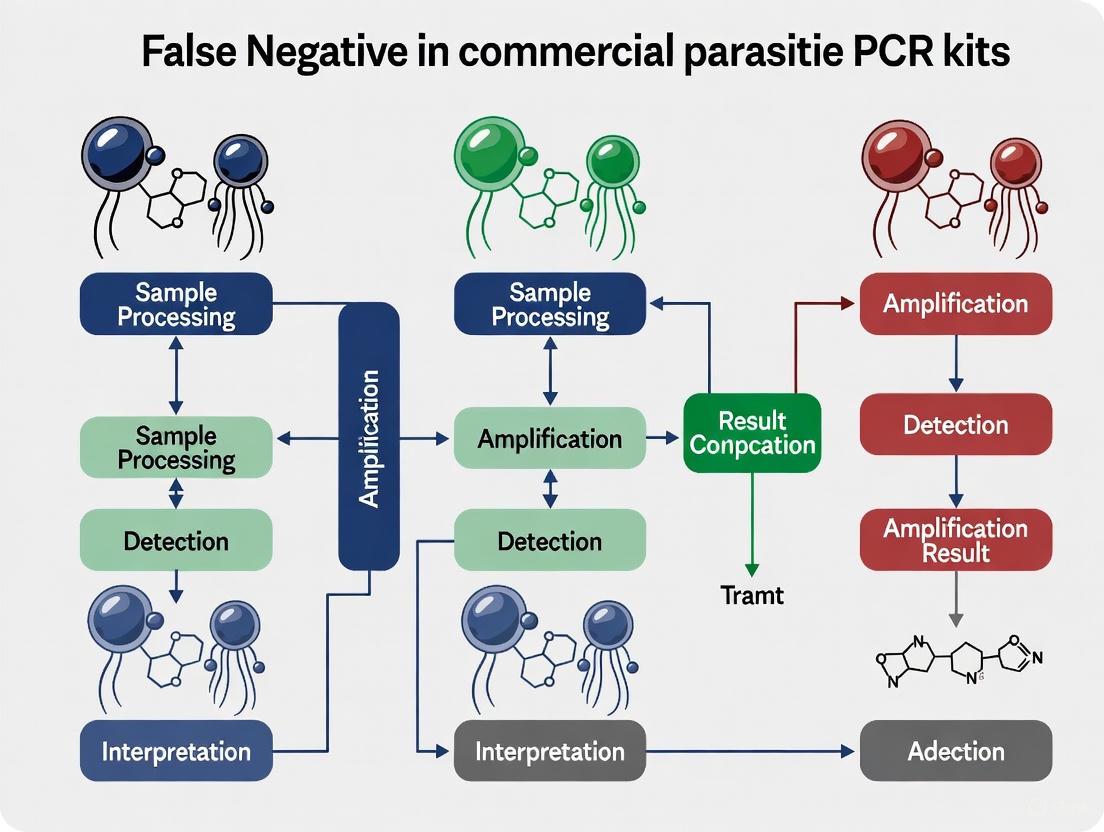
Molecular diagnostics, particularly commercial PCR kits, have revolutionized parasitology by offering high sensitivity and specificity.
Navigating False Negatives in Commercial Parasite PCR Kits: A Scientific Review of Causes, Solutions, and Validation Strategies
Abstract
Molecular diagnostics, particularly commercial PCR kits, have revolutionized parasitology by offering high sensitivity and specificity. However, false-negative results remain a significant challenge, potentially leading to misdiagnosis and inadequate patient management. This article provides a comprehensive analysis for researchers and development professionals on the causes of false negatives in commercial parasite PCR assays, exploring foundational issues from genetic variation to sample processing. We examine methodological applications of multiplex and simplex platforms, troubleshoot common pitfalls, and present validation frameworks for kit comparison. By synthesizing recent multicenter evaluations and emerging strategies, this review aims to equip scientists with the knowledge to optimize molecular parasite detection, improve test accuracy, and guide future assay development.
Understanding the Scope and Root Causes of False Negatives in Parasite Molecular Diagnostics
False negative results in molecular diagnostic testing for parasitic infections represent a critical challenge with direct consequences for patient care and public health. A false negative occurs when a diagnostic test incorrectly reports the absence of a pathogen in an infected individual, leading to misdiagnosis, delayed treatment, and potential ongoing disease transmission. In the context of commercial parasite PCR kits, these errors can arise from multiple technical factors including reagent inhibition, sequence mismatches, suboptimal sample processing, and inadequate internal controls. This technical support center provides researchers and laboratory professionals with evidence-based troubleshooting guidance to identify, prevent, and resolve issues contributing to false negative results in parasitic disease diagnostics.
Quantitative Data on Diagnostic Performance
The tables below summarize performance characteristics of various diagnostic methods for parasitic infections, highlighting factors contributing to false negative results.
Table 1: Comparative Performance of Diagnostic Methods for Intestinal Protozoa
| Parasite | Microscopy Sensitivity | Commercial PCR Kits | In-House PCR | Key Limitations |
|---|---|---|---|---|
| Giardia duodenalis | Variable (operator-dependent) | High sensitivity and specificity [1] [2] | High sensitivity and specificity [2] | Inconsistent DNA extraction efficiency [1] |
| Cryptosporidium spp. | Moderate to low | High specificity, limited sensitivity [1] | High specificity, limited sensitivity [1] | Robust oocyst wall impedes DNA extraction [1] |
| Entamoeba histolytica | Cannot differentiate from non-pathogenic species | Essential for species differentiation [1] | Essential for species differentiation [1] | Microscopy cannot distinguish pathogenic from non-pathogenic species [1] |
| Dientamoeba fragilis | Low (easily missed) | Inconsistent detection [1] | Inconsistent detection [1] | Fragile trophozoite, easily destroyed in sample processing [1] |
Table 2: Impact of Technical Factors on False Negative Rates in PCR Diagnostics
| Technical Factor | Impact on False Negative Rate | Supporting Evidence |
|---|---|---|
| PCR product carryover contamination | Complete inhibition of legitimate target amplification, even with 60ng target DNA [3] | UNG-digested PCR product or primer-dimers blocked amplification [3] |
| Primer-template mismatches | Variable: single mismatches can cause Ct value shifts from <1.5 to >7.0 [4] [5] | Position and type of mismatch determine impact; 3' end mismatches most detrimental [4] [5] |
| Sample preservation method | Preserved stool samples yielded better PCR results than fresh samples [1] | Likely due to better DNA preservation in fixed specimens [1] |
| Thermal inactivation (56°C for 30min) | 46.7% of weak-positive samples became negative post-treatment [6] | Chemical inactivation with guanidinium showed better preservation (13.3% false negatives) [6] |
Troubleshooting Guides
Common Causes and Solutions for False Negative Results
Problem: Inhibition of PCR Amplification
Symptoms: Failure to amplify both target and control DNA; inconsistent results across samples processed together.
Possible Causes:
- Carryover contamination from previous PCR products, even when using uracil-DNA-glycosylase (UNG) systems [3]
- Primer-dimer formation from negative control reactions [3]
- Presence of PCR inhibitors in sample matrix [7]
Solutions:
- Implement strict physical separation of pre- and post-PCR areas [7]
- Incorporate internal control systems to detect inhibition [8]
- Use of BSA (200-400ng/μL) to counteract phenolic compounds and other inhibitors [7]
- Avoid over-reliance on UNG systems alone for contamination control [3]
Problem: Sequence Mismatches Between Primers and Target
Symptoms: Reduced sensitivity for specific genetic variants; declining assay performance over time.
Possible Causes:
- Natural genetic evolution of parasite populations [4] [5]
- Geographic genetic variation in parasite strains [4]
Solutions:
- Regular in silico monitoring of primer binding sites using tools like PSET (PCR Signature Erosion Tool) [4] [5]
- Implement multiplex assays targeting multiple genetic regions [6] [8]
- Design primers to conserved genomic regions with lower evolutionary rates [6]
Problem: Suboptimal Sample Collection and Processing
Symptoms: Inconsistent results between samples; failure of internal controls.
Possible Causes:
- Degradation of parasite DNA during storage or transport [7]
- Inadequate disruption of robust parasite cysts/oocysts [1]
- Use of inappropriate swabs or collection devices containing PCR inhibitors [7]
Solutions:
- Use appropriate preservation media for stool samples [1]
- Implement mechanical disruption methods for robust cysts/oocysts [2]
- Validate complete DNA extraction protocols for specific parasite types [1] [2]
- Incorporate human mRNA controls (e.g., ABL1) to verify sample adequacy [8]
Frequently Asked Questions (FAQs)
Q: Why does our laboratory get false negatives for Cryptosporidium even with commercial PCR kits?
A: Cryptosporidium oocysts have robust walls that make DNA extraction challenging. Many commercial kits have limited sensitivity for this parasite due to inefficient disruption of the oocyst wall [1]. Consider incorporating additional mechanical disruption steps or using specialized extraction protocols validated for Cryptosporidium.
Q: How can we distinguish true negatives from false negatives caused by PCR failure?
A: Implement robust internal controls that monitor each step of the process. The ABL1 mRNA control system detects failures in sample collection, RNA isolation, reverse transcription, and amplification [8]. Only when the internal control amplifies properly can a negative result be trusted.
Q: Our PCR assays for Giardia showed excellent sensitivity initially but has declined over time. What could explain this?
A: This could indicate "signature erosion" due to genetic drift in the parasite population [4]. Primers designed against older sequences may have accumulating mismatches that reduce efficiency. Regular in silico analysis of primer binding sites against current circulating strains is recommended, with primer updates as needed.
Q: Can contamination controls like UNG actually cause false negatives?
A: Yes. UNG-digested PCR products and primer-dimers from previous reactions can inhibit amplification of legitimate targets, even at high concentrations [3]. This inhibition occurs regardless of UNG presence. Strict physical separation of PCR setup from amplification areas is crucial.
Q: What is the most reliable way to detect low-level parasite infections that often yield false negatives?
A: Consider more sensitive methods like digital PCR, which has demonstrated 10-fold lower detection limits compared to conventional PCR [6]. For low parasite densities, the increased sensitivity of digital PCR can significantly reduce false negative rates.
Experimental Protocols for Validation
Protocol 1: Internal Control Implementation for Comprehensive Process Monitoring
Purpose: To validate the inclusion of an internal control system that monitors sample collection, nucleic acid extraction, reverse transcription, and amplification.
Reagents:
- Primers and probes for human ABL1 gene mRNA (designed to span exon-exon junctions)
- Target-specific primers and probes
- Nucleic acid extraction reagents
- Reverse transcription and PCR master mix
Procedure:
- Collect patient samples using standard swabs, ensuring adequate collection of human mucosal cells
- Co-extract human and potential parasite nucleic acids using validated methods
- Perform multiplex RT-PCR including:
- ABL1 primers/probe (human RNA control)
- Primary parasite target primers/probe
- Secondary parasite target primers/probe (if available)
- Interpret results:
- ABL1 + target amplification: valid positive
- ABL1 only: valid negative
- No amplification: invalid test (sample collection or processing failure)
- Target amplification without ABL1: potentially false positive (requires retesting)
Validation: Test with known positive and negative samples to establish performance characteristics [8].
Purpose: To identify and troubleshoot sources of PCR inhibition that may cause false negatives.
Reagents:
- Known positive control DNA (parasite target)
- Test samples
- PCR master mix
- Additional BSA (if testing inhibition reversal)
Procedure:
- Prepare a dilution series of positive control DNA
- Spike each test sample extract with the positive control DNA
- Run PCR with both sample-specific and spike-in targets
- Compare Ct values of spike-in targets across samples
- Significant Ct delay (>3 cycles) indicates presence of inhibitors
- Test inhibition reversal strategies:
- Dilution of sample extract
- Addition of BSA (200-400ng/μL)
- Alternative DNA extraction methods
- Increased number of PCR cycles
Interpretation: Samples showing inhibition should be processed with optimized methods to prevent false negatives [3] [7].
Research Reagent Solutions
Table 3: Essential Reagents for Minimizing False Negatives in Parasite PCR
| Reagent/Category | Function | Considerations for Use |
|---|---|---|
| UNG System | Prevents carryover contamination by degrading uracil-containing PCR products | May not prevent inhibition from primer-dimers; can contribute to false negatives if contaminated [3] |
| BSA (Bovine Serum Albumin) | Counteracts PCR inhibitors in sample matrices | Effective against phenolic compounds; use at 200-400ng/μL [7] |
| Internal Control RNA (e.g., ABL1) | Monitors sample adequacy, extraction, and amplification | Must be designed to detect cDNA only (span exon junctions) [8] |
| Mechanical Disruption Beads | Breaks robust parasite cysts/oocysts for DNA release | Essential for Cryptosporidium and other resistant forms [2] |
| Multi-Target Primer/Probe Sets | Reduces false negatives from sequence variants | Target conserved regions (ORF1ab, N) rather than variable regions (S, E) [6] |
Workflow and Process Diagrams
PCR False Negative Troubleshooting Pathway
Optimal Sample Processing Workflow
FAQs: Understanding Signature Erosion in Parasite Diagnostics
What is "signature erosion" and how does it cause false negatives in parasite detection? Signature erosion occurs when genetic mutations in a pathogen's genome accumulate within the regions targeted by a PCR assay's primers and probes. This leads to mismatches that reduce the assay's ability to bind efficiently and amplify the target DNA, potentially resulting in false negative results. This is a significant challenge for parasites with high genetic diversity, such as Plasmodium falciparum and intestinal protists like Blastocystis and Entamoeba [4] [9].
Which parasites are most prone to causing false negatives due to high genetic diversity? Research has highlighted several parasites with substantial genetic diversity that can impact diagnostic accuracy:
- Common Luminal Intestinal Parasitic Protists (CLIPPs): Genera like Blastocystis, Entamoeba, and Dientamoeba exhibit "cryptic genetic diversity." For instance, Entamoeba coli and Iodamoeba bütschlii are now considered species complexes, with genetic differences of up to 10% and 30% respectively among lineages, challenging traditional species concepts [10].
- Plasmodium falciparum: Deletions in the pfhrp2 and pfhrp3 genes, which are targets for rapid diagnostic tests (RDTs), lead to false negatives. A 2025 study in Papua, Indonesia, found a pfhrp2- deletion prevalence of 2.12%, demonstrating this ongoing issue [11].
- Strongyloides stercoralis: Geographic genetic variation impacts the performance of molecular detection assays, as variations in parasite strains can lead to primer/probe mismatches [12].
How can I monitor my PCR assays for potential signature erosion? In silico tools like the PCR Signature Erosion Tool (PSET) are critical for proactive monitoring. PSET aligns your assay's primer and probe sequences against constantly updated public sequence databases (e.g., GenBank, GISAID) to calculate percent identity and coverage. It flags emerging mutations that could lead to assay degradation, allowing you to redesign assays before false negatives become widespread [4] [9] [13].
Besides genetic diversity, what other factors can lead to false negatives in parasite PCR? False negatives can stem from multiple sources beyond genetic variation:
- Sample Quality: Poor DNA integrity or the presence of PCR inhibitors carried over from stool, blood, or other complex matrices [14].
- Suboptimal PCR Protocols: Inappropriate annealing temperatures, insufficient DNA polymerase, or incorrect Mg2+ concentrations can drastically reduce sensitivity [14].
- Low Parasitic Load: Especially in chronic or asymptomatic infections, the amount of target DNA may be below the detection limit of the assay [12].
Troubleshooting Guide: Addressing False Negatives
| Problem Area | Possible Cause | Recommended Action |
|---|---|---|
| Assay Design & Validation | Signature erosion due to parasite genetic diversity. | Use tools like PSET for continuous in silico assay monitoring [4] [9]. Design assays against conserved genomic regions (e.g., SSU rRNA gene) [10]. Include multiple molecular targets per parasite to compensate for variation [2]. |
| DNA Template | Poor DNA integrity or purity; PCR inhibitors from sample. | Re-purify DNA using kits designed for complex samples (e.g., stool). Use DNA polymerases with high processivity and inhibitor tolerance [14]. Evaluate DNA integrity by gel electrophoresis [14]. |
| PCR Components | Suboptimal reaction components leading to low sensitivity. | Increase the amount of input DNA or number of PCR cycles (up to 40) for low-copy targets [14]. Optimize Mg2+ concentration and use PCR additives (e.g., GC enhancer) for difficult templates [14]. Use hot-start DNA polymerases to prevent non-specific amplification and improve specificity [14]. |
| Thermal Cycling | Incorrect cycling parameters reducing amplification efficiency. | Optimize annealing temperature in 1–2°C increments using a gradient cycler [14]. Increase denaturation time/temperature for GC-rich targets or sequences with secondary structures [14]. |
Experimental Protocol: Validating Assay Performance Against Genetic Variants
This protocol outlines a methodology for wet lab testing of the in silico predictions of false negative results, based on published research [4] [9].
Objective
To experimentally quantify the impact of specific genetic mutations on PCR assay performance by comparing Cycle Threshold (Ct) shifts and amplification efficiency against a wild-type control.
Materials
- Synthetic DNA Templates: Wild-type and mutant "gBlock" gene fragments encompassing the entire assay amplicon plus flanking sequences, based on naturally occurring parasite variants [9].
- PCR Reagents: Master mix (e.g., TaqPath), primers, probes, nuclease-free water.
- Equipment: Real-time PCR instrument (e.g., Bio-Rad CFX96).
Procedure
- Template Dilution: Prepare serial dilutions (e.g., 50, 500, 5000, and 50,000 copies per reaction) of both wild-type and mutant synthetic DNA templates [9].
- PCR Setup: Perform qPCR reactions in triplicate for each template and concentration, including no-template controls (NTCs). Use a universal set of reagents and cycling conditions to ensure consistent comparison [9].
- Data Analysis:
- Calculate ΔCt: For each template concentration, determine the difference in Ct value: ΔCt = (Average CtMutated) - (Average CtWild-Type) [9].
- Assess Impact: A ΔCt value > 1-3 cycles is typically considered a significant performance reduction leading to potential false negatives [9].
- Compare Efficiencies: Calculate PCR amplification efficiency from the standard curve of each template. A significant drop in efficiency for the mutant indicates assay impairment.
This experimental data can then be used to train machine learning models to better predict the impact of future mutations [9].
Workflow: From Signature Erosion Detection to Assay Update
The following diagram illustrates the continuous cycle required to maintain diagnostic assay accuracy in the face of evolving parasites.
Research Reagent Solutions for Robust Parasite Detection
The following table details key reagents and their critical functions in developing and optimizing molecular assays resistant to genetic diversity issues.
| Reagent / Tool | Function & Importance in Addressing Genetic Diversity |
|---|---|
| High-Processivity DNA Polymerase | Polymerases with high affinity for templates are more tolerant of mismatches and PCR inhibitors common in clinical samples (e.g., stool), helping to maintain amplification where standard polymerases might fail [14]. |
| PCR Additives / Co-solvents | Reagents like GC enhancers or DMSO help denature GC-rich DNA and resolve secondary structures, which is crucial for amplifying diverse or difficult parasite templates [14]. |
| Synthetic DNA Templates (gBlocks) | These are used as positive controls and as wild-type/mutant templates for rigorous validation of assay performance against known genetic variants, as described in the experimental protocol above [9]. |
| In Silico Monitoring Tools (e.g., PSET) | This software is essential for proactive surveillance. It automates the comparison of your assay signatures against public databases to flag emerging mutations that could lead to signature erosion and false negatives [4] [13]. |
| Multiplex PCR Master Mix | Optimized master mixes are required for multiplex assays that detect several parasites or multiple genetic targets from a single parasite simultaneously, providing a buffer against false negatives from variation at a single locus [2]. |
FAQs: Addressing False Negatives in Parasite PCR
FAQ 1: What are the most critical pre-analytical factors causing false negatives in parasite PCR? The primary factors are inefficient DNA extraction due to the robust wall of parasite (oo)cysts and the presence of PCR inhibitors in stool samples. The thick wall makes DNA difficult to release, while inhibitors from the complex stool matrix can halt the PCR reaction. Furthermore, improper sample storage or use of suboptimal preservation media degrades DNA before extraction [15] [1].
FAQ 2: How does the choice of sample preservation method impact DNA yield and PCR sensitivity? The preservation method is crucial for DNA integrity. Studies show that fixed stool samples preserved in media like Para-Pak often yield better PCR results than fresh samples due to superior DNA stabilization. For other sample types like tissues, flash-freezing in liquid nitrogen followed by storage at -80°C is the gold standard. Chemical preservatives are an effective alternative when freezing is not feasible, as they stabilize nucleic acids by inhibiting degrading enzymes [16] [1].
FAQ 3: Our lab uses mechanical homogenization for difficult samples, but we get fragmented DNA. How can we optimize this? Overly aggressive mechanical processing causes DNA shearing. Optimization requires a balanced approach:
- Parameter Control: Precisely control homogenization speed, cycle duration, and temperature.
- Bead Selection: Use specialized bead types (e.g., ceramic or stainless steel) tailored to your sample. Tough samples like stool or bone may require a combination of chemical and mechanical lysis for effective disruption without excessive damage.
- Temperature Management: Use a homogenizer designed to minimize heat buildup, as excessive heat accelerates DNA degradation through oxidation and hydrolysis. For sensitive samples, a cryo-cooling unit is recommended [16].
FAQ 4: Why might a commercial PCR kit fail to detect a parasite that was visible under microscopy? This discrepancy can arise from several issues:
- True False Negative: The DNA extraction was inefficient for that specific parasite's cyst wall, or PCR inhibitors were not adequately removed.
- Microscopy False Positive: Microscopic identification is operator-dependent and can misidentify non-pathogenic protozoa (e.g., Entamoeba dispar) as pathogenic ones (e.g., Entamoeba histolytica). PCR can specifically differentiate these species [15] [1].
- Sample Degradation: The portion of the sample used for PCR may have degraded DNA, while the portion used for microscopy was preserved.
FAQ 5: What is the most reliable method to control for DNA extraction efficiency and the presence of PCR inhibitors? Include an internal extraction control (IEC). This is a known quantity of exogenous DNA (non-human, non-parasite) added to the sample at the start of the extraction process. Successful amplification of the IEC confirms that extraction was efficient and that no significant inhibitors are present in the final eluate. Failure to detect the IEC signals a problem with the extraction or inhibition that needs troubleshooting [1].
Troubleshooting Guides
Guide 1: Troubleshooting Low DNA Yield from Stool Samples
| Observed Problem | Potential Cause | Recommended Solution |
|---|---|---|
| Consistently low DNA yield from stool samples. | Inefficient lysis of hardy parasite (oo)cysts [15]. | Implement a pre-lysis mechanical homogenization step using bead-beating with specialized beads [16]. |
| Sample contains high levels of PCR inhibitors [15]. | Use a DNA extraction kit specifically validated for stool samples and includes inhibitor removal steps. Increase wash steps during extraction. | |
| DNA degradation due to improper storage. | Ensure samples are frozen at -20°C or -80°C shortly after collection if not immediately processed. Use appropriate preservation media [1]. |
Guide 2: Troubleshooting PCR Inhibition
| Observed Problem | Potential Cause | Recommended Solution |
|---|---|---|
| Internal extraction control fails to amplify, or sample amplification is inconsistent. | Co-purified PCR inhibitors (e.g., bil salts, complex polysaccharides, hematin) from the sample matrix [15]. | Dilute the DNA template: This can dilute inhibitors below a critical concentration.Purify DNA further: Use a commercial post-extraction cleanup kit.Add PCR enhancers: Include BSA or betaine in the PCR reaction mix to counteract inhibitors. |
| Incomplete removal of reagents from the extraction kit (e.g., alcohols, detergents). | Ensure all wash buffers contain ethanol as recommended. Let the spin column dry completely before elution. |
Experimental Protocols from Cited Studies
Protocol: DNA Extraction from Stool for Multiplex Parasite PCR
This protocol is adapted from multicentre studies evaluating commercial PCR assays [15] [1].
1. Sample Preparation:
- Collect 50-100 mg of stool specimen and suspend it in 1 mL of stool lysis buffer (e.g., ASL buffer from Qiagen).
- Pulse vortex for 1 minute and incubate at room temperature for 10 minutes.
- Centrifuge at full speed (14,000 rpm) for 2 minutes. The supernatant is used for nucleic acid extraction.
2. Automated Nucleic Acid Extraction:
- Use an automated system such as the Microlab Nimbus IVD or MagNA Pure 96 System.
- Extract nucleic acids according to the manufacturer's instructions. The system should automatically perform the processing and PCR setup.
- Include an internal extraction control in the first step to monitor for inhibition.
- Elute DNA in a volume of 50-100 µL.
3. Real-Time PCR Setup:
- Use a commercial multiplex PCR kit like the Allplex GI-Parasite Assay.
- Amplify on a real-time PCR instrument (e.g., CFX96) using the manufacturer's recommended cycling conditions.
- Fluorescence is typically detected at multiple temperatures, and a positive result is defined as a fluorescence curve crossing the threshold at a Ct value of <45 for individual targets [15].
Data Presentation: PCR Assay Performance
The table below summarizes the sensitivity and specificity of a commercial multiplex PCR assay compared to conventional methods, as reported in a 2025 multicentre Italian study [15].
Table 1: Performance Metrics of the Allplex GI-Parasite Assay (n=368 samples)
| Parasite | Sensitivity (%) | Specificity (%) |
|---|---|---|
| Entamoeba histolytica | 100 | 100 |
| Giardia duodenalis | 100 | 99.2 |
| Dientamoeba fragilis | 97.2 | 100 |
| Cryptosporidium spp. | 100 | 99.7 |
Workflow Visualization
Diagram Title: Sample Processing Workflow
The Scientist's Toolkit: Research Reagent Solutions
Table 2: Essential Reagents and Kits for Optimal Parasite DNA Analysis
| Item Name | Function/Application | Key Features |
|---|---|---|
| Stool Lysis Buffer (e.g., ASL Buffer) | Initial sample preparation and homogenization. | Begins the breakdown of stool components and parasite walls, preparing the sample for DNA binding [15]. |
| Automated Extraction System (e.g., Microlab Nimbus, MagNA Pure 96) | Automated nucleic acid purification. | Ensures consistency, reduces cross-contamination, and often includes integrated protocols for inhibitor removal [15] [1]. |
| Inhibitor Removal Technology (e.g., PowerSoil Pro Kit) | DNA purification from challenging, inhibitor-rich samples. | Specifically designed to remove humic acids, polyphenols, and other PCR inhibitors common in soil, stool, and environmental samples [17]. |
| Mechanical Homogenizer (e.g., Bead Ruptor Elite) | Cell lysis and disruption of tough parasite cysts. | Provides controlled, high-energy disruption using specialized beads to break open hardy cell walls that chemical lysis alone cannot [16]. |
| Multiplex Real-Time PCR Assay (e.g., Allplex GI-Parasite Assay) | Simultaneous detection of multiple parasite targets. | Streamlines detection, reduces hands-on time, and offers high sensitivity and specificity for common enteric protozoa [15]. |
| Internal Extraction Control (IEC) | Process control for extraction and inhibition. | Exogenous DNA added to the sample to verify that nucleic acid extraction was successful and that the final eluate is free of PCR inhibitors [1]. |
Troubleshooting Guides and FAQs
Frequently Asked Questions
What are the most common sources of PCR inhibitors in stool samples? Stool samples contain various PCR inhibitors, including phenolic compounds from diet or bacterial metabolism, fats, cellulose, constituents of bacterial degraded cells, heavy metals, and bile salts [18]. The complexity of stool composition means these inhibitors vary significantly between individuals based on clinical, dietary, gut microbiota, and environmental factors [19].
Why do some parasitic pathogens yield more false negatives than others in PCR? The physical structure of the parasite significantly impacts DNA extraction efficiency. Helminths like Ascaris lumbricoides have strong eggshells, while Strongyloides stercoralis larvae present with tough cuticles, making them difficult to lyse compared to more fragile protozoa like Blastocystis sp. [19]. This structural resistance leads to incomplete DNA release during extraction, contributing to false negatives.
How can I validate whether my DNA extraction method effectively removes inhibitors? A reliable approach is to spike a known amount of plasmid DNA harboring your target gene into the extracted DNA samples, then perform PCR. If the spike test is positive, your sample likely doesn't contain significant inhibitors; if negative, inhibitors are likely still present. This method confirmed that even after extraction, 60/85 samples prepared with the phenol-chloroform method still contained inhibitors [19].
Does the stage of disease or patient age affect inhibitor levels? Yes, PCR inhibitors accumulate with age, ranging from 0% in newborn stool samples to 17% in children aged 6 to 24 months, with this proportion increasing further in adult samples [18]. Additionally, diarrheal samples may contain more inhibitors than those from healthy individuals [18].
Troubleshooting Guide: Addressing Common PCR Failure Scenarios
Problem: Consistently negative PCR results despite microscopic confirmation of parasites
- Potential Cause: Inefficient lysis of hardy parasite structures (eggs, cysts, oocysts) or co-purification of PCR inhibitors.
- Solutions:
- Incorporate a mechanical disruption step: Implement bead-beating with 0.5mm glass beads during lysis [19] [20].
- Switch extraction kits: Use a kit specifically designed for fecal samples with robust inhibitor removal technology [19].
- Add an inhibitor removal step: Incorporate polyvinylpyrrolidone (PVP) during extraction to bind polyphenolic compounds [20].
- Validate with spike tests: Add control plasmid DNA to extracted samples to confirm absence of inhibitors [19].
Problem: Variable PCR results between sample replicates
- Potential Cause: Inhomogeneous distribution of parasites and inhibitors in stool matrix, or inconsistent lysis efficiency.
- Solutions:
- Improve sample homogenization: Thoroughly mix stool samples before aliquoting for DNA extraction [19].
- Standardize lysis conditions: Ensure consistent incubation times, temperatures, and vortexing protocols [19] [20].
- Increase sample volume: Use larger initial sample amounts to overcome patchy distribution of targets [20].
Problem: Faint or weak amplification signals
- Potential Cause: Partial inhibition or suboptimal DNA quality/quantity.
- Solutions:
- Dilute DNA template: Dilution may reduce inhibitor concentration below inhibitory threshold [18].
- Purify DNA further: Use additional purification columns (e.g., QIAquick PCR purification kit) [20].
- Add PCR enhancers: Include bovine serum albumin (BSA) or betaine in PCR reactions to counteract residual inhibitors [18].
Quantitative Data on DNA Extraction Methods
Comparison of DNA Extraction Method Performance for Intestinal Parasites
Table 1: Performance evaluation of four DNA extraction methods for PCR detection of intestinal parasites [19]
| Extraction Method | Relative DNA Yield | PCR Detection Rate | Key Advantages | Key Limitations |
|---|---|---|---|---|
| Phenol-Chloroform (P) | Highest (~4x other methods) | 8.2% (7/85 samples) | High DNA yield | Poor inhibitor removal; detected only S. stercoralis |
| Phenol-Chloroform with Bead-Beating (PB) | High | Not specified | Improved lysis of hardy parasites | Still limited by inhibitor removal |
| QIAamp Fast DNA Stool Mini Kit (Q) | Moderate | Not specified | Commercial convenience | Lower sensitivity for diverse parasites |
| QIAamp PowerFecal Pro DNA Kit (QB) | Moderate | 61.2% (highest) | Effective inhibitor removal; detected all tested parasites | Lower DNA yield than phenol methods |
Table 2: Parasite detection profile across extraction methods [19]
| Parasite | Phenol-Chloroform (P) | Phenol-Chloroform with Beads (PB) | QIAamp Fast DNA Stool (Q) | QIAamp PowerFecal Pro (QB) |
|---|---|---|---|---|
| Blastocystis sp. | Not detected | Not specified | Not specified | Detected |
| Ascaris lumbricoides | Not detected | Not specified | Not specified | Detected |
| Trichuris trichiura | Not detected | Not specified | Not specified | Detected |
| Hookworm | Not detected | Not specified | Not specified | Detected |
| Strongyloides stercoralis | Detected (7/20) | Not specified | Not specified | Detected |
Experimental Protocols
Principle: Combines mechanical disruption of parasitic structures with chemical DNA extraction.
Reagents Needed:
- Lysis solution (20 mM Tris-HCl pH 7.6, 2.5 mM MgCl2, 50 mM KCl, 150 µg/mL proteinase K, 0.5% Tween-20)
- Phenol:chloroform:IAA (25:24:1)
- Chloroform
- Ice-cold absolute ethanol
- 3M sodium acetate (pH 5.2)
- 70% ethanol
- TE buffer
- Sterile 0.5mm glass beads
Procedure:
- Add 200mg stool sample to microcentrifuge tube with 250mg sterile 0.5mm glass beads.
- Add 400μL lysis solution and horizontally vortex at maximum speed for 10min until homogeneous.
- Incubate at 65°C for 3h, then at 90°C for 10min to inactivate proteinase K.
- Add 200μL phenol:chloroform:IAA (25:24:1), mix thoroughly, and centrifuge at 13,000rpm at 4°C for 10min.
- Transfer upper aqueous phase to new tube, add 2 volumes chloroform, mix, and centrifuge again.
- Transfer supernatant to new tube, add 2.5 volumes ice-cold absolute ethanol and 0.1 volume 3M sodium acetate (pH 5.2).
- Precipitate DNA at -20°C overnight.
- Collect DNA by centrifugation at 13,000rpm at 4°C for 10min.
- Wash pellet with 1,000μL 70% ethanol, air-dry, and resuspend in 100μL TE buffer.
Principle: Optimized for difficult-to-lyse pathogens using mechanical disruption and specialized binding matrices.
Reagents Needed:
- FastDNA Kit reagents (CLS-VF, PPS, Binding Matrix, SEWS-M, DES)
- Lysing Matrix Multi Mix E
- Phosphate buffered saline (PBS)
- EDTA solution (0.5M, pH 8.0)
- Polyvinylpyrrolidone (PVP)
- QIAquick PCR purification kit (optional additional cleanup)
Procedure:
- Centrifuge 300-500μL stool aliquot at 14,000×g at 4°C for 5min.
- Suspend pellet in 1mL PBS-EDTA and repeat centrifugation twice.
- Resuspend final pellet in PBS-EDTA to approximately 300μL total volume.
- Add 300μL washed sample to tube containing Lysing Matrix Multi Mix E.
- Add 400μL CLS-VF, 200μL PPS, and PVP to final concentration 0.1-1%.
- Vortex mix, then process in FastPrep FP120 disrupter at speed 5.0-5.5 for 10sec.
- Centrifuge 5min at 14,000×g at room temperature.
- Transfer 600μL supernatant to new tube, add 600μL Binding Matrix, and mix gently by inversion.
- Incubate 5min at room temperature, then centrifuge at 14,000×g for 1min.
- Discard supernatant, resuspend pellet in 500μL SEWS-M.
- Centrifuge 1min at 14,000×g, discard supernatant.
- Resuspend matrix in 100μL DES, incubate 2-3min at room temperature.
- Centrifuge 2min at 14,000×g, transfer supernatant (containing DNA) to clean tube.
- Optional: Further purify DNA using QIAquick spin column per manufacturer's instructions.
Principle: Minimal preparation using FTA filters that lyse cells on contact and sequester DNA while removing inhibitors.
Reagents Needed:
- FTA filters
- FTA purification buffer
- 10mM Tris (pH 8.0) with 0.1mM EDTA
Procedure:
- Apply 10-25μL of partially purified and concentrated sample to FTA filter.
- Dry filter on 56°C heating block.
- Punch out 6mm disk and place in 1.5mL microcentrifuge tube.
- Wash disk twice with 0.5mL FTA purification buffer for 2min each.
- Wash twice with 0.5mL 10mM Tris (pH 8.0) containing 0.1mM EDTA for 2min each.
- Air-dry disk on 56°C heating block.
- Use washed filter directly as template source in PCR.
Workflow Visualization
Diagram 1: Comparison of standard versus optimized protocols for parasite DNA detection in stool samples, highlighting critical steps that reduce false negatives.
The Scientist's Toolkit: Research Reagent Solutions
Table 3: Essential reagents and materials for optimal parasite DNA extraction from stool samples
| Reagent/Material | Function | Application Notes | Citations |
|---|---|---|---|
| 0.5mm Glass Beads | Mechanical disruption of hardy parasite structures (eggs, cysts) | Critical for helminths with tough outer structures; use with bead-beater | [19] |
| Polyvinylpyrrolidone (PVP) | Binds polyphenolic PCR inhibitors | Add to final concentration 0.1-1% during lysis step | [20] |
| QIAamp PowerFecal Pro DNA Kit | Comprehensive DNA extraction with inhibitor removal | Specifically designed for difficult fecal samples; superior detection rates | [19] |
| FTA Filter Cards | Extraction-free DNA template preparation | Rapid method; lyses cells on contact and sequesters DNA | [21] |
| Inhibitor Removal Buffers (e.g., InhibitEX) | Specifically binds and removes PCR inhibitors | Included in commercial kits; critical for problematic samples | [19] |
| Proteinase K | Digests proteins and enhances cell lysis | Essential for breaking down parasite structures; use with extended incubation | [19] [20] |
| Internal Control Plasmids | Detection of PCR inhibition in extracted DNA | Spike into samples post-extraction to validate results | [19] |
| Binding Matrices (silica-based) | Selective DNA binding and purification | Effective for separating DNA from inhibitors in complex samples | [20] |
This technical support center provides troubleshooting guides and FAQs for researchers addressing false negatives in commercial PCR kits for parasite detection.
Frequently Asked Questions
What are the primary causes of false-negative results in parasite PCR?
False negatives can stem from several sources related to the sample, the parasite, and the kit itself. Key issues include:
- Inadequate DNA extraction: The robust wall structure of parasite oocysts can complicate DNA extraction, reducing yield [22].
- Sample preservation: DNA degradation can occur in improperly stored samples. One study noted that PCR results from preserved stool samples were superior to those from fresh samples, likely due to better DNA preservation [22].
- Inhibitors in the sample: Substances from the sample or collection process (e.g., from certain types of swabs or gloves) can inhibit the PCR reaction [7].
- Sub-optimal sample timing: The parasite load or the stage of infection can affect detection [6] [23].
- Kit-specific limitations: The limit of detection (LOD) varies between commercial kits, and some may have reduced sensitivity for certain parasite species or low-copy-number samples [24] [25].
How can I determine if a negative result is a true negative or a false negative?
Implementing a robust system of controls is essential to identify false negatives caused by reaction failure or inhibition.
- Internal Control: Co-amplify a mammalian housekeeping gene (e.g., GAPDH) present in the patient's cells. Failure to amplify this control indicates PCR inhibition or nucleic acid degradation [7].
- External Positive Control: Use a known sequence of the target pathogen (e.g., spiked genomic DNA) at concentrations near the assay's detection limit. This verifies the assay's sensitivity and that nucleic acid was not lost during purification [7].
My lab is considering switching to a new commercial PCR kit. How should we validate its sensitivity?
A thorough comparative validation against your current method is crucial. Key steps include:
- Test identical templates: Use a panel of well-characterized clinical samples or quantified DNA extracts to avoid variations from upstream processes [24].
- Determine the Limit of Detection (LOD): Test serial dilutions of target DNA to find the lowest concentration the kit can reliably detect [24].
- Check specificity: Verify the kit does not cross-react with other organisms commonly found in your sample type [24].
- Assess reproducibility: Run replicates in independent series to evaluate consistency [24].
Troubleshooting Guides
Guide 1: Addressing False Negatives from Sample & Workflow Issues
| Problem Area | Specific Issue | Corrective Action |
|---|---|---|
| Sample Collection & Storage | Use of wooden cotton or calcium alginate swabs [7] | Switch to synthetic swabs. |
| Excessive freeze-thaw cycles of samples [7] | Store samples in small, single-use aliquots. | |
| Sample thermal inactivation (e.g., 56°C for 30 min) [6] | Use chemical inactivation methods (e.g., guanidinium) instead. | |
| Nucleic Acid Handling | Contamination with RNases/DNases [7] | Use nuclease-free water, reagents, and labware. |
| Inadequate DNA extraction from parasites with robust walls [22] | Optimize or validate extraction protocols for specific parasites. | |
| PCR Inhibition | Presence of PCR inhibitors in the sample [7] | Incorporate Bovine Serum Albumin (BSA) (200-400 ng/µL) into the reaction mix. |
The following workflow diagram outlines a systematic procedure for diagnosing the cause of a false-negative result:
Guide 2: Comparing & Validating Kit Performance
When evaluating a new kit, use a standardized protocol to compare its analytical sensitivity directly with your current method. The table below summarizes key performance metrics from published comparisons.
Table 1: Representative Performance Data from Commercial PCR Kit Comparisons
| Pathogen / Context | Kits / Methods Compared | Key Finding on Analytical Sensitivity | Reference |
|---|---|---|---|
| SARS-CoV-2 | Sansure Biotech, GeneFinder, TaqPath | All kits showed strong agreement (p=0.107). Sansure Biotech showed slightly better diagnostic performance with lower average Ct values for the N gene [25]. | [25] |
| Borrelia burgdorferi s.l. (Lyme disease) | 11 CE-IVD marked kits vs. in-house PCR | Most kits could detect 10-10⁴ DNA copies/5µL. Three kits had a significantly higher LOD than the in-house reference method (P<0.05) [24]. | [24] |
| KRAS mutations (Colorectal Cancer) | TheraScreen Kit vs. Direct Sequencing | TheraScreen kit identified mutations in 44% of tumors vs. 41% for sequencing. The kit detected mutations at a 1% mutant DNA dilution, while sequencing required 10-30% [26]. | [26] |
| Intestinal Protozoa | Commercial RT-PCR (AusDiagnostics) vs. In-house RT-PCR | Complete agreement for G. duodenalis. For Cryptosporidium and D. fragilis, both showed high specificity but limited sensitivity, partly due to DNA extraction issues [22]. | [22] |
The following workflow provides a high-level overview of a kit validation experiment:
Detailed Experimental Protocol: Kit Comparison
Objective: To compare the analytical sensitivity and specificity of a new commercial PCR kit against a validated in-house or commercial reference method.
Materials:
- Test Kits: The new commercial kit(s) and the reference method.
- Template DNA:
- For Sensitivity (LOD): Serial dilutions (e.g., 10⁻¹ to 10⁴ genome equivalents/µL) of purified DNA from target parasite strains. Use at least 14 different strains/species if possible [24].
- For Specificity: DNA extracts from a panel of non-target organisms (e.g., other parasites, commensal flora, human DNA) [24].
- Equipment: Thermocyclers as specified by each kit's instructions.
Methodology:
- Sample Preparation: Aliquot identical DNA samples for all kits to be tested. This avoids bias from nucleic acid extraction steps and allows direct comparison of PCR performance [24].
- PCR Amplification: Perform all assays strictly following the manufacturers' instructions. Include all recommended positive, negative, and internal controls in each run.
- Data Collection:
- Record Cycle Threshold (Ct) values for positive results.
- Note the presence/absence of amplification in specificity panels.
- Perform all tests in duplicate or triplicate to assess reproducibility.
Data Analysis:
- Limit of Detection (LOD): Determine the lowest DNA concentration at which all replicates are positive for each kit [24].
- Reproducibility: Calculate the delta Ct (ΔCt) between replicates.
- Specificity: Calculate the percentage of non-target samples that correctly tested negative.
- Statistical Analysis: Use appropriate tests (e.g., Cohen's κ coefficient, Pearson's correlation) to compare the final results and Ct values between kits [25].
The Scientist's Toolkit
Table 2: Key Research Reagent Solutions for Sensitivity Testing
| Reagent / Material | Function in Experiment | Technical Notes |
|---|---|---|
| Quantified Genomic DNA | Serves as a standardized template for determining the Limit of Detection (LOD) and comparing kit performance. | Should include a range of species and strains relevant to your research (e.g., 8+ genospecies for Borrelia) [24]. |
| Internal Extraction Control | Monitors the efficiency of the DNA/RNA extraction process and detects the presence of PCR inhibitors. | Often supplied in commercial kits. If not, can be a non-competitive synthetic sequence or a host gene [22] [7]. |
| Bovine Serum Albumin (BSA) | Added to the PCR master mix to neutralize certain types of PCR inhibitors found in clinical samples. | Effective at neutralizing phenolic compounds and other inhibitors; typical concentration is 200-400 ng/µL [7]. |
| Uracil-DNA-Glycosylase (UNG) | Enzyme used to prevent false positives from "carryover" contamination by degrading PCR products from previous runs. | A common component in commercial PCR master mixes [7]. |
| Hot-Start DNA Polymerase | A modified enzyme activated only at high temperatures, improving specificity by preventing non-specific amplification during reaction setup. | Reduces primer-dimer formation and increases assay robustness [7]. |
Implementing Advanced Molecular Platforms for Optimal Parasite Detection
Core Concepts and Comparative Analysis
Q: What is the fundamental difference between a simplex and a multiplex PCR assay?
A: A simplex PCR assay is designed to detect a single target sequence (e.g., one specific gene from one specific organism) in a single reaction tube. In contrast, a multiplex PCR assay uses multiple primer sets to amplify multiple distinct target sequences simultaneously within a single reaction [27] [28].
This foundational difference leads to distinct advantages and challenges for each method, which are summarized in the table below.
Table 1: Strategic Comparison of Simplex and Multiplex PCR Assays
| Parameter | Simplex PCR | Multiplex PCR |
|---|---|---|
| Targets per Reaction | One | Multiple (often 3-5 in real-time PCR) [29] |
| Reagent & Time Cost | Higher (more reactions per sample) | Lower (substantial savings in reagents and time) [27] |
| Sample Volume Required | Higher | Lower (enables analysis of volume-limited samples) |
| Throughput | Lower | Higher (fewer wells needed per sample) [27] |
| Assay Design & Optimization | Simpler and more straightforward | Complex; requires careful optimization to prevent competition and interference [27] [30] |
| Internal Control | Requires a separate reaction | Can be co-amplified within the same reaction [31] |
| Risk of Competition | None | High (targets compete for enzymes, dNTPs, and primers) [27] [32] |
| Data Interpretation | Simple | Complex; potential for signal overlap or imbalanced amplification [29] |
Q: In a diagnostic setting, when should I prioritize one method over the other?
A: The choice hinges on your diagnostic question and operational constraints.
- Choose Simplex PCR when: Your goal is to confirm or rule out a single, specific pathogen with the highest possible sensitivity. It is also the preferred choice for quantitative applications (qPCR) where maximum accuracy is required, or when developing and validating a new assay before moving to multiplexing [33].
- Choose Multiplex PCR when: You need to efficiently test for a panel of pathogens that cause similar clinical syndromes (e.g., respiratory or gastrointestinal infections). It is ideal for syndromic testing, for genotyping (e.g., identifying species or resistance markers), and in situations where sample volume is limited or cost-per-test is a major driver [29] [28].
Troubleshooting False Negatives and Assay Optimization
Q: My multiplex assay is producing false negatives. What are the most common causes?
A: False negatives are a critical challenge in diagnostics. Within the context of multiplex PCR, they often arise from the issues outlined below.
Table 2: Troubleshooting Guide for False Negatives in Multiplex PCR
| Problem | Underlying Cause | Potential Solutions |
|---|---|---|
| Target Competition | One target (often the endogenous control) amplifies more efficiently, depleting reagents (dNTPs, enzymes) for other targets [27]. | - Primer-limiting: Reduce the concentration of the primer for the highly abundant/competitive target to force it to plateau earlier [27].- Reagent optimization: Increase concentrations of polymerase and dNTPs to support multiple reactions [29]. |
| Primer-Dimer & Off-Target Interactions | Primers interact with themselves (primer-dimer) or non-target sequences (primer-amplicon), depleting reagents and causing false negatives for the intended targets [30]. | - Improved primer design: Use specialized software to check for cross-homology and secondary structures [30] [29].- Hot-Start Polymerase: Use polymerases that are inactive at room temperature to prevent spurious amplification during setup [14]. |
| Insufficient Sensitivity | The multiplex reaction is less sensitive than a corresponding simplex assay, failing to detect low-abundance targets [33] [34]. | - Validate with singleplex: Compare duplex/triplex results with singleplex results on a subset of samples to check for agreement [27].- Use specific probes: Switch from DNA-binding dyes (e.g., SYBR Green) to target-specific probes (e.g., TaqMan) for greater specificity and sensitivity in a multiplex setting [27]. |
| Inhibition | Substances in the sample (e.g., from stool) inhibit the polymerase enzyme [2]. | - Internal Control: Always include an internal positive control (IPC) in the reaction to distinguish true negatives from inhibition [31].- DNA purification: Re-purify the DNA to remove inhibitors like hemoglobin, polysaccharides, or EDTA [14]. |
Q: How can I experimentally verify if my multiplex assay is performing as well as a simplex one?
A: A standard verification protocol involves running your assay in both multiplex and singleplex configurations on a representative sample set [27].
- Sample Selection: Select 5-6 samples from both your experimental and control groups [27].
- Parallel Testing: Run all selected samples in both the multiplex format and the corresponding singleplex reactions for each target.
- Data Comparison: Compare the results (e.g., Ct values for qPCR, presence/absence for conventional PCR). If the results are comparable between the two configurations, it is safe to proceed with the multiplex assay for the full experiment. A significant discrepancy (e.g., > 2 Ct value difference) indicates the multiplex format requires further optimization [27].
This process directly addresses the risk of false negatives by empirically validating the assay's performance.
Experimental Protocols and Workflow Diagrams
Experimental Protocol: Comparative Evaluation of PCR Assays
The following protocol is adapted from methodology used in kit validation studies [2] [31].
Objective: To compare the performance of a new multiplex PCR assay against a reference method (in-house singleplex or a validated commercial kit).
Materials:
- Samples: A panel of well-characterized clinical samples or Certified Reference Materials (CRMs) [31].
- DNA Extraction Kit: e.g., DNeasy Blood & Tissue Kit or equivalent.
- PCR Reagents: Master mixes for both the multiplex and simplex assays.
- Real-Time PCR Instrument.
Procedure:
- DNA Extraction: Extract DNA from all samples using a standardized, validated protocol. Elute DNA in a consistent volume.
- Experimental Setup: For each sample, set up two parallel reactions:
- Reaction A: The multiplex PCR assay.
- Reaction B: The corresponding set of singleplex PCR assays for each target in the multiplex.
- PCR Amplification: Run all reactions on the real-time PCR instrument according to the optimized cycling conditions for each assay.
- Data Analysis: Calculate key performance parameters for both methods:
- Analytical Sensitivity/LOD: Determine the limit of detection using serial dilutions of a known target [32].
- Analytical Specificity: Test against a panel of near-neighbor organisms and background DNA to check for cross-reactivity [32].
- Diagnostic Sensitivity & Specificity: Compare the results of the new assay against the reference method on the clinical sample panel.
The logical workflow for this comparative analysis and subsequent troubleshooting is outlined in the diagram below.
Diagram 1: Multiplex PCR Troubleshooting Workflow
The following diagram illustrates the core problem of competition in a multiplex reaction and the primer-limiting solution.
Diagram 2: Multiplex Competition & Primer-Limiting Solution
The Scientist's Toolkit: Essential Reagents and Materials
Table 3: Research Reagent Solutions for Multiplex PCR Development
| Reagent / Material | Function | Key Considerations for Multiplex |
|---|---|---|
| Hot-Start DNA Polymerase | Enzyme that becomes active only at high temperatures, preventing non-specific amplification and primer-dimer formation during reaction setup. | Critical for multiplex to reduce off-target interactions that deplete reagents [14]. |
| TaqMan Probes | Fluorescently labeled, target-specific probes (e.g., FAM, VIC) that provide a specific signal for each target in a multiplex reaction. | Essential for distinguishing multiple targets in real-time PCR; dyes must have unique, non-overlapping emission spectra [27] [29]. |
| Certified Reference Materials (CRMs) | Controls with a known and certified content of the target DNA. | Used as positive controls and for standard curves to validate assay accuracy and determine the Limit of Detection (LOD) [31]. |
| Internal Positive Control (IPC) | A non-interfering control sequence added to the reaction to monitor for PCR inhibition. | Distinguishes a true negative from a failed reaction due to inhibitors; mandatory for diagnostic assays [31]. |
| PCR Additives (e.g., DMSO, GC Enhancers) | Co-solvents that help denature complex DNA templates, especially those with high GC-content or secondary structures. | Can improve amplification efficiency of difficult targets but require re-optimization of annealing temperatures [14]. |
High-Resolution Melting (HRM) analysis is a powerful, post-polymerase chain reaction (PCR) technique that enables species differentiation based on the dissociation behavior of double-stranded DNA. By detecting subtle differences in DNA sequence composition, length, and GC content, HRM provides a rapid, cost-effective, and closed-tube method for identifying genetic variations. This technical support center addresses the application of HRM analysis within parasitology research, focusing specifically on overcoming challenges related to false negatives in commercial PCR kits. The following guides, protocols, and troubleshooting resources are designed to assist researchers in implementing robust HRM assays for accurate species detection and differentiation.
Key Applications and Assay Performance
HRM analysis has been successfully applied to differentiate various pathogenic species, demonstrating high sensitivity and specificity in both clinical and research settings. The table below summarizes performance data from key studies.
Table 1: Performance Metrics of HRM Assays for Pathogen Differentiation
| Pathogen Group | Target Gene | Analytical Sensitivity | Specificity | Key Differentiation Achievement | Reference |
|---|---|---|---|---|---|
| Leishmania spp. (Old World) | Strumpellin | 24 parasites | 100% (for reference strains) | Differentiation of 7 species/complexes and 3 genotypes of L. tropica | [35] |
| Shigella spp. | rrsA (16S rRNA) | 0.01 - 0.1 ng DNA | 100% | Correct species identification of all 49 isolates from clinical and food samples | [36] |
Troubleshooting Common HRM Issues
Frequently Asked Questions (FAQs)
1. Does my real-time PCR instrument require calibration for HRM analysis? Yes, the instrument must be calibrated for the specific HRM dye you are using. The calibration process typically involves multiple steps, though some newer instrument software versions have streamlined this into a single-step procedure [37].
2. What are the common causes of poor quality or inconsistent melting curves? Poor results can stem from several factors [37]:
- Using an HRM software version that is incompatible with your real-time PCR system software.
- Employing a run method that does not follow the recommended HRM protocol (e.g., using an incorrect ramp rate during the dissociation stage).
- The presence of outliers on the calibration plate. Note that you cannot omit any wells from the HRM calibration plate.
- A defective calibration file, which could be due to a bad calibration plate or an instrument uniformity issue.
3. My assay is producing unexpected positive results. What could be the cause? Unexpected positives can occur due to assay nonspecificity. One documented case involved a pinworm PCR where environmental samples tested positive, but the results could not be confirmed in animal subjects. The false positives were traced to the amplification of non-infectious nematodes present in the corncob bedding, highlighting the critical need for confirmatory testing and rigorous assay validation [38].
4. How can I prevent misdiagnosis due to genetic variations in target pathogens? False negatives can arise from pathogen genetic diversity. For example, Plasmodium falciparum strains with deletions of the pfhrp2 and/or pfhrp3 genes can evade detection by HRP2-based rapid diagnostic tests (RDTs) [39]. While this specific example pertains to RDTs, it underscores the importance of selecting a stable, conserved genetic target for any diagnostic assay, including HRM.
Experimental Protocol: HRM for Species Differentiation
This protocol outlines the general methodology for developing an HRM assay, as demonstrated for Shigella species differentiation [36].
The following diagram illustrates the key stages of a typical HRM experiment, from sample preparation to final analysis.
Detailed Methodology
1. DNA Extraction
- Extract genomic DNA from samples (e.g., cultured promastigotes, clinical aspirates, stool samples) using a standard commercial kit [35] [36].
- Quantify DNA purity and concentration using a spectrophotometer. DNA can be stored at -20°C until use.
2. Primer Design and Validation
- Target Selection: Identify a genetic target with sufficient single nucleotide polymorphisms (SNPs) or sequence variations between the species of interest. The Strumpellin gene was used for Leishmania [35], while the rrsA (16S rRNA) gene was effective for Shigella [36].
- Bioinformatics Analysis: Use sequence alignment software and phylogenetic tools to analyze the evolutionary conservation of the target and identify unique regions for primer design [35].
- Primer Specifications: Design primers to generate short amplicons (typically 80-150 bp) to maximize the impact of small sequence variations on melting temperature (Tm).
- Example: Shigella Primers
- Target Gene: rrsA
- Amplicon Size: 92 bp
- Theoretical Tm Range: 71.6°C - 72.6°C for different species [36].
3. PCR-HRM Reaction Setup
- Prepare the PCR mix in a total volume of 10-20 µL. The following table lists the essential reagents.
Table 2: Research Reagent Solutions for PCR-HRM
| Reagent | Function | Example / Note |
|---|---|---|
| PCR Master Mix | Provides enzymes, dNTPs, and buffer for amplification. | Use a mix compatible with your HRM dye. |
| HRM-Compatible Dye | Binds dsDNA and fluoresces, allowing melt curve generation. | e.g., SYTO 9, EvaGreen. |
| Forward & Reverse Primers | Specifically amplifies the target region. | Concentration must be optimized. |
| DNA Template | The sample containing the target sequence to be identified. | Use consistent quantities (e.g., 0.01-10 ng). |
| Nuclease-Free Water | Solvent to achieve desired final volume. | -- |
- A sample reaction setup is as follows [36]:
- 1X PCR Master Mix
- 0.2-0.5 µM of each primer
- Appropriate dilution of HRM dye (as per manufacturer's instructions)
- 0.01-10 ng of DNA template
- Nuclease-free water to volume.
4. Real-Time PCR Amplification and Melting
- Run the PCR cycling program on a real-time PCR instrument capable of HRM. A typical program includes:
- Initial Denaturation: 95°C for 10 minutes.
- Amplification (35-45 cycles): Denaturation at 95°C for 10-15 seconds, Annealing at optimized temperature (e.g., 58-60°C) for 20-30 seconds, Extension at 72°C for 20-30 seconds.
- Immediately after amplification, perform the HRM step:
- Denature at 95°C for 1 minute.
- Reanneal at a low temperature (e.g., 40°C) for 1 minute to ensure uniform formation of dsDNA.
- Perform the melt by gradually increasing the temperature from a low (e.g., 60°C) to a high (e.g., 95°C) temperature with a continuous fluorescence acquisition rate (e.g., 0.1-0.2°C per second).
5. Data Analysis
- Use the instrument's HRM software to analyze the raw fluorescence data.
- The software will typically generate normalized and difference plots to visually cluster samples with identical melting profiles.
- Compare the melting curves and derived Tm values of unknown samples to those of known reference strains for species identification [35] [36].
Essential Research Reagents and Materials
The table below details the key materials required to establish an HRM assay.
Table 3: Essential Materials for HRM Assay Development
| Category | Item | Critical Function / Note |
|---|---|---|
| Instrumentation | Real-Time PCR System with HRM capability | e.g., QuantStudio series, ViiA 7, 7500 Fast, 7900HT, StepOnePlus [37]. |
| Consumables | Optical PCR Plates & Seals | Must be compatible with the instrument and HRM dye. |
| Core Reagents | HRM-Compatible Fluorescent Dye | The choice of dye is critical and requires instrument calibration [37]. |
| Positive Control DNA | Genomic DNA from confirmed reference strains for each target species. Synthetic plasmids are also an option [37]. | |
| Bioinformatics | Primer Design Software | Essential for selecting specific targets and evaluating primer properties. |
| Sequence Alignment & Analysis Tools | Used for in silico analysis of target conservation and variation [35]. |
This technical support center provides troubleshooting guides and FAQs to address common challenges researchers face when using automated nucleic acid extraction systems. Within the context of research aimed at addressing false negatives in commercial parasite PCR kits, the quality of the extracted nucleic acid is a critical variable. The following sections offer detailed, evidence-based solutions to specific issues encountered during experiments, with a focus on standardizing sample processing to ensure reliable downstream molecular results.
Frequently Asked Questions (FAQs)
1. What is the most significant advantage of automating nucleic acid extraction? Automation significantly reduces the risk of human error and cross-contamination, which is a major concern in manual, multi-step processes [40]. Furthermore, automated systems standardize the extraction procedure, ensuring higher consistency, precision, and throughput, which is essential for generating reproducible data in research and diagnostics [41] [42].
2. My automated extraction yields are low. What could be the cause? Low yields can stem from several factors related to the sample, reagents, or instrument:
- Incomplete Lysis: Ineffective lysis of cells or tissues, especially with hardy pathogens like parasites with tough eggshells or cuticles, will not release nucleic acids efficiently [41] [43].
- Inefficient Binding: The nucleic acids may not be binding completely to the magnetic beads. This can be due to insufficient mixing time, incorrect binding buffer composition or pH, or the presence of excessive inhibitors in the sample matrix [41] [42].
- Bead Handling: Magnetic beads that have been frozen or degraded will not function correctly [44]. Ensure beads are fully resuspended and dispersed during binding and wash steps to maximize surface area for binding [42].
3. How does the extraction method specifically impact PCR false negatives in parasite detection? Stool samples are complex and contain PCR inhibitors. Furthermore, parasites like Ascaris lumbricoides have strong eggshells, and Strongyloides stercoralis have tough cuticles, making lysis difficult. Inefficient extraction methods may fail to both break these structures and remove inhibitors, leading to false negatives in subsequent PCR. A comparative study found that a method using a QIAamp PowerFecal Pro DNA Kit with bead-beating (QB) yielded a PCR detection rate of 61.2%, dramatically higher than a conventional phenol-chloroform method (P) at only 8.2% [43].
4. My extracted nucleic acids are impure and inhibit downstream PCR. What should I check? Purity issues often arise from inadequate washing or incomplete removal of reagents.
- Incomplete Washing: Ensure wash buffers are used at the correct volumes and that magnetic beads are fully resuspended during each wash to remove contaminants and salts [41] [42].
- Residual Ethanol: If beads are not dried properly after the final ethanol wash, residual alcohol can carry over and inhibit enzymes in PCR [42]. Follow manufacturer recommendations for drying time to avoid this.
- Sample Viscosity: Excessively viscous samples can prevent proper washing. Diluting the sample and ensuring it is properly homogenized and lysed can improve results [44].
5. What should I do if my automated instrument stops mid-run or displays an error? For instruments like the iPrep system, a basic reset can often resolve the issue. This may involve returning the tips to the holder, turning the machine off, removing and reinserting the card, and restarting [44]. For particle mover systems like KingFisher, if a protocol stops, it typically must be restarted from the beginning and cannot be resumed from the middle [44]. Always consult your specific instrument's manual for detailed error code procedures.
Troubleshooting Guide
Table 1: Common Problems and Solutions in Automated Nucleic Acid Extraction
| Problem | Possible Cause | Recommended Solution |
|---|---|---|
| Low Yield | Incomplete cell/parasite lysis | Optimize lysis protocol; use mechanical disruption (e.g., bead-beating) for tough samples [41] [43]. |
| Inefficient binding to magnetic beads | Ensure correct binding buffer pH; optimize mixing time/intensity; check bead integrity [44] [42]. | |
| Sample is too viscous | Dilute sample; ensure proper homogenization; add low amounts of detergent [44]. | |
| Beads are not fully resuspended | Ensure thorough mixing and dispersal of beads during binding and wash steps [42]. | |
| Poor Purity (Inhibition in PCR) | Incomplete washing of beads | Resuspend beads fully during wash steps; use recommended wash buffer volumes [41] [42]. |
| Residual ethanol from wash steps | Ensure proper drying time of beads post-wash (typically 20-30 min at room temperature) [42]. | |
| Carryover of PCR inhibitors | Use extraction kits designed for the sample type (e.g., stool); include additional wash steps [41] [43]. | |
| Instrument Error / Stoppage | Software or mechanical glitch | Turn instrument off and on; perform reset procedure as per user manual [44]. |
| Tip comb not seated properly | Ensure tip combs are correctly inserted into the holder [44]. | |
| Magnetic rod contamination | Wipe magnetic rods with a soft cloth soaked in a mild detergent or 70% alcohol [44] [40]. | |
| Cross-Contamination | Aerosols or carryover between samples | Use fresh pipette tips; change tip combs between runs; decontaminate instrument with UV and 70% alcohol between runs [41] [40]. |
| Magnetic rods are contaminated | Wipe rods with 70% alcohol between runs as part of routine maintenance [40]. |
Table 2: Comparison of DNA Extraction Methods from a Parasitology Study
This table summarizes quantitative data from a study comparing four DNA extraction methods for detecting intestinal parasites in human stool samples, highlighting the impact of method choice on yield and, crucially, detection success [43].
| Extraction Method | Description | Average DNA Yield (ng/μL) | PCR Detection Rate (%) | Key Findings |
|---|---|---|---|---|
| P (Phenol-Chloroform) | Conventional chemical extraction | ~200 | 8.2% | Only detected S. stercoralis. High inhibitor carryover. |
| PB (Phenol-Chloroform + Beads) | P method with bead-beating pretreatment | ~200 | 49.4% | Bead-beating improved detection but inhibitor removal was still suboptimal. |
| Q (QIAamp Fast DNA Stool Kit) | Commercial silica-membrane kit | ~50 | 44.7% | Better inhibitor removal than P, but lower DNA yield. |
| QB (QIAamp PowerFecal Pro DNA Kit) | Commercial kit with bead-beating | ~50 | 61.2% | Most effective method; successful lysis and low inhibitor carryover enabled detection of all parasite types. |
Essential Research Reagent Solutions
Table 3: Key Reagents for Effective Nucleic Acid Extraction
| Item | Function | Technical Notes |
|---|---|---|
| Lysis Buffer | Breaks open cells and pathogens to release nucleic acids. | Must be optimized for sample type (e.g., require stronger lysis for parasitic helminths) [41] [43]. |
| Binding Buffer | Creates conditions for nucleic acids to bind to silica membranes or magnetic beads. | Correct pH and ionic strength are critical for efficient binding and yield [41] [42]. |
| Magnetic Beads | Solid phase that reversibly binds nucleic acids for purification. | Do not freeze; ensure complete resuspension; follow manufacturer's storage instructions [44] [42]. |
| Wash Buffer | Removes contaminants (proteins, salts, inhibitors) from bound nucleic acids. | Typically contains ethanol; ensure complete removal during the drying step to prevent PCR inhibition [42] [40]. |
| Elution Buffer | Releases purified nucleic acids from the magnetic beads or membrane. | Low ionic strength solution (e.g., TE buffer or nuclease-free water); volume and incubation time affect final concentration [41]. |
| Proteinase K | Enzymatically digests proteins and degrades nucleases. | Essential for tough samples; incubation time and temperature must be optimized [43]. |
Experimental Workflow and Troubleshooting Logic
The following diagram outlines a standardized workflow for automated nucleic acid extraction and a systematic logic path for troubleshooting common problems of low yield and poor purity.
Multicenter studies are crucial in clinical and public health research as they enable quicker recruitment of participants and enhance the generalizability of findings by covering diverse populations [45]. However, these studies often face methodological and implementation challenges that can compromise validity, including performance variations across different laboratory settings [45]. In diagnostic research, particularly for pathogen detection, these variations can significantly impact test accuracy, leading to false-negative or false-positive results that affect clinical decision-making.
This technical support center focuses on addressing false negatives in commercial parasite PCR kits, with particular emphasis on challenges encountered across multiple research sites. By understanding the sources of variability and implementing standardized troubleshooting protocols, researchers can improve the reliability of molecular diagnostics in heterogeneous laboratory environments.
Documented Performance Variations Across Centers
Evidence from Respiratory Pathogen Detection Study
A 2023 multicenter evaluation of fast multiplex PCR for detecting pathogens in lower respiratory tract infections across six hospitals in Hunan Province, China, revealed significant variations in pathogen detection rates between centers [46] [47].
Table 1: Pathogen Detection Rates Across Six Hospital Centers
| Center | BALF Specimens | Culture-Positive Results | mPCR-Positive Results | P-value |
|---|---|---|---|---|
| Center 1 | 137 (18.8%) | 24 | 39 | 0.01* |
| Center 2 | 100 (13.7%) | 13 | 42 | 0.007* |
| Center 3 | 145 (19.9%) | 28 | 86 | 0.01* |
| Center 4 | 123 (16.9%) | 8 | 79 | 0.001* |
| Center 5 | 125 (17.2%) | 21 | 95 | 0.004* |
| Center 6 | 100 (13.7%) | 9 | 64 | 0.002* |
| Total | 728 | 103 (14.15%) | 405 (55.63%) | 0.005* |
*P-value < 0.05 considered statistically significant [46] [47]
The study found that multiple pathogens were detected by mPCR in 144 samples (19.8%), ranging from two pathogens in 115 samples (15.8%) to four pathogens in 8 samples (1.1%). In contrast, the culture method detected two pathogens in only four samples (0.5%), highlighting significant disparities in detection capability between methods and across centers [46].
Parasite Detection Study Revealing False Negatives
Research on cutaneous leishmaniasis diagnosis demonstrated concerning false-negative rates in microscopic examination. Among 29 microscopically negative smear slides from suspected patients, kDNA-Nested-PCR detected Leishmania major in 18 samples (62%), indicating a high rate of false negatives in routine parasitological methods [48].
The discrepancy was attributed to the superior sensitivity of kDNA amplification, which has a minimum detection level of 0.01 to 0.001 parasites per ml compared to conventional microscopy [48]. This finding underscores how methodological differences across centers can substantially impact diagnostic accuracy.
Experimental Protocols for Detecting False Negatives
kDNA-Nested-PCR Protocol for Leishmania Detection
Sample Collection and DNA Extraction:
- Collect exudate materials from cutaneous lesions of suspected patients [48]
- Extract DNA using a commercial DNA extraction kit (e.g., Bioneer DNA Extraction Kit) according to manufacturer instructions [48]
- Store DNA extracts at -20°C until use [48]
First PCR Reaction:
- Prepare 15 µL reaction mixture containing:
- 5 ng template DNA
- 10 pmol of each external primer (CSB2XF: CGAGTAGCAGAAACTCCCGTTCA; CSB1XR: ATTTTTCGCGATTTTCGCAGAACG)
- 7.5 µL master mix (e.g., Amplicons, Denmark)
- 4.5 µL distilled water [48]
- Use the following thermal cycling conditions:
- Initial denaturation: 5 min at 94°C
- 30 cycles of: 1 min at 94°C, 1 min at 55°C (annealing), 1 min at 72°C
- Final extension: 5 min at 72°C [48]
Nested PCR Reaction:
- Prepare 15 µL reaction mixture containing:
- 0.5 µL of the first PCR product
- 10 pmol of each internal primer (13Z: ACTGGGGGTTGGTGTAAAATAG; LiR: TCGCAGAACGCCCCT)
- 7.5 µL master mix
- 4.5 µL distilled water [48]
- Use thermal cycling conditions with annealing temperature increased to 57°C [48]
Analysis:
- Visualize PCR products by electrophoresis on 1.5% agarose gel stained with ethidium bromide [48]
- Expected band sizes: ~570 bp for L. major, ~750 bp for L. tropica [48]
- Confirm results by sequencing representative products [48]
BALF Processing and Multiplex PCR Protocol
Sample Collection and Culture:
- Collect bronchoalveolar lavage fluid (BALF) specimens and store at -80°C following routine microbiological testing [46] [47]
- Inoculate BALF onto three selective media:
- Incubate at 35°C in 5% CO₂ atmosphere and examine daily for bacterial growth [46] [47]
- Identify isolates using MALDI-TOF MS analysis [46] [47]
Multiplex PCR Testing:
- Use Respiratory Pathogens Multiplex Nucleic Acid Diagnostic Kit according to manufacturer instructions [46] [47]
- Process approximately 1mL of specimen using automated systems (e.g., Hongshi SLAN-96P or QuantStudio 5) [46] [47]
- Detect six bacterial targets (Pseudomonas aeruginosa, Klebsiella pneumoniae, Staphylococcus aureus, Streptococcus pneumoniae, Haemophilus influenzae, Legionella pneumophila) and six viral targets (Influenza A/B, Respiratory syncytial virus, Adenoviruses, Human rhinovirus, Mycoplasma pneumoniae) [46] [47]
- Consider Ct value ≤30 as threshold for culture positivity correlation [46]
Troubleshooting Guides and FAQs
Frequently Asked Questions
Q: What are the common causes of false negative results in PCR? A: False negatives can result from degraded or insufficient nucleic acid template, contamination with PCR inhibitors, poorly designed primers, low-quality reagents, suboptimal thermal cycling conditions, or equipment calibration issues [14] [7]. In multicenter studies, variations in sample collection, storage, and processing protocols across sites significantly contribute to false negatives [46] [48].
Q: How can PCR inhibition be detected and overcome? A: Inhibition can be identified through internal controls that should be included in each reaction [3] [7]. To overcome inhibition: further purify DNA templates, add bovine serum albumin (200-400 ng/µL) to reaction mixes, use polymerases with high inhibitor tolerance, or dilute template DNA [14] [7].
Q: What specific reagents can cause false negatives? A: Uracil-DNA-glycosylase (UNG), commonly included in master mixes to prevent carry-over contamination, can inhibit amplification when minute quantities of digested PCR product are present [3]. Primer-dimers from previous reactions can also cause false negatives regardless of UNG presence [3].
Q: How do digital PCR platforms compare to traditional PCR for detecting low pathogen loads? A: Digital PCR provides absolute quantification without calibration curves and is less susceptible to PCR inhibitors [49]. It offers superior sensitivity for detecting rare targets and can precisely measure pathogen load with a dynamic range of approximately 5 log values [49].
Q: What strategies minimize inter-site variability in multicenter studies? A: Implement rigorous site selection, detailed standardized protocols, comprehensive training, centralized data management with electronic case report forms, and regular monitoring visits [45] [50]. Effective communication networks and cultural sensitivity among investigators also reduce variability [45] [50].
Troubleshooting Guide for False Negatives
Table 2: Comprehensive PCR Troubleshooting Guide
| Observation | Possible Causes | Solutions |
|---|---|---|
| No amplification | Incorrect annealing temperature | Recalculate primer Tm; test temperature gradient 5°C below lower Tm [14] [51] |
| Poor primer design or specificity | Verify primer complementarity to target; use BLAST search; avoid GC-rich 3' ends [14] [7] [51] | |
| Presence of inhibitors | Purify template; add BSA; use inhibitor-resistant polymerases [14] [7] | |
| Insufficient template quality/quantity | Assess DNA integrity by gel electrophoresis; check 260/280 ratio; increase input [14] [51] | |
| Equipment malfunction | Verify thermocycler calibration; ensure consistent block temperature [51] | |
| Inconsistent results across sites | Protocol deviations | Establish clear SOPs; conduct training; implement central monitoring [45] [50] |
| Reagent lot variations | Use centralized reagent procurement; validate each lot [45] [50] | |
| Sample handling differences | Standardize collection, storage, transport conditions across sites [45] [50] | |
| Weak amplification | Suboptimal Mg²⁺ concentration | Optimize Mg²⁺ in 0.2-1 mM increments [14] [51] |
| Insufficient polymerase | Increase polymerase amount; choose high-sensitivity enzymes [14] | |
| Poor primer efficiency | Redesign primers; optimize concentrations (0.1-1 µM) [14] [51] | |
| Inhibition from carry-over contamination | UNG-digested PCR products | Use internal controls; avoid amplicon contamination [3] |
| Primer-dimers from previous reactions | Implement separate pre- and post-PCR areas; use clean equipment [3] [7] |
Research Reagent Solutions
Table 3: Essential Research Reagents and Their Functions
| Reagent/Category | Function | Considerations for Multicenter Studies |
|---|---|---|
| DNA Polymerases | Catalyzes DNA synthesis | Select high-fidelity, inhibitor-resistant versions; standardize across sites [14] [51] |
| UNG Enzyme | Prevents carry-over contamination | Be aware it may cause false negatives with low target copy numbers [3] |
| PCR Additives (BSA, GC enhancers) | Overcome inhibition, improve efficiency | Optimize concentrations; document lot numbers [14] [7] |
| Nucleic Acid Extraction Kits | Isolate DNA/RNA from samples | Use same kits across sites; validate recovery efficiency [48] [7] |
| Positive Controls | Monitor assay performance | Use synthetic controls with identical primer binding sites [3] [7] |
| Inhibition Resistance Additives | Counteract sample inhibitors | Implement standardized concentrations; document in protocols [14] [49] |
Visual Workflows and Diagrams
Multicenter PCR Validation Workflow
Multicenter PCR Validation Workflow
False Negative Troubleshooting Pathway
False Negative Troubleshooting Pathway
Technical Support Center
Frequently Asked Questions (FAQs)
Q1: Our lab is considering a switch from traditional microscopy to multiplex PCR for intestinal protozoa detection. What specific gains in accuracy can we expect?
Multiplex real-time PCR assays demonstrate significantly higher sensitivity and specificity compared to conventional microscopic methods. Evaluations of commercial assays like the Allplex GI-Parasite Assay show excellent performance characteristics [15].
The table below summarizes the performance metrics for the detection of key parasites:
| Parasite | Sensitivity (%) | Specificity (%) | Key Advantage over Microscopy |
|---|---|---|---|
| Entamoeba histolytica | 100 | 100 | Differentiates pathogenic E. histolytica from non-pathogenic E. dispar [15]. |
| Giardia duodenalis | 100 | 99.2 | High sensitivity even at low parasite loads [15]. |
| Dientamoeba fragilis | 97.2 | 100 | Eliminates need for skilled visualization of trophozoites in stained smears [15]. |
| Cryptosporidium spp. | 100 | 99.7 | No requirement for special stains like acid-fast for oocyst detection [15]. |
Q2: What are the primary cost considerations when integrating a new digital or molecular diagnostic technology?
The economic impact of new clinical technologies, including AI and molecular diagnostics, is complex. While they can reduce long-term operational costs, initial investments and some underreported indirect costs must be considered [52].
| Cost Factor | Description | Consideration for Integration |
|---|---|---|
| Technology Acquisition | Upfront cost of equipment (e.g., PCR machines, digital scanners) and reagents [52]. | A detailed budget impact analysis (BIA) is crucial to assess affordability. |
| Implementation & Maintenance | Costs of workflow integration, training, software updates, and ongoing technical support [52]. | Often underreported and can lead to an overstatement of economic benefits if not factored in. |
| Operational Efficiency | Reductions in manual labor, physical storage, and slide transport costs [53]. | Digital workflows can streamline processes, cutting down on repeat tests and improving turnaround times [53]. |
| Procedural Optimization | Minimizing unnecessary procedures and optimizing resource use [52]. | Highly accurate tests can prevent follow-up tests and unnecessary treatments, improving overall cost-effectiveness. |
Q3: We observe unexpected false negatives in our validated PCR assay. What are the primary wet-lab factors to investigate?
Unexpected false negatives can arise from several experimental factors. A systematic investigation is essential.
| Suspect Factor | Investigation Protocol | Potential Solution |
|---|---|---|
| Sample Integrity & Inhibitors | - Review sample storage conditions (time, temperature) [54].- Spike a sample aliquot with a known positive control and re-run the PCR. | Re-extract nucleic acids using a protocol designed to remove inhibitors or dilute the extract to dilute out inhibitors. |
| Primer/Template Mismatches | - Sequence the PCR target region from clinical samples.- Use in silico tools (e.g., PSET) to check for signature erosion due to pathogen evolution [5]. | Redesign assays if critical mismatches are found, especially near the 3' end of primers [5]. |
| Nucleic Acid Extraction | - Check extraction buffers and ensure proper lysis of thick-walled (oo)cysts [15].- Use an internal control to confirm successful extraction and absence of PCR inhibition. | Optimize lysis conditions (e.g., longer bead-beating) and use an internal control in every reaction. |
| Reagent Degradation | - Test a known positive control with a fresh aliquot of all reaction reagents. | Implement proper reagent storage and use freeze-thaxwed aliquots to avoid repeated cycles. |
Troubleshooting Guides
Issue: Inconsistent PCR amplification efficiency and high Ct values across a batch of stool samples.
This problem often points to the presence of PCR inhibitors in the sample or inefficient nucleic acid extraction.
Step-by-Step Diagnosis:
- Run an Internal Control: Ensure your PCR reaction includes an internal control. Its failure indicates the presence of PCR inhibitors.
- Check Extraction Quality: Review the extraction protocol. Stool samples require robust lysis buffers and mechanical disruption to break open hardy parasite (oo)cysts [15].
- Re-extract and Dilute:
- Re-extract nucleic acids from the affected samples, ensuring proper sample lysis.
- Dilute the extracted DNA (e.g., 1:5 or 1:10) to dilute potential inhibitors and re-amplify.
- Use a Inhibition Test: Spike a known quantity of the target DNA or a control plasmid into the completed PCR master mix and a separate aliquot containing the extracted sample DNA. A significantly higher Ct in the sample mix confirms inhibition.
Issue: A previously reliable PCR assay begins to yield false negatives as new pathogen variants circulate.
This is a classic case of "signature erosion," where mutations in the pathogen genome prevent primer/probe binding [5].
Step-by-Step Diagnosis:
- Confirm Specific Target Failure: If it is a multiplex assay, check if other targets in the same reaction are still amplifying correctly. This isolates the problem to a specific primer/probe set.
- Conduct In Silico Analysis: Use tools like the PCR Signature Erosion Tool (PSET) to check for mismatches between your assay's primers/probes and the circulating variant sequences [5].
- Validate with Alternate Method: Test the problematic samples with a different molecular method (e.g., a different PCR target, sequencing) to confirm the presence of the parasite.
- Wet-Lab Validation:
- Assay Robustness Testing: Most PCR assays are robust and can tolerate some mismatches without complete failure. However, the type and position of the mismatch matter. Mismatches near the 3' end of the primer have the most severe impact [5].
- Assay Redesign: If wet-lab testing confirms a drastic reduction in efficiency (>7.0 cycle threshold shift), the assay must be redesigned to target a conserved region and re-validated [5].
Experimental Protocol: Validating a Molecular Assay for Intestinal Protozoa
This protocol is adapted from multicentric studies evaluating commercial PCR kits [54] [15].
1. Sample Preparation and DNA Extraction
- Sample Collection: Collect 50-100 mg of stool specimen.
- Lysis: Suspend the sample in 1 mL of stool lysis buffer (e.g., ASL buffer from Qiagen). Vortex thoroughly and incubate at room temperature for 10 minutes.
- Clarification: Centrifuge at full speed (14,000 rpm) for 2 minutes. Use the supernatant for nucleic acid extraction.
- Nucleic Acid Extraction: Perform extraction using an automated system (e.g., Microlab Nimbus IVD) or a manual kit designed for stool samples. Automated systems reduce hands-on time and improve reproducibility [15].
2. Real-Time PCR Setup and Amplification
- PCR Master Mix: Prepare reactions according to the manufacturer's instructions for the multiplex PCR assay (e.g., Allplex GI-Parasite Assay).
- Loading: The automated system can handle the PCR setup. If manual, load DNA extract and master mix into the reaction plates.
- Amplification: Run on a real-time PCR instrument (e.g., CFX96) using the recommended cycling conditions. Typically, this includes fluorescence detection at multiple temperatures (e.g., 60°C and 72°C) [15].
- Controls: Include positive and negative controls in every run.
3. Data Analysis
- A positive result is typically defined as a fluorescence curve that crosses the threshold (Ct) value before a predefined cycle (e.g., <45) [15].
- Use the manufacturer's software for initial interpretation and curve analysis.
Research Reagent Solutions
The following table details key materials used in the molecular detection of intestinal parasites as featured in the cited research.
| Item | Function | Example from Research |
|---|---|---|
| Stool Lysis Buffer | Breaks down stool matrix and begins the process of lysing (oo)cysts to release nucleic acids. | ASL Buffer (Qiagen) [15]. |
| Automated Extraction System | Standardizes and automates nucleic acid purification, reducing hands-on time and variability. | Microlab Nimbus IVD system (Hamilton) [15]. |
| Multiplex PCR Master Mix | Contains enzymes, dNTPs, and buffers for amplification. Multiplex formulations allow for the detection of multiple targets in a single reaction. | Allplex GI-Parasite Assay (Seegene Inc.) [15]. |
| Optimized Primers/Probes | Specifically designed to amplify target DNA from parasites of interest. Critical for sensitivity and specificity. | Primers targeting the cytb gene for Spirometra mansoni detection [54]. |
| Positive Control Template | Contains the target DNA sequence to validate the PCR run and ensure reagent integrity. | Synthetic templates or genomic DNA from reference strains [5]. |
Workflow Visualization
Molecular Diagnostic Workflow
Balancing Workflow Factors
Strategies to Overcome Technical Limitations and Enhance Detection Sensitivity
Optimizing DNA Extraction from Resilient Parasite Cysts and Oocysts
Technical Support Center
Frequently Asked Questions (FAQs)
1. Why is DNA extraction from parasite cysts and oocysts particularly challenging? The primary challenge lies in breaking down the resilient structural walls of cysts and oocysts. These walls are composed of complex, rigid materials like chitin and other macromolecules that protect the parasite's genetic material. Standard DNA extraction protocols developed for bacteria or viruses are often insufficient to lyse these tough structures, leading to low DNA yield and poor quality, which subsequently causes false-negative results in downstream PCR analyses [55] [56].
2. What is the most critical step in optimizing DNA extraction from these resistant forms? Mechanical pretreatment is widely identified as the most crucial step for success. Enzymatic lysis alone is often inadequate. The integration of a mechanical disruption step, such as bead beating, is essential to physically break open the robust oocyst and cyst walls and release DNA for subsequent extraction [55] [57].
3. My PCR results for parasites are often negative despite microscopic confirmation. What could be wrong? This classic sign of a false-negative is frequently due to inefficient lysis of cysts or oocysts during the DNA extraction step. If the resilient wall isn't broken, the DNA remains trapped and unavailable for amplification. Verifying and optimizing your mechanical lysis protocol is the first troubleshooting step. Furthermore, the use of an internal control that checks for successful DNA extraction and the absence of PCR inhibitors can help distinguish true negatives from false ones [55] [8].
4. Are all bead-beating methods equally effective? No, the performance varies significantly based on several parameters. The type and size of beads, along with the grinding speed and duration, dramatically influence extraction efficiency. Studies show that using a mix of small, sharp beads of various materials (e.g., silica-zirconia) at a high speed (30 Hz) for a short duration (60 seconds) can be more effective than using large glass beads for longer periods [57].
5. Can I use next-generation sequencing (NGS) for parasite detection directly from complex samples? Yes. Metagenomic NGS (mNGS) is an emerging powerful tool that can bypass many limitations of targeted PCR. However, its success is still fundamentally dependent on efficient DNA extraction. Research has demonstrated that with an optimized lysis and extraction protocol, mNGS can consistently detect as few as 100 Cryptosporidium oocysts in 25 grams of lettuce, and simultaneously differentiate multiple protozoan parasites [55] [56].
Troubleshooting Guide
| Problem | Potential Cause | Recommended Solution |
|---|---|---|
| Low DNA yield | Inefficient lysis of oocyst/cyst wall | Implement or optimize a mechanical bead-beating step. Use small, sharp beads and validate speed/duration [55] [57]. |
| Inconsistent results between samples | Variable lysis efficiency | Standardize the sample preparation and lysis protocol. Ensure consistent sample volume, bead type, and beating time across all samples [57]. |
| False-negative PCR results | 1. Unlysed oocysts/cysts2. PCR inhibitors in the sample | 1. See "Low DNA yield" solution.2. Incorporate a purification step that removes inhibitors (e.g., silica-column purification). Use an internal control (e.g., human ABL1 mRNA) to detect inhibition [8]. |
| Inability to detect multiple parasites simultaneously | Reliance on targeted (e.g., PCR) methods | Develop a metagenomic sequencing (mNGS) approach. Ensure the DNA extraction protocol is universally efficient for the parasites of interest [55] [56]. |
| Poor performance with low parasite load | Insufficient sensitivity of the extraction method | Optimize mechanical pretreatment parameters to maximize the release of DNA from a small number of spores/oocysts. Centrifugation steps should also be optimized to pellet all particulates [57]. |
Quantitative Data on Method Performance
The following table summarizes key findings from a multicenter study that compared the performance of different DNA extraction methods for detecting Enterocytozoon bieneusi spores in stool samples. The data highlights the impact of the extraction method on sensitivity, particularly at low spore concentrations [57].
Table 1: Comparison of DNA Extraction Method Performance for E. bieneusi Spore Detection
| Extraction Method | Description (Key Features) | Detection Rate at 50 spores/mL | Detection Rate at 5 spores/mL | Mean Ct Value at 5000 spores/mL |
|---|---|---|---|---|
| Method 3 | Nuclisens easyMAG (BioMérieux) | 100% | 94.4% | 27.66 ± 0.20 |
| Method 4 | Quick-DNA Fecal/Soil Microbe Microprep Kit (ZymoResearch) | 100% | 94.4%* | 26.80 ± 0.27 |
| Method 1 | Not specified | 100% | 77.8% | Intermediate |
| Method 2 | Not specified | 90.9% | 50% | 32.48 ± 1.00 |
| Method 5 | Not specified | 100% | ~55% | Intermediate |
| Method 6 | Not specified | 50% | 0% | 30.55 ± 1.11 |
*Technical issues prevented completion of all replicates, but all that were run were positive.
Table 2: Impact of Bead-Beating Parameters on Extraction Efficiency (Ct Values)
| Spore Concentration | No Bead Beating | Bead Beating (30 Hz, 60s) | Ct Gain |
|---|---|---|---|
| 1000 spores/mL | 28.24 ± 0.68 | 26.04 ± 0.41 | ~2.2 cycles |
| 5000 spores/mL | 25.35 ± 0.45 | 21.24 ± 0.50 | ~4.1 cycles |
| 50,000 spores/mL | 21.90 ± 0.45 | 20.81 ± 0.50 | ~1.1 cycle |
Data adapted from [57], using MP Lysing Matrix E beads. Lower Ct values indicate higher DNA yield.
Detailed Experimental Protocols
Protocol 1: Optimized Mechanical Pretreatment for Stool Samples This protocol is adapted from a study that systematically optimized the bead-beating step for breaking E. bieneusi spores [57].
- Sample Preparation: Suspend approximately 200 mg of stool sample in a suitable lysis buffer provided by the DNA extraction kit.
- Bead Beating: Add a mixture of small, sharp beads (e.g., ZR BashingBeads or MP Lysing Matrix E) to the sample tube.
- Mechanical Disruption: Securely load the tubes into a homogenizer (e.g., TissueLyser II, Qiagen) and process at 30 Hz for 60 seconds.
- Completion: Proceed with the remaining steps of your chosen DNA extraction protocol, which may include further enzymatic lysis and purification.
Protocol 2: Metagenomic Detection of Parasites from Leafy Greens This workflow was successfully used for the detection of Cryptosporidium, Giardia, and Toxoplasma on lettuce [55] [56].
- Sample Washing: Place 25 g of lettuce in a stomacher bag with 40 ml of buffered peptone water + 0.1% Tween. Homogenize at 115 rpm for 1 minute.
- Filtration and Concentration: Pass the fluid through a 35 μm filter under vacuum to remove plant debris. Centrifuge the filtrate at 15,000x g for 60 minutes at 4°C to pellet the oocysts/cysts. Discard the supernatant.
- Rapid Lysis: Resuspend the pellet and lyse the microbes using a dedicated device (e.g., OmniLyse) for ~3 minutes.
- DNA Extraction and Amplification: Extract DNA using acetate precipitation. Due to low yield, perform whole-genome amplification on the extracted DNA.
- Sequencing and Analysis: Prepare libraries and sequence using a platform like MinION (Oxford Nanopore) or Ion S5 (Thermo Fisher). Analyze the resulting metagenomic data with a bioinformatics platform (e.g., CosmosID) for parasite identification.
Workflow Diagram
Optimized DNA Extraction Workflow for Resilient Parasites
Research Reagent Solutions
Table 3: Essential Materials for Optimized Parasite DNA Extraction
| Reagent/Kit | Function | Application Note |
|---|---|---|
| ZR BashingBeads / MP Lysing Matrix E | Mechanical disruption of resilient cyst/oocyst walls. | A mix of small, sharp beads of various materials (e.g., silica, zirconia) provides more efficient lysis than large, smooth glass beads [57]. |
| TissueLyser II (Qiagen) | High-frequency oscillating homogenizer for bead beating. | Ensures consistent and vigorous mechanical pretreatment across samples. Other comparable homogenizers can be used [57]. |
| OmniLyse Device | Rapid, dedicated lysis device for microbes. | Shown to achieve efficient lysis of Cryptosporidium oocysts in as little as 3 minutes [55] [56]. |
| Nuclisens easyMAG (BioMérieux) | Automated, magnetic bead-based nucleic acid extraction system. | Demonstrated superior performance for extracting DNA from low concentrations of microsporidia spores in a multicenter comparison [57]. |
| Quick-DNA Fecal/Soil Microbe Microprep Kit (ZymoResearch) | Manual, spin-column based DNA purification kit. | Another top-performing method for extracting DNA from complex and inhibitor-rich matrices like stool [57]. |
| ABL1 Gene Primers | Internal control for RNA extraction and RT-PCR. | Amplification of human ABL1 mRNA controls for sampling quality, RNA extraction, and reverse transcription, helping to identify false negatives [8]. |
FAQs: Addressing PCR Inhibition in Parasite Diagnostics
1. How can I tell if my PCR reaction is inhibited?
Inhibition is a common cause of false-negative results in parasite PCR. It can be detected through several methods [58]:
- Pathogen-Specific Amplification Control: This involves adding a known quantity of the target pathogen DNA to the patient's sample extract. A significant delay in the cycle of positivity (Cp) or failure to amplify this control indicates the presence of PCR inhibitors in the sample [58].
- Internal Amplification Control (IAC): An IAC is an exogenous DNA sequence added to the sample at the beginning of extraction. It is co-amplified with the target DNA. If the IAC fails to amplify, it suggests the entire reaction is inhibited, validating a negative result for the target as a true negative and flagging inhibited reactions for further investigation [58].
- Human Gene Amplification: Targeting a human gene (e.g., albumin) as an extraction control is less reliable for detecting inhibition in microbiological PCRs because the human DNA content varies greatly between samples, making it difficult to establish a meaningful threshold for inhibition [58].
2. What are the most effective strategies to overcome PCR inhibition?
Several practical and reagent-based approaches can be used to relieve inhibition [59]:
- Dilution of the Nucleic Acid Template: A simple 10-fold dilution of the extracted DNA/RNA can reduce inhibitor concentration. However, this also dilutes the target, potentially reducing sensitivity [59].
- Addition of PCR-Enhancing Proteins:
- Bovine Serum Albumin (BSA): BSA binds to a variety of inhibitory substances, such as humic acids, tannic acids, and components in feces [60]. It is effective at a typical concentration of 0.4–1 µg/µL in the reaction mix [61] [62].
- T4 Gene 32 Protein (gp32): This single-stranded DNA-binding protein can be even more effective than BSA in certain complex matrices like wastewater. A final concentration of 0.2 µg/µL has been shown to significantly improve detection [59].
- Sample Purification: Cleaning up the DNA extract using spin column-based kits (e.g., Monarch Kits) designed to remove contaminants like salts and organic compounds is highly effective [63].
- Inhibitor-Tolerant Polymerases: Using polymerases and buffer systems specifically engineered for robustness against inhibitors found in complex samples [59].
Table 1: Comparison of Common PCR Inhibition Overcoming Strategies
| Strategy | Mechanism of Action | Typical Concentration/Usage | Key Considerations |
|---|---|---|---|
| BSA | Binds to inhibitory organic substances [60] | 0.4 - 1 µg/µL in PCR mix [61] [62] | Cost-effective; widely used; may not work against all inhibitors [60] |
| T4 gp32 | Binds to ssDNA, stabilizes amplification [59] | 0.2 µg/µL in PCR mix [59] | Can be highly effective in environmental samples; may be more expensive [59] |
| Template Dilution | Reduces concentration of inhibitors | 1:10 dilution of extracted nucleic acids [59] | Simple but reduces target concentration, risking loss of sensitivity [59] |
| Nucleic Acid Clean-up | Physically removes contaminants | Use of spin columns (e.g., Monarch Kit) [63] | Highly effective for salt and organic contaminants; adds an extra step [63] |
3. Why might a commercial parasite PCR kit give a false negative, and how is this relevant to my research?
False negatives in commercial parasite PCR kits are a significant concern and are often linked to the following issues, which should be considered in your research design [22] [58]:
- PCR Inhibition: As discussed, inhibitors co-extracted from stool samples can block the polymerase reaction. This is a major hurdle in molecular parasitology [22].
- Inadequate DNA Extraction: The robust wall of protozoan cysts and oocysts (e.g., Giardia, Cryptosporidium) makes DNA extraction challenging. Inefficient lysis leads to low DNA yield and false negatives. Your research should standardize and validate the extraction step [22].
- Sequence Mismatches (Signature Erosion): Mutations in the parasite's genome can prevent primers and probes from binding efficiently. Continuous in silico monitoring of primer targets against circulating strains is recommended to prevent this [5].
Troubleshooting Guide: Step-by-Step Protocols
Protocol 1: Detecting Inhibition Using a Spike-In Control
This method helps confirm whether a negative result is due to the absence of the target or the presence of inhibitors [58].
- Preparation: Prepare a control DNA containing the target sequence of your PCR assay. This can be genomic DNA from the parasite or a plasmid clone.
- Sample Splitting: Split the patient's extracted DNA into two aliquots.
- Spiking: Add a small, known quantity of the control DNA to one aliquot. The other aliquot remains unspiked.
- Parallel PCR: Run both the spiked and unspiked samples in your PCR assay.
- Interpretation:
- If the unspiked sample is negative and the spiked sample is positive, the original sample is a true negative for the parasite, and the reaction is not inhibited.
- If both samples are negative, the reaction is likely inhibited, as even the added control failed to amplify.
Protocol 2: Implementing BSA to Relieve Inhibition
This protocol outlines how to incorporate BSA into your existing PCR workflow [61] [62] [60].
- Prepare BSA Stock: Obtain molecular-grade, acetylated BSA (e.g., nuclease-free). Prepare a stock solution as per the manufacturer's instructions.
- Modify Master Mix: Add BSA to your PCR reaction mix to achieve a final concentration of 0.4 to 1.0 µg/µL. For example, for a 25 µL reaction containing 12.5 µL of 2x master mix, you could add 2.5 µL of a 10 µg/µL BSA stock.
- Adjust Water: Reduce the volume of nuclease-free water in the master mix accordingly to accommodate the BSA volume.
- Run Reaction: Proceed with the PCR cycling conditions as standard.
Table 2: Research Reagent Solutions for Inhibition Relief
| Reagent | Function in Overcoming Inhibition |
|---|---|
| Molecular-Grade BSA | Neutralizes a wide range of PCR inhibitors, including humic acids and tannins, by binding them [60]. |
| T4 Gene 32 Protein (gp32) | A single-stranded DNA binding protein that stabilizes DNA and prevents the action of inhibitors on the polymerase [59]. |
| Inhibitor Removal Kits | Spin columns with a specialized matrix to remove polyphenolic compounds, humic acids, and other contaminants from nucleic acid extracts [59]. |
| Inhibitor-Tolerant Polymerase Mixes | Commercial enzyme blends containing specialized polymerases and buffer components designed to be robust in the presence of common inhibitors [59]. |
Workflow & Pathway Diagrams
Decision Workflow for Addressing Suspected PCR Inhibition
The diagram below outlines a logical workflow for diagnosing and resolving PCR inhibition in a diagnostic setting.
Mechanism of BSA in Inhibitor Neutralization
This diagram illustrates how BSA functions at a molecular level to protect the PCR reaction from inhibitors.
Frequently Asked Questions (FAQs)
FAQ 1: What are the primary causes of false-negative results in molecular diagnostics for parasites? False negatives in parasite PCR can arise from several factors. A leading cause is sequence divergence (genetic drift) in the target binding regions, which can reduce primer and probe annealing efficiency [64] [5]. Secondly, inefficient DNA extraction from robust parasite cysts or oocysts can lead to insufficient template quality and quantity [65] [1]. Finally, the presence of PCR inhibitors in stool samples or other complex matrices can also prevent amplification, yielding a false negative [2].
FAQ 2: How can I select optimal genomic targets for primer and probe design to ensure long-term assay reliability? Optimal target selection prioritizes genomic regions with lower inherent mutability [64] [66]. This involves bioinformatic analysis to identify conserved sequences across available pathogen genomes. Furthermore, targeting multiple genes that are both essential to the parasite and present in an optimal, detectable concentration in host cells bolsters assay robustness. For SARS-CoV-2, for instance, the E gene and other highly conserved genomic regions have been identified as suitable targets [64] [66]. Always aim for a shorter amplicon size (e.g., 100–150 bp) to improve amplification efficiency [64].
FAQ 3: What strategies can be used to redesign primers and probes for drifting variants? Redesigning assays for drifting variants requires a focus on Single Nucleotide Polymorphisms (SNPs). Constructing SNP-specific primers and probes is pivotal for distinguishing specific variants [64] [66]. Utilize in silico bioinformatic tools (e.g., MUSCLE for multiple sequence alignment) to analyze the positions and types of mutations in circulating variants [66]. This data allows for the rational construction of new primers and probes that bind specifically to the variant sequences, thereby restoring diagnostic accuracy [5].
FAQ 4: What is the role of controls in a PCR assay for parasite detection? Controls are essential for reliable interpretation of results and quality assurance. An internal control (e.g., a host housekeeping gene like G3PD) is co-amplified with the parasite target to assess sample DNA quality and the presence of PCR inhibitors [65]. An external control (e.g., a spiked plasmid) can be added to the sample to monitor the efficiency of the DNA extraction process and identify potential losses of genetic material [65]. Incorporating these controls into a multiplex format saves reagents and provides comprehensive quality checks for each sample [65].
Troubleshooting Guides
Troubleshooting Table: Common PCR Issues and Solutions
| Problem & Symptom | Potential Root Cause | Recommended Solution | Supporting Experimental Evidence |
|---|---|---|---|
| False Negative Results: Positive control works, but known positive samples are negative. | 1. Target sequence mutation: Drifting variants have SNPs in primer/probe binding sites [64] [5].2. Inefficient DNA extraction: Tough parasitic cyst/oocyst walls impede DNA release [1]. | 1. Redesign primers/probes: Use in silico tools to align current variants and design SNP-specific assays [66] [67].2. Optimize extraction: Implement mechanical grinding (e.g., with Lysing Matrix E tubes) and kit-based methods validated for parasites [1] [2]. | A triplex PCR incorporating an external control revealed DNA losses during extraction from Leishmania samples, leading to false negatives [65]. |
| Loss of Assay Sensitivity Over Time: Assay that once worked well now has reduced sensitivity for recent isolates. | Genetic drift: Accumulation of mutations in the target genome region over time, reducing binding efficiency [64]. | Continuous monitoring & redesign: Regularly perform in silico analysis (e.g., with tools like PSET) of your assay against publicly available genomic databases (GISAID, GenBank) to track signature erosion [66] [5]. | Analysis of SARS-CoV-2 VOCs showed that primers/probes must be constructed based on the latest genetic data of emerging variants to maintain accuracy [64] [66]. |
| Inconsistent Detection in Multiplex Assays: One target drops out while others amplify correctly. | Imbalanced primer efficiency: Primers for different targets have significantly different Tm or form dimers [2].Variable gene concentration: Differences in the abundance of target genes in the sample [64]. | Re-optimize multiplex mix: Titrate primer and probe concentrations for each target to find a balanced ratio. Select target genes with relatively stable and detectable concentrations [64] [66]. | A comparative study of multiplex PCR kits for intestinal protozoa found that simplex assays often showed better sensitivity/specificity, highlighting the need for careful optimization in multiplexing [2]. |
| PCR Inhibition: No amplification in sample or internal control, but positive control works. | Co-purified inhibitors: Substances from stool, blood, or reagents that inhibit polymerase activity [65] [68]. | Add an internal control: Use a control that is amplified from the sample DNA to distinguish true negatives from inhibition [65].Purify DNA: Use additional purification steps or kit formats that include robust inhibitor removal [68]. | For malaria PCR, an internal control is added during DNA extraction to act as a control for both the extraction procedure and PCR inhibition [68]. |
Experimental Protocol 1: Validating Primer/Probe Redesign Using a Triplex PCR Format
This protocol is adapted from a study on leishmaniasis diagnosis and can be applied to other parasites to control for false negatives [65].
1. Objective: To design and standardize a triplex PCR assay that simultaneously detects the target parasite's DNA, an internal control (to assess sample quality), and an external control (to monitor DNA extraction efficiency).
2. Materials:
- Primers and Probes:
- Target-specific system (e.g., for Leishmania braziliensis kDNA).
- Internal control system (e.g., for mammalian G3PD gene).
- External control system (e.g., primers for plasmid pUC18).
- DNA extracted from patient samples (e.g., blood, tissue).
- PCR Master Mix containing dNTPs, MgCl₂, and recombinant Taq DNA Polymerase.
- Real-Time PCR instrument.
3. Methodology:
- DNA Extraction: Spike a known quantity of the external control (e.g., pUC18 plasmid) into the sample lysis buffer before the DNA binding step during extraction [65].
- Primer Design: Design primers for all three targets to generate amplicons of distinct sizes (e.g., 138 bp for parasite kDNA, 567 bp for G3PD, and ~368 bp for pUC18) for gel electrophoresis resolution [65].
- Reaction Optimization:
- Test different concentrations of each primer pair (e.g., 1-20 μM) in the multiplex mixture.
- Optimize the concentrations of dNTPs, MgCl₂, and Taq polymerase.
- Test different annealing and extension temperatures using a gradient thermal cycler.
- Assay Run: Perform PCR with the optimized triplex conditions.
- Analysis: Resolve PCR products on a 1.5% agarose gel. A valid result requires amplification of the external control (successful extraction) and the internal control (good sample quality/no inhibition). The presence or absence of the parasite-specific band provides the diagnostic result.
Experimental Protocol 2: In Silico Assessment and Validation of Assay Performance
This protocol, based on SARS-CoV-2 research, outlines a bioinformatic workflow to predict and validate how genetic drift affects your assay [66] [5].
1. Objective: To use bioinformatic tools to assess the coverage of existing or newly designed primers and probes against a database of current pathogen sequences.
2. Materials:
- Sequence Data: Whole-genome sequences of the target pathogen from databases like NCBI GenBank or GISAID.
- Software: MEGA11 software with MUSCLE alignment, or specialized tools like ProbeTools [66] [67].
3. Methodology:
- Sequence Alignment: Perform a multiple sequence alignment (MSA) of your target gene using all available variant sequences and a reference genome.
- Mutation Analysis: Identify the positions and types of SNPs/mutations in the primer and probe binding regions for each variant [66].
- Coverage Assessment (using ProbeTools logic):
- Input your primer/probe sequences and the database of target sequences.
- The tool aligns the probes against the targets and calculates the percentage of nucleotide positions in each target sequence covered by your probes [67].
- This in silico prediction helps identify which variants might evade detection.
- Experimental Validation: Synthesize templates with identified mismatches and test them in vitro with your PCR assay. Measure metrics like Ct value shift and amplification efficiency to confirm in silico predictions [5].
The following workflow diagrams the in silico and experimental validation process.
The Scientist's Toolkit: Research Reagent Solutions
The following table details key reagents and their functions for developing robust parasite PCR assays.
| Research Reagent | Function / Rationale | Example Usage / Note |
|---|---|---|
| Internal Control Primers | Amplifies a constitutively expressed host gene (e.g., G3PD). Verifies sample DNA quality and absence of PCR inhibitors. | Negative result for internal control indicates unreliable test; sample re-extraction is required [65]. |
| External Control (Plasmid) | A non-target DNA (e.g., pUC18) spiked into sample. Monitors efficiency of DNA extraction process. | Added to sample lysis buffer before nucleic acid binding; poor recovery indicates extraction issues [65]. |
| Mechanical Lysis Matrix | Ceramic/silica beads for rigorous cell disruption. Essential for breaking tough parasitic cysts/oocysts (e.g., Cryptosporidium, Giardia). | Used in systems like FastPrep-24. Critical for efficient DNA release and avoiding false negatives [1] [2]. |
| Automated Nucleic Acid Extraction System | Standardizes extraction, reduces variability, and often includes inhibitor removal steps. Improves consistency and sensitivity. | Systems like MagNA Pure 96 (Roche) or easyMAG (BioMérieux) are commonly used in studies [1] [2]. |
| Commercial Multiplex PCR Kits | Pre-optimized assays for simultaneous detection of multiple parasites. Useful for screening but may require validation for local variants. | Kits like FTD Stool Parasites or DIAGENODE panels. Performance should be compared to in-house assays [2]. |
| Bioinformatic Tools (ProbeTools, MUSCLE) | Designs hybridization probes against hypervariable targets and performs multiple sequence alignments. Crucial for rational primer/probe (re)design. | ProbeTools uses k-mer clustering to create compact panels for diverse viral taxa; applicable to parasitic targets [67]. |
FAQs: Sample Preservation and Storage
Q1: What is the most reliable method for preserving DNA samples that must be shipped long-distance?
Freeze-drying (lyophilization) is highly recommended for samples that require long-distance shipping. A comparative study found that freeze-dried earthworm tissue samples shipped internationally showed excellent DNA amplification success. This method eliminates the risk of thawing during transit and requires no special packaging or dangerous goods declarations, unlike frozen samples or those preserved in ethanol. Freeze-dried samples can be stored long-term at room temperature in a desiccator, reducing storage costs [69].
Q2: How does the DNA extraction method interact with the choice of preservation technique?
The success of downstream DNA analysis depends on the compatibility of your preservation and extraction methods. Research indicates that DNA amplification success is significantly influenced by both factors. For example, freeze-dried samples perform best with silica-based extraction methods (e.g., peqGOLD), while samples stored in ethanol show better results with Chelex 100 extraction. The overall amplification success is generally higher with silica-based methods [69].
Q3: What are the primary mechanisms of DNA degradation, and how can they be minimized?
DNA degrades through several key mechanisms, and specific strategies can mitigate each [16]:
- Oxidation: Caused by exposure to heat or UV radiation. Use antioxidants and store samples at -80°C or in oxygen-free environments.
- Hydrolysis: The breakdown of DNA by water molecules. Use buffered solutions and store samples in dry or frozen conditions.
- Enzymatic Breakdown: Caused by nucleases present in biological samples. Inactivate nucleases with heat, chelating agents (e.g., EDTA), or nuclease inhibitors during extraction.
- Shearing & Fragmentation: Resulting from overly aggressive mechanical disruption during homogenization. Use homogenizers that allow for precise control of speed and cycle duration, and consider cryo-cooling to minimize heat buildup.
Q4: How long can prepared qPCR plates be stored before running, and under what conditions?
Prepared qPCR plates containing master mix and DNA template can be stored at 4°C for up to three days before thermocycling without significant loss of fidelity or sensitivity. This holds true across different assays and template concentrations, streamlining workflow in busy laboratories [70].
Troubleshooting Guide: Common DNA Preservation and Storage Issues
Problem: No or Low DNA Amplification After Storage
| Potential Cause | Recommended Solution | Underlying Principle |
|---|---|---|
| DNA degradation during storage | For long-term storage, flash-freeze samples in liquid nitrogen and store at -80°C. For field collection, use chemical preservatives that inhibit nucleases [16]. | Rapid freezing halts enzymatic activity. Chemical preservatives stabilize nucleic acids and prevent enzymatic breakdown [16]. |
| Incompatible extraction method | Match the extraction method to the preservation type. Use silica-based columns for freeze-dried tissues and other tough samples [69] [16]. | Different preservation methods cause varying levels and types of DNA damage. Silica-based methods are more effective at purifying high-quality DNA from complex or degraded samples [69]. |
| Inhibition of PCR | Add Bovine Serum Albumin (BSA) to the PCR reaction at ~400 ng/µL or use other additives like betaine. Re-purify the DNA if necessary [71] [72]. | BSA can bind to PCR inhibitors present in the sample, preventing them from interfering with the DNA polymerase [72]. |
Problem: Inconsistent Results Between Fresh and Preserved Samples
| Potential Cause | Recommended Solution | Underlying Principle |
|---|---|---|
| Suboptimal preservation medium | For stool samples, preservation in specific media (e.g., Para-Pak, S.T.A.R Buffer) provides better DNA stability than fresh/frozen samples alone [1]. | Preservation media are designed to stabilize nucleic acids and prevent bacterial overgrowth or degradation, leading to more consistent DNA recovery [1]. |
| Inadequate sample homogenization | For tough samples like bone or spores, use a combination approach: chemical demineralization with EDTA and powerful mechanical homogenization [16]. | A "combo power punch" ensures complete cell lysis and access to DNA trapped in a tough matrix, balancing effectiveness with DNA integrity [16]. |
Experimental Protocols for Key Studies
Protocol 1: Comparing DNA Preservation Methods for Long-Distance Transport
This protocol is adapted from a study that systematically evaluated preservation methods for international sample shipping [69].
- Sample Preparation:
- Collect tissue samples (e.g., earthworm pieces).
- To simulate different sample qualities, treat samples with 1% sodium hypochlorite for varying durations (0-50 minutes).
- Divide samples into three preservation groups.
- Preservation Methods:
- Freezing (F): Store at -20°C. Ship on dry ice.
- Ethanol (E): Store in 75% ethanol at room temperature.
- Freeze-dried (D): Flash-freeze samples and vacuum dry in a freeze-drier at -50°C for two days. Store at room temperature.
- DNA Extraction:
- Homogenize samples in a PBS buffer with Proteinase K.
- For each sample, perform two parallel extractions: one with a Chelex 100 method and one with a silica-based kit (e.g., peqGOLD).
- Evaluation:
- Perform PCR targeting DNA fragments of different lengths.
- Compare the amplification success rates between the different preservation-by-extraction method pairs.
Protocol 2: Evaluating qPCR Reagent Stability
This protocol assesses the stability of prepared qPCR reagents, which is critical for reliable detection, especially in environmental DNA (eDNA) studies [70].
- Reagent Preparation:
- Prepared Plate Stability: Prepare qPCR plates with master mix and synthetic DNA template (e.g., gBlocks) at known copy numbers (e.g., 4 and 20 copies/reaction).
- Primer-Probe Mix Stability: Aliquot primer-probe mixes and store at -20°C.
- Synthetic DNA Stability: Create a dilution series of synthetic DNA stocks and aliquot.
- Storage Conditions:
- Store one set of prepared plates at 4°C for 3 days. Run a control plate immediately (Day 0).
- Subject primer-probe and DNA template aliquots to long-term storage (-20°C) with monthly freeze-thaw cycles for up to 5 months.
- Analysis:
- Run all samples on a qPCR instrument.
- Compare DNA copy estimates, Ct values, PCR efficiency, and limits of detection (LOD) between test and control groups to determine reagent stability.
Workflow Diagrams
Sample Integrity Workflow
PCR Troubleshooting Path
Research Reagent Solutions
| Reagent / Tool | Function in Sample Preservation & DNA Analysis |
|---|---|
| Freeze-Dryer (Lyophilizer) | Removes water from frozen samples under vacuum, allowing stable room-temperature storage and shipping without risk of thawing [69]. |
| Chelex 100 Resin | A fast, cheap chelating resin used for DNA extraction. It binds metal ions that are cofactors for nucleases, protecting DNA from degradation. Works well with ethanol-preserved samples [69]. |
| Silica-Based DNA Kits (e.g., peqGOLD) | Provide high-quality DNA purification by binding DNA to a silica membrane in the presence of chaotropic salts. Wash steps remove impurities and inhibitors. Best for freeze-dried or tough samples [69] [16]. |
| Bovine Serum Albumin (BSA) | A PCR additive that binds to and neutralizes common inhibitors found in extracted DNA, improving amplification efficiency, especially from complex samples like stool [72]. |
| EDTA (Ethylenediaminetetraacetic acid) | A chelating agent used in lysis and storage buffers to inactivate metal-dependent nucleases (DNases), thereby protecting DNA from enzymatic breakdown [16]. |
| Mechanical Homogenizer (e.g., Bead Ruptor) | Uses beads and high-speed shaking to physically disrupt tough tissue or cell walls (e.g., bacterial spores, bone) for efficient DNA release. Parameters can be optimized to minimize DNA shearing [16]. |
| S.T.A.R Buffer (Stool Transport and Recovery Buffer) | A specialized buffer for stool samples that stabilizes nucleic acids and preserves the integrity of parasite DNA/RNA until nucleic acid extraction can be performed [1]. |
Accurate detection of parasitic infections via PCR is crucial for proper diagnosis and treatment. However, false negative results pose a significant challenge, potentially leading to misdiagnosis and inadequate patient care. These false negatives can stem from various sources, including PCR inhibitors present in stool samples, suboptimal DNA extraction efficiency, or reagent degradation [73]. Incorporating well-designed controls is essential to distinguish genuine negative results from assay failures. Chimeric plasmid controls offer a sophisticated solution to this problem by enabling comprehensive monitoring of assay performance, allowing researchers and clinicians to verify that every component of their molecular assay is functioning correctly and thereby increasing confidence in diagnostic results.
Understanding Chimeric Plasmid Controls
What Are Chimeric Plasmid Controls?
Chimeric plasmid controls are synthetic DNA constructs engineered to contain target sequences from multiple pathogens or genetic markers of interest assembled in tandem within a single plasmid backbone [74]. Unlike conventional positive controls that contain only a single target sequence, chimeric designs enable more comprehensive monitoring of assay performance. The "A/B testing" approach using paired chimeric standards, where target sequences are partitioned across two separate synthetic molecules, allows for built-in positive and negative controls within the same experimental framework [74]. For example, Standard A may contain target regions 1 and 3, while Standard B contains targets 2 and 4, enabling cross-validation where each standard acts as a positive control for some targets and a negative control for others within the same reaction.
Why Use Chimeric Controls for Parasite PCR?
The application of chimeric controls is particularly valuable in parasitic diagnostics, where commercial multiplex PCR kits may exhibit varying performance characteristics [73]. Studies comparing in-house PCR assays with commercial multiplex tests for detecting Giardia lamblia, Cryptosporidium species, and Entamoeba histolytica have demonstrated that commercial kits may fail to detect parasites found by in-house methods, highlighting the need for robust quality control measures [73]. Chimeric plasmids address this need by:
- Identifying assay failures due to PCR inhibitors or reagent problems
- Verifying primer and probe functionality for multiple targets simultaneously
- Distinguishing between true negatives and assay failures
- Standardizing performance across different laboratories and testing platforms
Implementation Protocols
Designing Chimeric Plasmid Controls
The design process for chimeric plasmid controls involves several key steps:
- Target Selection: Identify and retrieve the specific primer/probe binding regions for all targets in your diagnostic panel. For parasite detection, this may include sequences from Giardia lamblia, Cryptosporidium species, and Entamoeba histolytica based on your testing requirements [73].
- Sequence Partitioning: Divide the target sequences into two groups (A and B) for cross-validation. Ensure that each standard contains a complementary set of targets so that every target is represented in one standard but absent in the other [74].
- Vector Assembly: Incorporate the selected target sequences in tandem into a plasmid backbone, preceded by an appropriate promoter (e.g., T7 for RNA transcription) and followed by a poly-A tract and restriction site for linearization [74].
- Validation: Verify the constructed plasmid through sequencing and functionality testing with the intended primer/probe sets.
Table: Target Partitioning Example for Parasite Detection
| Standard | Target 1 | Target 2 | Target 3 | Target 4 |
|---|---|---|---|---|
| Chimeric A | G. lamblia | Not Present | E. histolytica | Not Present |
| Chimeric B | Not Present | C. parvum | Not Present | C. hominis |
Experimental Workflow for Implementation
The following diagram illustrates the complete workflow for implementing chimeric plasmid controls in your quality control system:
Quantitative Validation of Controls
When implementing chimeric controls, it's essential to establish their performance characteristics through quantitative validation:
Table: Performance Validation of Chimeric Controls
| Validation Parameter | Experimental Approach | Expected Results | Acceptance Criteria |
|---|---|---|---|
| Analytical Sensitivity | Tenfold serial dilutions tested with target-specific primers [74] | Linear decrease in Ct values with dilution | Efficiency of 90-110% with R² > 0.98 |
| Specificity | Test standards with non-target primer sets | No amplification with non-target primers | No cross-reactivity with non-target assays |
| Reproducibility | Inter-assay and intra-assay replication | Consistent Ct values across runs | CV < 5% for replicate testing |
| Stability | Long-term storage testing | Consistent performance over time | No significant degradation after 6 months at -20°C |
Troubleshooting Guides & FAQs
Control-Related Issues
Q: What should I do if my chimeric controls fail to amplify for all expected targets? [75]
- Check primer compatibility: Verify that your primer/probe sets are properly matched to the sequences incorporated in the chimeric plasmid. Even single mismatches can reduce amplification efficiency [76].
- Evaluate reaction conditions: Optimize annealing temperature using a gradient thermal cycler. Increase temperature in 2°C increments if you observe nonspecific amplification, or decrease if you have no amplification [75] [77].
- Assess component concentrations: Ensure adequate primer concentration (typically 100-1000 nM) and magnesium concentration (1-5 mM) as these significantly impact amplification efficiency [75].
- Verify plasmid integrity: Check plasmid concentration and purity via spectrophotometry, and ensure it has not undergone extensive freeze-thaw cycles or degradation.
Q: Why do I get unexpected amplification in my negative control reactions? [75]
- Contamination investigation: This typically indicates contamination with target DNA or amplicons from previous reactions. Identify and eliminate contamination sources.
- Decontamination procedures: Expose pipettes to UV light overnight, clean workstations with 10% bleach, and replace potentially contaminated reagents [75].
- Workflow separation: Establish physically separate pre-PCR and post-PCR areas with dedicated equipment, lab coats, and reagents for each area [75].
- Aliquot management: Prepare small aliquots of all reagents and never bring items from post-PCR areas back to pre-PCR areas [75].
Assay Performance Issues
Q: How can I address inconsistent results between my chimeric controls and patient samples? [73]
- Check for PCR inhibitors: Dilute template DNA 10-100 fold or purify using commercial cleanup kits. Inhibitors like polysaccharides, hemoglobin, or heparin can significantly reduce amplification efficiency [75].
- Verify DNA extraction efficiency: Include an internal control (such as phocine herpesvirus) during DNA extraction to monitor recovery and identify extraction failures [73].
- Evaluate sample quality: Assess DNA concentration and purity, as suboptimal samples can lead to variable results even when controls perform well.
- Consider target sequence variations: Mutations in natural sequences may affect amplification efficiency compared to synthetic controls, potentially requiring primer redesign [76].
Q: What could cause low sensitivity in detecting parasitic DNA despite proper control performance? [75] [73]
- Increase PCR cycle number: Gradually increase cycles by 3-5, up to 40 cycles maximum, particularly for low-abundance targets [75].
- Modify amplification conditions: Lower annealing temperature in 2°C increments, increase extension time, or increase template amount within recommended guidelines [75].
- Use nested PCR approaches: Consider re-amplifying primary PCR products using 10-fold dilutions and nested primers for enhanced sensitivity [75].
- Evaluate specimen collection: For parasite detection, compare different sample types—fecal samples generally show higher sensitivity than cloacal swabs, which may detect as few as 22% of infections [78].
Research Reagent Solutions
The following table outlines essential reagents and their functions for implementing chimeric plasmid controls in parasite detection assays:
Table: Essential Research Reagents for Chimeric Control Implementation
| Reagent/Category | Specific Examples | Function & Application Notes |
|---|---|---|
| DNA Polymerases | PrimeSTAR HS, Terra PCR Direct, SpeedSTAR HS [75] | Select based on template: GC-rich templates require specialized enzymes; contaminated samples benefit from inhibitor-tolerant polymerses. |
| Cloning Systems | pMK vector, E. coli DH5-α competent cells [74] [79] | For propagation and maintenance of chimeric plasmid controls. |
| DNA Extraction Kits | NucliSENS easyMAG, QIAamp UCP Pathogen Mini Kit [73] [80] | Efficient recovery of pathogen DNA from complex matrices like stool samples. |
| Inhibition Relief Reagents | BSA, glycerol, DMSO, formamide, betaine [77] | Additives to improve amplification efficiency from difficult templates like GC-rich regions. |
| Digital PCR Systems | Bio-Rad QX200, Raindrop system [80] | For absolute quantification of control standards and clinical samples with high sensitivity. |
| Commercial Control Kits | RIDAGENE Parasitic Stool Panel, LightMix Modular Assays [73] | Comparator controls for validating in-house chimeric control performance. |
Advanced Applications and Future Directions
The implementation of chimeric plasmid controls represents a significant advancement in quality assurance for molecular parasitology diagnostics. Recent technological innovations such as color cycle multiplex amplification (CCMA) further expand multiplexing capabilities by programming distinct fluorescence patterns for different targets, dramatically increasing the number of detectable pathogens in a single reaction [81]. Additionally, the adaptation of digital PCR platforms enables ultrasensitive detection of targets at frequencies as low as 0.001%, providing enhanced monitoring capabilities for low-abundance infections and early treatment response assessment [80].
When implementing these advanced applications, remember that the fundamental principle remains: robust controls are essential for distinguishing true scientific findings from methodological artifacts. By integrating chimeric plasmid controls into your quality control framework, you contribute to the overall reliability and reproducibility of parasitic disease research and diagnostics, ultimately leading to better patient outcomes and more trustworthy scientific literature.
Benchmarking Commercial Kits Against Reference Standards and In-House Assays
In the evaluation of diagnostic kits, particularly for the detection of parasitic infections, three statistical measures are paramount: sensitivity, specificity, and kappa agreement. These metrics provide a comprehensive framework for assessing a test's reliability, accuracy, and agreement with reference standards.
- Sensitivity measures the proportion of true positives correctly identified by the test, reflecting its ability to detect the target pathogen when present. High sensitivity is crucial for minimizing false negatives, a critical concern in clinical and research settings [82].
- Specificity measures the proportion of true negatives correctly identified, indicating the test's ability to correctly exclude non-infected samples [82].
- Kappa (κ) statistic quantifies the level of agreement between two diagnostic methods beyond what would be expected by chance alone. It is widely used to compare new diagnostic tests against established reference methods [39] [83].
Understanding the interrelationships between these metrics is essential for proper test interpretation. Research has established analytic formulas connecting these measures, providing clinicians and biostatisticians with tools to better evaluate diagnostic test outcomes when these measures are employed together [82].
Establishing Diagnostic Reliability: A Practical Framework
Performance Metrics in Practice
The table below summarizes ideal performance benchmarks for diagnostic kits, particularly those based on PCR technology:
| Performance Metric | Definition | Optimal Benchmark | Application Example |
|---|---|---|---|
| Sensitivity | Ability to correctly identify true positive cases [82]. | >95% [15] | A multiplex real-time PCR assay demonstrated 100% sensitivity for Entamoeba histolytica and Giardia duodenalis [15]. |
| Specificity | Ability to correctly identify true negative cases [82]. | >95% [15] | The same PCR assay showed 99.2% specificity for G. duodenalis and 100% for Dientamoeba fragilis [15]. |
| Kappa (κ) Agreement | Level of agreement between tests beyond chance [39]. | >0.61 (Substantial to Perfect Agreement) [39] | A study comparing HRP2-based RDTs to PCR for malaria diagnosis showed substantial agreement (κ=0.66) [39]. |
Experimental Protocol for Metric Validation
To accurately determine these metrics for a new diagnostic kit, researchers should follow a standardized experimental protocol:
- Sample Collection and Reference Testing:
- Collect a sufficient number of samples (e.g., stool for enteric protozoa) from the target population. A multicentre study on intestinal protozoa, for instance, analyzed 368 samples [15].
- Test all samples in parallel using the new kit (index test) and the established reference method (e.g., microscopic examination, considered the standard according to WHO and CDC guidelines) [15] [1].
- DNA Extraction and PCR Setup (for molecular kits):
- For fecal samples, use approximately 50-100 mg of stool suspended in a lysis buffer [15].
- Extract nucleic acids using automated systems (e.g., Microlab Nimbus IVD or MagNA Pure 96) to ensure consistency and minimize contamination [15] [1].
- Include positive and negative controls in each run to validate the experiment [15].
- Data Analysis and Calculation:
- Construct a 2x2 contingency table comparing the index test results against the reference standard.
- Calculate sensitivity as:
(True Positives / (True Positives + False Negatives)) * 100 - Calculate specificity as:
(True Negatives / (True Negatives + False Positives)) * 100 - Calculate Cohen's Kappa to measure agreement. Kappa values are interpreted as: 0.01-0.20 (slight), 0.21-0.40 (fair), 0.41-0.60 (moderate), 0.61-0.80 (substantial), and 0.81-1.00 (perfect agreement) [39] [15].
Workflow for Evaluating a Diagnostic Kit
The following diagram illustrates the key steps and decision points in the process of evaluating a diagnostic kit's performance, from sample collection to final metric calculation:
Troubleshooting Guide for Common Performance Issues
This section addresses specific issues that may arise during kit evaluation, their potential causes, and recommended solutions.
FAQ: Addressing False Negatives in PCR-Based Kits
Q: Our in-house PCR assay for Dientamoeba fragilis is showing unacceptably low sensitivity and a high rate of false negatives compared to commercial kits. What could be the cause?
A: Low sensitivity in PCR assays, particularly for parasites like D. fragilis, is often linked to inadequate DNA extraction due to the robust wall structure of parasite (oo)cysts [1]. Furthermore, stool samples contain a high density of PCR inhibitors that can lead to false negatives [15].
- Solution: Review and optimize the DNA extraction procedure. Consider using a different lysis buffer or incorporating additional purification steps, such as alcohol precipitation or drop dialysis, to remove inhibitors [84] [1]. Data also suggest that PCR results from preserved stool samples can be superior to fresh samples due to better DNA preservation [1].
Q: Our new commercial PCR kit shows excellent sensitivity but poor specificity, resulting in false positives for Entamoeba histolytica. How should we proceed?
A: False positives can stem from assay cross-reactivity or contamination.
- Solution: First, verify the assay's design to ensure it does not cross-react with non-pathogenic species like E. dispar [15]. Second, rigorously review your laboratory practices: use dedicated work areas and aerosol-resistant pipette tips, and include negative controls to detect contamination [84].
Q: The kappa agreement between our test and microscopy is only "moderate" (κ=0.45) despite good raw agreement. What does this mean, and how can we improve it?
A: Kappa is influenced by disease prevalence and can be low even with high raw agreement if there is a bias in how the two tests categorize positive/negative cases [83].
- Solution: Analyze the distribution of your results. A low kappa may indicate that your test is correctly identifying cases that microscopy—the reference standard—is missing due to its lower sensitivity [15] [1]. In such cases, an alternative reference standard, like a composite of methods or a different molecular test, might be needed for a more accurate kappa calculation.
Performance Issue Troubleshooting Table
| Observed Problem | Potential Root Cause | Corrective Action |
|---|---|---|
| Low Sensitivity/High False Negatives | Inefficient DNA extraction from thick-walled cysts [15] [1]. | Optimize lysis protocol; use sample preservation media [1]. |
| PCR inhibition from stool components [15]. | Further purify DNA template; decrease sample volume in reaction [84]. | |
| Parasite load below detection limit. | Concentrate sample prior to extraction; increase number of PCR cycles [84]. | |
| Low Specificity/High False Positives | Cross-reactivity with non-target organisms [15]. | Verify assay design for pathogen-specific targets (e.g., E. histolytica vs. E. dispar). |
| Contamination of reagents or work area [84]. | Use sterile, single-use aliquots; decontaminate workspaces; include negative controls. | |
| Low Kappa Statistic | High prevalence or bias effect [83]. | Interpret kappa in context of prevalence; consider using prevalence-adjusted statistics. |
| Imperfect reference standard [15] [1]. | Acknowledge limitations of microscopy; use a composite reference standard. |
The Scientist's Toolkit: Essential Reagents and Materials
The table below lists key materials required for the evaluation of parasite detection kits, based on protocols from recent studies.
| Reagent / Material | Function / Application | Examples & Notes |
|---|---|---|
| Stool Transport & Lysis Buffer | Preserves nucleic acids and begins breakdown of robust (oo)cyst walls for efficient DNA release [15] [1]. | S.T.A.R. Buffer (Roche), ASL Buffer (Qiagen) [15] [1]. |
| Automated Nucleic Acid Extraction System | Provides consistent, high-quality DNA purification while minimizing cross-contamination risk [15]. | Microlab Nimbus IVD (Hamilton), MagNA Pure 96 System (Roche) [15] [1]. |
| PCR Master Mix | Contains DNA polymerase, dNTPs, and optimized buffer for specific PCR assay requirements [85]. | Choice depends on assay; may require high-fidelity or hot-start polymerase [84]. |
| Commercial Multiplex PCR Assay | Validated panel for simultaneous detection of multiple parasites, serving as a benchmarking tool [15]. | Allplex GI-Parasite Assay (Seegene), AusDiagnostics RT-PCR test [15] [1]. |
| Positive & Negative Controls | Essential for validating each run of the experiment and ruling out contamination [84] [15]. | Should be included with every batch of samples processed. |
Rigorous evaluation of diagnostic kits using sensitivity, specificity, and kappa agreement is fundamental to ensuring reliable detection of parasitic infections. Molecular methods like PCR demonstrate superior performance characteristics compared to traditional microscopy, but they require meticulous attention to protocol optimization, particularly for DNA extraction and inhibitor management. By adhering to standardized experimental workflows, systematically troubleshooting performance issues, and understanding the interrelationships between key metrics, researchers and clinicians can effectively characterize and mitigate the challenge of false negatives, thereby improving diagnostic accuracy in both clinical and research settings.
Accurate detection of parasitic infections is a cornerstone of public health, clinical treatment, and epidemiological studies. The emergence of PCR-based molecular diagnostics has represented a significant advancement over traditional microscopic methods, offering the potential for enhanced sensitivity and specificity. However, false-negative results remain a significant challenge, potentially leading to missed diagnoses, inadequate treatment, and continued disease transmission. Within the context of a broader thesis on addressing false negatives in commercial parasite PCR kits, this technical support article synthesizes findings from recent multicenter comparative studies. It provides actionable troubleshooting guidance for researchers, scientists, and drug development professionals seeking to optimize their diagnostic workflows and critically evaluate the real-world performance of leading commercial kits against in-house laboratory developed tests (LDTs).
Comparative Performance Data: Commercial Kits vs. In-House Assays
A 2025 performance comparison study of real-time PCR assays for the diagnosis of Schistosoma mansoni and Strongyloides stercoralis provides a robust, real-world dataset. The study compared a commercial CE-IVD marked kit (Biosynex Helminths AMPLIQUICK RT-PCR) with the multiplex in-house RT-PCR used by a WHO Collaborating Centre reference laboratory [86].
Table 1: Performance Comparison of In-House and Commercial RT-PCR Assays
| Parasite & Sample Group | Assay Type | Sensitivity | Specificity | Statistical Significance (p-value) | Inter-Assay Agreement (Gwet's AC1) |
|---|---|---|---|---|---|
| S. mansoni (Cases) | In-House RT-PCR | Not significantly different | Not significantly different | p = 1.000 | 0.38 (Poor) |
| Biosynex RT-PCR | Not significantly different | Not significantly different | p = 1.000 | ||
| S. mansoni (Controls) | In-House RT-PCR | - | - | - | 1.00 (Perfect) |
| Biosynex RT-PCR | - | - | - | ||
| S. stercoralis (Cases) | In-House RT-PCR | Not significantly different | Not significantly different | p = 1.000 | 0.78 (Good) |
| Biosynex RT-PCR | Not significantly different | Not significantly different | p = 1.000 | ||
| S. stercoralis (Controls) | In-House RT-PCR | - | - | - | 1.00 (Perfect) |
| Biosynex RT-PCR | - | - | - |
Key Insight: While the overall sensitivity and specificity were not statistically different, the poor agreement (AC1=0.38) for S. mansoni-positive cases indicates that the two assays may not be interchangeable for this parasite, likely due to differences in molecular targets or amplification efficiency [86]. This underscores the necessity of understanding the specific components of a kit when investigating a false-negative result.
Troubleshooting Guides and FAQs
FAQ 1: Why might I get a false-negative result even with a high-quality commercial kit?
False negatives can arise from multiple points in the testing workflow, not just the kit's intrinsic performance. The following diagram outlines the primary investigation pathway.
Diagram: Investigating False Negative Results in Parasite PCR
FAQ 2: How do sample collection and storage conditions impact detection?
Pre-analytical variables are a major source of error. A study on Spirometra mansoni detection systematically evaluated these factors [87].
- Sampling Site: Research on S. mansoni in cat feces found that the sampling location within the stool (outside vs. inside ends, outside vs. inside middle) had no notable effect on the PCR detection results. This suggests that for this parasite, homogeneous mixing may not be critically necessary [87].
- Storage Conditions: The same study demonstrated that target DNA for S. mansoni could be effectively detected in samples stored for 180 days across a wide range of temperatures, from 37°C down to -80°C. This provides flexibility for field collection and transport [87].
Troubleshooting Protocol:
- Document Pre-analytics Meticulously: Record sample type, collection time, and storage time/temperature for every sample.
- Use an Internal Control: Always spike samples with an internal control (e.g., Phocid alphaherpesvirus 1 - PhHV-1) during the extraction step to distinguish true target negatives from PCR inhibition [86].
- Re-extract and Re-test: If a false-negative is suspected and sample volume allows, repeat the nucleic acid extraction and PCR amplification.
FAQ 3: A commercial kit and my in-house assay are giving conflicting results for the same sample. How should I proceed?
The 2025 comparative study highlights that discrepancies, especially in positive samples, are not uncommon [86].
Step-by-Step Resolution Protocol:
- Repeat Both Tests: Confirm the results by repeating both the commercial kit and the in-house assay from the original nucleic acid extract.
- Cross-Contamination Check: Ensure no cross-contamination occurred by running no-template controls (NTCs) for both assays.
- Review Molecular Targets: Investigate the gene targets and primer/probe sequences used in each assay. A discrepancy may arise if the commercial kit targets a single-copy gene while your in-house assay targets a multi-copy gene, or vice-versa.
- Utilize a Reference Method: Use a third, orthogonal method to adjudicate. This could be:
- DNA Sequencing: Sanger sequence the PCR amplicon from your in-house assay to confirm identity.
- Alternative Molecular Test: Use a different PCR protocol or isothermal amplification (e.g., LAMP) targeting a different gene.
- Coproparasitology: If possible, confirm by expert microscopy (e.g., formol-ether concentration technique - FECT) or coproculture, acknowledging that these may have lower sensitivity [86].
- Contact the Kit Manufacturer: Provide the kit's lot number and your data to the manufacturer's technical support. They may provide insight into known strain variations or kit performance characteristics.
The Scientist's Toolkit: Essential Research Reagent Solutions
Table 2: Key Reagents and Materials for Optimizing Parasite PCR Diagnostics
| Item | Function & Importance | Example from Literature |
|---|---|---|
| Internal Control (IC) | Distinguishes true negatives from PCR inhibition; critical for validating negative results. | Phocid alphaherpesvirus 1 (PhHV-1) spiked during extraction [86]. |
| High-Efficiency DNA Polymerase | Essential for robust amplification, especially with inhibitor-prone samples like stool. | Hot-start Taq DNA-polymerase used in parasite PCR and LAMP assays [88] [87]. |
| Optimized Primer/Probe Sets | The specificity and sensitivity of an assay are fundamentally determined by its primers and probe. | TaqMan probes for qPCR; specific primers for 18S SSU rRNA and mitochondrial genes (e.g., cox1, cytb) [88] [87]. |
| Inhibition Resistance Buffers | Specialized reaction buffers can overcome the effects of PCR inhibitors common in clinical samples. | Use of S.T.A. buffer (Roche) in stool sample pre-extraction processing [86]. |
| Standardized Reference Materials | Positive controls and quantified DNA standards are vital for assay calibration and comparing results across labs. | Use of egg-derived DNA and cloned plasmid DNA at known copy numbers for sensitivity evaluation [87]. |
Multicenter comparative studies reveal that while leading commercial PCR kits can perform on par with well-validated in-house assays used by reference centers, discrepancies in positive samples are a real and significant occurrence [86]. Mitigating the risk of false negatives requires a holistic approach that extends beyond simply choosing a "good" kit.
Synthesized Best Practices:
- Implement Rigorous Internal Controls: This is the single most important step for troubleshooting false negatives.
- Understand Your Assay's Limitations: Know the specific gene target of your kit and be aware of potential genetic diversity in the parasite population that could lead to primer/probe mismatch.
- Standardize Pre-analytical Steps: Control what you can from the moment of sample collection to minimize introduced variability.
- Engage in External Quality Assessment (EQA): Participation in EQA schemes provides an unbiased assessment of your entire diagnostic workflow.
The journey toward eliminating false negatives in parasite PCR is ongoing. By applying these troubleshooting principles and maintaining a critical, evidence-based approach to kit validation, researchers and clinicians can significantly enhance the reliability of molecular diagnostic data.
Technical Support Center
This support center provides troubleshooting and guidance for researchers investigating discordant results between molecular and conventional diagnostic methods, with a focus on resolving false negatives in commercial parasite PCR kits.
Troubleshooting Guide: Resolving PCR False Negatives
| Problem | Possible Causes | Recommended Solutions |
|---|---|---|
| No/Low Amplification | - Inhibitors in sample (e.g., stool components) [22] [71]- Suboptimal DNA extraction from thick-walled (oo)cysts [22]- Degraded template DNA [71]- Incorrect reagent concentrations or cycling conditions [89] [71] | - Re-extract DNA using automated systems (e.g., MagNA Pure, Microlab Nimbus) [22] [90]- Use inhibitors removal reagents (e.g., BSA) [71]- Optimize Mg2+ concentration and annealing temperature [89] [71]- Verify DNA quality and concentration [71] |
| Non-Specific Bands/Products | - Primers binding to non-target sequences [71]- Annealing temperature too low [89] [91]- Contaminated reagents or workspace [89] | - Redesign primers for greater specificity [71]- Use hot-start polymerase (e.g., NEB #M0490) [89]- Increase annealing temperature in 2°C increments [89] [71] |
| Inconsistent Results between Methods | - Higher sensitivity of PCR vs. microscopy [22] [90]- Low parasitic load in sample [22]- Sample aging or improper preservation [22] [78] | - Use PCR for primary detection, microscopy for complementary info [22]- Analyze multiple samples collected over days [90]- Use preserved stool samples (e.g., Para-Pak) for better DNA stability [22] |
Frequently Asked Questions (FAQs)
Q1: Why does my commercial parasite PCR kit detect pathogens that microscopy misses?
This is often due to the superior sensitivity of molecular methods. Studies show that real-time PCR can achieve sensitivities and specificities of 97-100% for parasites like Giardia duodenalis, Cryptosporidium spp., and Dientamoeba fragilis, while microscopy is limited by factors like low pathogen load and required operator expertise [90]. This is a known source of discordance, where PCR is positive and microscopy is negative [22].
Q2: How can I confirm that a positive PCR result is not a false positive?
To confirm a positive result:
- Run Controls: Always include negative controls (no template) to detect contamination and positive controls to verify assay performance [91].
- Retest: Repeat the PCR analysis [90].
- Use a Different Method: Correlate with a second method, such as antigen testing or microscopic examination, if the result remains clinically unexpected [90].
Q3: What is the best sample type to minimize false negatives in parasite detection?
For many pathogens, fecal samples are superior to cloacal or swab samples. One study on a snake lung parasite showed PCR had 98% sensitivity with fecal samples but only 22% sensitivity with cloacal swabs [78]. Furthermore, preserved stool samples (e.g., in Para-Pak media) often yield better PCR results than fresh samples due to improved DNA preservation [22].
Q4: My PCR results are inconsistent. What are the first things I should check?
Start with these fundamental steps:
- Verify DNA Quality and Quantity: Use spectrophotometry or fluorometry to ensure your template DNA is pure and of sufficient concentration [71].
- Check Reagents: Ensure all reaction components were added and are not degraded [89] [71].
- Confirm Thermocycler Programming: Verify that the times and temperatures in your protocol are correct and that the heating block is calibrated [89].
Experimental Protocols for Method Comparison
Protocol 1: Multicenter Evaluation of a Commercial PCR Assay
This protocol is adapted from recent multicentric studies evaluating PCR kits for intestinal protozoa [22] [90].
1. Sample Collection and Traditional Testing
- Collect fresh or preserved stool samples (e.g., in Para-Pak media) [22].
- Perform conventional microscopy according to WHO/CDC guidelines, including macroscopic examination and microscopic analysis after concentration (e.g., FEA technique) and staining (e.g., Giemsa) [22] [90].
- Perform antigen testing (e.g., for Giardia, Cryptosporidium) if available [90].
2. Molecular Testing with Commercial Kits
- DNA Extraction: Use an automated system like the MagNA Pure 96 System or Hamilton Microlab Nimbus IVD. Mix 50-100 mg of stool with lysis buffer, vortex, centrifuge, and use the supernatant for extraction [22] [90].
- PCR Setup: Use a commercial multiplex real-time PCR kit (e.g., Allplex GI-Parasite Assay). The Nimbus system can automate both nucleic acid extraction and PCR setup [90].
- Amplification: Run on a real-time PCR instrument (e.g., Bio-Rad CFX96) with the following typical cycling conditions [90]:
- Activation: 95°C for 15 minutes
- 40-45 cycles of:
- Denaturation: 95°C for 15 seconds
- Annealing/Extension: 60°C for 60 seconds (with fluorescence acquisition)
3. Data Analysis
- A sample is considered positive if the fluorescence curve crosses the threshold before cycle 45 [90].
- Calculate the sensitivity, specificity, and positive/negative predictive values of the PCR assay against the conventional method reference.
Protocol 2: Validation of a Novel In-House PCR Assay
This protocol outlines the development and validation of a novel PCR assay, as demonstrated in wildlife disease research [78].
1. Assay Design
- Target Selection: Choose a specific genetic target (e.g., Cytochrome c oxidase subunit I (CO1) gene for parasites) [78].
- Primer Design: Design primers to be specific to the target organism and avoid self-complementarity. Validate specificity in silico using tools like BLAST [78].
2. Assay Validation
- Sample Types: Test the assay on a variety of sample types (e.g., adult parasites, feces, swabs) from confirmed positive and negative control subjects (confirmed via dissection or gold-standard methods) [78].
- Sensitivity and Specificity: Calculate analytical sensitivity (e.g., limit of detection) and specificity (test against a panel of related non-target organisms) [78].
- Inter-laboratory Testing: Have the assay tested in a separate laboratory to confirm reproducibility [78].
Experimental Workflow for Discordance Analysis
The diagram below outlines a systematic workflow for investigating discordant results.
The Scientist's Toolkit: Key Research Reagent Solutions
The following reagents and instruments are critical for ensuring reliable molecular diagnostics and conducting discordance analysis.
| Item | Function | Example Use-Cases |
|---|---|---|
| Automated Nucleic Acid Extractor (e.g., MagNA Pure 96, Hamilton Nimbus) | Automates purification of DNA/RNA, reducing human error and improving consistency, which is critical for overcoming inhibitors in stool samples [22] [92]. | Standardized DNA extraction for PCR-based parasite detection [22] [90]. |
| Hot-Start DNA Polymerase (e.g., NEB #M0490) | Reduces non-specific amplification by remaining inactive until high temperatures are reached [89] [71]. | Improving specificity in multiplex PCR assays for pathogen detection [71]. |
| PCR Additives (BSA, Betaine) | Helps overcome PCR inhibition by binding contaminants or destabilizing secondary structures in the template DNA [71]. | Amplifying DNA from complex samples like stool or soil [71]. |
| Commercial Multiplex PCR Kits (e.g., Allplex GI-Parasite Assay) | Pre-mixed, optimized reagents for simultaneous detection of multiple targets in a single reaction [90]. | High-throughput screening for common enteric protozoa in clinical samples [90]. |
| Nucleic Acid Preservation Buffer (e.g., S.T.A.R. Buffer, Para-Pak media) | Stabilizes DNA/RNA in samples at room temperature, preventing degradation during transport and storage [22] [78]. | Preserving stool samples for multicenter research studies [22]. |
Accurate detection of pathogenic intestinal protozoa is crucial for clinical diagnostics and public health, with an estimated 3.5 billion people affected annually by these diarrheal diseases worldwide [1]. The transition from traditional microscopy to molecular methods like PCR represents a significant advancement in diagnostic parasitology, but introduces complex economic and technical challenges. False negative results in particular present a serious concern, potentially leading to missed diagnoses, inadequate treatment, and continued disease transmission [7]. This technical support guide addresses the intersection of clinical utility and economic constraints when implementing PCR-based parasite detection, providing researchers and laboratory professionals with evidence-based troubleshooting and implementation strategies.
Understanding False Negatives: Mechanisms and Detection
FAQ: What are the primary causes of false negative results in parasite PCR?
False negatives in molecular parasitology stem from multiple technical sources:
- Carry-over contamination with UNG-digested PCR products: Even minute quantities (10 picoliters) of previously amplified PCR product can completely inhibit amplification of legitimate target DNA when using uracil-DNA-glycosylase (UNG) containing master mixes [3].
- Primer-dimer interference: Contamination with primer-dimers from negative control PCR reactions can inhibit subsequent PCR amplification regardless of UNG presence, potentially blocking detection from as much as 60 ng of legitimate target DNA [3].
- Suboptimal DNA extraction: The robust wall structure of protozoan oocysts complicates DNA extraction, particularly for organisms like Cryptosporidium spp. and Dientamoeba fragilis [1].
- PCR inhibitors: Substances from stool samples, reagents, or equipment can inhibit polymerase activity, including phenolic compounds, heparin, hemoglobin, and various chemicals [7].
FAQ: How can we detect and verify false negative results?
Implement comprehensive control systems to identify false negatives:
- Internal controls: Spiked synthetic targets with identical primer-binding sites but different sizes or sequences should be included in each reaction [3]. For stool samples, incorporating phage or synthetic DNA controls verifies extraction efficiency and amplification efficacy.
- Human mRNA controls: Amplification of human ABL1 mRNA from swab or stool samples confirms adequate sample collection, RNA isolation, and reverse transcription efficiency. This approach successfully controlled for false negatives in SARS-CoV-2 testing [8].
- Housekeeping gene detection: Targeting conserved human genes (e.g., GAPDH) in clinical samples verifies overall reaction success and nucleic acid quality [7].
Economic Analysis: Commercial vs. In-House PCR Platforms
Performance Comparison Studies
Multicenter evaluations comparing commercial and in-house PCR platforms demonstrate variable performance across different parasites:
Table 1: Detection Performance Comparison Between PCR Platforms
| Parasite | Microscopy Results | In-house PCR Performance | Commercial PCR Performance | Inter-assay Agreement (Kappa) |
|---|---|---|---|---|
| Giardia duodenalis | 31 positive, 68 negative [73] | Detected 5 additional positives in microscopy-negative samples [73] | Variable detection rates between different commercial kits [93] | Substantial (0.61-0.8) [93] |
| Cryptosporidium spp. | 28 positive, 27 negative [73] | Superior detection in preserved vs. fresh samples [1] | Limited sensitivity due to DNA extraction issues [1] | Almost perfect (0.81-1) [93] |
| Entamoeba histolytica | Included in 285 microscopy-positive samples [1] | Critical for accurate diagnosis [73] | Essential for differentiating pathogenic species [1] | Moderate (0.41-0.6) [93] |
| Dientamoeba fragilis | Included in 285 microscopy-positive samples [1] | Inconsistent detection across platforms [1] | High specificity but limited sensitivity [1] | Almost perfect (0.81-1) [93] |
Cost-Benefit Analysis Framework
When evaluating PCR platforms for parasitic diagnosis, consider both direct and indirect costs:
Table 2: Cost-Benefit Analysis Components for Parasite PCR Implementation
| Cost Factor | Commercial Kits | In-House Methods |
|---|---|---|
| Initial Development | Lower (pre-developed) | Higher (primer design, validation) |
| Reagent Costs | Higher per test | Lower per test (bulk reagents) |
| Personnel Requirements | Lower (standardized protocols) | Higher (technical expertise needed) |
| Quality Control | Included | Additional time and resources |
| False Negative Implications | Variable by platform | Dependent on optimization |
| Regulatory Compliance | Simpler (CE-IVD marked) | Complex (in-house validation) |
| Throughput Capacity | Often optimized for high throughput | Flexible but requires optimization |
The fundamental principle of cost-benefit analysis in healthcare requires considering social perspective rather than institutional budget constraints alone [94]. While cost-effectiveness analysis might prioritize interventions with the lowest cost per outcome, this approach fails to capture the full societal impact of false negatives, including continued disease transmission and long-term complications.
Technical Troubleshooting Guide
Experimental Protocols for Minimizing False Negatives
Protocol 1: Internal Control Implementation
- Design: Create a synthetic target with identical primer-binding regions but different probe binding site or length
- Spiking concentration: Add at concentration near assay detection limit to monitor inhibition
- Amplification parameters: Use multiplex PCR conditions with distinguishable signals (different fluorophores or melting temperatures)
- Interpretation: Valid result requires internal control amplification; absence indicates potential false negative [8]
Protocol 2: Optimal DNA Extraction for Difficult Samples
- Sample preservation: Use preserved stool samples (e.g., Para-Pak media) rather than fresh samples when possible [1]
- Inhibition management: Incorporate 200-400 ng/μL bovine serum albumin to counteract phenolic compounds [7]
- Mechanical disruption: Include bead-beating or similar mechanical lysis for robust parasite walls [1]
- Internal extraction control: Add control organism (e.g., phage) before extraction to monitor efficiency [73]
Protocol 3: Contamination Prevention Protocol
- Physical separation: Maintain separate areas for pre-PCR, PCR amplification, and post-PCR steps [7]
- UNG implementation: Use uracil-DNA-glycosylase containing master mixes with dUTP instead of dTTP to prevent carry-over contamination [3]
- Environmental decontamination: Regular sterilization with 10% sodium hypochlorite (minimum 10 minutes contact time) followed by 70% ethanol [7]
- Equipment dedication: Assign dedicated pipettes, tips, and labware to each workstation [7]
Diagnostic Flowchart for Troubleshooting
Research Reagent Solutions
Table 3: Essential Reagents for Optimal Parasite PCR
| Reagent Category | Specific Examples | Function | Considerations |
|---|---|---|---|
| DNA Polymerase | Hot-start Taq polymerases | Increases specificity by preventing non-specific amplification at room temperature | Essential for complex stool samples [7] |
| Master Mix | UNG-containing master mixes (e.g., Applied Biosystems Gene Expression) | Prevents carry-over contamination by degrading uracil-containing PCR products | May contribute to false negatives if contaminated with digested products [3] |
| Extraction Kits | Automated systems (e.g., MagNA Pure 96) with stool-specific buffers | Standardized nucleic acid purification with internal controls | Superior for difficult-to-lyse parasites [1] |
| Inhibition Reagents | Bovine Serum Albumin (BSA) | Counteracts PCR inhibitors common in stool samples | Use 200-400 ng/μL final concentration [7] |
| Internal Controls | Synthetic targets, phage DNA, human RNA | Monitors extraction efficiency and amplification efficacy | Should be added prior to nucleic acid extraction [8] |
Implementation Recommendations
Strategic Platform Selection
Based on comparative studies, laboratories should consider:
- High-volume settings: Commercial platforms may offer better standardization and regulatory compliance despite higher per-test costs [93]
- Research applications: In-house methods provide flexibility for novel targets and optimization for specific sample types [73]
- Mixed approaches: Implement commercial tests for common parasites while maintaining in-house capacity for rare targets [1]
Quality Assurance Framework
- Regular comparator testing: Periodically run parallel analyses between different PCR platforms and microscopy [93]
- External quality assessment: Participate in proficiency testing programs for molecular parasitology
- Comprehensive validation: Establish sensitivity, specificity, and limit of detection for each parasite target [1]
- Ongoing training: Ensure technical staff understand contamination prevention and troubleshooting protocols [7]
The economic constraints facing molecular parasitology must be balanced against the substantial clinical costs of false negative results. Through strategic implementation of appropriate controls, optimized protocols, and careful platform selection, laboratories can maximize diagnostic accuracy while maintaining fiscal responsibility. The continuing evolution of PCR technologies promises improved detection capabilities, but requires parallel development of economic models that capture the full societal value of accurate parasitic diagnosis.
In the molecular diagnosis of intestinal protozoa, false negatives in commercial PCR kits present a significant challenge to researchers and clinicians. These inaccuracies can impact patient care, public health reporting, and clinical trial outcomes. Digital PCR (dPCR) and Next-Generation Sequencing (NGS) have emerged as powerful verification tools to combat this issue. This technical support center provides troubleshooting guides and detailed protocols to help researchers employ these technologies to validate and improve the accuracy of parasite detection assays.
Troubleshooting Guide: Addressing False Negatives in Parasite Detection
Sample Preparation and Quality Control
| Problem Area | Specific Issue | Possible Cause | Recommended Solution |
|---|---|---|---|
| Sample Integrity | Degraded DNA/RNA | Nuclease activity during improper storage [14] | Store nucleic acids in molecular-grade water or TE buffer (pH 8.0) [14]. |
| Sample Purity | PCR inhibitors in stool | Co-purification of humic acids, salts, urea, or phenolic compounds [95] | Re-purify DNA; use precipitation and wash with 70% ethanol. Use polymerases with high inhibitor tolerance [14]. |
| Parasite Lysis | Inefficient DNA extraction | Robust cyst/oocyst walls resisting lysis [1] | Incorporate rigorous mechanical lysis steps (e.g., bead beating) and use specialized stool lysis buffers [15]. |
| Sample Input | Low abundance targets | Very low parasite load in sample [96] | Concentrate sample prior to extraction; use a high-sensitivity method like dPCR for detection [95]. |
Assay Design and Execution
| Problem Area | Specific Issue | Possible Cause | Recommended Solution |
|---|---|---|---|
| Primer/Probe Binding | Sequence mismatch | Genetic variation in parasite strains not accounted for in assay design [1] | Verify primer/probe specificity using sequencing; design assays against conserved genomic regions. |
| PCR Inhibition | Reduced amplification efficiency | Carryover of inhibitors from stool despite extraction [15] | Dilute the DNA template; add bovine serum albumin (BSA) to the reaction mix; use an internal amplification control. |
| Detection Chemistry | Low signal amplitude | Inappropriate probe chemistry or concentration [95] | For dPCR, increase primer concentration to 0.5–0.9 µM and probe to 0.25 µM per reaction to enhance fluorescence [95]. |
| Limit of Detection | Target below detection threshold | Commercial kit LOD is insufficient for very low parasite loads [97] | Verify kit's Limit of Detection (LOD) with a traceable reference material; employ dPCR for its lower LOD (0.01-0.1%) [97]. |
Data Analysis and Verification
| Problem Area | Specific Issue | Possible Cause | Recommended Solution |
|---|---|---|---|
| Threshold Setting | Misclassification of partitions/droplets | Improper fluorescence threshold in dPCR analysis [98] | Use negative controls to set a baseline; manually adjust the threshold to clearly separate positive and negative clusters [95]. |
| Variant Detection | Rare genetic variants missed | NGS errors masking true low-frequency variants [99] | Implement error-correction strategies like molecular barcoding (UIDs/UMIs) to generate consensus sequences [99]. |
| Inconclusive Results | Discrepancy with clinical picture | Sample degradation or operator error [100] | Re-test the sample with an alternative molecular method (e.g., verify qPCR with dPCR/NGS) and repeat DNA extraction [15]. |
Performance Comparison of Detection Methods
The following table summarizes key performance metrics of molecular techniques relevant to verifying parasite detection assays, illustrating why dPCR and NGS are suited for tackling false negatives.
| Method | Typical Limit of Detection (LOD) | Key Advantage | Key Disadvantage | Best Use for Verification |
|---|---|---|---|---|
| Digital PCR (dPCR) | 0.01% - 0.1% mutant alleles [97] | Absolute quantification without a standard curve; high resistance to inhibitors [95] | Lower multiplexing capability than NGS; targets must be known a priori [99] | Gold standard for confirming low-level positives near the LOD of commercial kits. |
| Next-Generation Sequencing (NGS) | 2% - 6% (Standard); <1% (with error-correction) [96] [99] | Ability to discover unknown strains and detect multiple targets simultaneously [96] | Higher cost and complex data analysis; requires more DNA input [96] | Identifying unknown pathogens or strain variations causing false negatives. |
| ARMS-PCR | ~1% mutant alleles [96] | Low cost; commonly used in clinical labs [96] | Limited sensitivity compared to dPCR and advanced NGS [96] | -- |
| Microscopy | Variable (often low) | Can detect a wide range of non-targeted parasites [1] | Low sensitivity and specificity; requires skilled personnel [15] | -- |
Experimental Protocols for Verification
Protocol 1: Verifying Low-Abundance Positives with Droplet Digital PCR
This protocol uses the QIAcuity (nanoplate-based) or QX100 (droplet-based) dPCR systems to confirm suspected false negatives.
Key Reagents:
- Primers and Hydrolysis Probes: Designed for the specific parasite target. Use a final concentration of 0.5–0.9 µM for primers and 0.25 µM for probes [95].
- dPCR Supermix: e.g., Bio-Rad ddPCR Supermix for Probes or equivalent.
- Nuclease-Free Water
- DNA Template: The same extract tested by the commercial kit.
Methodology:
- Reaction Setup: Prepare a 20-40 µL reaction mix containing dPCR supermix, primers, probe, and the DNA template.
- Partitioning:
- PCR Amplification: Transfer the plate or droplets to a thermal cycler. Use a standard cycling protocol (e.g., 10 min at 95°C, 40 cycles of 15 sec at 95°C and 60 sec at 60°C, followed by a 10 min hold at 98°C) [97].
- Reading and Analysis:
- Read the plate or droplets on a compatible reader to measure endpoint fluorescence in each partition.
- Use the instrument's software (e.g., QuantaSoft) to count the positive and negative partitions.
- Apply Poisson correction to calculate the absolute copy number of the target per microliter of input DNA [101].
Protocol 2: Interrogating Assay Specificity with Targeted NGS
This protocol uses amplicon sequencing to check for sequence variations in the primer/probe binding region that could lead to false negatives.
Key Reagents:
- PCR Primers: Designed to amplify the region targeted by the commercial kit's assay.
- High-Fidelity DNA Polymerase: e.g., Phusion Hot Start II [97].
- Library Prep Kit: For NGS (e.g., Illumina compatible).
- Purification Beads: e.g., Agencourt AMPure XP Beads [97].
Methodology:
- First-Stage PCR: Amplify the target region from the DNA sample using high-fidelity polymerase. Keep PCR cycles low (e.g., 25 cycles) to reduce errors [97].
- Purification: Purify the PCR product using magnetic beads to remove primers and enzymes.
- Library Preparation: In a second, limited-cycle PCR (e.g., 10 cycles), add sequencing adapters and dual indices (barcodes) to the purified amplicons [97].
- Purification and Pooling: Purify the final library, quantify, and pool equimolar amounts of each sample.
- Sequencing and Analysis: Sequence on an NGS platform. Analyze data through a bioinformatics pipeline to map reads to the reference genome and identify single-nucleotide variants (SNVs) or insertions/deletions (indels) in the primer/probe binding sites.
Research Reagent Solutions
The following table lists essential reagents and their functions for setting up verification experiments with dPCR and NGS.
| Item | Function | Example / Key Feature |
|---|---|---|
| Hydrolysis Probes | Sequence-specific detection in dPCR and qPCR. | PrimeTime qPCR Probes (IDT); double-quenched (ZEN/TAO) to reduce background [101]. |
| High-Fidelity Polymerase | Accurate amplification for NGS library prep. | Phusion Hot Start II; used for minimal error rates during target amplification [97]. |
| dPCR Supermix | Optimized buffer and enzyme for partitioning. | ddPCR Supermix for Probes (Bio-Rad); formulated for droplet stability and robust amplification [97]. |
| Magnetic Beads | Size-selective purification of DNA fragments. | Agencourt AMPure XP; used for cleaning up PCR products and NGS libraries [97]. |
| NGS Library Prep Kit | Prepares DNA for sequencing. | Kits that include adapters and indices for multiplexing samples [97]. |
| Stool Lysis Buffer | Efficiently breaks down tough parasite cysts/oocysts. | ASL Buffer (Qiagen); used to homogenize stool samples and release nucleic acids [15]. |
Frequently Asked Questions (FAQs)
Q1: Our lab uses a commercial multiplex PCR for GI parasites, but we suspect it's missing some Dientamoeba fragilis infections. What is the best way to investigate this? A two-pronged verification approach is recommended:
- dPCR Verification: Design or source a highly specific D. fragilis assay. Test your archived DNA extracts with this dPCR assay. Due to its superior sensitivity and absolute quantification, dPCR can confirm true positives that the commercial kit missed, helping you determine the false negative rate [15] [1].
- NGS Interrogation: If dPCR confirms a problem, use targeted NGS on discrepant samples (commercial kit negative but dPCR positive). This can reveal if sequence polymorphisms in the D. fragilis strain are preventing primer or probe binding in the commercial assay [99].
Q2: How can we prevent false negatives caused by PCR inhibitors in difficult stool samples? dPCR is notably more tolerant to many common PCR inhibitors than qPCR. However, for severe inhibition:
- Dilute the DNA template and re-run the dPCR assay. This often dilutes the inhibitors to a level where amplification can proceed [95].
- Use a different DNA extraction kit that includes more rigorous wash steps or is specifically validated for complex samples like stool.
- Include an internal control in your reaction to monitor for inhibition. If the internal control fails to amplify, the sample extraction should be repeated [14].
Q3: When verifying a commercial kit, should we use dPCR or NGS? The choice depends on your goal:
- Use dPCR if your aim is to accurately quantify the target copy number and confirm whether the target is present at a level above a defined LOD. It is the best tool for absolute quantification of known targets [97].
- Use NGS if you suspect the commercial kit is failing due to unknown genetic variants, co-infections, or novel pathogens. NGS is a discovery-based tool that does not require prior knowledge of the exact sequence [96] [99]. For a comprehensive verification, many labs use both: dPCR for quantification and NGS for sequence confirmation.
Conclusion
Addressing false negatives in commercial parasite PCR kits requires a multifaceted approach that spans from understanding fundamental genetic and technical limitations to implementing rigorous validation protocols. The evidence indicates that while commercial multiplex kits offer efficient screening solutions, their sensitivity can vary significantly, with some simplex and in-house assays demonstrating superior performance for specific parasites. Key strategies for improvement include optimized DNA extraction protocols for resilient parasite forms, continuous monitoring of genetic variation to prevent signature erosion, and implementation of robust quality control measures using innovative tools like chimeric plasmid DNA. Future directions should focus on developing standardized reference materials, establishing consensus thresholds for detection limits, and integrating new technologies like digital PCR for absolute quantification. As molecular diagnostics continue to evolve, ongoing performance monitoring and adaptive assay design will be crucial for maintaining diagnostic accuracy in the face of evolving parasite populations and changing clinical needs.
References
- 1. Comparative analysis of commercial and “In-House ... [https://parasitesandvectors.biomedcentral.com/articles/10.1186/s13071-025-06879-9]
- 2. Commercial Simplex and Multiplex PCR Assays for the ... [https://www.mdpi.com/2076-2607/9/11/2325]
- 3. False negative results from using common PCR reagents - PMC [https://pmc.ncbi.nlm.nih.gov/articles/PMC3219698/]
- 4. testing the in silico predictions of false negative results due ... [https://pmc.ncbi.nlm.nih.gov/articles/PMC12615454/]
- 5. testing the in silico predictions of false negative results due ... [https://www.frontiersin.org/journals/cellular-and-infection-microbiology/articles/10.3389/fcimb.2025.1524025/full]
- 6. Considerations about Reducing False-Negative PCR Test ... [https://pmc.ncbi.nlm.nih.gov/articles/PMC9713756/]
- 7. Preventing False Positive and False Negative PCR Results [https://www.clinicallab.com/preventing-false-positive-and-false-negative-pcr-results-26261]
- 8. How to Avoid False-Negative and False-Positive COVID-19 ... [https://www.mdpi.com/2673-8937/2/2/18]
- 9. Using machine learning models to predict the impact of ... [https://www.nature.com/articles/s41598-025-98444-8]
- 10. Aspects of Genetic Diversity, Host Specificity and Public ... [https://pmc.ncbi.nlm.nih.gov/articles/PMC12418315/]
- 11. Cryptic absence and genetic variation of Plasmodium ... [https://www.nature.com/articles/s41598-025-02834-x]
- 12. Review Molecular detection of Strongyloides stercoralis [https://www.sciencedirect.com/science/article/abs/pii/S0009898125000634]
- 13. Loop-mediated isothermal amplification assays for the ... [https://bmcbioinformatics.biomedcentral.com/articles/10.1186/s12859-024-06001-3]
- 14. PCR Troubleshooting Guide | Thermo Fisher Scientific - US [https://www.thermofisher.com/us/en/home/life-science/cloning/cloning-learning-center/invitrogen-school-of-molecular-biology/pcr-education/pcr-reagents-enzymes/pcr-troubleshooting.html]
- 15. Evaluation of Allplex™ GI-Parasite Assay—A Multiplex Real ... [https://pmc.ncbi.nlm.nih.gov/articles/PMC12390207/]
- 16. How to Work with Challenging or Limited Genomic ... [https://blog.omni-inc.com/blog/how-to-work-with-challenging-or-limited-genomic-samples-updated-for-2025]
- 17. Development of real-time PCR methods for quality control ... [https://www.frontiersin.org/journals/public-health/articles/10.3389/fpubh.2025.1572201/full]
- 18. Application of PCR-Based Techniques for the Identification ... [https://www.mdpi.com/2036-7449/16/5/75]
- 19. Comparative Study of DNA Extraction Methods for the PCR ... [https://pmc.ncbi.nlm.nih.gov/articles/PMC9689707/]
- 20. Extraction of Parasite DNA from Fecal Specimens [https://www.cdc.gov/dpdx/diagnosticprocedures/stool/dnaextraction.html]
- 21. Extraction-Free, Filter-Based Template Preparation for ... - PMC [https://pmc.ncbi.nlm.nih.gov/articles/PMC86779/]
- 22. Comparative analysis of commercial and “In-House ... [https://pmc.ncbi.nlm.nih.gov/articles/PMC12317615/]
- 23. Effective Laboratory Diagnosis of Parasitic Infections of the ... [https://pmc.ncbi.nlm.nih.gov/articles/PMC11475984/]
- 24. Analytical comparison of 11 CE-IVD marked real-time PCR ... [https://link.springer.com/article/10.1007/s10096-025-05214-5]
- 25. Comparison and Sensitivity Evaluation of Three Different ... [https://www.mdpi.com/1999-4915/13/7/1321]
- 26. A Commercial Real-Time PCR Kit Provides Greater ... [https://www.sciencedirect.com/science/article/pii/S1525157810600633]
- 27. Multiplex vs. Singleplex qPCR: What Do I Need To Know? [https://www.thermofisher.com/blog/behindthebench/multiplex-vs-singleplex-qpcr-what-do-i-need-to-know/]
- 28. Focus on Multiplex PCR Assay and the Advantages over ... [https://www.medialabinc.net/pcr_fundamentals.aspx]
- 29. Multiplex Molecular Reactions: Design and Troubleshooting [https://www.sciencedirect.com/science/article/abs/pii/S0196439912000153]
- 30. The Four Most Common Problems in Multiplex pcr Design [https://www.dnasoftware.com/common-problems-in-multiplex-panel-design/]
- 31. Comparative assessment of three commercial kits and in ... [https://pmc.ncbi.nlm.nih.gov/articles/PMC11345693/]
- 32. The Pitfalls of PCR Diagnosis - WSAVA 2014 Congress [https://www.vin.com/apputil/content/defaultadv1.aspx?pId=12886&catId=57090&id=7054710]
- 33. Tracing the Negative Results of Multiplex Real-Time PCR ... [https://pmc.ncbi.nlm.nih.gov/articles/PMC9870701/]
- 34. Multiplex vs. singleplex assay for the simultaneous ... [https://pmc.ncbi.nlm.nih.gov/articles/PMC11927560/]
- 35. A High Resolution Melting Analysis (HRM) PCR assay for ... [https://pubmed.ncbi.nlm.nih.gov/39715284/]
- 36. Development of high-resolution melting (HRM) assay to ... [https://www.nature.com/articles/s41598-021-04484-1]
- 37. High Resolution Melt (HRM) Support—Troubleshooting [https://www.thermofisher.com/us/en/home/technical-resources/technical-reference-library/real-time-digital-PCR-applications-support-center/high-resolution-melt-support/high-resolution-melt-support-troubleshooting.html]
- 38. False-Positive Results after Environmental Pinworm PCR ... [https://pmc.ncbi.nlm.nih.gov/articles/PMC4253587/]
- 39. Analysis of false-negative rapid diagnostic tests for ... [https://pmc.ncbi.nlm.nih.gov/articles/PMC7985209/]
- 40. Common Problems with Nucleic Acid Extraction [https://www.sterilab.co.uk/news/common-problems-with-nucleic-acid-extraction]
- 41. 10 Common Mistakes in Nucleic Acid Extraction and How ... [https://www.4esci.com/10-common-mistakes-in-nucleic-acid-extraction-and-how-to-avoid-them.html?srsltid=AfmBOorkdfPDegoNPlzaKNhsA50YohOsPwDZy5tkjmiWy11Fcnc1MW2c]
- 42. Automating Nucleic Acid Extraction [https://www.promega.com/resources/technologies/lab-automation-resource-center/automating-nucleic-acid-extraction/]
- 43. Comparative Study of DNA Extraction Methods for the PCR ... [https://www.mdpi.com/2075-4418/12/11/2588]
- 44. Automated Nucleic Acid Purification Support ... [https://www.thermofisher.com/us/en/home/technical-resources/technical-reference-library/nucleic-acid-purification-analysis-support-center/specialized-automated-rna-isolation/specialized-automated-rna-isolation-troubleshooting.html]
- 45. Multicenter Studies: Relevance, Design and Implementation [https://pubmed.ncbi.nlm.nih.gov/34992183/]
- 46. Multicenter evaluation of fast multiplex PCR for detection ... [https://www.frontiersin.org/journals/cellular-and-infection-microbiology/articles/10.3389/fcimb.2025.1643991/full]
- 47. Multicenter evaluation of fast multiplex PCR for detection of ... [https://pmc.ncbi.nlm.nih.gov/articles/PMC12528164/]
- 48. Probability of false-negative results in microscopical ... [https://pmc.ncbi.nlm.nih.gov/articles/PMC7596115/]
- 49. More less-frequently asked questions on dPCR [https://www.qiagen.com/us/knowledge-and-support/knowledge-hub/science-matters/pcr-solutions/more-less-frequently-asked-questions-on-dpcr]
- 50. Tips and tricks for successfully conducting a multicenter study [https://www.sciencedirect.com/science/article/abs/pii/S2444382424000944]
- 51. PCR Troubleshooting Guide [https://www.neb.com/en-us/tools-and-resources/troubleshooting-guides/pcr-troubleshooting-guide?srsltid=AfmBOoq07bHTg-zjDKe_ozaC8vKK59ukuDU_ztF5fYs4C-S1yAPMcgy2]
- 52. Systematic review of cost effectiveness and budget impact of ... [https://pmc.ncbi.nlm.nih.gov/articles/PMC12381244/]
- 53. Cut Lab Costs with Digital Pathology: Optimize Workflows ... [https://www.grundium.com/blog/how-digital-pathology-reduces-lab-costs-through-workflow-optimization/]
- 54. Development of PCR, qPCR and LAMP methods for the ... [https://www.sciencedirect.com/science/article/pii/S2405676625000381]
- 55. Metagenomic detection of protozoan parasites on leafy ... [https://www.frontiersin.org/journals/microbiology/articles/10.3389/fmicb.2025.1566579/full]
- 56. Metagenomic detection of protozoan parasites on leafy ... [https://pmc.ncbi.nlm.nih.gov/articles/PMC11949954/]
- 57. Multicenter comparative study of Enterocytozoon bieneusi ... [https://www.nature.com/articles/s41598-024-66154-2]
- 58. Inhibition of polymerase chain reaction: Pathogen-specific ... [https://pmc.ncbi.nlm.nih.gov/articles/PMC6764677/]
- 59. Evaluation of PCR-enhancing approaches to reduce ... [https://www.sciencedirect.com/science/article/abs/pii/S0048969724069250]
- 60. Relief of amplification inhibition in PCR with bovine serum ... [https://pmc.ncbi.nlm.nih.gov/articles/PMC167874/]
- 61. bovine serum albumin increases RT-qPCR sensitivity ... [https://pmc.ncbi.nlm.nih.gov/articles/PMC10715206/]
- 62. What troubleshooting is recommended if the reaction is ... [https://pcrbio.com/resources/faqs/qpcrbio-probe-blue-mix/what-troubleshooting-is-recommended-if-the-reaction-is-being-inhibited-2/]
- 63. Restriction Enzyme Troubleshooting Guide [https://www.neb.com/en-us/tools-and-resources/troubleshooting-guides/restriction-enzyme-troubleshooting-guide?srsltid=AfmBOopDFeWRVKZnK8a5ix6R2HF_SDQBp0wFZS6n4xnMmp68qsY-rr3I]
- 64. Rational Primer and Probe Construction in PCR-Based ... [https://pubmed.ncbi.nlm.nih.gov/35601113/]
- 65. Tracking false-negative results in molecular diagnosis [https://pmc.ncbi.nlm.nih.gov/articles/PMC4012836/]
- 66. Rational Primer and Probe Construction in PCR-Based ... [https://pmc.ncbi.nlm.nih.gov/articles/PMC9122727/]
- 67. ProbeTools: designing hybridization probes for targeted ... [https://bmcgenomics.biomedcentral.com/articles/10.1186/s12864-022-08790-4]
- 68. Assessment of Commercial Real-Time PCR Assays for ... [https://pmc.ncbi.nlm.nih.gov/articles/PMC8641344/]
- 69. Storage and shipping of tissue samples for DNA analyses [https://pmc.ncbi.nlm.nih.gov/articles/PMC4461180/]
- 70. Effects of storage conditions on the stability of qPCR reagents [https://bmcresnotes.biomedcentral.com/articles/10.1186/s13104-024-06850-4]
- 71. PCR Troubleshooting: Common Problems and Solutions [https://www.mybiosource.com/learn/pcr-troubleshooting-common-problems-and-solutions/]
- 72. Optimizing PCR: Proven Tips and Troubleshooting Tricks [https://www.the-scientist.com/optimizing-pcr-proven-tips-and-troubleshooting-tricks-71660]
- 73. Selecting PCR for the Diagnosis of Intestinal Parasitosis [https://pmc.ncbi.nlm.nih.gov/articles/PMC5695021/]
- 74. Chimeric synthetic reference standards enable cross ... [https://www.nature.com/articles/s41598-021-81760-0]
- 75. Troubleshooting your PCR [https://www.takarabio.com/learning-centers/pcr/faq/troubleshooting?srsltid=AfmBOopnZhJt5vTSORrUsycjux6vql0uToCUeTZZJYWfdigx-XY6OxSq]
- 76. testing the in silico predictions of false negative results due ... [https://pubmed.ncbi.nlm.nih.gov/41245249/]
- 77. PCR Cycling Parameters—Six Key Considerations for ... [https://www.thermofisher.com/us/en/home/life-science/cloning/cloning-learning-center/invitrogen-school-of-molecular-biology/pcr-education/pcr-reagents-enzymes/pcr-cycling-considerations.html]
- 78. A novel PCR assay and sampling techniques for the ... [https://www.frontiersin.org/journals/amphibian-and-reptile-science/articles/10.3389/famrs.2025.1531792/full]
- 79. Construction of a Chimeric Plasmid Vector and Its ... [https://brieflands.com/journals/jjm/articles/98035]
- 80. Validation of a High-Sensitivity Assay for Detection of ... [https://pmc.ncbi.nlm.nih.gov/articles/PMC10488325/]
- 81. Advancing quantitative PCR with color cycle multiplex ... [https://pmc.ncbi.nlm.nih.gov/articles/PMC11417387/]
- 82. Relationships between statistical measures of agreement : sensitivity ... [https://pubmed.ncbi.nlm.nih.gov/19018927/]
- 83. A Comparison of the Sensitivity , Specificity and... | Türkiye Klinikleri [https://www.turkiyeklinikleri.com/article/en-a-comparison-of-the-sensitivity-specificity-and-prevalence-response-of-coefficients-of-ndividual-agreement-c-a-with-cohen-s-kappa-and-gwet-s-ac1-statistics-70226.html]
- 84. PCR Troubleshooting Guide [https://www.neb.com/en-us/tools-and-resources/troubleshooting-guides/pcr-troubleshooting-guide?srsltid=AfmBOoqLVQ5NvpmcssMXWAyJ-frWK79wCZ8ovzlTcxUCUH6EiWIhqxYU]
- 85. PCR Troubleshooting Tips [https://www.sigmaaldrich.com/US/en/technical-documents/technical-article/genomics/pcr/pcr-troubleshooting-tips?srsltid=AfmBOoqLfv16ModJTTBU_Jpsu8dKFqgghlOhbdq6J220_cvaEyLm7JGm]
- 86. Performance Comparison of In-House and Commercial ... [https://www.mdpi.com/2075-4418/15/22/2928]
- 87. Development of PCR, qPCR and LAMP methods for the ... [https://pmc.ncbi.nlm.nih.gov/articles/PMC12508883/]
- 88. Optimization of the real-time PCR platform method using ... [https://www.nature.com/articles/s41598-025-16972-9]
- 89. Taq PCR Kit Troubleshooting Guide [https://www.neb.com/en-us/tools-and-resources/troubleshooting-guides/taq-pcr-kit-troubleshooting-guide?srsltid=AfmBOop0iKwODdPI0zElxteXSZNtoy5Rv4gCXW6RD-v90wRsZV0XxIAJ]
- 90. Evaluation of Allplex™ GI-Parasite Assay—A Multiplex ... [https://www.mdpi.com/2414-6366/10/8/234]
- 91. A Guide To PCR Amplification Kits For Modern Research [https://techfundingnews.com/a-guide-to-pcr-amplification-kits-for-modern-research/]
- 92. Molecular Diagnostics or Traditional ... [https://www.celnovte.com/solution/molecular-diagnostics-vs-traditional-diagnostics-a-complete-comparison/]
- 93. Comparison of commercial and in-house real-time PCR ... [https://www.sciencedirect.com/science/article/abs/pii/S0001706X19317693]
- 94. Cost-Benefit Analysis versus Cost-Effectiveness Analysis from ... [https://pmc.ncbi.nlm.nih.gov/articles/PMC10001534/]
- 95. dPCR assay development | Digital PCR troubleshooting [https://www.qiagen.com/us/applications/digital-pcr/beginners/dpcr-guide/setup-and-troubleshooting]
- 96. The diagnostic accuracy of digital PCR, ARMS and NGS for ... [https://pmc.ncbi.nlm.nih.gov/articles/PMC7997033/]
- 97. Evaluation of droplet digital PCR and next generation ... [https://www.nature.com/articles/s41598-018-27368-3]
- 98. Digital PCR Support—Troubleshooting [https://www.thermofisher.com/us/en/home/technical-resources/technical-reference-library/real-time-digital-PCR-applications-support-center/digital-pcr-support/digital-pcr-support-troubleshooting.html]
- 99. Enhancing the accuracy of next-generation sequencing for ... [https://pmc.ncbi.nlm.nih.gov/articles/PMC6485430/]
- 100. Avoid Costly Errors in NGS Sample Handling and Library ... [https://seqwell.com/avoid-costly-errors-in-ngs-sample-handling-and-library-prep/]
- 101. Digital PCR - a simple guide, tips & tricks [https://www.lubio.ch/blog/dpcr-guide]