DNA Barcoding vs. Morphological Analysis: A Modern Paradigm for Parasite Identification in Biomedical Research
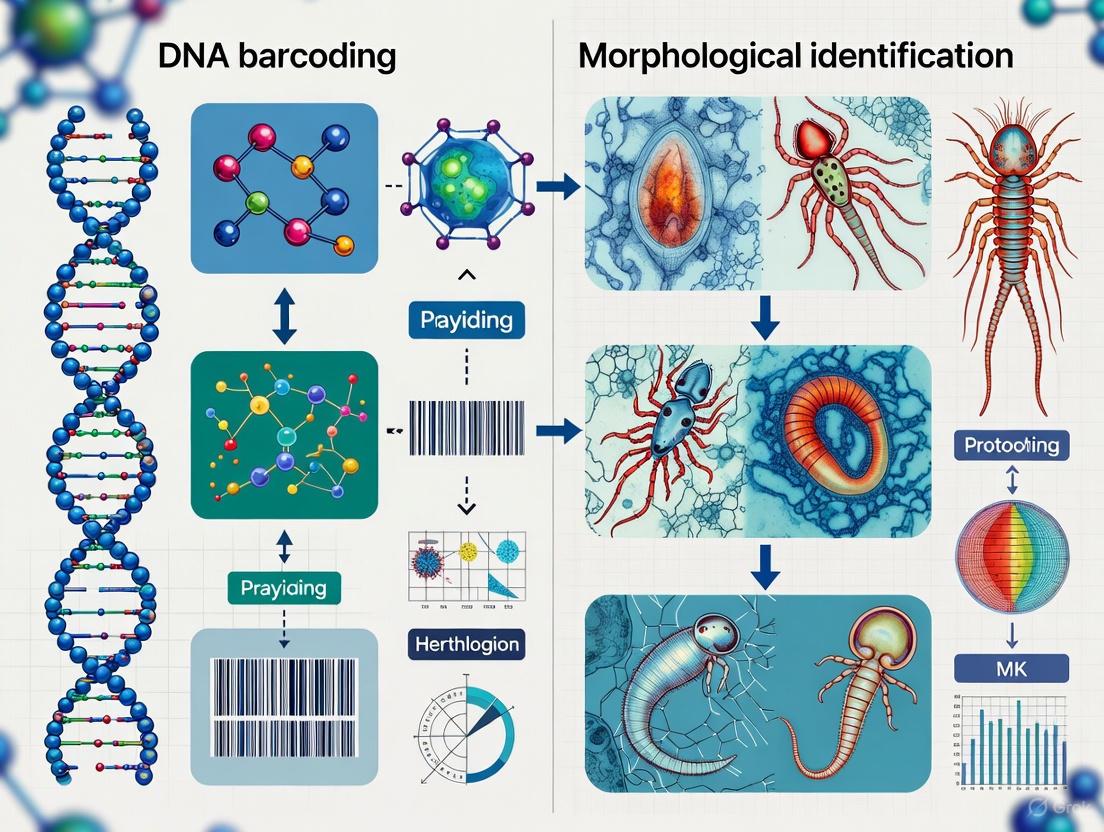
This article provides a comprehensive comparison of DNA barcoding and traditional morphological identification for parasites, tailored for researchers and drug development professionals.
DNA Barcoding vs. Morphological Analysis: A Modern Paradigm for Parasite Identification in Biomedical Research
Abstract
This article provides a comprehensive comparison of DNA barcoding and traditional morphological identification for parasites, tailored for researchers and drug development professionals. It explores the foundational principles of both methods, delves into specific methodological protocols and their applications in drug discovery and diagnostics, addresses common challenges and optimization strategies, and presents validation studies comparing their accuracy and efficiency. The synthesis aims to guide the selection and integration of these techniques to enhance precision in parasite research and therapeutic development.
The Building Blocks of Identification: Unpacking Morphological and DNA Barcoding Principles
Core Principles of Traditional Morphological Parasite Identification
For centuries, the identification of parasites through morphological examination has served as the cornerstone of parasitological diagnosis and research. This approach relies on the visual interpretation of parasite characteristics—including size, shape, internal structures, and staining properties—to differentiate species and determine infections. Despite the emergence of sophisticated molecular techniques like DNA barcoding, morphological identification remains fundamentally important in both clinical and research settings, particularly in resource-limited areas where it continues to provide a cost-effective and immediate diagnostic solution [1] [2]. The enduring relevance of morphological analysis is evidenced by its designation as the "gold standard" for numerous parasitic infections, such as malaria diagnosis via blood film examination, where it enables not only species identification but also the determination of parasite density crucial for clinical management [1].
The core premise of morphological identification rests on the consistent and discernible physical characteristics exhibited by different parasite species across their various life cycle stages. When performed by experienced diagnosticians, this method provides a reliable means of identification that requires minimal equipment compared to molecular techniques. However, the method is not without limitations, including its dependence on specimen quality, observer expertise, and the inherent challenges in distinguishing morphologically similar species or detecting low-level infections [1] [3]. This article examines the core principles, techniques, and applications of traditional morphological parasite identification, providing a comparative framework against which emerging molecular methods can be evaluated.
Fundamental Principles and Diagnostic Approaches
Core Morphological Concepts in Parasite Identification
Morphological identification of parasites is governed by several foundational principles that guide diagnosticians in accurate specimen interpretation. The first principle centers on life cycle stage recognition, as many parasites display markedly different morphological characteristics across their developmental stages. For intestinal protozoa, this typically involves distinguishing between the actively replicating but fragile trophozoite stage and the environmentally resistant, infectious cyst stage [4]. In helminths, identification may involve recognizing eggs, larvae, or adult forms, each with distinct morphological features.
The second principle involves the systematic observation of key diagnostic structures. For amoeboid parasites, critical features include nuclear characteristics (peripheral chromatin distribution and karyosomal chromatin appearance), cytoplasmic inclusions (presence of red blood cells, bacteria, or yeast), and overall size and motility patterns [4]. For flagellates, diagnosticians examine structures such as flagella number and insertion, undulating membranes, and adhesive discs. These characteristics remain consistent within species but vary sufficiently between species to allow differentiation when examined by trained personnel.
A third principle involves understanding staining affinities and optical properties of parasitic structures. Different components of parasites interact distinctively with various stains, providing critical diagnostic information. Chromatin structures typically stain deeply with basic dyes, while cytoplasmic elements may show variable affinity. The use of temporary stains like iodine helps visualize glycogen vacuoles and nuclear structures in cysts, while permanent stains provide detailed morphological information about internal structures [5] [4]. Refractivity—how light passes through parasitic structures—also provides important clues, particularly in unstained wet preparations where the presence of chromatoid bodies with characteristic shapes (elongated with rounded ends in Entamoeba histolytica versus splinter-like with pointed ends in Entamoeba coli) can aid identification [5] [4].
Essential Staining Techniques and Their Applications
Staining techniques enhance the visibility of key morphological features and are categorized based on their permanence and application. The table below summarizes the primary staining methods used in parasitology and their diagnostic utility:
Table 1: Staining Techniques for Morphological Parasite Identification
| Stain Category | Specific Types | Primary Applications | Key Diagnostic Features Enhanced |
|---|---|---|---|
| Temporary Stains | Iodine, Buffered Methylene Blue, Neutral Red | Rapid examination of wet mounts | Glycogen vacuoles, nuclear structure, flagella, inclusion bodies |
| Permanent Stains | Trichrome, Iron Hematoxylin, Giemsa | Detailed morphological study, specimen preservation | Nuclear detail, cytoplasmic inclusions, intracellular structures |
| Specialized Stains | Acid-fast stains, Chromotrope-based stains | Specific parasite groups | Oocyst walls of coccidia, microsporidial spores, Cryptosporidium |
Iodine-based temporary stains are particularly valuable for demonstrating glycogen masses in cysts and revealing nuclear number and structure, which are critical for differentiating species like Entamoeba histolytica and Entamoeba coli [4]. Permanent staining methods, such as Trichrome and Iron Hematoxylin, provide exceptional detail of internal structures, allowing for definitive species identification based on nuclear characteristics and cytoplasmic inclusions [3] [4]. Specialized stains like the acid-fast method are essential for detecting particularly challenging organisms such as Cryptosporidium oocysts, which might otherwise be missed in routine examinations [4].
The mechanisms through which these stains interact with parasite structures involve complex physicochemical processes that are incompletely understood [5]. What is empirically established is that different staining protocols aim to maximize contrast between parasitic elements and background fecal material, a process described as differentiating "background from foreground" in the fecal smear [5]. This contrast enhancement facilitates the recognition of diagnostic features that might otherwise be obscured in unstained preparations.
Standardized Morphological Identification Workflows
The accurate morphological identification of parasites follows systematic procedures that vary depending on specimen type and suspected parasites. The workflow below illustrates the general process for stool specimen examination, one of the most common applications of morphological parasitology:
Specimen Processing and Examination Procedures
The diagnostic process begins with proper specimen collection and handling, as the integrity of parasitic structures is highly dependent on timely and appropriate preservation [3]. Fresh specimens are preferred for observing motility in trophozoites, while preserved specimens are adequate for cyst identification and concentration procedures. Gross examination of specimens provides initial clues about potential parasitic infections; for example, the presence of blood or mucus suggests possible invasive pathogens like Entamoeba histolytica or Balantidium coli [3].
The direct wet mount represents the most rapid diagnostic approach, allowing immediate assessment of specimen adequacy and potential detection of motile trophozoites. Saline preparations preserve motility and enable observation of characteristic movement patterns—the directional, progressive motility with hyaline pseudopods in Entamoeba histolytica versus the sluggish, non-progressive motility with blunt pseudopods in Entamoeba coli [4]. Iodine wet mounts highlight nuclear features and glycogen masses in cysts, providing critical diagnostic information.
Concentration techniques (such as formalin-ethyl acetate sedimentation or zinc sulfate flotation) increase diagnostic sensitivity by concentrating parasitic forms from larger stool volumes [3]. These procedures are particularly valuable for detecting low-intensity infections where organisms might be too scarce to visualize in direct preparations alone. Following concentration, permanent staining creates a durable preparation that allows detailed study of morphological features under high magnification, facilitating definitive species identification based on nuclear structure, cytoplasmic characteristics, and inclusion bodies [3] [4].
Microscopy and Interpretation Guidelines
Systematic microscopic examination follows a standardized approach to ensure comprehensive specimen evaluation. Initial screening using the 10x objective allows rapid scanning of the entire preparation for detecting parasitic forms and assessing overall specimen characteristics. Subsequent examination under high-power (40x) and oil immersion (100x) objectives enables detailed morphological assessment of any suspected parasites [1] [3].
The identification process involves methodical comparison of observed structures against established morphological criteria, with particular attention to:
- Size measurements: Using micrometer calibration to determine if structures fall within species-specific ranges [4]
- Nuclear characteristics: Number, peripheral chromatin distribution, karyosomal appearance [4]
- Cytoplasmic features: Appearance (finely versus coarsely granular), presence of inclusions (red blood cells, bacteria, yeast) [4]
- Specialized structures: Flagella, undulating membranes, chromatoid bodies, glycogen vacuoles [4]
For blood parasites like malaria, examination of both thick and thin blood films follows similar principles—thick films for sensitive parasite detection and thin films for detailed morphological study and species identification based on staining characteristics, parasite stages, and infected red cell morphology [1]. The entire process requires considerable technical expertise, as morphological identification is classified as a high-complexity procedure under clinical laboratory regulations [3].
Essential Research Reagents and Materials
Successful morphological identification depends on properly equipped laboratory facilities and specific reagent systems. The following table details essential materials required for comprehensive parasitological examination:
Table 2: Essential Research Reagents and Materials for Morphological Identification
| Category | Specific Items | Primary Function | Application Notes |
|---|---|---|---|
| Collection & Preservation | Formalin, PVA, SAF vials | Preserve morphological integrity | Choice affects available testing options |
| Staining Reagents | Iodine, Trichrome, Giemsa, Acid-fast stains | Enhance structural visualization | Staining protocols require quality control |
| Microscopy Supplies | Microscope with oil immersion, Slides, Coverslips | Specimen examination | 100x oil immersion objective essential |
| Concentration Materials | Formalin-ethyl acetate, Centrifuge, Filters | Concentrate scarce organisms | Increases diagnostic sensitivity |
| Reference Materials | Morphological atlases, Digital image libraries | Comparative identification | Essential for accurate species differentiation |
The selection of preservation methods significantly impacts subsequent morphological analyses. Polyvinyl alcohol (PVA) preservation is preferred for protozoa as it simultaneously fixes specimens and provides appropriate consistency for staining, while formalin-based preservatives are adequate for helminth eggs and larvae [3]. Staining systems must be properly quality-controlled, as aging stains or improper pH can diminish morphological detail; for example, trichrome stain must maintain proper pH to effectively differentiate nuclear and cytoplasmic structures [3].
Microscopy equipment represents the most significant capital investment for morphological identification, requiring high-quality light microscopes with 100x oil immersion objectives capable of resolving fine nuclear details [1] [3]. For malaria diagnosis, examination of 200-300 oil immersion fields may be necessary before declaring a specimen negative, particularly in low-parasitemia infections or cases with partial chemoprophylaxis [1]. Reference collections of well-characterized specimens and digital image libraries provide crucial comparative material for accurate identification, helping mitigate the interpretive subjectivity inherent in morphological analysis [5].
Performance Assessment and Comparative Data
When evaluated against molecular reference methods, morphological identification demonstrates variable performance characteristics depending on parasite group, specimen quality, and examiner expertise. The following table summarizes comparative performance data across different parasite categories:
Table 3: Performance Metrics of Morphological Identification
| Parasite Category | Sensitivity Range | Key Advantages | Major Limitations |
|---|---|---|---|
| Intestinal Protozoa | ~51-95% (varies by species) | Cost-effective, provides immediate results | Requires multiple specimens, expertise-dependent |
| Blood Parasites (Malaria) | ~50-100 parasites/μL (detection limit) | Quantification possible, species differentiation | Sensitivity decreases with low parasitemia |
| Helminth Eggs | ~85-95% (with concentration) | Simple equipment needs, high specificity | Irregular egg shedding affects sensitivity |
| Microsporidia | ~30-50% (with special stains) | Detects unexpected pathogens | Requires specialized staining, low sensitivity |
For intestinal protozoa, performance varies substantially based on parasite load, with markedly reduced sensitivity in chronic or low-intensity infections [3]. Concentration techniques improve detection for many helminth eggs and protozoan cysts, but may be less effective for fragile trophozoites which are better detected in permanent stained smears [3]. In malaria diagnosis, skilled microscopists can achieve detection thresholds of approximately 50-100 parasites/μL of blood, with species identification accuracy exceeding 90% in experienced hands [1].
Several factors significantly impact morphological identification performance. Specimen quality profoundly affects outcomes, with delayed processing leading to diagnostic degradation of fragile trophozoites [3]. Examiner expertise represents perhaps the most significant variable, with studies demonstrating substantial inter-technician variability, particularly for less common parasites or atypical morphological presentations [1] [3]. This expertise dependency is reflected in the classification of parasitological procedures as high-complexity tests requiring extensive training and experience [3].
Integration with Modern Diagnostic Approaches
The evolving diagnostic landscape increasingly favors integrated approaches that combine traditional morphological expertise with advanced technologies. This hybrid model leverages the respective strengths of each method while mitigating their individual limitations. The conceptual relationship between these approaches is illustrated below:
Morphological and molecular methods exhibit complementary strengths that make them particularly powerful when used in concert. Traditional morphology provides a broad, unbiased screening approach capable of detecting unexpected pathogens without prior suspicion, while DNA barcoding offers exceptional specificity for distinguishing morphologically similar species [6] [7]. This complementary relationship is especially valuable for complex taxonomic groups where morphological differentiation challenges even experienced diagnosticians, such as the Entamoeba genus or helminth larvae [6] [7].
The integration of these approaches follows several practical pathways. Morphology often serves as an initial screening tool, with molecular methods providing definitive confirmation for morphologically ambiguous cases [7]. Conversely, DNA barcoding can rapidly screen large specimen collections, with morphological examination reserved for specimens yielding unexpected genetic results or representing potential new species [6] [8]. This bidirectional validation enhances overall diagnostic accuracy while simultaneously building reference databases that bridge morphological and genetic information.
Emerging technologies promise to further enhance traditional morphological approaches. Digital imaging and artificial intelligence are being developed to reduce interpretive subjectivity in morphological analysis, with studies demonstrating 98.8-99.0% precision in automated parasite detection systems [2]. Geometric morphometrics applies statistical shape analysis to quantify subtle morphological variations that may elude visual assessment, achieving 94.0-100.0% accuracy in species discrimination [2]. These technological enhancements preserve the accessibility and cost structure of morphological methods while addressing their primary limitations related to subjective interpretation.
Traditional morphological parasite identification remains an essential component of parasitological practice, providing a cost-effective, immediately actionable diagnostic method that continues to serve as the gold standard for numerous parasitic infections. Its core principles—based on systematic observation of diagnostic morphological features enhanced by appropriate staining techniques—have demonstrated remarkable resilience despite the emergence of sophisticated molecular alternatives. The future of morphological identification lies not in competition with molecular methods, but in strategic integration with them, creating hybrid diagnostic approaches that leverage the respective strengths of each technology. For researchers and clinical laboratories, maintaining morphological expertise remains imperative, both as a practical diagnostic tool and as a fundamental discipline that provides crucial context for interpreting molecular data. As technological advancements like digital imaging and artificial intelligence continue to evolve, they promise to enhance the precision and objectivity of morphological analysis while preserving its essential character as a direct observational science.
The accurate identification of species is a cornerstone of biological research, with profound implications for biodiversity conservation, pharmaceutical discovery, and ecosystem monitoring. For centuries, morphological identification—the visual analysis of physical characteristics—served as the primary method for species classification. However, this approach faces significant challenges, including phenotypic plasticity, the need for highly specialized taxonomic expertise, and difficulties in identifying larval, embryonic, or fragmentary specimens [6]. In response to these limitations, DNA barcoding has emerged as a powerful molecular tool that uses standardized short genetic sequences to discriminate between species, revolutionizing the field of taxonomic identification [9].
This paradigm shift is particularly relevant in pharmaceutical and bioprospecting contexts, where the accurate identification of source organisms is critical. For instance, plants in the genus Syringa are valued not only for their ornamental qualities but also as sources of diverse chemical constituents used in medical and cosmetic applications. The chemical composition varies significantly among different Syringa species, creating a pressing need for precise identification methods to prevent adulteration in raw material procurement for traditional medicines [9]. This guide provides a comprehensive comparison of DNA barcoding and morphological identification methods, examining their respective performance characteristics, experimental protocols, and applications in research and drug development.
Principles and Genetic Architecture of DNA Barcoding
Core Genetic Markers for Taxonomic Groups
DNA barcoding relies on standardized genetic markers that provide sufficient sequence variation to distinguish between species while being conserved enough for universal amplification. These markers differ across major taxonomic groups, with researchers selecting appropriate gene regions based on the target organisms.
Table 1: Standard DNA Barcode Regions for Major Organism Groups
| Organism Group | Primary Barcode Markers | Additional/Complementary Markers |
|---|---|---|
| Animals | Cytochrome c Oxidase I (COI) [10] [6] | Cytochrome b (cyt b), 18S ribosomal RNA [11] |
| Plants | ITS2, matK, rbcL [9] | psbA-trnH, trnL-trnF, trnL intron [9] |
| Plants (Chloroplast) | rbcL, matK [9] | psbA-trnH, trnL-trnF, trnC-petN [9] |
The COI gene has become the universal standard for animal identification due to its high mutation rate, which provides sufficient interspecific variability while maintaining minimal intraspecific variation. In plants, the selection of barcode markers is more complex due to slower evolutionary rates in chloroplast genomes, often necessitating multi-locus approaches combining nuclear and chloroplast regions for reliable discrimination [9]. For example, in Syringa species identification, the combination of ITS2 + psbA-trnH + trnL-trnF achieved an identification rate of 93.6%, significantly outperforming single-marker approaches [9].
Workflow and Mechanism of Action
The DNA barcoding process follows a standardized workflow from sample collection to species identification, with quality control measures at each stage to ensure reliability. The following diagram illustrates this integrated process:
Diagram 1: DNA Barcoding Workflow (47 characters)
The fundamental principle underlying DNA barcoding is the "barcoding gap"—the phenomenon where genetic differences between species exceed variation within species. This divergence creates distinct genetic clusters that computational algorithms can identify, enabling species-level discrimination. The Barcode of Life Data System (BOLD) serves as the primary repository and analysis platform, employing the Barcode Index Number (BIN) system to assign operational taxonomic units that typically correspond to biological species [10].
Performance Comparison: DNA Barcoding vs. Morphological Identification
Quantitative Performance Metrics
Direct comparative studies reveal significant differences in the performance characteristics of DNA barcoding and morphological identification across multiple metrics.
Table 2: Performance Comparison of Identification Methods
| Performance Metric | DNA Barcoding | Morphological Identification |
|---|---|---|
| Species-Level Identification Rate | 93.6% for Syringa with combined markers [9] | Highly variable; as low as 13.5% for larval fish by expert taxonomists [6] |
| Genus-Level Identification Rate | 96.6% for larval fish [6] | 41.1% for larval fish across five laboratories [6] |
| Family-Level Identification Rate | 96.6% for larval fish [6] | 80.1% for larval fish across five laboratories [6] |
| Capability with Damaged Specimens | Effective identification of 35 out of 37 damaged larval fish [6] | 0% identification rate for damaged specimens [6] |
| Embryo/Larval Identification | Successful identification of 103 fish embryos [6] | Not possible due to lack of morphological features [6] |
| Cost Efficiency | More cost-effective for large-scale monitoring [6] [12] | Requires highly trained specialists, increasing costs [6] |
The data demonstrate DNA barcoding's particular advantage in challenging identification scenarios, including larval stages, damaged specimens, and closely related species where morphological characters are limited or convergent. In one study of larval fish identification, the consistency between five morphological taxonomy laboratories was only 13.5% at the species level, compared to 96.6% genus-level and family-level consistency with DNA barcoding [6].
Despite its advantages, DNA barcoding faces several technical and practical challenges that researchers must consider in experimental design:
Database-Dependent Accuracy: The identification reliability is directly proportional to reference database completeness and quality. In one empirical test, more than half of butterfly species encountered problems in obtaining correct scientific names due to errors in the BOLD database [10].
Resolution Limitations with Recent Radiations: Recently diverged species complexes, such as fish in the genus Coregonus, may show insufficient genetic differentiation in standard barcode regions, resulting in shared haplotypes between morphologically distinct species [6].
Technical Failures: PCR amplification failures affected 23 larval fish specimens (3.5% of samples) in one study, preventing barcode sequence generation despite morphological identifiability [6].
Taxonomic Ambiguity: DNA barcoding can reveal cryptic species or populations that challenge existing taxonomic frameworks, requiring integrated approaches with morphology and ecology for resolution [10].
Morphological identification maintains advantages in certain contexts, particularly for preliminary field assessments, when specialized taxonomic expertise is available, and for distinguishing species with recent divergence where genetic markers show insufficient differentiation.
Experimental Protocols for DNA Barcoding
Standard Laboratory Workflow
The following protocol outlines the core DNA barcoding procedure, with specific examples from published studies:
Sample Collection and Preservation
- Tissue Sampling: Collect 5-10mg of tissue (muscle, leaf, liver) using sterile instruments. For endangered species, non-lethal sampling (feathers, hair, buccal swabs) is recommended.
- Preservation: Store samples in 95-100% ethanol at -20°C for long-term preservation. For field collections, DNA/RNA shield stabilization solutions prevent degradation.
DNA Extraction
- Method Selection: Use CTAB protocol for plants [10] or commercial kits (DNeasy Blood & Tissue Kit) for animal tissues.
- Quality Control: Verify DNA integrity via agarose gel electrophoresis and quantify using spectrophotometry (Nanodrop) or fluorometry (Qubit).
PCR Amplification
- Primer Design: Select appropriate barcode markers for target taxa (Table 1). For example:
- Reaction Setup: 15μL reaction volume containing: 9.9μL ddH₂0, 0.3μL of each primer (10μM), 3μL ScreenMix, and 1.5μL template DNA [10]
- Thermocycling Conditions: Initial denaturation at 94°C for 3min; 35 cycles of denaturation at 94°C for 30s, annealing at 50-55°C for 30s, extension at 72°C for 45s; final extension at 72°C for 10min [10]
Sequencing and Analysis
- Sequencing Method: Sanger sequencing for single specimens; nanopore sequencing (MinION) for high-throughput in situ applications [11]
- Data Processing: Trim sequences for quality, align using MUSCLE or ClustalW, perform genetic distance calculations (K2P), and construct phylogenetic trees (Neighbor-Joining, Maximum Likelihood) [9]
- Database Submission: Compare sequences against BOLD and GenBank using BLAST, and submit high-quality barcodes to public repositories
Advanced Integrated Methodologies
For taxonomically complex groups, iterative taxonomy approaches that combine morphological and molecular methods yield the most robust identifications. This integrated methodology includes:
Initial Morphological Assessment: Document diagnostic characters (e.g., leaf shape and base, inflorescence structure for plants; meristic counts for fish) [9] [13]
Multi-Locus Barcoding: Combine complementary markers to increase resolution, such as:
Phylogenetic Analysis: Construct trees with reference sequences to validate monophyly of putative species groups
Morphological Re-evaluation: Re-examine specimens in light of molecular results to identify previously overlooked diagnostic characters
This integrated approach significantly enhances identification rates. In a study of marine gastropods, combining all genetic markers improved species-level identification to 79% compared to 62% with COI alone, while also enabling the correlation of molecular groups with morphological synapomorphies [13].
Essential Research Reagent Solutions
Successful DNA barcoding requires specific laboratory reagents and materials optimized for different sample types and experimental conditions.
Table 3: Essential Research Reagents for DNA Barcoding
| Reagent/Material | Function | Application Notes |
|---|---|---|
| CTAB Extraction Buffer | DNA extraction from polysaccharide-rich tissues | Essential for plants and fungi; contains CTAB, NaCl, EDTA, Tris-HCl, β-mercaptoethanol [10] |
| Proteinase K | Protein digestion during DNA extraction | Improves yield from animal tissues; standard concentration 100μg/mL |
| ScreenMix | PCR amplification | Pre-mixed master mix containing polymerase, dNTPs, buffer; enables standardized amplification [10] |
| LEP Primers | COI amplification | F1 (5′-ATTCAACCAATCATAAAGATAT-3′) and R1 (5′-TAAACTTTCTGGATGTCCAAAAA-3′) for Lepidoptera and other arthropods [10] |
| ITS2 Primers | Nuclear marker amplification | Plant-specific primers for the ITS2 region; universal primers require taxon-specific optimization [9] |
| Agarose | Gel electrophoresis | Quality assessment of DNA extracts and PCR products; standard 1-2% gels with ethidium bromide or SYBR Safe |
| Ethanol (95-100%) | Sample preservation and DNA precipitation | Critical for field collections; prevents DNA degradation [11] |
| Nanopore Flow Cells | Portable sequencing | R9.4.1 or newer chemistry for field barcoding; enables in situ sequencing [11] |
The selection of appropriate reagents directly impacts success rates, particularly for challenging samples such as historical museum specimens, environmental samples, or preservative-exposed tissues. For example, the CTAB (cetyltrimethylammonium bromide) method is particularly effective for plant tissues high in polysaccharides and secondary metabolites that can inhibit PCR amplification [10].
Technological Innovations and Future Directions
Portable and Decentralized Technologies
Recent advances have democratized DNA barcoding through the development of portable, field-deployable technologies that enable in situ species identification:
Miniaturized Sequencing: Oxford Nanopore's MinION sequencer (smartphone-sized) permits real-time barcoding in remote locations, as demonstrated in the Peruvian Amazon where researchers generated 1,858 barcodes for vertebrates and plants entirely in situ [11]
Portable PCR Equipment: Battery-powered thermal cyclers and mini centrifuges facilitate complete molecular workflows outside traditional laboratories [11]
Citizen Science Integration: Simplified DNA barcoding protocols allow public participation in biodiversity monitoring, engaging community members in sample collection, DNA extraction, and PCR amplification [14]
These innovations are particularly valuable for reducing the geographic bias in genetic databases. Currently, the BOLD database contains only 0.52% of records from Peru despite its status as a megadiverse country, highlighting the need for decentralized sequencing capacity in biodiversity hotspots [11].
Bioinformatics and Data Integration
The growing volume of barcode data necessitates advanced computational approaches for effective analysis and interpretation:
Massive Parallel Barcoding (Megabarcoding): High-throughput approaches for soil macrofauna monitoring successfully identified 1,124 out of 1,283 previously unidentifiable individuals at competitive costs [12]
Morphological Profiling Integration: Automated image analysis and machine learning algorithms can correlate morphological features with molecular data, creating comprehensive bioactivity profiles for drug discovery applications [15]
Database Curation Improvements: Enhanced error detection algorithms and collaborative curation platforms address the high rates of misidentification (30% species-level, 26% generic errors) found in some reference databases [10]
The integration of DNA barcoding with other data streams creates powerful frameworks for biodiversity assessment and pharmaceutical discovery. For example, morphological profiling of small molecules generates bioactivity profiles that can be correlated with genetic barcodes of source organisms, enabling target prediction and mode-of-action analysis for novel compounds [15].
DNA barcoding represents a transformative methodology in species identification, offering significant advantages in accuracy, efficiency, and application range compared to traditional morphological approaches. The experimental data presented in this guide demonstrate that multi-locus barcoding strategies achieve superior discrimination rates (93.6% for Syringa) compared to single-marker approaches or morphological identification alone [9]. However, the most robust taxonomic frameworks emerge from integrative approaches that combine molecular data with morphological, ecological, and geographic information.
For research and drug development professionals, DNA barcoding provides an indispensable tool for quality control in natural product sourcing, identification of novel bioactive organisms, and monitoring of environmental impacts. The ongoing development of portable sequencing technologies and expanded reference databases will further enhance applications in field research and conservation. As the technology continues to evolve, DNA barcoding is poised to become an increasingly accessible and standardize method for species discrimination across diverse scientific disciplines.
The DNA barcoding gap represents a critical concept in molecular taxonomy, postulating that the genetic variation between species (interspecific) exceeds the variation within a species (intraspecific). This guide provides a comparative analysis of DNA barcoding performance against traditional morphological identification, focusing on applications in parasite research and drug development. We synthesize experimental data from diverse taxonomic groups, evaluate methodological protocols, and assess the reliability of barcoding gap application across different genetic markers and organismal types. The findings demonstrate that while barcoding offers substantial advantages for cryptic species identification and standardized diagnostics, its efficacy is contingent upon marker selection, taxonomic group, and reference database completeness.
Theoretical Foundation of the Barcoding Gap
The barcoding gap is formally defined as the separation between the distribution of intraspecific pairwise genetic distances and interspecific distances among related taxa using a standardized molecular marker [16] [17]. This concept provides the theoretical foundation for DNA-based species identification, proposing that a "gap" exists where genetic divergence between species exceeds variation within species, creating distinct boundaries for taxonomic classification [18].
The conceptual relationship between genetic distance and species delineation can be visualized as follows:
For optimal species discrimination, barcode markers must satisfy specific criteria: contain low intraspecific variation while maintaining high interspecific divergence, possess conserved flanking regions for universal primer design, and be short enough for practical amplification and sequencing [18]. Different taxonomic groups require specific molecular markers, as no single gene region works universally across all life forms:
- Animals: Cytochrome c oxidase I (COI) is the predominant marker [19] [17] [18]
- Plants: Combinations of matK, rbcL, trnH, and ITS regions [18]
- Fungi: Internal transcribed spacer (ITS) regions, with noted variability between ITS1 and ITS2 [16]
- Parasitic Protozoa: Multi-locus approaches using metabolic network models [20]
The practical manifestation of the barcoding gap varies significantly across taxonomic groups. In spiders, COI barcodes effectively identified species across geographical scales regardless of morphological diagnosability [17]. Conversely, fungal studies revealed substantial variation in barcode gap size between ITS1 and ITS2 regions, with ITS2 demonstrating larger gaps due to lower intraspecific variance [16].
Performance Comparison: DNA Barcoding vs. Morphological Identification
Quantitative Comparison Across Taxonomic Groups
Table 1: Method Performance Across Organismal Groups
| Organism Group | Identification Method | Species Identified | Identification Rate | Key Findings | Reference |
|---|---|---|---|---|---|
| Nematodes | Morphological | 22 species | 100% (baseline) | Traditional microscopy | [21] |
| Nematodes | Single-specimen barcoding (28S) | 20 OTUs* | 90.9% | Comparable to morphology | [21] |
| Nematodes | Metabarcoding (28S) | 48 OTUs, 17 ASVs | Higher OTU count | Overestimation potential | [21] |
| Mosquitoes | Morphological | 45 species | 100% (baseline) | Gold standard | [19] |
| Mosquitoes | COI barcoding | 45 species | 100% | Perfect concordance | [19] |
| Forest Soil Macrofauna | Morphological | 130/1413 individuals | 9.2% | Limited expertise | [12] |
| Forest Soil Macrofauna | Megabarcoding | 1124 additional individuals | 79.5% | Massive improvement | [12] |
| Host-Parasitoid Systems | Morphological | Baseline | Varies | Cryptic species missed | [22] |
| Host-Parasitoid Systems | DNA barcoding | Higher diversity | >39.4% | Revealed cryptic diversity | [22] |
OTU: Operational Taxonomic Unit; *ASV: Amplicon Sequence Variant*
Methodological Advantages and Limitations
Table 2: Method Comparison for Parasite Research
| Parameter | Morphological Identification | DNA Barcoding | Metabarcoding |
|---|---|---|---|
| Species Resolution | Limited for cryptic species, larvae, damaged specimens [19] | High for most species, reveals cryptic diversity [22] | Variable, depends on reference database [21] |
| Expertise Requirement | High (taxonomic specialists) [21] | Moderate (molecular biology) | Bioinformatics intensive |
| Processing Time | Slow (individual handling) | Moderate (batch processing) | Fast (high-throughput) |
| Cost per Sample | Low (microscopy) | Moderate (reagents, sequencing) | Low for large batches |
| Quantification Ability | Good (direct counting) | Limited (presence/absence) | Biased (PCR amplification) [21] |
| Reference Database | Taxonomic keys, literature | BOLD, GenBank (growing) [18] | Specialized curated databases |
| Ideal Application | Well-characterized taxa, intact specimens | Cryptic species, larvae, damaged samples [19] | Biodiversity surveys, bulk samples [12] |
Experimental Protocols for Barcoding Gap Analysis
Standard DNA Barcoding Workflow
The general workflow for DNA barcoding analysis involves sequential steps from sample collection to data interpretation:
Key Methodological Considerations
Sample Collection and Preservation: Collection strategy depends on target organisms. For parasite studies, this may involve host dissection, fecal sampling, or environmental collection. Proper preservation is crucial to prevent DNA degradation – options include silica gel desiccation, ethanol preservation, or freezing at -80°C [18]. For mosquito identification studies, legs were removed carefully to preserve voucher specimens while obtaining sufficient DNA material [19].
DNA Extraction Protocols: The choice of extraction method significantly impacts DNA yield and quality. The cetyltrimethylammonium bromide (CTAB) method is particularly effective for plant and fungal material containing polysaccharides and polyphenols [23]. Commercial silica column-based kits provide consistent results for animal tissues. For processed materials or complex samples, pre-washing with Sorbitol Washing Buffer can improve DNA quality by removing PCR inhibitors [23].
Marker Amplification and Sequencing:
- COI for animals: Primers LCO1490 and HCO2198 amplify ~658 bp region [19] [18]
- ITS for fungi: ITS1-F and ITS4 primers target the full ITS region [16]
- Multi-locus for plants: Combinations of rbcL, matK, and ITS provide sufficient resolution [23] [18]
Thermocycling conditions typically involve initial denaturation (94-95°C for 2-5 minutes), 35-40 cycles of denaturation (94°C for 30-45s), annealing (45-55°C for 45-60s), and extension (72°C for 45-60s), with final extension (72°C for 5-10 minutes) [19].
Barcoding Gap Analysis: Genetic distances are calculated using models like Kimura-2-Parameter (K2P). Intra- and interspecific distances are compared through pairwise distance calculations. The barcode gap is visualized by plotting intraspecific distances against interspecific distances for each species [16] [17]. Statistical validation may involve randomization tests to confirm significant separation between distance distributions [17].
Essential Research Reagent Solutions
Table 3: Key Reagents and Materials for Barcoding Research
| Reagent/Material | Function | Application Notes |
|---|---|---|
| DNA Extraction Kits (DNeasy Blood & Tissue Kit) | Nucleic acid purification | Consistent yield for animal tissues [19] |
| CTAB Extraction Buffer | Plant/fungal DNA isolation | Effective for polysaccharide-rich samples [23] |
| Proteinase K | Protein digestion | Enhances DNA release during extraction |
| Universal PCR Primers (LCO1490/HCO2198) | COI amplification | Standard for metazoan barcoding [19] |
| ITS Primers (ITS1-F/ITS4) | Fungal barcode amplification | Targets ITS region with broad taxonomic coverage [16] |
| PCR Master Mix | DNA amplification | Provides reaction components, magnesium optimization critical |
| Agarose Gels | Amplicon verification | Quality control pre-sequencing |
| Sanger Sequencing Reagents | DNA sequencing | Standard for single-specimen barcoding |
| NGS Library Prep Kits | Metabarcoding studies | Essential for high-throughput applications [21] [12] |
| Reference Databases (BOLD, GenBank) | Species identification | Taxonomic assignment of sequences [18] |
Discussion and Research Implications
The barcoding gap remains a powerful but nuanced concept in taxonomic research. Studies consistently demonstrate that DNA barcoding complements rather than replaces morphological identification, addressing specific limitations of traditional taxonomy while introducing new considerations for data interpretation.
In parasite research, molecular approaches enable identification of cryptic species and life stages that challenge morphological diagnosis. For protozoan parasites like Plasmodium, Toxoplasma, and Cryptosporidium, molecular tools facilitate comparative analyses across species boundaries, aiding drug target identification despite experimental challenges with unculturable species [20]. Metabolic network models (ParaDIGM) provide frameworks for comparing biochemical capabilities across parasite species, enhancing extrapolation from model organisms to clinically relevant pathogens [20].
The reliability of barcoding gap application varies taxonomically. Spider studies demonstrated effective species identification across geographical scales using COI barcodes [17], while fungal research revealed significant variation in barcode gap size between ITS1 and ITS2 regions, with implications for primer selection and taxonomic splitting practices [16]. These findings emphasize that a universal threshold for species delimitation remains elusive, necessitating taxon-specific validation.
Future methodological developments should focus on reference database expansion, standardization of multi-locus approaches for challenging taxa, and integration of morphological and molecular data within unified taxonomic frameworks. For drug development professionals and parasitologists, DNA barcoding offers robust species identification that strengthens epidemiological studies, therapeutic target validation, and biodiversity monitoring in changing ecosystems.
The accurate identification of parasites is a cornerstone of ecological, medical, and veterinary research. For decades, scientists relied primarily on morphological taxonomy, using microscopic examination of physical characteristics to distinguish species. However, this approach presents significant challenges, particularly for parasites like chironomid larvae, where high phenotypic plasticity, the existence of cryptic species, and the need for access to complete, identified individuals for comparison can make species-level identification difficult or even impossible [7]. This limitation can hinder the accurate assessment of biodiversity and the understanding of parasite life cycles.
The advent of DNA barcoding has provided a powerful alternative or complementary tool. This technique uses the sequence of a short, standardized genetic fragment as a unique identifier for a species. DNA barcoding not only allows for the identification of sister species but also facilitates the discovery of new, previously unknown ones [7]. To maximize accuracy and efficiency, the scientific community has converged on a suite of standard genetic markers for different kingdoms of life. This guide provides a comparative analysis of these standard markers—COI for animals, ITS for fungi, and chloroplast genes for plants—framed within the ongoing discussion of DNA barcoding versus traditional morphological identification.
Standardized Genetic Markers Across Kingdoms
The selection of a genetic marker for barcoding is based on several criteria: the presence of sufficiently conserved regions for primer design, interspecific variation (divergence between species) to distinguish them, and intraspecific conservation (similarity within a species) to group individuals correctly. The table below summarizes the key markers for animals, fungi, and plants.
Table 1: Standard DNA Barcode Markers for Major Organism Groups
| Organism Group | Primary Marker | Marker Full Name | Key Characteristics | Examples of Use in Research |
|---|---|---|---|---|
| Animals | COI | Cytochrome c Oxidase subunit I | A mitochondrial gene; provides strong species-level discrimination across most animal phyla. | The universal animal barcode; used in broad biodiversity surveys. |
| Fungi | ITS | Internal Transcribed Spacer | A non-coding region between ribosomal RNA genes; possesses a high degree of sequence variation. | Identification of phytopathogenic fungi; fungal metagenomics studies on fruits and vegetables [24]. |
| Plants | Chloroplast Genes | Ribulose-1,5-bisphosphate carboxylase/oxygenase large subunit (rbcL), Maturase K (matK) | Uniparentally inherited, structurally conserved genome with a combination of slow- and fast-evolving genes. | Core plant barcode; often used together for better resolution [25]. |
| Plants | Chloroplast Intergenic Spacers | trnH-psbA | A non-coding spacer region; often highly variable and useful for distinguishing closely related species. | Supplement to the core barcodes; provides higher resolution in specific genera [25]. |
The Hybrid Approach: Integrating Molecular and Morphological Data
While DNA barcoding is powerful, molecular techniques have limitations, including the lack of a complete barcode library for all taxa and the need for access to properly purified genetic material [7]. Consequently, the most robust methodological solution is a hybrid approach that integrates molecular data with elementary ecological knowledge and morphological identification. This synergy allows for the validation of molecular findings with physical evidence and helps interpret the ecological significance of the results, providing a fundamental tool for accurately assessing parasite communities and biodiversity [7].
Graphviz diagram illustrating the workflow for the integrated morphological and DNA barcoding identification method:
Workflow for Integrated Species Identification
Experimental Protocols and Data
Detailed Methodology for DNA Barcode Analysis
The following protocols are synthesized from standard methodologies used in recent genomic studies, particularly those involving plant chloroplast genomes and microbial sequencing [26] [25] [27].
Protocol 1: DNA Extraction, Sequencing, and Assembly for Chloroplast Genomes
Plant Material and DNA Extraction:
Library Preparation and Sequencing:
- Construct a shotgun library with an average insert size (e.g., 250-400 bp) following the manufacturer's guidelines [26] [25].
- Sequence the library on a next-generation sequencing (NGS) platform such as the Illumina Novaseq 6000 or X Ten Platform using a paired-end sequencing strategy (e.g., 150 bp reads) [26] [25].
Genome Assembly and Annotation:
- Trim raw reads for quality using tools like Skewer to remove low-quality bases and adapters [25].
- Assemble the chloroplast genome using a dedicated organelle assembler like GetOrganelle or by referencing a closely related species' genome [26] [25].
- Annotate the assembled genome using software such as CpGAVAS or Geneious Prime by aligning with a reference genome, manually adjusting start and stop codons [26] [25].
Protocol 2: Identification of Hypervariable Regions and Phylogenetic Analysis
Sequence Comparison and Divergence Hotspot Identification:
- Align multiple chloroplast genome sequences using MAFFT v7 [26].
- Analyze the aligned sequences for nucleotide variability using DnaSP software. Calculate Pi (nucleotide diversity) values using a sliding window approach (e.g., 200 bp step size, 800 bp window length) [26]. Genomic regions with high Pi values are considered hypervariable hotspots.
Phylogenetic Tree Construction:
- Compile a dataset of sequenced genomes, including outgroup species from related families [26].
- Select the best-fit nucleotide substitution model (e.g., K3Pu + F + R5) using ModelFinder [26].
- Construct a phylogenetic tree using the Maximum Likelihood (ML) method in IQ-tree with ultrafast bootstrap (1000 replicates) to assess branch support [26].
Quantitative Comparison of Marker Performance
Data from comparative genomic studies allows for a quantitative assessment of the characteristics of different markers, particularly for plants.
Table 2: Experimental Data from Comparative Chloroplast Genome Studies
| Study Focus | Genome Size Range | Number of Genes Annotated | Identified Hypervariable Regions | Phylogenetic Resolution |
|---|---|---|---|---|
| Ficus (8 species) [26] | 160,333 bp (F. heteromorpha) to 160,772 bp (F. curtipes) | 127 unique genes (83 protein-coding, 8 rRNA, 36 tRNA) | 8 hypervariable regions (e.g., trnS-GCU_trnG-UCC, trnT-GGU_psbD, ndhF_trnL-UAG, ycf1) |
Clarified relationships within subgenera; suggested merger of two subgenera. |
| Polygonum (4 species) [25] | 159,015 bp to 163,461 bp | 112 genes (78 protein-coding, 30 tRNA, 4 rRNA) | High variation in non-coding regions; IR region changes key for evolution. | Resolved phylogenetic tree; confirmed placement of one species in Fallopia genus. |
| Styrax (5 species) [27] | 157,817 bp to 158,015 bp | 132 genes (87 protein-coding, 37 tRNA, 8 rRNA) | Specific mutation hotspot regions involving IR expansion/contraction. | Revealed conflicts between trees from coding vs. complete genomes. |
The Scientist's Toolkit: Essential Research Reagents and Solutions
Successful DNA barcoding and genomic analysis rely on a suite of specific reagents, kits, and bioinformatics tools.
Table 3: Key Research Reagents and Solutions for Genetic Marker Studies
| Item | Function | Specific Example / Target |
|---|---|---|
| CTAB Buffer | DNA extraction from plant and fungal tissues; effective against polysaccharides and polyphenols. | Standard protocol for chloroplast genome studies [26] [25]. |
| Illumina Sequencing Platform | High-throughput sequencing to generate raw genomic data. | Novaseq 6000, X Ten Platform [26] [25]. |
| GetOrganelle / SOAPdenovo2 | Software for de novo assembly of organelle genomes from NGS data. | Used for assembling chloroplast genomes of Ficus and Polygonum [26] [25]. |
| MAFFT | Software for multiple sequence alignment of genomic data. | Aligning complete chloroplast genomes for comparison [26]. |
| MISA | Software for identifying Simple Sequence Repeats (SSRs/microsatellites). | SSR analysis in Ficus and Styrax chloroplast genomes [26] [27]. |
| IQ-tree | Software for constructing maximum likelihood phylogenetic trees. | Phylogenetic analysis of Ficus with bootstrap support [26]. |
| Specific PCR Primers | Amplifying target barcode regions (e.g., ITS, rbcL, matK, COI). | ITS for fungal identification; chloroplast gene primers for plants [24]. |
The debate between DNA barcoding and morphological identification is most productively resolved through integration. While morphological taxonomy provides essential ecological context and visual validation, DNA barcoding offers a powerful, objective tool for distinguishing cryptic species and processing large numbers of samples. The standard markers—COI for animals, ITS for fungi, and a combination of chloroplast genes like rbcL and matK for plants—each provide a robust foundation for this molecular identification. As sequencing technologies continue to advance and reference libraries expand, this hybrid approach will become increasingly indispensable for researchers, scientists, and drug development professionals working in parasitology, biodiversity, and beyond.
For researchers in parasitology, ecology, and drug development, accurate species identification is foundational to scientific progress. The traditional method of morphological identification, while essential, faces significant challenges including the need for specialized taxonomic expertise, the existence of cryptic species complexes, and the difficulty in identifying immature life stages. DNA barcoding has emerged as a powerful complementary tool, using short, standardized gene regions to facilitate species identification and discovery. The mitochondrial cytochrome c oxidase I (COI) gene serves as the primary barcode for animals, while other markers like ITS are used for fungi and a combination of plastid regions for plants [28] [29]. Two platforms form the core infrastructure for this molecular approach: The Barcode of Life Data System (BOLD) and GenBank. While both serve as massive repositories of genetic data, their architectures, curation processes, and identification performance differ substantially. Understanding these differences is crucial for researchers choosing the appropriate tool for specific applications, particularly in the context of parasite identification which informs drug and vaccine development [30].
System Architectures and Core Functions
BOLD and GenBank, while both genetic databases, were built with fundamentally different philosophies and operational goals, reflected in their data structures and curation standards.
The Barcode of Life Data System (BOLD)
BOLD is a specialized workbench and data repository specifically designed for the DNA barcoding community. Its architecture is built around the core concept of a barcode record, which persistently links a DNA sequence to its source specimen [31]. A record gains formal "BARCODE" designation only after meeting seven specific data standards, including species name, voucher specimen details with depository institution, collection record with geospatial coordinates, collector information, a COI sequence of at least 500 bp, PCR primer information, and associated trace files [31]. This rigorous linkage ensures data integrity and facilitates verification.
BOLD employs automated quality checks, including translation of COI sequences into amino acids to verify they derive from the correct gene and not nuclear pseudogenes, and screening for contaminants [31]. A key analytical feature of BOLD is the Barcode Index Number (BIN) system, which clusters sequences into molecular operational taxonomic units (mOTUs) using private algorithms, providing a registry for all animal species that often corresponds closely with known species [28]. The platform also provides a dedicated Identification Engine that compares query sequences against its curated library.
GenBank
GenBank, managed by the National Center for Biotechnology Information (NCBI), is a comprehensive, open-access sequence database that forms part of the International Nucleotide Sequence Database Collaboration (INSDC), which also includes the DNA DataBank of Japan (DDBJ) and the European Nucleotide Archive (ENA) [32]. Its mission is to be an all-inclusive repository for all publicly available DNA sequences, supporting a vast range of biological research beyond taxonomy, including genomics, molecular biology, and drug development [30] [32].
As a foundational bioinformatics resource, GenBank imposes minimal formatting requirements, leading to a more flexible but less standardized data structure compared to BOLD. Its primary tool for sequence-based identification is the Basic Local Alignment Search Tool (BLAST), which finds regions of local similarity between a query sequence and sequences in the database [32]. While extremely powerful, BLAST is a general-purpose homology search tool not exclusively optimized for species identification. The data in GenBank is subject to quality assurance checks for issues like vector contamination and correct taxonomy, but the system operates on a "self-policing" model where the community is expected to report and correct errors [30]. Notably, GenBank allows authors to request a hold on data release until publication to prevent scooping [32].
Table 1: Fundamental Architectural Differences Between BOLD and GenBank.
| Feature | BOLD Systems | GenBank |
|---|---|---|
| Primary Mission | Specialized workbench for DNA barcoding; species identification and discovery [31] | Comprehensive, public nucleotide sequence archive for all biological research [32] |
| Core Data Unit | Specimen-vouchered barcode record with required collateral data [31] | Sequence record with associated annotation and bibliography [32] |
| Data Standards | Strict, seven-element standard for "BARCODE" designation [31] | Flexible formatting to accommodate diverse data types [32] |
| Identification Engine | Dedicated BOLD Identification Engine | Basic Local Alignment Search Tool (BLAST) [32] |
| Curation Model | Automated quality checks (COI translation, contamination); project-based data ownership [31] | Centralized quality checks; community-driven error correction [30] |
Performance Comparison: Experimental Data and Analysis
Independent studies have systematically evaluated the identification accuracy of BOLD and GenBank across various taxa, providing crucial empirical data for researchers.
Large-Scale Insect Identification Accuracy
A 2023 study analyzing 1,160 COI sequences from eight insect orders in Colombia provides a direct performance comparison. The research assessed accuracy at the family, genus, and species levels by comparing the engine suggestions with taxonomic identifications made by specialists. The results are summarized in Table 2 below [33].
Table 2: Identification Accuracy of BOLD and GenBank for Insect Orders [33].
| Taxonomic Level | Overall Performance | Order-Specific Outperformer |
|---|---|---|
| Family Level | BOLD outperformed GenBank [33] | Coleoptera (BOLD higher) [33] |
| Genus Level | BOLD outperformed GenBank [33] | Coleoptera & Lepidoptera (BOLD higher); Other orders performed similarly [33] |
| Species Level | BOLD outperformed GenBank [33] | Coleoptera & Lepidoptera (BOLD higher); Other orders performed similarly [33] |
| Key Finding | For a subset of Scarabaeinae (Coleoptera), BOLD correctly identified species only when the match percentage was above 93.4% [33] |
The study concluded that BOLD exhibited "great potential" to accurately place insects into taxonomic categories and highlighted its reliability "in the absence of a large reference database for a highly diverse country" [33].
Despite the overall strong performance, DNA barcoding is not infallible. A systematic evaluation of 68,089 Hemiptera barcode sequences found that errors in public repositories "are not rare," with most being human errors such as specimen misidentification, sample confusion, and contamination [29]. A significant portion of these errors can be traced back to inappropriate practices in the DNA barcoding workflow, underscoring the need for rigorous protocols [29]. This affects both BOLD and GenBank, as data is often shared between them.
Another study on pygmy hoppers (Tetrigidae) revealed specific database limitations, noting that many records lack photographic vouchers and that the "taxonomic backbone of BOLD is out of date" [34]. This can lead to misidentifications being propagated through the system. Furthermore, while the BIN system is valuable for clustering, its algorithm is not public and the clusters can be unstable when new data is added, sometimes conflicting with clusters generated by other algorithms like ABGD and ASAP [34].
Diagram 1: Comparative workflow for species identification using BOLD and GenBank, highlighting key differences in quality control and analysis that contribute to varying identification accuracy.
Practical Applications and Research Toolkit
The choice between BOLD and GenBank, or the decision to use both, depends heavily on the specific research objectives, whether for biodiversity surveys, pathogen vector monitoring, or discovering novel bioactive compounds from organisms.
Case Studies in Applied Research
- Mosquito Surveillance: A 2024 study comparing multiplex PCR and DNA barcoding for identifying container-breeding Aedes species found that a tailored multiplex PCR protocol outperformed COI barcoding in ovitrap samples, correctly identifying 1990 out of 2271 samples compared to 1722 for barcoding [35]. Crucially, the multiplex PCR detected species mixtures in 47 samples, which Sanger sequencing-based barcoding missed. This demonstrates that while barcoding is powerful, purpose-built molecular assays can be more effective for targeted surveillance of known parasite vectors [35].
- Medicinal Plant Identification: Research on Syringa species, which contain pharmacologically active compounds, evaluated multiple DNA barcodes to combat market adulteration. The study found that a combination of three markers (ITS2 + psbA-trnH + trnL-trnF) achieved a 98.97% identification rate via BLAST, underscoring GenBank's utility for authenticating medicinal plant materials [9].
- Cryptic Diversity Discovery: Studies on insects consistently reveal that DNA barcoding can uncover cryptic species—morphologically similar but genetically distinct organisms [33] [29]. This is critical in parasitology, where cryptic species may differ in host specificity, pathogenicity, or drug susceptibility, directly impacting disease management and drug development strategies.
The Scientist's Toolkit: Essential Research Reagents and Materials
The following table details key reagents and materials essential for conducting DNA barcoding studies, based on methodologies cited in the research.
Table 3: Essential Reagents and Materials for DNA Barcoding Workflows.
| Item | Function/Description | Example Use |
|---|---|---|
| COI Primers (e.g., LCO1490/HCO2198) | Amplify the ~658 bp "barcode region" of the cytochrome c oxidase I gene via PCR [33]. | Standard barcoding for animal species, including insects and parasites [33]. |
| Alternative Genetic Markers (e.g., ITS2, psbA-trnH) | Used for barcoding non-animal taxa (ITS2 for Fungi; plastid markers for plants) [28] [9]. | Identifying fungal pathogens or medicinal plants [9] [28]. |
| High-Throughput DNA Isolation Kit | Efficient nucleic acid extraction from diverse specimen types, including tissues and whole small organisms [33]. | Processing large numbers of samples in biodiversity surveys [33]. |
| Taq DNA Polymerase & PCR Master Mix | Enzymatic amplification of the target barcode region from extracted DNA [33]. | A core step in all DNA barcoding protocols [33] [35]. |
| Sanger Sequencing Reagents | Determine the nucleotide sequence of the amplified PCR product. | Generating the barcode sequence for submission and analysis [35]. |
| Reference Database Access (BOLD, GenBank) | Platforms for sequence comparison, identification, and data storage. | The final step for identifying an unknown specimen via its barcode [33] [32]. |
Both BOLD and GenBank are indispensable tools in the modern biologist's arsenal, yet they serve complementary roles. BOLD, with its stricter data standards, specimen-centric model, and specialized identification engine, is generally more reliable and accurate for taxonomic identification, particularly in animals [33]. GenBank's strength lies in its comprehensive, all-inclusive nature and powerful BLAST tool, making it an unparalleled resource for broader genomic and bioinformatics research, including drug target identification [30].
For researchers focused on parasite identification, the choice is context-dependent. A taxonomist conducting a biodiversity survey of potential disease vectors would benefit from BOLD's curated structure and higher accuracy. A drug development researcher hunting for homologs of a potential target gene discovered in a parasite would rely on GenBank's vast genomic data. Ultimately, an integrative approach that combines morphological expertise with data from both molecular platforms, while being critically aware of the potential for errors in both, represents the most robust strategy for scientific discovery and its application in public health and medicine.
From Theory to Bench: Protocols and Cutting-Edge Applications in Biomedicine
The accurate identification of parasites and other organisms is a cornerstone of biological research, drug development, and diagnostic applications. For centuries, morphological identification was the primary method, relying on the visual assessment of physical characteristics under a microscope. While this method is still used, it requires highly specialized taxonomic expertise and often proves inadequate for damaged specimens, early life stages, or cryptic species complexes [6]. In contrast, DNA barcoding utilizes short, standardized genetic markers from an organism's genome to enable precise species identification, overcoming many of the limitations inherent in morphological approaches [36] [37].
The fundamental advantage of DNA barcoding lies in its standardization and reproducibility. Where morphological identification can be subjective—with studies showing consistency among taxonomists as low as 13.5% at the species level for larval fish—DNA barcoding provides an objective, data-driven metric for classification [6]. This is particularly critical in parasitology, where accurate identification directly impacts disease diagnosis, treatment strategies, and drug development efforts. This guide provides a comprehensive comparison of these methodologies, with a detailed, step-by-step workflow for implementing DNA barcoding in a research setting.
Performance Comparison: DNA Barcoding vs. Morphological Identification
Direct experimental comparisons reveal clear operational and performance differences between these two identification strategies.
Table 1: Experimental Performance Comparison in Species Identification
| Parameter | DNA Barcoding | Morphological Identification |
|---|---|---|
| Species-Level Accuracy | 76.9% concordance (with discrepancies due to recently diverged species) [6] | 76.9% concordance (limited for cryptic species) [6] |
| Genus-Level Accuracy | 96.6% concordance [6] | 96.6% concordance [6] |
| Damaged Specimen ID | Successful in 35 out of 37 damaged larval fish [6] | Impossible for 37 out of 37 damaged larval fish [6] |
| Embryo Identification | Successfully identified 103 embryos [6] | Unable to identify embryos due to lack of morphological features [6] |
| Technical Consistency | High objectivity; results are reproducible across labs [6] | Low objectivity; ~13.5% consistency among experts at species level [6] |
| Resolution in Problematic Genera | Limited for recently diverged groups (e.g., Coregonus) [6] | Limited for morphologically similar groups (e.g., Catostomus) [6] |
| Cost & Efficiency | More cost-effective and efficient for large-scale monitoring [6] | Less cost-effective, requires highly trained taxonomists [6] |
The data show that while both methods can achieve high taxonomic-level accuracy, DNA barcoding provides decisive advantages for non-ideal samples like embryos, larvae, or damaged specimens. Morphological identification remains a valuable tool but suffers from subjectivity and limitations when key physical characteristics are absent.
DNA Barcoding Workflow: A Step-by-Step Guide
The implementation of DNA barcoding follows a multi-stage process, from sample collection to sequence analysis. The workflow below illustrates the key steps, with detailed protocols and considerations for researchers.
Step 1: Sample Collection and Nucleic Acid Extraction
The first critical step is obtaining high-quality genetic material from the biological sample.
- Sample Collection: Samples can include tissue biopsies, whole small parasites, blood, cultured cells, or environmental samples. Fresh material is always preferred, but archived samples (e.g., FFPE tissue) can also be used, albeit with lower DNA yield and quality [38].
- Cell Lysis: The cellular structure is disrupted to create a lysate. This can be achieved through:
- Physical Methods: Grinding with a mortar and pestle (often under liquid nitrogen), bead beating, or sonication. These are essential for structured materials like tissues or plant/parasite cell walls [39].
- Chemical Methods: Using detergents (e.g., SDS) and chaotropic salts (e.g., guanidine hydrochloride) to disrupt cell membranes and denature proteins [39].
- Enzymatic Methods: Applying enzymes like proteinase K to digest proteins and lysozyme to break down bacterial cell walls [39].
- Nucleic Acid Purification: The DNA is separated from other cellular components. Silica-based purification is the most common methodology. It relies on the fact that DNA binds to silica in the presence of high-salt chaotropic conditions, allowing contaminants to be washed away before the pure DNA is eluted in a low-salt buffer [39]. The success of extraction is gauged by assessing DNA yield (quantity), purity (A260/A280 ratio ~1.8), and integrity (high molecular weight and lack of degradation) [40].
Step 2: Library Preparation for Next-Generation Sequencing (NGS)
This step fragments the purified DNA and adds platform-specific oligonucleotide adapters to make it "sequenceable."
- DNA Fragmentation: The long, extracted DNA is broken into short fragments of a defined size (typically 200-600 bp). This can be done enzymatically or via acoustic shearing [40] [38].
- Adapter Ligation: Short, synthetic DNA sequences, called adapters, are ligated to the ends of the DNA fragments. These adapters are complementary to the oligonucleotides on the sequencing flow cell and contain molecular barcodes (indices) that allow multiple samples to be pooled and sequenced together in a single run—a process known as multiplexing [40] [38].
- Library Quantification and Normalization: The final prepared library is quantified using methods like fluorometry or qPCR to ensure an optimal concentration of DNA fragments is loaded onto the sequencer, which is critical for generating high-quality data [40].
Step 3: Clonal Amplification and Sequencing
The prepared library is loaded onto an NGS platform for the sequencing reaction itself.
- Clonal Amplification: Individual DNA fragments from the library are amplified locally on the flow cell to create clusters of identical copies through a process called bridge amplification [40]. This amplification is necessary because the fluorescence from a single DNA molecule is too weak to be detected.
- Sequencing by Synthesis (SBS): The Illumina platform, the most common for DNA barcoding applications, uses SBS chemistry with fluorescently labeled, reversibly terminated nucleotides. In each cycle, a single complementary base is incorporated into the growing DNA strand, its fluorescence is imaged, and the terminator is cleaved to allow the next cycle to begin. This process is repeated for a predetermined number of cycles (e.g., 150-300) to determine the base sequence of each cluster [40] [41].
Step 4: Bioinformatic Data Analysis
The final step converts raw sequencing data into a species identification.
- Base Calling and Demultiplexing: The instrument's software translates the fluorescence images into nucleotide sequences (FASTQ files). Samples are then separated (demultiplexed) based on their unique barcodes [40].
- Processing and Analysis: This involves several sub-steps:
- Quality Filtering: Removing low-quality sequences and adapter sequences [40].
- Sequence Alignment: Assembling the short reads into a contiguous sequence or aligning them to a reference database [40].
- Variant Calling: Identifying nucleotide differences between the sample sequence and reference sequences.
- Interpretation and Identification: The final, high-quality DNA barcode sequence (e.g., the COI gene for animals) is queried against a reference database such as the International Barcode of Life (iBOL) to assign a species identity [36] [37].
Essential Research Reagent Solutions
Successful implementation of the DNA barcoding workflow depends on a suite of specialized reagents and kits.
Table 2: Key Reagents and Kits for DNA Barcoding Workflow
| Reagent / Kit Type | Primary Function | Examples & Considerations |
|---|---|---|
| Nucleic Acid Extraction Kits | Isolate DNA from various sample types. | Silica-membrane columns (e.g., Promega, Thermo Fisher); choice depends on sample type (tissue, blood, FFPE) [42] [39]. |
| DNA Polymerases | Amplify target barcode regions via PCR. | High-fidelity polymerases are critical to minimize errors during amplification prior to sequencing [40]. |
| Library Preparation Kits | Fragment DNA and attach sequencing adapters. | Illumina DNA Prep kits; include enzymes for fragmentation, end-repair, A-tailing, and ligation [40]. |
| Sequence Adapters & Barcodes | Unique identification of multiplexed samples. | Illumina CD Indexes; dual indexing is recommended to index both ends of a fragment, reducing sample cross-talk [40] [38]. |
| Quality Control Assays | Assess DNA and library quantity/quality. | Fluorometric assays (Qubit dsDNA HS Assay) for accurate quantification; gel electrophoresis for size confirmation [40]. |
The comparative data and detailed workflow presented in this guide demonstrate that DNA barcoding offers a powerful, standardized, and highly reliable alternative to traditional morphological identification. Its ability to identify damaged specimens, early developmental stages, and resolve taxonomically challenging groups makes it an indispensable tool for modern researchers and drug development professionals. While morphology retains its value for initial specimen sorting and field studies, the integration of DNA barcoding into research pipelines ensures a higher degree of accuracy, reproducibility, and efficiency, ultimately accelerating scientific discovery and diagnostic precision.
The accurate identification of parasites is a cornerstone of medical diagnostics, epidemiological surveillance, and biological research. For centuries, scientific discovery has relied on morphological taxonomy, which identifies species based on physical characteristics observable under a microscope. While this method provides the foundational classification for most known parasites, it faces significant limitations, including the inability to identify larvae, damaged specimens, or cryptic species complexes that are morphologically identical but genetically distinct [43] [7]. The advent of molecular biology has introduced DNA barcoding as a powerful, complementary tool. This technique uses a short, standardized gene sequence from a specific region of an organism's genome as a molecular "barcode" for species identification and discovery [44] [22].
The central thesis of modern parasitology is that an integrated approach, combining the deep knowledge of morphological taxonomy with the precision and standardization of DNA barcoding, offers the most robust framework for species identification [43] [7]. This paradigm shift enhances the accuracy of biodiversity assessments, facilitates the tracking of disease outbreaks, and enables the discovery of previously overlooked species. The core of this methodological transition lies in selecting the appropriate genetic marker. No single gene is perfect for all parasite groups; each marker offers a unique balance of universality, sequence variability, and discriminatory power. This guide provides a comparative overview of the most common barcode markers for parasites, equipping researchers with the data needed to select the optimal genetic tool for their specific research objectives.
Common DNA Barcode Markers and Their Applications
The choice of genetic marker is critical and depends on the taxonomic group of interest and the specific research question. No single gene universally serves all purposes. The most prevalent markers for parasitic eukaryotes are drawn from mitochondrial and nuclear genomic regions, each with distinct advantages and limitations.
Table 1: Common DNA Barcode Markers for Parasites
| Marker | Full Name | Genomic Location | Primary Parasite Applications | Key Advantages |
|---|---|---|---|---|
| cox1 / COI | Cytochrome c oxidase subunit I | Mitochondrial | Metazoan parasites (e.g., nematodes, trematodes, insects) [44] [43] [22] | High resolution for metazoans; extensive reference libraries [44] |
| 18S rRNA | Small subunit ribosomal RNA | Nuclear | Protozoan parasites (e.g., Plasmodium, Babesia, Hepatozoon) [45] | Broad universality across eukaryotes; useful for deep phylogeny [45] |
| ITS2 | Internal Transcribed Spacer 2 | Nuclear ribosomal cluster | Plants, fungi, and some protists [9] | High variability; good for distinguishing closely related species [9] |
| SNP Panels | Single Nucleotide Polymorphisms | Genome-wide (nuclear) | Strain typing and population genetics (e.g., Plasmodium spp.) [46] [47] | High resolution for population studies; easily standardized [46] |
Cytochrome c Oxidase Subunit I (cox1or COI)
The mitochondrial cox1 gene is the official standard barcode for animal species, including metazoan parasites. Its high mutation rate generates sufficient sequence variation to discriminate between closely related species [44]. Studies on filarioid worms and mosquitoes have demonstrated a very strong coherence between morphological identifications and those based on cox1 barcoding, confirming its utility as a reliable and democratic tool for species discrimination [44] [43]. However, its utility for some protozoan parasites is limited, and universal primers can sometimes fail to amplify diverse taxonomic groups.
18S Ribosomal RNA (18S rRNA)
The nuclear 18S rRNA gene is a highly conserved region essential for phylogenetic studies at higher taxonomic levels. Its utility in DNA barcoding for protists, including many parasitic protozoa, is well-established [45]. However, its high conservation can sometimes limit its power to distinguish between very closely related species. Research on tick-borne protists has shown that the detection success of 18S rRNA barcoding can vary significantly depending on the specific variable region (e.g., V4 vs. V9) and primer set used, indicating that the method requires further optimization for comprehensive pathogen screening [45].
Microsatellites (MS) vs. Single Nucleotide Polymorphisms (SNPs)
For investigations into parasite population genetics—such as measuring transmission dynamics, gene flow, and genetic diversity—two common types of neutral markers are used. Microsatellites (MS) are short, tandemly repeated DNA sequences that are highly polymorphic due to a high mutation rate. In contrast, Single Nucleotide Polymorphism (SNP) panels, or "SNP barcodes," are sets of defined positions in the genome where single base-pair variations occur.
A direct comparison of these methods for Plasmodium vivax and P. falciparum in the Peruvian Amazon found that both markers produced concordant results for key population genetic parameters like expected heterozygosity (He) and genetic differentiation (FST) [46] [48]. However, they exhibited key differences. Microsatellites identified a higher proportion of polyclonal P. vivax infections (69% vs. 33%), likely due to their higher sensitivity in detecting minor clones. On the other hand, SNP barcodes are more easily standardized across laboratories and are better suited for high-throughput, automated genotyping platforms like AmpliSeq assays [46] [47].
Comparative Performance: Key Experimental Data
The choice between markers is often guided by empirical data on their performance. Recent comparative studies provide valuable quantitative insights.
Table 2: Performance Comparison of SNP Barcodes vs. Microsatellites in Malaria Parasites
| Performance Metric | Plasmodium vivax | Plasmodium falciparum |
|---|---|---|
| Genetic Diversity (He) - MS | 0.68 - 0.78 [46] | 0 - 0.48 [46] |
| Genetic Diversity (He) - SNP | 0.36 - 0.38 [46] | 0 - 0.09 [46] |
| Genetic Differentiation (FST) - MS | 0.04 - 0.14 [46] | 0.14 - 0.65 [46] |
| Genetic Differentiation (FST) - SNP | 0.03 - 0.12 [46] | 0.19 - 0.61 [46] |
| Polyclonal Infection Detection | MS detected significantly more (69%) than SNP (33%) [46] | Similar detection rates (MS: 31%, SNP: 46%) [46] |
| Cost per Sample (USD) | $27 - $49 (MS) vs. $183 (AmpliSeq SNP) [46] | $27 - $49 (MS) vs. $183 (AmpliSeq SNP) [46] |
The data reveal that while both marker types capture similar trends in genetic structure, their absolute values for metrics like heterozygosity can differ. The significantly higher cost of the AmpliSeq SNP assay is a critical practical consideration, though the cost of other SNP genotyping methods may vary [46].
Another critical comparison is between DNA barcoding and traditional morphology. A study on host-parasitoid interactions found that DNA barcoding could recover a higher diversity of parasitoids than morphotyping, particularly in cryptic species complexes [22]. Meanwhile, research on filarioid worms showed a "very strong coherence" between DNA-based and morphological identification, validating the molecular approach [43]. For mosquito identification in Singapore, COI-based barcoding achieved a 100% success rate in identifying species, effectively complementing morphological methods [44].
Detailed Experimental Protocols from Cited Studies
To ensure reproducibility and provide a clear technical roadmap, below are detailed methodologies from key studies comparing barcoding approaches.
- Sample Preparation: P. vivax isolates are obtained from patient blood samples. DNA is extracted, and for some samples, Whole Genome Amplification (WGA) may be performed to increase yield.
- SNP Selection & Assay Design: Informative, neutral SNPs are selected from Whole Genome Sequencing (WGS) data based on criteria including even spacing across chromosomes, minor allele frequency (MAF) > 10%, and linkage disequilibrium (LD) < 0.2.
- Library Preparation & Sequencing: An amplicon sequencing assay is designed, combining a series of multiplex PCRs to amplify the targeted SNP loci. Sequencing is performed on an Illumina MiSeq platform.
- Data Analysis: Raw reads are mapped to a reference genome (e.g., P. vivax Salvador I strain). Genotypes are called with a minimum coverage threshold (e.g., 56X). Population genetic analyses (e.g., He, FST, structure) are conducted using bioinformatic tools.
- Specimen Collection and Morphology: Adult mosquitoes are collected from the field and identified by experienced taxonomists using morphological keys. Voucher specimens are deposited.
- DNA Extraction: DNA is extracted from specific body parts (e.g., legs) to preserve the voucher specimen for future reference.
- PCR Amplification: A ~735 bp region of the COI gene is amplified using specific primers. The PCR cocktail includes MgCl2, dNTPs, reaction buffer, Taq polymerase, and the primers.
- Cycle Sequencing: The PCR products are purified and sequenced using the Sanger method.
- Phylogenetic Analysis: Sequences are aligned using software like Clustal W. A phylogenetic tree is constructed (e.g., using the Neighbor-Joining algorithm in MEGA software) with bootstrap support to assess the robustness of species clusters.
- Biological Material: Parasite specimens are recovered from naturally infected hosts at necropsy. Specimens are preserved and stored in biorepositories.
- Morphological Analysis: For species identification, worms are cleared in lactophenol and examined under a microscope with a camera lucida. Key anatomical characters (sensory papillae, male tail morphology) are studied.
- Molecular Analysis: DNA is extracted from tissue samples. Two mitochondrial markers are amplified: cox1 using primers coIintF/coIintR and 12S rDNA using primers 12SF/12SR.
- Integrated Identification: The molecular distance estimates and MOTU (Molecular Operational Taxonomic Unit) clustering from the DNA sequences are directly correlated with the morphological identifications to validate the barcoding approach.
The following workflow diagram synthesizes the core steps of an integrated taxonomic approach for parasite identification.
The Scientist's Toolkit: Essential Research Reagent Solutions
Implementing the protocols described requires specific laboratory reagents and kits. The following table details key materials and their functions as referenced in the studies.
Table 3: Essential Research Reagents for DNA Barcoding Protocols
| Reagent / Kit | Function in the Protocol | Specific Example of Use |
|---|---|---|
| DNeasy Blood & Tissue Kit (Qiagen) | DNA extraction and purification from biological samples. | Used for extracting DNA from mosquito legs [44] and homogenized tick pools [45]. |
| Taq DNA Polymerase (Promega) | Enzyme for PCR amplification of the target DNA barcode region. | Used in the amplification of the COI gene from mosquito DNA [44]. |
| Purelink PCR Purification Kit (Invitrogen) | Purification of PCR products by removing excess primers, salts, and enzymes. | Used to clean COI amplicons before Sanger sequencing [44]. |
| Illumina Nextera XT Library Prep Kit | Preparation of sequencing libraries for high-throughput sequencing on Illumina platforms. | Used in the preparation of amplicon libraries for SNP barcoding [47] and 18S rRNA metabarcoding [45]. |
| AMPure Beads (Agencourt Bioscience) | Size-selective purification and clean-up of DNA fragments using magnetic beads. | Used for post-PCR clean-up during the 18S rRNA library preparation process [45]. |
The expanding toolkit for parasite identification underscores the power of integrating traditional morphological expertise with modern molecular barcoding. The experimental data clearly show that no single marker is universally superior; the optimal choice depends entirely on the parasitic group and the research question. For broad-spectrum identification of metazoan parasites and vectors, COI remains the gold standard [44] [43]. For protozoan parasites and deeper phylogenetic inquiries, 18S rRNA is indispensable, despite challenges with primer optimization [45]. When the goal is high-resolution tracking of parasite strains and outbreaks, SNP barcodes offer superior standardization and scalability, albeit often at a higher cost than microsatellites [46] [47] [48].
The future of parasite surveillance lies in the continued refinement of these molecular tools. This includes the development of larger, more curated reference sequence libraries to improve identification rates [22] [7], the optimization of multi-locus barcodes for complex taxa [9], and the integration of high-throughput metabarcoding to simultaneously uncover hosts, parasites, and their intricate interactions from environmental samples [22] [45]. By strategically selecting the right gene and embracing an integrated taxonomic approach, researchers and public health professionals can achieve a more precise and dynamic understanding of parasitic diseases, ultimately leading to more effective control and elimination strategies.
DNA metabarcoding has revolutionized biodiversity monitoring by enabling simultaneous identification of multiple species from complex samples. This comparison guide objectively evaluates the performance of metabarcoding against traditional morphological identification across ecological, pharmaceutical, and food safety applications. We synthesize experimental data from recent studies demonstrating that while metabarcoding generally detects higher taxonomic richness, the most robust biodiversity assessments integrate both molecular and morphological approaches. Performance varies significantly by marker selection, sample processing, and reference database completeness, with no single method outperforming in all scenarios. Our analysis provides researchers with evidence-based protocols and decision frameworks for selecting appropriate methodologies based on specific research goals, sample types, and required resolution.
The emergence of DNA metabarcoding represents a fundamental transformation in biodiversity assessment, moving beyond single-specimen analysis to comprehensive community characterization. This high-throughput approach combines DNA barcoding with next-generation sequencing to simultaneously identify multiple taxa from complex environmental samples including water, soil, and processed materials [49]. While traditional morphological identification remains the foundation of taxonomic classification, metabarcoding offers unprecedented scalability for biodiversity monitoring, food authentication, and traditional medicine verification [50] [51].
The critical research question facing scientists is no longer whether molecular methods have value, but rather how they compare to established morphological approaches across different applications and how both methods can be strategically integrated. This guide provides an evidence-based comparison of these methodologies, synthesizing performance metrics from recent studies across diverse fields to help researchers select optimal approaches for their specific needs.
Performance Comparison Across Applications
Ecological Biodiversity Assessment
Table 1: Method Performance in Ecological Studies
| Study & Organisms | Morphological Results | Metabarcoding Results | Concordance | Key Findings |
|---|---|---|---|---|
| Marine Copepods [52] | 34 species from 25 genera | 31 species from 20 genera | 70% at family level | Positive correlation between individual counts and sequence reads (Rho=0.58, p<0.001) |
| Diatoms in Serbian Lakes [53] | 212 taxa | 227 taxa | Strong agreement on environmental drivers | Metabarcoding more reliable in freshwater than saline lakes |
| Zooplankton in Portugal [54] | Lower species detection | Higher species resolution | Complementary | COI and bulk DNA outperformed 18S and eDNA |
Experimental data from marine copepod research demonstrates a significant positive correlation between morphology-based individual counts and metabarcoding sequence reads (Spearman's Rho = 0.58, p < 0.001), strengthening at genus level (Rho = 0.70, p < 0.001) [52]. Both methods successfully captured broad-scale community patterns and environmental responses, with metabarcoding showing particular strength in detecting specific Calanoid species, while morphology more effectively characterized Cyclopoida diversity.
In diatom-based water quality monitoring, both approaches consistently identified conductivity and salinity as the main environmental drivers, clearly separating freshwater from saline systems [53]. The co-inertia analysis demonstrated strong agreement between methods, with IPS and IBD emerging as the most consistent ecological indices across methodologies.
Food and Traditional Medicine Authentication
Table 2: Authentication Performance in Commercial Products
| Application | Methodology | Detection Capabilities | Limitations | Accuracy |
|---|---|---|---|---|
| Chinese Polyherbal Preparations [50] | Dual-marker (ITS2 + psbA-trnH) | 10/11 prescribed ingredients in best sample | Key fungal ingredient consistently undetectable | Identified multiple non-prescribed species as contaminants |
| Traditional Medicines [51] | Multi-locus metabarcoding | Endangered species (Ursus arctos, Aloe sp.) | DNA degradation from processing | In 14/18 TMs, <65% identified taxa matched label |
| Medicinal Leech Identification [55] | Mitochondrial mini-barcode (219bp) | 142/147 leech samples | Traditional COI only identified 79/147 | Effective for processed decoction pieces and patent medicines |
DNA metabarcoding reveals significant authenticity concerns in commercial herbal products. Analysis of Renshen Jianpi Wan products detected multiple high-abundance non-prescribed species from Fabaceae, Apiaceae, and Brassicaceae families as potential contaminants [50]. The key fungal ingredient Poria cocos was consistently undetectable, likely due to DNA degradation during processing and challenges in extracting fungal DNA from complex matrices.
A multi-locus DNA metabarcoding approach applied to 18 traditional medicines identified a wide range of declared and undeclared ingredients, including endangered species [51]. Strikingly, in 14 traditional medicines, less than 65% of the identified taxa matched the product label, and in two preparations, none of the identified species matched the ingredients list.
For processed materials, a novel 219 bp mitochondrial mini-barcode demonstrated remarkable advantages over traditional COI barcodes, successfully identifying 142 of 147 leech samples from both fresh and processed materials, while the COI barcode could only identify 79 samples [55].
Technical Methodologies and Protocols
Experimental Workflows
The experimental workflow for comparative analysis involves parallel processing of samples through morphological and molecular pipelines, followed by data integration and validation.
HAPP Pipeline for Enhanced Accuracy
For deep metabarcoding data, the HAPP (High-accuracy pipeline) incorporates novel algorithms like NEEAT for removing spurious operational taxonomic units (OTUs) originating from nuclear-embedded mitochondrial DNA sequences (NUMTs) or sequencing errors [56]. This pipeline integrates 'echo' signals across samples with identification of unusual evolutionary patterns among similar DNA sequences.
Essential Research Reagent Solutions
Table 3: Key Research Reagents and Materials for Metabarcoding Studies
| Reagent/Material | Function | Application Examples | Considerations |
|---|---|---|---|
| CTAB + Clean-up System [51] | DNA extraction from complex matrices | Traditional medicines, processed samples | Highest PCR amplification success across diverse sample types |
| Sterivex Filter Units (0.45μm) [57] | eDNA capture from water samples | Aquatic biodiversity surveys | Pre-filtration (595μm, 80μm) prevents clogging |
| Dual-marker Approaches [50] | Enhanced taxonomic coverage | Herbal product authentication | ITS2 + psbA-trnH for plants; multi-locus for plants+animals |
| Mitochondrial Mini-barcodes [55] | Species identification from degraded DNA | Processed traditional medicines | 219bp 16S rRNA fragment outperforms COI for degraded samples |
| HAPP Pipeline [56] | Bioinformatic processing | Deep metabarcoding data | Integrates NEEAT algorithm for NUMT removal |
| MiFish Universal Primers [57] | Fish diversity characterization | Marine and freshwater surveys | Standardized COI primers for aquatic vertebrates |
Critical Analysis and Research Gaps
Performance Limitations and Challenges
Despite its advantages, metabarcoding faces several significant limitations. Reference database incompleteness remains a fundamental constraint, particularly for diatom-based ecological indices where missing trait assignments reduce reliability in specialized habitats like saline lakes [53]. Quantitative interpretation challenges persist, though positive correlations between morphological counts and sequence reads provide promising calibration opportunities [52]. Methodological standardization is lacking across studies, with variations in DNA extraction methods, marker selection, and bioinformatic pipelines complicating cross-study comparisons [58] [51].
For traditional medicine authentication, DNA degradation during processing presents a major obstacle, particularly for fungal ingredients and high-temperature processed materials [50]. Additionally, primer bias affects detection efficiency, potentially explaining why some prescribed ingredients escape detection while non-prescribed species appear in results.
Integrated Approaches: The Path Forward
The most consistent finding across studies is that integrating morphological and molecular methods produces the most comprehensive biodiversity assessments [52] [54]. This synergistic approach leverages the taxonomic precision of morphology with the high-throughput sensitivity of metabarcoding.
Future methodological developments should focus on mini-barcode design for degraded samples [55], multi-locus strategies for comprehensive taxonomic coverage [51], and machine learning applications for handling complex metabarcoding data [58]. Additionally, expanding curated reference databases must parallel methodological advances to realize the full potential of DNA metabarcoding for complex community analysis.
Metabarcoding represents a powerful paradigm shift in biodiversity assessment, offering unprecedented scalability and resolution for complex community analysis. However, rather than replacing traditional morphological methods, the most robust approach strategically integrates both methodologies to leverage their complementary strengths. Performance varies significantly across applications, with metabarcoding demonstrating particular strength in detecting cryptic diversity, identifying species in mixed samples, and characterizing communities at scale, while morphology provides essential taxonomic validation, life stage information, and abundance calibration.
As methodological refinements continue to address current limitations around quantitative interpretation, reference database completeness, and standardization, metabarcoding is poised to become an increasingly essential tool for researchers across ecology, pharmaceuticals, and food safety. The strategic integration of morphological and molecular approaches will provide the most comprehensive understanding of complex biological communities across diverse research applications.
The global resurgence of herbal medicine brings to light critical challenges in quality control and safety assurance. Herbal products, consumed by millions worldwide for therapeutic purposes, are increasingly associated with safety concerns due to inadvertent contamination and intentional adulteration. These issues are particularly acute for parasitic contaminants, which can introduce significant health risks to consumers. Traditional methods for identifying these biological contaminants, primarily based on morphological examination, face substantial limitations when analyzing processed materials where diagnostic features are destroyed.
DNA barcoding has emerged as a transformative tool for authenticating herbal products and detecting biological contaminants. This molecular technique uses short, standardized genetic markers to identify species from minimal biological material, offering a powerful alternative to morphology-based identification. Within the broader context of comparative identification methodologies, DNA barcoding provides unprecedented precision for detecting parasitic and other biological contaminants in complex herbal matrices, representing a paradigm shift in quality control for herbal medicine and dietary supplements.
The pressing need for such advanced techniques is underscored by market analyses revealing that a significant proportion of commercial herbal products contain undeclared species. One comprehensive study found that 59% of herbal products tested contained DNA from plant species not listed on the labels, with product substitution occurring in 30 out of 44 products tested [59]. Such widespread quality issues necessitate more robust authentication methods to ensure consumer safety and product efficacy.
Methodology Comparison: DNA Barcoding vs. Morphological Identification
The identification of biological contaminants in herbal products relies on two fundamentally different approaches: traditional morphological analysis and modern DNA-based techniques. Each method offers distinct advantages and limitations for detecting parasitic and other biological contaminants.
Morphological Identification
Morphological identification relies on visual examination of macroscopic and microscopic characteristics to identify species based on physical features. This approach has been the traditional mainstay of herbal authentication but faces significant challenges when applied to processed materials.
- Dependency on Diagnostic Features: Requires intact morphological characters such as spores, hyphae, or other structural elements that are often lost or degraded during processing [60].
- Expertise Intensive: Demands highly trained taxonomists with specialized knowledge, a skill set that is becoming increasingly scarce [61].
- Limited to Whole Organisms: Effective primarily for intact organisms or those with preserved diagnostic structures, making identification from powdered or extracted materials nearly impossible [60].
- Vernacular Name Ambiguity: Reliance on common names introduces significant potential for misidentification, as one vernacular name may be applied to multiple, often widely divergent species [60].
DNA Barcoding
DNA barcoding uses short, standardized gene sequences to identify species regardless of the physical form or developmental stage of the biological material. This method leverages the unique DNA sequences present in all living organisms to achieve precise identification.
- Universal Application: Effective on any biological material containing DNA, including processed herbs, powders, and finished products where morphological features are destroyed [62].
- High Resolution: Capable of discriminating between closely related species and even detecting multiple species in mixed samples through metabarcoding approaches [63].
- Reference Database Dependent: Relies on comprehensive reference libraries of authenticated sequences, with database completeness being a current limitation [60].
- Technical Infrastructure: Requires molecular biology laboratory equipment and bioinformatics capabilities for sequence analysis [61].
Table 1: Comparative Analysis of Identification Methodologies
| Parameter | Morphological Identification | DNA Barcoding |
|---|---|---|
| Sample Requirement | Intact morphological features | Minimal DNA (even degraded) |
| Species Resolution | Limited for processed materials | High, even for closely related species |
| Technical Expertise | Taxonomic specialization | Molecular biology skills |
| Throughput Capacity | Low to moderate | High (especially with HTS) |
| Processed Samples | Limited effectiveness | Highly effective |
| Reference Resources | Physical specimens, taxonomic keys | DNA sequence databases |
| Cost Considerations | Lower equipment costs | Higher reagent and sequencing costs |
Key Experimental Studies and Data
Substantial experimental evidence demonstrates the efficacy of DNA barcoding for detecting contaminants and adulterants in herbal products. These studies highlight both the technical capabilities of the method and the concerning prevalence of quality issues in the herbal marketplace.
A landmark study conducted in North America revealed startling rates of contamination and substitution in herbal products. Using a tiered barcoding approach (rbcL + ITS2), researchers tested 44 herbal products representing 12 companies and 30 different species of herbs. The findings revealed that 59% of products contained DNA barcodes from plant species not listed on the labels, while 30 out of 44 products (68%) showed evidence of product substitution. Only 48% of products contained the labeled species, and even among these, one-third also contained contaminants or fillers not listed on the label [59].
More recent applications of DNA metabarcoding (the simultaneous identification of multiple species in a single sample) have further demonstrated the power of these techniques for complex herbal formulations. A study on Renshen Jianpi Wan, a traditional Chinese polyherbal preparation, employed a dual-marker protocol (ITS2 + psbA-trnH) to analyze 56 commercial samples. While the method successfully detected most prescribed ingredients, it also revealed multiple high-abundance non-prescribed species from Fabaceae, Apiaceae, and Brassicaceae families as potential contaminants [50].
The challenges of morphological identification were starkly illustrated in a study of Iranian market samples, where DNA barcoding was necessary for species-level identification of materials that were unidentifiable by morphology alone. The research demonstrated that an integrative approach combining sequence matching with morphological and ethnobotanical data increased identification success by 1.67-2.00 fold compared to sequence matching alone [60].
Table 2: DNA Barcoding Detection Rates in Herbal Product Studies
| Study Focus | Methodology | Sample Size | Contamination/Substitution Rate | Key Findings |
|---|---|---|---|---|
| North American Herbal Products [59] | rbcL + ITS2 barcoding | 44 products | 59% | Only 2/12 companies had products without substitution, contamination, or fillers |
| Commercial Chinese Polyherbal Preparations [50] | ITS2 + psbA-trnH metabarcoding | 56 products | Variable across samples | Detection of multiple non-prescribed species as potential contaminants |
| Global Metabarcoding Review [63] | Multi-locus metabarcoding | 42 studies across 15+ countries | 30-70% adulteration in polyherbal products | Some studies detected undeclared species in over 80% of samples |
| Market Samples in Iran [60] | ITS + trnL-F spacer barcoding | 50 market samples | Significant substitution | DNA barcoding essential for identifying material unidentifiable by morphology |
Experimental Protocols for DNA-Based Detection
Implementing DNA barcoding for detection of parasitic contaminants requires standardized protocols to ensure reproducible and reliable results. The following section outlines core methodological workflows employed in contemporary studies.
DNA Extraction and Amplification
The initial phase focuses on obtaining high-quality DNA from herbal samples, which can be challenging due to the presence of secondary metabolites and potential DNA degradation from processing.
- Sample Preparation: Grind 100 mg of herbal material to a fine powder using liquid nitrogen to facilitate cell lysis [59].
- DNA Extraction: Use commercial kits such as the Nucleospin Plant II Mini DNA Extraction kit, incorporating additional purification steps to remove PCR inhibitors common in herbal products [59].
- DNA Quantification: Measure DNA concentration and quality using spectrophotometric methods (e.g., Nanodrop) or fluorescent assays (e.g., Qubit) to ensure adequate material for amplification [63].
- PCR Amplification: Perform multiplex PCR reactions using barcode-specific primers. A typical 20 μL reaction contains 2.5 μL of genomic DNA, 2.5 μL of 10× Pfu buffer with MgSO₄, 2.5 μL of 2 mM dNTPs, 0.5 μL each of forward and reverse primers (10 pM), and 0.2 μL of 2.5 U Pfu DNA Polymerase [59].
- Thermocycling Conditions: Implement touchdown PCR protocols to enhance specificity: initial denaturation at 96°C for 1 minute, followed by 30 cycles of 10 s at 96°C, 5 s at 55°C, and 4 minutes at 60°C [59].
Sequencing and Data Analysis
Following successful amplification, sequencing and bioinformatic analysis enable species identification through comparison with reference databases.
- Sequencing Preparation: Purify PCR products and prepare for sequencing using Big Dye (version 3.1) sequencing reactions with 10 pMol of each primer [59].
- Sequence Generation: Perform bidirectional sequencing using capillary electrophoresis platforms (e.g., ABI 377 sequencer) [59].
- Sequence Processing: Align chromatographic traces using specialized software (e.g., Codoncode Aligner), generate contigs, and trim low-quality regions [59].
- Species Identification: Query processed sequences against reference databases (e.g., BOLD, GenBank) using similarity-based approaches (BLAST) or diagnostic methods [60].
- Validation and Reporting: Implement quality control measures including negative controls and replicate sampling, then report identified species with confidence metrics [50].
DNA Barcoding Workflow for Herbal Products
Essential Research Reagents and Tools
Implementing DNA barcoding for detection of parasitic contaminants requires specific research reagents and specialized tools. The following table details core components of the molecular toolkit for herbal product authentication.
Table 3: Essential Research Reagents for DNA Barcoding of Herbal Products
| Reagent/Tool | Function | Examples/Specifications |
|---|---|---|
| DNA Extraction Kits | Isolation of high-quality DNA from complex herbal matrices | Nucleospin Plant II Mini DNA Extraction kit [59] |
| Barcode Primers | Amplification of standardized gene regions for species identification | ITS2, psbA-trnH, rbcL, matK [62] [50] |
| Polymerase Enzymes | PCR amplification of target barcode regions | Pfu DNA Polymerase with proofreading capability [59] |
| Sequencing Chemistry | Generation of DNA sequence data | Big Dye terminator chemistry (version 3.1) [59] |
| Reference Databases | Species identification through sequence comparison | BOLD (Barcode of Life Data systems), GenBank [60] [61] |
| Bioinformatics Tools | Sequence processing, alignment, and analysis | Codoncode Aligner, QIIME, OBITools [63] [59] |
Future Perspectives and Integration with Complementary Methods
While DNA barcoding represents a significant advancement in detecting biological contaminants in herbal products, the future lies in integrated approaches that combine multiple analytical techniques. The limitations of DNA barcoding, particularly for heavily processed ingredients where DNA may be extensively degraded, highlight the need for complementary methods [50].
Metabolomics and chemical profiling offer valuable orthogonal approaches that can detect active compounds and potential toxic constituents that might not be identified through DNA analysis alone. As noted in recent research, "DNA barcoding needs to be employed together with other techniques to check and rationally and effectively quality control the herbal drugs" [61]. The integration with chromatographic techniques such as HPLC and HPTLC provides a comprehensive quality assessment framework that addresses both biological identity and chemical composition.
Emerging technologies such as high-resolution melting (HRM) analysis and isothermal amplification methods are expanding the applications of DNA-based identification to field settings and resource-limited environments [62]. These advancements, coupled with the development of mini-barcodes for degraded materials and super-barcodes using complete plastid genomes for closely related species, continue to enhance the resolution and applicability of molecular identification methods [62].
The growing global herbal market, projected to reach $420.7 billion by 2032, underscores the critical importance of robust quality control systems [50]. DNA barcoding, particularly in its metabarcoding implementation, provides regulatory agencies and manufacturers with a powerful tool to verify supply chain integrity, detect harmful substitutions, and ensure that consumers receive authentic, uncontaminated herbal products. As these methodologies become standardized and incorporated into pharmacopeial monographs, they will play an increasingly vital role in safeguarding public health while supporting the sustainable growth of the herbal medicine industry.
The isolation of specific ligands against biologically and pharmaceutically relevant targets is a critical step in the early stages of drug discovery. Traditional high-throughput screening (HTS) evaluates large collections of small molecules individually, requiring substantial resources and complex logistics for storing, handling, and testing hundreds of thousands of compounds [64]. While conventional HTS remains valuable, its limitations in screening library size and associated costs have prompted the development of alternative methodologies. DNA-Encoded Chemical Libraries (DELs) represent a transformative approach that has gained significant traction in both academic and industrial settings for hit identification [64]. This technology enables the screening of libraries containing billions of compounds in a single tube, dramatically increasing the scale and efficiency of screening compared to traditional HTS conducted on multi-well plates [65].
The conceptual foundation of DELs lies in the fusion of combinatorial chemistry with molecular biology. Each small molecule in a library is covalently linked to a unique DNA tag that serves as an amplifiable identification barcode [64]. This encoding principle was inspired by encoded protein libraries and first proposed by Brenner and Lerner, who suggested that synthetic chemical entities on beads could be linked to DNA fragments acting as identification barcodes [64]. The development of DEL technology parallels advances in DNA barcoding used in ecological and parasitological research. For instance, DNA metabarcoding has been successfully applied to identify host-parasitoid interactions and biting midge species, demonstrating the power of DNA-based identification in complex biological systems [66] [67]. Similarly, DELs use DNA tags to track chemical structures during affinity selection, creating a powerful bridge between combinatorial chemistry and genetic encoding.
DEL Technology: Design, Synthesis, and Screening
Library Design and Encoding Strategies
DEL construction employs split-and-pool methodologies to generate extensive chemical diversity through iterative cycles of chemical transformation and DNA tag elongation [64]. In a typical synthesis process, the initial set of DNA-linked building blocks is pooled together and then redistributed for the subsequent chemical step, where each new building block is coupled along with its corresponding DNA barcode. This process can be repeated for multiple cycles, generating vast libraries from a relatively small set of starting materials and reactions. Two primary encoding strategies have been developed:
DNA-Recorded Synthesis: This approach involves the iterative ligation of DNA fragments that record the history of chemical transformations applied during library synthesis. Each chemical building block is associated with a specific DNA sequence, and as synthetic steps progress, these DNA fragments are ligated together to create a full barcode that encodes the complete synthetic pathway [64].
DNA-Templated Synthesis: This methodology uses DNA templates to direct chemical reactions between DNA-linked reactants, leveraging the specificity of DNA hybridization to promote bond formation between specific building blocks [64]. The Harvard group led by David Liu pioneered this approach, using DNA-templated reactions to perform multi-step syntheses in aqueous solution [64].
Screening Methodology and Hit Identification
The DEL screening workflow employs affinity-based selection to identify binders to protein targets of interest:
- Incubation: The pooled DEL is incubated with the target protein, typically immobilized on solid supports to facilitate separation [64].
- Washing: Non-binding and weakly binding library members are removed through rigorous washing steps.
- Elution: Specifically bound compounds are eluted from the target.
- Amplification and Sequencing: The DNA barcodes of enriched compounds are amplified by PCR and identified by high-throughput sequencing [64] [65].
The resulting sequencing data, with read counts for specific barcodes, provides a quantitative measure of enrichment, enabling the identification of potential binders for downstream validation [68].
Table 1: Key Differences Between DEL Screening and Traditional HTS
| Parameter | DNA-Encoded Libraries (DELs) | Traditional HTS |
|---|---|---|
| Library Size | Millions to billions of compounds [68] | Typically thousands to ~1 million compounds [64] |
| Screening Format | Pooled in a single tube [65] | Individual compounds in multi-well plates (384 or 1536) [64] |
| Screening Cost | Relatively low with standard lab infrastructure [64] | Can reach up to $1 billion for library synthesis [64] |
| Identification Method | DNA sequencing of enriched barcodes [64] | Direct physical measurement of individual compounds |
| Compound Handling | Handled as a mixture | Individual compound storage and handling required |
Comparative Performance Analysis: DELs vs. Alternative Approaches
Direct Comparison with Traditional HTS
DEL technology offers several distinct advantages over traditional HTS approaches. While HTS activities are typically carried out on multi-well plates, interrogating single compounds against targets, DELs enable testing of billions of molecules simultaneously in the same vessel through affinity selection [64]. The cost differential is particularly striking – whereas synthesis of conventional chemical libraries for HTS may cost up to $1 billion, the synthesis and screening of DELs comprising billions of compounds requires only standard laboratory infrastructure and moderate investments [64]. This cost efficiency, combined with the massive library sizes accessible through DELs, has positioned the technology as a powerful complement or alternative to traditional HTS, particularly for challenging targets such as those involved in protein-protein interactions [64].
Integration with Machine Learning for Enhanced Hit Discovery
Recent advances have demonstrated the powerful synergy between DEL screening and machine learning (ML). The massive datasets generated from DEL screens, comprising both binders and non-binders, provide ideal training data for ML models that can then virtually screen readily accessible, drug-like libraries in an ultra-high-throughput fashion [68]. A comprehensive assessment of this DEL+ML paradigm using three different DELs and five ML models demonstrated its effectiveness for hit discovery [68]. The study screened Casein kinase 1α/δ (CK1α/δ) targets against DELs of varying sizes and chemical compositions, then trained ML models including Multi-layer Perceptron, Random Forest, and Graphical Neural Networks on the resulting data [68].
Table 2: Performance of Different DELs in CK1α/δ Screening Campaign [68]
| DEL Library | Library Size | Chemical Type | Orthosteric Binders for CK1α | Orthosteric Binders for CK1δ | Drug-like Binders (Lipinski's Rules) |
|---|---|---|---|---|---|
| HG1B | 1 billion members | Drug-like | 444,000 | 432,000 | 48% (CK1α), 46% (CK1δ) |
| DD11M | 11 million members | Diversity-oriented synthesis | 156,000 | 58,000 | Data not specified |
| MS10M | 10 million members | Peptide-like | 3,200 | 3,500 | Data not specified |
The study revealed that 10% of ML-predicted binders and 94% of predicted non-binders were confirmed in biophysical assays, including the identification of two nanomolar binders (187 and 69.6 nM) [68]. This highlights how the DEL+ML approach not only facilitates hit identification but also effectively filters out true negatives, optimizing resource allocation in drug discovery campaigns. Chemical diversity in the training data and model generalizability were identified as crucial factors for success, with the HG1B library showing superior performance in generating drug-like binders [68].
Experimental Protocols and Methodologies
DEL Screening Protocol
A typical DEL screening protocol involves the following key steps [68] [65]:
Target Preparation: The protein target is modified with an appropriate tag (e.g., biotin) for immobilization on solid supports such as streptavidin-coated beads.
Library Incubation: The DEL is incubated with the immobilized target in a suitable binding buffer. This step typically occurs in a single tube, allowing billions of compounds to be screened simultaneously.
Washing: Non-specific binders are removed through multiple washing steps with buffer containing mild detergents to reduce background noise.
Elution: Specifically bound ligands are recovered using conditions that disrupt protein-ligand interactions, such as changes in pH, temperature, or denaturing agents.
DNA Recovery and Amplification: The DNA barcodes from eluted ligands are purified and amplified by PCR. Care must be taken to avoid amplification bias during this step.
Sequencing and Data Analysis: The amplified DNA is sequenced using high-throughput platforms, and enrichment values are calculated by comparing sequence counts between selection conditions.
To identify orthosteric binders that compete with known inhibitors, researchers often perform parallel selections in the presence and absence of a control compound that binds the active site [68]. Compounds enriched only in the absence of the inhibitor are classified as orthosteric binders.
Hit Validation and Off-DNA Synthesis
A critical step in the DEL workflow is the validation of hits through off-DNA synthesis and testing. Identified compounds are synthesized without DNA tags and evaluated using traditional biophysical and biochemical assays to confirm binding affinity and functional activity [65]. This step is essential to verify that the observed activity is intrinsic to the small molecule and not influenced by the DNA tag. Common validation methods include surface plasmon resonance (SPR), thermal shift assays, and enzymatic activity assays.
The Scientist's Toolkit: Essential Research Reagents and Solutions
Table 3: Key Research Reagent Solutions for DEL Technology
| Reagent/Resource | Function/Description | Application in DEL Workflow |
|---|---|---|
| DNA Barcoding System | Short DNA sequences (6-7 bp) that encode chemical building blocks [64] | Library encoding and compound identification |
| Compatible Building Blocks | Chemical reagents suitable for DNA-compatible chemistry [64] | Library synthesis with diverse chemical space |
| Affinity Selection Matrices | Streptavidin beads or other solid supports for target immobilization [64] | Capture of target-binding compounds during screening |
| DNA Ligases | Enzymes for joining DNA fragments during encoding [64] | Library construction through barcode ligation |
| High-Fidelity Polymerase | PCR enzymes with low error rates for accurate amplification [65] | Amplification of DNA barcodes prior to sequencing |
| Next-Generation Sequencer | Platform for high-throughput DNA sequencing [64] | Identification of enriched compounds from selections |
| Bioinformatics Pipeline | Computational tools for processing sequencing data [68] | Data analysis, enrichment calculation, and hit identification |
Integration with Broader Research Context: DNA Barcoding Connections
DEL technology shares fundamental principles with DNA barcoding approaches used throughout biological sciences. In parasitology and vector biology, DNA barcoding using the cytochrome c oxidase subunit I (COI) gene has become instrumental for species identification, especially for cryptic species complexes that are morphologically indistinguishable [67]. For example, studies on Culicoides biting midges in Thailand employed DNA barcoding to clarify species diversity and detect Leishmania parasites, revealing cryptic species and mixed host blood meals that informed understanding of disease transmission dynamics [67].
Similarly, DNA metabarcoding approaches have been compared with standard barcoding and morphological identification for studying host-parasitoid interactions, demonstrating that molecular methods can substantially increase the recovery of real diversity compared to morphological approaches alone [66]. These parallel developments highlight how DNA-based identification – whether for insects or small molecules – enables researchers to decode complex systems with unprecedented resolution and scale.
The convergence of these fields extends to technological infrastructure as well. The FlyRNAi database and associated functional genomics resources, originally developed for Drosophila research, have expanded to support CRISPR reagent design and gene-centric bioinformatics in arthropod vectors of infectious diseases [69]. This resource expansion facilitates the transfer of tools and methodologies between model organisms and medically relevant species, creating synergies between basic and applied research.
DEL technology has established itself as a powerful platform for early-stage drug discovery, offering unprecedented access to vast chemical space through efficient encoding and screening methodologies. The integration of DEL with machine learning represents a particularly promising direction, leveraging the massive datasets generated by DEL screens to build predictive models that can further accelerate hit discovery [68]. As the field advances, key considerations for implementation include:
- Library Design: Strategic selection of building blocks and chemical reactions to maximize diversity while maintaining drug-like properties.
- Data Quality: Rigorous controls during screening and data analysis to distinguish true binders from background noise.
- Validation Pipeline: Efficient processes for off-DNA synthesis and confirmation of binding activity.
The parallels between DNA barcoding in biological identification and DELs in chemical screening highlight a broader trend toward encoded approaches for deciphering complex molecular interactions. As both technologies continue to evolve, they offer complementary paths toward understanding and manipulating biological systems for therapeutic benefit.
DEL Screening Workflow
DEL and ML Integration
Navigating Pitfalls: Overcoming Technical and Biological Challenges
Addressing Incomplete and Biased Reference Databases
In the field of parasitology and drug development, the accurate identification of organisms is foundational to research. The longstanding debate between traditional morphological identification and modern DNA barcoding often centers on a critical challenge: the incompleteness and biases present in genetic reference databases. This guide objectively compares the performance of these two methodologies, providing a detailed analysis of their strengths, limitations, and practical applications to help researchers select the most appropriate tool for their work.
Experimental Protocols in Practice
To contextualize the data presented in this guide, the following are summaries of key experimental methodologies from cited studies that directly compare morphological and DNA barcoding identification.
Protocol 1: Larval Fish Identification (Lake Huron)
- Sample Collection: 657 larval fish and 103 embryos were collected from the water intake system of a nuclear power facility on Lake Huron. Specimens were preserved in 95% ethanol [6].
- Morphological Identification: Highly trained taxonomists identified specimens using morphological characters. Damaged specimens were noted as unidentifiable [6].
- DNA Barcoding: DNA was extracted, and the cytochrome c oxidase I (COI) gene was amplified via PCR using two different primer sets. Sequences were compared against reference databases for identification [6].
- Analysis: Identifications from both methods were compared at the species, genus, and family levels to calculate percent similarity and resolve discrepancies [6].
Protocol 2: Multi-Laboratory Larval Fish Accuracy (Taiwan)
- Sample Collection: 100 morphotypes of marine larval fishes were collected from waters around Taiwan using plankton nets and light traps, then preserved in 95% ethanol [70].
- Morphological Identification: Each specimen was independently identified by five different laboratories (A–E) staffed by expert larval fish taxonomists [70].
- DNA Barcoding: The standard COI barcode region (658 bp) was amplified using primers FishF1 and FishR1. Sequences were compared against the Barcode of Life Database (BOLD) and a private Taiwanese fish database for identification, with similarity thresholds of >99% for species, 92–99% for genus, and 85–92% for family level [70].
- Analysis: The results from the five taxonomic laboratories were compared against the molecular identification to calculate accuracy rates at different taxonomic levels [70].
Protocol 3: Agricultural Pest Identification
- Sample Collection: 247 insect pests were collected from agricultural fields in Sialkot and Lahore, Pakistan [71].
- Morphological Identification: Specimens were identified to species level using morphological keys and catalogues [71].
- DNA Barcoding: A 658-bp region of the COI gene was sequenced from 48 samples. Data analysis, including the calculation of intra- and inter-species genetic distances and the construction of Neighbour-Joining trees, was performed using the BOLD platform [71].
- Analysis: Molecular identifications were used to confirm morphological assessments and correct misidentifications [71].
Comparative Performance Data
The following tables synthesize quantitative data from controlled experiments that directly compare the accuracy and effectiveness of morphological identification and DNA barcoding.
Table 1: Comparative Identification Accuracy Across Organisms
| Study Organism | Morphological ID Accuracy (Species Level) | DNA Barcoding ID Accuracy (Species Level) | Key Findings and Limitations |
|---|---|---|---|
| Larval Fish (Lake Huron) [6] | 88.7% (of attempted IDs) | 76.9% concordance with morphology | Discordance driven by inability of COI to resolve recently diverged species (e.g., Coregonus) and difficulty of morphological ID for damaged specimens. |
| Larval Fish (Taiwan) [70] | 13.5% (average across 5 labs) | 100% (reference method) | Morphological consistency was 80.1% (family), 41.1% (genus). DNA barcoding revealed significant misidentification. |
| Agricultural Pests [71] | High, but with specific misidentifications | 100% (reference method) | DNA barcoding corrected misidentifications made during morphological analysis, confirming 20 species from 48 sequenced samples. |
| Soil Macrofauna [12] | 9.2% (130 out of 1413 individuals) | ~79% (1124 out of 1413 individuals) | Massive DNA barcoding enabled species-level identification for the vast majority of individuals that were unidentifiable via morphology. |
Table 2: Inherent Methodological Trade-Offs
| Parameter | Morphological Identification | DNA Barcoding |
|---|---|---|
| Required Expertise | Highly trained taxonomists; specialized skills [6] [71]. | Standardized molecular biology techniques; less taxonomic specialization [6]. |
| Sample Requirements | Requires intact, key morphological features; damaged specimens often unidentifiable [6]. | Effective even with small, damaged, or processed tissue samples [6] [72]. |
| Life Stage Limitations | Often ineffective for eggs, embryos, or larval stages due to lack of diagnostic features [6]. | Effective for all life stages, including eggs and larvae [6] [12]. |
| Throughput & Cost | Time-consuming and labor-intensive; lower throughput [6]. | More cost-effective and efficient for large-scale monitoring; amenable to high-throughput workflows [6] [12]. |
| Cryptic Species Resolution | Poor, due to reliance on phenotypic plasticity [71]. | High, can reveal genetically distinct cryptic species [70] [71]. |
| Primary Limitation | Subjective, depends on specimen condition and developer stage [6] [70]. | Dependent on quality and completeness of reference databases; can fail for recently diverged taxa [6] [73]. |
The Scientist's Toolkit: Research Reagent Solutions
Successful DNA barcoding relies on a suite of specific reagents and tools. The following table details essential components for a standard workflow.
Table 3: Essential Reagents for DNA Barcoding Workflows
| Reagent / Kit | Function in the Experimental Protocol | Example Use Case |
|---|---|---|
| Genomic DNA Extraction Kit (e.g., E.Z.N.A. Tissue DNA Kit) | Isolates pure genomic DNA from tissue samples, which serves as the template for PCR [74] [71]. | Standardized DNA extraction from insect legs or fish muscle tissue for consistent PCR results [71]. |
| PCR Reagents (Buffer, dNTPs, Taq Polymerase) | Amplifies the target barcode region (e.g., COI, ITS2) from the extracted DNA, creating millions of copies for sequencing [70] [74]. | Targeting the ~658 bp COI region in insects or fish using universal primers like LCO1490/HCO2198 [70] [71]. |
| Universal Primers (e.g., LCO1490/HCO2198 for COI) | Short, specific DNA sequences that bind to and define the region of the genome to be amplified by PCR [70] [72]. | Serving as the standard "barcode" for animal species identification across diverse taxa [70] [72]. |
| Oxford Nanopore Rapid Barcoding Kit | Prepares amplified DNA libraries for sequencing on portable MinION devices, using barcodes to multiplex samples [74] [72]. | Enabling high-throughput, in-field barcoding of hundreds of invertebrate specimens for biodiversity monitoring [74]. |
| Sanger Sequencing / PacBio Services | Determines the precise nucleotide sequence of the amplified DNA barcode fragment. | Providing highly accurate sequences for individual specimens to be uploaded to reference databases like BOLD [73]. |
Workflow and Database Reliance
The core challenge of database incompatibility is embedded within the very structure of the DNA barcoding workflow. The following diagram illustrates the standard pipeline and highlights the critical point of failure: the comparison against an incomplete reference library.
Discussion and Strategic Recommendations
The experimental data clearly demonstrates that while DNA barcoding is a powerful tool with high accuracy and throughput, its effectiveness is directly constrained by the quality of reference databases. Incomplete databases lead to unambiguous failures to identify specimens. Conversely, morphological identification, while often less consistent and more prone to error with certain life stages or specimen conditions, does not suffer from this specific technological dependency.
For researchers in parasitology and drug development, this necessitates a strategic approach:
- Preliminary Database Assessment: Before initiating a large-scale barcoding project, survey existing databases (e.g., BOLD, GenBank) for your target organisms to gauge coverage.
- Adopt a Hybrid Methodology: Employ morphology and DNA barcoding as complementary techniques. Morphology can provide initial grouping and identify taxa missing from databases, while barcoding can confirm identities and flag cryptic species [71] [75]. Major initiatives like the National Ecological Observatory Network (NEON) are now adopting this strategy, using barcoding specifically for taxonomic confirmations of challenging groups [73].
- Contribute to Community Resources: The scientific value of DNA barcoding is magnified when researchers deposit voucher specimens and corresponding barcode sequences into public databases. This collective effort is the only way to resolve the fundamental issue of incomplete references [74] [73].
In conclusion, the choice between DNA barcoding and morphological identification is not a simple binary. DNA barcoding offers unparalleled objectivity and efficiency but is fundamentally limited by database completeness. Morphology, despite its subjectivity, remains a vital, database-independent tool. A pragmatic, integrated approach, coupled with active contribution to public genetic libraries, represents the most robust path forward for accurate species identification in critical research fields.
In the field of DNA barcoding, the "barcoding gap"—a clear distinction between intra- and interspecific genetic variation—is crucial for reliable species identification. However, this gap often disappears when dealing with recently diverged species, taxa with slow evolutionary rates, or groups complicated by hybridization. This guide compares the performance of DNA barcoding and traditional morphological identification in addressing this challenge, providing experimental data and methodologies relevant to researchers in parasitology and drug development.
Defining the Barcoding Gap and Its Challenges
The barcoding gap concept presupposes that genetic variation within species is always less than the variation between species. In practice, low interspecific variation in standard barcode regions can make this gap vanish, leading to misidentification.
- Causes of Low Variation: The problem is pronounced in recently diverged species, such as post-glacial fish species in the Great Lakes, where standard COI barcodes cannot resolve members of the genus Coregonus [6]. In plants, the problem arises in groups like Syringa due to cultivation, outcrossing, and natural hybridization, blurring species boundaries [9].
- Impact on Identification: When the barcoding gap is absent, DNA barcoding loses its discriminatory power. For instance, a study on Hemiptera found that data errors in public repositories, often stemming from misidentified specimens, further complicate species assignment [29].
Direct Comparison: Barcoding vs. Morphology for Problematic Taxa
The table below summarizes the performance of DNA barcoding and morphological identification in resolving taxonomically challenging groups, based on experimental data.
| Taxonomic Group / Context | Identification Method | Key Performance Metric | Reported Limitations & Challenges |
|---|---|---|---|
| Larval Fish, Lake Huron [6] | DNA Barcoding (COI) | 76.9% species-level similarity with morphology; identified 35/37 damaged specimens. | COI could not resolve members of the genus Coregonus; 23 specimens failed PCR. |
| Morphological Identification | 88.7% identified to species; 94.4% to family level. | Unable to identify embryos (103) and severely damaged specimens; requires highly trained taxonomists. | |
| Soil Fauna, Land-Use Study [75] | eDNA Metabarcoding | Indicated higher biodiversity in intensively managed croplands. | Potential primer bias, relic DNA; challenges interpretation of ecological trends. |
| Morphological Assessment | Indicated higher biodiversity in woodlands and grasslands. | More labor-intensive; may miss cryptic diversity. | |
| Hemiptera Insects [29] | DNA Barcoding (COI) | Analysis of 68,089 sequences revealed significant data quality issues. | ~5% of sequences contained errors (specimen misidentification, contamination, sample confusion). |
| Nine Syringa Species [9] | Multi-Locus Barcode (ITS2+psbA-trnH+trnL-trnF) | 93.6% species identification rate. | A single barcode (e.g., psbA-trnH) was insufficient for discrimination. |
| Morphological Identification | Statistical analysis of leaf and flower traits. | Inefficient; cannot fully capture genetic variations or distinguish closely related hybrids. |
Experimental Protocols for Overcoming Low Variation
Multi-Locus Barcoding Strategy
Research on Syringa plants demonstrates that a combination of barcodes can significantly improve resolution where single loci fail [9].
- DNA Extraction: Use a commercial plant DNA extraction kit. Verify DNA quality and concentration using 1% agarose gel electrophoresis and a spectrophotometer (e.g., NanoDrop 1000) [76].
- PCR Amplification: Amplify multiple barcode regions. For Syringa, the combination included the nuclear ITS2 region and the chloroplast intergenic spacers psbA-trnH and trnL-trnF [9].
- Sequencing and Analysis: Sequence the amplified products. Construct a neighbor-joining (NJ) phylogenetic tree using the concatenated sequences of all three barcodes. The optimal combination successfully clustered nine Syringa species into distinct clades [9].
Super-Barcode and Mini-Barcode Approaches
For cases where conventional barcodes lack resolution, advanced genomic techniques are employed.
- Super-Barcodes (Plastid Genomes): Using the entire chloroplast genome as a "super-barcode" provides a massive increase in data points, offering superior resolution for closely related species [62].
- Mini-Barcodes: When DNA is degraded (e.g., in processed herbal medicines or environmental samples), shorter fragments of standard barcodes ("mini-barcodes") are more easily amplified and can recover information from compromised samples [62].
Quality Control and Data Curation Workflow
A systematic evaluation of Hemiptera barcodes found that a significant portion of errors in public databases is due to human error [29]. The following workflow integrates quality checks to minimize misidentification.
The Scientist's Toolkit: Essential Research Reagents & Materials
The following table lists key reagents and materials essential for conducting robust DNA barcoding studies, especially for difficult taxa.
| Item Name | Function / Application |
|---|---|
| Commercial DNA Extraction Kit (e.g., Plant-specific Kit) | Standardized and efficient isolation of high-quality genomic DNA from diverse specimen types [76] [9]. |
| Universal & Taxon-Specific Primers | PCR amplification of standardized barcode regions (e.g., ITS2, psbA-trnH, matK, rbcL, COI) [62] [77]. |
| NanoDrop Spectrophotometer | Rapid assessment of DNA concentration and purity prior to PCR, crucial for amplification success [76]. |
| Chloroplast Loci Panels (e.g., rpl23/rpl2.l, trnE-UUC/trnT-GGU, ycf1) | A pre-selected set of highly variable chloroplast loci for cultivar-level and intraspecific identification in plants [77]. |
| Reference Database (e.g., BOLD, GenBank) | Publicly accessible curated libraries of reference barcode sequences for specimen identification and validation [29]. |
Strategic Recommendations for Researchers
Based on the comparative data, no single method is universally superior for resolving the barcoding gap. A synergistic approach is recommended.
- Embrace a Multi-Locus Strategy: Relying on a single barcode like COI or matK is often insufficient. Combining a nuclear region (e.g., ITS2) with one or more variable chloroplast regions (e.g., psbA-trnH, trnL-trnF) creates a more powerful diagnostic tool, as demonstrated in Syringa [9] [77].
- Prioritize Data Quality: The accuracy of any barcoding project depends on the quality of the reference library. Implement rigorous workflows that include morphological validation by experts and careful laboratory practices to prevent contamination and mislabeling [29].
- Combine Morphological and Molecular Data: Morphology remains an indispensable partner to DNA barcoding. It is particularly vital for identifying specimens where genetics fail due to low variation and for providing the necessary context to interpret molecular results, especially in ecological studies [6] [75].
The shift from morphological identification to DNA-based methods represents a paradigm shift in parasitology and biodiversity research. While techniques like DNA barcoding offer unprecedented resolution for distinguishing cryptic species and identifying larval stages, their accuracy is fundamentally constrained by technical artifacts introduced during laboratory processing [78] [21]. These hurdles—PCR contamination, sequencing errors, and amplification bias—distort community composition data, inflate diversity estimates, and can ultimately lead to erroneous biological conclusions. This guide objectively compares standard versus optimized experimental approaches for managing these technical challenges, providing supporting data to help researchers select the most appropriate methods for their specific applications within the broader context of molecular versus morphological identification research.
Experimental Comparisons: Standard vs. Modified Protocols
Impact of PCR Cycle Number and Reconditioning on Artifact Formation
A foundational study compared a standard PCR protocol (35 cycles) against a modified protocol (15 cycles + reconditioning PCR) for 16S rRNA gene amplification from complex bacterioplankton samples. The results demonstrate a substantial reduction in artificial diversity using the modified approach [79].
Table 1: Impact of PCR Protocol Modifications on Sequence Artifacts
| Metric | Standard Library (35 cycles) | Modified Library (15 cycles + reconditioning) | Change |
|---|---|---|---|
| Chimeric Sequences | 13% | 3% | 77% decrease |
| Unique 16S rRNA Sequences (Ribotypes) | 76% | 48% | 37% decrease |
| Estimated Total Sequences (Chao-1) | 3,881 | 1,633 | 58% decrease |
| Library Coverage | 24% | 64% | 167% increase |
| Singleton Sequences | 61.5% | 36% | 41% decrease |
Experimental Protocol: Two large clone libraries (~1,000 sequences each) were constructed from a single bacterioplankton sample. The standard library used 35-cycle amplification. The modified library limited amplification to 15 cycles to decrease the accumulation of polymerase errors and chimeras, followed by a reconditioning step (3 additional cycles in a fresh reaction mixture) to minimize heteroduplex molecules [79].
Interpretation: The data indicates that standard protocols significantly overestimate true microbial diversity. Clustering sequences into 99% similarity groups was found to effectively mitigate the impact of Taq polymerase errors, which were the dominant sequence artifact [79].
Performance Comparison of DNA Polymerases
The choice of DNA polymerase is a critical factor in determining the error rate of amplification. Different enzymes exhibit varying fidelities due to intrinsic properties such as proofreading activity.
Table 2: DNA Polymerase Error Rates and Properties
| Enzyme Type | Example Enzymes | Error Rate (per base per doubling) | Proofreading Activity | Common Use |
|---|---|---|---|---|
| Standard Polymerase | Taq Polymerase | ~1.0 × 10⁻⁴ to 2.0 × 10⁻⁴ [80] | No | Routine PCR |
| High-Fidelity Enzymes | Q5, Phusion, KAPA HiFi | ~1.0 × 10⁻⁶ to 4.4 × 10⁻⁷ [81] | Yes (3′→5′ exonuclease) | NGS Library Prep |
Experimental Protocol: A single-molecule sequencing assay (PacBio SMRT sequencing) was used to comprehensively catalog errors in PCR products. This method allows for direct sequencing of amplification products without an intermediary amplification step, enabling accurate identification of true replication errors [80].
Interpretation: For applications requiring high accuracy, such as rare variant detection or amplicon-based NGS, high-fidelity polymerases are essential. It is noteworthy that for extremely accurate polymerases like Q5, DNA damage introduced during thermocycling can become a major contributor to base substitution errors, sometimes exceeding the polymerase's own error rate [80].
Visualization of Experimental Workflows
Workflow for a Modified, Low-Bias PCR Protocol
The diagram below illustrates the key steps in a modified PCR protocol designed to minimize artifacts, as validated in [79].
The Scientist's Toolkit: Essential Reagents and Materials
Successfully managing technical hurdles requires a suite of reliable reagents and materials. The following table details key solutions used in the featured experiments and the broader field.
Table 3: Research Reagent Solutions for Mitigating Technical Artifacts
| Reagent/Material | Function | Example Use-Case |
|---|---|---|
| High-Fidelity DNA Polymerase | Reduces base misincorporation errors via 3'→5' proofreading exonuclease activity. | NGS library preparation, rare variant detection, and amplicon sequencing [81]. |
| Unique Molecular Identifiers (UMIs) | Short random nucleotide sequences that tag individual template molecules pre-amplification. | Computational deduplication of reads and removal of PCR-induced variants [81]. |
| Mock Community Controls | Comprised of known species at defined ratios; used as a positive control. | Quantifying and correcting for protocol-dependent biases, including extraction efficiency and chimera formation [82]. |
| Morphology-Based Correction | Computational correction of extraction bias using bacterial cell morphology data from mocks. | Improving taxon abundance accuracy in microbiome studies after DNA extraction [82]. |
| Standardized Lysis Buffers & Beads | Ensures consistent and efficient cell wall disruption across different sample types. | Minimizing extraction bias introduced by differential lysis efficiency of bacterial taxa [82]. |
The comparative data presented in this guide underscores a critical point: standard, unoptimized molecular protocols can generate substantial technical artifacts that confound biological interpretation. The evidence shows that modified amplification strategies, such as limiting cycle numbers and employing reconditioning steps, can reduce artificial inflation of diversity estimates by over 50% [79]. Furthermore, the selection of a high-fidelity polymerase is not a minor detail but a fundamental decision that can lower error rates by several orders of magnitude [81]. For researchers navigating the transition from morphological to molecular identification, a rigorous, bias-aware approach to laboratory workflow is not optional—it is the foundation upon which reliable DNA barcoding and metabarcoding data is built.
Handling Degraded DNA from Preserved or Processed Samples
The accurate identification of parasites and other organisms is a cornerstone of ecological, pharmaceutical, and medical research. For decades, morphological identification has been the traditional method, relying on the visual analysis of physical characteristics under a microscope. While this technique is inexpensive and does not require complex equipment, it demands high taxonomic expertise, is often time-consuming, and can be ineffective for cryptic species, larval stages, or damaged specimens [9] [62]. The limitations of morphological analysis are particularly pronounced when dealing with preserved, processed, or degraded samples, where key physical features may be lost or altered.
In contrast, DNA barcoding has emerged as a powerful molecular tool that can overcome these limitations. This method uses short, standardized gene regions to identify species based on their unique genetic signatures [83] [84]. However, a significant challenge for DNA barcoding is the degradation of DNA in samples exposed to environmental stressors such as heat, humidity, and chemical preservatives [85] [86]. Degraded DNA is typically fragmented and damaged, which can lead to the failure of polymerase chain reaction (PCR) amplification and subsequent sequencing. Therefore, optimizing protocols for handling and analyzing degraded DNA is critical for advancing research that relies on precise species identification.
DNA Degradation: Mechanisms and Impact on Analysis
DNA degradation is a natural process that occurs once a cell or organism dies. The primary mechanisms causing degradation include:
- Hydrolytic Damage: This involves the cleavage of chemical bonds in the DNA backbone through the addition of water. It can lead to depurination (loss of purine bases) and deamination (conversion of cytosine to uracil), ultimately resulting in strand breaks [87] [88].
- Oxidative Damage: Caused by reactive oxygen species (ROS), oxidative stress modifies nucleotide bases and causes DNA strand breaks [87].
- Enzymatic Breakdown: Endogenous cellular nucleases, as well as enzymes from microorganisms, rapidly break down DNA if not inactivated [87] [86].
The practical consequence of this degradation for genetic analysis is DNA fragmentation. In techniques like Short Tandem Repeat (STR) profiling, this manifests as a "ski-slope effect" in electropherograms, where there is a marked decrease in signal intensity for longer DNA amplicons, potentially leading to allele drop-outs and partial profiles [88]. This effect directly challenges the reliability of downstream applications.
Comparison of Identification Methods
The table below summarizes the core differences between morphological identification and DNA barcoding, highlighting the challenges and solutions for degraded samples.
| Feature | Morphological Identification | DNA Barcoding (with Degraded DNA) |
|---|---|---|
| Basis of Identification | Physical characteristics (e.g., shape, size, structure) | Sequence of a standardized short gene region [83] |
| Sample Requirement | Often requires intact, whole specimens | Effective with fragments, traces, or processed materials [83] |
| Key Challenge with Processed Samples | Loss or alteration of key morphological features | DNA fragmentation and damage inhibiting PCR [62] |
| Primary Solution | Not applicable | Use of mini-barcodes (shorter target regions) [62] and optimized preservation |
| Expertise Required | High taxonomic specialization | Molecular biology and bioinformatics |
| Throughput | Low to moderate | High, especially when combined with high-throughput sequencing [62] |
Optimized Protocols for Degraded DNA Analysis
Successful genetic analysis of degraded samples requires tailored approaches at every stage, from preservation to data analysis.
Sample Preservation and DNA Storage
Proper preservation immediately after collection is critical to halt degradation. The table below compares different storage methods based on recent forensic studies, which provide a robust model for challenging conditions.
| Storage Condition | Reported Efficacy for DNA Preservation | Key Findings & Considerations |
|---|---|---|
| Air-drying at Room Temperature | Effective, especially for short-term storage [85] | Simple and low-cost; beneficial for STR profiling from objects recovered from water [85]. |
| Freezing (-20°C to -80°C) | Considered the gold standard [87] | Slows DNA degradation significantly; requires continuous energy and specialized equipment [89]. |
| Chemical Preservatives (e.g., DNAgard, RNAlater, Modified TENT Buffer) | Highly effective for long-term room-temperature storage [86] [89] | DNAgard and modified TENT buffer showed high success in preserving "free DNA" in solution from decomposing tissues [86]. Anhydrobiosis technology (e.g., GenTegra) allows stable storage of very low DNA amounts (≤1 ng) at room temperature [89]. |
Experimental Protocol: Evaluating Preservative Solutions [86]
- Sample Preparation: Human skin and muscle tissues were harvested from cadavers at different stages of decomposition (fresh to bloat stage).
- Preservative Treatment: Tissues were stored in five preservatives: DNAgard, RNAlater, modified TENT, DESS, and LST. Storage was at 35°C and 60-70% relative humidity for up to three months.
- DNA Extraction & Analysis: DNA was extracted both from the tissue itself and from the "free DNA" that leached into the preservative solution. The quantity and quality of DNA were assessed via qPCR and STR profiling.
- Key Result: DNAgard and modified TENT buffer were the most successful, enabling STR profiling from the "free DNA" solution, which streamlines processing by avoiding lengthy tissue digestion.
DNA Extraction and Quality Control
- Extraction Method Selection: For tough samples like bone, a combination of chemical and mechanical lysis is often necessary. Protocols may use EDTA for demineralization coupled with powerful mechanical homogenization (e.g., using a Bead Ruptor Elite) to physically break the matrix. Careful optimization is required, as EDTA can inhibit PCR if not properly managed [87].
- Quality Control: Simply quantifying DNA concentration is insufficient for degraded samples. It is crucial to use qPCR kits that provide a Degradation Index (DI), which compares the amplification efficiency of a short vs. a long DNA target [88]. A high DI indicates significant fragmentation. Capillary electrophoresis systems can also provide a DNA Integrity Number (DIN) for a visual assessment of the fragment size distribution [88].
Targeting Mini-Barcodes for Amplification
The most effective wet-lab strategy for analyzing degraded DNA is to target mini-barcodes. These are shorter regions (often 100-300 bp) derived from conventional barcode loci, which are more likely to remain intact in fragmented DNA [62].
Experimental Protocol: Developing a Multi-Locus Barcode for Syringa [9]
- Objective: To identify an optimal DNA barcode combination for discriminating nine closely related Syringa species.
- Methodology: Researchers tested four single loci (ITS2, psbA-trnH, trnL-trnF, trnL) and eleven combinations. They analyzed the sequences based on genetic distance, BLAST identification success rates, and phylogenetic tree clustering.
- Key Result: The combination ITS2 + psbA-trnH + trnL-trnF proved most effective. The multi-locus approach provided a 93.6% identification rate, outperforming any single locus. This demonstrates that even for non-degraded samples, combined barcodes increase resolution, and the principles can be applied to shorter regions within these loci for degraded samples.
The Scientist's Toolkit: Essential Reagents and Materials
The table below details key reagents and their functions for working with degraded DNA.
| Research Reagent / Material | Primary Function in Handling Degraded DNA |
|---|---|
| DNAgard, GenTegra, RNAlater | Chemical preservatives that stabilize DNA at room temperature by inhibiting nucleases and preventing hydrolytic/oxidative damage [86] [89]. |
| EDTA (Ethylenediaminetetraacetic acid) | A chelating agent that binds metal ions required for nuclease activity, thus protecting DNA from enzymatic breakdown during extraction [87]. |
| Proteinase K | A broad-spectrum serine protease used in lysis buffers to digest proteins and inactivate nucleases that would otherwise degrade DNA [85]. |
| Uracil-DNA Glycosylase (UNG) | An enzyme that removes uracil bases from DNA strands. It can be used to help detect deamination damage (a common feature of degradation) and may improve the sensitivity of qPCR assays in some systems [88]. |
| Bead Ruptor Elite (or similar homogenizer) | Provides controlled mechanical homogenization to lyse tough or fibrous samples (e.g., bone, plant material) efficiently while minimizing excessive DNA shearing through adjustable parameters [87]. |
| Quantifiler Trio, PowerQuant, Investigator Quantiplex Pro Kits | qPCR quantification kits that include targets of different lengths to calculate a Degradation Index (DI), providing a critical quality metric for degraded DNA samples [88]. |
Visualizing Workflows for Degraded DNA Barcoding
The following diagram illustrates the comparative workflows for processing samples via DNA barcoding versus traditional morphology, with a focus on the critical decision points for degraded DNA.
The specific wet-lab protocol for analyzing degraded DNA via mini-barcodes can be summarized in the following workflow.
The limitations of morphological identification for preserved, processed, or degraded samples are effectively addressed by DNA barcoding technologies. While DNA degradation presents a significant challenge—causing fragmentation and potential amplification failure—a robust toolkit of methods exists to overcome it. The combination of appropriate chemical preservation, validated extraction protocols, stringent quality control using degradation indices, and the strategic use of mini-barcodes creates a powerful pipeline for successful species identification from suboptimal samples.
Framed within the broader thesis of DNA barcoding versus morphological identification, this comparison clearly shows that molecular methods offer a more reliable and scalable solution for modern biodiversity, forensic, and pharmaceutical research, especially when sample integrity is compromised. As reference libraries continue to expand and sequencing technologies become more sensitive, the application of DNA barcoding to the most challenging samples will only become more routine and decisive.
Optimizing Marker Selection and Multi-Locus Approaches for Difficult Taxa
Accurate species identification is a cornerstone of biological research, with profound implications for ecology, evolutionary studies, and the development of pharmaceutical resources. For many taxa, particularly parasites, traditional morphological identification often reaches its limits due to phenotypic plasticity, cryptic diversity, or the need for high-throughput processing [75]. While molecular techniques have overcome many of these hurdles, the selection of optimal genetic markers remains a critical challenge. This guide objectively compares the performance of single-locus DNA barcoding against multi-locus and genome-wide approaches, providing a structured framework for selecting the most effective method based on specific research goals, taxonomic scope, and available resources. The transition from morphological to molecular paradigms is underscored by studies showing contrasting diversity trends between the two methods, emphasizing the need for robust, genetically validated identification systems in biodiversity assessment and drug discovery pipelines [75].
Performance Comparison of Molecular Approaches
The choice between single-locus, multi-locus, and reduced-representation genomic strategies involves trade-offs between resolution, cost, technical requirements, and applicability across diverse taxa. The table below summarizes the key performance characteristics of these approaches, synthesizing data from multiple experimental comparisons.
Table 1: Performance Comparison of DNA-Based Identification Methods
| Method | Typical Number of Loci | Key Strengths | Major Limitations | Reported Identification Performance |
|---|---|---|---|---|
| Single-Locus DNA Barcode (e.g., COI, ITS2) | 1 | Standardized, cost-effective, extensive reference databases ( [73]) | Limited resolution for recently diverged taxa, single gene history | Varies by taxon; COI is conservative, less useful for diversity studies [73] |
| Multi-Locus PCR-RFLP | 3-5 | Higher resolution than single-locus, cost-effective without NGS | Marker conflicts possible, lower throughput than NGS | Outperformed single-locus; matched 49-SNP panel performance in Mytilus [90] |
| Multi-Locus Sequence Combination (e.g., ITS2+psbA-trnH+trnL-trnF) | 3+ | Combines nuclear and chloroplast genomes; high discrimination | Requires optimization of marker combination | 93.6-98.97% identification rate for nine Syringa species [9] |
| Amplified Fragment Length Polymorphism (AFLP) | 100-1000+ | No prior genomic knowledge needed, highly informative | Dominant markers, no sequence data, reproducibility concerns | Comparable to RADseq phylogeographic patterns in 4 of 6 species [91] |
| Restriction-Site Associated DNA (RADseq) | 5,000-15,000+ | Thousands of sequenced SNP markers, high resolution | High cost, computational intensity, high DNA quality required | High resolution for fine-scale phylogeographic patterns [91] |
Experimental Protocols and Methodologies
Protocol 1: Multi-Locus PCR-RFLP for Species Identification
This protocol, adapted from research on Mytilus mussels, is designed for reliable specimen identification when NGS resources are unavailable [90].
- DNA Extraction: Use a standard phenol-chloroform method or commercial kits on approximately 50–100 mg of tissue (e.g., mantle edge for mussels, parasite tissue). Quantify DNA purity and concentration using a spectrophotometer.
- Multi-Locus PCR Amplification: Co-amplify several nuclear and mitochondrial loci. The core reaction mix includes: 50-100 ng genomic DNA, 1X PCR buffer, 2.5 mM MgCl₂, 0.2 mM dNTPs, 0.2 µM each primer, and 1 U Taq DNA polymerase.
- Primer Loci: Commonly used loci include:
- Me15-16: Targets the polyphenolic adhesive protein gene.
- ITS: Internal transcribed spacer between 18S and 28S rDNA.
- mac-1: An intron-length polymorphism at the actin gene locus.
- 16S rRNA: Mitochondrial large ribosomal subunit.
- COI: Mitochondrial cytochrome c oxidase subunit I.
- Primer Loci: Commonly used loci include:
- Restriction Digestion: Digest PCR amplicons with appropriate restriction enzymes (e.g., AciI for Me15-16 amplicons). The reaction typically includes 8-10 µL of PCR product, 1X reaction buffer, and 5-10 U of enzyme, incubated for 3 hours at the enzyme's optimal temperature.
- Fragment Analysis: Separate digested fragments by size using agarose or polyacrylamide gel electrophoresis. Visualize banding patterns under UV light and score them against known species-specific profiles for identification.
Protocol 2: Multi-Locus DNA Barcoding Analysis
This protocol, used for Syringa species, details the process from sequencing to analysis for creating a combined barcode [9].
- Locus Selection & Amplification: Select a combination of nuclear and chloroplast barcodes. The optimal combination for plants is often ITS2 (nuclear) + psbA-trnH + trnL-trnF (chloroplast). Perform PCR amplification with taxon-specific primers for each locus.
- Sequencing and Alignment: Purify PCR products and perform Sanger sequencing in both directions. Assemble contigs from forward and reverse sequences, then align sequences for each locus across all samples using multiple sequence alignment software (e.g., ClustalW, MEGA).
- Data Analysis for Barcode Validation:
- Genetic Distance Analysis: Calculate intra- and interspecific genetic distances using the Kimura 2-parameter (K2P) model. A effective barcode shows a "barcoding gap" where most interspecific distances exceed intraspecific distances.
- BLAST Analysis: Query individual and combined sequences against reference databases (e.g., NCBI GenBank) to determine identification success rates.
- Phylogenetic Analysis: Construct neighbor-joining (NJ) trees to visualize whether species form distinct, monophyletic clades supported by high bootstrap values.
Protocol 3: Comparison of AFLP and RADseq for Phylogeography
This protocol provides a framework for comparing traditional and NGS-based marker techniques [91].
- Sample Preparation: Use the same DNA extracts for both AFLP and RADseq protocols to ensure direct comparability.
- AFLP Fingerprinting:
- Digestion-Ligation: Digest 250 ng of genomic DNA with two restriction enzymes (typically MseI and EcoRI). Ligate specific adapters to the fragment ends.
- Pre-selective and Selective Amplification: Perform two consecutive PCR rounds. The second (selective) PCR uses primers with 1-3 additional selective nucleotides.
- Fragment Detection: Separate amplified fragments on a DNA sequencer and score them as presence/absence matrices.
- Double-Digest RADseq (ddRADseq):
- Library Preparation: Digest 100 ng of genomic DNA with two restriction enzymes (e.g., SbfI and MseI). Ligate unique barcoded adapters to each sample for multiplexing.
- Size Selection: Perform precise size selection (e.g., 300-400 bp fragments) using automated electrophoresis systems.
- Sequencing and SNP Calling: Pool libraries and sequence on an Illumina platform. Process raw reads using a pipeline (e.g., STACKS) to demultiplex samples, align reads, and call SNPs with stringent quality filters.
- Data Comparison: For both datasets, calculate pairwise genetic distances between individuals. Use Mantel tests to assess correlation between AFLP- and RADseq-derived distance matrices. Visualize population structure using NeighborNet networks and Non-metric Multidimensional Scaling (NMDS).
Workflow Visualization for Molecular Identification
The following diagram illustrates the logical decision process for selecting an optimal molecular identification strategy based on research objectives and resources.
The Scientist's Toolkit: Essential Research Reagents and Materials
Successful implementation of the protocols above requires specific laboratory reagents and computational tools. The following table details key solutions and their functions.
Table 2: Essential Research Reagents and Materials for Molecular Identification Studies
| Item | Function/Application | Example Use Case |
|---|---|---|
| Phenol-Chloroform Reagents | High-quality DNA extraction from various tissue types. | Standardized DNA isolation for all downstream methods [90]. |
| Restriction Enzymes (e.g., AciI) | Digesting PCR amplicons to generate species-specific fragment patterns. | PCR-RFLP protocol for differentiating Mytilus species [90]. |
| AFLP Core Reagent Kit | Contains adapters, primers, and enzymes for reproducible genome fingerprinting. | Generating 100-1000+ anonymous loci for phylogeography without prior sequence knowledge [91]. |
| ddRADseq Library Prep Kit | Enzymatic fragmentation, barcoded adapter ligation, and size selection for NGS. | Preparing multiplexed libraries for SNP discovery via sequencing [91]. |
| Barcoded Oligonucleotide Probes | Hybridization-based capture of targeted genomic loci from fragmented DNA. | Targeted sequence capture for phylogenomics using taxon-specific or general locus sets [92]. |
| Urban Institute R Theme (urbnthemes) | R package for applying standardized, publication-quality styling to graphs and charts. | Creating consistent, clear data visualizations for publication [93]. |
Head-to-Head: Validating Efficacy and Synthesizing Comparative Evidence
Within the context of a broader thesis comparing DNA barcoding to morphological parasite identification, this guide provides an objective performance comparison of these methods for nematode community analysis. Accurate species identification is fundamental for ecological monitoring, biodiversity assessment, and understanding ecosystem functions [21]. Nematodes, representing a dominant component of soil and sediment meiofauna, are of particular interest due to their ecological importance and the significant challenges associated with their identification [94] [95]. For researchers, scientists, and drug development professionals, selecting the most appropriate identification method impacts the reliability, efficiency, and depth of biological data obtained. This article compares traditional morphological techniques with modern molecular approaches—specifically DNA barcoding (Sanger sequencing) and metabarcoding (high-throughput sequencing)—by synthesizing experimental data to highlight their respective performances, biases, and optimal use cases.
Principles of Each Identification Method
- Morphological Identification: This traditional method relies on the microscopic examination of morphological and anatomical characteristics. Key diagnostic features include body length and shape, structure of the mouth (buccal cavity) and stylet, tail shape, and the morphology of sexual organs [94] [96]. The method is cost-effective and allows for the direct observation of functional traits but requires extensive taxonomic expertise, which is in decline [94] [97].
- DNA Barcoding (Single-Specimen): This approach involves sequencing a short, standardized genetic marker from individual nematodes. Common targets include the 18S small subunit (SSU) and 28S large subunit (LSU) of ribosomal RNA genes [21] [98]. While the cytochrome c oxidase I (COI) gene is a standard barcode for many metazoans, it has shown variable performance in nematodes due to primer challenges [21].
- Metabarcoding (High-Throughput Sequencing): Metabarcoding extends the barcoding principle to entire communities by sequencing DNA extracted from bulk samples (e.g., sediment or soil). This allows for the simultaneous identification of many organisms in a single, high-throughput experiment [21] [99].
A direct comparison of these methods, as exemplified by a study analyzing 1,500 nematodes from sediment samples, reveals significant differences in their outcomes [21] [98]. The table below summarizes key quantitative findings from this and other comparative studies.
Table 1: Comparative performance of morphological, DNA barcoding, and metabarcoding methods for nematode identification.
| Method | Taxonomic Units Identified | Key Advantages | Key Limitations | Best-Suited Applications |
|---|---|---|---|---|
| Morphological Identification | 22 species [21] | • Links morphology to function [94]• Low cost [94]• Reliable for dominant species [21] | • Requires rare taxonomic expertise [94]• Time-consuming and laborious [99]• Poor resolution for juveniles/cryptic species [99] | • Trait-based ecological studies [95]• Validation of molecular data [99]• When physical specimens are required |
| Single-Specimen Barcoding (28S rDNA) | 20 Operational Taxonomic Units (OTUs) [21] | • High resolution for species delimitation [21]• Creates unambiguous reference sequences [97] | • Requires individual specimen processing [21]• Lower throughput and higher cost than metabarcoding [21] | • Building curated reference databases [21]• Phylogenetic studies [94]• Resolving cryptic species complexes |
| Metabarcoding (28S rDNA) | 48 OTUs, 17 Amplicon Sequence Variants (ASVs) [21] | • Highest throughput [21]• Detects cryptic and rare taxa [99]• Bypasses need for taxonomic expertise [95] | • PCR and sequencing biases [21]• Incomplete reference databases [21] [99]• Difficulty with reliable abundance quantification [21] | • Large-scale biodiversity surveys [99]• Rapid community-level assessments [99]• Biomonitoring |
A critical finding from direct comparisons is the low overlap in species identified by the different methods. One study found that only three species (13.6%) were consistently detected across morphological, barcoding, and metabarcoding approaches [21] [98]. This indicates that the methods are not always directly interchangeable and can provide complementary, rather than identical, pictures of community composition.
Furthermore, a meta-analysis and field experiment confirmed that while molecular and morphological methods show consistent patterns in community structure and responses to environmental factors, discrepancies exist. The molecular approach typically detects higher genus richness but can show lower Shannon diversity and evenness indices. It also has a tendency to over-represent omnivores-predators and under-represent herbivores compared to morphological counts, likely due to biases in DNA extraction and amplification related to body size and DNA content [99].
Detailed Experimental Protocols
To ensure reproducibility and provide a clear framework for researchers, this section outlines the standard protocols for the key experiments cited in the comparative analysis.
Protocol: Morphological Identification of Nematodes
The following workflow is adapted from established methodologies in nematology [21] [95].
- Sample Collection: Sediment or soil samples are collected from the study site using a corer or similar device.
- Nematode Extraction: Nematodes are extracted from the sample using techniques such as decanting and sieving, or density gradient centrifugation.
- Specimen Isolation: Individual living nematodes are hand-picked under a stereomicroscope (e.g., at 40x magnification) and transferred to a slide.
- Fixation and Mounting: Specimens are fixed using a preservative like formalin or ethanol and mounted on microscope slides following protocols such as the formalin-ethanol-glycerin method [95].
- Microscopic Examination: Slides are examined under a high-resolution compound microscope. Taxonomists identify specimens based on:
- Taxonomic Assignment: Identifications are made by comparing observed characteristics to taxonomic keys and descriptions [94].
Protocol: DNA Barcoding and Metabarcoding of a Nematode Community
This integrated protocol is based on the workflow from Schenk et al. (2020) [21] [98].
- Sample Preparation:
- For Barcoding: Single nematodes are isolated, washed, and transferred individually to PCR tubes.
- For Metabarcoding: A bulk community DNA is extracted from a pooled sample of hundreds to thousands of nematodes or directly from sediment/soil.
- DNA Extraction: Genomic DNA is purified using commercial kits (e.g., Genomic DNA Mini Kit). For metabarcoding, this step is critical, and methods must be optimized to lyse tough nematode cuticles [97].
- PCR Amplification:
- Target Genes: The 28S (LSU) and/or 18S (SSU) ribosomal RNA gene regions are amplified using universal primers.
- Reaction Setup: A standard 25 µL PCR reaction mix includes ultrapure water, PCR buffer, dNTPs, forward and reverse primers, DNA polymerase, and the DNA template.
- Thermal Cycling: Conditions typically include an initial denaturation (e.g., 94°C for 4 min), followed by 30-35 cycles of denaturation, primer annealing (e.g., 50°C for 0.5 min), and extension (e.g., 72°C for 1 min), with a final extension.
- Sequencing:
- For Barcoding: PCR products are purified and sequenced using Sanger sequencing.
- For Metabarcoding: PCR products are prepared into libraries and sequenced on a high-throughput platform (e.g., Illumina).
- Bioinformatic Analysis:
- Sequence Quality Control: Raw sequences are processed to remove low-quality reads and primers.
- Clustering/Denoising: For metabarcoding, sequences are clustered into Operational Taxonomic Units (OTUs) or denoised into Amplicon Sequence Variants (ASVs).
- Taxonomic Assignment: Processed sequences are compared against reference databases (e.g., BOLD, SILVA, or NEMBASE) using statistical tools to assign taxonomy [21] [97].
The following workflow diagram visualizes the parallel paths of morphological and molecular characterization.
The Scientist's Toolkit: Essential Research Reagents and Materials
Successful nematode identification, whether morphological or molecular, relies on specific reagents, instruments, and tools. The following table details key solutions and materials required for the experiments described in this guide.
Table 2: Key research reagent solutions and materials for nematode identification.
| Item Name | Function/Application | Specific Examples/Notes |
|---|---|---|
| Fixation & Mounting Reagents | Preserves nematode morphology for microscopic observation. | Formalin-ethanol-glycerin protocol [95]; Seinhorst's method [21]. |
| DNA Extraction Kits | Isolates high-quality genomic DNA from single nematodes or bulk samples. | Genomic DNA Mini Kit; kits optimized for tough nematode cuticles are crucial [21] [97]. |
| PCR Reagents | Amplifies target gene regions (e.g., 18S, 28S rRNA) for sequencing. | Includes Taq polymerase, dNTPs, PCR buffer, and universal primers (e.g., FishF1/FishR1 for COI) [70] [21]. |
| High-Throughput Sequencer | Enables massively parallel sequencing for metabarcoding studies. | Illumina platforms are commonly used for amplicon sequencing [21]. |
| Reference Databases | Essential for assigning taxonomy to DNA sequences. | BOLD (Barcode of Life Data System), SILVA (for rRNA), NEMBASE (nematode-specific) [21] [70] [97]. |
| Bioinformatic Software | Processes raw sequence data into biological insights. | Used for quality filtering (e.g., DADA2), sequence alignment (e.g., BioEdit), and phylogenetic analysis [21] [70]. |
This comparative analysis demonstrates that no single method for nematode identification is universally superior. Instead, they offer a trade-off between accuracy, throughput, resolution, and cost. Morphological identification remains invaluable for linking form to function and providing ground-truthed data, but it is hampered by its low throughput and reliance on scarce expertise. DNA barcoding provides a powerful tool for precise species-level identification of individual specimens and is critical for building reference databases. Metabarcoding offers unparalleled depth for community-level analysis and detecting cryptic diversity but is currently constrained by PCR biases, quantification challenges, and incomplete reference databases.
For researchers and drug development professionals, the choice of method should be dictated by the specific research question. For rapid, large-scale biodiversity assessment, metabarcoding is the most efficient tool. For definitive species identification, particularly in diagnostic or regulatory contexts, single-specimen barcoding is more robust. Morphological analysis continues to be essential for functional ecology and for validating molecular results. The future of accurate nematode community analysis lies not in selecting one method over the other, but in their integrated use, leveraging the strengths of each to achieve a comprehensive and reliable understanding of nematode diversity and function.
This guide objectively compares the performance of DNA-based methods (DNA barcoding and metabarcoding) and traditional morphological identification in zooplankton and marine biodiversity studies. The integration of these approaches is increasingly recognized as a powerful strategy, providing a more complete and accurate picture of marine ecosystems than either method could alone. The following data, protocols, and visualizations synthesize recent experimental findings to guide researchers in selecting and combining these techniques for their work.
Quantitative Performance Comparison
The table below summarizes key performance metrics from recent comparative studies, highlighting the complementary strengths of morphological and molecular approaches.
Table 1: Comparative Performance of Morphological and DNA-Based Identification Methods
| Study Focus & Citation | Morphological Identification | DNA Barcoding/Metabarcoding | Key Finding: Integrated Approach Advantage |
|---|---|---|---|
| Marine Copepods (nECS) [52] | 34 species from 25 genera identified. | 31 species from 20 genera identified. | ~70% concordance at family level; methods are complementary, with morphology better for Cyclopoida and metabarcoding more sensitive for specific Calanoid species. |
| Zooplankton (Gulf of Naples) [100] | 105 taxa identified. | COI gene: 206 taxa.18S V9 region: 139 taxa. | Markers are complementary; COI more effective for species-level metazoan ID, while 18S V9 detected appendicularians. eDNA revealed 13 new metazoan records. |
| Freshwater Zooplankton (Lake Starnberg) [101] | Morphological groups via ZooScan. | Species composition via COI metabarcoding. | 86.8% concordance between ZooScan counts and DNA read proportions; combination enhances data quality and enables advanced analysis. |
| Larval Fish (Ing River, Thailand) [102] | Highly challenging; high error rates for genus (70%) and species level. | 97.4% success rate (76/78 samples); 30 species identified from larval samples. | DNA barcoding is highly effective for identifying larval fish, which are notoriously difficult to identify morphologically. |
| Host-Parasitoid Interactions [66] [22] | Complicated by high diversity, crypsis, and rearing needs. | Metabarcoding recovered 92.8% of taxa in mock samples; estimated higher parasitoid diversity than morphology. | Effective for recovering complex interaction diversity; requires comprehensive reference libraries for accurate identifications. |
Detailed Experimental Protocols
To ensure reproducibility and provide context for the data in Table 1, here are the detailed methodological workflows from two key studies.
Protocol for Integrated Copepod Community Analysis
This protocol from the study in the northern East China Sea outlines a direct comparison on the same samples [52].
- Sample Collection: Zooplankton were collected via vertical tows from 10 stations using a plankton net (mouth diameter: 0.45 m, mesh size: 200 µm). Samples were preserved in 95% ethanol.
- Morphological Analysis: Samples were split. For morphological identification, copepods were identified and counted under a stereomicroscope using established taxonomic keys. Abundance was standardized to individuals per cubic meter (ind./m³).
- DNA Metabarcoding:
- DNA Extraction: Total genomic DNA was extracted from bulk zooplankton samples using the DNeasy Blood & Tissue Kit (Qiagen).
- PCR Amplification: The mitochondrial Cytochrome c Oxidase I (COI) gene was amplified using specific primers (e.g., jgHCO2198 and jgLCO1490).
- Library Preparation & Sequencing: Amplified products were built into libraries and sequenced on an Illumina MiSeq platform for 2x300 bp paired-end reads.
- Bioinformatics: Sequences were processed (quality filtering, denoising) into Amplicon Sequence Variants (ASVs) using DADA2. Taxonomy was assigned by comparing ASVs to reference databases (e.g., BOLD, GenBank).
Protocol for Zooplankton Method Comparison
This protocol from the Lake Starnberg study uniquely applied both methods to the exact same sample, allowing for a highly rigorous comparison [101].
- Sample Collection & Preparation: Ten vertical tows were taken in Lake Starnberg using a 250 µm plankton net. The collected zooplankton was preserved in >98% ethanol. Sub-samples were created using a zooplankton splitter.
- ZooScan (Morphological) Analysis:
- The subsample was scanned using a ZooScan system.
- Images were processed with ZooProcess and Plankton Identifier (PkID) software for automatic taxon assignment based on a pre-established learning set.
- All automatic categorizations were manually validated by zooplankton specialists.
- After scanning, the sample was carefully returned to ethanol for subsequent genetic analysis.
- DNA Metabarcoding Analysis:
- DNA was extracted from the same, scanned sample using the NucleoSpin Tissue Kit after homogenization.
- A ~421 bp fragment of the COI gene was amplified using primers BF2 and BR2 with Illumina overhang adapters.
- Libraries were prepared with a second PCR to attach indexes and sequenced on an Illumina platform.
- Sequences were processed and taxonomically assigned using BLAST searches against public databases.
Integrated Workflow Visualization
The following diagram synthesizes the protocols above into a generalized, optimal workflow for integrated morphological and molecular biodiversity assessment.
The Scientist's Toolkit: Essential Research Reagents & Materials
This table details key laboratory items and their specific functions in the experimental workflows for integrated biodiversity studies.
Table 2: Essential Reagents and Materials for Integrated Biodiversity Assessment
| Item Name | Specific Function & Application |
|---|---|
| Plankton Net (200-250 µm mesh) | Collects zooplankton samples from the water column via vertical or horizontal tows. |
| Ethanol (95-98%) | Preserves specimen integrity for both morphological and subsequent molecular analysis. |
| Zooplankton Splitter | Creates statistically identical sub-samples for parallel morphological and molecular processing. |
| DNA Extraction Kit (e.g., NucleoSpin Tissue Kit) | Isolves high-quality genomic DNA from bulk zooplankton samples. |
| PCR Reagents (Taq Polymerase, dNTPs, Buffer) | Amplifies the targeted barcode region (e.g., COI, 18S) for sequencing. |
| Taxon-Specific Primers (e.g., BF2/BR2 for COI) | Provides targeted amplification of the standard barcode gene for metazoans. |
| High-Throughput Sequencer (e.g., Illumina MiSeq) | Generates millions of DNA sequences from the amplified products in a single run. |
| Reference Database (e.g., BOLD, GenBank) | Allows for taxonomic assignment of unknown sequences by comparison to identified specimens. |
| ZooScan System with Zooprocess/PkID Software | Digitizes samples and enables semi-automated morphological identification and biomass estimation. |
The quantitative relationship between traditional morphological counts and high-throughput sequencing read numbers is a critical area of investigation in modern biodiversity science. This guide objectively compares the performance of these two fundamental approaches for quantifying biological communities, drawing upon experimental data from diverse taxonomic groups. While a positive correlation between organism abundance and sequence reads is frequently reported, this relationship is influenced by multiple factors including taxonomic group, marker gene selection, and bioinformatic processing. The following analysis synthesizes quantitative findings and methodological protocols to inform researchers in parasitology and drug development about the strengths and limitations of each technique.
Quantitative Data Synthesis
The table below summarizes key comparative studies quantifying the relationship between morphological counts and metabarcoding read numbers.
| Study Organism | Morphological Counts | Metabarcoding Reads | Correlation Strength | Key Finding | Source |
|---|---|---|---|---|---|
| Stream Macroinvertebrates | 8,276 individuals, 45 taxa | 165,508 reads (454 pyrosequencing) | Significant positive correlation (abundance vs. reads) | Metabarcoding enabled species-level identification; some scarce taxa missed. | [103] |
| Marine Copepods | 34 species identified | 31 species identified | Spearman’s Rho = 0.58 (species), 0.70 (genus) | Correlation improved at coarser taxonomic levels; approaches were complementary. | [52] |
| Host-Parasitoid Insects | Morphotypes counted | 92.8% taxa recovery from mock samples | No significant difference in ID success | Metabarcoding effectively recovered host-parasitoid diversity in a complex system. | [22] |
| Nematodes | 22 species identified | 20 OTUs (28S rDNA); 12 OTUs (18S rDNA) | Low species-level overlap (only 13.6% shared) | Discrepancy highlights need for improved reference databases. | [21] |
| Soil Fauna | Assessments from EU projects | eDNA data from LUCAS Soil 2018 | Contrasting trends | Molecular methods showed higher biodiversity in croplands; morphology showed the opposite. | [75] |
Detailed Experimental Protocols
To ensure reproducible results, researchers must adhere to standardized protocols for both morphological and molecular workflows. The following sections detail key methodologies from cited studies.
The morphological analysis provides the foundational count data against which metabarcoding reads are compared.
- Sample Collection: Organisms are collected from the target environment using standardized methods. For stream macroinvertebrates, this involves kick-net sampling across multiple habitats (e.g., riffles, pools) within a defined reach.
- Sample Preservation: Samples are immediately preserved in ethanol to maintain structural integrity for morphological analysis.
- Sorting and Enumeration: In the laboratory, samples are rinsed over a sieve. All macroinvertebrates are manually picked from debris under a stereomicroscope and sorted into broad taxonomic groups.
- Microscopic Identification: Sorted specimens are identified to the lowest possible taxonomic level (e.g., species, genus) using dichotomous keys and reference collections. This requires significant taxonomic expertise. Key morphological features (e.g., mouthparts, wing venation, genitalia) are examined under high magnification.
- Data Recording: The abundance of each taxon is recorded to create a count-based community matrix.
This protocol describes the process of converting a bulk community sample into sequence data.
- Bulk DNA Extraction: Total genomic DNA is extracted from the entire sample or a homogenized subsample using a commercial kit (e.g., DNeasy Blood & Tissue Kit). This captures DNA from all organisms present.
- PCR Amplification: A hypervariable region of a standard marker gene is amplified using universal primers. Common choices include:
- Cytochrome c Oxidase I (COI): Often used for metazoans [22].
- 18S rRNA SSU: More conserved, useful for broader taxonomic groups [21].
- 12S rRNA: Highly conserved within vertebrates, ideal for fish eDNA studies [104]. The PCR uses a high-fidelity polymerase and incorporates platform-specific adapter sequences.
- Library Preparation and Sequencing: The amplified products (amplicons) are purified, quantified, and normalized. Sequencing libraries are prepared and run on a High-Through Sequencing platform (e.g., Illumina MiSeq, producing 2x300 bp reads) [22].
The raw sequencing data undergoes a multi-step computational pipeline to generate taxonomic assignments and read counts.
- Demultiplexing: Raw sequence files are separated by sample using their unique barcode sequences.
- Quality Filtering & Trimming: Reads are processed to remove adapter sequences, primers, and low-quality bases.
- Inference of Sequences: The core step where error-corrected biological sequences are inferred. Two primary methods are used:
- Amplicon Sequence Variants (ASVs): Denoising algorithms (e.g., DADA2) resolve exact biological sequences, providing high resolution [104].
- Operational Taxonomic Units (OTUs): Sequences are clustered based on a similarity threshold (e.g., 97%).
- Taxonomic Assignment: The inferred sequences (ASVs/OTUs) are compared against a reference database (e.g., GenBank, BOLD) using classification tools like BLAST or Bayesian methods to assign taxonomy [104].
- Data Filtering: Contaminants (e.g., from negative controls) and non-target sequences are removed, resulting in a final table of taxa and their corresponding read counts per sample.
Workflow Visualization
The diagram below illustrates the logical relationship and key comparison points between the morphological identification and DNA metabarcoding workflows.
Research Reagent Solutions
The table below details essential reagents and materials required for executing the metabarcoding workflow, a key component in the quantitative comparison.
| Research Reagent / Kit | Function in Workflow | Specific Application Note |
|---|---|---|
| DNeasy Blood & Tissue Kit (Qiagen) | Bulk DNA extraction from environmental samples. | Effective for lysing diverse organism types in a community sample [19]. |
| Mock Community DNA | Positive control for bioinformatic pipeline validation. | Contains DNA from known species to test recovery rates and identify biases [22]. |
| Universal Primer Sets (e.g., COI, 18S, 12S) | PCR amplification of the barcode gene region. | Critical for taxonomic coverage; choice impacts resolution (e.g., COI for species, 18S for phyla) [21] [104]. |
| High-Fidelity DNA Polymerase | Accurate amplification of the target marker gene. | Reduces PCR errors introduced during library preparation [22]. |
| Illumina MiSeq Reagent Kit | High-throughput sequencing of amplicon libraries. | Generates millions of paired-end reads (e.g., 2x300 bp) required for metabarcoding [22]. |
| Reference Databases (BOLD, GenBank) | Taxonomic assignment of sequence reads. | Completeness and accuracy are paramount for reliable identification [21] [103]. |
| Bioinformatic Pipelines (e.g., DADA2, VSEARCH) | Processing raw sequences into ASVs/OTUs. | Different pipelines show consistent ecological results despite methodological variations [104]. |
The quantitative relationship between morphological counts and metabarcoding reads is not a simple 1:1 equivalence but a context-dependent correlation. The consensus across multiple studies indicates that while read numbers generally reflect morphological abundance, the strength of this relationship is modulated by taxonomic resolution, marker gene selection, and technical artifacts. For researchers in parasitology and drug development, this underscores the importance of method selection based on the specific research question. Morphological counting provides tangible, absolute abundances but is constrained by taxonomic expertise and throughput. Metabarcoding offers unparalleled scalability and sensitivity for detecting cryptic diversity but requires careful calibration to derive quantitative insights. The most robust approach, as evidenced by the data, is an integrated one, where both methods are used in concert to leverage their complementary strengths for a comprehensive understanding of community structure.
The accurate identification of species is a cornerstone of ecological monitoring, biodiversity conservation, and environmental impact assessment. For decades, scientific understanding of species composition has relied heavily on morphological identification conducted by expert taxonomists. However, the emergence of DNA barcoding has provided a powerful molecular alternative that can identify species using short, standardized gene sequences. While these approaches are sometimes positioned as competing methodologies, a growing body of evidence reveals they possess complementary strengths. This guide objectively compares their performance, demonstrating that morphological identification excels for dominant species with distinctive features, while DNA barcoding proves indispensable for revealing cryptic diversity and identifying larval or damaged specimens.
Quantitative Comparison of Identification Performance
Extensive studies across different organismal groups have quantified the relative performance of morphological and DNA barcoding identification methods. The following table summarizes key findings from peer-reviewed research:
Table 1: Comparative Performance of Morphological Identification and DNA Barcoding
| Study Organism/Context | Taxonomic Level | Morphological Identification Accuracy | DNA Barcoding Accuracy | Key Findings | Source |
|---|---|---|---|---|---|
| Larval Fishes (Lake Huron) | Species | 76.9% agreement with barcoding | 76.9% agreement with morphology | 37 damaged specimens unidentifiable morphologically; 35 identified via barcoding. | [6] |
| Larval Fishes (Taiwan) | Species | 13.5% (avg. across 5 labs) | ~100% (where reference sequences exist) | Morphological consistency between labs: 80.1% (family), 41.1% (genus), 13.5% (species). | [70] |
| Larval Fishes (Taiwan) | Genus | 41.1% (avg. across 5 labs) | ~100% (where reference sequences exist) | Recommendations suggest conservative morphological identification only to family level. | [70] |
| Nematodes (Freshwater Sediment) | Species | 22 morphospecies identified | 20 OTUs (28S rDNA), 12 OTUs (18S rDNA) | Only 3 species (13.6%) were shared across all three approaches (morphology, barcoding, metabarcoding). | [21] |
| Soil Fauna (Cross-European) | Community | Higher diversity in woodlands/grasslands | Higher biodiversity in croplands | Contrasting trends along land-use intensity gradients. | [75] |
The data consistently shows that DNA barcoding provides higher resolution and consistency for species-level identification, particularly for challenging groups like larval fish and nematodes. Morphological identification shows high variability between different laboratories and taxonomists, especially at the species level.
Detailed Experimental Protocols
To ensure reproducibility and proper understanding of the data, this section outlines the standard protocols used in the studies cited.
Protocol for Morphological Identification of Larval Fishes
The morphological identification process for larval fishes, as used in comparative studies, follows a meticulous workflow based on traditional taxonomic characters [6] [70].
- Sample Collection and Preservation: Specimens are collected using specialized gear such as plankton nets, light traps, or Isaacs-Kidd midwater trawls (IKMT). Specimens are immediately preserved in 95% ethanol to maintain morphological integrity for both physical and potential genetic analysis.
- Morphological Documentation: Each specimen is measured for standard body length (SL). High-quality photographs are taken from multiple angles to document key diagnostic characters.
- Taxonomic Characterization: Taxonomists identify specimens based on a combination of morphological characters, including:
- Body Shape and Pigmentation: Patterns of melanophore distribution and body proportions.
- Meristic Counts: Number of fin rays, vertebrae, and myomeres (muscle segments).
- Morphometric Measurements: Relative positions of fins, eye diameter, and body depth.
- Expert Identification: Identification is performed by trained taxonomists, often independently by multiple laboratories to assess consistency. Specimens that are damaged or lack key diagnostic features are categorized as "unidentifiable."
Protocol for DNA Barcoding
The DNA barcoding protocol is a standardized molecular biology workflow designed for high accuracy and reproducibility across different laboratories [6] [70] [105].
- DNA Extraction: Muscle or tissue is sampled from the specimen. Genomic DNA is extracted using commercial kits (e.g., Genomic DNA Mini Kit).
- PCR Amplification: A ~650 base pair region of the cytochrome c oxidase I (COI) gene is amplified using universal primers (e.g., FishF1 and FishR1 for fishes). The PCR reaction mix typically includes:
- Ultrapure water
- 10X PCR buffer
- dNTPs (deoxynucleotide triphosphates)
- Forward and reverse primers
- Taq polymerase
- DNA template The thermal cycling regime involves an initial denaturation (e.g., 4 min at 94°C), followed by 30-35 cycles of denaturation, annealing (e.g., 50°C), and extension (e.g., 72°C), with a final extension step.
- Sequencing and Analysis: PCR products are purified and sequenced. The resulting sequences are processed and compared against reference databases:
- Primary Database: Barcode of Life Data Systems (BOLD).
- Secondary Database: NCBI GenBank or other curated private databases (e.g., Taiwan Fish Database).
- Species Identification: Identification is based on sequence similarity. Thresholds commonly used are:
- Species level: >99% similarity
- Genus level: 92-99% similarity
- Family level: 85-92% similarity
The following diagram illustrates the parallel workflows and their points of convergence for a comparative study.
Research Reagent Solutions and Essential Materials
Successful implementation of both morphological and molecular identification requires specific research reagents and materials. The following table details key items and their functions based on the cited experimental protocols.
Table 2: Essential Research Reagents and Materials for Identification Studies
| Category | Item | Primary Function in Research | Example Use Case |
|---|---|---|---|
| Sample Collection & Preservation | Plankton Nets / Light Traps | Collection of larval fish and zooplankton specimens. | Sampling in marine/freshwater environments [70]. |
| 95% Ethanol | Preservation of specimen morphology and DNA for subsequent analysis. | Fixing larval fish post-collection [6] [70]. | |
| Morphological Analysis | Stereomicroscope | Detailed visualization of minute morphological characters. | Identifying larval fish meristic counts and pigmentation patterns [70]. |
| Digital Imaging System | Documentation of specimen morphology for records and expert consultation. | Creating reference photos for larval fish identification [70]. | |
| Molecular Biology | Genomic DNA Mini Kit | Isolation of high-quality genomic DNA from tissue samples. | DNA extraction from fish muscle tissue for barcoding [70]. |
| COI Primers (e.g., FishF1/FishR1) | Amplification of the standard COI barcode region via PCR. | Targeting the ~650 bp barcode fragment in fishes [70]. | |
| Taq Polymerase & dNTPs | Enzymatic amplification of the target DNA segment. | Core components of the PCR master mix [70]. | |
| Sanger Sequencing Services | Determination of the nucleotide sequence of the amplified PCR product. | Generating the DNA barcode sequence for analysis [6]. | |
| Bioinformatics | BOLD Systems Database | Primary repository for comparing DNA barcode sequences against identified references. | Species identification via sequence similarity search [70] [106]. |
Analysis of Strengths, Limitations, and Complementary Roles
The experimental data reveals a clear pattern of complementary strengths and weaknesses between the two methods.
Inherent Limitations Driving Complementary Use
- Morphological Identification Challenges: Heavily reliant on taxonomic expertise, which is declining [21]. Performance plummets for larval stages, damaged specimens, or groups with conserved morphology like nematodes [6] [21]. A study on larval fish found 5.6% of specimens were too damaged for morphological identification, but most of these were successfully identified via DNA barcoding [6].
- DNA Barcoding Challenges: Requires a well-curated reference database for accurate identification [105] [106]. Can fail to resolve recently diverged species due to shared ancestral polymorphisms, as seen in the genus Coregonus [6]. PCR amplification can fail for some specimens, as was the case for 23 larval fish in one study [6].
The Synergistic Approach for Comprehensive Biodiversity Assessment
The most robust biodiversity assessments integrate both methodologies. Morphology quickly processes dominant, easily recognizable species, while DNA barcoding is deployed for cryptic groups, early life stages, and damaged specimens. This synergy is critical for detecting cryptic diversity, as demonstrated in plateau loach (Triplophysa) species, where DNA barcoding revealed hidden taxonomic diversity that morphology alone failed to detect [105]. Furthermore, DNA barcoding can validate and refine morphological identifications, providing a crucial check on taxonomic consistency across different researchers and laboratories [70].
This guide provides an objective comparison between DNA barcoding and traditional morphological identification for parasite and small organism research. Based on current scientific literature, we analyze these methods across throughput, expertise, and resource requirements to inform research and drug development decisions. The evidence indicates that while DNA-based methods offer superior throughput and sensitivity for cryptic species, morphological identification remains indispensable for comprehensive biodiversity assessments, with hybrid approaches often providing the most robust solution.
Quantitative Performance Comparison
Table 1: Comprehensive Method Comparison Across Key Performance Metrics
| Performance Metric | Morphological Identification | DNA Barcoding (Single Specimen) | DNA Metabarcoding (Community) |
|---|---|---|---|
| Taxonomic Resolution | Species level (22 species identified in nematodes) [21] | Species level (100% success for mosquitoes; 20 OTUs for nematodes with 28S) [21] [19] | Higher OTUs but fewer ASVs (48 OTUs, 17 ASVs for 28S in nematodes) [21] |
| Throughput | Low to moderate (time-consuming, limited by expert availability) [103] | Moderate (requires individual processing) [107] | High (parallel processing of entire communities) [103] |
| Expertise Requirement | High taxonomic expertise (declining availability) [21] [7] | Molecular biology skills [84] | Bioinformatics and molecular expertise [103] |
| Handling of Cryptic Diversity | Limited (fails with cryptic species and morphological plasticity) [66] [107] | Excellent (reveals overlooked species complexes) [66] [107] | Excellent (detects cryptic diversity) [107] |
| Cost Factors | Lower equipment costs but high labor requirements | Moderate reagent and sequencing costs | Higher sequencing and computational costs |
| Quantitative Accuracy | Reliable abundance data [108] | Reliable for processed specimens | Correlation with abundance (92.8% recovery in mock samples) [107] [103] |
| Sample Integrity Requirement | Intact morphological features essential [19] | Works with damaged/fragmented specimens [84] | Works with environmental DNA (degraded material) [84] |
| Method Cross-Validation | Limited species overlap with molecular methods (only 13.6% shared) [21] | High concordance with morphology when databases are complete [19] | Detects taxa missed morphologically but may miss rare species [103] |
Table 2: Resource and Infrastructure Requirements
| Resource Category | Morphological Identification | DNA Barcoding |
|---|---|---|
| Equipment Needs | Microscopes (stereo and compound), slide preparation systems, taxonomic references | PCR thermocyclers, electrophoresis, Sanger or HTS sequencers, computational resources |
| Time Investment | Extensive specimen processing and identification (hours to days per sample) [103] | Faster than morphology but requires DNA extraction, amplification, and analysis [84] |
| Laboratory Space | Wet lab for sample processing, microscopy facilities | Molecular biology lab (pre-PCR and post-PCR separated areas) |
| Reagent Costs | Low (preservatives, mounting media) | Moderate to high (extraction kits, enzymes, sequencing reagents) |
| Personnel Expertise | Specialized taxonomists (increasingly rare) [21] | Molecular biologists (more readily available) |
| Training Requirements | Extensive apprenticeship (months to years) | Standard molecular techniques (weeks to months training) |
Experimental Protocols and Methodologies
Standard DNA Barcoding Workflow
The fundamental DNA barcoding protocol follows a standardized pipeline that has been optimized across multiple studies [19] [84]:
Sample Collection: Specimens are collected and preserved in molecular-grade ethanol or other DNA-compatible preservatives. For mosquitoes, legs are typically used for DNA extraction to preserve voucher specimens [19].
DNA Extraction: Tissue samples undergo DNA extraction using commercial kits (e.g., DNeasy Blood and Tissue Kit, Qiagen) or guanidine thiocyanate methods [108]. The quality and quantity of extracted DNA are verified through electrophoresis or spectrophotometry.
PCR Amplification: Target barcode regions are amplified using taxon-specific primers. Common markers include:
- COI: Primers LepF1/LepR1 for insects [107]
- 18S rRNA: Universal eukaryotic primers [21]
- 28S rRNA: For nematode differentiation [21] Reaction conditions typically involve initial denaturation (95°C for 5 min), 35-40 cycles of denaturation (94°C for 40 s), annealing (45-51°C for 1 min), and extension (72°C for 1 min), with final extension (72°C for 8 min) [19].
Sequencing: PCR products are purified and sequenced using Sanger sequencing (for individual specimens) or high-throughput platforms (e.g., Illumina MiSeq for metabarcoding) [107] [108].
Data Analysis: Sequences are processed, aligned, and compared against reference databases (BOLD, GenBank) using tools like MEGA, BLAST, or specialized pipelines [19] [29].
High-Throughput DNA Barcoding with Genetic Tagging
For abundance-based ecological assessment, a modified high-throughput approach has been developed [108]:
Specimen Sorting: Individual specimens are sorted into separate tubes (33-66 specimens per site for oligochaete bioassessment).
Genetic Tagging: Each specimen receives a unique combination of tagged primers during PCR amplification, enabling multiplexing of multiple specimens in a single sequencing run.
Library Preparation: Equimolar concentrations of PCR products are pooled into a single library per site and purified.
Illumina Sequencing: Tagged libraries are sequenced on Illumina platforms (2×300 bp for COI).
Bioinformatic Processing: Sequences are demultiplexed based on tags, clustered into molecular operational taxonomic units (MOTUs), and assigned to species using reference databases.
This approach maintains quantitative abundance data while enabling high-throughput processing, solving a major limitation of traditional metabarcoding [108].
Morphological Identification Protocol
Traditional morphological identification follows a standardized approach [21] [108]:
Sample Fixation: Specimens are fixed in formalin or other preservatives optimal for morphological integrity.
Specimen Sorting: Samples are subsampled using a standardized grid (e.g., 5×5 cell square) and specimens are randomly selected until target count (typically 100 specimens) is reached.
Slide Mounting: Specimens are mounted on slides in coating solution (lactic acid, glycerol, polyvinylic alcohol).
Microscopic Examination: Detailed morphological examination using compound microscope, identifying diagnostic characters according to taxonomic keys.
Taxonomic Validation: Identifications are verified by comparison with reference collections and expert consultation.
Comparative Experimental Data
Method Efficiency in Biodiversity Assessment
Table 3: Cross-Taxa Method Performance from Published Studies
| Study Organism | Morphological Results | DNA Barcoding Results | Key Findings | Citation |
|---|---|---|---|---|
| Nematodes | 22 species identified | 20 OTUs (28S), 12 OTUs (18S) | Only 13.6% species shared between methods; morphology better for rare species | [21] |
| Mosquitoes | 45 species identified | 100% identification success | 16 new barcode sequences added to databases | [19] |
| Host-Parasitoid Interactions | Underestimated parasitoid diversity | Higher parasitoid diversity, especially cryptic species | Metabarcoding recovered 92.8% of taxa in mock samples | [66] [107] |
| Stream Macroinvertebrates | 45 taxa (mostly genera) | 44 species | Significant correlation between read depth and abundance | [103] |
| Aquatic Oligochaetes | Limited species-level identification | 33 specimens sufficient for bioassessment | Genetic approach matched ecological diagnoses of morphology | [108] |
Error Analysis and Limitations
DNA barcoding accuracy is highly dependent on reference database completeness. Evaluation of 68,089 Hemiptera barcodes revealed several error sources [29]:
- Misidentification: 35-53% species-level identification accuracy in public databases
- Sample Contamination: From symbionts, parasites, or improper handling
- Technical Artifacts: PCR errors, chimeras, and sequencing mistakes
- Database Gaps: Incomplete reference libraries limit identification success
Morphological identification shows complementary limitations [7]:
- Cryptic Species: Cannot distinguish morphologically similar but genetically distinct species
- Taxonomic Expertise: Declining number of skilled taxonomists
- Developmental Stages: Immature stages often unidentifiable to species level
- Specimen Condition: Damaged specimens may lack diagnostic characters
The Scientist's Toolkit: Essential Research Reagents and Materials
Table 4: Key Reagents and Materials for Method Implementation
| Category | Specific Products/Methods | Application and Function |
|---|---|---|
| DNA Extraction | DNeasy Blood & Tissue Kit (Qiagen), Nucleospin Tissue Kit, Guanidine thiocyanate method | High-quality DNA extraction from various specimen types |
| PCR Amplification | MyTaq Red DNA Polymerase (Bioline), Standard Taq polymerase, Primer sets: LepF1/LepR1 (COI), mlCOIintF/jgHCO2198 | Target amplification of barcode regions with high fidelity |
| Sequencing Platforms | Sanger sequencing (ABI), Illumina MiSeq (2×300 bp), 454 Pyrosequencing | Generating sequence data with different throughput needs |
| Morphological Preservation | 4% neutral buffered formalin, 70-80% ethanol, Polyvinylic alcohol mounting medium | Preserving diagnostic morphological characters |
| Reference Databases | BOLD (Barcode of Life), GenBank (NCBI), Specialized taxonomic keys | Species identification and verification |
| Analysis Software | MEGA, BioEdit, RTAX classifier, MAFFT, BLAST | Sequence alignment, phylogenetic analysis, taxonomic assignment |
| Microscopy | Stereo and compound microscopes with digital imaging | Morphological examination and documentation |
Integrated Decision Framework
The choice between morphological and DNA-based identification methods depends on research objectives, resources, and sample characteristics. A hybrid approach that combines both methods provides the most comprehensive solution for biodiversity assessment [7].
Recommendations based on research goals:
Routine Biomonitoring: DNA metabarcoding offers the best solution for high-throughput assessment of community composition, especially when combined with targeted morphological verification [103].
Species Discovery and Description: Integrated approach essential, combining morphological examination with DNA barcoding to create vouchered reference specimens [109].
Abundance-Based Ecological Assessment: High-throughput DNA barcoding of sorted specimens provides quantitative data with species-level resolution [108].
Cryptic Species Detection: DNA barcoding is superior for revealing overlooked diversity and species complexes [66] [107].
Resource-Limited Settings: Morphological identification may be more accessible when molecular infrastructure is unavailable, though taxonomic expertise remains a constraint [21].
The future of parasite identification and biodiversity research lies in integrated methodologies that leverage the complementary strengths of both morphological and molecular approaches, supported by robust reference databases and validated through multidisciplinary collaboration.
Conclusion
DNA barcoding and morphological identification are not mutually exclusive but are powerfully complementary. While morphology provides a direct link to established taxonomy and is effective for dominant species, DNA barcoding offers unparalleled scalability, sensitivity for detecting cryptic diversity, and application in degraded samples. The integration of both methods, as evidenced in marine zooplankton and nematode studies, provides the most robust framework for comprehensive biodiversity assessment. For the future, the advancement of parasite research and drug discovery hinges on curating more complete reference databases, standardizing multi-locus barcoding protocols, and embracing integrated workflows. This synergistic approach will be crucial for tackling complex challenges, from monitoring environmental changes to ensuring the safety and efficacy of novel therapeutics.
References
- 1. Parasite Identification - an overview [https://www.sciencedirect.com/topics/medicine-and-dentistry/parasite-identification]
- 2. State-of-the-Art Techniques for Diagnosis of Medical ... [https://www.mdpi.com/2075-4418/11/9/1545]
- 3. Practical Guidance for Clinical Microbiology Laboratories [https://pmc.ncbi.nlm.nih.gov/articles/PMC5740970/]
- 4. Morphologic comparison of intestinal parasites [https://www.cdc.gov/dpdx/diagnosticprocedures/stool/morphcomp.html]
- 5. Staining blindly: an update on coloring techniques for fecal ... [https://pmc.ncbi.nlm.nih.gov/articles/PMC11229586/]
- 6. DNA barcoding vs. morphological identification of larval ... [https://www.sciencedirect.com/science/article/abs/pii/S0380133018301369]
- 7. Morphological taxonomy and DNA barcoding: Should they ... [https://www.sciencedirect.com/science/article/pii/S1642359323001374]
- 8. Morphological description and DNA barcoding research of ... [https://pmc.ncbi.nlm.nih.gov/articles/PMC11897579/]
- 9. Morphological description and DNA barcoding research of ... [https://www.frontiersin.org/journals/genetics/articles/10.3389/fgene.2025.1544062/full]
- 10. An Empirical Test of the BOLD Molecular Identification Engine [https://pmc.ncbi.nlm.nih.gov/articles/PMC12653883/]
- 11. Decoding the Peruvian Amazon with in situ DNA barcoding ... [https://www.nature.com/articles/s41597-025-05697-z]
- 12. Use of massive DNA barcoding to monitor biodiversity [https://www.sciencedirect.com/science/article/pii/S0378112725005122]
- 13. DNA barcoding of museum-vouchered samples collected ... [https://www.sciencedirect.com/science/article/pii/S2666833525001510]
- 14. Using DNA barcodes to capture local biodiversity [https://www.asbmb.org/asbmb-today/science/041525/using-dna-barcodes-to-capture-local-biodiversity]
- 15. Review Morphological profiling of small molecules [https://www.sciencedirect.com/science/article/pii/S2451945621000970]
- 16. Does One Size Fit All? Variations in the DNA Barcode ... [https://pmc.ncbi.nlm.nih.gov/articles/PMC10455624/]
- 17. DNA barcoding gap: reliable species identification over ... [https://pubmed.ncbi.nlm.nih.gov/25042335/]
- 18. DNA barcoding [https://en.wikipedia.org/wiki/DNA_barcoding]
- 19. DNA barcoding: complementing morphological identification ... [https://parasitesandvectors.biomedcentral.com/articles/10.1186/s13071-014-0569-4]
- 20. Comparative analyses of parasites with a comprehensive ... [https://pmc.ncbi.nlm.nih.gov/articles/PMC8901074/]
- 21. Comparison of morphological, DNA barcoding, and ... [https://pmc.ncbi.nlm.nih.gov/articles/PMC7083658/]
- 22. Performance of DNA metabarcoding, standard barcoding, and ... [https://journals.plos.org/plosone/article?id=10.1371/journal.pone.0187803]
- 23. DNA Barcoding for Tracing Biodiversity in Mixed Crop ... [https://www.mdpi.com/2304-8158/14/18/3256]
- 24. DNA sequencing, genomes and genetic markers of microbes ... [https://pmc.ncbi.nlm.nih.gov/articles/PMC7936329/]
- 25. A Comparative Analysis of the Chloroplast Genomes ... [https://www.frontiersin.org/journals/genetics/articles/10.3389/fgene.2022.764534/full]
- 26. Comparative Analysis of the Complete Chloroplast ... [https://pmc.ncbi.nlm.nih.gov/articles/PMC9224849/]
- 27. Comparative and evolutionary analysis of chloroplast ... [https://bmcgenomics.biomedcentral.com/articles/10.1186/s12864-025-11629-3]
- 28. BOLD Systems v3 - Community Standards [https://v3.boldsystems.org/index.php/CommunityStandards]
- 29. The devil is in the details: Problems in DNA barcoding ... [https://www.frontiersin.org/journals/ecology-and-evolution/articles/10.3389/fevo.2023.1149839/full]
- 30. How GenBank, Databases Speed Vaccine, Drug ... [https://www.ajmc.com/view/how-genbank-databases-speed-vaccine-drug-developmentand-precision-medicine]
- 31. bold: The Barcode of Life Data System (http ... - PubMed Central [https://pmc.ncbi.nlm.nih.gov/articles/PMC1890991/]
- 32. GenBank Overview - NCBI [https://www.ncbi.nlm.nih.gov/genbank/]
- 33. Taxonomic identification accuracy from BOLD and GenBank ... [https://pmc.ncbi.nlm.nih.gov/articles/PMC10124890/]
- 34. DNA Barcoding of Pygmy Hoppers—The First ... [https://www.mdpi.com/1424-2818/15/6/696]
- 35. Comparison of a multiplex PCR with DNA barcoding for ... [https://parasitesandvectors.biomedcentral.com/articles/10.1186/s13071-024-06255-z]
- 36. Research progress of DNA barcoding in precision ... [https://www.sciencedirect.com/science/article/abs/pii/S0003267025008864]
- 37. How is DNA barcoding used in research? [https://nanostring.com/blog/how-is-dna-barcoding-used-in-research/]
- 38. Sample Preparation for NGS – A Comprehensive Guide [https://frontlinegenomics.com/sample-preparation-for-ngs-a-comprehensive-guide/]
- 39. DNA Purification | DNA Extraction Methods [https://www.promega.com/resources/guides/nucleic-acid-analysis/dna-purification/]
- 40. Next-Generation Sequencing Illumina Workflow–4 Key Steps [https://www.thermofisher.com/us/en/home/life-science/cloning/cloning-learning-center/invitrogen-school-of-molecular-biology/next-generation-sequencing/illumina-workflow.html]
- 41. NGS for Beginners | Learn the basics of NGS [https://www.illumina.com/science/technology/next-generation-sequencing/beginners.html]
- 42. DNA Extraction Protocols | Thermo Fisher Scientific - US [https://www.thermofisher.com/us/en/home/references/protocols/nucleic-acid-purification-and-analysis/dna-extraction-protocols.html]
- 43. Integrated taxonomy: traditional approach and DNA for the... barcoding [https://frontiersinzoology.biomedcentral.com/articles/10.1186/1742-9994-6-1]
- 44. DNA barcoding: complementing morphological identification ... [https://pmc.ncbi.nlm.nih.gov/articles/PMC4282734/]
- 45. Using 18S rRNA Gene Fragments for DNA ... Barcoding Identification [https://pmc.ncbi.nlm.nih.gov/articles/PMC11597262/]
- 46. Comparing newly developed SNP barcode panels with ... [https://pmc.ncbi.nlm.nih.gov/articles/PMC11693692/]
- 47. SNP barcodes provide higher resolution than microsatellite ... [https://malariajournal.biomedcentral.com/articles/10.1186/s12936-020-03440-0]
- 48. Comparing newly developed SNP barcode panels ... - PubMed [https://pubmed.ncbi.nlm.nih.gov/39748949/]
- 49. DNA Metabarcoding: Current Applications and Challenges [https://pubmed.ncbi.nlm.nih.gov/40791109/]
- 50. DNA metabarcoding unveils authenticity and adulteration ... [https://www.frontiersin.org/journals/pharmacology/articles/10.3389/fphar.2025.1584065/full]
- 51. The application of multi-locus DNA metabarcoding in ... [https://www.sciencedirect.com/science/article/abs/pii/S0889157518303168]
- 52. Integrating DNA metabarcoding and morphological ... [https://www.nature.com/articles/s41598-025-89684-9]
- 53. Diatom metabarcoding vs. morphology in monitoring ... [https://www.frontiersin.org/journals/ecology-and-evolution/articles/10.3389/fevo.2025.1677773/full]
- 54. The Advantages of Combining Morphological and ... [https://www.mdpi.com/2673-1924/5/4/46]
- 55. Development of a mitochondrial mini-barcode and its ... [https://www.nature.com/articles/s41598-024-77913-6]
- 56. High-accuracy pipeline for processing deep metabarcoding data [https://journals.plos.org/ploscompbiol/article?id=10.1371/journal.pcbi.1013558]
- 57. Assessing the Performance of Environmental DNA ... [https://link.springer.com/article/10.1007/s12237-025-01613-1]
- 58. A benchmark analysis of feature selection and machine ... [https://www.sciencedirect.com/science/article/pii/S2001037025001382]
- 59. DNA barcoding detects contamination and substitution in ... [https://bmcmedicine.biomedcentral.com/articles/10.1186/1741-7015-11-222]
- 60. Unidentifiable by morphology : DNA of plant... | PLOS One barcoding [https://journals.plos.org/plosone/article?id=10.1371/journal.pone.0175722]
- 61. Advancements and future prospective of DNA barcodes in the ... [https://pmc.ncbi.nlm.nih.gov/articles/PMC9635000/]
- 62. DNA barcoding in herbal medicine: Retrospective and ... [https://pmc.ncbi.nlm.nih.gov/articles/PMC10257146/]
- 63. Metabarcoding in Herbal Product Surveillance: Detecting ... [https://www.preprints.org/manuscript/202507.2284/v1]
- 64. DNA-Encoded Chemical Libraries: A Comprehensive Review ... [https://pmc.ncbi.nlm.nih.gov/articles/PMC8369695/]
- 65. DNA-Encoded Library (DEL) Screening [https://www.sptlabtech.com/applications/dna-encoded-library-del-screening]
- 66. Performance of DNA metabarcoding, standard barcoding , and... [https://pubmed.ncbi.nlm.nih.gov/29236697/]
- 67. of Culicoides biting midges (Diptera...) DNA barcoding [https://parasitesandvectors.biomedcentral.com/articles/10.1186/s13071-025-06812-0]
- 68. Evaluation of DNA encoded library and machine learning ... [https://www.nature.com/articles/s44386-025-00007-4]
- 69. FlyRNAi.org 2025 update—expanded resources for new ... [https://pmc.ncbi.nlm.nih.gov/articles/PMC11701652/]
- 70. Evaluating the Accuracy of Morphological Identification of ... [https://journals.plos.org/plosone/article?id=10.1371/journal.pone.0053451]
- 71. Evaluating the accuracy of morphological identification ... [https://pmc.ncbi.nlm.nih.gov/articles/PMC7800583/]
- 72. Curated Experiment: DNA Barcoding [https://nanopore4edu.org/annotated_experiments/dna_barcoding/]
- 73. DNA Barcoding Approach Updated – Focus on Taxonomic ... [https://www.neonscience.org/impact/observatory-blog/dna-barcoding-approach-updated-focus-taxonomic-confirmations-rather-genetic]
- 74. A Comprehensive DNA Barcode Reference Library for the ... [https://pmc.ncbi.nlm.nih.gov/articles/PMC12476923/]
- 75. Molecular and morphological identification methods show ... [https://www.sciencedirect.com/science/article/pii/S0929139325006377]
- 76. Intraspecific DNA Barcoding and Variation Analysis for Citri ... [https://pmc.ncbi.nlm.nih.gov/articles/PMC8677393/]
- 77. DNA-Barcoding for Cultivar Identification and Intraspecific ... [https://www.mdpi.com/1422-0067/26/14/6808]
- 78. A DNA barcode library for Culex mosquitoes (Diptera [https://pubmed.ncbi.nlm.nih.gov/39982940/]
- 79. -Induced PCR Artifacts and Sequence : Insights from Bias ... Comparison [https://pmc.ncbi.nlm.nih.gov/articles/PMC1317340/]
- 80. Examining Sources of Error in PCR by Single-Molecule ... [https://pmc.ncbi.nlm.nih.gov/articles/PMC5218489/]
- 81. Minimizing PCR-Induced Errors in Next-Generation ... [https://thearkdb.org/minimizing-pcr-induced-errors-in-next-generation-sequencing-library-prep-the-role-of-high-fidelity-enzymes/]
- 82. De- biasing microbiome sequencing data: bacterial morphology-based... [https://microbiomejournal.biomedcentral.com/articles/10.1186/s40168-024-01998-4]
- 83. DNA Barcoding as a tool for species authentication and ... [https://www.sciencedirect.com/science/article/abs/pii/S2405985425000758]
- 84. DNA Barcoding Services for Accurate Species Identification [https://www.cd-genomics.com/dna-barcoding.html]
- 85. Evaluation of Storage Conditions and the Effect on DNA ... [https://pmc.ncbi.nlm.nih.gov/articles/PMC10969804/]
- 86. Preservation and rapid purification of DNA from ... [https://www.sciencedirect.com/science/article/abs/pii/S1872497316300825]
- 87. How to Work with Challenging or Limited Genomic ... [https://blog.omni-inc.com/blog/how-to-work-with-challenging-or-limited-genomic-samples-updated-for-2025]
- 88. Detecting DNA damage in stored blood samples - PMC [https://pmc.ncbi.nlm.nih.gov/articles/PMC10014702/]
- 89. Long-Term DNA Storage of Challenging Forensic ... [https://www.mdpi.com/2673-8856/5/2/29]
- 90. Comparison between single and multi-locus approaches for ... [https://pmc.ncbi.nlm.nih.gov/articles/PMC6928075/]
- 91. Performance comparison of two reduced-representation ... [https://www.nature.com/articles/s41598-020-79778-x]
- 92. Comparison of taxon‐specific versus general locus sets for ... [https://pmc.ncbi.nlm.nih.gov/articles/PMC5895190/]
- 93. Urban Institute Data Visualization style guide - GitHub Pages [http://urbaninstitute.github.io/graphics-styleguide/]
- 94. Nematode Identification Techniques and Recent Advances [https://pmc.ncbi.nlm.nih.gov/articles/PMC7598616/]
- 95. a first comprehensive dataset of functional traits for marine ... [https://www.nature.com/articles/s41597-025-05105-6]
- 96. Emerging Trends and Technologies Used for the ... [https://www.mdpi.com/2223-7747/13/21/3041]
- 97. A review of methods for nematode identification [https://www.sciencedirect.com/science/article/abs/pii/S0167701216301270]
- 98. Comparison of morphological, DNA barcoding, and ... [https://pubmed.ncbi.nlm.nih.gov/32211163/]
- 99. Morphological traits comparable to molecular approaches ... [https://www.sciencedirect.com/science/article/pii/S0038071725003402?dgcid=rss_sd_all]
- 100. Integrative approach to monitoring metazoan diversity and ... [https://www.nature.com/articles/s41598-024-69520-2]
- 101. Unraveling Zooplankton Diversity in a Pre-Alpine Lake [https://www.mdpi.com/2073-4441/16/3/411]
- 102. Efficacy of DNA barcoding for the identification of larval fish ... [https://www.sciencedirect.com/science/article/abs/pii/S245201442100042X]
- 103. Comparison of DNA metabarcoding and morphological ... [https://www.sciencedirect.com/science/article/abs/pii/S1470160X19301177]
- 104. Comparison of Bioinformatic Pipelines for eDNA ... [https://www.mdpi.com/2410-3888/10/5/214]
- 105. DNA barcoding reveals cryptic diversity in the underestimated ... [https://pmc.ncbi.nlm.nih.gov/articles/PMC7663858/]
- 106. The Expanding Role of DNA Barcodes [https://www.mdpi.com/1424-2818/14/3/213]
- 107. Performance of DNA metabarcoding, standard barcoding, and ... [https://pmc.ncbi.nlm.nih.gov/articles/PMC5728528/]
- 108. High-throughput DNA barcoding of oligochaetes for ... [https://www.nature.com/articles/s41598-020-58703-2]
- 109. DNA Barcoding and Morphological Identification of Benthic ... [https://www.frontiersin.org/journals/marine-science/articles/10.3389/fmars.2017.00066/full]