DNA Barcoding of Filarioid Worms: A Comprehensive Guide for Species Identification and Drug Development
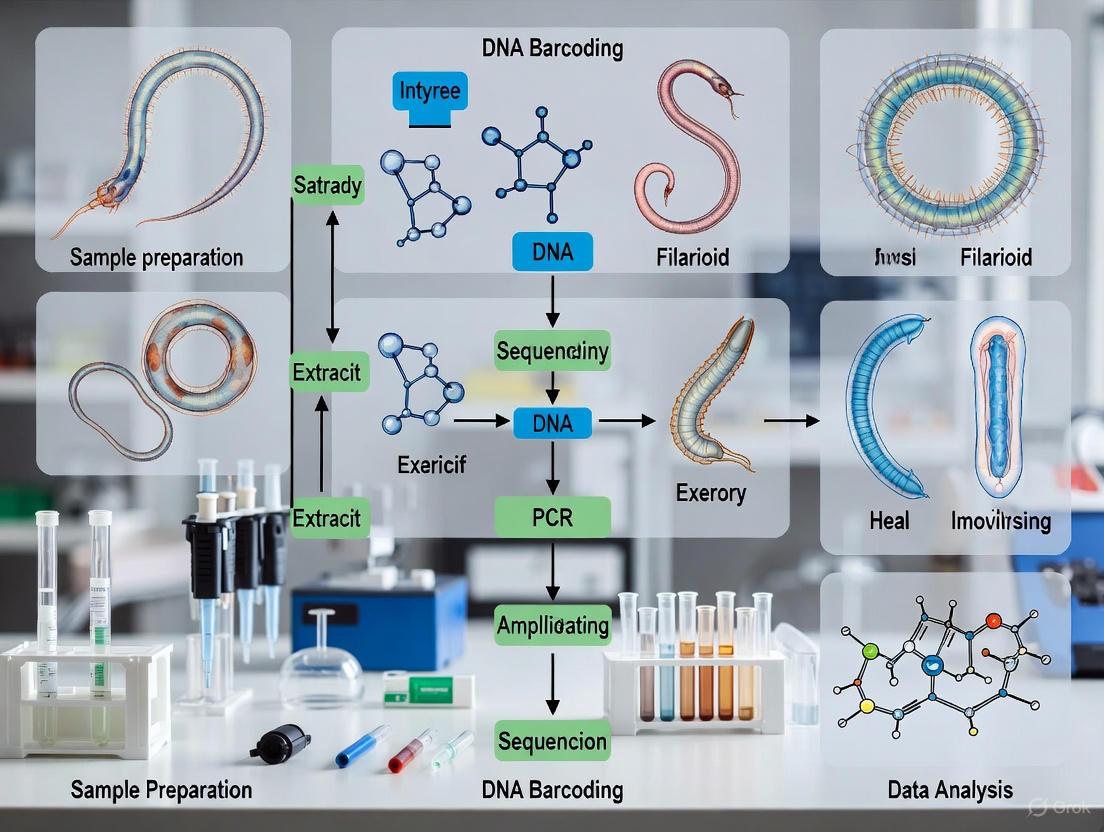
This article provides a comprehensive overview of DNA barcoding methodologies for filarioid worms, parasitic nematodes of significant medical and veterinary importance.
DNA Barcoding of Filarioid Worms: A Comprehensive Guide for Species Identification and Drug Development
Abstract
This article provides a comprehensive overview of DNA barcoding methodologies for filarioid worms, parasitic nematodes of significant medical and veterinary importance. Targeting researchers, scientists, and drug development professionals, it explores the foundational principles of using genetic markers, primarily the mitochondrial cytochrome c oxidase subunit 1 (cox1) gene, for precise species identification. The scope extends from core techniques and phylogenetic analysis to troubleshooting common pitfalls like pseudogenes and optimizing protocols for diverse samples, including feces and vectors. Finally, it validates the approach through comparative analysis with traditional morphology and discusses emerging applications, including the revolutionary potential of CRISPR-Cas9 for developing species-specific anti-parasitic agents, thereby synthesizing a complete resource for advancing the control and elimination of filarial diseases.
Unraveling Parasitic Diversity: The Core Principles of DNA Barcoding for Filarioid Nematodes
The Challenge: Limitations of Traditional Filarioid Worm Diagnosis
Filarioid nematodes are significant vector-borne parasites that cause debilitating diseases such as lymphatic filariasis (elephantiasis) and onchocerciasis (river blindness) in humans, as well as infections in animals worldwide [1] [2]. Accurate identification of these parasites is the cornerstone of correct diagnosis, effective treatment, and successful elimination programs. However, traditional diagnostic methods present substantial challenges that hinder these goals.
Table 1: Limitations of Traditional Diagnostic Methods for Filarioid Worms
| Method Category | Examples | Key Limitations |
|---|---|---|
| Microscopy | Blood smears (e.g., thin/thick films), Modified Knott's test, Skin snips | - Difficult morphological discrimination of closely related species [3]- Low sensitivity due to fluctuating microfilaremia (periodicity) [3]- Requires skilled parasitologist for morphological analysis [4] |
| Serology | Immunochromatographic tests (ICT), ELISA, Filariasis Test Strip (FTS) | - Cannot reliably distinguish between active infection and past exposure [5] [3]- May exhibit cross-reactivity between different filarial species [3]- Provides limited species-level information [3] |
These limitations are not merely operational. The very taxonomy of filarioid worms can be ambiguous, with cryptic species complexes that are morphologically identical but genetically distinct. For instance, DNA barcoding has revealed that Toxocara cati infecting domestic and wild felids is not a single species but a complex of at least five distinct clades, with substantial genetic differences (6.68%–10.84%) in the cytochrome c oxidase subunit I (cox1) gene [6]. Such cryptic diversity remains entirely undetectable through traditional means, leading to potential misdiagnosis and an incomplete understanding of transmission dynamics.
The Solution: Foundations of Molecular Identification
Molecular identification overcomes the shortcomings of traditional methods by targeting genetic sequences unique to each parasite species. This approach provides a powerful, precise, and democratizable tool for species discrimination [4].
DNA Barcoding and Marker Selection
DNA barcoding involves sequencing a short, standardized genetic fragment from a specimen and comparing it to a reference library of known species. For filarioid nematodes, the mitochondrial cytochrome c oxidase subunit I (cox1) gene has emerged as the most suitable marker due to its high degree of interspecific genetic diversity, which allows for clear species differentiation, and its ease of amplification with universal primers [4] [3]. Comparative studies have confirmed high coherence between morphological identification and DNA barcoding using cox1 [4]. Another mitochondrial gene, 12S rDNA, is also used but can be more sensitive to variations in data analysis algorithms [4].
The process enables the delineation of Molecular Operational Taxonomic Units (MOTUs), allowing researchers to correlate all life stages of an organism—including eggs, larvae, and fragments of adult worms—to a specific molecular entity, even in the absence of taxonomic expertise at the time of collection [4].
Advanced Molecular Applications
Building upon basic barcoding, several advanced molecular techniques have been developed for more complex diagnostic and research scenarios:
- Circulating Cell-Free Nucleic Acid Detection: This method detects parasite-derived DNA (ccfDNA) or RNA (ccfRNA) released into the host's bloodstream. The WbTR1 target is a highly sensitive biomarker for detecting active Wuchereria bancrofti infection. A significant advantage is its rapid clearance post-treatment, making it a promising tool for monitoring treatment efficacy, as levels become undetectable within a year after definitive therapy [5].
- Long-Read Metabarcoding: This next-generation sequencing approach uses platforms like Oxford Nanopore's MinION to sequence near-full length barcode genes (e.g., ~650 bp of cox1) from complex samples. It allows for the simultaneous detection and characterization of entire parasite communities from a single sample, proving highly effective at identifying coinfections and novel or rare pathogens that conventional PCR would miss [3].
- Xenomonitoring: Molecular screening of mosquito vectors for filarial DNA is a key strategy for surveillance. This approach helps map the circulation of parasites in a region, identify potential vectors, and assess transmission risks without relying on human testing [7].
Experimental Protocols for Molecular Identification
Protocol 1: Conventional DNA Barcoding with Sanger Sequencing
This protocol is ideal for identifying individual worms or samples with single-species infections [4].
- Sample Preparation: Parasite specimens (adults, microfilariae, or fragments) are collected from hosts or vectors. Genomic DNA is extracted using commercial kits, such as the DNeasy Blood and Tissue Kit (Qiagen).
- PCR Amplification:
- Primers: Use pan-filarial primers COIintF (5'-AGA TTT GTT TGA TCG TTG ATC G-3') and COIintR (5'-AAC AAT ATG TGA TGC TCG TGT G-3'), which amplify an approximately 650 bp fragment of the cox1 gene [4] [3].
- Reaction Mix: 12.5 μL LongAmp Hot Start Taq 2× Master Mix, 1 μL of each primer (10 μM), 3 μL of genomic DNA, and nuclease-free water to a total volume of 25 μL.
- Cycling Conditions: Initial denaturation at 94°C for 3 min; 40 cycles of 94°C for 30s, 50°C for 30s, and 65°C for 1 min; final extension at 65°C for 5 min.
- Sequencing and Analysis: PCR products are purified and sequenced bidirectionally using Sanger sequencing. The resulting sequences are compared against public databases (e.g., GenBank) using tools like BLAST to assign species identity.
Protocol 2: Long-Read Metabarcoding for Complex Samples
This protocol is designed for detecting all filarioids in a sample, such as blood, enabling the study of coinfections and pathogen communities [3].
- Sample and DNA Extraction: Collect sample (e.g., whole blood). Extract total DNA, ensuring it is of high quality and purity. Quantify DNA using a fluorometer (e.g., Qubit 4).
- Library Preparation for Nanopore Sequencing:
- Primary PCR: Amplify the cox1 gene using the COIintF and COIintR primers that have been modified with overhangs compatible with Oxford Nanopore Technologies (ONT) sequencing adapters.
- Barcoding PCR: In a second, limited-cycle PCR, attach unique barcodes to each sample to allow for multiplexing.
- Pooling and Clean-up: Quantify and pool the barcoded PCR products in equimolar ratios. Purify the pooled library.
- Adapter Ligation: Use ONT's Ligation Sequencing Kit (SQK-LSK110) to ligate sequencing adapters to the purified amplicon pool.
- Sequencing and Bioinformatics: Load the library onto an ONT MinION flow cell and perform sequencing. Base-calling generates raw sequence data, which is then demultiplexed (separated by barcode). The sequences are clustered into MOTUs and compared to curated reference databases for taxonomic assignment.
The following workflow diagram illustrates the key steps of the long-read metabarcoding protocol:
The Scientist's Toolkit: Essential Research Reagents and Materials
Table 2: Key Research Reagent Solutions for Molecular Identification of Filarioids
| Reagent / Material | Function / Application | Example Product / Note |
|---|---|---|
| DNA Extraction Kit | Isolation of high-quality genomic DNA from parasites, host tissues, or vectors. | DNeasy Blood & Tissue Kit (Qiagen) [3] |
| Pan-Filarial PCR Primers | Amplification of the standard DNA barcode region from a wide range of filarioid species. | COIintF & COIintR (targeting ~650 bp of cox1) [4] [3] |
| PCR Master Mix | Robust amplification of target DNA, especially for longer barcode fragments. | LongAmp Hot Start Taq 2× Master Mix [3] |
| Sequencing Kit (ONT) | Preparation of libraries for long-read, portable sequencing. | Ligation Sequencing Kit (SQK-LSK110) [3] |
| Portable Sequencer | Enables field-deployable, long-read sequencing for metabarcoding. | Oxford Nanopore MinION Mk1B [3] |
The transition from traditional, morphology-based identification to molecular methods is not merely an incremental improvement but a fundamental shift in the study and control of filarioid worms. DNA barcoding, with the cox1 gene at its core, provides a reliable, consistent, and precise tool for species discrimination. It unveils cryptic diversity, enables the identification of all parasite life stages, and facilitates high-resolution surveillance in vectors and hosts. The continued development and deployment of these molecular tools—from conventional barcoding to advanced metabarcoding and ccfDNA detection—are indispensable for advancing our understanding of filarioid epidemiology, monitoring the success of elimination campaigns, and ultimately achieving the goal of controlling these neglected tropical diseases.
DNA barcoding has emerged as a revolutionary tool in parasitology, providing a standardized, molecular-based approach for species identification that complements traditional morphological methods. This technique is particularly valuable for parasitic nematodes, where morphological identification can be challenging due to the paucity of distinguishing characters in juvenile stages, the presence of cryptic species, and the difficulty of obtaining intact specimens from hosts [4]. For parasitologists studying filarioid worms and related parasites, DNA barcoding enables rapid and accurate identification of all life cycle stages, including those from vectors and animal reservoir hosts, thereby facilitating epidemiological surveys, diagnosis of parasitic diseases, and detection of emergent zoonotic filarial diseases [4]. The utility of this approach extends beyond academic taxonomy to direct applications in disease control programs and drug development initiatives where precise parasite identification is fundamental.
Core Genetic Markers in Parasitology
The effectiveness of DNA barcoding depends on selecting appropriate genetic markers with sufficient sequence variation to discriminate between species while being conserved enough for universal amplification. Research has identified optimal markers from both mitochondrial and nuclear genomes, each with distinct properties suited for different taxonomic levels and applications.
Mitochondrial Markers
Mitochondrial DNA genes have become the cornerstone of DNA barcoding for parasitology due to their higher mutation rates compared to nuclear DNA, providing greater resolution for distinguishing closely related species [8].
Cytochrome c oxidase subunit I (COI/cox1): The most widely used barcode marker for metazoans, including parasitic helminths. Studies on filarioid nematodes demonstrate that cox1 provides high-quality performance with strong branch support in phylogenetic trees and clear differentiation among haplotypes [9] [4]. Its high threshold genetic divergence (approximately 0.47% for Culex quinquefasciatus mosquitoes) makes it ideal for molecular identification of parasite vectors and the parasites themselves [9].
12S and 16S ribosomal RNA: Mitochondrial rRNA genes offer an alternative to cox1, with easier amplification and good sources of synapomorphies in loop regions [4]. These markers are particularly useful when cox1 amplification fails or when comparing across studies that have historically used these markers.
Other mitochondrial protein-coding genes: Additional markers including cytochrome c oxidase subunit II (COII), cytochrome B (cytb), and NADH dehydrogenase subunit 1 (NAD1) provide supplementary sources of sequence variation for resolving difficult taxonomic groups [8].
Nuclear Markers
Nuclear markers, while evolving more slowly than mitochondrial DNA, provide valuable complementary data for phylogenetic studies and situations where mitochondrial markers lack resolution.
Nuclear ribosomal internal transcribed spacers (ITS1 and ITS2): These non-coding regions exhibit higher sequence variation than ribosomal genes and have been successfully utilized for species differentiation of helminths [8]. Their utility is particularly noted for diagnostic purposes where species-specific primers can be designed.
Nuclear rRNA genes (18S and 28S): These highly conserved sequences make them ideal for resolving higher taxonomic levels and providing phylogenetic frameworks for classifying helminths [8]. The combination of 18S and 28S rRNA genes increases resolution in cestode and trematode systematics [8].
Table 1: Suitability of Genetic Markers for Different Applications in Parasitology
| Genetic Marker | Sequence Variation | Best Application | Primer Design | Database Coverage |
|---|---|---|---|---|
| cox1 | High | Species identification, population genetics | Universal primers available | Extensive for filarioids |
| 12S rDNA | Moderate | Species identification, phylogenetic studies | Relatively easy | Good for filarioids |
| 18S rRNA | Low | Higher-level taxonomy, deep phylogeny | Challenging for some groups | Comprehensive |
| 28S rRNA | Low-moderate | Higher-level taxonomy, systematics | Challenging for some groups | Good |
| ITS regions | High | Species differentiation, diagnostics | Species-specific possible | Variable among taxa |
DNA Barcoding Workflow for Filarioid Worms
The standard DNA barcoding workflow involves sequential steps from specimen collection to data analysis, with specific considerations for parasitic nematodes.
Sample Collection and Preservation
Proper specimen handling is critical for successful DNA barcoding. For filarioid worms, samples may include:
- Adult worms recovered from definitive hosts during necropsy or surgery
- Microfilariae concentrated from blood samples using techniques like the modified Knott's test
- Infective larvae dissected from vector insects
- Environmental samples containing parasite DNA
Samples should be preserved in 95-100% ethanol or stored at -20°C to prevent DNA degradation. The Biorepositories initiative provides standardized procedures for long-term storage of parasitological specimens [4].
DNA Extraction and PCR Amplification
DNA extraction from filarioid worms follows standard protocols with modifications depending on sample type:
- Tissue lysis: Proteinase K digestion at 56°C for several hours to overnight
- DNA purification: Commercial kits such as the DNeasy Blood & Tissue Kit (Qiagen) provide reliable results
- DNA quantification: Fluorometric methods (e.g., Qubit Fluorometer) ensure accurate DNA measurement
PCR amplification typically uses pan-filarial primers that target conserved regions flanking variable sequences:
- cox1: Primers coIintF (5'-TGATTGGTGGTTTTGGTAA-3') and coIintR (5'-ATAAGTACGAGTATCAATATC-3') amplify an approximately 650 bp fragment [4] [3]
- 12S rDNA: Primers 12SF and 12SR amplify a shorter, more conserved region useful for degraded samples [4]
Reaction conditions must be optimized for each parasite group, with annealing temperatures typically between 50-55°C and extension times appropriate for the amplicon size.
Sequencing and Data Analysis
Both Sanger sequencing and next-generation sequencing platforms can be employed:
- Sanger sequencing: Suitable for individual specimens, providing high-quality sequences for reference databases
- Next-generation sequencing: Enables metabarcoding of complex samples containing multiple species
Data analysis involves:
- Sequence alignment using algorithms like ClustalW or MUSCLE
- Genetic distance calculation using models such as Kimura 2-parameter
- Phylogenetic reconstruction via neighbor-joining, maximum likelihood, or Bayesian methods
- Species delimitation using threshold genetic distances or more sophisticated models
For filarioid nematodes, a threshold of 2% sequence divergence in cox1 has been proposed as a practical cutoff for species discrimination, though this varies among taxa [4].
Advanced Applications: DNA Metabarcoding
DNA metabarcoding represents a significant advancement beyond conventional barcoding, allowing simultaneous detection of multiple parasite species within a single sample. This approach is particularly valuable for detecting coinfections, rare pathogens, and novel species that might be missed by traditional methods [3].
Metabarcoding Workflow for Filarioid Detection
Recent studies have demonstrated the power of long-read metabarcoding using Oxford Nanopore Technology's MinION platform for filarial worm detection. This approach:
- Amplifies an approximately 650 bp region of the cox1 gene using modified pan-filarial primers [3]
- Identifies infections with multiple filarioids simultaneously, including Acanthocheilonema reconditum, Brugia spp., and zoonotic Dirofilaria sp. 'hongkongensis' [3]
- Detects over 15% more mono- and coinfections compared to traditional diagnostics like modified Knott's test and conventional PCR with Sanger sequencing [3]
- Enables portable, field-based identification of parasites without need for complex laboratory infrastructure
Comparative Performance of Diagnostic Methods
Table 2: Comparison of Diagnostic Methods for Filarioid Nematodes
| Method | Sensitivity | Species Resolution | Coinfection Detection | Technical Requirements | Cost |
|---|---|---|---|---|---|
| Microscopy | Low to moderate | Low to moderate | Limited | Basic laboratory | Low |
| Conventional PCR | Moderate to high | High | Limited | Molecular biology facility | Moderate |
| Real-time PCR | High | High | Limited (unless multiplexed) | Advanced molecular facility | High |
| DNA Barcoding | High | Very high | Moderate | Sequencing facility | Moderate to high |
| Metabarcoding | Very high | Very high | Excellent | Bioinformatics expertise | High |
Practical Implementation Guide
Research Reagent Solutions
Table 3: Essential Research Reagents for DNA Barcoding of Parasites
| Reagent/Kit | Function | Application Notes |
|---|---|---|
| DNeasy Blood & Tissue Kit (Qiagen) | DNA extraction | Effective for diverse sample types including whole worms, blood, and vectors |
| LongAmp Hot Start Taq Master Mix | PCR amplification | Preferred for long amplicons; provides high fidelity for sequencing |
| ONEtaq Master Mix | Conventional PCR | Reliable for standard barcoding applications with various primer sets |
| PCR Barcoding Kit (Oxford Nanopore) | Library preparation | Essential for metabarcoding approaches using MinION platform |
| Proteinase K | Tissue lysis | Critical for digesting tough cuticles of nematodes; incubation at 56°C recommended |
Troubleshooting Common Challenges
Several challenges may arise during DNA barcoding of parasitic helminths:
- Insufficient DNA yield: Increase starting material or extend proteinase K digestion time
- PCR inhibition: Use of dilution series or inhibitor removal techniques during DNA extraction
- Coamplification of host DNA: Design of parasite-specific primers or use of nested PCR approaches
- Mixed infections: Application of metabarcoding rather than conventional barcoding
- Reference database gaps: Contribute novel sequences to public databases (GenBank, BOLD)
For filarioid worms, the coherence between DNA-based and morphological identification is generally very strong, making DNA barcoding a reliable tool for routine identification [4].
DNA barcoding has transformed parasitological research by providing a standardized, sequence-based approach for species identification that complements traditional morphology-based methods. For filarioid worms and related parasites, the cytochrome c oxidase I (cox1) gene has proven particularly effective as a barcode marker, enabling identification of all life stages, detection of cryptic species, and tracking of transmission patterns. The recent development of metabarcoding approaches further enhances this capability, allowing comprehensive characterization of parasite communities in hosts and vectors. As reference databases expand and sequencing technologies become more accessible, DNA barcoding will play an increasingly vital role in epidemiological studies, disease control programs, and drug development efforts targeting parasitic diseases of medical and veterinary importance.
Within the field of molecular taxonomy and diagnostics, the cytochrome c oxidase subunit 1 (cox1) mitochondrial gene has emerged as the undisputed gold standard for DNA barcoding. This in-depth technical guide elucidates the foundational genetic properties that establish cox1 as the premier barcode marker, with a specific focus on its application in the research of filarioid worms and related parasitic nematodes. We explore the gene's high interspecies divergence, robust primer binding sites, and extensive reference database coverage that, in concert, provide unparalleled resolution for species identification, phylogenetic analysis, and the detection of cryptic diversity. Framed within the context of filarioid research, this whitepaper further presents standardized experimental protocols, critical reagent solutions, and analytical workflows that empower researchers and drug development professionals to leverage cox1 barcoding for advanced pathogen discovery and epidemiological surveillance.
DNA barcoding constitutes a revolutionary methodology in taxonomic science, enabling the identification of species using short, standardized genetic sequences from a conserved region of the genome. The fundamental premise is that a uniform genetic marker can be deployed across broad phylogenetic groups to reliably distinguish species, much like a supermarket barcode distinguishes products. For the animal kingdom, the mitochondrial cytochrome c oxidase subunit I (cox1) gene has been universally adopted for this purpose. This 5' region of the cox1 gene, approximately 650 base pairs in length, provides the optimal balance of conserved regions for primer design and variable regions for species discrimination [10].
The selection of cox1 is not arbitrary but is grounded in its distinct molecular biological properties. As a core catalytic component of the mitochondrial electron transport chain, cox1 is essential for aerobic respiration [11]. This critical function imposes strong selective constraints on its sequence, maintaining conserved regions across vast evolutionary distances. Simultaneously, the mitochondrial genome's characteristics—including a lack of introns, a higher mutation rate than nuclear DNA, and maternal inheritance without recombination—make cox1 an ideal candidate for resolving closely related species and constructing phylogenetic hypotheses [12]. In parasitology, these attributes have proven indispensable for tackling complex diagnostic challenges, particularly with morphologically similar or cryptic species of clinical and veterinary importance.
Genetic Properties Establishing COX1 as the Gold Standard
The preeminence of cox1 as a DNA barcode is underpinned by a suite of specific genetic characteristics that collectively outperform other molecular markers. The criteria for an ideal barcode include universal applicability, high interspecies variation, low intraspecies divergence, and robust flanking sites for primer design; cox1 uniquely satisfies all these requirements for metazoan identification.
High Interspecies Resolution and Sequence Divergence
The primary requirement for a DNA barcode is sufficient nucleotide diversity to discriminate between sister species. Comparative analyses of genetic markers across nematode parasites demonstrate that cox1 provides superior taxonomic resolution.
Table 1: Comparison of Genetic Markers for Nematode Identification
| Genetic Marker | Average Pairwise Nucleotide p-Distance | Interspecies Resolution | Sequence Availability in GenBank |
|---|---|---|---|
| cox1 | 86.4% - 90.4% | High | 2491 sequences (for 30 studied species) |
| ITS-1 | 72.7% - 87.3% | High | 1082 sequences |
| ITS-2 | 72.7% - 87.3% | High | 994 sequences |
| 18S rRNA | 98.8% - 99.8% | Low | 212 sequences |
| 12S rRNA | 86.4% - 90.4% | Moderate-High | 428 sequences |
| 16S rRNA | 86.4% - 90.4% | Moderate-High | 143 sequences |
Data adapted from a study analyzing 30 species from Ascarididae, Ancylostomatidae, and Onchocercidae families [12].
As evidenced in Table 1, cox1 exhibits significantly higher sequence divergence compared to the more conserved 18S rRNA gene, while maintaining a substantial advantage in reference sequence availability. This robust sequence library is critical for reliable identification, as it provides the necessary comparative framework for classifying unknown specimens. In practical applications, this high resolution enables the discrimination of closely related filarioid species that are morphologically similar, such as the differentiation between Dirofilaria repens and the novel zoonotic species Dirofilaria asiatica (formerly known as Candidatus Dirofilaria hongkongensis) [13] [14].
Optimal Gene Structure for Primer Design
The cox1 gene architecture features conserved regions that flank highly variable domains, creating an ideal template for universal PCR amplification across diverse taxonomic groups. This structure allows researchers to employ standardized primer sets that can successfully amplify cox1 from a wide spectrum of organisms, from vertebrates to invertebrates including parasitic nematodes.
For filarioid nematodes and other arachnids, primer pairs such as LCO1490/HCO2198 (Folmer primers) have demonstrated 100% amplification success across major phylogenetic lineages [15]. To address the challenge of generating continuous, indel-free sequences for phylogenetic analysis, a novel forward primer (C1-J-2123) was developed to overlap with the standard Folmer region, achieving a 93% success rate and facilitating more accurate sequence alignments [15]. This capacity for robust amplification across diverse taxa makes cox1 particularly valuable in surveillance studies where the target species range may not be fully known.
Application in Filarioid and Parasitic Nematode Research
In the specific context of filarioid worms and related parasites, cox1 barcoding has transformed diagnostic capabilities, epidemiological monitoring, and taxonomic classification. These vector-borne pathogens of the Onchocercidae family present significant challenges for traditional morphological identification, creating an urgent need for precise molecular tools.
Unveiling Cryptic Diversity and Zoonotic Potential
The application of cox1 barcoding has been instrumental in revealing cryptic species complexes within morphologically similar parasites. This has profound implications for understanding their zoonotic potential and transmission dynamics:
Dirofilaria asiatica: Previously identified as Dirofilaria sp. Hong Kong genotype, this zoonotic filarioid was definitively characterized as a novel species through cox1 sequencing, with phylogenetic analyses confirming its presence in canines and humans across Bhutan, Hong Kong, India, and Sri Lanka [13]. This genetic characterization is essential for tracking its emergence in new geographic regions, such as recent findings in Cambodian dogs where local prevalence reached 4% in the Tbong Khmum district [13].
Toxocara cati: cox1 barcoding revealed that this common feline ascarid represents a species complex, with substantial genetic differences (6.68%-10.84%) between parasites infecting domestic cats versus wild felids [6]. The phylogenetic analysis identified five distinct clades correlated with host species, suggesting ongoing speciation events with significant implications for understanding transmission cycles and zoonotic risk.
Dipetalonema-like filarioids: cox1 sequencing of tick-borne filarioids in French Guiana uncovered significant divergence from known genera, suggesting a novel genus within the Dipetalonema lineage [16]. This discovery highlights the extensive undocumented diversity of filarioids and their adaptation to different arthropod vectors.
Enhancing Diagnostic Sensitivity and Specificity
Traditional diagnostic methods for filarioid infections, including microscopic examination of blood for microfilariae, suffer from limitations in sensitivity and specificity, particularly in low-parasitemia infections or when morphological differentiation is challenging [14] [12]. cox1-based molecular assays address these shortcomings through:
Metabarcoding approaches: Novel nanopore-based metabarcoding assays targeting cox1 can characterize entire communities of filarial nematodes from blood samples, simultaneously detecting infections with Acanthocheilonema reconditum, Brugia sp. Sri Lanka genotype, and zoonotic Dirofilaria sp. 'hongkongensis' with over 15% higher detection of mono- and coinfections compared to conventional PCR or modified Knott's test [14].
Species-specific identification: The high resolution of cox1 enables precise identification of etiological agents in human infections, such as distinguishing between Dirofilaria immitis, D. repens, and D. asiatica, which may present with similar clinical manifestations but have different treatment implications and zoonotic potential [13] [17].
Table 2: COX1 Barcoding Applications in Selected Parasitic Nematodes
| Parasite Species | Host | Application | Key Finding |
|---|---|---|---|
| Dirofilaria asiatica | Canines, Humans | Species characterization & distribution mapping | First detection in Cambodia; 4% local prevalence in dogs [13] |
| Toxocara cati | Domestic and wild felids | Cryptic species identification | 5 distinct clades with 6.68%-10.84% genetic divergence [6] |
| Filaria martis | Beech marten | Subcutaneous filariosis identification | 100% nucleotide identity across Italy and Spain isolates [17] |
| Brugia sp. Sri Lanka genotype | Canines | Co-infection detection | Metabarcoding identified additional filarioid species missed by conventional PCR [14] |
Experimental Protocols and Methodologies
Implementing cox1 as a primary barcode requires standardized methodologies to ensure reproducibility and comparability of results across laboratories. The following section outlines established protocols for DNA extraction, amplification, and sequencing specifically optimized for filarioid worms and related nematodes.
Sample Collection and DNA Extraction
Proper sample handling and DNA extraction are critical first steps for successful cox1 barcoding:
Sample Collection: For blood-dwelling filarioids, collect 2mL of whole blood via cephalic or jugular venipuncture into EDTA tubes to prevent coagulation. Temporarily store samples on ice in the field before transferring to -20°C for long-term storage [13]. For adult worms or microfilariae from subcutaneous tissues, preserve specimens in 70-95% ethanol for morphological correlation or place directly in lysis buffer for DNA extraction.
DNA Extraction: Use commercial DNA extraction kits such as the DNeasy Blood & Tissue Kit (Qiagen) following the manufacturer's protocol with minor modifications: extend proteinase K digestion to 30 minutes at 56°C and perform two elution steps (30μL followed by 20μL) to maximize DNA yield [13]. For high-throughput applications, automated systems like the MagMAX Express magnetic particle processor can be optimized for processing diverse tissue types [15].
PCR Amplification and Sequencing
The amplification of the cox1 barcode region employs specific primer sets and cycling conditions:
Primer Selection: For the standard ~650bp barcode region, use the Folmer primers LCO1490 (5'-GGTCAACAAATCATAAAGATATTGG-3') and HCO2198 (5'-TAAACTTCAGGGTGACCAAAAAAT-3') [15]. To obtain extended coverage for phylogenetic analyses, incorporate the primer pair C1-J-2123 (5'-GATCGAAATTTTAATACTTCTTTTTTTGA-3') and C1-N-2776 (5'-GGATAATCAGAATATCGTCGAGG-3'), which provides overlap with the Folmer region [15].
PCR Reaction Setup: Prepare 25μL reactions containing 12.5μL OneTaq 2× Master Mix (New England Biolabs), 1μL of each primer (10μM concentration), and 2μL of template DNA. Utilize the following thermocycling conditions: initial denaturation at 95°C for 40 seconds; 40 cycles of 95°C for 40 seconds, 50°C for 45 seconds, and 68°C for 45 seconds; final extension at 68°C for 5 minutes [13].
Sequencing Methodologies: For conventional Sanger sequencing, purify PCR products and sequence in both directions using the same amplification primers. For metabarcoding approaches utilizing nanopore sequencing (Oxford Nanopore Technologies MinION), prepare barcoded libraries according to manufacturer protocols and sequence using FLO-MIN106 flow cells with real-time basecalling enabled [14].
The following workflow diagram illustrates the complete cox1 barcoding process from sample to identification:
Figure 1: Workflow for COX1 DNA barcoding of parasitic nematodes, from sample collection to species identification.
The Scientist's Toolkit: Essential Research Reagents
Successful implementation of cox1 barcoding requires specific laboratory reagents and materials optimized for parasite molecular work. The following table details critical components for establishing a robust barcoding pipeline.
Table 3: Essential Research Reagents for COX1 Barcoding Experiments
| Reagent/Material | Function | Specific Examples & Notes |
|---|---|---|
| DNA Extraction Kit | Nucleic acid purification from diverse sample types | DNeasy Blood & Tissue Kit (Qiagen); MagMAX Express for automated extraction [13] [15] |
| PCR Master Mix | Amplification of target cox1 fragments | OneTaq 2× Master Mix (New England Biolabs) with standard buffer [13] |
| cox1 Primers | Specific amplification of barcode region | LCO1490/HCO2198 (Folmer primers); C1-J-2123/C1-N-2776 for extended coverage [15] |
| Sequencing Kit | Generation of sequence data | Nanopore Ligation Sequencing Kit (SQK-LSK109) for metabarcoding; BigDye Terminator for Sanger [14] |
| Positive Controls | Verification of assay performance | Genomic DNA from confirmed specimens of D. immitis, Brugia spp., or other relevant filarioids [13] [14] |
| Reference Databases | Species identification platform | BOLD Systems (Barcode of Life Data System); NCBI GenBank [15] [10] |
The cytochrome c oxidase subunit I (cox1) gene rightfully maintains its position as the gold standard for DNA barcoding in filarioid worms and related parasitic nematodes. Its genetic properties—including high interspecies divergence, conserved primer binding sites, and sufficient length for informative polymorphism—create an optimal tool for species discrimination that surpasses alternative markers. The demonstrated applications in revealing cryptic diversity, tracking zoonotic transmission, and improving diagnostic accuracy underscore its indispensable value in both basic parasitology and applied clinical research.
For the scientific community engaged in filarioid research and drug development, cox1 barcoding provides a universal language for pathogen identification that transcends geographical and taxonomic boundaries. The standardized protocols and reagent solutions outlined in this technical guide establish a foundation for reproducible, comparable results across laboratories. As sequencing technologies continue to evolve toward portable, real-time platforms like nanopore sequencing, the integration of cox1 barcoding into field-based surveillance programs promises to revolutionize our understanding of filarioid epidemiology and control. Through the consistent application of this powerful genetic tool, researchers can address critical gaps in our knowledge of parasite biodiversity, host range, and transmission dynamics, ultimately contributing to enhanced therapeutic strategies and public health interventions.
Establishing Phylogenetic Relationships and Revealing Cryptic Species Complexes
The accurate delineation of species boundaries represents a fundamental challenge in evolutionary biology, particularly within parasitic nematodes where morphological conservation often masks significant genetic diversity. For filarioid worms and related parasites (Nematoda, Spirurida), which include agents of debilitating tropical diseases such as river blindness and lymphatic filariasis, precise identification is crucial for diagnosis, epidemiological surveillance, and drug development [4]. This technical guide explores the integrated use of phylogenetic analysis and DNA barcoding to establish evolutionary relationships and uncover cryptic species complexes within this medically significant group. The approach recognizes that while molecular data provide powerful discriminatory power, the foundation of robust taxonomy requires correlation with meticulously validated morphological characters [18] [4].
The phenomenon of cryptic species diversity—where morphologically similar organisms constitute distinct biological species—has profound implications for understanding parasite transmission dynamics, host specificity, and drug susceptibility. DNA barcoding initiatives, coordinated by the Consortium for the Barcode of Life (CBoL), aim to develop standardized, economical tools for species identification [4]. For filarioid nematodes, this is particularly valuable for identifying juvenile stages in vectors, diagnosing co-infections, and working with specimens damaged during collection from host tissues [4]. This guide provides researchers with comprehensive methodologies for implementing integrated taxonomic approaches to reveal previously unrecognized diversity within filarioid worms.
DNA Barcoding Markers: Performance Comparison for Filarioid Nematodes
The selection of appropriate genetic markers is paramount for successful DNA barcoding. Mitochondrial genes are preferred for their high evolutionary rates, limited recombination, and abundance in public databases. For filarioid nematodes, comparative studies have evaluated the performance of two primary mitochondrial markers: cytochrome c oxidase subunit I (coxI) and 12S ribosomal DNA (12S rDNA) [18] [4].
Table 1: Performance Comparison of DNA Barcoding Markers for Filarioid Nematodes
| Parameter | coxI Marker | 12S rDNA Marker |
|---|---|---|
| Sequence Quality | High-quality performances | High-quality performances |
| Manageability | Excellent | Affected by alignment algorithm and gap treatment |
| Species Discrimination Power | High coherence with morphological identification | High coherence with morphological identification |
| Threshold Definition | Consistent performance with defined nucleotide divergence | Performance varies with criteria used for threshold value |
| New Species Inference | Suitable for inferring potential new species | Less reliable for new species inference |
| Technical Considerations | Manageable for routine identification | Sensitivity to analytical parameters affects reliability |
Both markers demonstrate high coherence with morphology-based identifications, but coxI exhibits superior manageability and consistency across different analytical approaches [18]. The performance of 12S rDNA is significantly influenced by alignment algorithms, gap treatment methods, and the criteria used to define threshold values for species boundaries. Consequently, coxI has emerged as the more reliable marker for routine identification and detection of putative new species through defined levels of nucleotide divergence [18] [4].
Workflow for Integrated Phylogenetic Analysis
The process of establishing phylogenetic relationships and revealing cryptic species complexes requires a methodical integration of morphological and molecular approaches. The following workflow outlines the key stages in this process, from specimen collection through to integrated analysis.
Integrated Phylogenetic Workflow
This workflow emphasizes the parallel processing of morphological and molecular data streams, which converge at the integrated taxonomic assessment stage. Specimen collection represents a critical initial phase, particularly challenging for filarioid nematodes as most specimens derive from wild, naturally infected hosts recovered during necropsy [4]. Proper preservation following Biorepositories initiative procedures ensures both morphological integrity and DNA quality for subsequent analyses [4].
Experimental Protocols for DNA Barcoding of Filarioid Nematodes
Specimen Collection and Morphological Analysis
Materials Required:
- Lactophenol for clearing specimens
- Optical microscope with camera lucida
- Taxonomic identification keys [4]
Methodology:
- Clear collected worm specimens in lactophenol to enhance morphological visibility
- Perform anatomical analysis using optical microscope equipped with camera lucida
- Document key taxonomic characters including:
- Body measurements and proportions
- Number and spatial arrangement of sensory papillae on head and male tail
- Reproductive structures and their variations
- Buccal cavity and esophageal morphology [4]
- Compare observed characters against validated identification keys [citation:20 in citation:5]
- Assign preliminary species identification based on morphological characteristics
This morphological analysis establishes the foundational taxonomy against which molecular identifications will be compared, enabling assessment of coherence between approaches [18].
DNA Extraction, Amplification, and Sequencing
Materials Required:
- Specific primers: coIintF and coIintR for coxI; 12SF and 12SR for 12S rDNA [4]
- Standard DNA extraction kits (phenol-chloroform or commercial silica-based methods)
- PCR reagents: Taq polymerase, dNTPs, buffer solutions
- Sanger sequencing equipment and reagents
Methodology:
- DNA Extraction:
- Follow standard proteinase K digestion protocols
- Use phenol-chloroform or silica-based extraction methods
- Elute DNA in TE buffer or molecular grade water
- Quantify DNA concentration using spectrophotometry or fluorometry
PCR Amplification:
- Prepare 25-50μL reaction mixtures containing:
- 1× PCR buffer
- 1.5-2.5mM MgCl₂
- 0.2mM each dNTP
- 0.2-0.5μM each primer
- 0.5-1.0 unit Taq polymerase
- 10-100ng template DNA
- Apply thermal cycling conditions optimized for filarioid nematodes:
- Initial denaturation: 94°C for 3-5 minutes
- 35-40 cycles of: 94°C for 30-45 seconds, 45-55°C for 30-60 seconds, 72°C for 60-90 seconds
- Final extension: 72°C for 5-10 minutes [4]
- Prepare 25-50μL reaction mixtures containing:
DNA Sequencing:
- Purify PCR products using enzymatic or column-based methods
- Prepare sequencing reactions with fluorescent terminator chemistry
- Perform capillary electrophoresis on sequencing platforms
- Verify sequence quality through chromatogram inspection
Data Deposition:
- Submit validated sequences to public databases (EMBL/GenBank)
- Follow EBI Barcoding Procedure for standardization
- Include associated specimen metadata and voucher information [4]
Phylogenetic Analysis and Tree Annotation
Phylogenetic reconstruction provides the framework for visualizing evolutionary relationships and identifying potential cryptic species complexes. The ggtree package in R enables sophisticated annotation of phylogenetic trees, allowing researchers to integrate multiple data types directly onto tree structures [19].
Table 2: Essential ggtree Layers for Phylogenetic Tree Annotation
| Layer Function | Description | Application in Cryptic Species Detection |
|---|---|---|
geom_cladelab() |
Annotates a clade with bar and text label | Highlight putative cryptic species clades |
geom_hilight() |
Highlights selected clade with rectangular or round shape | Emphasize divergent lineages within morphospecies |
geom_tiplab() |
Displays tip labels | Show specimen identifiers or species names |
geom_nodepoint() |
Annotates internal nodes with symbolic points | Indicate bootstrap support or posterior probabilities |
geom_strip() |
Annotates associated taxa with bar and label | Connect related taxa across non-monophyletic groups |
geom_balance() |
Highlights two direct descendant clades of a node | Illustrate sister group relationships |
The following diagram illustrates the application of these annotation layers to visualize key features of phylogenetic trees relevant to cryptic species detection:
Phylogenetic Tree Annotation Methods
Implementation example in R:
This code produces a publication-ready phylogenetic tree with highlighted clades representing potential cryptic species, supported by statistical values at key nodes [19].
Detection and Validation of Cryptic Species Complexes
The identification of cryptic species complexes requires establishing genetically distinct lineages within morphologically similar populations. DNA barcoding facilitates this process through quantitative analysis of genetic distances and phylogenetic distinctness.
Genetic Distance Analysis
Calculate intra-specific and inter-specific genetic distances using appropriate nucleotide substitution models:
- Intra-specific variation: Typically <2% for coxI in filarioid nematodes
- Inter-specific divergence: Generally >5-8% for coxI, depending on the genus
- Threshold values: Define species boundaries based on discontinuous distributions of pairwise distances
Diagnostic Character Identification
Within potential cryptic species complexes:
- Identify fixed nucleotide substitutions that distinguish lineages
- Verify absence of intermediate haplotypes
- Confirm monophyly of putative species through bootstrap resampling (>70% support) or Bayesian posterior probabilities (>0.95)
Morphological Re-assessment
Following genetic identification:
- Re-examine morphological characters of genetically distinct lineages
- Employ multivariate morphometrics to detect subtle phenotypic differences
- Utilize scanning electron microscopy for ultrastructural characterization
- Correlate molecular divisions with previously overlooked morphological features
Essential Research Reagents and Tools
Successful implementation of integrated taxonomy requires specific research reagents and bioinformatic tools. The following table details essential resources for studying phylogenetic relationships and cryptic species in filarioid worms.
Table 3: Research Reagent Solutions for Filarioid Nematode Taxonomy
| Reagent/Tool | Specification | Application in Research Workflow |
|---|---|---|
| coxI Primers | coIintF (5'-GGTCAACAAATCATAAAGATATTGG-3') and coIintR (5'-TAAACTTCAGGGTGACCAAAAAATCA-3') [citation:22 in citation:5] | Amplification of coxI barcode region for species discrimination |
| 12S rDNA Primers | 12SF (5'-TAGAATTAGGGCWGATAYTG-3') and 12SR (5'-AAACTAGGATTAGATACCC-3') [citation:9 in citation:5] | Alternative mitochondrial marker amplification |
| DNA Extraction Kit | Standard proteinase K/phenol-chloroform or commercial silica-based kits | High-quality genomic DNA isolation from worm specimens |
| PCR Reagents | Taq polymerase, MgCl₂, dNTPs, reaction buffers | Reliable amplification of barcode regions from limited template |
| ggtree R Package | R package for phylogenetic tree annotation [19] | Visualization and annotation of evolutionary relationships |
| Sequence Alignment Software | MAFFT, MUSCLE, or ClustalW | Multiple sequence alignment for distance calculation |
| Phylogenetic Analysis Packages | MrBayes, RAxML, BEAST2 | Construction of phylogenetic trees from sequence data |
| Morphological Clearing Agent | Lactophenol | Tissue clearing for microscopic examination of anatomical features |
Discussion and Implications for Disease Management
The integrated approach to establishing phylogenetic relationships and revealing cryptic species complexes in filarioid nematodes has transformative implications for parasitic disease management. The demonstration that DNA barcoding and morphological identification show "very strong" coherence for most species validates molecular approaches as reliable, consistent tools for species discrimination in routine identification [18] [4].
From a therapeutic perspective, the discovery of cryptic species complexes may explain variations in drug efficacy across different geographical regions. Previously attributed to emerging resistance, treatment failures might instead reflect biological differences between cryptic species with distinct physiological characteristics. Similarly, vaccine development efforts must account for potential antigenic variation between genetically distinct but morphologically similar parasites.
The detection of cryptic species also impacts epidemiological modeling and control strategies. Vector competence, host specificity, and transmission dynamics may all vary between cryptic species, requiring tailored interventions for different genetic lineages. Molecular identification tools enable rapid screening of vectors and hosts for specific filarioid lineages, enhancing surveillance precision in endemic areas.
For taxonomic practice, this integrated approach represents a pragmatic synthesis of traditional and molecular methods. While DNA barcoding offers speed and standardization, morphological analysis provides the essential connection to centuries of taxonomic literature and biological understanding. The future of filarioid nematode taxonomy lies in continued correlation between these approaches, leveraging their respective strengths to develop a more accurate and predictive classification system.
As sequencing technologies advance and costs decline, the integration of multilocus data and genomic-scale approaches will further refine our understanding of phylogenetic relationships and species boundaries in this medically significant group of parasites.
The parasitic nematode Toxocara cati is a recognized zoonotic agent and one of the most common internal parasites of cats worldwide [20]. Historically, understanding of its true zoonotic potential and genetic diversity has been limited. This case study examines how the application of DNA barcoding has fundamentally challenged the traditional taxonomic view of T. cati, revealing it not as a single species but as a species complex with significant genetic divergence linked to different felid hosts [6] [21]. This discovery, framed within a broader thesis on the DNA barcoding of filarioid worms and related parasites, underscores the critical role of molecular taxonomy in parasitology. It provides a new framework for more accurate diagnosis, drug discovery, and control strategies for this neglected infection.
Background and Significance
The Parasite and Its Clinical Importance
Toxocara cati is a roundworm that infects the small intestine of both wild and domestic felids [22]. Humans act as paratenic hosts, becoming infected through the accidental ingestion of embryonated eggs from contaminated soil, water, or food, or through the consumption of undercooked paratenic hosts [23] [24]. In humans, larval migration can lead to several clinical syndromes, including Visceral Larva Migrans (VLM), Ocular Larva Migrans (OLM), and neurological toxocariasis [23] [20]. The global seroprevalence of human toxocariasis is significant, with estimates of 37.7% in Africa and 34.1% in South-East Asia, highlighting its status as a neglected global zoonosis [23].
The Limitation of Traditional Taxonomy and Diagnostics
Traditional diagnosis of Toxocara infection, whether in definitive or paratenic hosts, has relied heavily on microscopic identification of eggs or serological assays using excretory-secretory (TES) antigens [25] [22]. A major diagnostic challenge is the antigenic similarity between T. cati and T. canis, leading to potential cross-reactivity and misdiagnosis [22] [26]. Furthermore, morphological discrimination between Toxocara species and their close relatives is difficult and requires specialized expertise, a problem exacerbated when only eggs are available for examination [26]. These diagnostic shortcomings have obscured the true epidemiology and clinical significance of T. cati.
The DNA Barcoding Investigation
Core Hypothesis and Rationale
The investigation was driven by the hypothesis that significant genetic divergence exists within T. cati infecting different felid species, potentially indicating a speciation event and the existence of a cryptic species complex [6]. This hypothesis was grounded in the ecological principle of host-parasite co-evolution, where isolation in different host species can drive genetic differentiation.
Experimental Workflow and Methodologies
The research followed a structured molecular phylogenetic approach to test this hypothesis.
Sample Collection and DNA Extraction
- Sample Source: Adult Toxocara worms were collected from the intestines of naturally infected domestic cats and various wild felids from different geographical regions [6] [21].
- DNA Extraction: Genomic DNA was purified from worm tissues using commercial kits, such as the GeneJET Genomic DNA Purification Kit, following established protocols [26]. The DNA was eluted and stored at -20°C until subsequent use.
Target Gene Amplification and Sequencing
- Barcoding Marker: The mitochondrial cytochrome c oxidase subunit 1 (cox1) gene was targeted for DNA barcoding [6] [21]. This gene is a standard marker for metazoan barcoding due to its high mutation rate and utility in distinguishing closely related species.
- PCR Amplification: Polymerase Chain Reaction (PCR) was performed using specific primers designed to amplify the cox1 region. A typical PCR reaction mixture includes:
- Template DNA (100-200 ng)
- Forward and Reverse Primers (20 pmol each)
- Taq DNA Polymerase (e.g., 1.25 IU)
- Reaction Buffer (e.g., 5x MyTaq Buffer)
- DNase-free water [26].
- Thermocycling Conditions: An example profile: initial denaturation at 94°C for 30 seconds, followed by 35 cycles of denaturation (94°C for 30s), annealing (56-58°C for 30s), and extension (72°C for 30s), with a final extension at 72°C for 5 minutes [26].
- Sequencing: The resulting PCR amplicons were purified and subjected to capillary sequencing. The obtained sequences were deposited in public databases like GenBank [26].
Phylogenetic and Genetic Analysis
- Sequence Alignment and Phylogenetics: The cox1 sequences from different hosts were aligned using software like Bioedit. A phylogenetic tree was reconstructed using maximum likelihood methods (e.g., PhyML) to visualize the evolutionary relationships among the samples [26].
- Species Delimitation: The Assemble Species by Automatic Partitioning (ASAP) analysis was employed on the cox1 barcode data to objectively assess species boundaries and test the support for distinct species status of the identified clades [6] [21].
- Genetic Distance Calculation: The percentage of genetic divergence (p-distance) between and within the identified clades was calculated to quantify the degree of sequence difference.
Key Findings and Data
Revealing a Species Complex
The phylogenetic analysis of cox1 sequences did not yield a single, monophyletic T. cati clade. Instead, the worms grouped into five distinct, well-supported clades that correlated strongly with the host species from which they were derived [6] [21]. The ASAP analysis supported the species status of these clades, confirming that what was once classified as T. cati is likely a complex of at least five different species.
Table 1: Genetic Divergence (p-distance) between T. cati Clades from Different Hosts
| Comparison Between Clades | Representative Genetic Distance (%) |
|---|---|
| Domestic cat vs. Wild felid clades | 6.68% - 10.84% [6] [21] |
The magnitude of this genetic divergence is substantial, far exceeding typical intra-species variation and falling within the range expected for distinct nematode species.
Global Prevalence and Diagnostic Context
A recent global meta-analysis provided context for the scope of T. cati infection in its definitive host, which is critical for understanding the potential impact of the newly discovered diversity.
Table 2: Global Prevalence of T. cati in Cats (Felis catus)
| Diagnostic Method | Pooled Prevalence (95% CI) | Notes |
|---|---|---|
| Coproparasitological | 17.0% (16.2% - 17.8%) | Based on 289 studies [20] |
| Molecular (PCR) | 4.9% (1.9% - 7.9%) | Based on 4 studies [20] |
The higher prevalence observed with coproparasitological methods underscores their continued use, but also their limitation: they cannot differentiate between the potentially distinct species within the complex, which may have different biological and zoonotic potentials.
The Scientist's Toolkit: Essential Research Reagents
Table 3: Key Reagent Solutions for Toxocara Speciation Research
| Reagent / Kit | Function in Research |
|---|---|
| GeneJET Genomic DNA Purification Kit | Extraction of high-quality genomic DNA from adult worms or larvae [26]. |
| cox1 gene primers | PCR amplification of the standard DNA barcode region for metazoans [6]. |
| ITS-2 gene primers | PCR amplification of the ribosomal ITS-2 region, used for specific discrimination of T. canis and T. cati [25] [26]. |
| MyTaq Reaction Buffer & Taq Polymerase | Enzymatic amplification of target DNA sequences via PCR [26]. |
| PowerMax Soil DNA Isolation Kit | Extraction of DNA from environmental samples (e.g., soil) for detecting Toxocara eggs [25]. |
| QIAamp DNA Stool Mini Kit | Extraction of DNA from feline or canine fecal samples for molecular diagnosis [25]. |
Implications for Research and Drug Development
Diagnostics and Public Health
The recognition of T. cati as a species complex has profound implications. It suggests that current serological tests, which often use T. canis TES antigens, might have variable sensitivity for detecting infections caused by different members of the T. cati complex [22] [24]. This could lead to an underestimation of its true contribution to human disease. Future diagnostic development should focus on species-specific antigens, potentially discovered through proteomic [22] and in silico immunoinformatic approaches [24], to improve diagnostic accuracy.
Drug Discovery and anthelmintic Development
The treatment of toxocariasis, particularly against larval stages in tissues, remains challenging due to the limited efficacy of current drugs like albendazole and mebendazole [23]. The genetic divergence uncovered in this study suggests potential physiological and biochemical differences between the cryptic species, which could affect drug susceptibility.
- Novel Drug Targets: Genomic and transcriptomic resources for T. cati are being developed to identify potential new drug targets [27]. The genetic differences between species could be exploited to develop broad-spectrum or species-specific anthelmintics.
- Drug Transport and Tolerance: Research in T. canis has identified a repertoire of P-glycoprotein (P-gp) drug transporters that may contribute to macrocyclic lactone tolerance in somatic larvae [28]. Similar mechanisms could be at play in the T. cati complex, and differences in P-gp expression or function between species could influence treatment outcomes. The use of P-gp inhibitors like verapamil has been shown to increase larval susceptibility to ivermectin in vitro [28], pointing to a potential avenue for enhancing drug efficacy.
This case study demonstrates that DNA barcoding with the cox1 gene has effectively revealed a previously unrecognized species complex within Toxocara cati. The substantial genetic divergence between lineages from domestic and wild felids, supported by phylogenetic and species delimitation analyses, necessitates a re-evaluation of the biology, epidemiology, and zoonotic potential of this parasite. For researchers and drug development professionals, these findings clarify that the "scarcity of validated molecular targets and limited chemical space explored are the main bottlenecks" in the field [23]. Moving forward, integrating this new genetic framework with advanced functional genomics, proteomics, and drug efficacy studies will be crucial for developing more accurate diagnostics and effective, targeted control strategies against this widespread zoonotic pathogen.
From Lab to Field: Practical Protocols and Cutting-Edge Applications of Filarial Barcoding
The cytochrome c oxidase subunit I (cox1) gene serves as a powerful molecular tool for DNA barcoding, enabling precise species identification, phylogenetic analysis, and population genetic studies of parasitic worms [29] [30]. For filarioid worms and other parasites, accurate genetic characterization is crucial for understanding transmission dynamics, detecting zoonotic reservoirs, and monitoring the success of elimination campaigns [31] [3] [32]. This protocol provides a comprehensive technical guide for generating cox1 barcodes from parasite material, detailing every step from DNA extraction to sequence analysis. The methodologies are framed within the context of contemporary filarioid worm research, addressing specific challenges such as working with degraded DNA from field-collected samples and differentiating between closely related species [31] [3].
Sample Collection and Preparation
Successful DNA barcoding begins with proper sample collection and preservation. For filarioid worms, relevant sample types include:
- Whole Parasites: Adult worms or microfilariae collected from definitive hosts (humans, animals) or vectors [31] [32].
- Host Blood: Venous blood from infected hosts, which can be used directly or for isolating microfilariae [31] [3] [32].
- Vector Mosquitoes: Pools of mosquitoes collected from endemic areas for xenomonitoring [33] [34].
Immediately after collection, preserve samples in absolute ethanol and store at -20°C for long-term stability. For blood samples, DNA can be extracted directly or blood can be applied to filter paper or specialized sample application pads from diagnostic test cards [34].
DNA Extraction
The quality of extracted DNA is foundational for successful PCR amplification. The following method provides a balance of simplicity, cost-effectiveness, and effectiveness for various sample types.
Rapid TE Buffer Extraction Method
This protocol is adapted from established, simple methods for extracting DNA from filarial parasites in mosquitoes and is suitable for a variety of sample types [33] [35].
Reagents Required: TE Buffer (10 mM Tris-HCl, 1 mM EDTA, pH 8.0), absolute ethanol.
Procedure:
- For a tissue sample (e.g., a piece of a parasite or a pool of mosquitoes), dry it thoroughly and mechanically disrupt it using a sterile pestle to create a fine powder.
- Transfer the powdered material to a 1.5 mL microcentrifuge tube.
- Add 100 μL of TE buffer and vortex vigorously to homogenize the tissue.
- Boil the homogenate for 10 minutes in a heating block or water bath.
- Centrifuge at 14,000 rpm for 10 minutes to pellet debris.
- Carefully transfer the supernatant, which contains the DNA, to a new tube.
- The DNA extract is now ready for use as a template in PCR. For long-term storage, keep at -20°C. DNA extracted by this method remains stable for at least one year [35].
Table 1: Commercially Available Kits as Alternatives for DNA Extraction
| Kit Name | Sample Type | Key Features |
|---|---|---|
| DNeasy Blood & Tissue Kit (Qiagen) | Parasite tissue, host blood [3] | High purity and yield, spin-column technology |
| NucleoSpin 96 Tissue Kit (Macherey-Nagel) | High-throughput tissue samples [36] | 96-well format, suitable for large-scale barcoding projects |
| Wizard Genomic DNA Purification Kit (Promega) | Blood filters, mosquito pools [34] | Effective for diverse sample types, including filter-bound material |
PCR Amplification of thecox1Gene
Amplification of the cox1 barcode region can be performed using standard PCR with universal or specific primers. For degraded DNA, a strategy involving two overlapping fragments is highly recommended [36].
Standard Single-Amplicon Workflow
This approach is ideal for samples with high-quality DNA.
- Primer Sequences: Universal primers such as LCO1490 and HCO2198 are widely used [36]. For filarioid worms, the modified pan-filarial primers COIintF and COIintR amplify an ~650 bp fragment and have proven highly effective [3] [34].
- Reaction Setup:
- Thermal Cycling Conditions:
Two-Amplicon Workflow for Degraded DNA
For older or suboptimally preserved samples, amplifying the cox1 gene in two shorter, overlapping fragments significantly increases success rates [36].
- Primer Design: Design external and internal primer pairs. The internal primers should be located roughly in the middle of the target barcode fragment, creating a sizeable overlap (e.g., 46 bp) [36].
- Procedure: Perform two separate PCRs for each sample.
- PCR 1: Uses the forward external primer and reverse internal primer.
- PCR 2: Uses the forward internal primer and reverse external primer.
- Application: This strategy is the basis of high-throughput methods like CODEX, which can process thousands of samples simultaneously by incorporating barcodes [36].
The following diagram illustrates the core experimental workflow for the cox1 DNA barcoding process.
Sequencing
Sanger Sequencing
The conventional method for individual PCR products.
- Purification: Purify PCR products before sequencing using a commercial kit to remove excess primers and dNTPs.
- Sequencing Reaction: Outsource to a sequencing facility or perform in-house. Bidirectional sequencing (both forward and reverse primers) is essential for accuracy [29].
- Assembly: Manually assemble forward and reverse sequences into a single contiguous sequence (contig) using software like SeqMan Pro (DNASTAR) [29].
High-Throughput Sequencing (HTS)
For large-scale barcoding projects or detecting coinfections, HTS is more efficient.
- Library Preparation: For platforms like Illumina, use a double-indexing approach where amplicons from each sample receive a unique combination of two barcodes, allowing thousands of samples to be multiplexed in a single run [36].
- Long-Read Sequencing: Oxford Nanopore Technologies' (ONT) MinION can sequence the near-full-length cox1 amplicon, providing rapid, portable sequencing suitable for field deployment [3].
Table 2: Key Reagent Solutions for cox1 Barcoding
| Research Reagent | Function/Explanation |
|---|---|
| Pan-filarial COI Primers (COIintF/R) [3] | Primer pairs designed to amplify the cox1 gene from a broad range of filarioid worms, ensuring detection of known and novel pathogens. |
| Taq Master Mix with MgCl₂ | A pre-mixed solution containing Taq DNA polymerase, dNTPs, and reaction buffer. MgCl₂ concentration (e.g., 2.5 mM) is critical for PCR efficiency [36] [33]. |
| PCR Barcodes (Indexes) | Short, unique DNA sequences ligated to amplicons during library prep to allow sample multiplexing and downstream demultiplexing in HTS [36]. |
| LongAmp Hot Start Taq | A polymerase optimized for long amplicons, useful for amplifying the full-length ~650 bp cox1 barcode, especially in metabarcoding assays [3]. |
Data Analysis
The final step involves processing raw sequence data to obtain biological insights.
- Sequence Cleaning and Assembly: Use bioinformatic pipelines (e.g., the CODEX pipeline) to clean raw reads, merge paired-end sequences, and assemble the final cox1 barcode fragment [36].
- Validation: Annotate the assembled sequence using web servers like MITOS2 to validate the open reading frame and confirm conserved start/stop codons, ensuring the structural integrity of the mitochondrial gene [29].
- Taxonomic Identification: Perform a BLASTn analysis against the NCBI Nucleotide Database to confirm species identity [29] [30].
- Genetic and Phylogenetic Analysis:
- Use software like DnaSP to calculate population genetic parameters, including haplotype diversity (Hd), nucleotide diversity (π), and neutrality tests (Tajima's D) [29].
- Perform multiple sequence alignment with CLUSTAL.
- Construct phylogenetic trees (e.g., Neighbor-Joining, Maximum Parsimony) using MEGA software with bootstrap analysis (e.g., 1000 replicates) to assess branch confidence [29] [30].
Filarioid nematodes are vector-borne pathogens of significant medical and veterinary importance, causing diseases such as lymphatic filariasis, onchocerciasis, and loiasis. Traditional diagnostic methods rely primarily on the microscopic detection of microfilariae in blood smears or skin biopsies, techniques that are inherently invasive, relatively insensitive at low infection intensities, and operationally challenging for large-scale surveillance [37] [38]. The emergence of molecular detection methods has revolutionized parasitological diagnosis, offering enhanced sensitivity and specificity. Within this molecular paradigm, a novel and promising approach involves the detection of filarial DNA in non-invasive samples, particularly feces. This technique challenges conventional understanding, as these parasites reside in tissues, blood, or lymphatics, not the gastrointestinal tract. This whitepaper explores the proof-of-concept, methodologies, and current limitations of detecting filarial DNA in fecal samples, framing this advancement within the broader context of DNA barcoding research for filarioid worms and related parasites [39] [4].
The principle of using fecal samples for detecting blood-borne pathogens was first established for Plasmodium species in non-human primates (NHPs) and later in humans [39]. This discovery paved the way for investigating whether filarial DNA, derived from circulating microfilariae, could also be detected in feces. The underlying hypothesis suggests that microfilariae or their DNA fragments may be released into the digestive tract through mechanisms potentially involving co-infections with blood-feeding helminths like hookworms (Necator americanus) or Trichuris trichiura, which cause gastrointestinal bleeding [37] [39]. This approach aligns with the goals of integrated taxonomy and DNA barcoding initiatives, which seek to provide reliable, standardized, and economical tools for species identification across all life stages, including from sub-optimal sample sources like feces [4].
Current Landscape of Non-Invasive Filarial DNA Detection
Research into detecting filarial DNA in feces has yielded contrasting results between non-human primates and humans, highlighting the complex and developing nature of this field.
Proof-of-Concept in Non-Human Primates
A pivotal study successfully demonstrated that filarial DNA can be detected in the fecal samples of wild NHPs. The research analyzed 315 fecal samples from six NHP species (including gorillas, chimpanzees, and mandrills) in Cameroon and Gabon. Using PCRs targeting mitochondrial gene fragments (12S rDNA and cox1), the study found that 121 samples (38.4%) produced sequences with significant homology to Onchocercidae reference sequences. Phylogenetic analysis of the cox1 sequences revealed that several from chimpanzees in Gabon and Cameroon clustered together with Mansonella perstans with high bootstrap support. This breakthrough provided the first evidence that DNA from Mansonella spp. and related filariae can be detected in primate feces, raising important questions about wildlife reservoir hosts and potential zoonotic transmission cycles [39].
Challenges in Human Application
In contrast to the success in NHPs, a rigorous study on human populations failed to detect filarial DNA in stool samples. The research was conducted with 52 individuals from Cameroon with confirmed high-density infections of Mansonella perstans and/or Loa loa, as determined by blood smear microscopy. Despite using conventional PCR to target multiple genetic markers (12S rDNA, Cox1, ITS1, and the LL20-15kDa ladder antigen gene), no filarial DNA was amplified from any of the 52 stool samples. Notably, only 10 of these patients had co-infections with soil-transmitted helminths (Trichuris trichiura and/or Ascaris lumbricoides), and none were infected with the hookworm Necator americanus [37].
This stark discrepancy suggests a fundamental difference in the mechanism enabling fecal detection between NHPs and humans. A proposed hypothesis is that co-infections with specific soil-transmitted helminths (STHs) that cause significant intestinal bleeding may be a critical facilitating factor. The bleeding could allow (micro)filariae or their DNA to cross into the digestive tract. The absence of such co-infections, particularly with hookworms, in the human study cohort might explain the negative results. Future studies are needed to evaluate whether a co-infection with these specific gastrointestinal helminths facilitates the molecular detection of filarial DNA in human stools [37].
Related Non-Invasive Method: Xenosurveillance Using Mosquito Excreta
A highly promising and related non-invasive approach is the detection of pathogen DNA in mosquito excreta/feces (E/F). This xenosurveillance method leverages hematophagous arthropods as "flying syringes" that sample blood from multiple hosts. Pathogen DNA from the blood meal can be detected in the mosquito's excreta, providing a community-level snapshot of circulating pathogens without directly sampling humans [40] [41].
Field studies in Ghana and Cameroon have successfully detected the DNA of multiple human filarial pathogens, including Wuchereria bancrofti, Mansonella perstans, and Loa loa, as well as Plasmodium falciparum, in mosquito E/F collected using superhydrophobic cones. This method shows particular promise for integrated disease surveillance because it can detect pathogens not strictly vectored by the mosquito itself, as demonstrated by the detection of M. perstans, which is transmitted by Culicoides midges [40] [41]. The workflow for this methodology is illustrated in Figure 1.
Table 1: Summary of Key Studies on Non-Invasive Detection of Filarial DNA
| Study Focus | Sample Type | Sample Size | Key Filarial Pathogens Targeted | Detection Success | Key Finding |
|---|---|---|---|---|---|
| NHP Fecal Detection [39] | NHP Feces | 315 | Mansonella spp. | 38.4% (121/315) | First proof-of-concept that filarial DNA can be detected in primate feces. |
| Human Fecal Detection [37] | Human Feces | 52 | M. perstans, L. loa | 0% (0/52) | Highlights limitations; suggests STH co-infection may be a required factor. |
| Mosquito E/F Surveillance [40] | Mosquito Excreta/Feces | Field collections | W. bancrofti, M. perstans, P. falciparum | Successful for all targets | Demonstrates multi-pathogen, community-level surveillance from mosquito E/F. |
| Mosquito Carcass Xenosurveillance [41] | Mosquito Carcasses & E/F | Field collections | L. loa, W. bancrofti, M. perstans, P. falciparum | Successful for all targets | Confirms potential for integrated xenosurveillance of filarial and malaria parasites. |
Detailed Experimental Protocols for Fecal and Xenosurveillance Detection
For researchers aiming to implement or refine these non-invasive detection methods, the following detailed protocols, compiled from the cited studies, provide a foundational workflow.
Protocol A: DNA Extraction from Primate or Human Fecal Samples
The DNA extraction protocol is a critical step for overcoming PCR inhibitors and retrieving sufficient quality DNA from complex fecal material [37] [39].
- Sample Collection and Preservation: Immediately after defecation, collect approximately 1-2 mL (about 1 gram) of stool and place it in a tube containing an equal volume of RNAlater (Ambion). This preservative stabilizes nucleic acids and inhibits degradation. Samples can be stored at -20°C for long-term preservation.
- Homogenization and Clarification: Resuspend 1.5 mL of the fecal-RNAlater mixture in a specific lysis buffer provided in the QIAamp Fast Stool DNA Mini kit (Qiagen). Vortex thoroughly to homogenize. The sample is then clarified by centrifugation to pellet coarse, insoluble debris.
- Inhibition Removal and Digestion: Transfer the supernatant to a new tube and add an InhibitEX tablet/ buffer (Qiagen). This step is crucial for adsorbing common PCR inhibitors found in feces. After a brief incubation, centrifuge again to remove the inhibitor-bound matrix.
- Enhanced Digestion for Parasite DNA (Optional but Recommended): To improve the liberation of DNA from resilient parasite eggs or fragments, subject the clarified lysate to additional mechanical disruption using tubes containing silica beads (lysis matrix E) in a FastPrep-24 homogenizer (MP Biomedical). Follow this with an overnight incubation with Proteinase K at 56°C.
- DNA Binding and Elution: Pass the digested lysate through a DNA binding column. Wash the column to remove residual salts and contaminants. Finally, elute the purified genomic DNA in 100 μL of elution buffer. The extracted DNA should be quantified and assessed for quality (e.g., via Nanodrop) before downstream application.
Protocol B: PCR Amplification of Filarial DNA from Fecal Extracts
Following DNA extraction, targeted amplification of filarial DNA is performed. The choice of genetic marker influences specificity and discrimination power [37] [39] [4].
Table 2: Key Genetic Targets and Primers for Detecting Filarial DNA
| Genetic Target | Primer Names | Primer Sequences (5' → 3') | Amplified Fragment Size | Utility and Notes |
|---|---|---|---|---|
| Mitochondrial 12S rDNA | 12SF / 12SdegR | F: GTTCCAGAATAATCGGCTAR: ATTGACGGATGRTTTGTACC | ~450 bp | Less discriminating power; good for initial screening [37]. |
| Mitochondrial Cytochrome C Oxidase I (cox1) | COIintF / COIintR | F: TGA TTG GTG GTT TTG GTA AR: ATA AGT ACG AGT ATC AAT ATC | ~650 bp | Recommended for DNA barcoding; higher discrimination for phylogenetic analysis [37] [4]. |
| Internal Transcribed Spacer 1 (ITS1) | Mp-Sen-F / Mp-Sen-R | Sequence not fully detailed in sources | Varies | Used for specific detection; details are protocol-dependent [37]. |
| O-150 Repeat | OvFWD / OvREV / OvProbe | F: TGT GGA AAT TCA CCT AAA TAT GR: AAT AAC TGA TGA CCT ATG ACCProbe: 6-FAM-TAG GAC CCA ATT CGA ATG TAT GTA CCC-IBFQ | Varies | Highly specific for O. volvulus; used in qPCR assays [38]. |
- PCR Setup: Use conventional or nested PCR protocols. A typical 25 μL reaction mixture includes:
- 12.5 μL of a 2x Master Mix (e.g., OneTaq 2× Master Mix from New England Biolabs).
- 1 μL each of forward and reverse primer (10 μM concentration).
- 2-5 μL of template DNA extracted from feces.
- Nuclease-free water to volume.
- Thermal Cycling: A sample thermal profile for the primary amplification of cox1 is as follows [37]:
- Initial Denaturation: 94°C for 30 seconds.
- Amplification (40 cycles): Denaturation at 94°C for 30 sec, Annealing at 45°C for 30 sec, Extension at 72°C for 45 sec.
- Final Extension: 72°C for 5 minutes. For nested PCR, use 1-2 μL of the primary PCR product as a template for a second round of amplification with internal primers, often with a higher annealing temperature (e.g., 54°C) to increase specificity.
- Analysis and Sequencing: Analyze PCR products by gel electrophoresis. Successfully amplified fragments of the expected size should be purified and sequenced by Sanger sequencing. The resulting sequences must be assembled and compared to reference sequences in genomic databases (e.g., GenBank) using tools like BLASTn for species identification [37] [39].
Protocol C: Detection via Mosquito Excreta/Feces (E/F) Collection
This protocol outlines the use of superhydrophobic cones for collecting mosquito E/F, a high-throughput xenosurveillance method [40].
- Mosquito Collection and Housing: Collect blood-fed mosquitoes from the field using appropriate methods (e.g., aspirators from indoor resting sites). House collected mosquitoes individually or in pools in paper cups fitted with a superhydrophobic conical insert.
- E/F Collection: The superhydrophobic surface directs mosquito liquid excreta and feces to flow down the cone and into a microcentrifuge tube placed at the bottom. E/F can be collected directly into the tube or onto absorbent sample collection cards for preservation and easy transport.
- DNA Extraction and Pathogen Detection: Extract total DNA from the E/F material using a commercial kit (e.g., DNeasy Blood & Tissue Kit, Qiagen). Subsequently, screen the DNA using multiplex or specific PCR assays (as described in Protocol B) for various blood-borne pathogens, including filarial worms and malaria parasites.
Figure 1: Experimental workflow for detecting filarial DNA in fecal samples, from collection to phylogenetic analysis.
The Scientist's Toolkit: Essential Research Reagents and Materials
Successful implementation of non-invasive filarial DNA detection relies on a suite of specialized reagents and equipment. The following table details key solutions used in the featured experiments.
Table 3: Research Reagent Solutions for Non-Invasive Filarial DNA Detection
| Reagent / Material | Manufacturer / Source | Function in the Protocol |
|---|---|---|
| RNAlater Stabilization Solution | Ambion (Thermo Fisher Scientific) | Preserves nucleic acid integrity in fecal samples immediately upon collection, preventing degradation during transport and storage. |
| QIAamp Fast Stool DNA Mini Kit | Qiagen | Provides optimized buffers, inhibitor removal resins, and spin columns for efficient purification of PCR-quality DNA from complex fecal matrices. |
| Lysis Matrix E (Silica Beads) | MP Biomedical | Used in conjunction with a homogenizer for the mechanical disruption of resilient parasite eggs and tissues to improve DNA yield. |
| FastPrep-24 Homogenizer | MP Biomedical | Instrument for high-speed, automated mechanical homogenization of samples using lysing matrices, ensuring efficient cell lysis. |
| Proteinase K | Various (e.g., Qiagen) | A broad-spectrum serine protease that digests contaminating proteins and nucleases, facilitating DNA release and protecting it from degradation. |
| OneTaq 2× Master Mix | New England Biolabs | A pre-mixed, optimized solution containing DNA polymerase, dNTPs, and buffer for robust and reliable PCR amplification. |
| cox1 & 12S rDNA Primers | Custom Synthesis (e.g., IDT) | Species-specific or degenerate oligonucleotide primers designed to amplify diagnostic fragments of filarial mitochondrial genes for DNA barcoding. |
| Superhydrophobic Cone | Custom Fabrication | A specialized surface treatment in collection cups that directs mosquito excreta/feces into a microtube for non-destructive sample collection. |
Discussion and Future Research Directions
The detection of filarial DNA in non-invasive samples like feces represents a frontier in the diagnosis and surveillance of filarial infections. While proven feasible in wildlife populations, its application in human public health remains contingent on overcoming significant hurdles. The primary challenge is understanding the precise mechanism that enables filarial DNA to appear in feces. The leading hypothesis, which posits that co-infections with blood-feeding intestinal helminths are a facilitating factor, requires rigorous testing [37]. Future studies should deliberately enroll human cohorts with and without specific STH co-infections (particularly Necator americanus) to definitively evaluate this association.
From a technical standpoint, the field must move beyond conventional PCR. The adoption of more sensitive molecular techniques, such as droplet digital PCR (ddPCR), could enhance the detection of low-abundance filarial DNA in the presence of overwhelming host and environmental DNA in stool samples. Furthermore, the development of isothermal amplification methods (e.g., LAMP) for direct detection in feces could make this approach field-deployable in resource-limited endemic areas, similar to LAMP assays developed for detecting Onchocerca volvulus in skin biopsies [38].
Finally, the integration of next-generation sequencing (NGS) and metabarcoding approaches, as demonstrated in a study on canine Dirofilaria asiatica [13], holds immense promise. Such methods would allow for the simultaneous detection and differentiation of multiple filarial species, as well as other pathogens, from a single non-invasive sample, paving the way for comprehensive, community-wide integrated surveillance systems. As DNA barcoding reference libraries for filarioid worms continue to expand [4], the accuracy and utility of these non-invasive methods will only increase, solidifying their role in the ongoing battle against filarial diseases.
Molecular epidemiology represents a powerful paradigm shift in public health and infectious disease research, integrating genetic data with traditional epidemiological approaches to elucidate the dynamics of pathogen transmission. This discipline involves the use of molecular tools to identify the genetic basis of disease, including variants within hosts and pathogens that influence infection, transmission, and prevention [42]. For parasitic diseases, particularly those caused by filarioid worms, molecular epidemiology provides unprecedented resolution for tracking transmission pathways, identifying cryptic species, and delineating the role of sylvatic (wildlife) reservoirs in maintaining disease cycles. The application of next-generation sequencing (NGS) technologies has revolutionized this field by enabling highly accurate, hypothesis-free analysis of multiple isolates, replacing multiple targeted tests to identify organisms and examine resistance and virulence factors [42].
In the context of filarioid nematodes, molecular epidemiological approaches are particularly valuable for addressing longstanding challenges in disease control and elimination. These parasites, which include agents of lymphatic filariasis, onchocerciasis, and other neglected tropical diseases, often exhibit complex life cycles involving multiple host species and arthropod vectors. The genetic characterization of these parasites provides critical insights into their population structure, evolutionary history, and transmission dynamics—information essential for designing and monitoring effective intervention strategies [43]. As control programs for filarial diseases expand into new geographical areas, molecular epidemiology offers the necessary tools to detect emerging zoonotic threats, monitor for drug resistance, and verify interruption of transmission.
Molecular Tools for Tracking Pathogen Transmission
Core Molecular Techniques
Molecular epidemiology employs a diverse arsenal of genetic tools to trace transmission pathways and identify infection sources. Whole-genome sequencing (WGS) stands as the gold standard, providing the highest resolution for discriminating between even closely related isolates. WGS enables comprehensive analysis of single nucleotide polymorphisms (SNPs), structural variations, and gene content across the entire pathogen genome, offering unparalleled strain differentiation capability [42]. For filarioid nematodes, WGS studies have revealed substantial genetic diversity and population structure, as demonstrated in Wuchereria bancrofti populations from Papua New Guinea where researchers identified five major widespread strains alongside numerous minor strains exhibiting geographic stratification [43].
DNA barcoding utilizes short, standardized genetic markers to assign specimens to known species or reveal cryptic diversity. For filarioid nematodes, the mitochondrial cytochrome c oxidase subunit I (coxI) gene has emerged as a highly effective barcode region due to its manageable application and high discrimination power [4]. Comparative studies have demonstrated strong coherence between DNA barcoding and morphology-based identification of filarioid nematodes, with coxI outperforming other mitochondrial markers like 12S rDNA in reliability and ease of use [4]. This approach is particularly valuable for identifying immature parasite stages in vectors or host tissues, which often lack the morphological characters necessary for traditional diagnosis.
Targeted sequencing approaches focus on specific genomic regions of epidemiological interest, such as genes associated with drug resistance or virulence. These methods include multi-locus sequence typing (MLST) and various PCR-based genotyping schemes that balance throughput with resolution for specific applications. For instance, sequencing of the highly variable P2 domain in the norovirus capsid gene has proven effective for linking patients with identical strains into transmission clusters that would be missed by standard epidemiological analysis alone [44].
Analytical Frameworks
The power of molecular epidemiology extends beyond laboratory techniques to encompass sophisticated analytical frameworks for interpreting genetic data. Phylogenetic analysis reconstructs evolutionary relationships among pathogen isolates, allowing researchers to infer the direction and timing of transmission events and identify introduction sources during outbreaks. The phylogenetic relationships within the Onchocercidae family (filarial nematodes) reveal that speciation from the common ancestor of both Brugia malayi and W. bancrofti occurred approximately 5-6 million years ago, with shared ancestry to other filarial nematodes dating back about 15 million years [43].
Molecular cluster analysis identifies groups of infections caused by genetically similar pathogens, suggesting recent transmission from a common source. This approach has been successfully applied in healthcare settings, where sequencing recognized 11 new norovirus clusters based on identical P2 domains, increasing the total number of recognized clusters by 50% compared to standard epidemiological criteria alone [44]. These molecular clusters frequently revealed connections between patients in different wards and identified outpatients as possible sources of introduction, providing specific targets for improving infection control measures [44].
Table 1: Molecular Techniques for Tracking Parasite Transmission
| Technique | Resolution | Primary Applications | Example in Filariasis Research |
|---|---|---|---|
| Whole-genome sequencing | High (single nucleotide) | Outbreak investigation, evolutionary studies, drug resistance monitoring | Identification of 5 major W. bancrofti strains in Papua New Guinea [43] |
| DNA barcoding (coxI) | Moderate (species/subspecies) | Species identification, biodiversity assessment, cryptic species detection | Discrimination of filarioid species with high coherence to morphological identification [4] |
| Mitochondrial genome sequencing | Moderate (haplotype) | Population structure, phylogeography, transmission tracking | Reconstruction of evolutionary history within Onchocercidae [43] |
| Targeted genotyping | Variable (marker-dependent) | High-throughput screening, specific gene association studies | P2 domain sequencing for norovirus cluster identification [44] |
Sylvatic Reservoirs in Disease Transmission
Concepts and Definitions
Sylvatic transmission cycles involve the circulation of pathogens among wildlife populations, independent of domestic animals or humans. The term "sylvatic" specifically refers to the part of the transmission cycle of a disease or parasite that circulates in wildlife, standing in contrast to "domestic" cycles that involve humans or their immediate environments [45]. These sylvatic reservoirs play a crucial role in the epidemiology of many parasitic diseases, particularly in tropical regions where biodiversity is high and human-wildlife interfaces are common. Sylvatic systems typically involve specialized host-parasite relationships that have evolved over long periods, often resulting in limited pathogenicity in reservoir hosts compared to accidental hosts like humans or domestic animals.
For filarioid nematodes, sylvatic cycles present significant challenges for disease control and elimination programs. Many filarial species naturally circulate among wildlife populations through various arthropod vectors, creating persistent reservoirs that can potentially reseed human transmission even after successful control in human populations. The Brazilian Amazon region exemplifies this complexity, where despite the successful eradication of Wuchereria bancrofti, three species of conventional microfilaremic human filarial parasites remain endemic: Mansonella ozzardi, Mansonella perstans, and Onchocerca volvulus [46]. Additionally, several sylvatic filarial parasites in the region have been recorded causing zoonoses, while others have never been recorded outside the region, highlighting the diverse sylvatic reservoir potential [46].
Documented Sylvatic Reservoirs of Filarioid Nematodes
The Brazilian Amazon represents a hotspot for sylvatic filarial diversity and potential zoonotic transmission. Mansonella ozzardi is by far the most common filarial parasite in Brazil, exhibiting a broad but patchy distribution throughout the western Amazon region. This species has been recorded in the Brazilian states of Acre, Roraima, Matto Grosso, and within almost every municipality of Amazonas state, though pollution of urban stream and river systems appears to prevent the development of the simuliid vectors in urban areas, explaining the parasite's reduced distribution within cities and an absence of recent reports from the state capital Manaus [46]. Interestingly, decades of WHO-led periodic ivermectin treatment of Yanomami tribe people have resulted in the partial suppression of O. volvulus transmission in this focus and has also probably affected the transmission of M. ozzardi in the region, demonstrating the interconnectedness of human and sylvatic cycles [46].
The zoonotic filarial parasite Dirofilaria immitis is also found in the Amazon region, along with the recently characterized Dirofilaria asiatica, which has been increasingly identified as a cause of disease in people traveling from South Asia [13]. D. asiatica predominantly infects dogs and represents a growing zoonotic concern, particularly in regions like Cambodia where it has been detected in 4% of dogs sampled in the Tbong Khmum district [13]. Phylogenetic and haplotype network analyses of Cambodian D. asiatica sequences show strong clustering with sequences from canines and humans in Bhutan, Hong Kong, India, and Sri Lanka, indicating a widespread sylvatic reservoir maintained in canine populations across Asia [13].
Table 2: Sylvatic Filarioid Nematodes in the Brazilian Amazon Region
| Parasite Species | Primary Reservoirs | Geographic Distribution in Amazon | Zoonotic Potential |
|---|---|---|---|
| Mansonella ozzardi | Unknown wildlife, humans | Widespread but patchy in western Amazon | Established human pathogen |
| Onchocerca volvulus | Humans, possibly wildlife | Yanomami territory (Roraima state) | Established human pathogen |
| Mansonella perstans | Unknown wildlife, humans | Limited information | Established human pathogen |
| Dirofilaria immitis | Canines, wild carnivores | Regionwide | Confirmed zoonotic transmissions |
| Uncharacterized sylvatic species | Various wildlife | Regionwide | Suspected in atypical human infections |
Integrated Methodologies for Transmission Studies
Field Collection and Sample Processing
Robust molecular epidemiological investigation of filarioid nematodes begins with systematic field collection and sample processing protocols. For human infections, sample collection may include blood samples for microfilaremic species, skin snips for onchocerciasis diagnosis, or biopsy specimens of subcutaneous nodules containing adult worms [47]. Blood collection typically involves drawing 2mL of whole blood into anticoagulant-containing tubes (e.g., EDTA), followed by temporary storage on ice and subsequent freezing at -20°C until DNA extraction can be performed [13]. Skin snips for onchocerciasis diagnosis should be thin enough to include the outer part of the dermal papillae but not so thick as to produce bleeding, and are immediately placed in normal saline or distilled water to encourage emergence of microfilariae [47].
For sylvatic reservoir studies, sample collection expands to include wildlife sampling through humane capture and release methods, and vector collection using appropriate trapping techniques. In canine studies, such as those conducted in Cambodia for D. asiatica, relevant metadata including age (assessed by dentition), sex, breed, neutering status, reproductive status, and sampling location coordinates should be recorded by a veterinarian, along with observations of ectoparasites like fleas, ticks, and lice [13]. Proper documentation and ethical compliance are essential, with fieldwork typically conducted under appropriate animal ethics committee-approved permits [13].
Molecular Laboratory Protocols
DNA extraction represents a critical first step in molecular processing, with quality directly impacting downstream applications. For filarioid nematodes, DNA is typically extracted from blood or tissue samples using commercial kits such as the DNeasy Blood & Tissue Kit (Qiagen), often with modifications to optimize yield. Standard protocols involve a 30-minute proteinase K digestion at 56°C and two final elution steps (first in 30μL and second in 20μL for 50μL total eluent) to maximize DNA recovery [13].
PCR amplification of target genes follows DNA extraction, with marker selection dependent on research goals. For DNA barcoding, the coxI gene is amplified using specific primers such as coIintF and coIintR, with PCR reactions typically consisting of 12.5μL OneTaq 2× Master Mix, 1μL of each primer, and 2μL of template DNA in a 25μL total reaction volume [13] [4]. Thermocycling conditions are commonly: 1 cycle of 95°C for 40s, 40 cycles of 95°C for 40s, 50°C for 45s, and 68°C for 45s, with a final extension of 68°C for 5 minutes [13]. For more variable genomic regions, such as the norovirus P2 domain, genotype-specific primers may be necessary due to high genetic diversity [44].
Sequencing and analysis complete the molecular workflow, with Sanger sequencing traditionally used for single-gene approaches and next-generation sequencing employed for whole-genome or metabarcoding applications. For nanopore-based metabarcoding approaches, pre-screening of samples with conventional PCR helps identify positive samples before deeper sequencing, optimizing resource utilization [13]. The obtained sequences are then aligned using software packages like Bionumerics and analyzed through phylogenetic methods (e.g., neighbor-joining) to identify clusters of identical sequences [44].
Experimental Protocols for Key Analyses
DNA Barcoding of Filarioid Nematodes
DNA barcoding has emerged as a reliable, consistent tool for species discrimination in routine identification of parasitic nematodes [4]. The protocol begins with sample preparation and DNA extraction from well-preserved biological specimens, recognizing that most samples derive from wild naturally infected hosts recovered at necropsy. For morphological correlation, an anatomical analysis is performed with worms cleared in lactophenol using an optical microscope equipped with a camera lucida, studying validated characters including measurements, number and disposition of sensory papillae on head and male tail, and different parts of the reproductive system [4].
The PCR amplification specifically targets the coxI mitochondrial gene using primers coIintF and coIintR, with standard reaction conditions [4]. Alternatively, for comparative purposes, the 12S rDNA gene can be amplified using primers 12SF and 12SR, though studies have demonstrated that despite both coxI and 12S rDNA allowing high-quality performances, only coxI reveals itself to be truly manageable for routine applications [4]. The alignment algorithm, gaps treatment, and criteria used to define threshold values all significantly affect the performance of DNA barcoding with the 12S rDNA marker, creating additional analytical complications.
For sequence analysis, the obtained sequences are entered and aligned in specialized software packages and compared using molecular distance estimation methods. Using coxI and a defined level of nucleotide divergence to delimit species boundaries, DNA barcoding can also be used to infer potential new species [4]. The integrated approach of combining DNA-based and morphological identifications provides higher discrimination power, clearly revealing where these identification methods are consistent and where they diverge [4].
Molecular Cluster Analysis in Healthcare Settings
Molecular cluster analysis has proven particularly valuable for investigating nosocomial transmission, as demonstrated in a comprehensive study of norovirus infections in hospitalized patients [44]. The protocol begins with case definition and classification, using temporal criteria to distinguish acquisition sources. A conservative approach ensures high specificity by considering the possibility of nosocomial transmission only if a patient is diagnosed with infection for the first time more than 4 days after admission. Patients testing positive 0-1 day after admission are defined as community-acquired cases, while those with positive stools diagnosed 2-4 days after hospitalization are classified as indeterminate [44].
Molecular typing employs a two-step approach for norovirus, first assigning viruses to a genotype by sequencing region A of the polymerase gene, followed by sequencing the corresponding P2 domains in the capsid gene using specific P2 primer sets for each genotype [44]. This approach is necessary because the genetic diversity of norovirus P2 regions is so high that a single set of primers has inherently low sensitivity. RNA extraction is performed using a Magna Pure LC plate for RT-PCR with an elution volume of 50μL (Roche Diagnostics GmbH), followed by reverse transcription of 20μL RNA extract to cDNA with random hexamers using a MultiScribe reverse transcriptase kit (Applied Biosystems) [44].
For sequence analysis and cluster identification, the obtained sequences are entered and aligned in Bionumerics (software package 5.1; Applied Maths) and typed with a genotyping tool for noroviruses. The P2 domain sequences, with an average length of 550nt, are compared using the neighbor-joining method (TREECON for Windows) to identify patients with identical sequences, defining sets of identical sequences as molecular clusters [44]. This approach can identify hidden transmission networks, as evidenced by a study where sequence alignment recognized 11 new clusters based on identical P2 domains (4 GII.3 and 7 GII.4 clusters), involving patients in different wards and increasing the total number of recognized clusters by 50% [44].
The Scientist's Toolkit: Essential Research Reagents and Materials
Table 3: Essential Research Reagents for Molecular Epidemiology of Filarioid Nematodes
| Reagent/Kit | Manufacturer | Primary Function | Application Example |
|---|---|---|---|
| DNeasy Blood & Tissue Kit | Qiagen | DNA extraction from blood and tissue samples | Genomic DNA isolation from canine blood for D. asiatica detection [13] |
| OneTaq 2× Master Mix | New England Biolabs | PCR amplification | Pre-screening PCR for filarioid detection in canine blood samples [13] |
| Magna Pure LC System | Roche Diagnostics | Automated nucleic acid extraction | RNA extraction from norovirus-positive stool samples [44] |
| MultiScribe Reverse Transcriptase | Applied Biosystems | cDNA synthesis from RNA templates | Reverse transcription of norovirus RNA prior to genotyping [44] |
| BigDye Terminator 3.1 | Applied Biosystems | DNA sequencing reaction | Sequencing of norovirus P2 domain for cluster analysis [44] |
| Lymphocyte Separation Medium | MP Biomedicals | Microfilariae isolation | Separation of B. malayi microfilariae from host blood cells [48] |
| Proteinase K | Various | Tissue digestion for DNA extraction | 30-minute digestion at 56°C during DNA extraction [13] |
Data Interpretation and Integration with Traditional Epidemiology
Analyzing Molecular Data
The interpretation of molecular epidemiological data requires careful consideration of both genetic and contextual factors. Genetic distance thresholds must be established to define meaningful relationships between isolates, with different thresholds applicable for different research questions. For strain tracking in outbreak settings, very limited genetic diversity is expected, while for population-level studies of sylvatic reservoirs, greater diversity is anticipated. In DNA barcoding of filarioid nematodes, using coxI and a defined level of nucleotide divergence to delimit species boundaries has proven effective not only for species identification but also for inferring potential new species [4].
Phylogenetic clustering patterns provide insights into transmission dynamics and population structure. Studies of W. bancrofti have revealed both widespread strains and minor strains exhibiting geographic stratification, reflecting both migration patterns and local transmission networks [43]. Similarly, norovirus sequencing has identified specific genotype associations with transmission patterns, with GII.3 strains associated with nosocomial spread more often than other viruses in children's wards, while GII.4 strains predominated in adult wards [44]. These patterns inform targeted intervention strategies based on transmission setting.
Integration with epidemiological metadata represents a critical step in deriving meaningful conclusions from molecular data. The connection of sequence data with background information listing age, sampling date, date of discharge from hospital, and location (ward) where the patient stayed while hospitalized enables the reconstruction of transmission networks and identification of potential point sources [44]. In healthcare settings, this integration has demonstrated that molecular clusters frequently involve patients in different wards and may include outpatients as potential introduction sources, providing specific targets for enhanced infection control measures [44].
Mapping Sylvatic Transmission Cycles
Understanding sylvatic transmission cycles requires specialized analytical approaches that account for the complex interactions between wildlife reservoirs, vectors, and human populations. Host competence assessments determine the relative capacity of different wildlife species to maintain and transmit filarial parasites, influenced by factors such as susceptibility to infection, microfilariae production, and attractiveness to vectors. In the Brazilian Amazon, the precise wildlife reservoirs for Mansonella ozzardi remain incompletely characterized, hampering efforts to understand its epidemiology and potential for persistence independent of human hosts [46].
Landscape genetics approaches examine how environmental features and habitat fragmentation influence gene flow among parasite populations, revealing barriers and corridors to transmission. Sylvatic filarial parasites in the Amazon region are typically found in undisturbed ecosystems such as remote wilderness, mountain areas, and national parks, where their primary hosts engage in feeding behaviors like cannibalism and scavenging that maintain transmission [46]. These ecological preferences create a heterogeneous distribution pattern, with parasites often restricted to specific habitats less impacted by human activity.
Cross-species transmission assessment evaluates the potential for parasites to move between wildlife and human populations, a particular concern for emerging filarial diseases. Molecular tools can detect atypical human microfilarial infections and determine whether they represent known human-infecting species or zoonotic transfers from wildlife reservoirs [46]. While molecular efforts to confirm distinct novel human filarial parasite species from the Amazon region have hitherto failed, the possibility that atypical microfilariae represent hybrids between human and sylvatic species remains, presenting a potential mechanism for emergent disease [46].
Molecular epidemiology has transformed our approach to tracking transmission and identifying sylvatic reservoirs of filarioid worms, providing powerful tools for disease control and elimination efforts. The integration of molecular data with traditional epidemiological approaches offers unprecedented resolution for understanding transmission dynamics, with DNA barcoding emerging as a reliable, consistent tool for species discrimination in routine identification of parasitic nematodes [4]. The demonstrated coherence between DNA-based and morphological identification for most filarioid species provides confidence in applying these methods to both human diseases and sylvatic transmission cycles [4].
The identification and characterization of sylvatic reservoirs represent a particular challenge and priority for filarial disease control. As noted in the Brazilian Amazon context, despite the successful eradication of W. bancrofti, the region remains endemic to O. volvulus, M. ozzardi, and M. perstans, with sylvatic filarial parasites in the Amazon region likely causing an increasing number of undetected zoonoses [46]. The limited surveillance and management of these sylvatic reservoirs outside of formal control programs creates potential gaps in our understanding of transmission dynamics and risks of emergence or reemergence.
Looking forward, technological advances in sequencing, data analysis, and field-based diagnostics will further enhance molecular epidemiological capabilities. The development of portable sequencing technologies like the iSeq 100 System enables local scientists in endemic areas to analyze transmission patterns and trace outbreak origins without relying on distant reference laboratories [42]. Similarly, emerging filarial disease treatments may radically change disease control options in the Brazilian Amazon and beyond, creating new opportunities for integration with molecular surveillance [46]. As these tools evolve, molecular epidemiology will continue to provide critical insights for breaking transmission cycles and moving toward elimination of filarial diseases as public health problems.
Within the broader scope of DNA barcoding research on filarioid worms and related parasites, understanding the vector component—specifically, mosquito populations—is crucial. Many parasitic nematodes, including filarioids, require arthropod vectors to complete their life cycles and are transmitted to vertebrates through mosquito bites [4]. The accurate identification of both the parasite and its vector is therefore a foundational pillar of epidemiological studies and control interventions. DNA barcoding has emerged as a powerful tool to surmount the limitations of traditional morphological identification, which can be laborious, require deep expertise, and is often unfeasible for immature or damaged specimens [49] [4]. By using short, standardized genetic markers, researchers can precisely identify mosquito species, uncover cryptic diversity, and map the intricate relationships between vector populations and the parasites they transmit. This technical guide explores the core methodologies, applications, and experimental protocols of DNA barcoding as applied to mosquito populations, with a specific focus on its role in elucidating parasite diversity and transmission dynamics.
Core Methodologies in Mosquito Barcoding
Standard DNA Barcoding Approach
The standard DNA barcoding workflow for individual mosquitoes involves a series of methodical steps from specimen collection to sequence analysis. The primary barcode region for animals is a 658-base pair fragment of the mitochondrial Cytochrome c Oxidase I (COI) gene, often amplified using the universal primers LCO1490 and HCO2198 [49]. This gene is favored for its high copy number and substantial interspecies sequence variation, which provides excellent discriminatory power.
Experimental Protocol: Standard COI Barcoding [49]
- Sample Collection and DNA Extraction: Collect adult mosquitoes using methods like EVS CO2 traps baited with dry ice. Euthanize specimens immediately upon collection and store at -80°C. For DNA extraction, use one to six legs from an individual mosquito and employ a commercial DNA extraction kit (e.g., Qiagen DNeasy kit) following the manufacturer's instructions.
- PCR Amplification: Perform amplification in a 25 µL reaction volume containing approximately 3 µL of DNA template, standard PCR master mix, and 0.5 µL of each primer (10 µM). Use the following thermal cycling parameters:
- Initial Denaturation: 95°C for 5 minutes.
- 35 Cycles of:
- Denaturation: 95°C for 30 seconds.
- Annealing: 48°C for 45 seconds.
- Extension: 68°C for 1 minute.
- Final Extension: 68°C for 5 minutes.
- Post-PCR Analysis and Sequencing: Visualize PCR products on a 2% agarose gel to confirm successful amplification. Purify the products using a system like ExoSAP-IT. Perform Sanger sequencing using a genetic analyzer (e.g., ABI 3130). Assemble the resulting forward and reverse sequences into a consensus sequence.
- Data Analysis: Upload consensus sequences to databases like the Barcode of Life Data Systems (BOLD). Use the Refined Single Linkage (RESL) algorithm within BOLD to assign Barcode Index Numbers (BINs) and compare sequences with existing reference libraries for species identification.
High-Throughput Amplicon Sequencing (Megabarcoding)
For large-scale surveillance, high-throughput amplicon sequencing (also termed megabarcoding) enables the simultaneous processing of hundreds of samples. This method uses a multiplex PCR approach, custom dual indexing, and Illumina sequencing to profile multiple genetic targets across many specimens in a single run [50] [51]. This is particularly valuable for biodiversity monitoring and comprehensive resistance screening.
Experimental Protocol: High-Throughput SNP Profiling [50]
This protocol is designed to simultaneously identify species, detect insecticide resistance mutations, and screen for Plasmodium infection in mosquitoes of the An. gambiae complex.
- Panel Design: Design a multiplex PCR panel targeting 14 specific genetic fragments (approximately 500 bp each). Key targets include:
- Species Identification: Nuclear ribosomal ITS1, ITS2, IGS; SINE200 retrotransposon; mitochondrial cox1 and nd4.
- Insecticide Resistance: Key SNPs in genes such as vgsc (knock-down resistance), ace1, gste2, and rdl.
- Pathogen Detection: A target for detecting Plasmodium species.
- Library Preparation and Sequencing: Perform multiplex PCR on extracted DNA from numerous samples. Incorporate unique dual indices (barcodes) for each sample during a second PCR round to enable sample pooling. Purify the final libraries and sequence them on an Illumina platform (e.g., MiSeq).
- Bioinformatic Analysis: Demultiplex sequences based on their unique barcodes. Use an in-house script or pipeline to align sequences and call alleles at the targeted SNP positions. For species identification, compare sequences to a curated reference database.
Metabarcoding for Biodiversity Assessment
Metabarcoding is a metagenomic approach used to assess the biodiversity of entire communities from a single environmental sample, such as mosquito pools or even host tissues. It typically targets a different marker, such as the 18S ribosomal RNA gene, and leverages Next-Generation Sequencing (NGS) to detect a wide range of parasites without prior identification skills or dissection [52]. This method is powerful for discovering unknown parasite diversity and understanding community structures.
Data Presentation: Barcoding Markers and Applications
The effectiveness of a DNA barcoding strategy hinges on selecting the appropriate molecular marker. Different markers offer varying levels of resolution, taxonomic coverage, and suitability for specific applications.
Table 1: Key Genetic Markers for Mosquito and Parasite Barcoding
| Marker | Type | Primary Application | Advantages | Limitations |
|---|---|---|---|---|
| COI [49] [53] | Mitochondrial gene | Species identification of mosquitoes; standard animal barcode | High interspecific divergence; well-established reference libraries | Primer binding sites can be variable; can co-amplify nuclear pseudogenes |
| 16S rRNA [53] | Mitochondrial ribosomal gene | Mosquito identification; eDNA/metabarcoding | Broader taxonomic coverage due to conserved primer sites; useful for degraded DNA | Slower evolutionary rate than COI; fewer reference sequences available |
| ITS2 [53] | Nuclear ribosomal spacer | Discrimination of very closely related or cryptic mosquito species | High variability provides high resolution | Intra-individual variation (multiple copies) can complicate Sanger sequencing |
| 18S rRNA [52] | Nuclear ribosomal gene | Biodiversity assessment of eukaryotic parasites (e.g., in host guts) | Broad, universal primer sets for diverse parasites | Lower resolution for distinguishing closely related species |
The quantitative data generated from barcoding studies provides critical insights into population genetics and species boundaries. Key metrics include intraspecific variation (diversity within a species) and interspecific divergence (differences between species), which collectively inform the accuracy of DNA-based identification.
Table 2: Representative Quantitative Outcomes from Mosquito Barcoding Studies
| Study Context | Key Quantitative Findings | Interpretation and Significance |
|---|---|---|
| Western Australian Mosquitoes [49] | Average intraspecific distance: 1.0% Average interspecific distance: 6.8% | A significant "barcode gap" allows for reliable species discrimination in most cases. |
| Anopheles annulipes s.l. [49] | High intraspecific distance: 9.1% | Suggests the presence of a genetically diverse species complex or cryptic species. |
| Culex sitiens subgroup [49] | Low COI divergence between Cx. annulirostris, Cx. palpalis, and Cx. sitiens | Challenges in identification with COI alone; may require additional markers for resolution. |
Visualization of Barcoding Workflows
The following diagram illustrates the two primary workflows for DNA barcoding of mosquitoes, from specimen to identification, highlighting the parallel paths of individual and high-throughput analysis.
Diagram 1: Barcoding Workflow Comparison
The Scientist's Toolkit: Essential Research Reagents and Materials
Successful implementation of DNA barcoding protocols relies on a suite of specific reagents and materials. The following table details key solutions and their functions in the context of the described experiments.
Table 3: Research Reagent Solutions for Mosquito Barcoding
| Research Reagent / Kit | Function / Application | Example Use in Protocol |
|---|---|---|
| Qiagen DNeasy Kit [49] | DNA extraction and purification from mosquito tissues | Used to extract high-quality genomic DNA from mosquito legs for PCR amplification. |
| Universal COI Primers (LCO1490/HCO2198) [49] | Amplification of the standard ~658 bp COI barcode fragment | Used in standard barcoding PCR with an annealing temperature of 48°C. |
| Custom Multiplex PCR Panel [50] | Simultaneous amplification of multiple genomic targets for NGS | Designed to target 14 fragments for species ID, resistance SNPs, and Plasmodium detection. |
| Illumina Sequencing Reagents [50] [52] | High-throughput sequencing of amplicon libraries | Used for both targeted amplicon sequencing (MiSeq) and 18S metabarcoding. |
| ExoSAP-IT [49] | Enzymatic purification of PCR products | Treatment of PCR amplicons prior to Sanger sequencing to remove unused primers and dNTPs. |
| BOLD Database [49] [54] | Cloud-based data storage, curation, and analysis for DNA barcodes | Platform for uploading sequences, assigning BINs, and comparing with global reference libraries. |
DNA barcoding has fundamentally transformed the field of vector biology, providing researchers and public health professionals with a precise, scalable, and efficient tool for mapping mosquito diversity and its interaction with parasites. As demonstrated, techniques range from standard COI barcoding for species identification to sophisticated high-throughput panels that simultaneously reveal vector species, insecticide resistance mechanisms, and pathogen infection status. Integrating these molecular data with ecological and epidemiological studies is essential for developing targeted vector control strategies, tracking the spread of invasive species, and ultimately mitigating the burden of mosquito-borne diseases. This technical guide, framed within the wider context of parasitology research, underscores the critical role of DNA barcoding in advancing our understanding of the complex interactions between vectors and the filarioid worms and related parasites they transmit.
The fight against parasitic diseases caused by filarioid worms (superfamily Filarioidea) represents one of the most significant challenges in global health, affecting nearly one billion people worldwide and causing substantial socioeconomic losses [55] [56]. These neglected tropical diseases, including lymphatic filariasis caused by Wuchereria bancrofti and Brugia species, have historically been difficult to control due to complex parasite life cycles, limited diagnostic tools, and anthelmintic drug resistance [55] [3] [56]. The emergence of post-genomic technologies has revolutionized our approach to these pathogens, creating new pathways from parasite identification to therapeutic intervention.
This technical guide examines the integrated application of DNA barcoding and CRISPR-Cas9 gene editing in filarioid worm research. DNA barcoding provides a powerful tool for accurate species identification and understanding population genetics, which is crucial for epidemiology and surveillance [3] [57]. Meanwhile, CRISPR-Cas9 enables functional genomic studies that can identify essential parasite genes and validate potential drug targets [55] [58]. The convergence of these technologies establishes a powerful pipeline for targeted anthelmintic development, offering promising solutions to the growing challenge of drug resistance [56] [58].
DNA Barcoding: Foundation for Targeted Intervention
Principles and Genetic Targets for Filarial Worm Identification
DNA barcoding utilizes standardized genetic markers to achieve accurate species identification, which is fundamental for understanding parasite epidemiology, host range, and transmission dynamics. For filarioid worms, the cytochrome c oxidase subunit I (COI) gene has emerged as a particularly valuable barcoding region due to its significant interspecific genetic diversity while maintaining intraspecific stability [3]. This ~650 base pair region of the mitochondrial genome provides sufficient variation for discriminating between closely related filarial species and genotypes, enabling researchers to map the genetic landscape of parasitic infections with precision.
The utility of COI barcoding extends beyond simple species identification. Genetic analyses of barcoding regions can reveal population structures, phylogeographic patterns, and evolutionary relationships within and among filarioid species [3] [57]. For example, recent research on avian filarioids has uncovered potentially novel species and genera, highlighting the previously underestimated diversity within this parasite group [59]. Similarly, genetic characterization of Aedes caspius mosquito populations—vectors for filarial pathogens—has revealed high haplotype diversity (Hd = 0.954) and nucleotide diversity (Pi = 0.01495) across different geographical regions, factors that may influence transmission dynamics [57].
Advanced Metabarcoding Approaches for Parasite Detection
Next-generation sequencing technologies have enabled the development of metabarcoding approaches that can simultaneously detect multiple parasite species from complex samples. A recently developed long-read metabarcoding platform using Oxford Nanopore Technologies' MinION sequencer demonstrates the power of this approach for filarial worm diagnosis [3]. This method can characterize diverse filarial genera—including Breinlia, Brugia, Cercopithifilaria, Dirofilaria, Onchocerca, and Wuchereria—from blood samples, providing a more comprehensive view of parasite communities than traditional diagnostics.
Table 1: Performance Comparison of Filarial Worm Detection Methods
| Method | Sensitivity | Species Identification | Coinfection Detection | Infrastructure Requirements |
|---|---|---|---|---|
| Microscopy (Modified Knott's Test) | Low (periodic microfilaremia) | Limited morphological discrimination | Limited | Basic laboratory |
| Conventional PCR with Sanger Sequencing | Moderate | Species-level for targeted species | Limited to designed targets | Standard molecular biology |
| Long-read Metabarcoding (MinION) | High | Multi-species across diverse genera | Excellent for mixed infections | Portable sequencing device |
This metabarcoding approach has demonstrated superior diagnostic capability, identifying over 15% more mono- and coinfections compared to conventional PCR with Sanger sequencing or the microscopy-based modified Knott's test [3]. The portability of the MinION platform further enables field deployment, facilitating real-time surveillance in endemic regions with limited laboratory infrastructure—a significant advancement for monitoring programs in remote areas.
CRISPR-Cas9: Precision Engineering for Functional Genomics
Mechanism and Workflow for Parasite Gene Editing
CRISPR-Cas9 technology has emerged as a powerful tool for functional genomics in parasitic nematodes, enabling targeted genetic modifications that facilitate the validation of potential drug targets. The adaptive immune system of prokaryotes forms the foundation of this technology, where the Cas9 nuclease is directed by a guide RNA (gRNA) to create precise double-strand breaks at specific genomic loci [58]. These breaks are then repaired through either the error-prone non-homologous end joining pathway, resulting in gene knockouts, or the homology-directed repair pathway, allowing for precise gene modifications.
The application of CRISPR-Cas9 in filarioid worm research follows a systematic workflow that begins with target selection based on genomic data, followed by gRNA design and synthesis, delivery of CRISPR components into parasites, validation of genetic modifications, and finally phenotypic characterization [58]. While the technology was initially developed in free-living nematodes like Caenorhabditis elegans—the first metazoan to have its genome fully sequenced—methodologies are now being adapted for parasitic species [55] [58].
Applications in Target Validation and Gene Function Studies
In filarioid worm research, CRISPR-Cas9 serves multiple critical functions in the drug development pipeline. First, it enables direct validation of potential drug targets by creating knockout strains and observing resulting phenotypic changes, including reduced infectivity, growth defects, or mortality [58]. Studies on trypanosomatid parasites have demonstrated that knocking out virulent genes leads to significant decreases in infectivity and growth rates, along with morphological defects [58].
Second, CRISPR-Cas9 facilitates the study of gene function by creating targeted mutations in specific parasite genes hypothesized to be essential for survival, development, or pathogenesis. This functional information is invaluable for prioritizing targets for drug development. Finally, the technology can be used to investigate drug resistance mechanisms by editing genes suspected of conferring resistance and assessing changes in drug sensitivity [58].
Table 2: CRISPR-Cas9 Applications in Parasitic Nematode Research
| Application | Experimental Approach | Outcome Measures | Significance for Drug Development |
|---|---|---|---|
| Target Validation | Knockout of candidate drug target genes | Reductions in infectivity, growth rates, morphological defects [58] | Confirms essentiality of target before investing in compound screening |
| Resistance Mechanism Studies | Editing genes suspected in resistance | Changes in drug sensitivity profiles | Identifies potential resistance mechanisms to inform drug design |
| Functional Genomics | Tissue-specific or conditional knockouts | Stage-specific lethality, impaired development | Reveals biological functions of potential targets across life stages |
Integrated Pipeline: From Barcoding to Targeted Therapies
Sequential Workflow for Drug Target Identification
The integration of DNA barcoding and CRISPR-Cas9 technologies establishes a powerful pipeline for systematic anthelmintic development. This multi-stage process begins with comprehensive parasite sampling from host organisms or vectors across different geographical regions [3] [57]. DNA extraction from these samples enables genetic characterization through DNA barcoding, which accurately identifies parasite species and reveals population structures [3] [59].
Comparative genomics analyses of the resulting data can then identify species-specific sequences and essential genes that represent potential drug targets [55] [60]. For instance, targeting the UDP-galactopyranose mutase (UGM) enzyme in Brugia malayi offers therapeutic promise because this enzyme is absent in mammals, potentially reducing host toxicity [60]. CRISPR-Cas9-mediated gene editing subsequently validates the essentiality of these candidate targets by creating knockout strains and assessing phenotypic consequences [58]. Finally, high-throughput screening identifies compounds that inhibit the validated targets, as demonstrated by recent discoveries of avocado fatty alcohols/acetates (AFAs) that inhibit acetyl-CoA carboxylase (POD-2), a key enzyme in lipid biosynthesis [61].
The following diagram illustrates this integrated pipeline from parasite identification to lead compound development:
Case Study: Brugia malayi and UDP-Galactopyranose Mutase Inhibition
A compelling example of this integrated approach involves targeting the UDP-galactopyranose mutase (UGM) enzyme in Brugia malayi [60]. This target was selected through comparative genomics that identified species-specific essential enzymes absent in mammalian hosts. Structure-based virtual screening of 2,845 flavonoid-based analogues identified several lead compounds with strong binding affinities (docking scores between -8.98 and -11.358 kcal/mol) to BmUGM [60].
Molecular dynamics simulations conducted over a 200 ns timeframe confirmed the stability of protein-ligand interactions, while density functional theory (DFT) analyses and ADMET (absorption, distribution, metabolism, excretion, toxicity) predictions validated favorable pharmacokinetic properties [60]. This integrated computational approach identified "ligand 5" as a promising candidate for further experimental validation, demonstrating how target identification through genomic analyses can transition to lead compound development.
Advanced Methodologies: Experimental Protocols and Techniques
Long-Read Metabarcoding Protocol for Filarial Detection
The long-read metabarcoding approach for filarial worm detection utilizes Oxford Nanopore Technology's MinION platform and involves the following detailed protocol [3]:
Sample Preparation and DNA Extraction:
- Collect blood samples from host organisms in EDTA-containing tubes to prevent coagulation
- Extract genomic DNA using DNeasy Blood and Tissue Kits (Qiagen) following manufacturer's protocols
- Elute DNA in 200 µL of buffer AE and quantify using a fluorometric method (e.g., Qubit dsDNA HS Assay Kit)
- Store extracted DNA at -20°C until library preparation
Library Preparation and Sequencing:
- Perform first-step PCR amplification in 25 µL reactions containing:
- 12.5 µL LongAmp Hot Start Taq 2× Master Mix
- 7.5 µL nuclease-free water
- 1 µL forward primer FilCOIintONTF (10 µM)
- 1 µL reverse primer FilCOIintONTR (10 µM)
- 3 µL template DNA (10-20 ng/µL)
- Use thermal cycling conditions: initial denaturation at 94°C for 3 min; 35 cycles of 94°C for 30s, 55°C for 30s, 65°C for 1 min; final extension at 65°C for 5 min
- Purify PCR products using AMPure XP beads and quantify
- Prepare sequencing library using Ligation Sequencing Kit (SQK-LSK110) with PCR Barcoding Expansion kits (EXP-PBC001 or EXP-PBC096)
- Load library onto MinION Mk1B sequencer with R9.4.1 flow cells
- Run sequencing for up to 72 hours, basecalling in real-time
Data Analysis:
- Demultiplex sequences based on barcodes
- Filter sequences by quality (Q-score >7) and length (600-700 bp)
- Cluster sequences into operational taxonomic units (OTUs) at 97% similarity
- Perform BLAST analysis against curated filarial COI databases for species assignment
CRISPR-Cas9 Workflow for Gene Editing in Parasitic Nematodes
The following diagram outlines the key steps in CRISPR-Cas9 mediated gene editing for parasitic nematodes:
The CRISPR-Cas9 protocol for gene editing in parasitic nematodes involves the following critical steps [58]:
Target Selection and gRNA Design:
- Identify target genes through genomic analyses, transcriptomic data, or proteomic studies
- Design 20-nucleotide guide RNA sequences with 5'-NGG PAM sites using computational tools
- Select gRNAs with minimal off-target potential based on genome-wide specificity scoring
- Synthesize gRNA oligonucleotides with T7 promoter sequences for in vitro transcription
Vector Construction and Component Preparation:
- Clone gRNA sequences into appropriate expression vectors under U6 snRNA promoters
- Express Cas9 protein under tissue-specific or ubiquitous promoters
- Prepare Cas9 mRNA and gRNAs using in vitro transcription kits
- Purify nucleic acids using phenol-chloroform extraction and ethanol precipitation
Delivery Methods:
- Microinjection: Inject Cas9-gRNA ribonucleoprotein complexes into gonads of adult worms or developing embryos using micromanipulation systems
- Electroporation: Incubate larvae or microfilariae with CRISPR components and apply electrical pulses to facilitate uptake
- Viral Transduction: Engineer baculovirus or lentivirus vectors to deliver CRISPR components
Screening and Validation:
- Culture treated parasites and allow recovery for 24-48 hours
- Screen for phenotypic changes indicative of successful gene editing
- Extract genomic DNA from individual worms and perform PCR amplification of target loci
- Analyze PCR products using T7 endonuclease I assay or restriction fragment length polymorphism
- Sequence cloned PCR products to confirm precise edits at nucleotide level
- Establish stable mutant lines through successive generations
Research Reagent Solutions: Essential Materials for Filarial Worm Research
Table 3: Essential Research Reagents for DNA Barcoding and CRISPR-Cas9 Applications
| Reagent Category | Specific Products | Application | Key Features |
|---|---|---|---|
| DNA Extraction Kits | DNeasy Blood and Tissue Kit (Qiagen) | High-quality DNA isolation from blood, tissues, and parasites | Silica-membrane technology, removal of PCR inhibitors |
| PCR Reagents | LongAmp Hot Start Taq 2× Master Mix (NEB) | Amplification of barcode regions | Processivity for long targets, hot start capability |
| Sequencing Platforms | MinION Mk1B (Oxford Nanopore) | Long-read metabarcoding | Portability, real-time sequencing, long read lengths |
| CRISPR Components | Alt-R CRISPR-Cas9 System (Integrated DNA Technologies) | Gene editing in parasites | High-specificity Cas9, modified gRNAs with improved stability |
| Bioinformatics Tools | DNAsp, PopART, BLAST | Genetic diversity analysis, haplotype networking, sequence alignment | Specialized for population genetics and sequence analysis |
| Cell Viability Assays | AlamarBlue, MTT | Compound toxicity screening | Colorimetric or fluorometric readouts for high-throughput |
The integration of DNA barcoding and CRISPR-Cas9 technologies has created a powerful framework for advancing filarioid worm research from fundamental species identification to targeted therapeutic development. DNA barcoding provides the essential foundation of accurate parasite identification and population genetic characterization, while CRISPR-Cas9 enables functional validation of potential drug targets through precise genome editing [3] [58]. This synergistic approach addresses critical challenges in parasitology, including the need for broad-spectrum diagnostics and novel anthelmintics with mechanisms of action distinct from current therapies.
Future developments in this field will likely focus on refining delivery methods for CRISPR components in parasitic nematodes, expanding the toolkit to include base editing and prime editing technologies, and integrating multi-omics data to identify increasingly specific therapeutic targets [56] [58]. Additionally, the application of long-read metabarcoding in surveillance programs will enhance our understanding of parasite biogeography and transmission dynamics, enabling more targeted interventions [3] [62]. As these technologies continue to mature and converge, they hold significant promise for developing the next generation of anthelmintics needed to address the growing challenge of drug resistance in parasitic nematodes [55] [56] [61].
Navigating Technical Challenges: Pseudogenes, Marker Selection, and Data Optimization
Nuclear Mitochondrial DNA segments (NUMTs) are fragments of the mitochondrial genome (mtDNA) that have been inserted into the nuclear genome [63]. These sequences represent an evolutionarily conserved phenomenon originating from the ancient endosymbiotic relationship between mitochondria and host cells [64]. Initially regarded as inert pseudogenes or genomic artifacts, NUMTs are now recognized as dynamic elements that can significantly compromise molecular studies, particularly in the field of parasitic nematode research [65] [66].
The inadvertent co-amplification of NUMTs alongside authentic mtDNA poses a substantial challenge for phylogenetic characterization and molecular diagnosis of filarioid worms and related parasites [65] [14]. When NUMTs are mistakenly analyzed as genuine mitochondrial sequences, they introduce false-positive variants and can lead to incorrect phylogenetic inferences, overestimation of species diversity, and erroneous conclusions about heteroplasmy [63] [67]. This is especially problematic in filarial worm research, where accurate species identification is crucial for understanding epidemiology, drug sensitivity, and transmission patterns [14] [66].
The transfer of mtDNA into the nuclear genome is an ongoing process, with NUMTs arising de novo through mechanisms potentially involving DNA repair pathways and mitochondrial damage [63] [64]. Once integrated into the nuclear genome, NUMTs evolve at a slower mutation rate compared to their mitochondrial counterparts, effectively becoming "nuclear fossils" that preserve ancestral mtDNA configurations [63] [68]. This characteristic, while valuable for evolutionary studies, complicates their detection and removal from contemporary mitochondrial analyses.
The NUMT Challenge in Filarioid Worm Research
Documented Cases in Parasitic Nematodes
Research on Trichuris whipworms provides a compelling case study of NUMT interference in parasite phylogenetics. A 2020 study revealed that mitochondrial cox1 pseudogenes from Trichuris suis (pig whipworm) were present in the genome of Trichuris trichiura (human whipworm) [65]. This contamination led researchers to conclude that "sole use of cox1 gene for phylogenetic inference may lead to wrong inferences" regarding the relationship between these nematodes [65]. The study demonstrated discordance between phylogenies established using nuclear genes (18S and beta-tubulin) versus mitochondrial (cox1) genes, directly implicating NUMTs as the source of this discrepancy.
Similarly, in Mansonella filarial parasites, researchers have identified horizontally transferred DNA from both mitochondria (nuMTs) and Wolbachia endosymbionts (nuWTs) in the nuclear genome [66]. These transfers complicate genome assembly and annotation efforts, potentially obscuring legitimate drug targets and evolutionary relationships. The presence of these integrated sequences necessitates rigorous filtering protocols to distinguish authentic mitochondrial genes from their nuclear counterparts.
Consequences for Molecular Diagnosis and Barcoding
The implications of NUMT contamination extend beyond basic evolutionary studies to practical diagnostic applications:
- Species Misidentification: NUMTs with high similarity to authentic mtDNA can be misidentified as novel species or haplotypes, leading to overestimation of biodiversity [14] [67].
- Compromised DNA Barcoding: The cytochrome c oxidase subunit I (cox1) gene, widely used as a DNA barcode for species identification, is particularly vulnerable to NUMT co-amplification [14] [67].
- False Heteroplasmy: Low-frequency NUMT sequences can be misinterpreted as heteroplasmic mtDNA variants, especially in samples with low mitochondrial copy number [63] [68].
- Phylogeographic Errors: NUMT contamination can produce misleading geographic patterns in population genetic studies [67].
The development of novel metabarcoding approaches for filarioid worms specifically addresses these challenges by implementing strategies to minimize NUMT interference [14]. These methods are particularly important for detecting coinfections and characterizing emerging pathogens where accurate species discrimination is critical for clinical management and public health interventions.
Detection and Identification Methods
Computational Approaches
Bioinformatic methods form the first line of defense against NUMT contamination in mitochondrial studies. Both reference-based and de novo discovery approaches have been developed, with the most effective strategies combining multiple techniques [63] [68].
Table 1: Computational Methods for NUMT Detection
| Method Type | Specific Tools/Approaches | Key Principles | Advantages | Limitations |
|---|---|---|---|---|
| Similarity Searches | BLASTN, Bowtie, BWA | Aligns sequencing reads or assembled contigs to reference mtDNA genome | Fast, comprehensive detection of known NUMTs | May miss divergent NUMTs; requires high-quality reference [68] [69] |
| Protein-Based Searches | TFASTX, protein:translated-DNA | Compares translated protein sequences to detect more divergent NUMTs | 50% more sensitive than DNA searches alone; detects ancient NUMTs | Computationally intensive; requires protein coding regions [69] |
| k-mer Analysis | k-mer based NUMT detection | Identifies short mtDNA-like segments in nuclear genome | Detects highly fragmented NUMTs; works with poor-quality assemblies | May produce false positives; requires optimization [63] |
| Pan-Mitogenome Comparison | Human pan-mitogenome (HPMT) | Uses diverse mtDNA sequences from population rather than single reference | Identifies ~10% more NUMTs; captures population variation | Requires extensive mtDNA database [68] |
A comprehensive analysis comparing detection methods across vertebrate genomes demonstrated that protein:translated-DNA similarity searches identify approximately 50% more NUMTs than standard DNA:DNA searches [69]. This enhanced sensitivity is particularly valuable for detecting ancient NUMTs that have accumulated significant sequence divergence from their mitochondrial origins.
More recent approaches utilize a human pan-mitogenome (HPMT) comprising over 128,000 distinct mitochondrial sequences to represent the full spectrum of mtDNA diversity [68]. This method identified approximately 10% additional NUMTs in human reference genomes compared to approaches using a single reference sequence, highlighting the importance of incorporating population variation into NUMT detection pipelines [68].
Experimental Verification Techniques
While computational methods provide initial NUMT identification, experimental validation is often necessary, particularly for potential drug targets or diagnostic markers in parasite research. The following protocols have been successfully employed to verify NUMT presence and avoid amplification artifacts:
Gel Electrophoresis and Re-amplification Protocol (as applied in ant research, adaptable to parasites):
- Amplify a longer stretch of mitochondrial DNA using primers distant from the target region
- Visualize amplicons on TAE gel and excise bands of appropriate size
- Re-amplify the excised DNA with standard primers
- Sequence and compare to original results [70]
This approach capitalizes on the fact that most NUMTs are less than 1 kb in length, while authentic mitochondrial fragments can be amplified in larger contiguous segments [70].
Experimental NUMT Validation in Domestic Yak (adaptable to parasite systems):
- Design primers within flanking regions of suspected NUMT integration sites
- Verify nuclear specificity of each primer by alignment to nuclear and mitochondrial genomes
- Perform touchdown PCR with progressively lowering annealing temperature
- Analyze products by agarose gel electrophoresis for expected length
- Confirm identity of amplicons by Sanger sequencing [71]
This methodology successfully validated five NUMT regions in the domestic yak genome, providing a template for similar verification in parasitic nematodes [71].
Diagram 1: Integrated workflow for NUMT identification and avoidance in mitochondrial studies. This comprehensive approach combines computational and experimental methods to ensure reliable mitochondrial data.
Strategies for NUMT Avoidance in Experimental Design
Wet-Lab Techniques
Several laboratory techniques can minimize NUMT co-amplification during sample processing:
Mitochondrial Enrichment Prior to DNA Extraction:
- Isolate mitochondria from cells or tissues using differential centrifugation techniques
- Use commercially available mitochondrial isolation kits to reduce nuclear contamination
- Process enriched mitochondrial fractions for DNA extraction [63]
This approach physically separates mitochondria from nuclei, significantly reducing the proportion of nuclear DNA (including NUMTs) in the final extract. Following enrichment, methods like Mito-SiPE can be employed for sequence-independent, PCR-free mitochondrial DNA enrichment [63].
PCR Primer Design and Optimization:
- Design primers that span exon-exon junctions when targeting cDNA
- Avoid primers that bind to regions with known NUMT sequences
- Validate primer specificity by alignment to both nuclear and mitochondrial genomes [71]
- Use touchdown PCR protocols with higher annealing temperatures to increase specificity [71]
Long-Range Amplification Strategies:
- Amplify larger mitochondrial fragments (>1 kb) that are less likely to be represented by NUMTs
- Utilize primers targeting regions distant from suspected NUMT integration sites
- Excise and purify appropriately sized amplicons from agarose gels before sequencing [70]
Bioinformatic Filtering
Following sequencing, bioinformatic filters can identify and remove potential NUMT contamination:
Table 2: Bioinformatic Filters for NUMT Identification
| Filter Type | Application Method | Interpretation | Effectiveness |
|---|---|---|---|
| Variant Allele Frequency (VAF) | Exclude variants present at <1-5% frequency | NUMTs often appear as low-frequency heteroplasmies | Highly effective for identifying false heteroplasmies [63] |
| Sequence Quality Metrics | Filter reads with unusual quality profiles | NUMT-derived reads may show different quality patterns | Moderate; requires optimization for specific datasets |
| Known NUMT Databases | Align to cataloged NUMT regions | Sequences matching known NUMTs are excluded | High for conserved NUMTs; misses novel insertions [68] |
| Open Reading Frame Analysis | Check for premature stop codons, indels | NUMTs often contain disruptive mutations | Effective for protein-coding genes [70] [71] |
| Read Length Filtering | Prefer longer reads for assembly | NUMTs are often shorter than authentic mtDNA | Highly effective with long-read technologies [14] |
The implementation of these filters requires careful consideration of the specific research context. For instance, in studies of low-level heteroplasmy, overly stringent VAF filters might eliminate genuine rare variants along with NUMT-derived sequences [63].
Research Reagent Solutions for NUMT Management
Table 3: Essential Research Reagents and Resources for NUMT Studies
| Reagent/Resource | Specific Examples | Application in NUMT Management | Key Considerations |
|---|---|---|---|
| Mitochondrial Isolation Kits | Commercial kits for tissue/cell culture | Enrichment of mitochondrial fraction prior to DNA extraction | Reduces nuclear DNA contamination by physical separation [63] |
| Long-Range PCR Kits | Kits with high-fidelity polymerases | Amplification of large mtDNA fragments less likely to be NUMTs | Enables targeting of fragments >1kb to avoid NUMT co-amplification [70] |
| MtDNA Enrichment Protocols | Mito-SiPE, rolling circle amplification | PCR-free enrichment of mtDNA | Avoids NUMT co-amplification during enrichment step [63] |
| NUMT Reference Databases | Custom databases from BLAST/TFASTX | Bioinformatic filtering of known NUMTs | Critical for excluding previously characterized NUMTs [68] |
| Pan-Mitogenome Resources | HPMT (Human Pan-Mitogenome) | Comprehensive NUMT detection using population variation | Identifies ~10% more NUMTs than single-reference approaches [68] |
| Oxidative Phosphorylation Inhibitors | Rapamycin and similar compounds | Study of NUMT formation under mitochondrial stress | Useful for investigating NUMT generation mechanisms [64] |
NUMT Considerations in Filarioid Worm Research
Application to Filarial Nematode Studies
The development of a long-read metabarcoding assay for filarial worm detection specifically addresses NUMT-related challenges in parasite research [14]. This approach, utilizing Oxford Nanopore Technologies' MinION sequencer to target the cytochrome c oxidase subunit I (COI) gene, demonstrated superior performance compared to conventional PCR and microscopy-based methods [14]. The method identified additional filarioid species and over 15% more mono- and coinfections in canine blood samples from Sri Lanka, highlighting the practical benefits of NUMT-aware methodologies in parasitology [14].
In Mansonella research, genome assembly and annotation efforts have specifically addressed horizontally transferred DNA from both mitochondria (nuMTs) and Wolbachia endosymbionts (nuWTs) [66]. The careful identification and characterization of these transferred sequences is crucial for accurate gene annotation, particularly for potential drug targets. For example, phylogenetic analysis of anti-filarial drug targets in Mansonella requires discrimination between authentic mitochondrial genes and their nuclear counterparts [66].
Implications for Drug Target Discovery
NUMT contamination can significantly impact drug discovery efforts in filarioid worms:
- False Target Identification: NUMTs containing premature stop codons or frameshifts may be mistaken for pathogenic mitochondrial mutations
- Compromised Phylogenetic Analysis: Incorrect evolutionary relationships may misdirect target validation studies
- Misinterpretation of Drug Resistance: NUMT-derived sequences could be misidentified as resistance-associated mitochondrial variants
The identification of fragmented drug target genes in Mansonella ozzardi assemblies highlights the importance of distinguishing genuine gene fragmentation from assembly artifacts caused by NUMTs or other technical issues [66]. Researchers must verify that apparent gene disruptions are not due to NUMT contamination before drawing biological conclusions about potential drug targets.
The management of NUMTs represents a critical methodological consideration in filarioid worm research and related parasitological fields. As genomic technologies advance, the scientific community must maintain vigilance against this persistent source of contamination. Promising future directions include:
- Development of parasite-specific NUMT databases to facilitate filtering in non-model organisms
- Implementation of single-mitochondria sequencing to completely bypass nuclear contamination
- Application of machine learning approaches to distinguish NUMTs from authentic mtDNA based on multiple sequence features
- Standardization of NUMT reporting guidelines in parasitology publications to improve methodological transparency
By integrating the computational and experimental strategies outlined in this technical guide, researchers can significantly reduce NUMT-related artifacts in their mitochondrial analyses, leading to more reliable phylogenetic reconstructions, more accurate diagnostic assays, and more productive drug discovery efforts in filarioid worms and related parasites.
In the field of parasitology, accurate species identification is the cornerstone of disease diagnosis, ecological study, and the development of control measures. For filarioid worms—vector-borne nematodes of the Onchocercidae family that cause debilitating diseases such as river blindness and lymphatic filariasis—this task presents significant challenges due to their complex life cycles and frequent morphological similarities between species [72]. DNA barcoding has emerged as a powerful tool to overcome these limitations, yet the selection of appropriate genetic markers remains a subject of intense research and debate. The performance of these markers directly impacts the accuracy of species identification, the discovery of cryptic diversity, and the effectiveness of large-scale metabarcoding studies. This technical review provides an in-depth comparison of three principal genetic markers—the mitochondrial cytochrome c oxidase subunit 1 (cox1), mitochondrial 12S ribosomal RNA (12S rDNA), and the internal transcribed spacer (ITS) regions of nuclear ribosomal DNA—within the context of filarioid worm research. By synthesizing current evidence and providing standardized protocols, this work aims to guide researchers in selecting optimal markers for their specific applications, ultimately strengthening taxonomic and diagnostic practices in parasitology.
Marker Performance Comparison
Resolution and Discriminatory Power
The utility of a genetic marker for species identification is largely determined by its interspecies resolution and ability to distinguish between closely related taxa.
cox1: The cox1 gene consistently demonstrates high interspecies resolution for nematodes of clinical and veterinary importance, including filarioids. Phylogenetic analyses reliably separate species within genera such as Onchocerca, Dirofilaria, and Brugia with strong statistical support [12]. It exhibits sufficient genetic variation with pairwise nucleotide p-distances typically ranging from 86.4% to 90.4% among species within the Onchocercidae family, providing a clear barcoding gap for species delimitation [12].
12S rDNA: This mitochondrial ribosomal RNA gene also shows good discriminatory power for filarioid worms, though its performance can be more variable than cox1. When applied to zoonotic vector-borne helminths, it successfully delineated distinct haplotypes for species including Onchocerca lupi and Dirofilaria repens [73]. However, its resolution is sometimes inferior to cox1; for example, in one study, cox1 clustering revealed five distinct Thelazia callipaeda haplotypes that had similar 12S rDNA sequences [73].
ITS Regions (ITS-1 and ITS-2): The ITS regions, particularly ITS-2, are valuable for species-level identification and reveal substantial genetic diversity. They display a high degree of sequence variation, with average pairwise nucleotide p-distances ranging from 72.7% to 87.3% among filarioid species [12]. This high variability makes them excellent markers for differentiating closely related species, although the trade-off is that they may be less suitable for designing broad-range primers for metabarcoding unknown communities.
Table 1: Comparative Resolution of Genetic Markers for Filarioid Nematodes
| Marker | Genetic Distance Range (%) | Species Discriminatory Power | Remarks |
|---|---|---|---|
| cox1 | 86.4 - 90.4 [12] | High | Considered a core barcode; high interspecies resolution [12] |
| 12S rDNA | Not Quantified | Moderate to High | Useful for haplotype delineation; may show lower resolution than cox1 in some cases [73] |
| ITS-1 | 72.7 - 87.3 [12] | High | High sequence variation; useful for lower taxonomic levels [12] |
| ITS-2 | 72.7 - 87.3 [12] | High | High sequence variation; useful for lower taxonomic levels [12] |
| 18S rRNA | 96.3 - 99.8 [12] | Low | Highly conserved; suitable for higher-level taxonomy only [12] |
Practical Application and Technical Considerations
Beyond raw discriminatory power, practical aspects such as primer design, amplification success, and data availability are critical for selecting a marker.
Sequence Availability: A significant advantage of cox1 is its extensive representation in public databases. A survey found 2,491 cox1 sequences available for 30 key nematode species of the Ascarididae, Ancylostomatidae, and Onchocercidae families. In contrast, the other markers had far fewer sequences: 212 for 18S, 1,082 for ITS-1, 994 for ITS-2, 428 for 12S, and 143 for 16S [12]. This wealth of data makes cox1 highly practical for comparative identification.
Amplification and Analysis: The 12S rDNA gene is often noted for being easy to amplify, but its performance in DNA barcoding can be significantly affected by technical choices. One study found that alignment algorithms, the treatment of gaps in the sequence data, and the criteria for defining species thresholds all had a substantial impact on the performance of 12S rDNA, whereas cox1 was more robust and manageable across different analytical parameters [72].
Use in Metabarcoding: For high-throughput community analysis, cox1 has been successfully deployed in long-read metabarcoding assays on platforms like Oxford Nanopore's MinION. This approach has been validated for characterizing a diverse spectrum of filarial genera, including Onchocerca, Brugia, and Dirofilaria, from complex samples like blood [14].
Recommendations for an Integrated Approach
A single-marker approach is rarely sufficient for comprehensive taxonomic resolution. The most robust strategy involves an integrated, multi-marker framework:
Primary Marker: cox1 is recommended as the primary barcode due to its high interspecies resolution, well-established protocols, and extensive database coverage [12]. It is particularly effective for identifying a broad range of filarioid worms and revealing population-level substructures, as demonstrated in studies of Onchocerca skrjabini from different host species and geographic regions [74].
Complementary Markers: The ITS regions, especially ITS-2, serve as excellent complementary markers to cox1. Their high variation provides additional resolution for complex species groups or for verifying identifications [12].
Specific Use Cases: 12S rDNA remains a useful tool, particularly in studies focusing on phylogenetic placement within certain filarioid groups or when used in conjunction with cox1 for multi-locus genotyping to provide a more comprehensive genetic profile [74] [73].
Table 2: Summary of Marker Applications and Recommendations
| Marker | Primary Strengths | Primary Limitations | Ideal Use Case |
|---|---|---|---|
| cox1 | High species resolution; extensive reference databases; suitable for metabarcoding [14] [12] | Mitochondrial; may not reflect nuclear gene flow | Primary barcode for species identification and haplotype analysis |
| 12S rDNA | Easy to amplify; good for phylogenetic studies [72] | Performance sensitive to analysis parameters; lower resolution than cox1 in some cases [73] [72] | Complementary marker for phylogenetics and specific diagnostic assays |
| ITS-1/ITS-2 | High sequence variation; excellent for species-level discrimination [12] | Multicopy gene; potential for intragenomic variation; less suited for broad metabarcoding | Resolving cryptic species and clarifying complex species boundaries |
| Combined Approach | Maximum resolution and reliability; enables robust phylogenetic placement | More costly and time-consuming | Integrative taxonomy, description of new species, and resolving taxonomic uncertainties |
Experimental Protocols for Marker Analysis
Standardized laboratory protocols are essential for generating reproducible and comparable genetic data. Below are detailed methodologies for the analysis of these genetic markers, adapted from current filarioid research.
Sample Preparation and DNA Extraction
The initial steps are critical for obtaining high-quality, amplifiable DNA.
- Sample Origin: Adult worms can be collected from subcutaneous tissues, nodules, or body cavities of host animals during necropsy. For blood-dwelling microfilariae, blood samples from infected hosts are used [74] [75].
- Digestion for Worm Isolation: For worms embedded in host tissues (e.g., subcutaneous nodules), incubation in a subtilisin-enzyme solution (e.g., 10% v/v, buffered at pH 8.0) at 58°C for 2-12 hours can lysate the tissue and free the parasites for collection [74].
- DNA Extraction: Use commercial kits such as the DNeasy Blood and Tissue Kit (Qiagen) or the NucleoSpin Tissue Kit (Macherey-Nagel) according to the manufacturer's protocols for animal tissues. Elution volumes typically range from 100-200 µL to maximize DNA concentration [74] [76].
PCR Amplification and Sequencing
Targeted amplification of the genetic markers requires specific primer sets and cycling conditions.
Table 3: Standard PCR Primers and Cycling Conditions
| Target | Primer Name | Primer Sequence (5' to 3') | PCR Cycling Conditions | Reference |
|---|---|---|---|---|
| cox1 | LCO1490 | GGTCAACAAATCATAAAGATATTGG | 1. 96°C for 1 min2. 35 cycles of: - 94°C for 1 min - 55°C for 1 min - 72°C for 1.5 min3. 72°C for 7 min | [76] |
| HCO2198 | TAAACTTCAGGGTGACCAAAAAATCA | |||
| 12S rDNA | Varies by study | Specific primers not listed in results | A standard program is 35-40 cycles with an annealing temperature of 50-55°C. | [74] |
| ITS-2 | Varies by study | Specific primers not listed in results | A standard program is 35-40 cycles with an annealing temperature of 50-55°C. | [12] |
Reaction Setup: A typical 25 µL PCR reaction mixture includes:
- 12.5 µL of a 2x mastermix (e.g., MyTaq Red Mix)
- 0.4 µM of each forward and reverse primer
- 1-4 µL of DNA template
- Nuclease-free water to 25 µL [76].
Post-PCR Analysis:
- Visualize PCR products on a 1.5% agarose gel to confirm successful amplification of the expected band size.
- Purify the amplicons and submit them for Sanger sequencing in both directions using the same PCR primers.
Data Analysis and Species Identification
- Sequence Assembly and Alignment: Assemble forward and reverse sequence reads into a consensus sequence. Align sequences from multiple specimens using software like MUSCLE [76].
- Phylogenetic Analysis: Construct phylogenetic trees using Maximum Likelihood (e.g., RAxML) or Bayesian Inference (e.g., MrBayes) methods. This helps visualize the relationship between the query sequence and reference species [74] [76].
- Genetic Distance Calculation: Calculate pairwise genetic distances (e.g., p-distances) using software like MEGA X. This provides a quantitative measure of divergence between sequences [12].
- Species Delimitation: Apply species delimitation algorithms such as ASAP (Assemble Species by Automatic Partitioning) or ABGD (Automatic Barcode Gap Discovery) to objectively cluster sequences into putative species [77] [73].
Workflow and Toolkit
Genetic Marker Selection Workflow
The following diagram illustrates the decision-making process for selecting and applying genetic markers in filarioid research, based on the comparative data presented in this review.
The Scientist's Toolkit: Essential Research Reagents and Materials
Table 4: Key Reagents and Kits for Molecular Identification of Filarioids
| Item | Function/Application | Example Product/Citation |
|---|---|---|
| DNA Extraction Kit | Genomic DNA purification from worms, nodules, or blood samples. | DNeasy Blood & Tissue Kit (Qiagen) [74] [75]; NucleoSpin Tissue Kit [76] |
| PCR Master Mix | Amplification of target DNA barcodes with polymerase, dNTPs, and buffer. | MyTaq Red Mix (Bioline) [76]; Multiplex PCR Master Mix (Qiagen) [74] |
| Specific Primers | Targeted amplification of cox1, 12S, or ITS regions. | See Table 3 for primer sequences [76] |
| Enzyme for Tissue Lysis | Digestion of host tissue to isolate intact worms for DNA extraction. | Subtilisin-based enzyme solution [74] |
| Sequencing Service | Generation of high-quality sequence data for barcode analysis. | Sanger sequencing services (e.g., Apical Scientific) [76] |
| Bioinformatics Tools | Sequence alignment, phylogenetic tree construction, and genetic distance calculation. | MUSCLE (alignment), RAxML/MrBayes (phylogenetics), MEGA X (distance calculation) [76] [12] |
The comparative analysis of cox1, 12S rDNA, and ITS regions reveals a clear hierarchy of utility for the DNA barcoding of filarioid worms. The mitochondrial cox1 gene stands out as the most robust and practical single-locus barcode due to its high interspecies resolution, manageable analysis workflow, and extensive database support. The ITS regions, particularly ITS-2, serve as powerful complementary markers for resolving difficult species complexes. While 12S rDNA is a useful phylogenetic tool, its sensitivity to analytical parameters and sometimes lower resolution compared to cox1 suggests it should be deployed as part of a multi-locus strategy rather than as a primary standalone marker. The future of filarioid taxonomy and diagnostics lies not in reliance on a single marker, but in the continued development and standardization of integrated methodologies that combine the strengths of mitochondrial and nuclear genetic data. This approach, coupled with emerging technologies like long-read metabarcoding, will be crucial for unraveling the cryptic diversity, ecology, and evolutionary history of these medically significant parasites.
The accurate identification of filarioid worms and related parasites is foundational for diagnosing and managing widespread parasitic diseases. However, a significant analytical challenge arises from complex infections, where a host is co-infected with multiple, closely related parasitic species or strains. Traditional morphological identification becomes exceptionally difficult when dealing with juvenile stages, fragments of worms recovered from host tissues, or mixed samples from co-infections [4]. DNA barcoding has emerged as a powerful tool for species discrimination, yet its efficacy is compromised when a single sample contains multiple parasitic templates, leading to ambiguous or conflated genetic sequences [4] [18]. This technical guide outlines advanced genomic strategies to deconvolute these mixed templates, enabling precise pathogen identification within the broader research objective of developing targeted interventions for filarial diseases.
Core Concepts: From Mixed Samples to Strain-Level Resolution
The fundamental goal in analyzing mixed genomic templates is to move from a complex mixture of DNA to a clear understanding of the individual species or strains present. The core challenge lies in the high genetic similarity between co-infecting filarioids, which standard DNA barcoding approaches can struggle to resolve. While markers like coxI and 12S rDNA are well-established for identifying pure samples [4], mixed templates require more sophisticated techniques. The overarching workflow involves separating the mixed sequence data, assigning reads to their correct taxonomic origin, and then performing downstream analysis on the demixed components. This process is analogous to genomic epidemiology pipelines developed for bacterial pathogens, which have been successfully adapted to handle mixed infection samples from plate sweeps, significantly reducing laboratory costs and streamlining the analytical process [78].
Computational Deconvolution: The mGEMS Pipeline
A primary strategy for handling mixed genomic data is computational deconvolution. The mGEMS (mixed Genome Epidemiology using Mixed Samples) pipeline, originally developed for bacterial genomics, offers a robust framework applicable to parasitic data [78].
Workflow and Key Components
The mGEMS pipeline uses a reference-based approach to probabilistically assign sequencing reads to specific lineages within a mixed sample. The following diagram illustrates the core workflow:
Key Software and Analytical Tools
Table 1: Essential Computational Tools for the mGEMS Pipeline
| Tool Name | Function | Key Feature |
|---|---|---|
| Themisto [78] | Scalable Pseudoalignment | Rapidly aligns short reads to a large reference database of known lineages. |
| mSWEEP [78] | Relative Abundance Estimation | Uses Bayesian mixture modeling to estimate the proportion of each lineage in the mixture. |
| mGEMS Binner [78] | Probabilistic Read Binning | Assigns sequencing reads to bins for each reference group, allowing a single read to belong to multiple bins. |
| Shovill [78] | Genome Assembly | Assembles the binned reads into draft genomes for each lineage, enabling subsequent phylogenetic analysis. |
Experimental Design and Wet-Lab Strategies
Complementary wet-lab strategies are crucial for managing mixed templates before sequencing.
Pre-Sequencing Sample Preparation
The initial handling of samples is critical. For parasitic nematodes, this often involves careful morphological dissection and DNA extraction from individual worms where possible. However, for mixed infections in host tissues or vectors, an enrichment step via culture on selective media—akin to methods used for bacterial pathogens—can help deplete host DNA and increase the target pathogen's biomass [78]. While direct metagenomic sequencing from clinical samples is possible, it often faces challenges like high host DNA background and low detection power for low-abundance strains [78]. Therefore, a strategic decision must be made between direct sequencing and a culture-enrichment step followed by sequencing of the mixed culture.
DNA Barcoding with Multiple Markers
An integrated approach using multiple DNA barcoding markers can help resolve mixed templates. The following workflow is recommended for filarioid worms:
The Scientist's Toolkit: Essential Research Reagents
Table 2: Key Research Reagent Solutions for Analyzing Mixed Genomic Templates
| Reagent / Material | Function / Application | Technical Notes |
|---|---|---|
| coxI Primers (e.g., coIintF & coIintR) [4] | PCR amplification of the cytochrome c oxidase subunit I gene for DNA barcoding. | Considered more manageable than 12S rDNA for filarioid identification; provides high-quality performance [4]. |
| 12S rDNA Primers (e.g., 12SF & 12SR) [4] | PCR amplification of the 12S ribosomal DNA gene. | Mitochondrial marker; can be a source of synapomorphies but performance is affected by alignment parameters [4]. |
| Selective Culture Media [78] | Enrichment of target parasitic stages or closely related organisms from a mixed sample. | Increases the relative abundance of the target pathogen, simplifying downstream genetic analysis. |
| High-Fidelity PCR Mix | Accurate amplification of template DNA for sequencing. | Crucial for minimizing errors during the amplification of barcoding regions prior to sequencing. |
| Next-Generation Sequencing Library Prep Kit | Preparation of sequencing libraries from mixed DNA samples. | Essential for whole-genome shotgun metagenomics or for preparing plate-sweep libraries for the mGEMS pipeline. |
Detailed Experimental Protocols
Protocol 1: DNA Barcoding for Mixed Template Detection
This protocol is adapted from filarioid worm identification studies [4].
- DNA Extraction: Perform standard DNA extraction procedures on the parasitic sample. For mixed tissues, a bulk extraction is typical.
- PCR Amplification:
- Primers: Use primer pairs for mitochondrial markers: coIintF & coIintR for coxI, and 12SF & 12SR for 12S rDNA [4].
- Reaction Setup: Set up PCR reactions using a high-fidelity polymerase master mix according to manufacturer specifications.
- Cycling Conditions: Standard cycling conditions with an annealing temperature optimized for the primer pairs and the filarioid species.
- Sanger Sequencing: Purify PCR products and perform Sanger sequencing in both forward and reverse directions.
- Analysis:
- Chromatogram Inspection: Manually inspect sequencing chromatograms for double peaks (overlapping signals) at a single nucleotide position, which is a primary indicator of a mixed template.
- Sequence Alignment: Assemble sequences and align them to reference databases.
- Molecular Distance Estimation: Calculate intra- and inter-species genetic distances using the aligned sequences to infer potential new species or identify the components of a mixture [4].
Protocol 2: Metagenomic Deconvolution via mGEMS
This protocol is adapted from bacterial genomic epidemiology [78] and can be tailored for parasitic applications.
- Reference Database Curation:
- Compile a database of whole-genome sequences for the filarioid worms or related parasites of interest.
- Group the reference sequences into clonal groups or lineages (e.g., using Multilocus Sequence Typing or phylogenetic clustering).
- Pseudoalignment with Themisto:
- Input: Mixed short-read sequencing data and the curated reference database.
- Command: Run Themisto (v0.1.1 or later) to pseudoalign the reads against the reference database, including the reverse complement of reads.
- Abundance Estimation with mSWEEP:
- Input: The pseudoalignment results and the clonal grouping file.
- Command: Execute mSWEEP (v1.3.2 or later) with default settings to estimate the relative sequence abundances of each clonal group.
- Read Binning with mGEMS Binner:
- Input: The probabilistic read assignments from mSWEEP.
- Command: Run the mGEMS binner (v0.1.1 or later) with default settings. This produces bins of reads assigned to each reference clonal group.
- Downstream Analysis:
- Assemble the binned reads for each lineage using an assembler like Shovill [78].
- Perform variant calling and phylogenetic analysis on the assembled genomes to trace transmission or evolutionary relationships.
The analysis of mixed genomic templates in filarioid worm research is a complex but surmountable challenge. By integrating traditional DNA barcoding with advanced computational deconvolution pipelines like mGEMS, researchers can achieve unprecedented resolution in identifying species and strains within complex infections. These strategies, supported by robust experimental design and a clear toolkit of reagents, are essential for advancing our understanding of parasitic disease epidemiology, ultimately informing the development of more effective diagnostics and therapeutic agents.
Optimizing Primers and PCR Conditions for Difficult or Degraded Samples
In the field of molecular parasitology, the accurate identification of filarioid worms and related parasites through DNA barcoding is fundamental to ecological studies, disease monitoring, and drug development research. However, this work is frequently hampered by the poor quality and quantity of DNA obtainable from field-collected samples. These samples may be degraded through environmental exposure or contain PCR inhibitors co-purified during DNA extraction. Success in these challenging scenarios depends on a meticulously optimized molecular workflow, from sample preservation through final amplification.
This technical guide provides detailed methodologies for optimizing primers and PCR conditions specifically for difficult or degraded parasite DNA samples, enabling reliable results even with suboptimal template material.
Strategic Primer Design and Selection
The foundation of successful amplification from challenging samples lies in the careful design and selection of primers.
Universal and Enhanced Primer Sequences
For DNA barcoding of parasitic helminths, universal primers targeting standardized gene regions allow for amplification across a broad taxonomic range. The table below summarizes key primer sequences validated in parasitological and biodiversity research.
Table 1: Universal and Enhanced Primers for DNA Barcoding
| Target Group | Primer Name | Sequence (5' → 3') | Target Gene | Key Features & Applications |
|---|---|---|---|---|
| Metazoans / Invertebrates | LCO1490 [79] | GGTCAACAAATCATAAAGATATTGG | COI | Folmer "universal" primer; widely used but may fail for some taxa [80]. |
| HCO2198 [79] | TAAACTTCAGGGTGACCAAAAAATCA | COI | Reverse primer for Folmer pair [80]. | |
| Marine Metazoans (Broad Range) | LoboF1 [80] | TCTAAAAAACTAATCAYAAAGATATYGG | COI | Enhanced primer for broader amplification across 8 phyla [80]. |
| LoboR1 [80] | CCTCTVCCTCCYCCTGAAGG | COI | Reverse primer for LoboF1; high cost-effectiveness for community studies [80]. | |
| Vertebrates | VF1d [79] | TCTCAACCAACCACAARGAYATYGG | COI | Designed for vertebrate barcoding [79]. |
| VR1d [79] | TAGACTTCTGGGTGGCCRAARAAYCA | COI | Reverse primer for VF1d [79]. | |
| 12S rRNA (Degraded DNA) | L1085 [81] | AAAAAGCTTCAAACTGGGATTAGATACCCCACTAT | 12S rRNA | Targets short fragments; ideal for highly degraded samples [81]. |
| H1259 [81] | TGACTGCAGAGGGTGACGGGCGGTGTGT | 12S rRNA | Reverse primer for L1085 [81]. | |
| Cytochrome b (Degraded DNA) | L15601 [81] | TACGCAATCCTACGATCAATTCC | cyt b | Very short amplicon (148 bp); successful where longer primers fail [81]. |
| H15748 [81] | GGTTGTCCTCCAATTCATGTT | cyt b | Reverse primer for L15601 [81]. |
Critical Parameters for Primer Design
When designing new primers, either manually or with software like Primer3 or Primer-BLAST, adhere to the following parameters to maximize specificity and efficiency [82] [83]:
- Primer Length: Optimal length is 18-24 bases to ensure specificity and efficient annealing [82].
- Melting Temperature (Tm): The Tm for both forward and reverse primers should be between 55°C and 65°C, and closely matched within 1-2°C of each other [82].
- GC Content: Aim for 40-60% to balance stability and avoid secondary structures [82].
- 3' End Stability: The last five bases at the 3' end should be rich in G and C bases to enhance stability and ensure efficient polymerase extension initiation [82].
- Avoiding Secondary Structures: Use software analysis to avoid primer-dimer formation and hairpins. The strongest total dimer should be unstable (ΔG ≥ -6.0 kcal/mol), and any 3'-terminal dimer should be very weak (ΔG ≥ -2.0 kcal/mol) to prevent non-specific amplification [83].
PCR Reaction Optimization
After securing well-designed primers, the reaction conditions themselves must be calibrated to overcome the challenges of difficult templates.
Optimization of Critical Reaction Components
Table 2: Key PCR Components and Optimization Strategies for Challenging Samples
| Component | Standard/Range | Optimization Strategy | Impact on Challenging Samples |
|---|---|---|---|
| Annealing Temperature (Ta) | Often 60°C | Gradient PCR: Test a range (e.g., 55-65°C). Select Ta yielding brightest, specific band with lowest Cq [83]. | Increased Ta improves specificity; decreased Ta can aid primer binding to degraded DNA but risks non-specific products [82]. |
| Mg2+ Concentration | 1.5 - 2.0 mM | Titrate in 0.5 mM increments from 1.0 mM to 3.0 mM [82]. | Mg2+ is an essential cofactor. Too low: no product. Too high: non-specific binding and reduced fidelity [82]. |
| DNA Polymerase | Standard Taq | Use high-fidelity (e.g., Pfu) for complex templates or hot-start to prevent primer-dimer formation [82]. | High-fidelity enzymes possess 3'→5' exonuclease (proofreading) activity, significantly reducing error rates during amplification [82]. |
| Primer Concentration | 200 - 500 nM | Test concentrations from 50 nM to 800 nM. Select combination with lowest Cq and no NTC amplification [83]. | Lower concentrations can reduce primer-dimer formation in samples with low target DNA [83]. |
| Buffer Additives | - | DMSO (2-10%): Disrupts secondary structures in GC-rich templates. Betaine (1-2 M): Homogenizes base stability in long templates [82]. | Additives can significantly improve yield and specificity when amplifying problematic genomic regions or degraded DNA [82]. |
| Template Quality/Purity | - | Dilute template (10-100x) to reduce co-purified inhibitors (e.g., humic acid, phenols, EDTA) [82]. | Dilution minimizes PCR inhibitors without excessively reducing target DNA concentration. |
Advanced Strategies for Inhibitor-Rich and Degraded Templates
- Combined Lysis Approach: For tough samples like bone or nematode cuticles, combine chemical demineralization (e.g., with EDTA) with vigorous mechanical homogenization (e.g., using a bead ruptor with specialized beads). This "combo power punch" maximizes DNA recovery while managing the fact that EDTA, a known PCR inhibitor, is also an effective demineralization agent [84].
- Internal Controls for qPCR: When performing quantitative PCR for parasite load monitoring, incorporate a known quantity of a linearized plasmid as an internal standard. This controls for variations in DNA extraction efficiency and PCR inhibition, ensuring accurate quantification [85].
- Short Amplicon Targets: For highly degraded DNA, the probability of amplifying a short fragment is vastly higher. Prioritize primer pairs that generate amplicons as short as 148-200 bp, as demonstrated successfully with the L15601/H15748 primer pair on degraded bone material [81].
Experimental Protocols for Validation
Protocol: Gradient PCR for Annealing Temperature Optimization
This protocol is essential for determining the optimal annealing temperature (Ta) for a new primer set or a challenging sample type [83].
- Prepare Master Mix: Create a standard PCR master mix containing buffer, dNTPs, MgCl2, DNA polymerase, primers (at a fixed concentration, e.g., 400 nM each), and nuclease-free water.
- Aliquot and Add Template: Aliquot the master mix into PCR tubes, then add an equal amount and quality of the target DNA template to each tube.
- Set Up Gradient: Place the tubes in a thermal cycler with a gradient function across the block. Set the annealing temperature gradient to span a relevant range (e.g., 50°C to 65°C).
- Run PCR: Use a standard three-step cycling protocol with 35-40 cycles.
- Analyze Results: Run the PCR products on an agarose gel.
- The optimal Ta is the highest temperature that produces a single, bright band of the expected size.
- Lower temperatures often show brighter bands but may have non-specific products; higher temperatures yield specific bands but with lower intensity or none at all.
Protocol: Primer Concentration Optimization
This protocol is crucial for maximizing signal and minimizing primer-dimer artifacts, especially in multiplex reactions or with low-abundance targets [83].
- Design a Matrix: Prepare a two-dimensional test matrix where forward primer concentration (e.g., 50, 200, 400, 600 nM) and reverse primer concentration (e.g., 50, 200, 400, 600 nM) are varied independently.
- Prepare Reactions: Set up individual PCR reactions for each concentration combination in the matrix, keeping all other components constant.
- Run PCR: Amplify using a fixed, empirically chosen annealing temperature.
- Evaluate Performance: Analyze results via gel electrophoresis or qPCR analysis.
- Select the primer concentration combination that yields the lowest Cq value (for qPCR) or brightest specific band, with no amplification in the no-template control (NTC) and minimal primer-dimer formation.
The Scientist's Toolkit: Research Reagent Solutions
Table 3: Essential Reagents and Kits for Working with Challenging Parasite DNA Samples
| Reagent/Kit | Function | Application Notes |
|---|---|---|
| PrepFiler BTA Forensic DNA Extraction Kit | Optimized DNA extraction from tough, inhibitor-rich materials like bone, tissue, and feces [81]. | Designed for forensic applications, making it highly effective for degraded and challenging parasitological samples. |
| E.Z.N.A. Mollusc DNA Kit | DNA extraction from a variety of tissue types [80]. | Successfully used for DNA barcoding from a wide range of marine metazoans, including parasites. |
| High-Fidelity DNA Polymerases (e.g., Pfu, KOD) | PCR amplification with 3'→5' proofreading activity for high accuracy [82]. | Critical for generating high-quality sequences for barcoding and downstream cloning. Error rates can be as low as 1/10 that of standard Taq. |
| Hot-Start DNA Polymerases | Polymerase is inactive until a high-temperature activation step, preventing non-specific amplification at room temperature [82]. | Dramatically reduces primer-dimer and non-specific product formation, especially in complex multiplex assays. |
| DMSO (Dimethyl Sulfoxide) | Buffer additive that disrupts DNA secondary structures [82]. | Use at 2-10% for GC-rich templates (>65%) or templates with strong secondary structures. |
| Betaine | Buffer additive that equalizes the stability of GC and AT base pairs [82]. | Use at 1-2 M concentration to improve amplification of long templates and GC-rich regions. |
| Silica-Membrane Based Purification Kits | Purification and concentration of DNA while removing common inhibitors [85]. | Can be adapted for use with Guanidine Hydrochloride-EDTA treated blood samples to minimize PCR inhibition in clinical samples. |
Optimizing molecular protocols for difficult or degraded parasite DNA is not a single-step process but a systematic workflow. It begins with strategic sample preservation and extraction, proceeds through intelligent primer design and selection—prioritizing short amplicons for degraded material—and culminates in the meticulous optimization of PCR components. By adhering to the detailed methods and strategies outlined in this guide, researchers can overcome the significant challenges presented by field-collected or clinical parasite samples, thereby generating robust, reproducible DNA barcoding data that advances our understanding of filarioid worms and supports critical drug development efforts.
In the molecular taxonomy of filarioid worms, DNA barcoding has emerged as a powerful tool for species discrimination, yet its efficacy is critically dependent on two fundamental analytical components: the choice of alignment algorithms for data processing and the methodological framework for defining species boundaries. This technical guide examines the pitfalls associated with these components within the context of filarioid nematode research, where accurate species identification is paramount for diagnosing parasitic diseases such as lymphatic filariasis and onchocerciasis. Based on empirical studies, we demonstrate how alignment parameters and marker selection significantly impact species discrimination success rates, while contrasting approaches to species delimitation can yield substantially different taxonomic conclusions. We provide structured methodologies for optimizing these analytical processes and present a standardized framework for integrating molecular data with traditional morphology to achieve robust species identification in filarioid worms and related parasites.
Filarioid nematodes (superfamily Filarioidea) comprise a group of specialized parasitic worms that include significant pathogens of both medical and veterinary importance, causing diseases such as lymphatic filariasis, onchocerciasis, and dirofilariasis [86]. These nematodes present particular challenges for traditional morphological identification, especially for juvenile stages, damaged specimens, or when dealing with co-infections of multiple species [72]. DNA barcoding has therefore become an indispensable tool in filarioid research, enabling rapid and accurate species identification that is accessible to non-taxonomic experts and applicable to various life stages and specimen conditions.
The core principle of DNA barcoding involves sequencing a short, standardized genetic region to facilitate species identification and discovery [87]. For filarioid nematodes, the mitochondrial cytochrome c oxidase subunit I (coxI) gene has emerged as a highly effective barcode marker, demonstrating strong coherence with morphology-based identifications and enabling the detection of potential cryptic species [72]. Other mitochondrial markers, particularly 12S ribosomal DNA, have also been employed but present different analytical challenges and performance characteristics.
Despite its utility, the implementation of DNA barcoding in filarioid research is fraught with analytical challenges that can significantly impact the reliability of species identifications. Two areas particularly vulnerable to methodological pitfalls include the alignment algorithms used for sequence data processing and the approaches used to define species boundaries from molecular data. This guide examines these critical areas in depth, providing researchers with frameworks for optimizing their analytical workflows and avoiding common errors that can compromise taxonomic conclusions.
Pitfalls in Alignment Algorithms and Sequence Analysis
Impact of Alignment Parameters on Species Discrimination
The initial stage of DNA barcode analysis—sequence alignment—represents a critical potential source of error that is frequently underestimated. Research on filarioid nematodes has demonstrated that the performance of DNA barcoding can be significantly affected by alignment methodology, particularly when using certain genetic markers [72].
Table 1: Impact of Alignment Algorithm and Gap Treatment on 12S rDNA Performance in Filarioid Nematodes
| Alignment Algorithm | Gap Treatment | Species Discrimination Success Rate | Remarks |
|---|---|---|---|
| ClustalW | Complete deletion | 84.2% | Recommended when including regions with indels |
| MUSCLE | Partial deletion | 91.5% | Higher discrimination but requires parameter optimization |
| MAFFT | Complete deletion | 87.3% | Balanced performance for routine identification |
| ClustalW | Partial deletion | 89.7% | Compromise approach for diverse datasets |
Empirical studies comparing traditional morphological approaches with DNA barcoding for filarioid nematodes revealed that both alignment algorithm and gap treatment approach significantly affect the performance of the 12S rDNA marker [72]. Specifically, the criteria used to define threshold values for species discrimination were highly dependent on these alignment parameters. In contrast, the coxI marker demonstrated more consistent performance across different alignment strategies, making it more manageable for standardized applications [72].
The underlying challenge stems from the fact that different alignment algorithms employ distinct scoring systems for matches, mismatches, and gaps, potentially resulting in varying phylogenetic signals from the same dataset. This problem is particularly pronounced in ribosomal DNA markers like 12S rDNA, where insertions and deletions (indels) are more common and their treatment in alignments can dramatically influence downstream analyses.
Experimental Protocol: Optimization of Alignment Parameters
To mitigate alignment-related pitfalls in filarioid barcoding studies, the following standardized protocol is recommended:
Marker Selection: Prioritize coxI over 12S rDNA for routine barcoding applications due to its more consistent performance across different alignment parameters [72].
Algorithm Comparison:
- Perform alignments with at least two different algorithms (e.g., MUSCLE and MAFFT)
- Compare resulting tree topologies and bootstrap supports
- Select the algorithm that produces the most stable tree topology with highest nodal support
Gap Treatment Strategy:
- For coxI datasets: Use complete deletion of gaps/missing data
- For 12S rDNA datasets: Implement partial deletion allowing for up to 50% gap/missing data per site
- Conduct sensitivity analysis with varying gap treatment parameters
Validation Step:
- Compare molecular identifications with morphological data where available
- Assess congruence between different markers for the same taxa
- Verify that alignment parameters do not produce systematically biased results
This protocol ensures that alignment strategies are empirically validated rather than arbitrarily selected, reducing the risk of methodological artifacts influencing species identifications.
Methodological Challenges in Defining Species Boundaries
Contrasting Approaches and Their Limitations
Defining species boundaries from molecular data represents perhaps the most conceptually challenging aspect of DNA barcoding research. Multiple methods exist, each with distinct theoretical foundations and practical limitations, often yielding contrasting results when applied to the same dataset [88].
Fixed Threshold Approaches: These methods define species boundaries based on a predetermined level of genetic divergence, such as percentage sequence difference in the barcode region. While computationally simple and widely implemented, these approaches assume relatively constant rates of molecular evolution across taxa and through time—an assumption frequently violated in real-world scenarios [87]. In filarioid nematodes, a defined level of nucleotide divergence in the coxI gene has been successfully used to infer potential new species [72], but this approach requires careful calibration against morphological data.
Multispecies Coalescent Models (MSC): MSC-based methods have gained popularity with the advent of genomic-scale datasets. These models account for the stochastic nature of gene lineage sorting during speciation and can jointly estimate species trees and species boundaries [89]. Methods like the birth-death collapse model implemented in DISSECT and STACEY incorporate a threshold time (ϵ) below which populations are considered conspecific [89]. However, these methods tend to be computationally intensive and may capture population-level structure rather than species-level divergence, potentially leading to taxonomic inflation [88].
Automated Delimitation Methods: Approaches such as the General Mixed Yule-Coalescent (GMYC) model automatically identify the transition between species-level and population-level divergence on phylogenetic trees [87]. While efficient for large datasets, these methods are restricted to single-locus data and have limited abilities to report statistical uncertainty [89].
Comparative Analysis of Species Delimitation Methods
Table 2: Performance Characteristics of Species Delimitation Methods for Filarioid Worms
| Method Category | Specific Methods | Data Requirements | Computational Demand | Key Limitations |
|---|---|---|---|---|
| Fixed Threshold | Percentage divergence, ABGD | Single locus (coxI) | Low | Assumes constant molecular clock; Sensitive to sampling density |
| Coalescent-Based | BPP, DISSECT/STACEY, StarBeast3 | Multi-locus or genomic | High to Very High | May over-split at population level; Prior sensitive |
| Automated Delimitation | GMYC, mPTP, PTP | Single locus (coxI) | Low to Moderate | Restricted to single locus; Limited model flexibility |
| Integrated Validation | gdi, Reference-based taxonomy | Multi-locus plus external data | Variable | Requires closely-related species for calibration |
Recent studies on various organisms highlight the dramatic discrepancies that can arise between different species delimitation approaches. Research on the Hajar banded ground gecko (Trachydactylus hajarensis) demonstrated that different species delimitation methods yielded starkly contrasting results, supporting hypotheses ranging from a single species to four distinct species within the group [88]. This case study illustrates the very real risk of taxonomic inflation when relying on any single delimitation method without external validation.
Similar challenges have been documented in protist systems, where the absence of clearly defined morphological characters complicates the validation of molecular species boundaries. In the Cryptophyceae, for instance, the performance of potential barcode markers cannot be monitored using morphological feedback, potentially resulting in artifactual species trees if markers are inappropriately selected [87].
Integrated Experimental Framework for Filarioid Nematodes
Recommended Workflow for Species Delimitation
Based on current research, we recommend the following integrated workflow for species delimitation in filarioid nematodes:
Apply Multiple Species Delimitation Methods (SDMs): Implement at least one method from each major category (fixed threshold, coalescent-based, automated delimitation) to identify consistent patterns across methodological approaches [88].
Assess Discordance Between Methods: Quantify the degree of discordance between methods. High discordance indicates the need for additional data collection or more sophisticated analyses.
Evaluate Gene Flow and Population Structure: Use genomic data to assess levels of current or historical gene flow between putative species, as strong gene flow may indicate conspecific populations rather than distinct species [88].
Integrate Morphological Validation: Where possible, verify molecular species boundaries with traditional morphological characters, as demonstrated in the integrated taxonomy approach for filarioid nematodes [72].
Reagent Solutions and Research Tools
Table 3: Essential Research Reagents and Tools for Filarioid DNA Barcoding Studies
| Reagent/Tool | Specific Product/Kit | Function in Experimental Workflow |
|---|---|---|
| DNA Extraction Kit | DNeasy Blood and Tissue Kit (Qiagen) | High-quality DNA extraction from various sample types including whole blood, tissues, and parasites [3] |
| PCR Master Mix | LongAmp Hot Start Taq 2× Master Mix (NEB) | Amplification of barcode regions with high fidelity and efficiency [3] |
| Pan-Filarial Primers | FilCOIintONT_F/R (modified from COIintF/R) | Amplification of ~650bp coxI region for barcoding and metabarcoding [3] |
| Sequencing Technology | Oxford Nanopore MinION | Portable long-read sequencing for metabarcoding applications [3] |
| Reference Database | Barcode of Life Data Systems (BOLD) | Species identification by comparison to reference sequences [72] |
Protocol for Species Boundary Validation in Filarioid Worms
To address the challenges of species delimitation in filarioid research specifically, we propose the following validation protocol:
Multi-Marker Barcoding Approach:
- Amplify and sequence both coxI and 12S rDNA markers for all specimens
- Compare species boundaries inferred from each marker
- Resolve discordances through additional data collection or analyses
Sample Strategy:
- Include multiple individuals per putative species from across their geographic range
- Specifically sample contact zones where putative species distributions meet
- Include reference specimens from established collections where possible
Analytical Framework:
- Calculate genealogical divergence index (gdi) values for putative species pairs
- Compare gdi values to established thresholds (≤0.2 for conspecific populations; ≥0.7 for distinct species; 0.2-0.7 for ambiguous cases) [88]
- Implement the Yule-skyline collapse model in StarBeast3 to allow speciation rates to vary through time [89]
Integration with Traditional Taxonomy:
- Collaborate with morphological taxonomists specializing in filarioid worms
- Examine type specimens and original species descriptions
- Consider functional biological characteristics where known (host specificity, vector compatibility, etc.)
This integrated protocol leverages the strengths of multiple approaches while mitigating their individual limitations, providing a more robust framework for species delimitation in filarioid nematodes.
The accurate delimitation of species boundaries in filarioid nematodes using DNA barcoding requires careful attention to both analytical details and conceptual frameworks. Alignment algorithms and parameters significantly impact species discrimination success, particularly for certain genetic markers, while the choice of species delimitation method can dramatically influence taxonomic conclusions. Based on the current state of research, we recommend the following best practices:
Standardize the coxI marker as the primary barcode for filarioid nematodes, but maintain flexibility in alignment strategies based on empirical validation.
Implement multiple species delimitation methods rather than relying on any single approach, and quantitatively assess concordance and discordance between methods.
Integrate molecular data with traditional taxonomy through collaboration with morphological experts and examination of type specimens.
Account for methodological uncertainties in downstream applications, particularly in drug development contexts where species identification informs treatment strategies.
Maintain comprehensive reference collections with both molecular and morphological data to facilitate ongoing validation of species boundaries.
As DNA barcoding continues to evolve with technological advancements in sequencing and computational methods, the frameworks presented here provide a foundation for robust species identification in filarioid nematode research. By recognizing and addressing the pitfalls in alignment algorithms and species boundary definition, researchers can enhance the reliability of their taxonomic conclusions and contribute to more effective management and control of filarioid-borne diseases.
Benchmarking Molecular Data: Validation Against Morphology and Comparative Systematics
Integrated taxonomy, which combines traditional morphological analysis with DNA barcoding, represents a transformative approach for species identification in parasitology. This whitepaper demonstrates that the coherence between DNA-based and morphological identification for filarioid nematodes is remarkably strong, providing a reliable foundation for diagnostic protocols, drug development, and epidemiological surveillance. Research confirms that an integrated approach yields higher discrimination power than either method used independently, enabling accurate identification of known species and detection of putative new taxa. The technical guidelines and experimental protocols detailed herein provide researchers with a standardized framework for implementing integrated taxonomy in studies of filarioid worms and related parasites, with significant implications for understanding parasite biodiversity and controlling parasitic diseases.
Filarioid worms (superfamily Filarioidea) are vector-borne nematode parasites of significant medical and veterinary importance, causing debilitating diseases such as lymphatic filariasis and onchocerciasis in humans, as well as heartworm disease in animals [4] [90]. The accurate identification of these parasites is fundamental to diagnosis, treatment, and control strategies, yet has historically presented challenges due to the morphological similarities between species, the difficulty of obtaining intact adult specimens, and the limitations of identifying juvenile stages or microfilariae using traditional methods alone [4] [91].
Integrated taxonomy addresses these challenges by combining the established principles of morphological taxonomy with molecular techniques, primarily DNA barcoding. This approach leverages the strengths of both methodologies: the extensive historical context and phenotypic validation of morphology, and the high resolution, objectivity, and ability to work with incomplete specimens offered by DNA analysis [4] [92]. For filarioid nematodes, this synergy is particularly powerful, allowing researchers to correlate different life stages, identify pathogens in vectors, and diagnose infections from blood samples or tissue fragments where diagnostic morphological characters are absent [4] [3].
The core premise of integrated taxonomy is that morphological and molecular identifications should be consistent. Research on filarioid worms has confirmed a high degree of coherence between these approaches, validating DNA barcoding as a reliable, consistent, and accessible tool for species discrimination in the routine identification of parasitic nematodes [4] [18]. This whitepaper elaborates on the technical protocols, data analysis frameworks, and practical applications of integrated taxonomy, providing researchers with a comprehensive guide for its implementation in filarioid parasite research.
DNA Barcoding Markers: Performance and Selection
The selection of appropriate genetic markers is critical to the success of DNA barcoding in an integrated taxonomic framework. Mitochondrial genes are predominantly used due to their high copy number, absence of introns, and typically higher mutation rates compared to nuclear genes, which provide sufficient genetic variation for distinguishing between closely related species [49] [3].
Table 1: Comparison of Primary DNA Barcoding Markers for Filarioid Nematodes
| Marker | Gene Length (bp) | Primary Advantages | Limitations/Challenges | Manageability for Routine Use |
|---|---|---|---|---|
| Cytochrome c oxidase I (coxI) | ~650 bp [3] | High inter-species divergence; well-established reference databases; manageable data analysis [4] | -- | High [4] |
| 12S rDNA | ~450-500 bp [93] [92] | Easy to amplify; good source of synapomorphies; abundant in databases [4] | Performance sensitive to alignment parameters and gap treatment [4] | Moderate [4] |
| 18S rDNA | ~740-753 bp [93] [92] | Highly conserved; useful for deeper phylogenetic relationships [92] | Lower resolution for closely-related species [92] | Low (for species-level ID) |
The performance of these markers has been rigorously evaluated. Studies comparing the suitability and efficacy of traditional morphological approaches with DNA barcoding for filarioid nematodes found that both coxI and 12S rDNA allow for high-quality performances, but only coxI was found to be consistently manageable [4] [18]. The analysis with 12S rDNA was found to be affected by the alignment algorithm, the treatment of gaps, and the criteria used to define the threshold value for species delimitation [4]. Consequently, coxI has emerged as the marker of choice for filarial worm metabarcoding studies, enabling species-level classification due to significant interspecific genetic diversity at this locus [3].
For a more robust phylogenetic analysis, particularly when describing new species, a multi-gene approach is often adopted. This may involve sequencing a combination of mitochondrial genes (e.g., coxI, 12S rRNA) and nuclear genes (e.g., 18S rDNA, myosin heavy chain (myoHC), 70 kilodalton heat shock protein (hsp70), RNA polymerase II large subunit (rbp1)) to increase discriminatory power [92] [93].
Experimental Protocols for Integrated Taxonomy
Sample Collection and Morphological Identification
The foundation of integrated taxonomy is the accurate morphological identification of voucher specimens, which serve as the reference for validating molecular data.
- Specimen Collection: Parasites are typically recovered from the tissues of definitive hosts during necropsy. For filarioid worms, key examination sites include subcutaneous tissues, body cavities, lymphatic system, heart, and connective tissues surrounding the trachea and esophagus [91] [90]. Blood samples can be collected for detecting circulating microfilariae [93] [91].
- Morphological Processing: Adult worms are cleared in lactophenol and examined under an optical microscope equipped with a camera lucida [4] [90]. Standard morphological characters studied include body measurements, the number and arrangement of sensory papillae on the head and male tail, the structure of the esophagus, and the morphology of spicules in males and the vulva in females [4] [72] [91].
- Microfilariae Examination: Blood smears are stained with Giemsa or other histochemical stains. The length and width of microfilariae, the presence of a sheath, and the arrangement of tail nuclei are key diagnostic features [93] [91]. Acid phosphatase staining can reveal specific enzymatic patterns for species identification [93].
Molecular Laboratory Workflow
The molecular protocol involves DNA extraction, PCR amplification of barcode regions, and sequencing.
Diagram 1: Molecular workflow for DNA barcoding
- DNA Extraction: DNA is extracted from worm tissue or host blood using commercial kits, such as the Qiagen DNeasy Blood and Tissue Kit, following the manufacturer's protocol [93] [3]. DNA is eluted in buffer (e.g., AE buffer) and quantified using a fluorometer [3].
- PCR Amplification: Amplification of the barcode region is performed in a 25 µL reaction mixture. A typical reaction includes:
- Master Mix: 12.5 µL of a 2X Taq Master Mix (e.g., LongAmp Hot Start Taq from NEB) [3].
- Primers: 1 µL each of forward and reverse primer (10 µM concentration). For coxI, commonly used primers are coIintF (5'-TGATTGGTGGTTTTGGTAA-3') and coIintR (5'-ATAAGTACGAGTATCAATATC-3') [93] [90].
- Template DNA: 3 µL of genomic DNA.
- Water: Nuclease-free water to volume.
- PCR Cycling Conditions:
- Sequencing: PCR products are purified (e.g., with ExoSAP-IT or gel extraction kits) and sequenced bidirectionally using Sanger sequencing or on high-throughput platforms like Oxford Nanopore's MinION for metabarcoding studies [49] [3].
Data Analysis and Species Delimitation
The analytical phase involves comparing obtained sequences to reference databases to assign species identity.
- Sequence Processing: Raw sequence traces are trimmed and assembled into consensus sequences using bioinformatics software (e.g., Geneious Prime) [49].
- Genetic Distance Calculation: The Kimura 2-parameter (K2P) model is often used to calculate intra-species and inter-species genetic distances [49] [90]. A defined level of nucleotide divergence is used to delimit species boundaries; for example, in one study, a genetic distance of 11.8% in the coxI gene indicated a different genus [90].
- Phylogenetic Analysis: Sequences are aligned with reference data from public databases (GenBank, BOLD) using tools like MAFFT [49]. Phylogenetic trees are constructed using methods such as Maximum Likelihood, with bootstrap analysis (e.g., 1000 replicates) to assess node support [93] [92].
- Metabarcoding Analysis: For MinION sequencing, raw reads are demultiplexed, filtered by quality, and classified against a curated database of filarial COI sequences to identify all species present in a sample [3].
The Scientist's Toolkit: Essential Research Reagents and Materials
Successful implementation of integrated taxonomy relies on a suite of specialized reagents and tools.
Table 2: Key Research Reagent Solutions for Integrated Taxonomy
| Item/Category | Specific Examples | Function in Workflow |
|---|---|---|
| DNA Extraction Kits | Qiagen DNeasy Blood & Tissue Kit [3]; NucleoSpin Blood [93]; MagAttract 96 cador Pathogen Kit [92] | Isolation of high-quality genomic DNA from parasite tissue or host blood. |
| PCR Master Mixes | LongAmp Hot Start Taq 2X Master Mix (NEB) [3]; GoTaq Green Master Mix (Promega) [93] | Enzymatic amplification of target DNA barcode regions with high fidelity. |
| Key Primers | coIintF / coIintR (pan-filarial coxI) [4] [3]; LCO1490 / HCO2198 (universal COI) [49] | Specific binding and amplification of the target barcode gene region. |
| Sequencing Kits | Oxford Nanopore Ligation Sequencing Kit (SQK-LSK110) [3]; ABI BigDye Terminator v3.1 [49] [92] | Preparation of DNA libraries for sequencing on respective platforms. |
| Sequence Databases | Barcode of Life Data Systems (BOLD) [49]; GenBank [93] | Reference databases for sequence comparison and species identification. |
Quantitative Data and Coherence Assessment
The coherence between morphological and DNA-based identification is quantified by comparing the outcomes of both methods across a range of species.
Table 3: Coherence Metrics Between Morphological and DNA Barcoding Identification
| Study Focus | Genetic Distance Range (coxi) | Key Coherence Findings |
|---|---|---|
| Filarioid Nematodes (General) | -- | DNA barcoding and morphology-based identification revealed high coherence for almost all species examined [4] [18]. |
| Western Australian Mosquitoes | Avg. Intraspecific: 1.0%Avg. Interspecific: 6.8% [49] | COI barcode accurately identified most species, validating its use alongside morphology for vector surveillance [49]. |
| Malayfilaria sofiani n. g., n. sp. | 11.8% K2P distance from W. bancrofti [90] | Molecular data supported morphological distinctions, justifying the description of a new genus and species. |
| Avian Onchocercidae | -- | Phylogenetic analysis confirmed that traditional adult morphological characters have phylogenetic value and that microfilariae morphology can be diagnostic [91]. |
The integrated approach not only confirms known species but also enables the discovery and validation of new taxa. For instance, in a study of Iberian hares, genetic distances and phylogenetic analysis of multiple genes (12S rRNA, coxI, 18S rRNA, myoHC, hsp70, rbp1) suggested that the filaroid specimens found belonged to a putative new species, provisionally named Micipsella iberica n. sp. [92]. Similarly, the description of Malayfilaria sofiani from treeshrews was substantiated by both morphological distinctness and significant genetic divergence from related genera [90].
Decision Framework and Applications
The following diagram outlines the logical workflow and decision points in an integrated taxonomic study, from specimen collection to final identification.
Diagram 2: Integrated taxonomy decision pathway
This integrated approach has several critical applications in research and drug development:
- Diagnostics and Surveillance: Enables rapid and accurate identification of filarioid pathogens in definitive hosts and vectors from minute tissue samples or blood, crucial for monitoring transmission and the impact of control programs [4] [3].
- Biodiversity and Discovery: Facilitates the detection and description of new species and cryptic species complexes, which is essential for understanding the true diversity and evolutionary history of parasites [91] [90] [92].
- Biomarker and Target Identification: Accurate species identification ensures that subsequent research into molecular drug targets, vaccines, and diagnostics is based on correct taxonomic foundations, thereby increasing the likelihood of successful development and specificity.
Integrated taxonomy, which synergistically combines morphological and DNA barcoding approaches, provides a powerful and coherent framework for the identification of filarioid worms and related parasites. The high level of consistency between these methods, as demonstrated in numerous studies, validates DNA barcoding—particularly using the coxI gene—as a reliable tool for species discrimination. The experimental protocols, analytical frameworks, and reagent solutions detailed in this whitepaper offer a standardized pathway for researchers to implement this approach effectively. As the field progresses, integrated taxonomy will remain indispensable for advancing our understanding of parasite biodiversity, improving diagnostic accuracy, and supporting the development of novel interventions against these significant pathogens.
The filarial nematodes of the Mansonella and Brugia genera encompass significant human pathogens with substantial global health impacts. Infections with these parasites are responsible for diseases ranging from mansonellosis to lymphatic filariasis, affecting hundreds of millions worldwide [94] [95] [96]. Despite their medical importance, the taxonomy and phylogeny of these nematodes remain fraught with uncertainties, complicating diagnosis, treatment, and control efforts. The application of advanced genomic techniques has begun to resolve long-standing taxonomic controversies, revealing previously unrecognized species diversity and evolutionary relationships. This whitepaper examines how DNA barcoding and whole-genome sequencing are addressing these taxonomic challenges, with specific case studies from the Mansonella and Brugia genera, providing a framework for precise phylogenetic classification essential for drug development and elimination programs.
The neglected status of many filarial infections, particularly those caused by Mansonella species, has resulted in a critical shortage of genomic resources compared to other parasitic nematodes [94] [66]. This genomic deficit has impeded progress in understanding fundamental biological aspects, including species delimitation, population structures, and molecular evolution. Similarly, within the Brugia genus, unresolved questions regarding zoonotic potential and cryptic species complexes present obstacles for surveillance and management strategies [96]. The integration of genomic epidemiology into filarial research has created unprecedented opportunities to address these taxonomic uncertainties, enabling evidence-based classification and revealing transmission patterns essential for elimination campaigns [97].
Taxonomic Challenges in the Mansonella Genus
Case Study: Sympatric Speciation ofMansonella perstansandMansonellasp. "DEUX"
The taxonomic status of Mansonella parasites circulating in Gabon has presented a significant classification challenge. Initially identified in febrile children in 2015, a potential new variant provisionally named Mansonella sp. "DEUX" was found at high frequencies in rural Fougamou, Gabon, where it represented the most frequent filarial species [94]. The central taxonomic question was whether this variant represented a distinct species or merely a genotype of M. perstans.
To resolve this uncertainty, researchers conducted whole-genome sequencing of microfilariae isolated from individuals with mono-infections [94]. The methodological approach involved several sophisticated steps:
- Sample Collection and DNA Extraction: Microfilariae were isolated from human blood samples through filtration, with DNA extracted using a commercial purification kit. Critical quality control measures included qPCR confirmation of mono-infections to ensure sample purity [94].
- Sequencing and Assembly: Libraries were prepared using the Nextera DNA Flex kit and sequenced on an Illumina NovaSeq6000 platform. Taxonomic classification with Kraken2 separated human reads from putative Mansonella sequences, followed by de novo assembly using the SPAdes assembler [94].
- Phylogenetic Analysis: Annotated protein sequences were used to reconstruct phylogenetic relationships, while mitochondrial markers (12S rDNA and cox1) provided additional evolutionary insights [94].
The genomic evidence compellingly supported the recognition of Mansonella sp. "DEUX" as a distinct species. Phylogenetic analyses demonstrated significant evolutionary divergence, with an estimated separation time from M. perstans of approximately 778,000 years [94]. This finding was corroborated by mitochondrial gene phylogenies, solidifying the hypothesis of two sympatric human-infecting Mansonella species in the region. The availability of whole-genome data for both taxa now provides a robust foundation for developing specific diagnostic tools and investigating biological differences.
Comparative Genomics ofM. perstansandM. ozzardi
The genomic characterization of M. perstans and M. ozzardi has further elucidated the genetic underpinnings of their taxonomic distinctions. A recent study generated high-quality genomes for two isolates each of M. perstans (from Cameroon) and M. ozzardi (from Brazil and Venezuela), providing the first comprehensive genomic resources for these species [66]. The genomes are approximately 76 Mb in size and encode approximately 10,000 genes each, with completeness metrics (BUSCO scores ≈90%) comparable to other sequenced filarial nematodes [66].
Comparative genomic analyses revealed several taxonomically informative features:
Table 1: Genomic Features of Mansonella Species
| Genomic Feature | M. perstans | M. ozzardi | Technical Significance |
|---|---|---|---|
| Genome Size | ~76 Mb | ~76 Mb | Enables comparative genomics and phylogenetic placement |
| Protein-Coding Genes | ~10,000 | ~10,000 | Provides targets for diagnostic and therapeutic development |
| BUSCO Completeness | ~90% | ~90% | Indicates high assembly quality for reliable analysis |
| Wolbachia Endosymbiont | Present (wMpe) | Present (wMoz) | Offers alternative target for anti-filarial treatment |
| Horizontal Gene Transfers | nuMTs and nuWTs identified | nuMTs and nuWTs identified | Informs evolutionary history and host-symbiont interactions |
Horizontal DNA transfers—both from mitochondria (nuMTs) and from Wolbachia endosymbionts (nuWTs)—were identified in both species, providing insights into evolutionary processes shaping their genomes [66]. Perhaps most significantly, analysis of anti-filarial drug targets revealed that the gon-2 gene, which encodes a putative target of diethylcarbamazine (DEC), was fragmented in both M. ozzardi isolates but intact in M. perstans [66]. This genetic difference may explain the differential response to DEC treatment observed between these species and underscores how genomic data can elucidate functional taxonomic distinctions with direct clinical implications.
Unresolved Complexities in the Brugia Genus
Species Diversity and Zoonotic Potential
The genus Brugia presents distinct taxonomic challenges centered on species delineation and zoonotic transmission risks. While B. malayi and B. timori are recognized human pathogens causing lymphatic filariasis, the taxonomic status and disease relevance of other Brugia species remain less clearly defined [96]. The situation is complicated by the diverse animal reservoirs that maintain various Brugia species and their potential for zoonotic transmission.
Table 2: Brugia Species Diversity and Host Range
| Species | Primary Hosts | Geographic Range | Zoonotic Potential | References |
|---|---|---|---|---|
| B. malayi | Humans, non-human primates, felids, pangolins | South and Southeast Asia | Established human pathogen | [96] |
| B. timori | Humans | Lesser Sunda Islands, Indonesia | Established human pathogen | [96] |
| B. pahangi | Domestic cats, wild felids, non-human primates | India, Southeast Asia | Suspected, based on genetic similarity to human-infecting species | [96] |
| B. patei | Domestic dogs, cats, genets, galagos | Kenya (Pate Island) | Unknown, requires further investigation | [96] |
| B. beaveri | Raccoons, bobcats, minks | Southeastern United States | Confirmed in human cases without travel history | [96] |
| B. lepori | Cottontail rabbits | Louisiana, USA | Potential, based on North American human cases | [96] |
Molecular analyses have revealed significant taxonomic complexities within the genus. Human cases of Brugia infection have been reported across the United States in individuals with no history of travel to endemic regions, suggesting that B. beaveri, B. lepori, and potentially other undescribed species may function as zoonotic agents [96]. The accurate identification of these parasites and understanding of their transmission dynamics are crucial for diagnosis and management, particularly in non-endemic areas where physician awareness may be low.
Diagnostic Delineation Challenges
The morphological similarity among Brugia species, particularly at the microfilarial stage, creates diagnostic challenges that can impede accurate species identification. Traditional microscopic examination, while practical in resource-limited settings, lacks the specificity to distinguish between closely related species and cannot differentiate zoonotic from human-adapted strains [96]. This taxonomic uncertainty has direct implications for clinical management and public health interventions.
Molecular diagnostics have significantly improved resolution for species identification. Nucleic acid amplification tests (NAATs) provide enhanced sensitivity and specificity compared to traditional methods [96]. Advanced techniques utilizing genomic markers allow for precise discrimination between Brugia species and can detect mixed infections that might otherwise be missed. The development of these molecular tools represents a critical advancement in the taxonomic delineation of Brugia species, enabling more accurate surveillance and appropriate intervention strategies in elimination programs.
Methodological Framework: Genomic Protocols for Taxonomic Resolution
Whole Genome Sequencing and Assembly
The resolution of taxonomic uncertainties in filarial nematodes relies heavily on robust genomic methodologies. The following experimental workflow outlines the key procedures for generating high-quality genomic data from clinical isolates:
Sample Collection and Processing: For human-infecting filariae, blood is collected from infected individuals and microfilariae are enriched through filtration methods. For Mansonella species, 18ml of venous blood is collected in EDTA tubes, diluted with PBS, and filtered through 5µm filters to concentrate microfilariae [94]. The filter is washed with PBS, centrifuged, and the pellet preserved in RNAlater at -80°C [94]. For studies involving wildlife reservoirs, non-invasive sampling methods can be employed, such as collection of fecal samples from non-human primates, though these require careful host species confirmation through microsatellite analysis [39].
DNA Extraction and Quality Control: Genomic DNA is extracted using commercial kits (e.g., NEB Monarch Genomic Purification Kit) with modifications to improve yield, such as extended incubation at 56°C [94]. For samples with potential host contamination, enrichment protocols (e.g., NEBNext Microbiome DNA Enrichment) can be applied to reduce human DNA [66]. Quality control measures include qPCR to confirm species identity and exclude co-infections [94].
Library Preparation and Sequencing: Libraries are prepared using Illumina kits (e.g., Nextera DNA Flex) with 4-20ng of input DNA, followed by tagmentation, purification, and PCR amplification (8-12 cycles) [94]. For PacBio long-read sequencing, 250ng of DNA is used without fragmentation, enabling production of long reads that facilitate assembly [66]. Sequencing is typically performed on Illumina platforms (MiSeq, NextSeq500) for short-read data, or PacBio RSII for long-read data [94] [66].
Bioinformatic Processing: Raw reads undergo quality filtering and adapter removal before taxonomic classification with Kraken2 to separate parasite sequences from host and microbial contaminants [94]. De novo assembly is performed using specialized assemblers (SPAdes for Illumina data, Canu for PacBio data) [94] [66]. Assembly quality is assessed using QUAST for scaffold metrics and BUSCO for completeness evaluation [94]. Gene annotation employs tools like AUGUSTUS with protein hints from related species (e.g., B. malayi) to improve accuracy [94].
Phylogenetic Analysis and Molecular Dating
Once genomic data are assembled and annotated, several analytical approaches can resolve taxonomic relationships:
- Multiple Sequence Alignment: Annotated protein sequences from the newly sequenced genomes are aligned with orthologs from related species using programs like Exonerate [94].
- Phylogenetic Reconstruction: Maximum likelihood or Bayesian methods are used to infer evolutionary relationships based on concatenated protein sequences or nuclear gene sets [94].
- Molecular Dating: Divergence times between lineages can be estimated using relaxed molecular clock models, calibrated with fossil data or known biogeographic events [94].
- Mitochondrial Phylogenies: Additional phylogenetic analyses using mitochondrial markers (12S rDNA, cox1) provide independent validation of relationships inferred from nuclear data [94] [39].
These methodological approaches collectively provide robust frameworks for taxonomic delineation, enabling researchers to distinguish between closely related species and reconstruct their evolutionary history.
Table 3: Essential Research Reagents for Filarial Genomic Studies
| Reagent/Resource | Specific Example | Application in Taxonomic Research | References |
|---|---|---|---|
| DNA Extraction Kit | NEB Monarch Genomic Purification Kit | High-quality DNA extraction from microfilariae | [94] |
| Microbiome Enrichment | NEBNext Microbiome DNA Enrichment | Reduces host DNA contamination in clinical samples | [66] |
| Library Prep Kit | Illumina Nextera DNA Flex | Library preparation for whole-genome sequencing | [94] |
| Sequencing Platform | Illumina NovaSeq6000, PacBio RSII | High-throughput sequencing for genomic assembly | [94] [66] |
| Taxonomic Classifier | Kraken2 | Bioinformatics separation of parasite from host reads | [94] |
| Genome Assembler | SPAdes, Canu | De novo genome assembly from sequencing reads | [94] [66] |
| Gene Predictor | AUGUSTUS | Ab initio gene prediction with external hints | [94] |
| Phylogenetic Software | Not specified in results | Evolutionary analysis and tree reconstruction | [94] |
Implications for Disease Control and Drug Development
The resolution of taxonomic uncertainties in filarial nematodes has direct implications for global disease control efforts. The identification of Mansonella sp. "DEUX" as a distinct species necessitates the development of species-specific diagnostics and reevaluation of treatment protocols in affected regions [94]. Similarly, the recognition of diverse Brugia species with zoonotic potential requires updated surveillance strategies that account for sylvatic transmission cycles [96].
From a therapeutic perspective, genomic comparisons have revealed important differences in drug target genes between filarial species. The fragmentation of the gon-2 gene in M. ozzardi, a putative DEC target, provides a molecular explanation for this species' poor response to DEC treatment [66]. Such findings emphasize the importance of species-specific drug development and the need for broad-spectrum anti-filarial agents that target conserved essential pathways.
The presence of Wolbachia endosymbionts in many filarial species, including M. perstans and M. ozzardi, offers an alternative therapeutic target [94] [66]. Antibiotics such as doxycycline that target these bacteria have shown efficacy in clearing microfilariae [66], providing a treatment option for infections with species that respond poorly to conventional anti-helminthics. The genomic characterization of Wolbachia strains (wMpe from M. perstans and wMoz from M. ozzardi) enables comparative analyses to identify conserved essential genes that could serve as targets for novel anti-symbiont drugs [66].
Genomic approaches are revolutionizing the taxonomy of filarial nematodes, resolving long-standing uncertainties and revealing previously unappreciated diversity. Case studies from the Mansonella and Brugia genera demonstrate how whole-genome sequencing, phylogenetic analysis, and comparative genomics can delineate species boundaries, elucidate evolutionary relationships, and identify molecular differences with clinical significance. As genomic technologies become more accessible and analytical methods continue to refine, the integration of these tools into filarial research will accelerate, providing the evidence base for taxonomic classification essential for effective disease control, drug development, and elimination efforts. The ongoing generation of high-quality genomic resources for neglected filarial species will be particularly critical in addressing the knowledge gaps that have historically impeded progress against these debilitating parasitic infections.
Within the fields of molecular taxonomy and phylogenetic research, the transition from single-gene markers to complete mitochondrial genome (mitogenome) assembly represents a significant methodological evolution. This is particularly true for the study of filarioid worms and related parasitic nematodes, where accurate species identification is the cornerstone of diagnosing widespread parasitic diseases such as river blindness and lymphatic filariasis [4]. While traditional DNA barcoding using a short fragment of the cytochrome c oxidase subunit I (coxI) gene has provided a valuable tool for species discrimination, it often lacks the resolution required for studying complex species flocks or resolving deep phylogenetic relationships [98] [99].
The mitogenome, a compact, maternally inherited, and generally non-recombining molecule, offers a substantially larger number of phylogenetic characters. The assembly and analysis of the complete mitogenome enhance phylogenetic resolution by providing data from multiple protein-coding genes, ribosomal RNA genes, and transfer RNA genes simultaneously, often leading to topologies with greater support and precision [98] [100]. This technical guide explores the theoretical foundations, methodologies, and applications of mitogenome assembly, with a specific focus on its power to resolve phylogenetic structures that remain elusive to single-gene approaches in parasitology and beyond.
The Theoretical Case for Mitogenomes in Phylogenetics
Limitations of Single-Gene Barcoding
Single-gene barcoding, typically targeting a 648 base-pair region of the coxI gene for metazoans, has revolutionized species identification by providing a standardized, sequence-based identification system [99]. Its strengths lie in its simplicity, cost-effectiveness, and the existence of large reference databases. However, this approach has inherent limitations:
- Insufficient Phylogenetic Signal: For recently diverged taxa or rapid adaptive radiations, the limited number of variable sites in a single gene may not provide enough phylogenetic signal to resolve species-level relationships [98] [101].
- Incongruent Topologies: Different mitochondrial genes can yield contradictory tree topologies, leading to uncertainties in taxonomy and evolutionary relationships [98] [100].
- Sensitivity to Introgression: As a single locus, the mitochondrial genome behaves as a single genetic marker. Mitochondrial introgression—the transfer of mitochondrial DNA between species—can lead to discordance between the mitochondrial gene tree and the species tree, misleading phylogenetic inference [101].
The Power of a Genomic Approach
Employing the entire mitogenome mitigates these issues by increasing the number of informative characters available for analysis. Research on delphinids and killer whales has demonstrated that complete mitogenomes provide higher phylogenetic resolution and more precise divergence date estimates compared to any single mitochondrial gene [98] [100]. Although the mitogenome is linked and inherited as a single unit, the analysis of its concatenated genes often produces a more robust and reliable phylogenetic estimate due to the sheer volume of data.
It is crucial to note that the most informative mitochondrial genes are not universal; they can vary across taxonomic groups. For example, in killer whales (Orcinus), the most informative genes were COX1, CYTB, ND3, and ATP6, whereas for the Delphinidae family, ND1, COX1, and ND4 were most useful [98]. This underlines a key advantage of mitogenome assembly: by sequencing the entire molecule, researchers ensure access to the most informative regions for their specific taxonomic group of interest.
Mitogenome Assembly Methodologies
The assembly of a complete mitochondrial genome involves several critical steps, from sample preparation and sequencing to bioinformatic assembly and annotation. The chosen strategy often depends on the research objectives, available resources, and the biological characteristics of the target organism.
Sequencing Strategies
Table 1: Comparison of Mitogenome Sequencing Approaches
| Sequencing Approach | Description | Best Suited For | Considerations |
|---|---|---|---|
| Shotgun Genome Skimming | Low-coverage, shallow sequencing of total genomic DNA to enrich for high-copy organellar DNA [102]. | Assembling mitogenomes for multiple individuals or species simultaneously; non-model organisms. | Cost-effective at scale; simultaneously recovers mitochondrial and nuclear ribosomal repeats without targeted enrichment [102]. |
| Long-Read Sequencing (PacBio, Nanopore) | Sequencing of long DNA fragments (several kilobases), often producing reads long enough to span repetitive regions [103] [104]. | Resolving complex mitogenome architectures with repeats and structural variations; de novo assembly. | Higher per-base cost but superior for resolving complex structures; platforms like PacBio HiFi offer high accuracy [103]. |
| Hybrid Approaches | Combination of short-read (e.g., Illumina) and long-read data to leverage accuracy and length [104]. | Verifying assembly accuracy and resolving problematic regions; complex plant mitogenomes. | Uses short reads to polish and validate assemblies generated from long reads. |
Bioinformatic Assembly Algorithms and Tools
The raw sequencing data must be assembled into a complete genome using specialized bioinformatic tools. Assembly algorithms generally fall into three categories [105]:
- Reference-based Assembly: Maps reads to a closely related reference mitogenome. It is fast but may fail to capture structural variations unique to the target species.
- De novo Assembly: Assembles reads without a prior reference, ideal for novel genomes. Common tools include SMARTdenovo and NextDenovo, which excel in contiguity, and Flye and GetOrganelle, which excel in correctness [105].
- Iterative Mapping and Extension (IME): Starts with a "seed" sequence (often a known mitochondrial gene) and iteratively maps reads to extend the assembly.
For complex mitogenomes, particularly in plants which are prone to lateral gene transfer from chloroplasts (MTPTs) and integration into the nucleus (NUMTs), careful bioinformatic filtering is essential to remove contaminating sequences and produce a faithful assembly [106] [105].
The following diagram illustrates a generalized workflow for mitogenome assembly, integrating both laboratory and computational steps:
Comparative Analysis: Mitogenomes vs. Single Genes in Practice
Empirical studies across diverse taxa consistently demonstrate the superior resolving power of mitogenomes.
Case Study 1: Resolving Cetacean Phylogenies
A landmark study on delphinids and killer whales quantitatively compared phylogenetic estimates from individual genes and complete mitogenomes [98] [100]. The research found that while a subset of genes could approximate the mitogenome topology, the complete molecule provided the highest phylogenetic resolution and the most precise estimates of divergence times. For instance, mitogenomes revealed the divergence times and phylogenetic relationships of killer whale ecotypes with a clarity that was unattainable using the control region (CR) or cytochrome b (CytB) alone [98].
Case Study 2: Filarioid Worm Systematics
In parasitology, an integrated taxonomic approach combining morphology and DNA barcoding revealed high coherence between the two methods for filarioid nematodes [4]. The study compared two mitochondrial markers, coxI and 12S rDNA, and found that both allowed high-quality performance, but coxI was more manageable and reliable for defining species boundaries. The authors concluded that an integrated approach has higher discrimination power and proposed DNA barcoding as a robust tool for routine identification. The logical progression from this work is the adoption of mitogenomics, which encapsulates all mitochondrial markers, for tackling even more challenging taxonomic problems [4].
Case Study 3: Limitations in Young Radiations
Despite its power, mitogenome analysis is not a panacea. A study on a young adaptive radiation of Tylomelania freshwater snails in Sulawesi found that despite the high number of variable sites in the mitogenome, the resulting phylogeny was largely congruent with, and no better resolved than, previous single-locus trees [101]. Many species were recovered as polyphyletic, likely due to rapid diversification and mitochondrial introgression. This critical finding illustrates that mitogenomes, while providing more data, still behave as a single locus and are susceptible to the same evolutionary pitfalls, such as introgression, that can confound single-gene analyses [101].
Table 2: Impact of Mitogenome vs. Single-Gene Analysis on Phylogenetic Resolution
| Study Organism | Single-Gene Result | Mitogenome Result | Key Implication |
|---|---|---|---|
| Killer Whales (Orcinus) [98] | Low resolution with CR; recent divergence (0.03 MYBP). | High resolution for ecotypes; older divergence (0.135-0.7 MYBP). | Mitogenomes reveal deeper evolutionary history and clearer ecotype relationships. |
| Filarioid Nematodes [4] | coxI and 12S provide reliable but single-locus identification. | Not directly studied, but integrated approach recommended. | Suggests potential for multi-gene mitochondrial analysis to improve diagnostics. |
| Tylomelania Snails [101] | Polyphyletic morphospecies; unresolved relationships. | Similar topology; polyphyletic species persisted. | In young radiations, mitogenomes alone cannot overcome issues of introgression/ILS. |
Essential Reagents and Tools for Mitogenome Research
The experimental pipeline for mitogenome assembly relies on a suite of critical research reagents and bioinformatic tools.
Table 3: Research Reagent Solutions for Mitogenome Assembly
| Category / Item | Function / Description | Example Use Case |
|---|---|---|
| DNA Extraction Kit | High-quality, high-molecular-weight DNA extraction. | QIAGEN DNeasy Plant Mini Kit used for Camellia species [103]. |
| Mitochondrial Gene Primers | Amplification of specific mitochondrial loci for initial screening or validation. | Primers for coxI (coIintF/R) and 12S rDNA (12SF/R) in filarioid worms [4]. |
| PacBio Sequel II | Platform for generating long, accurate HiFi reads for complex assembly. | Used to assemble the multipartite mitogenomes of Camellia oleifera and C. lanceoleosa [103]. |
| Illumina NovaSeq 6000 | Platform for generating high-volume short reads for genome skimming. | Used in genome skimming of marine fishes to assemble mitogenomes and ribosomal repeats [102]. |
| Flye Assembler | De novo assembler for long reads, effective at resolving repeat regions. | Used in the assembly of Camellia mitogenomes from HiFi reads [103]. |
| MITOS & Arwen | Automated annotation tools for mitochondrial protein-coding, rRNA, and tRNA genes. | Used for the annotation of the Mansonella ozzardi mitogenome [106]. |
The assembly and phylogenetic application of mitogenomes represent a significant advance over single-gene barcoding, offering markedly improved resolution for discerning evolutionary relationships among species. For researchers studying filarioid worms and other parasites, this translates to a more powerful tool for species identification, understanding epidemiology, and tracing evolutionary pathways. The methodology is particularly potent for well-differentiated taxa and when used as part of an integrated approach that includes morphological data.
However, as evidenced by studies of rapid radiations, the mitogenome is not infallible. Its behavior as a single, linked locus means it remains vulnerable to confounding processes like introgression. Therefore, while mitogenome assembly is a formidable tool that should be in the arsenal of modern phylogeneticists and parasitologists, the ultimate future of resolving the most stubborn phylogenetic challenges lies in the integration of mitogenome data with independent evidence from nuclear genomes.
DNA barcoding has emerged as a revolutionary tool for species identification, discovery, and biodiversity assessment, offering significant advantages over traditional morphological methods. This technical guide examines the core performance metrics—sensitivity, specificity, and discriminatory power—of DNA barcoding technologies, with specific application to parasitology research on filarioid worms and related nematodes. As molecular diagnostics evolve from single-target PCR to next-generation sequencing platforms, understanding these reliability parameters becomes crucial for research and drug development targeting neglected tropical diseases.
The assessment of barcoding reliability spans multiple technical dimensions. Sensitivity refers to the method's capacity to detect target species at low abundance or from minimal template. Specificity defines the method's ability to distinguish target from non-target sequences. Discriminatory power represents the technique's resolution for delineating closely related taxa, including cryptic species. For filarioid worms, which include significant zoonotic pathogens, these metrics directly impact diagnostic accuracy, epidemiological understanding, and therapeutic development.
DNA Barcoding Markers: Comparative Analysis
The selection of appropriate genetic markers forms the foundation of reliable DNA barcoding. Different genomic regions offer varying levels of resolution, amplification efficiency, and taxonomic coverage, making marker choice critical for specific applications.
Key Genetic Markers and Their Properties
Table 1: Comparison of Primary DNA Barcoding Markers for Parasitic Nematodes
| Marker | Genomic Location | Length (bp) | Evolutionary Rate | Discriminatory Power | Primary Applications |
|---|---|---|---|---|---|
| COI | Mitochondrial | ~650 | High | Species-level identification | Filarioid worms, mosquitoes, strongylids [3] [53] [107] |
| ITS2 | Nuclear | Variable | Moderate to high | Species-complex resolution | Strongylidae, cryptic species detection [53] [107] |
| 16S rRNA | Mitochondrial | Variable | Moderate | Genus-level identification | Mosquito barcoding, eDNA studies [53] |
| 18S rRNA | Nuclear | ~1800 | Slow | Higher-level taxonomy | Phylogenetic studies of filarioids [3] |
The cytochrome c oxidase subunit I (COI) gene has established itself as a gold standard for metazoan barcoding due to its high substitution rate and sufficient conserved primer sites. Studies on equine Strongylidae have demonstrated that COI exhibits higher discriminatory power than ITS2, despite overlapping intra- and interspecific genetic distances [107]. This marker successfully differentiates filarioid pathogens across genera including Breinlia, Brugia, Cercopithifilaria, Dipetalonema, Dirofilaria, Onchocerca, and Wuchereria [3] [14].
The internal transcribed spacer 2 (ITS2) region provides complementary value for resolving species complexes but presents challenges due to intra-individual variation and high polymorphism rates in mosquitoes and other insects [53]. For mosquito identification, ITS2 has been shown to be less optimal compared to mitochondrial markers [53].
The 16S ribosomal RNA gene offers advantages for metabarcoding applications, particularly in environmental DNA (eDNA) studies, due to its conserved flanking regions that facilitate primer design and broader taxonomic coverage [53]. Research on Italian mosquitoes demonstrated equivalent discriminatory power between 16S and COI markers, suggesting its utility as an alternative barcoding region [53].
Marker Selection for Filarioid Worms
For filarioid nematodes specifically, the near-full-length COI gene (~650 bp) provides optimal species-level classification due to significant interspecific genetic diversity at this locus [3] [14]. This marker has been successfully deployed in a long-read metabarcoding platform for detecting diverse filarial pathogens in canine and human hosts, demonstrating particular value for identifying zoonotic species like Dirofilaria sp. 'hongkongensis' (now classified as D. asiatica) [3] [13].
Technical Metrics for Reliability Assessment
Sensitivity and Specificity in Detection
Sensitivity in DNA barcoding encompasses both analytical sensitivity (minimum detectable DNA concentration) and diagnostic sensitivity (proportion of true positives correctly identified). Specificity refers to the method's ability to correctly exclude non-target species and avoid false positives.
Table 2: Performance Metrics of Barcoding Platforms for Parasite Detection
| Platform/Method | Theoretical Sensitivity | Practical Specificity | Multiplexing Capacity | Coinfections Detection |
|---|---|---|---|---|
| Sanger Sequencing | Low (dominant species) | High (with clean sequences) | None | Poor [3] |
| ONT MinION Metabarcoding | High (rare variants) | Moderate (requires clustering) | High (multiple species) | Excellent [3] [14] |
| Illumina Short-Read | High (rare variants) | High (with sufficient depth) | High | Excellent [3] |
| Conventional PCR | Moderate | Moderate (primer-dependent) | Low | Poor [3] [13] |
The development of a long-read metabarcoding assay using Oxford Nanopore Technologies' MinION platform demonstrated significantly enhanced sensitivity compared to traditional methods. When benchmarked against conventional PCR with Sanger sequencing and the modified Knott's test, the metabarcoding approach identified over 15% more mono- and coinfections in canine blood samples from Sri Lanka [3]. This improved sensitivity is particularly valuable for detecting microfilaremia that may wane below the detection limit of microscopic methods [3] [14].
Specificity challenges arise primarily from primer cross-reactivity and off-target amplification. Pan-filarial primers (COIintF and COIintR) have been successfully designed to amplify an approximately 650 bp region of the filarial worm COI gene while maintaining specificity across diverse genera [3]. For Mansonella perstans, species-specific loop-mediated isothermal amplification (LAMP) assays have been developed to enable rapid detection with high specificity in resource-limited settings [108].
Discriminatory Power and Resolution
Discriminatory power refers to a marker's ability to distinguish between closely related species, including cryptic species that are morphologically similar but genetically distinct. Comparative phylogenetic analyses of COI and ITS2 for equine Strongylidae revealed that although both markers showed overlapping pairwise identities in intra- and inter-species comparisons, COI had higher discriminatory power than ITS2 [107].
The nanopore-based metabarcoding approach has proven particularly valuable for discriminating between cryptic species. For example, it has enabled the differentiation of Dirofilaria asiatica (formerly known as Dirofilaria sp. Hong Kong genotype) from other Dirofilaria species, facilitating better understanding of its epidemiology in Asian countries including Cambodia, Sri Lanka, and India [13]. This discriminatory capacity has important implications for disease management, as different filarioid species may have varying zoonotic potential and require different treatment approaches.
Diagram 1: Factors influencing reliability metrics in DNA barcoding. Sensitivity depends on sequencing platform performance, specificity on reference database completeness and bioinformatic analysis, and discriminatory power on primer design and genetic marker selection.
Experimental Protocols and Methodologies
Long-Read Metabarcoding for Filarioid Worms
The following protocol outlines the optimized methodology for filarial worm COI gene metabarcoding using Oxford Nanopore Technologies' MinION platform, as validated in recent studies [3] [14]:
Sample Preparation and DNA Extraction:
- Collect whole blood in EDTA tubes and store at -20°C until processing
- Extract DNA using DNeasy Blood & Tissue Kits (Qiagen) with modifications: extend proteinase K digestion to 30 minutes at 56°C
- Perform two elution steps (30 μL + 20 μL) for maximum DNA recovery
- Quantify DNA using fluorometric methods (e.g., Qubit 4 Fluorometer with dsDNA HS assay kit)
Library Preparation and Sequencing:
- Utilize ONT Ligation Sequencing Kit (SQK-LSK110) with PCR Barcoding Expansion kits (EXP-PBC001 or EXP-PBC096)
- Perform first-step PCR amplification in 25 μL reactions containing:
- 12.5 μL LongAmp Hot Start Taq 2× Master Mix
- 7.5 μL nuclease-free water
- 1 μL forward primer FilCOIintONTF (modified COIintF)
- 1 μL reverse primer FilCOIintONTR (modified COIintR)
- 3 μL template DNA
- Use modified pan-filarial primers (COIintF and COIintR) that amplify an approximately 650 bp region of the filarial worm COI gene [3]
- Follow ONT protocols "Ligation sequencing amplicons - PCR barcoding" with modifications to improve yield
- Sequence on MinION Mk1B sequencer using appropriate flow cells
Bioinformatic Analysis:
- Process raw signals through base-calling algorithms (e.g., Guppy)
- Demultiplex reads by barcode
- Perform quality filtering and adapter trimming
- Cluster sequences using algorithms like NanoCLUST
- Align to reference databases (NCBI, BOLD)
- Assign taxonomy based on sequence identity thresholds (typically >97% for species-level identification)
This protocol has demonstrated capacity to characterize filarial parasites from diverse genera including Breinlia, Brugia, Cercopithifilaria, Dipetalonema, Dirofilaria, Onchocerca, Setaria, Stephanofilaria, and Wuchereria [3] [14].
Pre-screening and Validation Methods
To enhance efficiency and reduce costs, pre-screening protocols can be implemented:
- Pre-screen DNA samples using conventional PCR with pan-filarial primers
- Visualize amplification products on 1.5% agarose gels
- Proceed only PCR-positive samples to metabarcoding [13]
- Validate findings through comparison with morphological identification when possible
- Use kappa statistics to compare agreement between metabarcoding and traditional diagnostics [3]
Diagram 2: Workflow for long-read metabarcoding of filarioid worms, highlighting key steps from sample collection to taxonomic assignment. Pre-screening increases cost-effectiveness, while MinION sequencing enables field deployment.
The Scientist's Toolkit: Essential Research Reagents
Table 3: Key Research Reagents for DNA Barcoding of Parasitic Nematodes
| Reagent/Kit | Manufacturer | Function | Application Note |
|---|---|---|---|
| DNeasy Blood & Tissue Kit | Qiagen | DNA extraction from blood, worms, vectors | Modified with extended proteinase K digestion and double elution [3] [13] |
| LongAmp Hot Start Taq 2× Master Mix | New England Biolabs | PCR amplification of long barcodes | Optimized for ~650 bp COI amplicons [3] |
| ONT Ligation Sequencing Kit (SQK-LSK110) | Oxford Nanopore Technologies | Library preparation for MinION | Used with PCR Barcoding Expansion kits [3] |
| OneTaq 2× Master Mix | New England Biolabs | Conventional PCR for pre-screening | Used with COIfilF and COIfilR primers [13] |
| Qubit dsDNA HS Assay Kit | Thermo Fisher Scientific | DNA quantification | Fluorometric measurement for accurate normalization [3] |
Advancements and Future Perspectives
The evolution of DNA barcoding technologies continues to address previous limitations in molecular diagnostics for parasitic nematodes. Early molecular methods were constrained by their finite range of detectable taxa and diverse, non-standardized methodologies [109]. The current trend toward standardized barcoding regions and portable sequencing platforms represents significant progress.
Nanopore-based metabarcoding demonstrates particular promise for field applications due to the portability of MinION technology [3] [14]. This addresses a critical need in filarioid research, where field-deployable diagnostic tools can enhance epidemiological surveillance in remote endemic areas. The application of such methods in Cambodia successfully identified D. asiatica infections in canines with 4% prevalence in Tbong Khmum district, highlighting the practical value of these advancements [13].
Future developments will likely focus on multi-marker barcoding approaches that leverage the complementary strengths of COI, ITS2, and 16S markers to enhance resolution across diverse taxonomic groups. Additionally, the integration of DNA barcoding with environmental RNA (eRNA) analysis may provide insights into active transmission zones and vector dynamics for filarioid diseases. As reference databases expand, the discriminatory power and specificity of barcoding methods will continue to improve, further solidifying their role in parasitology research and therapeutic development.
DNA barcoding represents a powerful and rapidly evolving toolset for filarioid worm research, offering significant advantages in sensitivity, specificity, and discriminatory power over traditional diagnostic methods. The metrics and methodologies outlined in this technical guide provide researchers with a framework for selecting appropriate markers, designing robust experiments, and interpreting results within the context of parasite biology and disease epidemiology. As sequencing technologies become increasingly accessible and reference databases expand, DNA barcoding will play an increasingly vital role in understanding, monitoring, and controlling filarioid infections of human and veterinary importance.
Accurate diagnosis is the cornerstone of effective parasitic disease control, yet traditional methods often present significant limitations. Microscopy, the long-standing gold standard, can lack sensitivity and requires skilled technicians [110]. Antigen and antibody tests, while valuable for rapid screening, can struggle to distinguish between active and past infections, and their specificity can be compromised by cross-reactivity among related parasite species [3] [110]. Within this diagnostic landscape, DNA barcoding has emerged not as a replacement, but as a powerful complementary technology. This is particularly true in the field of filarioid worm research, where the accurate identification of species, genotypes, and cryptic diversity is paramount for understanding transmission dynamics and developing targeted interventions [4] [73]. By targeting standardized genetic markers, DNA barcoding provides an objective, high-resolution method for species delineation, effectively overcoming the constraints of traditional diagnostics and enriching the data obtained from antigen and antibody assays.
This whitepaper explores how the integration of DNA barcoding is revolutionizing the diagnosis of filarioid and other parasitic worms. We will delve into the technical protocols that enable this integration, showcase its application through recent research, and provide a structured comparison of diagnostic methodologies, framing it all within the context of a comprehensive, integrative taxonomic approach.
Technical Foundations of DNA Barcoding for Parasitic Worms
Core Genetic Targets and Primer Systems
The efficacy of DNA barcoding hinges on selecting appropriate genetic markers that provide sufficient variation for species-level discrimination while being conserved enough for broad amplification. For filarioid worms and related parasites, two mitochondrial genes are predominantly used: cytochrome c oxidase subunit I (cox1) and the 12S ribosomal RNA (12S rRNA) gene [4] [73].
The cox1 gene is often the marker of choice due to its high evolutionary rate, which provides strong interspecific divergence. This makes it ideal for discriminating between closely related species. Protocols commonly use primers such as FilCOIintONTF and FilCOIintONTR, which are modified versions of the pan-filarial primers COIintF and COIintR described by Casiraghi et al. These primers amplify an approximately 650 base pair (bp) region that has proven highly effective for species identification [3] [4].
The 12S rRNA gene is also widely utilized. It is often easier to amplify from degraded or low-quantity samples, making it a valuable alternative or complement to cox1. Studies have demonstrated its utility in delineating haplotypes and understanding the population genetic structure of zoonotic filarioids [73].
For a broader screening approach that includes both helminths and protozoa, the 18S ribosomal RNA (18S rRNA) gene, particularly the V9 hypervariable region, can be employed. This marker is useful for eukaryotic metabarcoding, allowing for the simultaneous detection of a wide spectrum of parasites in a single assay [110].
Table 1: Key Genetic Markers for DNA Barcoding of Parasitic Worms
| Genetic Marker | Key Primer Examples | Amplicon Size | Primary Applications | Advantages |
|---|---|---|---|---|
| Cytochrome c oxidase I (cox1) | FilCOIintONT_F/R, COIintF/R [3] [4] | ~650 bp | Species-level identification, phylogenetic studies, cryptic species discovery [4] [73] | High resolution for distinguishing closely related species |
| 12S ribosomal RNA (12S rRNA) | 12SF, 12SR [4] | Varies (~300-500 bp) | Haplotype delineation, population genetics, species identification [4] [73] | Robust amplification, useful for degraded samples |
| 18S rRNA (V9 region) | 1391F, EukBR [110] | Varies | Eukaryotic metabarcoding, community profiling, detection of diverse parasites [110] | Broad-range detection of eukaryotic pathogens |
Critical Workflow: From Sample to Sequence
The DNA barcoding workflow involves several critical steps, each requiring optimization for reliable results.
Sample Collection and Preservation: The integrity of molecular diagnostics begins with proper sample handling. For helminths collected during necropsy, relaxation in warm saline solution followed by fixation in ethanol is recommended for morphological and molecular work. Formalin fixation is suboptimal for DNA barcoding as it fragments DNA and reduces its quality [111]. Non-invasive samples like feces or blood can also be used; blood samples for filarial detection are often collected in EDTA tubes and stored frozen until DNA extraction [3].
DNA Extraction and PCR Amplification: Robust DNA extraction is crucial, especially from complex samples like feces or vectors. Commercial kits, such as the DNeasy Blood and Tissue Kit, are commonly used [3]. The subsequent PCR must be optimized with validated primer sets. For instance, a typical 25 µl PCR reaction for the filarial cox1 gene might use LongAmp Hot Start Taq 2× Master Mix, with an annealing temperature of 55°C for 30 cycles [3] [110].
Sequencing and Analysis: While Sanger sequencing is suitable for individual specimens, Next-Generation Sequencing (NGS) platforms, including Illumina and Oxford Nanopore's MinION, enable metabarcoding—the simultaneous identification of multiple species in a single sample [3] [112]. The MinION platform is particularly notable for its portability, allowing for field deployment [3]. Bioinformatic analysis then processes the raw sequence data using pipelines like QIIME 2 and DADA2 for error correction and to generate Amplicon Sequence Variants (ASVs) for taxonomic classification against reference databases such as NCBI GenBank [3] [110].
The following diagram illustrates the core decision-making workflow for selecting and applying these different diagnostic methods based on specific research or clinical needs.
Integrative Taxonomy: A Synergistic Diagnostic Framework
Integrative taxonomy formalizes the combination of multiple lines of evidence for robust species identification. In this framework, DNA barcoding does not operate in isolation but works in concert with morphological, pathological, and ecological data [111]. This synergy is powerfully demonstrated in filarioid worm research.
Resolving Species Complexes and Cryptic Diversity
Morphological identification of closely related filarioids can be exceedingly difficult, leading to the grouping of distinct species into "complexes." DNA barcoding provides the tool to "detangle" these complexes. For example, the Echinostoma "revolutum" complex was successfully resolved using an integrative approach [111]. Similarly, studies have revealed potential cryptic diversity—morphologically similar but genetically distinct species—within various helminth groups, which has profound implications for understanding their epidemiology and zoonotic potential [111] [73].
Genetic delineation of these species often relies on analyzing variations in key barcoding genes. The following table summarizes the genetic diversity found in some major zoonotic filarioids, highlighting the resolution provided by molecular methods.
Table 2: Genetic Diversity of Key Zoonotic Filarioid Worms Based on Barcoding Studies
| Parasite Species | Genetic Marker | Number of Haplotypes Delineated | Geographical Distribution of Haplotypes | Significance |
|---|---|---|---|---|
| Dirofilaria repens [73] | cox1 & 12S rRNA | 12 | Europe, Asia, Africa | Most common zoonotic filarioid; multiple haplotypes indicate complex spread |
| Brugia malayi [73] | cox1 & 12S rRNA | 11 | Southeast Asia, South Asia | Causes lymphatic filariasis in humans; diversity reflects local transmission |
| Onchocerca lupi [73] | cox1 & 12S rRNA | 7 | Europe, Americas, Middle East | Emerging zoonosis; genetic diversity linked to canine and human infections |
| Thelazia callipaeda [73] | cox1 & 12S rRNA | 28 (7 new in 2022) | Europe, Asia | "Oriental eye worm"; expanding range; new haplotypes discovered in China |
Enhancing Serological Diagnostics
Antigen and antibody tests are vital for rapid diagnosis and surveillance. However, their limitations create a perfect niche for DNA barcoding to provide complementary information.
- Confirming Serological Results: A positive antibody test indicates exposure but not necessarily an active, mature infection. The detection of parasite DNA via barcoding in the same host confirms the presence of the living parasite, clarifying the clinical picture [3] [108].
- Identifying Causative Agents in Cross-Reactive Scenarios: When antigen or antibody tests show cross-reactivity between related species (e.g., D. immitis and D. repens), DNA barcoding can provide an unequivocal species identification from a blood sample or the parasite material itself [73].
- Characterizing Novel Pathogens: In cases of suspected new or emerging filarioid infections, serology is of limited use. DNA barcoding allows for the initial genetic characterization of the novel pathogen, which can later inform the development of specific antigen or antibody tests [3] [112].
Advanced Applications: Metabarcoding and the "Nemabiome"
The logical extension of DNA barcoding is metabarcoding, which moves beyond identifying a single parasite to profiling the entire parasitic community in a host or environment. This has given rise to the concept of the "nemabiome"—the spectrum of parasitic nematode species within a host or population [3] [112].
A novel long-read metabarcoding assay for the filarial cox1 gene, developed for the Oxford Nanopore MinION platform, demonstrates the power of this approach. This assay was able to characterize parasites from a diverse range of genera (Breinlia, Brugia, Dirofilaria, Onchocerca, etc.) and, when applied to canine blood samples, identified 15% more mono- and coinfections than traditional diagnostics like the modified Knott's test or conventional PCR with Sanger sequencing [3]. This superior sensitivity is critical for understanding the true burden of polyparasitism and its impact on host health and disease transmission.
Similarly, metabarcoding has been successfully applied to gastrointestinal helminths using fecal samples. This non-invasive method provides a high-throughput, high-resolution alternative to fecal egg count and larval culture, which are poor at distinguishing species within a community [112]. The ability to accurately profile complex parasite communities opens new avenues for studying host-parasite interactions, drug efficacy, and the ecological drivers of parasitic disease.
Implementing DNA barcoding and metabarcoding requires a suite of specialized reagents and tools. The following table details key solutions essential for research in this field.
Table 3: Research Reagent Solutions for DNA Barcoding of Parasitic Worms
| Reagent / Tool Category | Specific Examples | Function in Workflow | Technical Notes |
|---|---|---|---|
| DNA Extraction Kits | DNeasy Blood & Tissue Kit (Qiagen), Fast DNA SPIN Kit for Soil (MP Biomedicals) [3] [110] | Isolation of high-quality genomic DNA from various sample matrices (e.g., blood, worms, feces). | The "for Soil" kits are effective for complex, inhibitor-rich samples like feces. |
| PCR Master Mixes | LongAmp Hot Start Taq 2× Master Mix (NEB), KAPA HiFi HotStart ReadyMix (Roche) [3] [110] | Amplification of target barcode regions with high fidelity and yield. | KAPA HiFi is often preferred for NGS library prep due to its high accuracy. |
| Specialized Primers | FilCOIintONT_F/R (for cox1), 1391F/EukBR (for 18S V9) [3] [110] | Targeted amplification of specific barcode loci from complex DNA mixtures. | Primers are modified with sequencing adapters for NGS platforms. |
| Sequencing Platforms | Oxford Nanopore MinION, Illumina iSeq 100 [3] [110] | Generation of raw sequence data (long-read vs. short-read). | MinION offers portability; Illumina offers high throughput and accuracy. |
| Bioinformatics Pipelines | QIIME 2, DADA2, SAMtools, Minimap2 [3] [110] [113] | Processing raw sequences: demultiplexing, quality filtering, chimera removal, taxonomic assignment. | A combination of Minimap2 and SAMtools is effective for mapping reads [113]. |
| Reference Databases | NCBI GenBank, Custom 18S rRNA databases [110] [73] | Taxonomic classification of generated sequence variants by comparison to known sequences. | Curated, parasite-specific databases improve assignment accuracy. |
The future of diagnostics for filarioid worms and related parasites lies not in the supremacy of a single method, but in the strategic integration of multiple technologies. Antigen and antibody tests remain indispensable for large-scale surveillance and rapid clinical screening. However, DNA barcoding and metabarcoding provide the indispensable resolution, specificity, and comprehensiveness needed to address the complex challenges of modern parasitology. By enabling the precise identification of species, cryptic variants, and co-infections, barcoding transforms raw diagnostic data into actionable scientific insight. As these molecular tools become more accessible, portable, and integrated into standard practice, they will accelerate drug discovery, refine epidemiological models, and ultimately enhance our capacity to control and eliminate neglected parasitic diseases.
Conclusion
DNA barcoding, particularly using the cox1 gene, has matured into a robust, reliable, and essential tool for the identification and study of filarioid worms. It successfully bridges the gap between traditional morphology and modern genomics, enabling precise species discrimination, revealing hidden biodiversity, and facilitating accurate molecular epidemiology. The integration of this technology is critical for monitoring the progress of global elimination programs for diseases like lymphatic filariasis. Future directions point toward the expanded use of next-generation sequencing for full mitogenome analysis, the development of rapid, field-deployable barcoding tools, and the groundbreaking application of barcode sequences as targets for species-specific therapeutic agents using technologies like CRISPR-Cas9. For researchers and drug developers, these advances promise not only more refined diagnostic capabilities but also entirely new paradigms for combating parasitic infections.
References
- 1. Immune Responses to Filarial Nematodes: A Mechanistic ... [https://www.mdpi.com/2673-5601/5/4/57]
- 2. Unraveling the Dynamics of Human Filarial Infections [https://pmc.ncbi.nlm.nih.gov/articles/PMC11945129/]
- 3. Development and validation of a long-read metabarcoding ... [https://bmcmicrobiol.biomedcentral.com/articles/10.1186/s12866-023-03159-3]
- 4. Integrated taxonomy: traditional approach and DNA barcoding ... [https://frontiersinzoology.biomedcentral.com/articles/10.1186/1742-9994-6-1]
- 5. Circulating Cell-Free Nucleic Acid Detection for ... [https://pmc.ncbi.nlm.nih.gov/articles/PMC12527000/]
- 6. DNA barcoding shows that Toxocara cati infecting ... [https://www.sciencedirect.com/science/article/pii/S0304401725001256]
- 7. Natural infection of filarioid nematodes in mosquitoes [https://journals.plos.org/plosntds/article?id=10.1371/journal.pntd.0013395]
- 8. Assessing the suitability of mitochondrial and nuclear DNA ... [https://parasitesandvectors.biomedcentral.com/articles/10.1186/s13071-021-04737-y]
- 9. Exploring genetic variation in haplotypes of the filariasis ... [https://pubmed.ncbi.nlm.nih.gov/28126462/]
- 10. DNA barcoding – A new device in phycologist's toolbox [https://www.sciencedirect.com/science/article/abs/pii/S1642359318301526]
- 11. COX1 Gene - Ma'ayan Lab – Computational Systems Biology [https://maayanlab.cloud/Harmonizome/gene/COX1]
- 12. Mitochondrial and ribosomal markers in the identification of ... [https://parasitesandvectors.biomedcentral.com/articles/10.1186/s13071-023-06113-4]
- 13. Genetic characterization of zoonotic Dirofilaria asiatica in ... [https://pmc.ncbi.nlm.nih.gov/articles/PMC12502528/]
- 14. Development and validation of a long-read metabarcoding ... [https://pmc.ncbi.nlm.nih.gov/articles/PMC10799534/]
- 15. Automated DNA Extraction and a New cox1 Primer ... [https://pmc.ncbi.nlm.nih.gov/articles/PMC4240537/]
- 16. Multi-locus sequence analysis unveils a novel genus of ... [https://pmc.ncbi.nlm.nih.gov/articles/PMC10941835/]
- 17. Massive subcutaneous filariosis by Filaria martis in beech ... [https://www.sciencedirect.com/science/article/pii/S2405673124000709]
- 18. Integrated taxonomy: traditional approach and DNA barcoding for the identification of filarioid worms and related parasites (Nematoda) - PubMed [https://pubmed.ncbi.nlm.nih.gov/19128479/]
- 19. Chapter 5 Phylogenetic Tree Annotation [https://yulab-smu.top/treedata-book/chapter5.html]
- 20. Toxocara cati Infection in Cats (Felis catus): A Systematic ... [https://www.mdpi.com/2076-2615/14/7/1022]
- 21. DNA barcoding shows that Toxocara cati infecting ... [https://pubmed.ncbi.nlm.nih.gov/40472750/]
- 22. Identification and Immunological Characterization of ... [https://pmc.ncbi.nlm.nih.gov/articles/PMC7988680/]
- 23. Toward anthelmintic drug candidates for toxocariasis [https://www.sciencedirect.com/science/article/abs/pii/S0223523423002349]
- 24. In Silico Discovery of Antigenic-Secreted Proteins to ... [https://pmc.ncbi.nlm.nih.gov/articles/PMC11805878/]
- 25. Duplex quantitative real-time PCR assay for the detection and ... [https://pmc.ncbi.nlm.nih.gov/articles/PMC3533947/]
- 26. Genetic Analysis of Toxocara Spp. in Stray Cats and Dogs ... [https://pmc.ncbi.nlm.nih.gov/articles/PMC6296006/]
- 27. Genomic/Transcriptomic Analysis of Toxocara Cati, The ... [https://www.vet.cornell.edu/research/awards/201904/genomictranscriptomic-analysis-toxocara-cati-most-common-parasitic-nematode-cats]
- 28. Repertoire of P-glycoprotein drug transporters in the ... [https://www.nature.com/articles/s41598-023-31556-1]
- 29. Complete cox 1 gene and ITS sequence of Hirudinaria ... [https://www.nature.com/articles/s41598-025-19661-9]
- 30. Analysis of DNA cox1 barcoding revealed novel haplotype ... [https://www.nature.com/articles/s41598-025-85986-0]
- 31. Brugia malayi and other filarial parasite species in animals in ... [https://journals.plos.org/plosntds/article?id=10.1371/journal.pntd.0013593]
- 32. Brugia malayi and other filarial parasite species in animals ... [https://pmc.ncbi.nlm.nih.gov/articles/PMC12503295/]
- 33. A simple and rapid DNA extraction method for the detection ... [https://www.sciencedirect.com/science/article/abs/pii/S0001706X0200267X]
- 34. A REAL-TIME PCR-BASED ASSAY FOR DETECTION OF ... [https://pmc.ncbi.nlm.nih.gov/articles/PMC2196401/]
- 35. A rapid and simplified method of DNA extraction for the ... [https://www.sciencedirect.com/science/article/abs/pii/S0001706X0100136X]
- 36. The CODEX Approach: High‐Throughput Sequencing of ... [https://pmc.ncbi.nlm.nih.gov/articles/PMC12550459/]
- 37. Limitations of PCR detection of filarial DNA in human stools ... [https://pmc.ncbi.nlm.nih.gov/articles/PMC8162058/]
- 38. An isothermal DNA amplification method for detection of ... [https://pmc.ncbi.nlm.nih.gov/articles/PMC5134125/]
- 39. Detection of DNA of filariae closely related to Mansonella ... [https://parasitesandvectors.biomedcentral.com/articles/10.1186/s13071-020-04184-1]
- 40. Field evaluation of DNA detection of human filarial and ... [https://pmc.ncbi.nlm.nih.gov/articles/PMC7170280/]
- 41. Integrated xenosurveillance of Loa loa, Wuchereria bancrofti ... [https://journals.plos.org/plosntds/article?id=10.1371/journal.pntd.0010868]
- 42. Molecular Epidemiology | Determine infection sources and ... [https://www.illumina.com/areas-of-interest/microbiology/molecular-epidemiology.html]
- 43. Molecular epidemiology, phylogeny and evolution of the ... [https://pubmed.ncbi.nlm.nih.gov/25176600/]
- 44. Using Molecular Epidemiology To Trace Transmission of ... [https://pmc.ncbi.nlm.nih.gov/articles/PMC3043516/]
- 45. Sylvatic - an overview [https://www.sciencedirect.com/topics/veterinary-science-and-veterinary-medicine/sylvatic]
- 46. Filarial disease in the Brazilian Amazon and emerging ... [https://pmc.ncbi.nlm.nih.gov/articles/PMC10821485/]
- 47. DPDx - Onchocerciasis [https://www.cdc.gov/dpdx/onchocerciasis/index.html]
- 48. Live Brugia malayi Microfilariae Inhibit Transendothelial ... [https://pmc.ncbi.nlm.nih.gov/articles/PMC3510151/]
- 49. DNA Barcoding for the Identification of Adult Mosquitoes ... [https://pmc.ncbi.nlm.nih.gov/articles/PMC11549376/]
- 50. High-throughput barcoding method for the genetic ... [https://www.nature.com/articles/s41598-022-17822-8]
- 51. Use of massive DNA barcoding to monitor biodiversity [https://www.sciencedirect.com/science/article/pii/S0378112725005122]
- 52. A novel method to assess the biodiversity of parasites ... [https://www.sciencedirect.com/science/article/pii/S1383576916300010]
- 53. Barcoding of Italian mosquitoes (BITMO): generation and ... [https://parasitesandvectors.biomedcentral.com/articles/10.1186/s13071-024-06478-0]
- 54. Thieme E-Journals - Journal of Pediatric Infectious Diseases / Abstract [https://www.thieme-connect.de/products/ejournals/abstract/10.1055/s-0037-1603561]
- 55. Post-genomic progress in helminth parasitology - PMC [https://pmc.ncbi.nlm.nih.gov/articles/PMC7284816/]
- 56. Advances in Anthelmintic Target Identification - PMC [https://pmc.ncbi.nlm.nih.gov/articles/PMC12028019/]
- 57. Genetic diversity and population structure of Aedes caspius ... [https://www.nature.com/articles/s41598-025-99340-x]
- 58. Current trends in application of CRISPR/Cas9 in gene ... [https://pubmed.ncbi.nlm.nih.gov/39982610/]
- 59. Filarioidea) in Burmese fighting chickens (Gallus ... [https://www.sciencedirect.com/science/article/pii/S2667114X25000639]
- 60. In silico screening of flavonoid-based inhibitors targeting ... [https://pubmed.ncbi.nlm.nih.gov/41205375/]
- 61. A new class of natural anthelmintics targeting lipid ... [https://www.nature.com/articles/s41467-024-54965-w]
- 62. Integrating post-validation surveillance of lymphatic filariasis ... [https://journals.plos.org/plosone/article?id=10.1371/journal.pone.0315625]
- 63. The Mighty NUMT: Mitochondrial DNA Flexing Its Code in ... [https://pmc.ncbi.nlm.nih.gov/articles/PMC10216076/]
- 64. Review article Nuclear mitochondrial DNA transfer revisited [https://www.sciencedirect.com/science/article/abs/pii/S1568163725002387]
- 65. Evidence for mitochondrial pseudogenes (numts) as a ... [https://www.sciencedirect.com/science/article/pii/S1567134820304585#!]
- 66. Genomes of the human filarial parasites Mansonella ... [https://www.frontiersin.org/journals/tropical-diseases/articles/10.3389/fitd.2023.1139343/full]
- 67. A Genome-Wide Analysis of Nuclear Mitochondrial DNA ... [https://pmc.ncbi.nlm.nih.gov/articles/PMC11856540/]
- 68. Comprehensive Identification of Mitochondrial ... [https://pmc.ncbi.nlm.nih.gov/articles/PMC10671835/]
- 69. Comparison of detection methods and genome quality ... [https://www.frontiersin.org/journals/genetics/articles/10.3389/fgene.2022.984513/full]
- 70. NuMts Detection and Avoidance [https://bio-protocol.org/exchange/minidetail?id=712055&type=30]
- 71. Nuclear sequences of mitochondrial origin in domestic yak [https://www.nature.com/articles/s41598-024-61147-7]
- 72. Integrated taxonomy: traditional approach and DNA barcoding ... [https://pmc.ncbi.nlm.nih.gov/articles/PMC2657783/]
- 73. Genetic and geographical delineation of zoonotic vector- ... [https://www.nature.com/articles/s41598-022-10553-w]
- 74. Morphological description and multilocus genotyping of ... [https://pmc.ncbi.nlm.nih.gov/articles/PMC9676152/]
- 75. Detection of Canine Vector-Borne Filariasis and Their ... [https://www.mdpi.com/2076-2607/8/5/770]
- 76. DNA barcoding of black flies (Diptera: Simuliidae) in Indonesia [https://parasitesandvectors.biomedcentral.com/articles/10.1186/s13071-023-05875-1]
- 77. testing cox1 performance as a DNA barcode of Nematoda [https://pubmed.ncbi.nlm.nih.gov/33460338/]
- 78. Bacterial genomic epidemiology with mixed samples - PMC [https://pmc.ncbi.nlm.nih.gov/articles/PMC8743562/]
- 79. PCR: Finding or Designing Primers for your Species of ... [https://edna.dnabarcoding101.org/pcr.html]
- 80. Enhanced primers for amplification of DNA barcodes from a ... [https://bmcecol.biomedcentral.com/articles/10.1186/1472-6785-13-34]
- 81. Comparison of Universal mtDNA Primers in Species ... [https://pmc.ncbi.nlm.nih.gov/articles/PMC11591333/]
- 82. Optimizing PCR Reaction Conditions for High Fidelity and ... [https://www.labx.com/resources/optimizing-pcr-reaction-conditions-for-high-fidelity-and-yield/5579]
- 83. PCR Assay Optimization and Validation [https://www.sigmaaldrich.com/US/en/technical-documents/technical-article/genomics/pcr/assay-optimization-and-validation?srsltid=AfmBOoqOuOkB0-nR3uDxbq6yhUUVNsc0MVKQVUDpppTdWT-OJGhEEJMN]
- 84. How to Work with Challenging or Limited Genomic ... [https://blog.omni-inc.com/blog/how-to-work-with-challenging-or-limited-genomic-samples-updated-for-2025]
- 85. Accurate real-time PCR for monitoring bloodstream strategy ... parasitic [https://pubmed.ncbi.nlm.nih.gov/19381287/]
- 86. Filarioidea [https://en.wikipedia.org/wiki/Filarioidea]
- 87. Pitfalls of Establishing DNA Barcoding Systems in Protists [https://journals.plos.org/plosone/article?id=10.1371/journal.pone.0043652]
- 88. Integrating species delimitation methods is critical to avoid ... [https://www.sciencedirect.com/science/article/abs/pii/S1055790323001343]
- 89. Quantitatively defining species boundaries with more ... [https://www.nature.com/articles/s42003-022-03723-z]
- 90. Morphological and molecular characteristics of Malayfilaria ... [https://parasitesandvectors.biomedcentral.com/articles/10.1186/s13071-017-2105-9]
- 91. Molecular and morphological characterization of three new ... [https://parasitesandvectors.biomedcentral.com/articles/10.1186/s13071-021-04614-8]
- 92. Genetic and morphological identification of filarial worm ... [https://www.nature.com/articles/s41598-022-13354-3]
- 93. molecular identification of Brugia sp. infection in a lion - PMC [https://pmc.ncbi.nlm.nih.gov/articles/PMC11047776/]
- 94. Whole genome analysis of two sympatric human Mansonella [https://pmc.ncbi.nlm.nih.gov/articles/PMC10145164/]
- 95. Mansonella ozzardi [https://en.wikipedia.org/wiki/Mansonella_ozzardi]
- 96. Current Status of the Diagnosis of Brugia spp. Infections - PMC [https://pmc.ncbi.nlm.nih.gov/articles/PMC11434688/]
- 97. Genomic Epidemiology in Filarial Nematodes - PubMed Central [https://pmc.ncbi.nlm.nih.gov/articles/PMC6964045/]
- 98. Mitogenome Phylogenetics: The Impact of Using Single ... [https://journals.plos.org/plosone/article?id=10.1371/journal.pone.0027138]
- 99. sciencedirect.com/topics/agricultural-and-biological-sciences/ dna ... [https://www.sciencedirect.com/topics/agricultural-and-biological-sciences/dna-barcoding]
- 100. Mitogenome Phylogenetics: The Impact of Using Single ... [https://pmc.ncbi.nlm.nih.gov/articles/PMC3206919/]
- 101. Mitogenomes do not substantially improve phylogenetic ... [https://bmcecolevol.biomedcentral.com/articles/10.1186/s12862-024-02235-0]
- 102. Skimming for barcodes: rapid production of mitochondrial genome and... [https://peerj.com/articles/13790/]
- 103. De novo assembly of the complete mitochondrial genomes ... [https://www.nature.com/articles/s41598-025-86411-2]
- 104. Mitochondrial genome assembly and comparative analysis ... [https://www.frontiersin.org/journals/plant-science/articles/10.3389/fpls.2025.1556379/full]
- 105. Advance in the assembly of the plant mitochondrial ... [https://pmc.ncbi.nlm.nih.gov/articles/PMC12576441/]
- 106. Mansonella ozzardi mitogenome and pseudogene characterisation... [https://www.nature.com/articles/s41598-018-24382-3?error=cookies_not_supported&code=b6ed4733-a33f-4db9-9d98-b31c92cb77c5]
- 107. Comparative phylogenetic and sequence identity analysis ... [https://pubmed.ncbi.nlm.nih.gov/39955017/]
- 108. Review Mansonella perstans – the forgotten filaria [https://www.sciencedirect.com/science/article/pii/S1471492225002259]
- 109. DNA barcodes for biosecurity: invasive species identification [https://pmc.ncbi.nlm.nih.gov/articles/PMC1609225/]
- 110. Optimization of 18 S rRNA metabarcoding for the ... [https://www.nature.com/articles/s41598-024-76304-1]
- 111. Integrative taxonomy in helminth analysis: protocols and ... [https://pmc.ncbi.nlm.nih.gov/articles/PMC11881375/]
- 112. Transforming gastrointestinal helminth parasite identification ... [https://parasitesandvectors.biomedcentral.com/articles/10.1186/s13071-024-06388-1]
- 113. In-silico DNA barcoding surpasses whole genome ... - Sciety [https://sciety.org/articles/activity/10.21203/rs.3.rs-7651154/v1?utm_source=sciety_labs_article_page]