Cost-Effectiveness of In-House vs. Commercial PCR Diagnostics: A Strategic Analysis for Research and Development
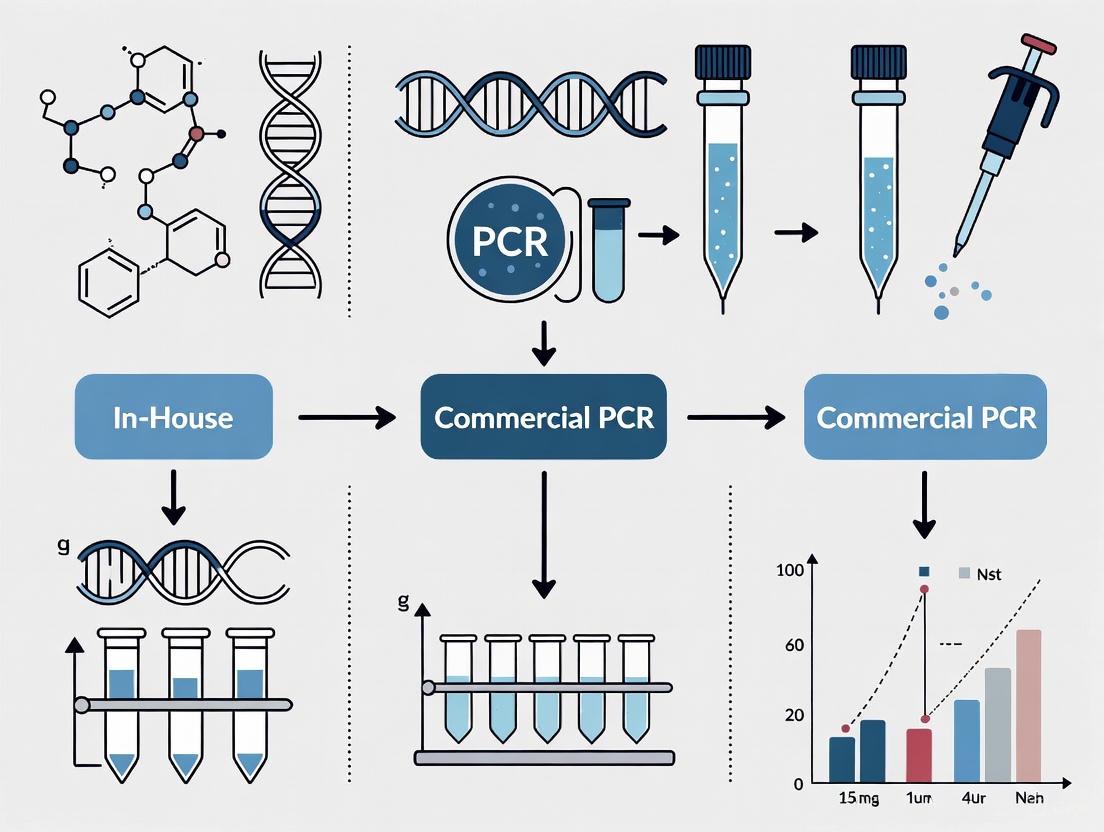
This article provides a comprehensive analysis of the cost-effectiveness of in-house versus commercial PCR diagnostics, tailored for researchers, scientists, and drug development professionals.
Cost-Effectiveness of In-House vs. Commercial PCR Diagnostics: A Strategic Analysis for Research and Development
Abstract
This article provides a comprehensive analysis of the cost-effectiveness of in-house versus commercial PCR diagnostics, tailored for researchers, scientists, and drug development professionals. It explores the foundational economic and performance principles of both approaches, examines their application across various disease states from respiratory infections to tuberculosis, addresses key troubleshooting and optimization challenges in assay development, and validates findings through comparative clinical performance data. The synthesis aims to inform strategic decision-making for implementing molecular diagnostics in research and clinical development pipelines, highlighting the impact on resource allocation, antimicrobial stewardship, and overall healthcare costs.
Defining the Cost-Effectiveness Landscape in PCR Diagnostics
The pursuit of cost-effectiveness in molecular diagnostics necessitates a thorough understanding of the core financial outlays involved in polymerase chain reaction (PCR) testing. Whether for research or clinical application, laboratories must navigate the economic balance between establishing in-house ("homebrew") assays and relying on commercial kits. This technical guide provides an in-depth analysis of the three primary cost components—reagents, equipment, and labor—framed within the broader thesis of cost-effectiveness for PCR diagnostics. For researchers and drug development professionals, this breakdown is essential for strategic planning, efficient resource allocation, and optimizing the return on investment in molecular biology workflows. A detailed cost analysis reveals that the largest share of expenditure is often attributed to laboratory consumables, which can account for over 85% of the total cost per test, underscoring the critical importance of reagent selection and management [1].
Core Cost Components of PCR
The total cost of a PCR test is an aggregate of direct and indirect expenses spread across consumables, capital assets, and human resources. A granular, activity-based micro-costing approach is required to accurately capture the value of every input consumed in the service provision [1].
Reagents and Consumables
Reagents and consumables represent the most significant recurrent variable cost in PCR testing. Their cost is directly proportional to the number of tests performed.
- Primary Reagents: This category includes the essential biochemical components for DNA amplification: DNA polymerase (e.g., Taq polymerase), primers, deoxynucleotides (dNTPs), a polymerase-specific buffer, and the template nucleic acid [2]. DNA polymerase alone can constitute a major portion of the reagent cost, as it is critical to amplification fidelity and efficiency [2].
- Secondary Additives: To optimize reaction specificity and yield, especially for challenging templates, secondary reagents are often used. These include magnesium salt (a co-factor for the polymerase), dimethyl sulfoxide (DMSO) to reduce secondary structure in DNA, and bovine serum albumin (BSA) to stabilize the enzyme [2].
- Formats: Reagents are procured either as individual components or, for greater workflow efficiency, as ready-to-use master mixes and kits [3] [4] [2]. Master mixes pre-blend the core components, reducing pipetting steps and potential contamination.
Table 1: Cost Distribution for a COVID-19 rRT-PCR Test (Provider Perspective)
| Cost Category | Percentage of Total Cost | Key Components |
|---|---|---|
| Laboratory Consumables | 87% | rRT-PCR reagents & kits, plasticware, glassware |
| Human Resources | 10% | Salaries for scientific, technical, and support staff |
| Equipment & Building | <3% | rRT-PCR machines, biosafety cabinets, building space |
Data derived from a micro-costing study at a national reference laboratory in India [1].
Equipment and Capital Outlay
PCR equipment encompasses the instruments required for nucleic acid amplification and analysis. These are capital costs, typically amortized over their useful life.
- PCR Machines (Thermal Cyclers): The core instrument for DNA amplification. Prices vary significantly based on type and features [5] [6]:
- Conventional PCR Machines: Used for standard endpoint PCR. New systems cost between $3,000 and $30,000, while used systems offer a budget-friendly option at $1,000 to $15,000 [6].
- Quantitative PCR (qPCR) Machines: Enable real-time, quantitative analysis. These are more expensive, with systems ranging from $15,000 to over $90,000 [5].
- Ancillary Equipment: A functional PCR lab requires additional capitalized equipment, including biosafety cabinets, centrifuges, vortexers, pipettes, and automated nucleic acid extraction systems [1]. The total investment in laboratory equipment for a molecular diagnostics setup can be substantial.
Labor cost is a semi-fixed expense, covering the skilled personnel required to execute the testing workflow. This includes:
- Scientific Staff: For assay design, validation, and data interpretation.
- Technical Staff: For sample processing, RNA/DNA extraction, reaction setup, and instrument operation.
- Supporting Staff: For administrative, logistical, and maintenance functions.
A detailed costing study allocated approximately 10% of the total test cost to human resources, calculated based on the time dedicated by each staff category to the testing process [1]. The "skill premium" for trained molecular biologists is a key factor in this component.
Comparative Cost Analysis: In-House vs. Commercial Tests
The choice between in-house and commercial PCR tests is a central dilemma with direct implications for cost, quality, and operational flexibility.
Quantitative Cost Data
Table 2: Comparative Cost Analysis of Different PCR Applications
| Application / Test Type | Cost Per Test (USD) | Context and Notes |
|---|---|---|
| COVID-19 rRT-PCR | $7.50 (₹566) | Provider cost at a national reference lab in India (2020-2021); consumables dominated costs [1]. |
| TB Diagnosis (AFB smear + in-house PCR dot-blot) | ~$13,749 per correctly diagnosed case | Cost-effectiveness analysis in a Brazilian TB/HIV hospital; strategy was more cost-effective than culture [7]. |
| TB Diagnosis (AFB smear + culture) | ~$50,773 per correctly diagnosed case | Higher cost due to longer turnaround time and associated treatment costs [7]. |
Strategic Considerations
In-House ("Homebrew") Assays:
- Advantages: Lower per-test reagent cost, high degree of customization and flexibility for specific research needs [8] [7].
- Disadvantages: Require significant upfront investment in assay development, optimization, and validation. Costs for quality control and troubleshooting must be factored in. Consistency may vary between labs and operators [8].
Commercial Kits:
- Advantages: High reliability, convenience, and standardized protocols. They reduce the need for in-house expertise in assay design and are often pre-validated for specific applications, accelerating implementation [8] [9].
- Disadvantages: Higher per-test cost for reagents [8]. May lack flexibility for non-standardized targets.
A 2025 multicentre study on intestinal protozoa detection found that while a commercial RT-PCR test and an in-house assay showed complete agreement for detecting Giardia duodenalis, commercial tests can offer a streamlined workflow [8]. The decision often hinges on testing volume, available expertise, and required throughput.
Experimental Protocols for Costing Studies
To ensure reproducibility and accurate comparison between different PCR setups, detailed methodologies for cost-calculation and assay performance are essential.
Micro-Costing Methodology for Unit Cost Calculation
Objective: To determine the precise per-unit (test) cost from the provider's perspective using a bottom-up, activity-based micro-costing technique [1].
- Define Cost Centers: Identify all units involved in the testing process (e.g., core diagnostic lab, administrative and maintenance unit).
- Catalog Resources:
- Capital Resources: Itemize all equipment (rRT-PCR machines, biosafety cabinets, automated nucleic acid extraction systems), furniture, and building space. Record purchase prices and estimate useful life. Annualize costs by applying a discount rate.
- Recurrent Resources:
- Human Resources (HR): Record gross monthly salaries for all staff (scientific, technical, contractual, support). Conduct time-allocation interviews to determine the proportion of time dedicated to the PCR testing workflow.
- Consumables: From stock registers, record the quantity of all reagents, kits, plasticware, and glassware consumed over a reference period (e.g., one month). Obtain unit prices from purchase records and bills.
- Overheads: Quantify utility bills (electricity, water) and other overhead expenses.
- Data Aggregation and Analysis:
- Sum all costs for the reference period.
- Divide the total cost by the number of tests performed in that period to calculate the unit cost.
- Perform univariate sensitivity analysis to determine how unit cost changes with variations in key parameters (e.g., price of consumables, number of tests, staff salaries) [1].
Protocol for Comparative Performance Evaluation
Objective: To compare the performance and effective cost-effectiveness of a commercial PCR test against an in-house developed assay [8].
- Sample Collection: Collect clinical samples (e.g., stool for protozoa, sputum for TB) from consecutively enrolled patients meeting the clinical case definition. Obtain ethical approval and informed consent.
- Testing in Parallel: Subject each sample to the following tests simultaneously:
- The index test(s): The commercial PCR kit and the in-house PCR assay.
- The reference standard: This could be a combination of traditional methods (e.g., microscopy and culture) combined with clinical diagnosis for resolution of discrepant results [7].
- Laboratory Methods:
- For the in-house PCR, use a validated protocol. For example, for TB diagnosis, this may involve DNA extraction followed by amplification targeting the IS6110 insertion element, with product detection via electrophoresis or a colorimetric dot-blot assay [7].
- For the commercial test, strictly follow the manufacturer's instructions.
- Data Analysis:
- Calculate sensitivity, specificity, positive predictive value (PPV), and negative predictive value (NPV) for each molecular test against the reference standard.
- Compare the agreement between the commercial and in-house tests (e.g., percentage agreement, kappa statistic) [8].
- Cost-Effectiveness Analysis:
- Incorporate the performance metrics (number of correctly diagnosed cases) with the comprehensive cost data derived from the micro-costing methodology.
- Calculate the cost per correctly diagnosed case for each strategy to determine the most cost-effective option [7].
The Scientist's Toolkit: Key Research Reagent Solutions
The following table details essential materials and solutions used in modern PCR workflows, with a focus on their function in optimizing reactions for research and diagnostics.
Table 3: Essential Reagents and Kits for PCR Workflows
| Product / Solution | Function | Key Characteristics |
|---|---|---|
| Hot Start PCR Reagents | Improves reaction specificity by inhibiting polymerase activity at room temperature [4]. | Prevents non-specific amplification and primer-dimer formation during reaction setup [4]. |
| KOD DNA Polymerase | A high-fidelity DNA polymerase for applications requiring ultra-low error rates [4]. | Higher accuracy than Taq polymerase; fast extension rate and high processivity [4]. |
| Direct PCR Kits | Enables PCR amplification directly from crude samples (e.g., tissue, blood) [4]. | Eliminates DNA purification steps, saving time and resources through integrated lysis and amplification [4]. |
| qPCR Master Mixes | Ready-to-use mixes for quantitative real-time PCR [4]. | Contains all core components (polymerase, dNTPs, buffer); optimized for sensitivity and compatibility with various instruments [4]. |
| One-Step RT-qPCR Kits | Integrates reverse transcription and qPCR in a single tube [4]. | Streamlines workflow for RNA target detection, reduces hands-on time and contamination risk [4]. |
Workflow and Logical Diagrams
The following diagram illustrates the logical flow of the cost analysis process for evaluating PCR testing strategies, as described in this guide.
Diagram 1: PCR Cost Analysis Workflow. This diagram outlines the logical process for analyzing the cost components of PCR testing to inform strategic decisions.
The core components of a PCR testing cost structure and their interrelationships can be visualized as follows.
*Diagram 2: PCR Cost Component Structure. This diagram breaks down the total cost of a PCR test into its three core components and further details the elements within each category._
A comprehensive understanding of the core cost components—reagents, equipment, and labor—is fundamental to advancing the thesis of cost-effectiveness in PCR diagnostics. The data reveals that reagents and consumables are the dominant cost driver, making them a primary target for efficiency gains. The decision between in-house and commercial tests is not merely a technical one but a strategic financial calculation, balancing the lower per-test cost and flexibility of in-house assays against the convenience, reliability, and speed of implementation offered by commercial kits. For researchers and drug development professionals, applying a rigorous, micro-costing methodology is essential for making informed decisions that ensure scientific goals are met in a fiscally sustainable manner. As the PCR reagents market continues to grow, projected to reach US$2.32 billion by 2032, the economic implications of these choices will only become more pronounced [2].
The choice between in-house developed and commercial polymerase chain reaction (PCR) assays is a critical decision for diagnostic laboratories, with significant implications for test performance, operational workflow, and economic efficiency. This foundational comparison examines the core analytical parameters of sensitivity and specificity within the broader context of cost-effectiveness research. While commercial tests offer standardization and regulatory approval, in-house assays provide customization and potential cost savings, creating a complex landscape for researchers and laboratory directors [10] [11].
The pursuit of optimal diagnostic solutions requires a systematic approach to evaluating these competing methodologies. This technical guide provides a framework for direct comparison, presenting standardized methodologies, quantitative performance data, and analytical workflows to support evidence-based decision-making for scientific professionals engaged in assay selection and diagnostic development.
Performance Metrics: Quantitative Comparative Analysis
Extensive evaluations across various infectious diseases reveal distinct performance patterns between commercial and in-house PCR assays. The data, synthesized from multiple clinical studies, provide insights into their relative strengths and limitations.
Table 1: Comparative Analytical Performance of Commercial vs. In-House PCR Assays
| Pathogen Category | Assay Type | Reported Sensitivity (%) | Reported Specificity (%) | Key Findings |
|---|---|---|---|---|
| SARS-CoV-2 [12] | Commercial Kits (Overall) | 80.5 - 100 (Range) | 87.9 - 99.8 (Range) | High-performing kits (GeneFinder, InBios, NxTAG, Simplexa, FDA-CDC) showed excellent detection; overall specificity was 97.9%. |
| Intestinal Protozoa [10] | Commercial (AusDiagnostics) | Variable by pathogen | Variable by pathogen | Complete agreement with in-house PCR for Giardia duodenalis; limited sensitivity for Cryptosporidium spp. and D. fragilis due to DNA extraction issues. |
| In-House RT-PCR | Variable by pathogen | Variable by pathogen | High sensitivity/specificity for G. duodenalis; performed better on preserved stool samples versus fresh samples. | |
| Chlamydia abortus [11] | Commercial Kits | Effective for symptomatic cases | Effective for symptomatic cases | Effective in clinical samples from symptomatic animals; interpretation criteria needed review for improved reliability. |
| In-House (ompA-based) | 98.0 | 96.6 | Superior diagnostic accuracy for routine testing, especially in asymptomatic carriers. | |
| SARS-CoV-2 Serology [13] | In-house ELISA (Anti-RBD) | 100 (Post 2 weeks of symptoms) | 97.7 | Substantial agreement (80.8%) with Elecsys CLIA; cost-effective tool for serosurveillance. |
| Commercial Elecsys CLIA (Anti-N) | 99.5 (Post 14 days of PCR confirmation) | 99.8 | High sensitivity and specificity; used as a reference for in-house ELISA. |
Key Reagent Solutions and Their Functions
The execution of both commercial and in-house PCR assays relies on a foundation of critical reagents and instruments. The following table catalogues essential components referenced in the evaluated studies.
Table 2: Key Research Reagent Solutions in PCR Diagnostics
| Reagent / Instrument Category | Specific Example | Function in Assay |
|---|---|---|
| Nucleic Acid Extraction | MagNA Pure 96 System (Roche) [10] | Automated nucleic acid purification from clinical samples using magnetic bead technology. |
| Sample Preparation Buffer | S.T.A.R. Buffer (Roche) [10] | Stool transport and recovery buffer that stabilizes samples for subsequent DNA extraction. |
| PCR Master Mix | TaqMan Fast Universal PCR Master Mix (Thermo Fisher) [10] | Provides optimized buffer, enzymes, dNTPs, for efficient and specific DNA amplification in real-time PCR. |
| Commercial Multiplex PCR Panel | BioFire FilmArray Pneumonia Panel (bioMérieux) [14] | Syndromic panel for simultaneous detection of multiple pathogens and antibiotic resistance genes from a single sample. |
| Automated Immunoassay System | Cobas e601 System (Roche) [13] | Platform for running Elecsys CLIA serological assays, providing high-throughput automated testing. |
| Antigen for Serology | Recombinant RBD Protein [13] | Used to coat plates in in-house ELISA to specifically capture anti-SARS-CoV-2 IgG antibodies from patient serum. |
Experimental Protocols for Comparative Evaluation
Standardized Methodology for Assay Comparison
A cross-European laboratory evaluation for detecting Chlamydia abortus provides a robust model for comparative studies [11]. The protocol emphasizes consistency across multiple testing sites and uses well-characterized sample sets to ensure reliable results.
Protocol Steps:
- Sample Collection: Obtain clinical samples (e.g., placentas, vaginal swabs, fetal organs) from both symptomatic and asymptomatic subjects. This differentiation is crucial for evaluating assay performance across disease states [11].
- DNA Extraction: Perform nucleic acid extraction using a standardized, automated system (e.g., MagNA Pure 96) across all participating laboratories to minimize variability [10].
- Parallel Testing: Run all samples in parallel using both commercial kits (strictly following manufacturer protocols) and the in-house PCR methods (e.g., ompA-based assays) [11].
- Data Analysis: Calculate sensitivity, specificity, positive predictive value (PPV), and negative predictive value (NPV) for each method. Use a bivariate model for paired performance estimates and generate summary receiver operating characteristic (SROC) curves [12].
- Result Interpretation: Compare diagnostic odds ratios (DOR) to identify assays with superior detection performance. The ompA-based in-house assay, for instance, demonstrated a sensitivity of 98.0% and specificity of 96.6%, making it recommended for routine testing [11].
Protocol for In-House Assay Development and Validation
The development and validation of a cost-effective, in-house ELISA for SARS-CoV-2 serology, as demonstrated by the Armauer Hansen Research Institute (AHRI), offers a template for creating robust in-house tests [13].
Protocol Steps:
- Plate Coating: Coat microtiter plates with purified recombinant receptor-binding domain (RBD) of the SARS-CoV-2 spike protein (1 μg/mL in PBS) and incubate overnight at 4°C [13].
- Blocking: Remove excess antigen and block plates with 4% skimmed milk in PBS with 0.1% Tween-20 for 2 hours at room temperature to prevent non-specific binding [13].
- Sample Incubation: Add patient serum or plasma samples to the wells and incubate, allowing specific antibodies to bind to the coated antigen.
- Detection: Add an enzyme-conjugated secondary antibody (e.g., Horseradish Peroxidase-conjugated anti-human IgG) and incubate.
- Signal Development: Add a colorimetric substrate solution. The enzyme converts the substrate, producing a measurable color change proportional to the amount of antibody bound.
- Validation: Test the in-house assay against established commercial assays (e.g., Elecsys CLIA, rapid LFAs) on a large set of clinical samples (e.g., n=1441). Calculate overall percentage agreement, positive percent agreement (PPA), negative percent agreement (NPA), and Cohen's kappa (κ) to quantify concordance [13].
Cost-Effectiveness and Market Context
The performance of a diagnostic assay cannot be divorced from its economic impact. Evidence indicates that while molecular tests like PCR incur upfront costs, they can generate significant downstream savings and improve patient outcomes. A study on rapid, syndromic PCR for hospital-acquired pneumonia (HAP/VAP) found that PCR-guided therapy led to lower total ICU costs (£33,149 vs. £40,951 for standard of care) and was cost-effective for antibiotic stewardship, though not for clinical cure due to fewer cured cases in the intervention group [14].
Furthermore, a large US claims data analysis showed that patients with respiratory infections tested with syndromic RT-PCR had significantly lower subsequent healthcare costs and resource utilization than those tested with traditional methods (e.g., culture), implicating potential for improved value in patient care [15]. The global PCR diagnostics market, projected to grow from USD 6.21 billion in 2024 to USD 10.87 billion by 2032, reflects the expanding adoption and commercial viability of these technologies [16].
The choice between in-house and commercial PCR diagnostics involves a multi-factorial decision process that balances performance, cost, and operational capacity.
This foundational comparison demonstrates that the optimal choice between commercial and in-house PCR assays is context-dependent. Commercial tests offer reliability, standardization, and regulatory compliance, making them suitable for high-throughput, standardized diagnostics [12] [17]. In-house assays provide flexibility, potential cost savings for high-volume testing, and the ability to target novel pathogens, making them viable in resource-conscious or research-oriented settings [13] [10]. A thorough evaluation of both analytical performance and economic impact, guided by the standardized protocols and decision framework presented herein, is essential for advancing effective and sustainable diagnostic operations.
Polymersse Chain Reaction (PCR) technologies have revolutionized molecular biology and diagnostics, providing powerful tools for amplifying and detecting nucleic acids. This guide explores the spectrum of PCR platforms, from traditional methods to advanced quantitative and digital systems, focusing on their technical principles, applications, and performance characteristics. The selection of an appropriate PCR platform is a critical decision for researchers and diagnostic developers, impacting not only the quality of scientific data but also the operational costs and feasibility of testing programs. This is particularly relevant when evaluating the cost-effectiveness of in-house developed tests versus commercial diagnostic solutions [18]. As the PCR technologies market continues to grow, projected to advance at a CAGR of 7.0% from 2024 to 2030 [19], understanding the technical capabilities and limitations of each platform becomes essential for optimizing resource allocation in research and clinical settings.
The evolution of PCR technology has progressed from basic qualitative detection to sophisticated quantitative and absolute measurement systems. Conventional PCR established the fundamental principles of DNA amplification, while real-time PCR introduced quantitative capabilities through fluorescent detection. Most recently, digital PCR has brought unprecedented precision through sample partitioning and absolute quantification without standard curves [20]. This technical progression has expanded applications from simple presence/absence testing to complex analyses including gene expression profiling, viral load monitoring, rare mutation detection, and minimal residual disease assessment [21].
This guide provides a comprehensive technical comparison of these platforms, detailed experimental methodologies, and a structured framework for evaluating their implementation in both research and diagnostic contexts, with particular emphasis on the cost-benefit analysis of laboratory-developed tests versus commercial diagnostic solutions.
Technical Foundations of PCR Platforms
Conventional PCR
Conventional PCR, the original implementation of the technology, is a fundamental molecular biology technique that amplifies specific DNA sequences through thermal cycling. The process involves repeated cycles of denaturation (separating DNA strands), annealing (primer binding to target sequences), and extension (DNA synthesis by polymerase enzyme) [22]. This exponential amplification process can generate millions of copies of the target DNA sequence from minimal starting material.
The detection method for conventional PCR is end-point analysis, typically performed using gel electrophoresis. This technique separates amplified DNA fragments by size, allowing visualization of amplification products but providing only qualitative or semi-quantitative results [22] [20]. The lack of robust quantification, combined with lower sensitivity and specificity compared to advanced methods, limits its applications in modern diagnostic settings where precise quantification is essential.
Real-Time PCR (qPCR)
Real-time PCR, also known as quantitative PCR (qPCR), represents a significant advancement over conventional PCR by enabling monitoring of DNA amplification as it occurs in real-time [22]. This technology utilizes fluorescent reporter molecules that increase in signal intensity proportionally to the amount of amplified DNA. The key quantitative parameter in real-time PCR is the cycle threshold (Ct), which represents the PCR cycle number at which the fluorescence signal exceeds a predefined background threshold [23].
The quantification capability of real-time PCR relies on the inverse relationship between the starting quantity of the target nucleic acid and the Ct value. Targets present in higher concentrations will produce detectable fluorescence earlier in the amplification process (lower Ct values), while lower concentrations will result in later detection (higher Ct values) [22]. This quantitative capability has made real-time PCR indispensable in applications such as gene expression analysis, viral load quantification, and pathogen detection [21].
Real-time PCR systems can utilize either DNA-binding dyes or target-specific probes for detection. DNA-binding dyes like SYBR Green intercalate with double-stranded DNA and are cost-effective but lack specificity for distinguishing between different amplification products. In contrast, sequence-specific probes (such as TaqMan probes) provide enhanced specificity through hybridization to internal target sequences and utilize fluorescence resonance energy transfer (FRET) for detection [22].
Digital PCR (dPCR)
Digital PCR (dPCR) represents the most recent evolution in PCR technology, introducing a fundamentally different approach to quantification. This method partitions the PCR reaction mixture into thousands of individual nanoscale reactions, either in microfluidic chambers (nanowell-based systems like QIAcuity) or water-in-oil emulsion droplets (droplet digital PCR or ddPCR) [24]. Each partition functions as an independent PCR reactor, containing either zero, one, or a few target molecules.
Following amplification, each partition is analyzed for fluorescence signal to determine whether amplification has occurred (positive partition) or not (negative partition) [20]. The absolute quantity of the target nucleic acid in the original sample is then calculated using Poisson statistical analysis based on the ratio of positive to total partitions, without requiring standard curves [24].
This partitioning approach provides dPCR with several advantages over real-time PCR, including superior sensitivity for detecting rare genetic variants, exceptional precision for absolute quantification, and reduced susceptibility to PCR inhibitors that can affect amplification efficiency [24] [20]. These characteristics make dPCR particularly valuable for applications requiring absolute quantification, such as liquid biopsies for cancer monitoring, detection of minimal residual disease, validation of gene expression findings, and accurate quantification of low-abundance pathogens [24].
Comparative Analysis of PCR Platforms
Technical Performance Comparison
The three primary PCR platforms differ significantly in their technical capabilities, making each suitable for specific applications and research questions. Understanding these performance characteristics is essential for selecting the appropriate technology for a given experimental or diagnostic need.
Table 1: Technical Comparison of Conventional PCR, Real-Time PCR, and Digital PCR
| Parameter | Conventional PCR | Real-Time PCR (qPCR) | Digital PCR (dPCR) |
|---|---|---|---|
| Quantification Capability | Qualitative/Semi-quantitative | Fully quantitative (relative quantification) | Absolute quantification without standards |
| Detection Method | End-point (gel electrophoresis) | Real-time fluorescence monitoring | End-point counting of positive partitions |
| Sensitivity | Moderate | High (detection of low copy numbers) | Very high (detection of rare mutations and single copies) |
| Precision and Accuracy | Low precision and accuracy | High precision for relative quantification | Superior precision and accuracy for absolute quantification |
| Throughput | Low to moderate | High (especially with automated systems) | Moderate to high (platform-dependent) |
| Multiplexing Capability | Limited (size-based separation) | Good (multiple fluorescence channels) | Good (multiple fluorescence channels) |
| Susceptibility to Inhibitors | High | Moderate to high | Low (due to sample partitioning) |
| Requirement for Standard Curves | Not applicable | Required for quantification | Not required |
| Data Output | Presence/absence of target | Ct values, amplification curves, melting curves | Absolute copy number concentration |
| Key Applications | Cloning, genotyping, teaching, basic research | Gene expression, viral load monitoring, pathogen detection | Rare mutation detection, copy number variation, liquid biopsy, rare sequence detection |
Application-Oriented Platform Selection
The choice between conventional PCR, real-time PCR, and digital PCR should be guided by the specific requirements of the experimental or diagnostic application:
Conventional PCR remains appropriate for applications where simple qualitative detection is sufficient, such as confirming the presence of a specific gene in cloning procedures, educational demonstrations, genotyping with clear size differences, and other scenarios where budget constraints are paramount and quantitative data is not required [22].
Real-Time PCR is the preferred choice for the majority of quantitative applications in research and diagnostics. Its established position in gene expression analysis, viral load monitoring (as demonstrated during the COVID-19 pandemic) [1], pathogen quantification, and genetic validation studies makes it the workhorse of modern molecular biology laboratories. The robust protocols, extensive validation data, and relatively lower cost compared to dPCR contribute to its widespread adoption [22] [21].
Digital PCR excels in specialized applications requiring the highest sensitivity and precision. Its ability to detect rare mutations in oncological research (e.g., liquid biopsies), accurately quantify copy number variations, validate findings from other PCR platforms, and measure minimal residual disease makes it particularly valuable in clinical research and advanced diagnostic development [24] [20]. The technology's resistance to inhibitors also provides advantages when working with complex sample matrices.
Experimental Design and Methodologies
Workflow Comparison
The experimental workflows for conventional PCR, real-time PCR, and digital PCR share common initial steps but diverge in their amplification and detection phases. The following diagram illustrates the core processes and decision points for each platform:
Diagram 1: PCR Platform Workflow Comparison
Key Experimental Protocols
Real-Time PCR Efficiency Determination
PCR efficiency is a critical parameter in real-time PCR that significantly impacts quantification accuracy. The efficiency (E) of a PCR reaction represents the proportion of template molecules that are duplicated in each cycle. An ideal reaction has an efficiency of 100% (E=1.0), meaning the template quantity doubles every cycle. However, reaction inhibitors, suboptimal primer design, or poor reaction conditions can reduce efficiency, leading to inaccurate quantification [23].
The standard method for determining PCR efficiency involves creating a dilution series of the target nucleic acid, typically 5-fold or 10-fold dilutions. Each dilution is amplified in real-time PCR, and the resulting Ct values are plotted against the logarithm of the template concentration or dilution factor. The slope of this standard curve is used to calculate PCR efficiency using the formula:
E = 10^(–1/S) – 1
Where S represents the slope of the standard curve [23].
For accurate relative quantification using the comparative ΔΔCt method, the amplification efficiencies of the target and reference genes must be approximately equal. A validation experiment should be performed to confirm that the difference in efficiency between targets is negligible. If the absolute value of the slope of the plot of ΔCt (Cttarget - Ctreference) versus the log template amount is less than 0.1, the efficiencies can be considered comparable [23].
When efficiencies differ significantly, the ΔΔCt method will produce inaccurate results. The magnitude of this error can be substantial; for example, with a PCR efficiency of 0.9 instead of 1.0, the error at cycle 25 reaches 261%, resulting in a calculated expression level that is 3.6-fold lower than the actual value [23]. In such cases, efficiency-corrected calculation methods or standard curve-based approaches must be employed.
Digital PCR Absolute Quantification Protocol
Digital PCR provides absolute quantification without requiring standard curves, but requires specific experimental considerations:
Sample Partitioning: The PCR reaction mixture is partitioned into thousands of individual reactions using microfluidic systems (nanowells or droplets). The partitioning should be optimized to ensure a sufficient number of partitions for statistical robustness while maintaining a reasonable number of target molecules per partition for accurate Poisson distribution application [24].
Thermal Cycling: Partitions undergo standard PCR amplification. The endpoint detection approach means amplification does not need to be monitored in real-time, simplifying the thermal cycling requirements.
Fluorescence Reading: Following amplification, each partition is analyzed for fluorescence signal using specialized readers. The binary classification of partitions as positive or negative is based on fluorescence thresholds established from negative controls.
Poisson Statistical Analysis: The absolute concentration of the target nucleic acid is calculated using Poisson statistics to account for the possibility of multiple target molecules being present in a single partition. The formula for concentration calculation is:
Concentration = –ln(1 – p) × (total partitions / partition volume)
Where p represents the proportion of positive partitions [24].
This absolute quantification approach demonstrates particular value in applications such as respiratory virus quantification, where dPCR has shown superior accuracy compared to real-time RT-PCR, especially for medium to high viral loads [24].
Essential Research Reagent Solutions
Successful implementation of PCR-based assays requires careful selection of reagents and consumables. The following table outlines key components and their functions in PCR workflows:
Table 2: Essential PCR Research Reagents and Their Functions
| Reagent Category | Specific Examples | Function | Technical Considerations |
|---|---|---|---|
| Polymerase Enzymes | Taq polymerase, reverse transcriptase | Catalyzes DNA synthesis; reverse transcribes RNA to cDNA for RT-PCR | Thermostability, fidelity, processivity, inhibitor resistance |
| Primers | Target-specific oligonucleotides | Binds to complementary sequences to initiate amplification | Specificity, GC content, length, secondary structure, concentration optimization |
| Detection Chemistry | SYBR Green, TaqMan probes, molecular beacons | Generates fluorescence signal for detection in real-time PCR and dPCR | Specificity (probes vs. dyes), cost, multiplexing capability, quenching efficiency |
| dPCR Partitioning Reagents | Partitioning oils, surface coatings | Creates nanoscale reactions for digital quantification | Partition stability, uniformity, chemical compatibility with PCR components |
| Nucleic Acid Extraction Kits | Silica-membrane columns, magnetic beads | Isolates and purifies nucleic acids from biological samples | Yield, purity, processing time, compatibility with sample type, automation capability |
| Quantification Standards | Synthetic oligonucleotides, reference materials | Calibrates and validates PCR quantification | Traceability, stability, concentration accuracy, matrix effects |
Cost-Effectiveness Analysis: In-House vs. Commercial PCR Diagnostics
Economic Considerations for Platform Selection
The economic evaluation of PCR platforms extends beyond initial instrument acquisition to include ongoing operational costs, personnel requirements, and implementation timelines. These factors play a crucial role in determining the cost-effectiveness of in-house laboratory-developed tests (LDTs) versus commercial diagnostic solutions [18].
Table 3: Cost Structure Analysis for PCR Platforms
| Cost Component | Conventional PCR | Real-Time PCR | Digital PCR |
|---|---|---|---|
| Instrument Acquisition | Low ($5K-$15K) | Moderate to High ($25K-$100K+) | High ($50K-$150K+) |
| Cost per Test (Consumables) | Low ($1-$5) | Moderate ($5-$20) | High ($15-$40) |
| Labor Requirements | High (manual analysis) | Moderate (automated analysis) | Moderate (automated analysis) |
| Space Requirements | Moderate (instrument + gel documentation) | Moderate (consolidated system) | Moderate to High (instrument + potentially partitioning system) |
| Training Needs | Basic technical skills | Advanced technical and data analysis skills | Specialized technical and statistical skills |
| Throughput Capacity | Low to Moderate | High | Moderate to High |
| Maintenance Costs | Low | Moderate to High | High |
A detailed cost-analysis of COVID-19 rRT-PCR testing conducted in India revealed that the per-test cost was approximately $7.5 during the early pandemic phase. Laboratory consumables constituted the largest proportion (87%) of total costs, followed by human resources (10%) [1]. This highlights the significant impact of reagent costs in overall test economics, particularly in high-volume testing scenarios.
In-House vs. Commercial Assay Considerations
The decision between developing laboratory-developed tests (LDTs) and implementing commercial PCR assays involves balancing multiple factors:
Laboratory-Developed Tests (LDTs) offer greater flexibility for detecting novel or rare pathogens, rapid response capability for emerging threats, and potential cost savings for high-volume routine testing [18]. The development of the first SARS-CoV-2 LDT shortly after sequence publication demonstrates this responsiveness advantage [18]. However, LDTs require significant validation efforts, ongoing quality control, and expertise in assay design and optimization. Regulatory considerations, including potential future FDA oversight of LDTs, add complexity to this approach [18].
Commercial Assays provide standardized protocols, regulatory approvals (CE marking or FDA clearance), technical support, and quality-controlled reagents [18]. These advantages facilitate implementation in laboratories with limited method development expertise. However, commercial kits are generally more expensive than LDTs and may not be available for specialized or rare targets. Furthermore, as noted in validation guidelines, "CE marking does not necessarily guarantee the rigorous validation of the assay" [18], emphasizing that laboratories must still perform verification studies appropriate for their specific patient populations and testing environments.
The economic balance between these approaches depends on testing volume, technical expertise availability, regulatory requirements, and the need for assay customization. High-volume testing in specialized reference laboratories may benefit from LDT approaches, while lower-volume or more standardized testing scenarios may favor commercial solutions.
Emerging Trends in PCR Technologies
The PCR technology landscape continues to evolve, driven by several key trends:
Automation and Artificial Intelligence: Integration of automation and AI is transforming PCR workflows, reducing manual intervention, improving reproducibility, and enhancing data analysis capabilities. These advancements are particularly valuable in high-throughput diagnostic laboratories handling increased testing volumes [25].
Multiplexing Capabilities: Development of advanced multiplex PCR systems enabling simultaneous detection of multiple targets in a single reaction. This trend is especially relevant in respiratory virus diagnostics, where co-infections present significant clinical challenges [24] [21].
Point-of-Care Applications: Miniaturization of PCR systems and development of rapid-cycling instruments are expanding PCR applications to point-of-care settings. These systems reduce reagent volumes, shorten assay times, and enable molecular testing outside traditional laboratory environments [19].
Digital PCR Adoption: While currently limited by higher costs and reduced automation compared to real-time PCR [24], dPCR is finding increasing application in specialized areas requiring absolute quantification, particularly in oncology and liquid biopsy applications [21]. As the technology matures and costs decrease, broader adoption is anticipated.
The spectrum of PCR platforms, from conventional to real-time and digital PCR, offers researchers and clinicians a range of technological solutions with complementary strengths and applications. Conventional PCR remains valuable for basic qualitative applications, while real-time PCR provides robust quantitative capabilities for most research and diagnostic needs. Digital PCR offers superior precision and absolute quantification for specialized applications requiring the highest sensitivity.
The selection of an appropriate PCR platform must consider both technical requirements and economic factors, particularly in the context of in-house versus commercial diagnostic development. Factors such as testing volume, required throughput, quantification accuracy, sensitivity requirements, and available resources should guide this decision. As PCR technologies continue to advance, with increasing automation, multiplexing capabilities, and miniaturization, their role in research and clinical diagnostics is expected to expand further, providing powerful tools for understanding and detecting disease.
The cost-effectiveness of PCR-based testing depends on appropriate technology matching to application requirements, optimized workflow implementation, and careful consideration of the total cost of ownership rather than merely initial instrument acquisition costs. This comprehensive understanding of the PCR technology landscape enables researchers and diagnostic developers to make informed decisions that maximize scientific and clinical value while optimizing resource utilization.
The choice between implementing in-house developed tests or commercial assays is a critical economic and strategic decision for diagnostic laboratories. This decision is particularly salient in the field of PCR-based molecular diagnostics, where factors such as test performance, regulatory compliance, and operational complexity directly impact the total cost of ownership. Within the context of a broader thesis on cost-effectiveness, this analysis provides a technical framework for evaluating the direct costs associated with each pathway. The growing stringency of regulations, such as the European In Vitro Diagnostic Regulation (IVDR) which requires laboratories to justify the use of in-house assays when CE-IVD marked alternatives exist, adds a layer of complexity to this economic calculus [26]. This guide synthesizes current research data and methodologies to equip researchers and drug development professionals with the tools for a rigorous direct cost analysis.
Performance and Economic Data Comparison
A direct cost analysis must be grounded in comparative performance data and a detailed understanding of cost components. The following tables summarize key findings from recent studies and break down the primary cost factors influencing the in-house versus commercial decision.
Table 1: Comparative Performance of In-House vs. Commercial PCR Assays
| Pathogen/Target | Assay Type | Sensitivity | Specificity | Key Findings & Notes | Source |
|---|---|---|---|---|---|
| Intestinal Protozoa (Giardia, Cryptosporidium, E. histolytica, D. fragilis) | In-house RT-PCR | High | High | Complete agreement with commercial assay for G. duodenalis. Performance for D. fragilis was inconsistent, potentially due to DNA extraction issues. | [8] |
| Commercial RT-PCR (AusDiagnostics) | High | High | |||
| Schistosoma mansoni | In-house RT-PCR | Not significantly different (p=1.0) | Not significantly different (p=1.0) | Performance was not statistically different, but concordance for positive cases was poor (AC1=0.38), suggesting clinically significant discrepancies may occur. | [26] |
| Commercial RT-PCR (Biosynex Helminths AMPLIQUICK) | Not significantly different (p=1.0) | Not significantly different (p=1.0) | |||
| Strongyloides stercoralis | In-house RT-PCR | Not significantly different (p=1.0) | Not significantly different (p=1.0) | Performance was not statistically different, with good concordance for positive cases (AC1=0.78). | [26] |
| Commercial RT-PCR (Biosynex Helminths AMPLIQUICK) | Not significantly different (p=1.0) | Not significantly different (p=1.0) |
Table 2: Direct Cost Component Analysis for PCR Assays
| Cost Category | In-House Assays | Commercial Assays | Impact on Total Cost |
|---|---|---|---|
| Initial Development & Validation | High (Primer/Probe design, protocol optimization, extensive validation) | None (Assumed by manufacturer) | A significant, upfront, fixed cost for in-house tests. |
| Equipment | Variable (Can often use open-platform instruments) | Variable (May require proprietary platforms; "high capital" can be a barrier) | Platform locking with commercial kits can increase long-term costs [27]. |
| Reagents & Consumables | Lower per-test cost (Bulk purchase of core reagents) | Higher per-test cost (Pre-dispensed, proprietary kits; reagents are 55-65% of lifetime cost) | The dominant recurring cost; commercial kits offer a predictable, but higher, per-test price [27]. |
| Labor | High (Requires skilled technicians for preparation, QC, and troubleshooting) | Lower (Streamlined, standardized workflows reduce hands-on time) | Simplified commercial workflows can "slash" hands-on time and training needs [28]. |
| Quality Control & Assurance | High (Ongoing in-house responsibility for full QC lifecycle) | Lower (Largely transferred to the manufacturer) | A recurring, often underestimated, operational cost for in-house tests. |
| Regulatory Compliance | High (IVDR justification, extensive documentation, maintenance) | Lower (Manufacturer provides CE-IVD mark and technical documentation) | Compliance for in-house tests is a "cumulative burden" favoring well-capitalized entities [27]. |
Detailed Experimental Protocols for Cost-Effectiveness Research
To ensure the reproducibility of cost-effectiveness studies, the following outlines standardized protocols for comparing assays and modeling economic outcomes.
Protocol for Diagnostic Performance Comparison
This protocol is adapted from a study comparing in-house and commercial PCRs for helminth diagnostics [26].
1. Sample Selection and Classification:
- Population: Use well-characterized, biobanked clinical samples.
- Case Definition: Classify samples as positive "cases" based on a composite reference standard (e.g., positivity by a reference PCR and/or a gold-standard method like copromicroscopy or culture).
- Control Definition: Classify samples as negative "controls" based on negativity by all comparative diagnostic methods.
- The study on S. mansoni and S. stercoralis used 45 cases/52 controls and 29 cases/54 controls, respectively [26].
2. DNA Extraction:
- Re-extract DNA from all selected samples immediately before testing to minimize pre-analytical variation.
- Process each sample aliquot in parallel using the specific pre-extraction procedures required by the in-house and commercial methods to ensure optimal performance for each.
3. Parallel PCR Testing:
- Perform both the in-house and commercial RT-PCR assays on the re-extracted DNA from each sample.
- Include appropriate controls (positive, negative, internal extraction) in each run to monitor for contamination and assay efficiency.
- The thermocycling conditions and reaction mixes will be unique to each assay and should be followed as per validated protocols.
4. Data Analysis:
- Calculate sensitivity, specificity, positive predictive value (PPV), and negative predictive value (NPV) for each assay against the predefined case/control status.
- Use statistical tests like McNemar's Chi-squared test to determine if differences in sensitivity and specificity are significant (with a common threshold of p < 0.05).
- Assess agreement between the two methods using coefficients such as Gwet's AC1, which is more robust than Cohen's Kappa when prevalence is very high or low.
Protocol for Cost-Effectiveness Analysis (CEA)
This protocol is based on methodologies used in evaluations of novel rapid diagnostic tests for tuberculosis and bloodstream infections [29] [30] [31].
1. Model Design:
- Type: Construct a decision-tree model to capture the initial diagnostic pathways and short-term outcomes (e.g., correct/incorrect diagnosis, treatment initiation). For chronic diseases, a Markov model can be linked to the decision tree to simulate long-term outcomes like quality-adjusted life years (QALYs).
- Perspective: Define the analysis perspective, typically healthcare provider (direct medical costs) or societal (includes productivity losses).
- Comparators: The model should compare the new diagnostic strategy (e.g., in-house test) against the current standard of care (e.g., commercial test or traditional method).
2. Parameter Estimation:
- Test Performance: Input sensitivity and specificity values derived from studies using the protocol in Section 3.1.
- Cost Data: Collect direct medical costs (test reagents, equipment, labor, confirmatory testing, treatment) and indirect costs (patient travel, productivity loss). Costs should be inflated to a common currency and year.
- Health Outcomes: For cost-utility analysis, use QALYs. Parameters for utility weights and disease progression are typically sourced from published literature.
3. Analysis:
- Base-Case Analysis: Calculate the Incremental Cost-Effectiveness Ratio (ICER): (CostNew - CostStandard) / (EffectivenessNew - EffectivenessStandard).
- Threshold Analysis: Compare the ICER to a pre-specified Willingness-To-Pay (WTP) threshold per QALY gained (e.g., $1,357 in a rural Philippines study [29]).
- Net Monetary Benefit (NMB): Calculate as (Effectiveness * WTP) - Cost. A positive NMB indicates cost-effectiveness.
- Sensitivity Analysis: Perform probabilistic sensitivity analysis to model the impact of uncertainty in all input parameters on the results. One-way sensitivity analysis can identify the most influential parameters (e.g., test specificity was a key driver in a TB test CEA [31]).
Workflow and Decision Pathway Visualizations
Assay Selection Workflow
CEA Parameter Relationships
The Scientist's Toolkit: Essential Research Reagents and Materials
Table 3: Key Research Reagent Solutions for Comparative Studies
| Reagent / Material | Function in Protocol | Specific Example / Note |
|---|---|---|
| Biobanked Clinical Samples | Serves as the validated sample panel for head-to-head assay performance comparison. | Samples should be characterized by a reference standard (e.g., PCR, microscopy). Stored in preservation media can yield better DNA results [8]. |
| DNA Extraction Kits | Isolate nucleic acid from samples, a critical step that can impact downstream PCR efficiency. | Different extraction methods may be required for in-house vs. commercial assays, as seen in the intestinal protozoa study [8]. |
| PCR Master Mix | Contains enzymes, dNTPs, and buffer necessary for the DNA amplification reaction. | In-house assays require separate sourcing and optimization. Commercial kits provide pre-mixed, lyophilized pellets for consistency [28]. |
| Primers & Probes | Target-specific oligonucleotides that define the assay's specificity and enable detection. | Designed and validated in-house. The commercial Biosynex test showed discrepant results for S. mansoni, likely due to different molecular targets [26]. |
| Internal Control | Monitors nucleic acid extraction efficiency and PCR inhibition, ensuring result validity. | Often added during extraction, e.g., Phocid alphaherpesvirus 1 (PhHV-1), to achieve a specific Ct value range [26]. |
| Positive & Negative Controls | Verify that the assay is functioning correctly and is free from contamination in each run. | Commercially available quantified standards or well-characterized patient samples. Essential for both in-house and commercial workflows. |
The economic evaluation of diagnostic technologies, particularly polymerase chain reaction (PCR) testing, has become increasingly critical in healthcare management. For researchers and drug development professionals, understanding the broader economic impact of these technologies extends beyond simple test costs to encompass system-wide effects on healthcare resource utilization (HCRU) and total costs of care. Within the context of comparing in-house versus commercial PCR diagnostics, economic assessments must consider how testing speed, accuracy, and implementation setting influence downstream medical expenditures, antibiotic stewardship, and patient flow management.
This technical guide synthesizes current evidence on how PCR diagnostics, including both in-house developed tests and commercial systems, affect healthcare economics. The analysis focuses specifically on respiratory tract infections (RTIs) as a clinically and economically significant model system, given that RTIs account for almost one-fifth of all outpatient visits (193 visits per 1000 people) and more than $1 billion in healthcare expenditures annually in the United States [15].
Quantitative Economic Outcomes of PCR Testing
Recent large-scale retrospective studies provide compelling evidence for the economic value of syndromic PCR testing in respiratory infections. A 2025 propensity-matched, retrospective study analyzing data from the IQVIA PharMetrics Plus database (July 2020-October 2023) demonstrated significant reductions in healthcare costs associated with syndromic RT-PCR testing compared to traditional diagnostic methods [15] [32].
Table 1: Healthcare Cost Comparison Between Syndromic RT-PCR and Culture-Based Testing
| Cost Category | Oropharyngeal Infections | Respiratory Tract Infections |
|---|---|---|
| Total Outpatient Services | $2,598 (RT-PCR) vs $2,970 (Culture) (P<0.0001) | $2,796 (RT-PCR) vs $3,221 (Culture) (P<0.0001) |
| Physician Office Visits | $624 (RT-PCR) vs $689 (Culture) (P=0.0002) | $525 (RT-PCR) vs $703 (Culture) (P=0.0057) |
| Emergency Department Visits | $290 (RT-PCR) vs $397 (Culture) (P=0.0192) | $253 (RT-PCR) vs $355 (Culture) (P=0.0011) |
| Other Medical Services | $1,684 (RT-PCR) vs $1,883 (Culture) (P<0.0001) | $2,018 (RT-PCR) vs $2,163 (Culture) (P<0.0001) |
Additional research has confirmed these findings across different healthcare settings. A 2024 analysis of the Marketscan Commercial Database revealed that patients with upper respiratory tract infections who received PCR testing had significantly lower total costs ($353.42 PMPM) over a 4-week period compared to those receiving culture-based testing ($586.32 PMPM) [33]. A substantial component of this savings came from reduced pharmacy costs in the PCR cohort ($35.90 PMPM) compared to the culture cohort ($61.10 PMPM), suggesting more appropriate antibiotic prescribing [33].
Point-of-care PCR testing demonstrates particular economic advantages despite higher initial test costs. A cost-consequence analysis of the Xpert Xpress CoV-2/Flu/RSV plus test strategy found savings of $196–$269 per patient compared to send-out PCR and antigen strategies, respectively, attributable to reduced downstream resource utilization including hospitalizations and ICU admissions [34].
Table 2: Economic Impact of Rapid PCR Testing in Emergency Settings
| Study | Setting | Intervention | Economic Outcome |
|---|---|---|---|
| Soto et al. (2016) [35] | Emergency Department | Xpert Flu vs in-house PCR | Reduced cost per patient: $113 (ED), $70 (hospitalized) |
| Davies et al. (2024) [34] | Point-of-Care Testing | POC PCR vs antigen/send-out PCR | Savings of $196–$269 per patient |
| Seasonal PCR Panel Study (2025) [36] | Emergency Department | Seasonal PCR vs conventional testing | Reduced antibiotic duration by 1.5–1.7 days |
Methodologies for Economic Evaluation of PCR Diagnostics
Retrospective Database Analysis
The propensity-matched, retrospective cohort design represents a robust methodology for evaluating the real-world economic impact of diagnostic technologies. The 2025 study by Evans et al. provides a exemplary model for this approach [15] [32]:
Data Source: IQVIA PharMetrics Plus adjudicated claims database, representing a US commercially insured population under 65 years.
Cohort Identification: Patients with ICD-10-CM codes for diagnosis or symptoms of oropharyngeal infection or RTI in outpatient settings between January 2021 and April 2023.
Matching Methodology: Direct matching by age group followed by propensity score matching (PSM) using greedy nearest neighbor matching without replacement at 1:1 ratio, with caliper widths of 0.01 of the standard deviation of the logit of the propensity score.
Subcohorts: Patients receiving syndromic RT-PCR were matched against four comparator groups: other PCR, point-of-care (POC) only, culture, or no test.
Outcome Measures: All-cause HCRU and costs (allowed amount) over 6-month follow-up period across multiple service categories: total outpatient, physician office visits, ED visits, and other medical services.
Statistical Analysis: Standardized mean differences (SMDs) were computed to assess baseline imbalances, with SMD <0.10 indicating successful matching. Post-matching analyses used weighted χ² tests for categorical variables and weighted t-tests for continuous variables.
Cost-Minimization Analysis for In-House PCR Development
For researchers evaluating in-house versus commercial PCR systems, cost-minimization analysis (CMA) provides a critical methodology. A study on cytomegalovirus (CMV) quantitative PCR offers a transferable protocol [37]:
Perspective: Laboratory cost perspective, assuming diagnostic equivalence between methodologies.
Cost Components: Reagents, consumables, equipment depreciation, technical time, quality control, and overhead allocation.
Methodology Validation: Analytical sensitivity (limit of detection and quantification), analytical specificity (cross-reactivity testing), precision, curve variability analysis, and inter-laboratorial reproducibility.
Cost Calculation: Comprehensive accounting of all input costs for both in-house and commercial tests, expressed as cost per test.
The CMV study demonstrated that in-house quantitative PCR cost 37.8% of the hospital's existing commercial test and 82.2% less than the m2000 RealTime System (Abbott Laboratories) while maintaining equivalent efficacy [37].
Prospective Quasi-Randomized Studies
For assessing the impact of novel testing strategies on clinical workflows and stewardship outcomes, prospective quasi-randomized designs offer valuable insights [36]:
Design: Prospective, single-center, quasi-randomized comparative study using alternating weekly allocation ('PCR week' vs 'Traditional week').
Participants: Adults with radiographically confirmed pneumonia in emergency department settings.
Intervention: Season-specific multiplex PCR panels versus conventional diagnostics.
Primary Outcomes: Time to final pathogen report and diagnostic yield (≥1 pathogen detected).
Secondary Outcomes: Empiric-antibiotic appropriateness within 24 hours, regimen changes ≤72 hours, antibiotic duration, length of stay, and 30-day mortality.
Statistical Power: Sample size calculation based on 15-20% improvement in pathogen detection or 12-24-hour reduction in time to result, with approximately 75 patients per arm per season.
PCR Testing Impact Pathway
The following diagram illustrates the mechanistic pathway through which PCR testing influences healthcare resource utilization and costs:
Essential Research Reagent Solutions
For researchers conducting economic evaluations of PCR diagnostics, particularly comparing in-house versus commercial systems, the following reagents and materials represent critical components for experimental protocols:
Table 3: Essential Research Reagents for PCR Diagnostic Economic Studies
| Reagent/Material | Function in Economic Research | Application Examples |
|---|---|---|
| WHO International Standards | Calibration and harmonization of in-house PCR assays | CMV quantitative PCR calibration [37] |
| Multiplex PCR Panels | Simultaneous detection of multiple pathogens | Seasonal respiratory panels [36] |
| Microfluidic Chips | Sample preparation and miniaturization | Point-of-care test development [38] |
| Silica-Based Columns | Nucleic acid purification | Sample preparation workflows [38] |
| Fluorophore-Labeled Probes | Real-time detection and quantification | Multiplex qPCR assays [39] |
| Reverse Transcriptase | RNA target amplification | Respiratory virus detection [15] [35] |
The economic impact of PCR diagnostics on healthcare resource utilization and total costs of care demonstrates a consistent pattern across multiple studies and healthcare settings. Syndromic PCR testing, particularly when implemented with rapid turnaround times, is associated with significant reductions in outpatient costs, emergency department visits, and other medical services compared to traditional diagnostic methods [15] [32] [33]. The economic advantages manifest through multiple mechanisms: more appropriate antibiotic prescribing, reduced isolation times, faster emergency department throughput, and shorter hospital stays [36] [35].
For researchers evaluating in-house versus commercial PCR systems, the economic considerations extend beyond per-test costs to encompass the broader impact on healthcare utilization. In-house tests offer substantial cost savings (37.8-82.2% reductions) while maintaining diagnostic performance [37], though require significant validation and quality control infrastructure. Commercial systems provide standardization and regulatory compliance advantages but at higher direct costs.
Future developments in point-of-care PCR technology, particularly innovations addressing speed, miniaturization, and cost-efficiency (QUICK-PCR) [38], promise to further enhance the economic value of molecular diagnostics. For drug development professionals and researchers, these economic considerations are essential for comprehensive technology assessment and implementation planning.
Strategic Implementation and Disease-Specific Applications
The development of in-house polymerase chain reaction (PCR) assays represents a critical strategic capability for diagnostic and research laboratories, particularly when framed within the compelling context of cost-effectiveness. The global PCR technologies market is projected to reach USD 31.39 billion by 2034, driven largely by commercial diagnostic kits [40]. However, the unprecedented demand for molecular testing during the COVID-19 pandemic exposed significant vulnerabilities in supply chains and cost structures, disproportionately affecting developing nations where standard commercial PCR assays became cost prohibitive [41]. This economic reality has accelerated the development of alternative detection methods that circumvent commercial diagnostic testing kits while maintaining diagnostic accuracy.
In-house assays offer laboratories exceptional flexibility, allowing for rapid customization against emerging pathogens and specific research requirements without the constraints of proprietary systems. The economic advantage is substantial: studies demonstrate that in-house SYBR Green-based RT-PCR assays can reduce testing costs to approximately $2-6 per sample compared to significantly more expensive commercial TaqMan probe-based kits [42]. This 5-15 fold cost reduction creates compelling value propositions for laboratories operating under budget constraints while maintaining performance parameters that meet rigorous validation standards. When properly validated, these laboratory-developed tests demonstrate performance characteristics comparable to commercial alternatives, with studies showing sensitivity of 93-98% and specificity of 97-100% when properly optimized [42] [41].
Foundational Elements of In-House Assay Development
Research Reagent Solutions for In-House PCR Development
The successful implementation of in-house PCR assays depends on strategic selection of core components that balance cost, quality, and performance requirements.
Table 1: Essential Research Reagents for In-House PCR Development
| Component | Function | Considerations for Cost-Effectiveness |
|---|---|---|
| Primers | Specific binding to target DNA sequences | In-house design and synthesis reduce costs; careful bioinformatic analysis ensures specificity [42]. |
| DNA Polymerase | Enzymatic amplification of target sequences | Thermostable enzymes with high fidelity; selection based on required performance [43]. |
| Fluorescent Dyes | Detection of amplified products | SYBR Green is cost-effective ($2-6/sample) vs. TaqMan probes; requires melting curve analysis for specificity [42] [41]. |
| dNTPs | Building blocks for DNA synthesis | Quality affects efficiency; balance purity requirements with cost [43]. |
| Buffer Components | Optimal enzymatic reaction conditions | MgCl₂ concentration optimization is crucial for assay performance [42]. |
| Positive Controls | Assay validation and performance monitoring | Certified reference materials or well-characterized synthetic sequences [44] [41]. |
| Internal Controls | Monitoring extraction and amplification efficiency | Host genes (e.g., β-actin, RNAse P) identify inhibition/failure [42] [41]. |
Strategic Design and Workflow Planning
The assay development process requires meticulous planning with cost considerations integrated at each decision point. Laboratories must balance reagent quality against budget constraints, recognizing that critical components like enzymes and primers may justify premium quality while standard buffers may not [43]. This strategic approach ensures resources are allocated to components with the greatest impact on assay performance.
Core Workflow: From Primer Design to Validation
Primer Design and In Silico Validation
The foundation of any robust in-house PCR assay begins with meticulous primer design. During COVID-19, researchers designed primer sets targeting specific regions of the SARS-CoV-2 genome (N, E, RdRp, S) along with host genes (β-actin, RNAse P) as internal controls [42]. The process employed sophisticated bioinformatic tools to ensure specificity:
- Oligo-analyzer tools assessed secondary structures, hairpins, homodimers, and cross-dimers
- Primer-BLAST against reference genomes (Wuhan-Hu-1 for SARS-CoV-2) confirmed target-specific matching
- Mutation analysis within primer-binding regions addressed potential variants
- Human genome and pathogen databases ensured no non-target similarity [42]
This comprehensive in silico validation ensured that viral genome segments alone would be amplified, eliminating cross-reactivity before laboratory testing began. The primer design phase represents one of the most significant cost advantages for in-house assays, as once established, these primers can be synthesized at minimal expense compared to proprietary probe systems.
Reaction Optimization and Experimental Protocols
The transition from theoretical design to functional assay requires systematic optimization of reaction conditions. The following protocol adapted from SARS-CoV-2 assay development demonstrates this process:
Initial Singleplex Assay Development:
- Begin with individual primer sets for each target using known positive samples
- Verify specific amplification through gel electrophoresis with expected band sizes
- Establish melting temperature (Tm) for each target: N gene (82.32±0.17°C), E gene (79.40±0.31°C), RdRp (77.57±0.17°C) in SARS-CoV-2 assays [42]
- Identify and eliminate primer-dimer formation through dissociation curve analysis
- Optimize annealing temperature through gradient PCR
Multiplex Assay Optimization:
- Systematically test primer combinations in duplex and triplex configurations
- Balance primer concentrations to ensure equivalent amplification efficiency
- Verify distinct melting temperatures for each target (3-5°C separation recommended)
- Incorporate internal control (e.g., human β-actin at 85.78±0.24°C) [42]
- Validate with clinical samples comparing crude vs. column-based RNA extraction [42]
This optimization process typically requires multiple iterations to achieve robust multiplex detection. For SYBR Green-based assays, the distinct Tm values for each target enable specific detection without expensive probes, dramatically reducing costs while maintaining accuracy through melting curve analysis [41].
Analytical Validation Methods
Comprehensive validation establishes assay reliability and performance characteristics compared to reference methods.
Table 2: Analytical Validation Parameters and Assessment Methods
| Validation Parameter | Assessment Method | Performance Target |
|---|---|---|
| Analytical Sensitivity | Limit of detection (LOD) using serial dilutions | ≤5-10 DNA copies [44] |
| Analytical Specificity | Testing against near-neighbor organisms | 100% specificity (no cross-reactivity) [41] |
| Diagnostic Accuracy | Comparison with gold standard/reference method | 93.85-98.46% accuracy [41] |
| Repeatability | Intra-assay variation with multiple replicates | CV < 5-10% |
| Reproducibility | Inter-assay variation across days/operators | CV < 10-15% |
| Robustness | Deliberate variations in reaction conditions | Consistent performance |
The validation process should employ well-characterized samples including certified reference materials when available [44]. For infectious disease testing, this typically includes 100-200 clinical samples previously characterized by reference methods to establish sensitivity, specificity, and overall accuracy [41]. The validation should also assess performance across different sample types (e.g., nasopharyngeal swabs, saliva, serum) and extraction methods to establish robust operational parameters.
Cost-Benefit Analysis: In-House vs. Commercial Assays
The economic rationale for in-house assay development extends beyond simple per-test cost comparisons to encompass broader operational advantages.
Direct Cost Considerations
The most immediate advantage of in-house assays is substantial reduction in per-test costs. SYBR Green-based methods reduce reagent costs to $2-6 per sample compared to significantly more expensive commercial TaqMan probe-based kits [42]. This cost differential becomes operationally significant at scale, particularly for high-volume testing applications. Additional savings come from reduced dependency on specialized proprietary reagents and the ability to optimize reactions for cost-efficient performance without compromising quality.
Commercial kit prices reflect not only production costs but also research and development, marketing, and profit margins. In-house assays eliminate these premium cost components while maintaining performance through careful optimization. One study demonstrated that in-house methods could achieve 97.7% sensitivity and 100% specificity compared to commercial assays, representing excellent value for performance [45].
Operational and Strategic Advantages
Beyond direct cost savings, in-house assays offer significant operational benefits:
- Supply Chain Resilience: Laboratories control primer synthesis, reducing vulnerability to commercial supply disruptions [41]
- Customization Flexibility: Rapid adaptation to emerging variants or specific research needs without waiting for commercial development [42]
- Reduced Turnaround Time: Onsite development and optimization accelerates implementation compared to procurement processes
- Method Ownership: Complete understanding of assay components and parameters facilitates troubleshooting and optimization
These advantages must be balanced against the required investments in personnel expertise, development time, and validation resources. The decision matrix below illustrates key considerations in the build-versus-buy decision process for PCR assays.
Implementation and Quality Assurance
Technology Integration and Automation
Modern in-house assay development increasingly incorporates technological advancements to enhance efficiency and reliability. Automation and artificial intelligence are transforming PCR workflows by reducing manual intervention, improving reproducibility, and accelerating optimization processes [40]. Automated systems can handle significantly smaller volumes, extending reagent life and creating substantial savings while maintaining assay quality [43].
The integration of high-resolution melting (HRM) analysis with SYBR Green-based assays provides a cost-effective alternative to probe-based detection while maintaining specificity through distinct melting profiles [41]. This approach enables multiplex detection of multiple targets in a single reaction tube without the expense of multiple probes, creating exceptional value for complex testing panels.
Quality Management and Continuous Improvement
Sustained success with in-house assays requires robust quality management systems:
- Regular Proficiency Testing: Continuous performance monitoring against reference standards
- Lot-to-Lot Validation: Quality verification for each new reagent batch
- Personnel Training: Ongoing education to maintain technical expertise [43]
- Process Documentation: Detailed standard operating procedures and batch records
- Data Management: Secure storage and analysis of validation and performance data
These quality measures ensure that in-house assays maintain performance standards equivalent to commercial alternatives while delivering significant cost advantages. The initial investment in validation is offset by long-term operational savings and enhanced testing flexibility.
The development of in-house PCR assays represents a strategically valuable capability that balances economic efficiency with analytical performance. When properly designed and validated using the systematic workflow outlined, laboratory-developed tests can achieve sensitivity of 93-98% and specificity of 97-100% while reducing costs to $2-6 per sample [42] [41]. The economic advantage is particularly compelling in resource-constrained environments and for specialized applications where commercial solutions are unavailable or cost-prohibitive.
The decision to pursue in-house development involves careful consideration of technical expertise, testing volume, customization needs, and regulatory requirements. However, the demonstrated performance of properly validated in-house assays confirms their role as scientifically rigorous and economically viable alternatives to commercial diagnostic kits. As PCR technologies continue to evolve, the flexibility and cost-effectiveness of in-house assays will remain essential tools for diagnostic and research laboratories worldwide.
Respiratory tract infections (RTIs) represent a significant global health burden, characterized by non-specific symptoms that make accurate, timely diagnosis challenging. The paradigm for diagnosing these infections has shifted dramatically with the advent of syndromic molecular testing, which allows for the simultaneous detection of multiple pathogens in a single test. Respiratory pathogen panels, which utilize multiplex real-time polymerase chain reaction (RT-PCR) technology, have emerged as a transformative model for diagnostic efficiency, offering substantial advantages over traditional testing methods in both clinical and economic dimensions [46] [15].
This technical assessment examines respiratory pathogen panels through the critical lens of cost-effectiveness, specifically within the broader research context comparing in-house versus commercial PCR diagnostics. For researchers and healthcare systems evaluating diagnostic strategies, the central consideration extends beyond analytical performance to encompass total healthcare costs, workflow efficiency, and clinical impact [15] [47]. Syndromic respiratory panels present a compelling case study for how optimized molecular testing platforms can deliver value across these domains.
Performance Characteristics of Contemporary Respiratory Panels
Analytical Performance Metrics
Recent multicenter evaluations demonstrate that modern syndromic respiratory panels achieve high levels of diagnostic accuracy across a broad spectrum of viral and bacterial targets. The analytical performance of these systems forms the foundation for their clinical utility and economic value.
Table 1: Performance Metrics of Selected Respiratory Pathogen Panels
| Assay Name | Targets | Positive Percent Agreement (PPA) | Negative Percent Agreement (NPA) | Overall Diagnostic Accuracy | Reference |
|---|---|---|---|---|---|
| GeneXpert Respiratory Panel (GX-RP) | 26 pathogens | 93.1% (overall) | 99.9% (overall) | PABAK*: 99.0% | [46] |
| LIAISON PLEX Respiratory Flex Assay | 14 viral, 5 bacterial | 90.3%-100% (viral); 92.3%-100% (bacterial) | 95.8%-100% (viral); >99% (bacterial) | 99.7% (RSV); 99.0% (SARS-CoV-2) | [48] [49] |
| BioFire FilmArray Pneumonia Panel | 27 bacteria, 7 viruses | Significantly higher than culture (60.3% vs. 52.8%) | Substantial concordance with culture (77.2%) | N/A | [50] |
PABAK: Prevalence-Adjusted Bias-Adjusted Kappa
The LIAISON PLEX Respiratory Flex Assay demonstrates particularly robust performance, with Adenovirus, Influenza A, and Influenza B achieving 100% PPA in clinical evaluations. Notably, this platform offers customizable multiplexing, allowing laboratories to tailor panels to local epidemiology and budget constraints, potentially enhancing cost-effectiveness without compromising diagnostic scope [48] [49].
Comparative Platform Methodologies
The experimental protocols for evaluating respiratory panels involve rigorous comparison studies using clinical specimens against established standard-of-care (SOC) methods. The fundamental workflow follows these key methodological steps:
Specimen Collection: Nasopharyngeal swabs (NPS) are collected from patients presenting with symptoms of upper respiratory tract infection using standardized collection kits [46] [48].
Nucleic Acid Extraction: Nucleic acids are extracted from specimens using automated systems. For example, the LIAISON PLEX study utilized the LIAISON PLEX Sample Preparation System following manufacturer protocols [48].
Amplification and Detection: Processed samples are loaded onto the respective platforms. The GeneXpert system employs cartridge-based testing with integrated sample preparation, while the LIAISON PLEX platform utilizes a modular approach [46] [48].
Comparator Testing: Samples are tested in parallel with FDA-cleared and SOC molecular diagnostic platforms, such as the BioFire FilmArray Respiratory 2.1 plus, Hologic Panther Fusion, Cepheid Xpert Xpress CoV-2/Flu/RSV Plus, or Abbott Alinity m Resp-4-Plex [46] [48].
Statistical Analysis: Performance metrics including PPA, NPA, overall percent agreement, and kappa coefficients are calculated with 95% confidence intervals. Discordance analysis is performed to resolve discrepant results [46] [48].
Health Economic and Resource Utilization Impact
Cost-Effectiveness and Healthcare Utilization
The economic value of syndromic respiratory panels extends beyond the direct cost of testing to encompass broader impacts on healthcare resource utilization (HCRU). A recent propensity-matched study analyzing data from the IQVIA PharMetrics Plus database demonstrated significant advantages for syndromic RT-PCR testing compared to traditional diagnostic approaches [15].
Table 2: Healthcare Cost Comparison: Syndromic RT-PCR vs. Traditional Testing
| Cost Category | Syndromic RT-PCR | Matched Culture Cohort | P-value |
|---|---|---|---|
| Total Outpatient Services | $2,598 (±$7,564) | $2,970 (±$8,417) | < 0.0001 |
| Physician Office Visits | $624 (±$1,150) | $689 (±$1,082) | 0.0002 |
| Emergency Department Visits | $290 (±$1,145) | $397 (±$1,630) | 0.0192 |
| Other Medical Services | $1,684 (±$6,799) | $1,883 (±$7,568) | < 0.0001 |
The economic advantage of syndromic testing stems from several factors. Patients receiving syndromic RT-PCR testing had significantly lower utilization of other medical services and any outpatient services compared to all matched comparator cohorts [15]. This reduction in downstream healthcare utilization suggests that comprehensive pathogen identification enables more targeted management, reducing the need for additional consultations, diagnostic tests, and empirical treatments.
Point-of-Care Testing Efficiency
The diagnostic efficiency model extends to point-of-care (POC) molecular testing, which demonstrates substantial advantages over laboratory-based testing. A real-world comparison of POC versus laboratory-based molecular testing for influenza-like illness found that patients tested with the Xpert Xpress platform were diagnosed more quickly (zero versus four or more days) and were more likely to receive appropriate treatment (7.4% vs. 4.3%) [51].
The POC testing group also showed reduced additional testing after the initial visit (<15% of patients had two or more tests versus 50% for the lab send-out group), highlighting how rapid, comprehensive results can streamline the diagnostic process and reduce overall resource consumption [51].
The Researcher's Toolkit: Essential Reagents and Platforms
Key Research Reagent Solutions
The implementation and evaluation of respiratory pathogen panels require specific research reagents and platforms that ensure reliable, reproducible results. The following table details essential materials and their functions in syndromic PCR testing workflows.
Table 3: Essential Research Reagents and Platforms for Respiratory Panel Testing
| Component Category | Specific Examples | Function in Workflow | Technical Notes |
|---|---|---|---|
| Nucleic Acid Extraction | Silica-based columns, Automated extraction systems | Isolation and purification of target NA from clinical specimens | Critical for removing PCR inhibitors; impacts sensitivity [38] |
| Amplification Master Mix | SYBR Green, TaqMan probes, Multiplex PCR reagents | Fluorescent detection of amplified nucleic acids | SYBR Green offers cost-efficiency; probe-based methods enable multiplexing [38] [52] |
| Target-Specific Primers/Probes | Custom primer sets, Commercial primer panels | Specific amplification of target pathogen sequences | Design impacts specificity; multiplexing requires compatibility testing [48] [52] |
| Positive Controls | Synthetic gene fragments, Inactivated viral stocks | Verification of assay performance and reliability | Essential for quality assurance; should encompass all targets [48] |
| Internal Controls | Exogenous RNA/DNA controls, Housekeeping genes | Monitoring extraction efficiency and inhibition detection | Critical for distinguishing true negatives from assay failures [46] [48] |
Future Directions and Implementation Considerations
Technological Advancements
The future of syndromic respiratory testing lies in the development of more accessible, cost-efficient platforms that maintain high accuracy while expanding testing capabilities. Research is increasingly focused on developing QUICK-PCR (Quick, Ubiquitous, Integrated, Cost-efficient molecular diagnostic Kit) systems that address the 6S criteria: simplicity, speed, small size, sustainability, sensitivity, and specificity [38].
Innovations in rapid thermal cycling technologies (Joule heating, thermoelectric heating, plasmonic heating) and integrated readout methods (fluorescence, colorimetry, electrochemical techniques) promise to further reduce turnaround times and equipment costs while maintaining the gold-standard accuracy of PCR [38]. These advancements are particularly relevant for resource-limited settings where traditional PCR infrastructure may be unavailable.
Strategic Implementation Considerations
For researchers and healthcare systems evaluating respiratory pathogen panels, several strategic considerations emerge:
Customization versus Standardization: The availability of customizable panels (e.g., LIAISON PLEX Respiratory Flex Assay) allows laboratories to align testing with local epidemiology, seasonal trends, and budget constraints, potentially optimizing cost-effectiveness [49].
Workflow Integration: Successful implementation requires careful consideration of how syndromic testing integrates into existing laboratory workflows, including specimen processing, result reporting, and clinical decision support systems.
Economic Evaluation Framework: Assessment should extend beyond reagent costs to encompass total healthcare impact, including antibiotic stewardship, infection control outcomes, and reduced hospitalization rates [15] [51].
Platform Selection Criteria: Decisions should balance analytical performance, throughput requirements, operational complexity, and long-term sustainability goals.
Syndromic respiratory pathogen panels represent a transformative model for PCR testing efficiency, demonstrating that comprehensive diagnostic information can be delivered in a clinically relevant timeframe with positive economic impact. The evidence confirms that these panels provide equivalent or superior accuracy to traditional methods while significantly reducing downstream healthcare costs and resource utilization [46] [15].
For researchers investigating the cost-effectiveness of in-house versus commercial PCR diagnostics, respiratory panels offer a compelling case study. The demonstrated reductions in unnecessary antibiotic use, more targeted patient management, and streamlined diagnostic pathways present a robust value proposition that extends beyond traditional performance metrics [15] [51]. As technology continues to evolve toward more accessible, cost-efficient platforms, syndromic testing for respiratory pathogens will likely serve as a blueprint for efficient diagnostic approaches across multiple disease states.
Sepsis, a life-threatening organ dysfunction caused by a dysregulated host response to infection, remains a major global health challenge with significant mortality rates [53]. The early identification of causative pathogens and prompt initiation of targeted antimicrobial therapy are critical determinants of patient outcomes, particularly in bloodstream and fungal infections. Traditional culture-based methods, while considered the gold standard, require 48-72 hours for results, potentially delaying appropriate treatment [54]. Molecular diagnostics, especially polymerase chain reaction (PCR) technologies, have emerged as transformative tools for rapid pathogen identification in sepsis management. This technical review examines the application of PCR-based diagnostics in bloodstream and fungal infections, with particular emphasis on their cost-effectiveness profile within the broader context of in-house versus commercial diagnostic solutions. The integration of these advanced diagnostic techniques into sepsis management algorithms represents a significant advancement in precision medicine, enabling more targeted antimicrobial therapy and supporting antimicrobial stewardship efforts [54] [55].
Sepsis Diagnostics: Current Landscape and Challenges
The Diagnostic Imperative in Sepsis Management
Sepsis and septic shock are medical emergencies where treatment and resuscitation must begin immediately [53]. The Surviving Sepsis Campaign guidelines emphasize early identification and appropriate management in the initial hours after development to improve outcomes. Traditional sepsis management has relied on clinical assessment, standard biomarkers, and culture-based microbiological identification, which create significant diagnostic delays. Blood culture-based methods remain the reference standard but require substantial time for pathogen growth and identification [55]. This diagnostic gap has driven the development and implementation of rapid molecular diagnostics that can provide pathogen identification within hours rather than days.
The epidemiology of fungal sepsis underscores the diagnostic challenges. A 2025 nationwide multicenter cohort study of 11,981 sepsis patients found fungal pathogens in 3.4% of cases, with Candida albicans (47.9%), Candida glabrata (20.6%), and Candida tropicalis (13.5%) being the most prevalent species [56]. Risk factors for fungal pathogens included chronic kidney disease, immunocompromised status, and invasive mechanical ventilation. Notably, only 6.6% of patients with confirmed fungal pathogens received appropriate antifungal treatment, highlighting the critical need for improved diagnostic pathways [56].
Conventional Diagnostic Modalities
Table 1: Comparison of Diagnostic Methods for Bloodstream and Fungal Infections
| Parameter | Traditional Culture | Single PCR | Multiplex PCR |
|---|---|---|---|
| Time to Results | 48-72 hours | 3-4 hours | 1-4 hours |
| Pathogen Coverage | Limited (single) | Limited (single) | Broad (multiple pathogens) |
| Sensitivity | Variable | High | High |
| Specificity | Variable | High | High |
| Cost | Moderate | High | Moderate to High |
| Labor Intensity | High | Low | Low |
| Equipment Requirements | Standard incubators | Thermal cyclers | Specialized thermal cyclers |
| Implementation Setting | Standard laboratories | Reference laboratories | Specialized and reference laboratories |
Data synthesized from [54] and [55]
Traditional culture methods face particular challenges in patients who have previously received antibiotics, with significantly reduced sensitivity for pathogen detection [54]. Culture-based antifungal susceptibility testing adds further delays, complicating appropriate therapy selection for fungal sepsis. Biomarkers like procalcitonin (PCT), C-reactive protein (CRP), and presepsin provide adjunctive information but lack sufficient specificity to guide targeted antimicrobial therapy [57].
PCR Technologies in Sepsis Diagnostics
Technical Foundations of PCR-Based Sepsis Diagnostics
PCR-based diagnostics for sepsis operate on the fundamental principle of amplifying specific nucleic acid sequences from pathogens directly from clinical specimens, most commonly from positive blood cultures. Conventional single-plex PCR targets a single pathogen per reaction, while multiplex PCR (mPCR) simultaneously amplifies multiple targets in a single reaction vessel [54]. Recent advancements include real-time PCR platforms that incorporate fluorescent probes for simultaneous detection and quantification, and digital PCR (dPCR) that enables absolute quantification of pathogen DNA [54].
The SEPSI system evaluated in a 2025 study exemplifies modern multiplex PCR applications for sepsis [55]. This platform employs two complementary panels: the SEPSI ID panel targeting 29 microorganisms (gram-negative bacteria, gram-positive bacteria, yeast, and mold species) and the SEPSI DR panel detecting 23 resistance genes and four virulence factors. The technical workflow uses only 2 µL of broth from positive blood cultures without nucleic acid extraction and provides results in approximately 1 hour [55]. This streamlined protocol represents a significant advancement in reducing turnaround time for critical diagnostic information.
Performance Characteristics of PCR-Based Diagnostics
Table 2: Performance Metrics of Multiplex PCR Systems for Bloodstream Infection Detection
| Performance Measure | SEPSI ID Panel | SEPSI DR Panel | Traditional Culture |
|---|---|---|---|
| Sensitivity | 96.88% | 97.8% | Variable (50-90%) |
| Specificity | 100% | 96.7% | ~99% |
| Positive Predictive Value | 100% | 89.7% | Variable |
| Negative Predictive Value | Not reported | Not reported | Variable |
| Turnaround Time | ~1 hour | ~1 hour | 48-72 hours |
| Polymicrobial Detection Capability | Yes | N/A | Limited |
Data adapted from [55]
The high sensitivity and specificity of multiplex PCR systems enable detection of pathogens that are difficult to culture, including fastidious organisms and those present in low abundance [54]. The comprehensive resistance gene detection in systems like SEPSI DR facilitates earlier optimization of antimicrobial therapy, particularly crucial for antimicrobial stewardship in an era of increasing resistance [55].
The experimental protocol for evaluating such systems typically involves: (1) collection of positive blood culture samples, (2) minimal processing (aliquoting and dilution) without nucleic acid extraction, (3) amplification using pathogen-specific primers and probes, and (4) detection using multiplex real-time PCR instruments [55]. Validation against reference methods like whole-genome sequencing and conventional culture ensures accuracy, with statistical analysis of sensitivity, specificity, positive predictive value, and negative predictive value providing performance metrics [55].
Figure 1: Workflow of Multiplex PCR-Based Sepsis Diagnostics
Cost-Effectiveness Analysis: In-House vs. Commercial PCR Solutions
Methodological Framework for Economic Evaluation
Economic evaluations of diagnostic technologies typically employ cost-effectiveness analysis (CEA) comparing incremental costs and health outcomes between alternative strategies. The standard metric is the Incremental Cost-Effectiveness Ratio (ICER), calculated as the difference in cost divided by the difference in effectiveness between two interventions [58]. The World Health Organization recommends cost-effectiveness thresholds based on a country's gross domestic product (GDP) per capita, generally considering interventions cost-effective if the ICER is less than three times the GDP per capita [58].
For PCR diagnostics in sepsis, relevant costs include direct medical costs (equipment, reagents, personnel), direct non-medical costs (transportation, accommodation), and indirect costs (productivity losses) [58]. Effectiveness measures may include diagnostic accuracy (sensitivity, specificity), time to appropriate therapy, mortality reduction, length of hospital stay, and quality-adjusted life years (QALYs). Decision-analytic modeling using tree-based approaches (e.g., decision trees, Markov models) facilitates the comparison of long-term outcomes and costs associated with different diagnostic strategies [58].
Economic Evidence for Rapid Diagnostic Technologies
Table 3: Cost-Effectiveness Comparison of Diagnostic Platforms for Infection Detection
| Parameter | Rapid Antigen Test | Multiplex PCR | Traditional Culture with PCR confirmation |
|---|---|---|---|
| Cost per Test | $62.16 | $201.37 | $202.87 |
| Effectiveness | 0.90 | 0.91 | 0.91 (with delay) |
| Incremental Cost | Reference | $139.21 | $140.71 |
| Incremental Effectiveness | Reference | 0.00547 | 0.01 |
| ICER | Reference | $25,450.27 | $14,071.00 |
| Major Cost Drivers | Test kits, personnel | Equipment, reagents | Incubation, personnel, confirmatory tests |
| Time to Result Impact | Reduced isolation costs | Earlier appropriate therapy | Delayed appropriate therapy |
Data synthesized from [58] and [59]
A 2022 cost-effectiveness analysis of rapid tests versus PCR for respiratory infections found that while PCR had marginally higher effectiveness (0.91 vs. 0.90), the rapid test was more cost-effective due to substantially lower costs ($62.16 vs. $201.37) [58]. The ICER was $25,450.27, exceeding the cost-effectiveness threshold of $6,000 based on the country's per capita GDP, favoring the rapid test strategy. Sensitivity analysis confirmed the robustness of this conclusion across parameter variations [58].
Similarly, a 2023 analysis of COVID-19 tests found that the average cost of RT-PCR tests ($202.87) was 165.32% higher than rapid antigen tests, making rapid tests the cost-effective alternative despite slightly lower sensitivity [59]. These findings highlight the importance of context in determining cost-effectiveness, particularly in resource-constrained settings.
For in-house versus commercial PCR solutions, the economic balance depends on test volume, equipment costs, and technical expertise. Commercial kits typically have higher per-test costs but lower initial investment and technical barriers. In-house protocols require significant validation and expertise but offer greater customization and potentially lower long-term costs for high-volume settings [54].
Impact on Antimicrobial Stewardship and Clinical Outcomes
Optimizing Antimicrobial Therapy
Multiplex PCR's ability to rapidly detect specific pathogens and antibiotic resistance genes enables clinicians to select narrow-spectrum antibiotics rather than relying on broad-spectrum empiric therapy [54]. This precision reduces unnecessary antibiotic exposure, decreasing the likelihood of antimicrobial resistance development. In bloodstream infections, multiplex PCR has been shown to reduce time to targeted therapy by approximately 48 hours compared to culture-based methods [55].
A study on bloodstream infections demonstrated that multiplex PCR implementation led to a 30% reduction in broad-spectrum antibiotic use and significantly reduced microbiological reporting time [54]. Similarly, in respiratory infections, multiplex PCR decreased length of stay by 1-2 days and reduced antibiotic usage by 30% compared to traditional diagnostics [54]. These findings underscore the role of rapid molecular diagnostics in antimicrobial stewardship programs aimed at combating the global threat of antimicrobial resistance.
Biomarker Integration with Molecular Diagnostics
Emerging biomarkers provide complementary information to PCR-based pathogen detection in sepsis management. Heparin-binding protein (HBP), monocyte distribution width (MDW), interleukin-10 (IL-10), presepsin, and procalcitonin show promise for early sepsis recognition and prognosis stratification [57]. The combination of molecular pathogen identification and biomarker monitoring enables a comprehensive approach to sepsis management, addressing both the causative pathogen and the host response.
Procalcitonin has emerged as the most well-studied biomarker for antibiotic guidance, with higher levels typically observed in Gram-negative compared to Gram-positive infections [57]. The integration of procalcitonin monitoring with multiplex PCR results could potentially guide both initiation and duration of antimicrobial therapy, though clinical protocols for this combined approach require further validation.
Implementation Considerations and Research Gaps
The Scientist's Toolkit: Essential Research Reagents and Platforms
Table 4: Key Research Reagent Solutions for Sepsis Diagnostic Development
| Reagent Category | Specific Examples | Research Function | Technical Considerations |
|---|---|---|---|
| Nucleic Acid Extraction Kits | Silica-membrane columns, magnetic beads | Isolation of pathogen DNA/RNA from clinical samples | Yield, purity, inhibition removal, automation compatibility |
| PCR Master Mixes | Probe-based qPCR mixes, dPCR supermixes | Amplification and detection of target sequences | Multiplexing capability, inhibitor resistance, efficiency |
| Pathogen-Specific Primers/Probes | SEPSI ID panel targets, custom designs | Specific identification of pathogens | Specificity, cross-reactivity testing, validation requirements |
| Resistance Gene Detection Assays | SEPSI DR panel targets, custom designs | Detection of antimicrobial resistance markers | Correlation with phenotypic resistance, clinical relevance |
| Positive Controls | Synthetic genes, characterized isolates | Assay validation and quality control | Stability, concentration accuracy, lack of contamination |
| Internal Controls | Process controls, amplification controls | Monitoring extraction and amplification efficiency | Non-interference with targets, quantitative capability |
Data synthesized from [54] and [55]
Addressing Implementation Challenges
Despite the demonstrated benefits of PCR-based sepsis diagnostics, several challenges limit widespread implementation. False positives may occur due to contamination or detection of non-viable organisms, potentially leading to inappropriate treatment [54]. Distinguishing true infection from colonization remains particularly challenging in samples like respiratory secretions where pathogen presence doesn't always indicate active disease [54].
The high initial costs of multiplex PCR equipment and requirement for specialized training present significant barriers, especially in low-resource settings [54] [55]. A study by Zhang et al. indicated that despite long-term cost savings from faster patient recovery and reduced hospital stays, upfront costs still pose implementation challenges [54].
Figure 2: Diagnostic Pathway and Economic Evaluation Framework
Future research should focus on developing more affordable and portable PCR platforms, validating standardized protocols for in-house test development, and conducting prospective studies on the long-term economic impact of rapid sepsis diagnostics across diverse healthcare settings [54]. Additionally, implementation science research is needed to identify effective strategies for integrating these technologies into clinical workflows and antimicrobial stewardship programs.
PCR-based diagnostics, particularly multiplex platforms, represent a significant advancement in sepsis management by enabling rapid identification of bloodstream and fungal pathogens along with critical resistance markers. While economic evaluations demonstrate favorable cost-effectiveness profiles for rapid testing strategies overall, the choice between in-house and commercial PCR solutions depends on institutional test volume, technical expertise, and resource availability. The integration of these molecular diagnostics with biomarker monitoring and antimicrobial stewardship programs offers a comprehensive approach to improving sepsis outcomes while combating antimicrobial resistance. Future developments should focus on enhancing accessibility in resource-limited settings and further validating the clinical and economic benefits of these technologies across diverse healthcare environments.
Tuberculosis (TB) remains a leading cause of mortality among people with HIV (PWH), accounting for approximately 24% of the 660,000 individuals with TB/HIV co-infection who died in 2023 [60]. The diagnostic challenges inherent in TB/HIV co-infection, including atypical clinical presentations and increased paucibacillary disease, necessitate highly sensitive and specific diagnostic tools. This case study evaluates the cost-effectiveness of in-house polymerase chain reaction (PCR) diagnostics for TB/HIV co-infection within the broader context of economic evaluations comparing in-house versus commercial PCR solutions. Evidence from multiple clinical and economic models demonstrates that strategic implementation of advanced molecular diagnostics, including in-house PCR, can significantly reduce mortality while proving cost-effective for healthcare systems [61] [60]. The analysis reveals that molecular tests like PCR offer superior sensitivity and specificity compared to traditional methods, leading to more efficient resource utilization and improved patient outcomes in TB/HIV management.
HIV-associated TB (HIV-TB) represents a critical global health challenge, with HIV infection increasing the risk of developing active TB by approximately 19-fold [62]. The World Health Organization (WHO) African region bears a disproportionate burden, accounting for 25% of global TB/HIV cases [62]. The diagnosis of TB in PWH is complicated by the increased prevalence of extrapulmonary TB (EPTB), pauci-bacillary specimens, and non-specific clinical presentations that often mimic other HIV-associated opportunistic infections [61] [60]. Conventional diagnostic methods like smear microscopy demonstrate significantly reduced sensitivity in immunocompromised patients, leading to diagnostic delays and increased mortality.
Molecular diagnostics, particularly PCR-based technologies, have revolutionized TB/HIV diagnosis by offering improved sensitivity, specificity, and faster turnaround times compared to conventional methods. The economic evaluation of in-house PCR versus commercial platforms represents a critical research focus within laboratory medicine, balancing test performance, infrastructure requirements, operational complexity, and total cost-to-benefit ratio. This case study examines the technical and economic evidence supporting in-house PCR implementation for TB/HIV diagnosis within the framework of cost-effective diagnostic optimization.
Current Diagnostic Landscape for TB/HIV Co-Infection
Conventional Diagnostic Methods
Traditional TB diagnostics remain limited in their application for HIV-co-infected patients:
- Smear Microscopy: Despite low cost and rapid turnaround, sensitivity declines dramatically with decreasing CD4 counts, with reported sensitivity of only 21% in HIV-positive individuals compared to 11% in HIV-negative patients [61].
- Tuberculin Skin Test (TST): Used for tuberculosis infection (TBI) detection, TST has limited specificity due to cross-reactivity with BCG vaccination and non-tuberculous mycobacteria [63].
- Culture: While representing the historical gold standard, culture requires 2-8 weeks for results, delaying critical treatment initiation for co-infected patients [64].
Advanced Molecular Diagnostics
Molecular assays have significantly improved TB/HIV diagnosis:
- Commercial PCR Platforms (Xpert MTB/RIF): WHO-recommended for TB diagnosis, offering moderate sensitivity and rapid results (approximately 90 minutes) while simultaneously detecting rifampicin resistance [61] [60].
- Interferon-Gamma Release Assays (IGRAs): Blood tests that measure immune response to TB-specific antigens, with higher specificity than TST but requiring sophisticated laboratory infrastructure [63].
- MPT64 Antigen Detection: An immunohistochemistry-based test demonstrating superior diagnostic sensitivity for EPTB (0.74) compared to Xpert (0.27) and smear microscopy (0.11) in HIV-negative patients, with similar trends observed in HIV-positive individuals [61].
Economic Evaluation Framework for Diagnostic Tests
Economic evaluations in healthcare typically employ several methodological approaches to assess value:
- Cost-effectiveness Analysis (CEA): Compares costs and health outcomes of alternative interventions, with results expressed as incremental cost-effectiveness ratios (ICERs) per quality-adjusted life-year (QALY) or other natural units [65] [61].
- Cost-minimization Analysis: Used when interventions demonstrate equivalent effectiveness, focusing solely on cost differences.
- Cost-utility Analysis: A form of CEA that measures health benefits in utility-based units, typically QALYs.
The Markov model structure represents a robust analytical framework for evaluating the long-term costs and outcomes of TB/HIV diagnostic strategies, simulating disease progression through discrete health states over specified time horizons [65] [63]. These models incorporate probabilities of transitioning between health states (e.g., no TBI, TBI, TB disease, TB recovered, death) to estimate cumulative costs and health outcomes under different diagnostic approaches [63].
Key Economic Metrics in Diagnostic Evaluation
Table: Key Metrics for Economic Evaluation of Diagnostic Tests
| Metric | Description | Application in TB/HIV Diagnostics |
|---|---|---|
| Incremental Cost-Effectiveness Ratio (ICER) | Additional cost per additional unit of health effect | Cost per QALY gained or per TB case detected [65] [61] |
| Quality-Adjusted Life-Year (QALY) | Composite measure of survival and quality of life | Primary outcome in cost-utility analyses [65] [61] [63] |
| Willingness-to-Pay (WTP) Threshold | Maximum amount payers will pay for a health gain | Typically $100,000/QALY in US settings [65] |
| Turnaround Time (TAT) | Time from sample collection to result availability | Impacts isolation costs and transmission risk [66] |
Cost-Effectiveness Evidence for TB/HIV Diagnostic Strategies
Direct Evidence for PCR in TB/HIV Diagnosis
Recent economic evaluations demonstrate the favorable cost-effectiveness profile of molecular diagnostics for TB/HIV:
A 2024 economic evaluation comparing three diagnostic tests for EPTB found the MPT64 test "cost-effective for EPTB diagnosis and absolutely dominated ZN microscopy and Xpert" using baseline model inputs [61]. The analysis, conducted from a health system perspective in Tanzania, incorporated a Markov model with a 60-year time horizon and 3% discount rate for both costs and QALYs. When diagnostic sensitivity was increased to levels appropriate for lymph node aspirates, Xpert became the most cost-effective option, highlighting how test performance characteristics specific to sample types influence cost-effectiveness [61].
For tuberculosis infection testing in PWH, sequential testing strategies demonstrate favorable economics. A 2022 US-based study found that "confirm negative TST followed by QFT-Plus" represented the preferred cost-effective option, gaining 0.1170 QALY at a total cost of $3,377 [63]. This strategy maintained the highest probability of being cost-effective when the willingness-to-pay threshold exceeded $2,340 per QALY [63].
Indirect Evidence from Other Infectious Disease Models
While direct economic evaluations of in-house PCR for TB/HIV are limited in the current literature, robust evidence from other infectious disease applications provides relevant insights:
A 2023 study on in-house Candida auris PCR screening demonstrated significant operational and economic benefits, with the median turnaround time reduced from 11 days to 2 days after implementing in-house testing [66]. This intervention resulted in substantial cost savings estimated between $772,513 and $3,730,480, primarily through more efficient use of infection control measures and reduced rates of hospital-onset fungemia [66].
A cost-effectiveness analysis of PCR for Helicobacter pylori screening demonstrated an ICER of $38,591.89 per QALY when compared to the 13C-UBT strategy, falling below conventional willingness-to-pay thresholds [65]. Population screening with PCR reduced cumulative gastric cancer incidence from 0.84% to 0.74% and peptic ulcer disease risk from 14.8% to 6.0% [65].
For hospital-acquired pneumonia, a 2025 RCT economic evaluation found PCR-guided therapy resulted in lower average ICU costs (£33,149 versus £40,951 for standard care), representing a difference of -£7,802 [14]. While cost-effective for antibiotic stewardship outcomes, the intervention was not cost-effective for clinical cure due to fewer cured cases in the intervention group [14].
Comparative Cost and Performance Data
Table: Comparative Performance and Cost of Diagnostic Technologies
| Diagnostic Method | Reported Sensitivity | Reported Specificity | Cost per Test | Turnaround Time |
|---|---|---|---|---|
| Smear Microscopy | 11-21% (HIV+) [61] | 99% (HIV+) [61] | $0.50 [64] | 1-2 hours |
| Xpert MTB/RIF | 27% (HIV-), 13% (HIV+) for EPTB [61] | 99% [61] | $20-40 [61] [64] | 90 minutes |
| MPT64 Antigen | 74% (HIV-), comparable in HIV+ [61] | 99% [61] | Not specified | Several hours |
| In-house PCR | Varies by implementation | Varies by implementation | Lower per-test but requires infrastructure [66] | 2 days [66] |
| IGRAs (QFT-Plus) | 76.4% (US-born HIV+), 77.2% (foreign-born HIV+) [63] | 99.3% (US-born HIV+), 64.6% (foreign-born HIV+) [63] | Higher than TST [63] | 24-48 hours |
Experimental Protocols for In-House PCR Implementation
Laboratory Workflow for TB/HIV PCR Detection
The standard diagnostic process for PCR-based TB detection consists of four critical steps: (1) sample collection, (2) sample preparation, (3) thermal cycling, and (4) detection [38]. For pulmonary TB, induced sputum remains the preferred specimen, while for EPTB, tissue biopsies, lymph node aspirates, or other body fluids are collected based on disease localization [61].
Detailed Molecular Protocol
Specimen Processing and Nucleic Acid Extraction:
- Decontamination: Treat sputum samples with N-acetyl-L-cysteine-sodium hydroxide (NALC-NaOH) to eliminate contaminating flora while maintaining mycobacterial viability.
- Lysis: Incubate specimens with lysis buffer containing guanidine thiocyanate, Triton X-100, and proteinase K at 65°C for 30 minutes to disrupt mycobacterial cell walls.
- Nucleic Acid Purification: Use silica-based column technology with binding conditions optimized for mycobacterial DNA. Wash columns twice with ethanol-based wash buffers.
- Elution: Elute purified DNA in 50-100 μL of Tris-EDTA buffer, pH 8.0.
PCR Reaction Setup:
- Master Mix Preparation: Combine the following components per reaction:
- 12.5 μL of 2X PCR buffer
- 1.0 μL of each primer (10 μM stock)
- 0.5 μL of probe (5 μM stock)
- 0.2 μL of DNA polymerase (5 U/μL)
- 4.8 μL of nuclease-free water
- Template Addition: Add 5 μL of extracted DNA template to 20 μL of master mix.
- Controls: Include positive extraction control, negative extraction control, positive amplification control, and negative amplification control in each run.
Thermal Cycling Conditions:
- Initial Denaturation: 95°C for 5 minutes
- Amplification (45 cycles):
- Denaturation: 95°C for 15 seconds
- Annealing: 60°C for 30 seconds
- Extension: 72°C for 30 seconds
- Final Extension: 72°C for 7 minutes
Result Interpretation:
- Analyze amplification curves using manufacturer-defined threshold lines.
- Report samples with cycle threshold (Ct) values <40 as positive for Mycobacterium tuberculosis complex.
- Include identification of common contaminants (e.g., Mycobacterium avium complex) through multiplex primer design.
The Scientist's Toolkit: Research Reagent Solutions
Table: Essential Research Reagents for In-House TB/HIV PCR Development
| Reagent/Category | Function | Specific Examples | Technical Notes |
|---|---|---|---|
| Sample Preparation | Mycobacterial lysis and nucleic acid preservation | Guanidine thiocyanate, Proteinase K, NALC-NaOH | Critical for efficient DNA release from tough mycobacterial cell walls |
| Nucleic Acid Extraction | Isolation and purification of target DNA | Silica-based columns, Magnetic beads, Phenol-chloroform | Automated extraction systems improve reproducibility and throughput |
| PCR Amplification | Target DNA amplification | Primers for IS6110, MPB64, Primers for HIV pol/gag | Multiplex designs enable simultaneous TB/HIV detection |
| Enzyme Systems | Catalyzing DNA amplification | Taq polymerase, Reverse transcriptase | Hot-start enzymes improve specificity; RT necessary for HIV RNA detection |
| Detection Chemistry | Signal generation for amplicon detection | SYBR Green, TaqMan probes, Molecular beacons | Probe-based methods offer better specificity for complex samples |
| Inhibition Controls | Monitoring PCR interference | Exogenous internal controls, Phocine herpesvirus | Essential for accurate negative result reporting |
Technical Implementation Considerations
Quality Assurance Framework
Implementing in-house PCR requires robust quality management systems:
- Pre-analytical Controls: Standardize specimen collection, transport, and storage conditions to maintain nucleic acid integrity.
- Analytical Validation: Establish assay performance characteristics including sensitivity, specificity, precision, reportable range, and reference intervals.
- Post-analytical Procedures: Implement validated result reporting protocols with appropriate interpretive comments for clinical correlation.
Biosafety and Containment
TB PCR laboratories require appropriate biosafety level (BSL) containment:
- BSL-2 facilities for extracted nucleic acids
- BSL-3 practices for initial specimen processing due to viable mycobacteria in clinical samples
- Unidirectional workflow to prevent amplicon contamination
In-house PCR represents a cost-effective diagnostic solution for TB/HIV co-infection when implemented within appropriate healthcare contexts. The economic advantage derives from reduced per-test costs, faster turnaround times enabling more efficient infection control, and improved test performance leading to better patient outcomes. Future research should focus on optimizing sample preparation methods for paucibacillary specimens, developing multiplex platforms for simultaneous TB/HIV/drug resistance detection, and validating point-of-care PCR systems for resource-limited settings where the TB/HIV burden is highest.
The evolving landscape of molecular diagnostics continues to offer opportunities for cost-effective TB/HIV management. Advances in microfluidic technologies, rapid thermal cycling, and integrated result readout systems promise to further enhance the accessibility and efficiency of PCR-based diagnostics, ultimately contributing to reduced TB incidence and mortality among people living with HIV globally.
Multiplex polymerase chain reaction (PCR) panels represent a transformative advancement in molecular diagnostics, enabling the simultaneous detection and identification of numerous pathogens from a single sample. For researchers and drug development professionals, these syndromic panels are crucial tools that maximize pathogen coverage and information yield, directly influencing the strategic evaluation of in-house versus commercial diagnostic solutions [67]. The core value of multiplexing lies in its ability to address complex diagnostic questions with unprecedented speed and comprehensiveness, testing for multiple pathogens in the time it traditionally took to identify one [68].
The technology has evolved significantly from early methods that relied on gel electrophoresis for product separation to contemporary real-time PCR techniques that discriminate targets using fluorescent labels and melting temperatures [68]. This evolution has facilitated their widespread adoption across clinical and research settings, with the global multiplex PCR assay market projected to grow from USD 1.45 billion in 2024 to USD 3.25 billion by 2034, reflecting a compound annual growth rate of 8.54% [69]. This review examines the technical foundations, applications, and economic considerations of multiplex panels to inform cost-effectiveness analyses within diagnostic development pipelines.
Technical Foundations of Multiplex PCR
Core Principles and Design Challenges
Multiplex PCR operates on the fundamental principle of amplifying multiple specific DNA sequences in a single reaction tube using multiple primer pairs [69]. This simultaneous amplification creates significant efficiencies but introduces substantial design complexities that escalate as the number of targets increases. The primary technical challenge stems from the quadratic growth in potential primer-dimer interactions; for an N-plex reaction with 2N primers, there are (2N choose 2) potential primer-dimer species [70]. For a 50-plex reaction (100 primers), this translates to 4,950 potential interactions—nearly 5,000 times more than in a single-plex reaction [70].
Traditional experimental optimization approaches, which involve optimizing individual PCRs before combining them, often prove inadequate for complex multiplex panels. This method typically requires 3-6 months for a 10-plex PCR with a high failure rate because adjusting conditions to resolve one problematic interaction frequently creates new incompatibilities elsewhere in the system [71]. The numerous interacting variables create a non-convex optimization landscape where traditional step-by-step experimental approaches become computationally and practically intractable [70].
Computational Design Breakthroughs
Advanced computational approaches have emerged to address these design challenges, enabling robust multiplex assay development. Simulated Annealing Design using Dimer Likelihood Estimation (SADDLE) represents one such algorithmic framework that systematically minimizes primer-dimer formation through iterative optimization [70]. The SADDLE workflow comprises six key steps:
- Primer candidate generation for each gene target
- Initial primer set selection from candidates
- Loss function evaluation on the initial set
- Temporary primer set generation via random changes
- Probabilistic acceptance based on Loss comparison
- Iterative repetition until an optimal set is obtained [70]
This computational approach dramatically reduces primer-dimer formation. In experimental validations, SADDLE decreased the dimer fraction from 90.7% in a naively designed 96-plex primer set (192 primers) to just 4.9% in the optimized set, with maintained performance even when scaling to 384-plex (768 primers) [70]. Such computational advancements are essential for unlocking the full potential of highly multiplexed panels.
Key Reaction Components and Optimization Strategies
Successful multiplex PCR requires careful balancing of reaction components and conditions. Key elements include primer concentrations, magnesium concentration, buffer composition, DNA polymerase selection and concentration, and thermal cycling parameters [68]. Unlike single-plex PCR, where conditions can be optimized for a single target, multiplex reactions must accommodate multiple primer pairs with potentially different optimal annealing temperatures and efficiency profiles.
Experimental optimization strategies often employ "primer chessboarding," which systematically tests different primer concentration combinations to identify conditions that support balanced amplification of all targets [68]. Additionally, the concentration of DNA polymerase often needs increased compared to single-plex reactions because the enzyme must simultaneously extend multiple primers across different templates [68]. Maintaining reagent balance becomes increasingly critical as multiplex density scales, with potential competition effects between primers for reagents and polymerase activity.
Commercial Multiplex Panels: Capabilities and Target Coverage
Gastrointestinal Pathogen Panels
Syndromic multiplex PCR panels have revolutionized the diagnosis of gastrointestinal infections, allowing rapid simultaneous detection of multiple pathogens with superior analytic sensitivity compared to conventional methods [72]. The comprehensive pathogen coverage of commercially available panels is exemplified by the BioFire FilmArray Gastrointestinal Panel (GIP), which detects 22 targets including bacteria (Campylobacter, Salmonella, Yersinia enterocolitica, Vibrio species, diarrheagenic E. coli pathotypes), viruses (Adenovirus F40/41, Norovirus, Rotavirus A, Sapovirus), and parasites (Cryptosporidium, Cyclospora cayetanensis, Entamoeba histolytica, Giardia) [72].
Other commercial platforms offer similar comprehensive coverage, though with variations in specific targets included. The BD MAX system employs separate panels for enteric bacteria, viruses, and parasites, while the QIAstat-Dx GIP covers 21 targets including less common pathogens like Plesiomonas shigelloides [72]. These panels provide exceptional diagnostic breadth but maintain the limitation that they cannot recover pathogens outside their predetermined target menu, necessitating complementary culture methods for public health surveillance and emerging pathogen detection [72].
Table 1: Comparative Target Coverage of Commercial Gastrointestinal Multiplex Panels
| Panel Name | Bacterial Targets | Viral Targets | Parasitic Targets | Total Targets |
|---|---|---|---|---|
| BioFire FilmArray GIP | 12 | 5 | 5 | 22 |
| BioFire FilmArray GIP Mid | 7 | 1 | 3 | 11 |
| xTAG GPP | 9 | 3 | 3 | 15 |
| QIAstat-Dx GIP | 13 | 5 | 4 | 22 |
| BioCode GPP | 11 | 3 | 3 | 17 |
Respiratory and Critical Care Panels
In respiratory infections and critical care settings, rapid multiplex panels have demonstrated significant impacts on clinical decision-making and antimicrobial stewardship. The FilmArray Respiratory Panel 2.1 plus detects 23 common respiratory pathogens, including 19 viruses and 4 bacteria, while the FilmArray Pneumonia Panel plus identifies 15 typical bacterial pathogens associated with pneumonia [73]. These panels provide results within 1-2 hours, enabling rapid differentiation between bacterial and viral etiologies—a critical determination for appropriate antibiotic use [67].
For critically ill patients with suspected sepsis or meningitis, rapid multiplex molecular syndromic panels can detect pathogens and genotypic resistance markers within 1-4.5 hours, dramatically accelerating time to appropriate therapy [67]. Some advanced panels include resistance gene detection for carbapenemases (blaKPC, blaNDM, blaVIM, blaOXA-48), extended-spectrum β-lactamases (blaCTX-M), methicillin resistance (mecA), and vancomycin resistance (vanA/vanB) [67]. This comprehensive diagnostic information supports antimicrobial stewardship efforts by facilitating early transition from broad-spectrum to targeted therapy.
Performance Characteristics and Limitations
Commercial multiplex panels exhibit generally high sensitivity and specificity, though several important limitations affect their implementation and interpretation. The exceptional analytical sensitivity of nucleic acid amplification tests creates challenges in distinguishing active infection from colonization or detecting molecular remnants of past infections [67]. In non-sterile sample types like respiratory secretions, this can lead to false positives or detection of multiple pathogens without clear clinical significance.
Additionally, while these panels provide rapid pathogen identification, most cannot replace conventional culture when phenotypic antimicrobial susceptibility testing is required [67]. This limitation is particularly relevant for bacterial pathogens where resistance patterns may not correlate perfectly with genotypic markers. False positives may also occur due to cross-reactivity between genetically similar organisms, requiring careful result interpretation within the clinical context [73].
In-House Multiplex Assay Development
Development Workflow and Considerations
Developing in-house multiplex assays requires a systematic approach addressing numerous technical and validation challenges. The process begins with careful target selection based on clinical or research needs, followed by extensive primer design and optimization. Unlike commercial panels with fixed targets, in-house assays offer flexibility to include novel, emerging, or regionally relevant pathogens not available in commercial systems [74].
A critical consideration in development is balancing the amplification efficiency across all targets, as disproportionate amplification can saturate detection systems and mask less abundant targets [74]. This is particularly challenging when simultaneously detecting organisms with vastly different expected concentrations in clinical samples, such as in vector-host-parasite systems where host DNA may dominate the reaction [74]. Empirical optimization through template dilution studies and primer concentration adjustments is often necessary to establish balanced amplification.
Table 2: Performance Comparison of Singleplex vs. Multiplex PCR Approaches
| Parameter | Singleplex PCR | Multiplex PCR |
|---|---|---|
| Detection Probability | Higher for individual targets [74] | Similar for abundant targets, reduced for low-abundance targets [74] |
| Time Efficiency | Multiple reactions required | Single reaction for multiple targets [74] |
| Cost per Target | Higher | Lower [69] |
| Sample Requirement | Larger volume needed | Minimal sample consumption [69] |
| Design Complexity | Moderate | High [70] [71] |
| Optimization Timeline | Weeks | Months for complex panels [71] |
Technical Validation and Troubleshooting
Robust validation is essential for laboratory-developed multiplex tests, requiring extensive testing against reference methods and clinical samples. Key validation parameters include analytical sensitivity (limit of detection for each target), analytical specificity (cross-reactivity assessment), reproducibility, and sample type validation [68]. This process demands significant resources, with complex 10-plex assays potentially requiring 3-6 months of optimization by experienced personnel [71].
Common troubleshooting challenges include primer-dimer formation, imbalanced amplification, and false positives due to cross-reactivity. Addressing these issues may involve iterative primer redesign, adjustment of magnesium concentrations, thermal cycling optimization, or implementation of hot-start PCR techniques [68]. The SADDLE algorithm and similar computational approaches can significantly reduce these challenges by preemptively minimizing problematic interactions during the design phase [70].
Cost-Effectiveness Analysis: In-House vs. Commercial Platforms
Direct and Indirect Cost Considerations
Evaluating the cost-effectiveness of in-house versus commercial multiplex PCR requires analysis of both direct and indirect costs across the testing lifecycle. Commercial panels typically involve higher per-test reagent costs but lower development and validation expenses, making them economically favorable for laboratories with moderate testing volumes [72]. In-house assays require substantial upfront investment in development, optimization, and validation but may offer lower marginal costs per test at high volumes [69].
Beyond direct reagent and instrument costs, important indirect considerations include personnel training requirements, quality control infrastructure, regulatory compliance, and result interpretation complexity [73]. Commercial systems typically provide standardized workflows, automated interpretation, and regulatory support, reducing the burden on laboratory staff. In-house methods offer greater flexibility but require more extensive technical expertise and quality management systems [73].
Clinical and Operational Impact
The cost-benefit analysis extends beyond the laboratory to encompass clinical and operational outcomes. Rapid multiplex panels can reduce time-to-diagnosis for bloodstream infections by 40%, enabling earlier appropriate therapy and significantly improving patient outcomes [73]. Studies demonstrate that multiplex PCR guidance reduces broad-spectrum antibiotic use by 30%, shortens hospital stays by 1-2 days, and decreases mortality in septic patients by 20% [73]. These clinical benefits create substantial economic value through reduced length of stay, decreased antibiotic complications, and improved resource utilization.
The operational efficiency of multiplex testing also contributes to cost-effectiveness. By consolidating multiple single tests into one panel, laboratories reduce hands-on time, streamline workflows, and decrease overall turnaround time [69]. This efficiency must be balanced against the higher per-test cost of commercial panels, with the optimal choice depending on institutional testing volume, patient population, and available expertise.
Economic Modeling Framework
A comprehensive economic model for comparing diagnostic approaches should incorporate fixed costs (equipment, development, validation), variable costs (reagents, consumables, labor), and outcome-based costs (length of stay, antibiotic utilization, complication rates). For commercial systems, fixed costs are primarily associated with instrumentation acquisition, while variable costs are dominated by test-specific consumables [69]. In-house assays distribute costs differently, with higher fixed costs in development and validation but potentially lower variable costs at scale [69].
The model should also account for test performance characteristics including sensitivity, specificity, and impact on clinical decision-making. While multiplex panels generally demonstrate excellent analytical sensitivity, their clinical utility depends on appropriate result interpretation and integration with antimicrobial stewardship programs [67]. The economic value is maximized when test results directly inform therapeutic decisions within a structured institutional framework.
The Scientist's Toolkit: Essential Research Reagents and Materials
Table 3: Essential Research Reagents for Multiplex PCR Development
| Reagent/Material | Function | Key Considerations |
|---|---|---|
| Primer Pools | Target-specific amplification | Designed with uniform Tm; minimized dimer potential [70] |
| DNA Polymerase | Enzymatic amplification | High concentration; hot-start capability [68] |
| dNTP Mix | Nucleotide substrates | Balanced concentration; quality-controlled [68] |
| Magnesium Chloride | Cofactor for polymerase | Concentration optimization critical [68] |
| Buffer System | Reaction environment | Stabilizes interaction; compatible with all primers [71] |
| Template DNA | Target nucleic acids | Quality/quantity assessment; inhibition monitoring [74] |
| Probe System | Detection/quantification | Fluorophore labels; minimal spectral overlap [68] |
| Internal Controls | Process monitoring | Distinguish assay failure from true negative [67] |
Future Directions and Innovations
The multiplex PCR landscape continues evolving with several promising innovations enhancing pathogen coverage and information yield. Digital PCR (dPCR) technologies enable absolute quantification of pathogen load, potentially improving sensitivity for low-abundance targets and providing additional prognostic information [73]. Nanoparticle-enhanced PCR and portable point-of-care devices are expanding access to multiplex testing in resource-limited settings, potentially democratizing advanced diagnostics [73].
Artificial intelligence and machine learning approaches are increasingly applied to optimize multiplex assay design and result interpretation. Recent demonstrations show that machine learning algorithms can enhance classification accuracy of multiplex PCR experiments using synthetic DNA templates when combined with real-time digital PCR systems [69]. These data-driven approaches help overcome throughput, cost, time, and reliability constraints of traditional multiplexing techniques [69].
Emerging research also focuses on standardizing quantification in multiplex assays and developing more sophisticated normalization methods. As these technical advances mature, they will further influence the cost-benefit calculus between commercial and in-house approaches, potentially lowering barriers to high-performance multiplex testing across diverse healthcare and research settings.
Multiplex PCR panels represent a paradigm shift in pathogen detection, offering unprecedented coverage and information yield within syndromic frameworks. For researchers and drug development professionals evaluating diagnostic strategies, the choice between commercial and in-house approaches involves balancing multiple factors including testing volume, target flexibility, development resources, and clinical utility. Commercial panels provide standardized, validated solutions with rapid implementation but fixed target menus and higher per-test costs. In-house assays offer customizability and potentially lower marginal costs but require substantial expertise and extended development timelines.
The cost-effectiveness analysis must extend beyond direct reagent costs to encompass clinical outcomes, operational efficiencies, and antimicrobial stewardship impacts. As multiplex technologies continue advancing through computational design optimization, portable platforms, and artificial intelligence integration, both approaches will likely see expanded capabilities and applications. Understanding these technical foundations and economic considerations enables informed strategic decisions that maximize the diagnostic and research value of multiplex pathogen panels.
Overcoming Challenges in PCR Assay Development and Deployment
Optimizing Sample Preparation and Nucleic Acid Extraction Protocols
Sample preparation and nucleic acid (NA) extraction represent the foundational first step in the polymerase chain reaction (PCR) workflow, with their efficiency and cost directly influencing the overall economics and reliability of in-house molecular diagnostics. Research and investigation are at the foundation of molecular biology, underpinning everything from disease diagnostics to next-generation sequencing [75]. However, the quality of DNA research is only as good as the techniques employed [75]. In the context of a clinical laboratory deciding between in-house and commercial PCR tests, the sample preparation protocol dictates not only the upfront reagent costs but also downstream analysis success, turnaround time, and ultimately, the cost-effectiveness of the entire diagnostic pipeline.
The pursuit of cost-effective in-house PCR diagnostics necessitates a meticulous evaluation of this initial step. Emerging methods, such as magnetic silica bead-based extraction, promise to revolutionize this space by drastically reducing both time and cost while maintaining high yields [76]. This technical guide explores the optimization of sample preparation and NA extraction protocols, framing the discussion within the economic considerations essential for laboratories engaged in diagnostic research and development.
Core Principles of Nucleic Acid Extraction
Nucleic acid extraction is a critical upstream step in various molecular analytical workflows, including PCR, microarray, sequencing, and other hybridization-based applications [76]. The process can be broadly categorized into chemically driven methods and solid-phase extractions [76]. Solid-phase extraction, the most common approach in molecular diagnostics, relies on the adsorption of NAs onto solid matrices in the presence of chaotropic salts or other buffers [76]. The key steps involved are:
- NA Binding: Nucleic acids bind to a solid matrix (e.g., silica beads or membranes) in the presence of a chaotropic agent or binding buffer.
- Washing: The matrix is washed to remove non-specifically bound impurities, such as proteins, salts, and other PCR inhibitors.
- Elution: The purified NA is released from the matrix using an appropriate low-salt elution buffer.
Optimizing Key Parameters for Maximum Yield and Purity
The Impact of pH and Binding Mode on Efficiency
The pH during the binding step is a critical factor for maximizing nucleic acid yield. A lower pH reduces the negative charge on silica beads, thereby decreasing electrostatic repulsion between the silica and the negatively charged DNA phosphate backbone, which favors binding [76]. A comparative study demonstrated that a binding buffer at pH 4.1 resulted in 98.2% of input DNA bound to silica beads within 10 minutes, whereas a buffer at pH 8.6 only achieved 84.3% binding in 15 minutes [76].
The mode of bead mixing during binding also significantly impacts efficiency. A "tip-based" method, where the binding mix is aspirated and dispensed repeatedly using a pipette, was compared to traditional orbital shaking [76]. With 100 ng of input DNA, the tip-based method achieved approximately 85% binding within just one minute, compared to only 61% with orbital shaking [76]. This demonstrates that rapid and efficient mixing can drastically reduce binding time and improve yield.
Table 1: Optimization of Binding Conditions for DNA Extraction
| Parameter | Condition A | Condition B | Impact on DNA Binding Yield |
|---|---|---|---|
| Binding Buffer pH | pH 4.1 | pH 8.6 | 98.2% bound in 10 min (A) vs. 84.3% in 15 min (B) [76] |
| Mixing Mode | Pipette "tip-based" | Orbital shaking | ~85% bound in 1 min (A) vs. ~61% in 1 min (B) for 100 ng input [76] |
| Bead Quantity | 50 µL beads | 10 µL beads | ~96% binding (A) vs. ~56% binding (B) for 1000 ng input DNA [76] |
Elution Condition Optimization
The elution step is equally critical for obtaining a high concentration of purified nucleic acids. Factors such as elution time, temperature, and buffer pH affect the final yield. Research indicates that nearly all bound nucleic acid can be eluted by optimizing these parameters, though the specific optimal conditions for time and temperature were not detailed in the provided results [76]. Using a pre-warmed elution buffer (e.g., at 40°C) and allowing adequate incubation time can significantly improve elution efficiency, especially for high-GC content DNA [75].
Sample-Specific Collection and Preparation
Different biological materials require tailored approaches to ensure high-quality DNA extraction [75]:
- Cell Cultures: Harvest at 80–90% confluency for optimal DNA yield and avoid over-trypsinization, which can damage cells and reduce viability [75].
- Whole Blood: Use EDTA tubes, which preserve DNA integrity better than heparin or citrate. For storage, keep at 4°C short-term or freeze at -80°C for long-term preservation, while avoiding repeated freeze-thaw cycles [75].
- Saliva: Use sterile, DNA-free containers or commercial saliva collection kits. Proper storage is essential to preserve DNA integrity [75].
Comparative Analysis of Extraction Methodologies
Magnetic Silica Bead-Based Methods
Magnetic silica bead-based methods are robust and automatable, making them a mainstay in many clinical laboratories [76]. The recently developed SHIFT-SP (Silica bead-based HIgh yield Fast Tip-based Sample Prep) method exemplifies optimization in this category. It is rapid (6–7 minutes) and efficient, extracting nearly all the nucleic acid in the sample [76]. In a direct comparison:
- SHIFT-SP took 6-7 minutes and had a high DNA yield.
- A commercial bead-based method took about 40 minutes with a similar DNA yield to SHIFT-SP.
- A commercial column-based method took 25 minutes with half the DNA yield of SHIFT-SP [76].
However, magnetic bead methods can be time-intensive and costly, with a risk of bead carryover into the final eluate, which can inhibit polymerase activity in downstream PCR applications [75].
Silica Column-Based Methods
Traditional spin columns are manual, labor-intensive, and time-consuming, requiring ancillary equipment like centrifuges and vortex mixers [75]. Steps like centrifugation can lead to sample loss. While familiar and widely used, their limitations in scalability and automation make them less suitable for high-throughput laboratories focused on cost-effectiveness.
Emerging and Alternative Technologies
Alternative methods, such as anion exchange, rely on charge-based binding of NA to beads in the absence of chaotropes, using pH changes to facilitate binding and elution [76]. However, in a head-to-head comparison, ion exchange-based kits performed worse than silica-based kits when extracting DNA from whole blood both in terms of yield and quality [76].
Solution-based methods like those using NiXTips present an alternative by alleviating common challenges associated with beads and columns. They are noted for high efficiency, cost-effectiveness, scalability, and automation compatibility without requiring additional hardware or risking bead carryover [75].
Table 2: Comparative Analysis of Nucleic Acid Extraction Methods
| Method | Total Time | Relative DNA Yield | Key Advantages | Key Limitations |
|---|---|---|---|---|
| SHIFT-SP (Bead-Based) | 6-7 min [76] | ~100% (Nearly all input) [76] | Very fast, high yield, automation compatible [76] | Risk of bead carryover if not optimized [75] |
| Commercial Bead-Based | ~40 min [76] | Similar to SHIFT-SP [76] | Robust, automatable, good inhibitor removal [76] [75] | Time-intensive, higher cost, risk of bead carryover [75] |
| Commercial Column-Based | ~25 min [76] | ~50% of SHIFT-SP [76] | Familiar technology, no bead carryover risk | Manual, labor-intensive, lower scalability, sample loss risk [75] |
| Solution-Based (NiXTips) | Not Specified | High [75] | Cost-effective, no hardware or beads, no carryover risk [75] | Less established in clinical workflows |
The Scientist's Toolkit: Essential Reagents and Materials
Table 3: Research Reagent Solutions for Nucleic Acid Extraction
| Item | Function / Application | Considerations for Cost-Effectiveness |
|---|---|---|
| Silica-coated Magnetic Beads | Solid matrix for binding nucleic acids in the presence of chaotropic salts [76]. | Bead quantity must be scaled with input sample; higher amounts improve yield for high-input samples but increase cost [76]. |
| Chaotropic Salts (e.g., Guanidine Hydrochloride) | Denature proteins, inactivate nucleases and viruses, and facilitate NA binding to silica [76]. | A key component of lysis/binding buffer; efficient washing is required to remove salts, as they are PCR inhibitors [76]. |
| Binding Buffer (Low pH) | Creates optimal acidic environment (e.g., pH ~4.1) to maximize NA binding efficiency to silica [76]. | pH optimization is a low-cost way to significantly improve yield and reduce sample loss [76]. |
| Wash Buffers | Typically ethanol-based; remove proteins, salts, and other contaminants from the bead-NA complex [75]. | Inadequate washing leads to contamination and PCR inhibition. Extra wash steps may be needed for complex samples [75]. |
| Nuclease-free Water or Low-Salt Elution Buffer | Elutes purified NA from the solid matrix; pre-warming to 40-60°C can improve elution efficiency [75]. | A low-salt environment is crucial for downstream applications. Small elution volumes yield higher concentrate [76]. |
| Proteinase K | Enzymatic digestion of proteins during lysis to facilitate NA release and purification [75]. | Incubation for 1-3 hours can support thorough digestion, improving yield from complex samples [75]. |
Troubleshooting Common Workflow Problems
Even optimized protocols can encounter issues. The table below outlines common problems, their causes, and potential solutions.
Table 4: Troubleshooting Guide for Nucleic Acid Extraction
| Problem | Possible Cause | Solution |
|---|---|---|
| Low Yield | Incomplete lysis; Incomplete binding; Inefficient elution [75]. | Increase incubation time or enzyme concentration; Increase number of binding cycles or bead volume; Elute sample at 40°C [76] [75]. |
| Degraded DNA | Harsh handling (e.g., vigorous vortexing) or old/improperly stored samples [75]. | Use fresh samples, minimize vortexing, and ensure proper storage conditions (e.g., -80°C) [75]. |
| Contamination (Inhibitors) | Inadequate washing of the NA-matrix complex [75]. | Add an extra wash step or use higher-grade reagents [75]. |
| Bead Carryover | Beads remain in the final DNA eluate [75]. | Use mitigation strategies like additional centrifugation or consider bead-free alternatives (e.g., NiXTips) for sensitive applications [75]. |
The optimization of sample preparation and nucleic acid extraction is a critical determinant in the economic viability and technical success of in-house PCR diagnostics. As this guide has detailed, parameters such as pH, mixing mode, and reagent selection have a direct and profound impact on yield, purity, and operational efficiency. The choice between magnetic bead, column, or solution-based methods involves a careful trade-off between speed, yield, scalability, and cost.
The compelling cost-benefit of optimized in-house methods is clear. For instance, in newborn screening for spinal muscular atrophy, a digital PCR-based diagnosis demonstrated a cost per test of approximately $20, compared to $70 for the traditional MLPA method [77]. Such economic advantages, coupled with technical optimizations that reduce turnaround time and improve detection sensitivity, provide a strong rationale for laboratories to invest in refining their sample preparation protocols. By systematically applying the optimization strategies and comparative analyses outlined herein, researchers and drug development professionals can significantly enhance the performance and cost-effectiveness of their molecular diagnostic workflows.
Balancing Primer/Probe Concentrations and Reaction Conditions for Robust Assays
The pursuit of robust and reliable polymerase chain reaction (PCR) assays represents a cornerstone of modern molecular diagnostics and research. Achieving optimal performance requires precise balancing of primer and probe concentrations with carefully optimized reaction conditions, a process that directly impacts assay sensitivity, specificity, and efficiency. This technical challenge exists within a broader economic context, where laboratories must increasingly weigh the benefits of commercial kits against cost-effective in-house alternatives without compromising analytical quality. Extensive research demonstrates that well-optimized in-house PCR methods can achieve performance comparable to commercial systems while significantly reducing costs [78] [42]. This whitepaper provides a comprehensive technical guide to method development for researchers and drug development professionals seeking to implement robust, cost-effective PCR assays through systematic optimization of critical parameters.
The Economic Imperative for Optimization
The global real-time quantitative PCR market continues to expand, driven by applications across clinical diagnostics, pharmaceutical development, and basic research [79]. However, commercial PCR kits represent a substantial financial burden, particularly for high-throughput applications or resource-limited settings. The ongoing coronavirus pandemic has further exacerbated economic constraints in many developing countries, reducing available research funding and limiting access to cutting-edge biological techniques [78].
Table 1: Cost and Performance Comparison of Commercial vs. In-House PCR Methods
| Method Type | Cost Per Reaction | Sensitivity | Specificity | Implementation Complexity |
|---|---|---|---|---|
| Commercial Kits | $10–$25 [42] | High [10] | High [10] | Low |
| In-House SYBR Green | $2–$6 [42] | 93% [42] | 97% [42] | Moderate |
| In-House Probe-Based | ~80% cost reduction [78] | Comparable to commercial [78] | Comparable to commercial [78] | High |
Studies consistently demonstrate that properly optimized in-house methods can reduce costs by approximately 80% compared to commercial kits while maintaining analytical performance [78]. For instance, one investigation developed a cost-effective approach for preparing cDNA synthesis and real-time PCR mastermixes with similar efficiencies to commercially available kits [78]. Another study reported that an in-house SYBR Green multiplex assay for SARS-CoV-2 detection provided 93% sensitivity and 97% specificity compared to commercial TaqMan-based tests, at a fraction of the cost ($2–6 per sample) [42].
Fundamental Principles of Primer and Probe Design
Core Design Considerations
Before concentration optimization begins, proper primer and probe design establishes the foundation for assay success. Key considerations include:
- Amplicon Length: Optimal amplicons of 75–150 bp enhance amplification efficiency
- Melting Temperature (Tm): Primers should have Tm values of 58–60°C with minimal difference (<2°C) between forward and reverse primers
- Specificity Verification: Tools like Primer-BLAST should confirm target specificity and absence of stable secondary structures, hairpins, or dimer formations [42]
- Sequence Validation: Ensure primer binding regions are free of frequent mutations that might compromise annealing [42]
Calculating Oligonucleotide Concentrations
Accurate determination of primer and probe stock concentrations is essential for reproducible assay performance. The concentration in moles/liter can be calculated using the formula [80]:
C = (dilution factor × A₂₆₀) ÷ (sum of extinction coefficient contributions × cuvette path length)
Extinction coefficients for nucleobases are:
- Adenine (A): 15,200 M⁻¹cm⁻¹
- Cytosine (C): 7,050 M⁻¹cm⁻¹
- Guanine (G): 12,010 M⁻¹cm⁻¹
- Thymine (T): 8,400 M⁻¹cm⁻¹
For fluorescently labeled probes, include dye extinction coefficients:
- FAM: 20,958 M⁻¹cm⁻¹
- TAMRA: 31,980 M⁻¹cm⁻¹
For lyophilized oligonucleotides, reconstitution volume can be calculated as [80]: Volume (L) = mass of solute (μmol) ÷ desired concentration (μM)
Systematic Optimization of Reaction Conditions
Primer and Probe Concentration Optimization
Empirical optimization of primer and probe concentrations remains critical for robust assay performance. A standard optimization approach involves testing a matrix of primer concentrations while maintaining constant reaction conditions [81].
Table 2: Optimization Matrix for Primer and Probe Concentrations
| Component | Tested Concentration Range | Optimal Typical Concentration | Optimization Approach |
|---|---|---|---|
| Primers | 50–900 nM each [81] | 200–400 nM each | Matrix testing with forward and reverse primers varied independently |
| Hydrolysis Probes | 50–300 nM [81] | 100–250 nM | Variation while maintaining optimal primer concentrations |
| SYBR Green I | 0.1–1× final concentration | Manufacturer's recommendation | Evaluation based on signal intensity and primer-dimer formation |
The optimization process involves assembling multiple PCR reactions where forward and reverse primer concentrations are varied independently across a predetermined range. Following amplification, comparison of amplification plots and standard curves determines the combination providing the highest efficiency, sensitivity, and reproducibility [81]. For SYBR Green assays, melting curve analysis must also be performed to assess specificity [81].
Buffer Component Optimization
In-house mastermix formulation allows customization of buffer components to enhance assay performance:
Table 3: In-House Buffer Compositions for PCR and cDNA Synthesis
| Buffer Component | 2X In-House PCR Buffer | 5X BEAR Buffer (cDNA Synthesis) |
|---|---|---|
| Tris-HCl | 90 μL 2M (pH 8.1) | 250 mM (pH 8.4) |
| KCl | 250 μL 3M | 375 mM |
| MgCl₂ | 75 μL 1M | 15 mM |
| Additional Components | 850 mg Trehalose, 30 μL 100% Tween-20, 150 μL 20 mg/mL BSA | 10% Trehalose, 50 mM DTT, 0.5 mM EDTA |
Studies demonstrate that in-house formulated buffers with optimized component concentrations can achieve performance comparable to commercial mastermixes [78]. The inclusion of stabilizers like trehalose and BSA enhances reagent stability, with in-house mastermixes maintaining performance when stored at 4°C for up to two weeks or at -20°C for long-term storage [78].
Thermal Cycling Parameters
Optimized thermal cycling conditions complete the assay development process:
- Initial Denaturation: 95°C for 15–20 minutes (for polymerase activation)
- Amplification Cycles (40–45 cycles):
- Denaturation: 95°C for 10–15 seconds
- Annealing: 53–60°C for 10–15 seconds (target-specific)
- Extension: 72°C for 15–30 seconds
- Melting Curve Analysis (SYBR Green): 95°C for 15 seconds, 60°C for 15 seconds, followed by gradual temperature increase with continuous fluorescence monitoring [78] [42]
Experimental Protocols for Optimization
Primer Concentration Optimization Protocol
Materials Needed:
- Purified DNA template or cDNA
- Forward and reverse primers (stock solutions at 100 μM)
- 2× PCR mastermix (commercial or in-house)
- Real-time PCR instrument
Methodology:
- Prepare a primer matrix with forward primer concentrations of 50, 100, 200, 300, 400, and 500 nM and reverse primer concentrations of 50, 100, 200, 300, 400, and 500 nM
- Assemble 25 μL reactions containing:
- 12.5 μL 2× mastermix
- Variable primer concentrations according to matrix
- 5 μL template (or equivalent volume for no-template control)
- Nuclease-free water to 25 μL final volume
- Perform real-time PCR using optimized thermal cycling conditions
- Analyze amplification plots and calculate PCR efficiency for each combination using the formula: Efficiency = (10^(-1/slope) - 1) × 100%
- Select primer concentrations yielding efficiency of 90–105% with minimal primer-dimer formation in no-template controls [81]
SYBR Green Multiplex Assay Development
Materials Needed:
- SYBR Green I dye (10,000× concentrate)
- Hot-start Taq DNA polymerase
- dNTP mix (10 mM)
- Optimized primer sets for multiple targets
- 2× in-house PCR buffer [78]
Methodology:
- Prepare 2× SYBR Green mastermix:
- 1000 μL 2× in-house buffer
- 25 μL 10 mM dNTP
- 0.1 μL 10,000× SYBR Green I
- 10 μL Hot-start Taq polymerase [78]
- For multiplex optimization, test different primer combinations in duplex, triplex, and quadruplex configurations
- Assemble reactions with final primer concentrations of 200–400 nM each
- Perform real-time PCR with melting curve analysis
- Verify distinct melting temperature (Tm) peaks for each amplicon:
- Successful multiplex assays show clearly separated Tm peaks (e.g., 79.40°C, 82.32°C, and 85.78°C for three targets) [42]
- Validate specificity by gel electrophoresis showing single bands of expected size for each target
Validation and Performance Assessment
Analytical Validation Parameters
Comprehensive assay validation should assess multiple performance characteristics:
- Amplification Efficiency: 90–105% with R² > 0.985 for standard curves
- Sensitivity: Limit of detection (LOD) determined by probit analysis
- Specificity: No amplification in no-template controls and non-target samples
- Reproducibility: Inter- and intra-assay coefficient of variation < 5% for Ct values
Comparative studies demonstrate that well-validated in-house methods can perform equivalently to commercial tests. One multicentre study comparing commercial and in-house PCR assays for detecting intestinal protozoa found complete agreement for Giardia duodenalis detection, with both methods demonstrating high sensitivity and specificity [10]. Similarly, another study reported that in-house PCR assays for Mycoplasma pneumoniae detection could demonstrate DNA in concentrations comparable to 1 CFU/μl, though some variability in crossing points was observed [82].
Troubleshooting Common Optimization Issues
- High Background in No-Template Controls: Reduce primer concentrations; increase annealing temperature; use hot-start polymerase
- Poor Amplification Efficiency: Optimize Mg²⁺ concentration; verify primer design; check template quality
- Non-Specific Amplification in SYBR Green: Redesign primers; optimize annealing temperature; include melting curve analysis
- Inconsistent Replicate Results: Verify pipetting accuracy; ensure complete reagent mixing; check thermal cycler calibration
The Scientist's Toolkit: Essential Research Reagent Solutions
Table 4: Key Reagents for In-House PCR Assay Development
| Reagent/Chemical | Function/Purpose | Example Application |
|---|---|---|
| Hot-start Taq DNA Polymerase | Reduces non-specific amplification by requiring thermal activation | Core enzyme for in-house mastermix formulation [78] |
| SYBR Green I Dye | Intercalating dye for real-time detection of double-stranded DNA | Cost-effective alternative to probe-based detection [78] [42] |
| EvaGreen Dye | Alternative DNA binding dye with potentially better performance | Can outperform SYBR Green I in reaction efficiency [78] |
| dNTP Mix | Nucleotide substrates for DNA synthesis | Essential component of both cDNA synthesis and PCR mastermixes [78] |
| Trehalose | Stabilizing agent for enzyme preservation | Enhances mastermix stability in in-house formulations [78] |
| BSA (Bovine Serum Albumin) | Protein stabilizer that prevents enzyme adhesion | Improves assay robustness in in-house buffers [78] |
| M-MLV Reverse Transcriptase | Enzyme for cDNA synthesis from RNA templates | Can be purified in-house for cost-effective cDNA synthesis [78] |
The strategic balancing of primer/probe concentrations with reaction conditions enables development of robust PCR assays that combine analytical performance with economic efficiency. Systematic optimization following the methodologies outlined in this whitepaper allows researchers to achieve assay performance comparable to commercial kits while significantly reducing costs. The validation data from multiple studies confirms that properly optimized in-house methods demonstrate sensitivity and specificity parameters approaching 97% compared to commercial standards [42] [10]. As molecular diagnostics continues to evolve, the principles of careful optimization and validation remain fundamental to achieving reliable, cost-effective results across diverse applications from basic research to clinical diagnostics.
Addressing Contamination Control and False-Positive Risks
The choice between in-house and commercial PCR assays is a critical strategic decision for diagnostic laboratories, with significant implications for test accuracy, operational workflow, and overall cost-effectiveness. While in-house protocols offer customization and potential cost savings, they often carry heightened risks of contamination and false-positive results [10]. These inaccuracies have substantial downstream financial consequences, including unnecessary therapeutic interventions, increased healthcare costs, and mismanagement of valuable resources [83]. Conversely, commercial kits provide standardization and built-in contamination controls but at a higher initial reagent cost [84]. Therefore, implementing robust contamination control is not merely a technical concern but a fundamental component of a cost-effective molecular diagnostic strategy. This guide details practical methodologies for minimizing false-positive risks, enabling researchers and laboratory managers to make informed decisions that balance analytical sensitivity with economic efficiency.
Understanding the origins of contamination is the first step in developing an effective control strategy. The exquisite sensitivity of PCR, which enables the detection of just a few copies of target nucleic acid, also makes it susceptible to false positives from minimal contaminating material [84].
The primary sources of contamination in a PCR workflow include:
- Amplicon Contamination: Previously amplified PCR products (amplicons) are the most potent source of contamination due to their high concentration and sequence similarity to the target.
- Sample Cross-Contamination: Occurs during sample processing when nucleic acid from one specimen is accidentally transferred to another. Inadequate DNA extraction protocols can exacerbate this issue, as seen with pathogens like Cryptosporidium spp. and D. fragilis [10].
- Environmental Contaminants: Ubiquitous environmental organisms or target sequences present in laboratory reagents, water, or on laboratory surfaces can be co-amplified.
- Positive Control Contamination: Plasmid DNA or other materials used as positive controls can contaminate clinical samples if handled improperly. Traditional positive controls based on infectious agents pose additional risks to laboratory personnel [84].
The following diagram illustrates how contamination enters and propagates through the standard PCR workflow.
Quantitative Comparison of Contamination Risks and Mitigation Costs
The financial implications of false-positive results extend far beyond the cost of a single test. A single false positive can trigger a cascade of unnecessary expenses, including confirmatory testing, inappropriate treatments, and extended hospital stays [83]. One analysis suggests that improving test specificity to reduce false positives could save up to $202 million in a single tertiary-care medical center alone [83].
The table below summarizes the primary contamination sources, their impacts, and the relative costs of mitigation for in-house versus commercial PCR systems.
Table 1: Contamination Sources, Impacts, and Mitigation Cost Analysis
| Contamination Source | Impact on Results | Risk Level (In-house vs. Commercial) | Key Mitigation Strategies | Relative Mitigation Cost |
|---|---|---|---|---|
| Amplicon Contamination | High false-positive rate | Higher in In-house | Physical separation, Uracil-DNA Glycosylase (UNG), Closed-tube systems | Moderate (Workflow redesign) vs. Low (Built-in) |
| Sample Cross-Contamination | Erroneous patient results | Higher in In-house [10] | Automated nucleic acid extraction, Stringent workflow protocols | High (Equipment) vs. Included |
| Reagent/Environmental Contamination | Batch-level false positives | Variable | UV irradiation, Aliquotting reagents, Use of ultrapure water | Low vs. Low |
| Positive Control Contamination | Systemic false positives | Higher in In-house | Chimeric plasmid DNA (cpDNA) controls [84] | Low (cpDNA) vs. Included |
Experimental Protocols for Contamination Control and Assay Validation
Implementing and validating a robust contamination control strategy requires systematic experimentation. The following protocols are essential for both ongoing quality control and the initial validation of new PCR assays.
Protocol for Validating Contamination Controls Using Chimeric Plasmid DNA
The use of chimeric plasmid DNA (cpDNA) as a positive control mitigates the risk of handling infectious agents and provides a tool for detecting genetic contamination from the control itself [84].
Objective: To establish a cpDNA-based positive control that also functions as an internal contamination indicator. Materials:
- Chimeric Plasmid DNA (cpDNA): Recombinant plasmid harboring the target pathogen gene and a distinct, non-pathogenic exogenous sequence [84].
- PCR Master Mix: Contains DNA polymerase, dNTPs, and buffer.
- Pathogen-Specific Primers/Probes: Designed to amplify the target sequence.
- Contamination Indicator Probe: A probe with a distinct fluorescent label (e.g., TxR) targeting the exogenous sequence in the cpDNA [84].
- Real-time PCR Instrument.
Methodology:
- Assay Setup: Prepare the real-time PCR reaction mix containing primers and probes for both the pathogen target and the exogenous contamination indicator.
- Amplification: Run the PCR under standard cycling conditions.
- Analysis:
- A positive signal for the pathogen-specific probe (e.g., FAM) indicates a valid test.
- A positive signal only for the contamination indicator probe (e.g., TxR) signifies that contaminating cpDNA, not the actual pathogen, was amplified [84].
- Positive signals for both probes in a patient sample indicate control contamination.
Interpretation: This protocol allows labs to distinguish between a true positive and a false positive caused by control material, thereby improving diagnostic accuracy.
Protocol for Determining Assay Specificity and Cross-Reactivity
Objective: To verify that the PCR assay detects only the intended target and does not cross-react with genetically similar organisms or common human flora. Materials: DNA extracts from a panel of non-target organisms (e.g., related pathogens, commensal microbes, human genomic DNA). Methodology:
- Panel Testing: Test the DNA panel using the standard PCR protocol.
- Analysis: Analyze all results for any non-specific amplification. Cross-reactivity is indicated by amplification curves in non-target wells.
Interpretation: An assay with high specificity will show no amplification with the non-target panel. Cross-reactivity necessitates a re-design of primers/probes to ensure diagnostic specificity.
The Scientist's Toolkit: Essential Reagents and Controls
Selecting the appropriate reagents and incorporating critical controls is fundamental to establishing a reliable and contamination-free PCR operation.
Table 2: Essential Research Reagent Solutions for Contamination Control
| Item | Function in Contamination Control | Application Notes |
|---|---|---|
| Chimeric Plasmid DNA (cpDNA) | Safe, non-infectious positive control; contains unique sequence to identify control-derived contamination [84]. | Superior to traditional controls; enables contamination tracking. |
| Uracil-DNA Glycosylase (UNG) | Enzymatic prevention of amplicon carryover; degrades uracil-containing PCR products from previous runs. | Must be incorporated into master mix; requires dUTP in place of dTTP. |
| Aerosol-Resistant Pipette Tips | Prevents sample and amplicon aerosol from entering and contaminating pipette shafts. | Essential for all liquid handling, especially during PCR setup. |
| dUTP | Substrate for UNG system; incorporated into amplicons during PCR, making them susceptible to degradation in subsequent runs. | Used in place of dTTP in the PCR master mix. |
| Automated Nucleic Acid Extraction System | Reduces human error and cross-contamination between samples during the sample prep stage [83]. | Critical for improving sensitivity for tough-to-lyse pathogens [10]. |
Integrated Workflow for Minimizing False Positives
A successful contamination control strategy relies on integrating physical, biochemical, and procedural methods throughout the entire testing process. The following workflow synthesizes the key elements discussed into a coherent, actionable pipeline.
In the economic calculus of in-house versus commercial PCR diagnostics, the cost of false positives is a decisive variable. While in-house assays offer customization, they demand significant investment in rigorous contamination control protocols—including physical workflow separation, automated extraction, and advanced biochemical controls like UNG and cpDNA—to achieve the reliability of commercial systems [10] [84] [83]. The methodologies detailed in this guide provide a framework for implementing such controls effectively. Ultimately, a laboratory's choice must be informed by a thorough cost-benefit analysis that weighs the higher upfront cost of commercial kits against the hidden expenses of validating and maintaining a low-error in-house system. A proactive, integrated approach to contamination control is not an ancillary cost but a fundamental investment in diagnostic accuracy and long-term fiscal efficiency.
Strategies for Cost Reduction Without Compromising Sensitivity
In the field of molecular diagnostics, the polymerase chain reaction (PCR) remains the gold standard for sensitivity and specificity, but its widespread application, especially in resource-constrained settings, is often limited by cost and operational complexity [38]. The fundamental challenge for researchers and laboratory scientists is to implement strategies that significantly reduce the cost per test while maintaining the high analytical sensitivity required for accurate clinical and research outcomes. This balance is particularly critical in the context of the ongoing debate between in-house and commercial PCR diagnostics, where economic considerations directly influence diagnostic accessibility and feasibility.
The COVID-19 pandemic highlighted critical bottlenecks in PCR testing, including reagent shortages, prolonged processing times, and the high cost of commercial kits [85]. In response, the scientific community has developed innovative approaches that streamline workflows, reduce reagent consumption, and leverage automation. This technical guide synthesizes evidence-based strategies for cost reduction, providing detailed methodologies and economic data to inform laboratory decision-making. By implementing these protocols, researchers can achieve significant cost savings while preserving the diagnostic sensitivity essential for reliable results.
Core Strategies for Cost-Effective PCR
Simplification of Sample Preparation
The sample preparation stage often presents significant opportunities for cost and time savings. The traditional RNA/DNA extraction process is both time-consuming and expensive, accounting for a substantial portion of total test costs [1].
Direct PCR Protocols: A 2025 study demonstrated that eliminating the RNA extraction step entirely through a direct RT-PCR method (Tata MD CHECK RT-PCR XF kit) can reduce turnaround times while maintaining high sensitivity (93.9%) and specificity (100%) for SARS-CoV-2 detection [85]. This approach not only reduces reagent costs but also minimizes the hands-on time required from skilled personnel.
Sonication-Enhanced Detection: For challenging pathogens like Candida auris, incorporating a sonication step prior to automated extraction on platforms like the cobas 6800 system can enhance sensitivity, with studies showing a significant reduction in Ct values (median decrease of 2.07 cycles) [86]. This pre-treatment improves DNA yield without adding significantly to cost, potentially reducing false negatives and the need for repeat testing.
Implementation of Pooled Testing Strategies
Pooled testing, where multiple samples are combined and tested as a single reaction, represents a powerful strategy for cost reduction in low-prevalence settings.
Four-in-One Pooling Protocol: A validated protocol for C. auris surveillance demonstrated that pooling four samples after sonication pre-treatment could reduce costs by approximately three-fold when prevalence rates are low (0.53% positive rate) [86]. The study reported a positive agreement of 79.7% compared to individual testing, making it suitable for surveillance purposes where high fungal load carriers need identification.
Economic Impact: The same study calculated that pooled testing could result in substantial savings, with an incremental cost of $242,995 avoided for further identification of 14 positive samples among 12,978 samples when compared to individual testing approaches [86]. The cost-effectiveness of this strategy is highly dependent on local prevalence rates, with optimal savings achieved when positivity rates remain below 5%.
Adoption of Multiplex PCR Assays
Multiplex PCR allows for the simultaneous detection of multiple targets in a single reaction, offering significant advantages in test efficiency and resource utilization.
Multiplex Assay Efficiency: Compared to conventional singleplex tests, multiplex assays reduce the amount of sample required, decrease hands-on time, and lower overall costs per data point [69]. The global multiplex PCR assay market, projected to reach USD 3.25 billion by 2034 at a CAGR of 8.54%, reflects the growing adoption of this technology [69].
Point-of-Care Multiplex Applications: A health economic analysis of POC PCR testing for respiratory illnesses found that a multiplex PCR test (Xpert Xpress CoV-2/Flu/RSV plus) saved $196-$269 per patient compared to send-out PCR and antigen strategies, despite higher per-test costs [34]. These savings resulted from reduced downstream costs, including fewer hospitalizations, ICU admissions, and repeat tests.
Utilization of Point-of-Care and Automated Platforms
Decentralizing testing from central laboratories to point-of-care settings with automated systems can generate substantial economic benefits.
Point-of-Care Economics: POC PCR testing demonstrates that significant healthcare system savings come from improved clinical outcomes rather than just reagent cost reduction [34]. Rapid turnaround times enable faster clinical decision-making, leading to more appropriate antibiotic use, reduced hospital stays, and optimized isolation precautions.
Full Automation Advantages: Automated platforms like the cobas 6800 system reduce the need for specialized technical expertise and minimize human error, leading to more consistent results and lower labor costs [86]. These systems also standardize workflows, improving reproducibility across different testing sites and operators.
Table 1: Comparative Analysis of PCR Cost-Reduction Strategies
| Strategy | Potential Cost Reduction | Impact on Sensitivity | Key Considerations |
|---|---|---|---|
| Direct PCR (No Extraction) | Significant (eliminates extraction kit costs) | Sensitivity: 93.9% (for SARS-CoV-2) [85] | Optimal for high viral loads; may reduce detection at high Ct values |
| Sample Pooling (4-in-1) | ~3-fold reduction in low prevalence settings [86] | Positive agreement: 79.7% [86] | Best for prevalence <5%; requires retesting of positive pools |
| Multiplex PCR | Lower cost per data point; saves $196-269/patient for respiratory testing [34] [69] | Maintains high multiplex sensitivity [69] | Requires careful primer design; enables comprehensive pathogen detection |
| Point-of-Care Automation | Reduces downstream costs (hospitalizations, repeat tests) [34] | Comparable to lab-based PCR [34] | Higher initial instrument investment; saves on labor and transportation |
Detailed Experimental Protocols
Direct RT-PCR Without RNA Extraction
Principle: This protocol bypasses the conventional RNA extraction step by using a direct amplification approach, saving time and reducing reagent costs while maintaining high sensitivity [85].
Materials:
- Viral Transport Media (VTM) containing patient nasopharyngeal/oropharyngeal swab
- Tata MD CHECK RT-PCR XF kit or comparable direct PCR reagents
- Real-time PCR instrument with appropriate channel configurations
- Standard biosafety cabinet and personal protective equipment
Procedure:
- Sample Collection: Collect nasopharyngeal and oropharyngeal swabs according to standard clinical procedures and place them in VTM.
- Sample Processing: Mix the VTM thoroughly by vortexing for 10-15 seconds. No RNA extraction step is performed.
- Reaction Setup: Aliquot the direct PCR reaction mix into appropriate reaction tubes or plates. Add 5-10μL of the untreated VTM sample directly to the reaction mix.
- Thermal Cycling: Perform RT-PCR using manufacturer-recommended conditions:
- Reverse Transcription: 50°C for 10-15 minutes
- Initial Denaturation: 95°C for 3-5 minutes
- 40-45 cycles of:
- Denaturation: 95°C for 10-15 seconds
- Annealing/Extension: 55-60°C for 30-60 seconds (with fluorescence acquisition)
- Result Interpretation: Analyze amplification curves and Ct values according to established cutoff criteria. Samples with Ct values below the validated threshold are considered positive.
Validation Parameters: The direct method demonstrated sensitivity of 93.9%, specificity of 100%, PPV of 100%, and NPV of 84.4% when compared to conventional RT-PCR with RNA extraction [85].
Pooled Testing Protocol with Sonication Pre-treatment
Principle: This protocol combines multiple samples after appropriate pre-treatment to reduce the number of tests required, significantly cutting costs in surveillance scenarios with low disease prevalence [86].
Materials:
- Individual surveillance swabs (nasal, throat, axilla, groin)
- Sonication water bath or probe sonicator
- Appropriate transport media
- PCR reagents and platform (e.g., cobas 6800 system)
- Sterile pipettes and consumables
Procedure:
- Sample Collection: Collect individual surveillance swabs from patients and place in appropriate transport media.
- Sonication Pre-treatment: Subject samples to sonication using optimized parameters:
- Frequency: 20-40 kHz
- Duration: 5-15 minutes
- Temperature: Controlled room temperature or 4°C
- Pool Preparation: Combine equal volumes (e.g., 50μL) from four different sonicated samples into a single master tube. Mix thoroughly by vortexing.
- Nucleic Acid Extraction: Extract nucleic acids from the pooled sample using automated or manual methods.
- PCR Amplification: Perform target amplification using validated assay conditions.
- Result Interpretation:
- If the pool tests negative, all individual samples are reported as negative.
- If the pool tests positive, each constituent sample is tested individually to identify the positive specimen(s).
Validation Parameters: This approach demonstrated a limit of detection of 7.51 CFU/mL (95% CI: 5.27-20.22 CFU/mL) for C. auris after sonication pre-treatment, with a positive agreement of 79.7% compared to individual testing [86].
Economic Analysis and Implementation Framework
Cost-Benefit Analysis of Different Strategies
Understanding the economic impact of various cost-reduction approaches is essential for informed decision-making in laboratory management.
Table 2: Detailed Cost Analysis of PCR Testing Strategies
| Cost Component | Conventional RT-PCR with Extraction | Direct RT-PCR (No Extraction) | Pooled Testing (4-in-1) | Point-of-Care Multiplex PCR |
|---|---|---|---|---|
| Consumables/Reagents | ₹566 ($7.5) per test [1] | Significant reduction (eliminates extraction kits) | ~3-fold reduction in reagents [86] | Higher per-test cost offset by downstream savings [34] |
| Equipment | High (dedicated extraction systems) | Moderate to high | High (automated systems) | High initial instrument investment |
| Labor | High (trained technicians) | Reduced hands-on time | Moderate (automation reduces labor) | Minimal (automated, near-patient) |
| Downstream Clinical Costs | Variable | Similar to conventional | Similar to conventional | Saves $196-269 per patient [34] |
Implementation Considerations for Laboratories
Successful implementation of cost-reduction strategies requires careful consideration of several factors:
- Prevalence Rates: Pooled testing is most cost-effective when disease prevalence is low (<5%) [86]. Laboratories should monitor local epidemiology and adjust testing algorithms accordingly.
- Sample Type Compatibility: Direct PCR methods may perform differently across various sample matrices. Extensive validation is required for each sample type before implementation.
- Quality Assurance: Any modification to established protocols requires rigorous validation against gold standard methods, with ongoing quality control measures to ensure maintained sensitivity.
- Regulatory Compliance: Laboratories must ensure that implemented changes comply with local regulatory requirements and accreditation standards.
The Scientist's Toolkit: Essential Research Reagent Solutions
Table 3: Key Research Reagents and Materials for Cost-Effective PCR
| Reagent/Material | Function | Cost-Reduction Application |
|---|---|---|
| Direct PCR Master Mix | Contains polymerases and reagents optimized for direct amplification from crude samples | Enables extraction-free protocols; reduces hands-on time and reagent costs [85] |
| Multiplex PCR Primers/Probes | Specifically designed primer-probe sets for simultaneous target amplification | Allows multiple pathogen detection in single reaction; saves sample and reagents [69] |
| Sonication Equipment | Mechanical cell lysis through ultrasonic energy | Enhances DNA yield from difficult samples; improves sensitivity without costly reagents [86] |
| Automated Nucleic Acid Extraction Systems | High-throughput instrumentation for parallel sample processing | Reduces labor costs and improves reproducibility; enables pooled testing strategies [86] |
| Bead-Based Extraction Kits | Magnetic bead technology for nucleic acid purification | More scalable than column-based methods; compatible with automation [69] |
Visualizing Cost-Reduction Strategy Workflows
Decision Pathway for PCR Cost-Reduction Strategies
PCR Cost Breakdown and Reduction Opportunities
The pursuit of cost-effective PCR diagnostics does not require compromising sensitivity when evidence-based strategies are properly implemented. Direct PCR methods, pooled testing algorithms, multiplex assays, and point-of-care automation each offer distinct pathways to significant cost reduction while maintaining diagnostic accuracy. The optimal approach depends on specific laboratory contexts, including disease prevalence, sample types, available infrastructure, and technical expertise.
For researchers engaged in the in-house versus commercial PCR diagnostics debate, these strategies provide compelling options to enhance affordability without sacrificing reliability. As molecular diagnostics continue to evolve, the integration of these approaches with emerging technologies like microfluidics and artificial intelligence will further advance the accessibility of high-quality PCR testing across diverse healthcare settings.
Navigating Regulatory and Quality Assurance Requirements for In-House Tests
The development and implementation of in-house Polymerase Chain Reaction (PCR) tests represent a significant opportunity for clinical laboratories to enhance diagnostic capabilities, improve patient care, and potentially reduce costs. However, this endeavor requires careful navigation of an increasingly complex regulatory landscape and implementation of robust quality assurance systems. The regulatory environment for Laboratory Developed Tests (LDTs) is undergoing substantial transformation, moving from a historically lenient approach to a more rigorous framework that aligns with medical device regulations [87]. Simultaneously, updated quality standards are raising the bar for laboratory competence and operational excellence [88].
Within the context of cost-effectiveness research comparing in-house versus commercial PCR diagnostics, understanding these regulatory and quality requirements is paramount. The initial investment in compliance infrastructure significantly impacts the total cost of ownership for in-house testing programs. Laboratories must strategically balance the potential long-term savings and operational control of in-house PCR against the substantial upfront and ongoing costs of maintaining regulatory compliance and quality systems. This technical guide provides a comprehensive framework for navigating these requirements while maintaining focus on the economic considerations inherent to in-house PCR test implementation.
Current Regulatory Landscape for LDTs
The FDA LDT Final Rule: A Paradigm Shift
The U.S. Food and Drug Administration (FDA) published its final rule on LDTs in May 2024, marking a fundamental shift in the regulatory approach to laboratory-developed testing. This rule explicitly amends 21 CFR Part 809.3(a) to include LDTs in the definition of in vitro diagnostic products (IVDs), effectively ending the FDA's longstanding policy of enforcement discretion [87]. This change reflects the agency's concerns about the complexity and widespread use of modern LDTs, which have evolved from relatively simple, low-volume tests to sophisticated, high-volume testing operations that significantly impact patient care decisions.
The FDA is implementing this transition through a phased, five-stage timeline that extends from 2025 to 2028, allowing laboratories to adapt gradually to the new requirements. The compliance deadlines are structured to prioritize reporting and quality systems before moving to premarket review requirements [87].
Table 1: FDA LDT Final Rule Phase-In Timeline and Key Requirements
| Stage | Deadline | Key Requirements |
|---|---|---|
| Stage 1 | May 6, 2025 | Medical Device Reporting (MDR), Correction and Removal Reporting, Complaint Files [87] |
| Stage 2 | May 6, 2026 | Registration and Listing, Labeling, Investigational Use [87] |
| Stage 3 | May 6, 2027 | Quality System Requirements (21 CFR Part 820) [87] |
| Stage 4 | November 6, 2027 | Premarket Approval (PMA) for high-risk LDTs [87] |
| Stage 5 | May 6, 2028 | 510(k) or De Novo for moderate/low-risk LDTs [87] |
Critical Stage 1 Compliance Requirements
With the May 6, 2025 deadline for Stage 1 compliance approaching, laboratories must implement three core systems that serve distinct but interconnected functions in ensuring test quality and patient safety [87]:
Medical Device Reporting (MDR - 21 CFR Part 803): Requires reporting of events where an LDT may have caused or contributed to death, serious injury, or significant malfunction. Laboratories must report within 30 calendar days of becoming aware of a reportable event, with a 5-day emergency reporting requirement for particularly dangerous situations [87].
Correction and Removal Reporting (21 CFR Part 806): Mandates reporting of product modifications and withdrawals within 10 days for serious issues classified as Class 1 or 2 recalls. This system requires careful assessment of health hazard evaluations and recall classifications that most laboratories have not previously encountered [87].
Complaint Handling (21 CFR 820.198): Serves as the foundational system for capturing and documenting all quality-related communications while feeding relevant information to the MDR and correction/removal systems. Complaint handling under FDA oversight differs significantly from typical laboratory incident management, requiring specific documentation elements and trending analyses aligned with FDA's enforcement approach [87].
CE-IVDR Transition for European Markets
For laboratories operating in or serving European markets, the In Vitro Diagnostic Regulation (IVDR) transition deadline of May 26, 2025, represents another critical regulatory milestone. This regulation replaces the previous In Vitro Diagnostic Directive (IVDD) with significantly enhanced requirements for clinical evidence, performance evaluation, quality management system integration, and post-market surveillance [89]. Software used for diagnostic purposes, including that supporting PCR analysis, must now carry CE-IVDR certification, requiring laboratories to contact vendors for certification documentation and develop transition plans for non-compliant systems [89].
Quality Management and Accreditation Standards
ISO 15189:2022 Updates and Requirements
The updated ISO 15189:2022 standard for medical laboratory quality and competence introduces several critical changes that laboratories must implement by December 2025. This revised standard integrates point-of-care testing (POCT) requirements that were previously outlined in ISO 22870:2016, creating a unified framework for accreditation across different testing environments [88]. The enhanced standard places greater emphasis on risk management, requiring laboratories to implement robust processes to identify, assess, and mitigate potential risks that could impact service quality [88].
Additional significant updates include more detailed structural and governance requirements with clearer definitions of roles and responsibilities, as well as enhanced resource management focusing on personnel, equipment, and facilities [88]. While implementing these changes incurs additional costs for process updates, staff training, and resource acquisition, laboratories that successfully transition will benefit from enhanced quality, streamlined operations, and a stronger competitive position in the marketplace [88].
Quality Assurance and Quality Control Frameworks
For laboratories performing PCR analyses, comprehensive quality assurance and quality control (QA/QC) systems are fundamental to generating reliable results. The U.S. Environmental Protection Agency provides specialized guidance for QA/QC in PCR testing, emphasizing the type of QC checks that should be performed during sample analysis using real-time PCR [90]. While this guidance was developed for environmental samples, the fundamental principles apply to clinical PCR testing and include:
- Establishment of stringent contamination control protocols
- Implementation of controls throughout the testing process
- Regular calibration and maintenance of equipment
- Validation of sample preparation and DNA extraction procedures
- Personnel training and competency assessment
- Documentation and record-keeping systems
Operational Models and Methodological Considerations
Hub-and-Spoke Implementation Model
For multi-location laboratory networks, the hub-and-spoke model offers a practical approach to implementing in-house PCR testing while optimizing resources and maintaining quality standards. This model centralizes PCR testing operations at a designated "hub" facility that provides testing services to multiple clinical "spoke" sites [91]. The hub facility requires dedicated laboratory space, PCR instrumentation, trained technical staff, and appropriate CLIA certification, while spoke locations need only collect and transport samples to the hub [91].
The hub-and-spoke model provides several advantages for managing regulatory and quality requirements:
- Centralized Quality Control: All testing is performed in a single controlled environment, minimizing variability and errors while ensuring consistent protocol adherence [91].
- Consolidated Expertise: Technical expertise is concentrated at the hub, allowing highly trained specialists to operate equipment, troubleshoot issues, and ensure accuracy without spreading resources thinly across multiple locations [91].
- Optimal Resource Utilization: Equipment, reagents, and consumables are shared, reducing redundancy and enabling bulk processing that lowers cost per test [91].
- Standardized Processes: All testing procedures, including sample collection, delivery, interpretation, and data reporting follow standardized protocols across the network [91].
- Scalable Compliance: The model simplifies expansion, allowing new clinics to begin operations immediately by sending samples to the existing hub without establishing complex lab infrastructure at each location [91].
Analytical Method Selection: Commercial vs. In-House PCR
Selecting between commercial and in-house PCR tests requires careful consideration of performance characteristics, validation requirements, and operational factors. A 2025 multicenter study comparing commercial RT-PCR tests with in-house RT-PCR assays for detecting intestinal protozoa demonstrated that both approaches can achieve high sensitivity and specificity when properly validated [10]. The study analyzed 355 stool samples across 18 Italian laboratories, with results showing complete agreement between commercial (AusDiagnostics) and in-house PCR methods for detecting Giardia duodenalis, with both demonstrating performance similar to conventional microscopy [10].
For Cryptosporidium spp. and Dientamoeba fragilis detection, both commercial and in-house methods showed high specificity but limited sensitivity, attributed to challenges in DNA extraction from these parasites [10]. The study also highlighted that molecular assays were particularly critical for accurate diagnosis of Entamoeba histolytica, which cannot be differentiated from non-pathogenic species by microscopy alone [10]. Importantly, PCR results from preserved stool samples outperformed those from fresh samples, likely due to better DNA preservation in fixed specimens [10].
Sample Preparation and DNA Extraction Protocols
Proper sample preparation is critical for successful PCR testing, particularly for pathogens with robust wall structures that complicate DNA extraction. The multicentre study on intestinal protozoa utilized a standardized DNA extraction protocol that can be adapted for various sample types [10]:
Sample Suspension: 350 μl of Stool Transport and Recovery Buffer (S.T.A.R. Buffer; Roche Applied Sciences) was mixed with approximately 1 μl of each fecal sample using a sterile loop and incubated for 5 minutes at room temperature.
Centrifugation: Samples were centrifuged at 2000 rpm for 2 minutes to pellet particulate matter.
Supernatant Collection: 250 μl of supernatant was carefully transferred to a fresh tube to avoid disturbing the pellet.
Internal Control Addition: 50 μl of internal extraction control was added to monitor extraction efficiency.
Automated Extraction: DNA extraction was performed using the MagNA Pure 96 DNA and Viral NA Small Volume Kit on the MagNA Pure 96 System (Roche Applied Sciences), which utilizes magnetic separation of nucleic acid-bead complexes.
For in-house RT-PCR amplification, each reaction mixture contained 5 μl of extracted DNA, 12.5 μl of 2× TaqMan Fast Universal PCR Master Mix (Thermo Fisher Scientific), 2.5 μl of primers and probe mix, and sterile water to a final volume of 25 μl [10].
Cost-Benefit Analysis in Regulatory Context
Economic Impact of Diagnostic Testing Strategies
Understanding the economic implications of testing strategies is essential when evaluating in-house PCR implementation. A 2025 study published in the American Journal of Managed Care demonstrated that syndromic RT-PCR tests for respiratory infections were associated with significantly lower healthcare resource utilization and costs compared to traditional diagnostic methods [15]. The propensity-matched, retrospective study analyzed data from the IQVIA PharMetrics Plus database (July 2020-October 2023) and found that patients receiving syndromic RT-PCR testing had lower mean costs for outpatient services, physician office visits, emergency department visits, and other medical services over a 6-month follow-up period compared to matched patients receiving other testing methods or no testing [15].
A health economic analysis of point-of-care PCR testing for influenza-like illnesses revealed significant improvements in clinical and economic outcomes compared to point-of-care antigen or send-out PCR strategies [92]. Despite higher per-test costs for POC PCR, overall efficiencies were gained through lower numbers of total tests administered and more appropriate treatments, yielding savings of $196-$269 per patient compared to alternative strategies [92]. These economic benefits resulted from reduced downstream costs, including fewer repeat tests, hospitalizations, and ICU admissions [92].
Table 2: Economic Comparison of PCR Testing Strategies
| Testing Strategy | Per-Test Cost | Downstream Cost Impact | Overall Economic Outcome |
|---|---|---|---|
| Point-of-Care PCR | Higher | Significant reduction in hospitalizations, repeat testing, and inappropriate treatment | Savings of $196-$269 per patient vs. alternatives [92] |
| Send-Out PCR | Moderate | Delayed results lead to interim empiric treatment and potential mismanagement | Higher overall costs due to extended treatment pathways [92] |
| Syndromic RT-PCR | Variable | Lower outpatient, ED, and other medical service utilization | Significantly lower total healthcare costs over 6 months [15] |
| Traditional Culture | Lower | Higher rates of return visits, ancillary testing, and inappropriate antibiotic use | Higher total costs despite lower initial test cost [15] |
Cost of Regulatory Compliance
Implementing and maintaining regulatory compliance represents a significant cost factor in in-house PCR testing programs. Laboratories must budget for both initial implementation expenses and ongoing operational costs, including:
- Quality System Implementation: Development of standardized procedures, documentation systems, and training programs
- Personnel Costs: Hiring or training staff with expertise in regulatory affairs and quality management
- Testing and Validation: Analytical and clinical validation studies required for LDT verification
- Documentation Systems: Electronic systems for tracking complaints, corrections, and adverse events
- Audit and Assessment: Internal and external audit costs, including accreditation fees
- Post-Market Surveillance: Ongoing monitoring of test performance and adverse events
While these compliance costs are substantial, they must be weighed against the long-term benefits of in-house testing, including test customization, operational control, and potential cost savings through optimized test menus and reduced send-out fees.
Implementation Roadmap and Visual Guides
Regulatory Compliance Workflow
The following diagram outlines the key decision points and processes for maintaining compliance with evolving LDT regulations:
Diagram 1: LDT Regulatory Compliance Roadmap
Quality Management System Framework
An effective quality management system integrates multiple components to ensure test reliability and regulatory compliance:
Diagram 2: Quality Management System Framework
Essential Research Reagent Solutions
The following table details key reagents and materials required for implementing in-house PCR tests, along with their specific functions in the testing process:
Table 3: Essential Research Reagent Solutions for In-House PCR Testing
| Reagent/Material | Function | Technical Considerations |
|---|---|---|
| Nucleic Acid Extraction Kit | Isolation and purification of target DNA/RNA from clinical samples | Automated systems (e.g., MagNA Pure 96) improve reproducibility; internal extraction controls monitor efficiency [10] |
| PCR Master Mix | Provides enzymes, dNTPs, and optimized buffer for amplification | Selection depends on application (multiplex, RT-PCR, dPCR); contains Taq polymerase, MgCl₂, stabilizers [10] |
| Primers & Probes | Target-specific amplification and detection | Designed for specific pathogens; concentration optimization critical for sensitivity/specificity; dual-labeled probes for qPCR [10] |
| Positive Controls | Verification of assay performance | Synthetic nucleic acids or characterized patient samples; should cover entire assay process [90] |
| Negative Controls | Detection of contamination | Nuclease-free water or negative patient samples; included in each run [90] |
| Internal Controls | Monitoring inhibition and extraction efficiency | Non-competitive controls for process verification; added during extraction [10] |
| Standard Reference Materials | Quantification and calibration | Serial dilutions for standard curves; traceable to international standards [90] |
Successfully navigating the regulatory and quality assurance requirements for in-house PCR tests demands a systematic, well-documented approach that integrates compliance activities into all aspects of test development and implementation. The evolving regulatory landscape, characterized by the FDA's LDT final rule and updated international standards like ISO 15189:2022, requires laboratories to adopt more rigorous quality systems and reporting mechanisms. When evaluated within the context of cost-effectiveness research, the substantial investment in regulatory compliance and quality management must be balanced against the potential benefits of in-house testing, including improved turnaround times, test customization, and long-term cost savings. Laboratories that strategically implement these requirements while maintaining focus on analytical performance and clinical utility will be well-positioned to deliver high-quality, cost-effective molecular diagnostic services.
Benchmarking Performance and Validating Clinical Utility
For nearly a century, microbial culture has served as the unchallenged gold standard for infectious disease diagnosis. However, the emergence of polymerase chain reaction (PCR) technologies has fundamentally reshaped diagnostic paradigms, creating an ongoing scientific discourse regarding method superiority across different clinical contexts. This comparative analysis examines the technical performance, cost-effectiveness, and clinical utility of PCR—both in-house and commercial platforms—alongside traditional culture and other diagnostic methods. Framed within a broader thesis on the cost-effectiveness of in-house versus commercial PCR diagnostics, this review synthesizes evidence from multiple clinical settings to provide researchers and drug development professionals with a rigorous technical foundation for diagnostic selection and implementation.
The evolution from traditional to molecular diagnostics represents not merely a technological shift but a fundamental transformation in clinical microbiology workflows, result interpretation, and therapeutic decision-making. While culture maintains advantages in antibiotic susceptibility testing and broad-pathogen detection, PCR offers unprecedented speed, sensitivity, and standardization potential. This technical guide systematically evaluates the evidence for establishing new gold standards across various clinical applications, with particular attention to the economic implications of diagnostic choices in an era of increasing healthcare cost constraints.
Performance Comparison: Analytical and Diagnostic Characteristics
The comparative performance of diagnostic methods varies significantly across pathogens, sample types, and clinical contexts. The table below synthesizes performance characteristics from multiple studies evaluating PCR against culture and other comparator methods.
Table 1: Performance Characteristics of Diagnostic Methods Across Pathogens and Sample Types
| Infectious Syndrome/Pathogen | Method | Sensitivity (%) | Specificity (%) | Time to Result | Reference Standard |
|---|---|---|---|---|---|
| Pulmonary Tuberculosis | AFB smear + culture | Not reported | Not reported | 30-45 days | Clinical PTB definition [93] |
| AFB smear + PCR dot-blot | Not reported | Not reported | 3.32 days | Clinical PTB definition [93] | |
| Mycoplasma pneumoniae | Commercial qPCR (artus) | ~100%* | 100%* | Hours | Culture and clinical correlation [82] |
| In-house qPCR (RepMp1) | ~100%* | 100%* | Hours | Culture and clinical correlation [82] | |
| SARS Coronavirus | In-house RT-PCR assays | 83-100% | 94-100% | Hours | Composite of multiple assays [94] |
| Commercial RT-PCR (RealArt) | 94% | 98% | Hours | Composite of multiple assays [94] | |
| Helicobacter pylori | PCR (gastric biopsies) | 100%* | 98%* | Hours | Latent class analysis [65] |
| 13C-UBT | 96%* | 93%* | Hours | Latent class analysis [65] | |
| Intestinal parasites (multiple) | Microscopy | Variable | Variable | Hours | No gold standard [95] |
| Commercial qPCR kits | Variable | Variable | Hours | Latent class analysis [95] | |
| In-house qPCR | Variable | Variable | Hours | Latent class analysis [95] |
Analytical sensitivity; CFU/μl rather than clinical sensitivity
The performance data reveal several critical patterns. First, PCR methods consistently demonstrate equivalent or superior analytical sensitivity compared to culture-based approaches, particularly for fastidious organisms. The M. pneumoniae study, for instance, found all five PCR assays (both commercial and in-house) could detect approximately 1 CFU/μl, a level of sensitivity difficult to achieve with culture [82]. Second, PCR dramatically reduces time-to-result, from weeks for mycobacterial culture to days or even hours [93]. Third, the reference standard problem complicates performance assessment, as many studies use composite standards or latent class analysis to address the absence of a perfect gold standard [65] [95].
The comparative performance between commercial and in-house PCR assays shows minimal differences in analytical sensitivity but notable variability in practical implementation. One comprehensive study comparing commercial and in-house platforms for parasitic diagnostics found substantial to almost perfect agreement (κ = 0.61-1.00) for most parasites, though performance varied significantly for specific pathogens like Strongyloides stercoralis (κ = 0-0.2) and Taenia species (κ < 0) [95]. This pathogen-dependent performance underscores the importance of context-specific validation.
Cost-Effectiveness Analysis: Diagnostic Value Beyond Performance
While technical performance is necessary, economic considerations often determine real-world adoption. Comprehensive cost-effectiveness analyses must encompass not only test-specific costs but also downstream clinical outcomes, antibiotic stewardship, and healthcare system impacts.
Table 2: Cost-Effectiveness Comparisons of Diagnostic Strategies
| Clinical Context | Compared Strategies | Cost Difference | Effectiveness Outcomes | Cost-Effectiveness Conclusion |
|---|---|---|---|---|
| Pulmonary TB diagnosis in Brazil | AFB smear + culture vs. AFB smear + PCR dot-blot | Total cost: US$5,635,760 vs. US$1,498,660 | Similar diagnostic accuracy | PCR more cost-effective; cost per correct diagnosis: US$50,773 vs. US$13,749 [93] |
| COVID-19 diagnosis in Iran (5% prevalence) | PCR vs. CT vs. IgM&IgG | Not specified | Case identification | PCR most cost-effective at low prevalence [96] |
| COVID-19 diagnosis in Iran (50% prevalence) | PCR vs. CT vs. IgM&IgG | Not specified | Case identification | IgG&IgM most cost-effective at high prevalence [96] |
| ICU HAP/VAP in UK | Standard care vs. PCR-guided therapy | £33,149 vs. £40,951 per patient | Antibiotic stewardship: superior with PCR; Clinical cure: non-inferior | Cost-effective for antibiotic stewardship but not for clinical cure [14] |
| H. pylori screening in US | No screening vs. 13C-UBT vs. PCR | Incremental cost: PCR vs. 13C-UBT | QALYs gained | PCR screening cost-effective (ICER: $38,591.89/QALY) [65] |
| Respiratory infections in US | Syndromic PCR vs. culture vs. other tests | Lower outpatient costs ($2,598 vs. $2,970) | Reduced subsequent healthcare utilization | Syndromic PCR associated with lower HCRU and costs [15] |
The economic evidence demonstrates that context significantly influences cost-effectiveness. For tuberculosis diagnosis in Brazil, the in-house PCR dot-blot method demonstrated substantial cost savings per correctly diagnosed case—approximately one-quarter the cost of the culture-based approach [93]. Similarly, for respiratory infections, syndromic PCR testing was associated with significantly lower post-index healthcare costs, including reduced outpatient services, physician visits, and emergency department utilization [15].
The relationship between disease prevalence and cost-effectiveness emerges as a critical consideration. For COVID-19 diagnosis, PCR was most cost-effective at low prevalence (5%), while serological testing (IgG/IgM) became more economical at high prevalence (50%) [96]. This prevalence-dependent cost-effectiveness has important implications for test selection in outbreak versus endemic situations.
The cost structure differs substantially between in-house and commercial PCR. One study found reagent and technologist costs for in-house SARS-CoV RT-PCR assays ranged from $5.46 to $9.81 (Canadian) per test, compared to $40.37 for a commercial assay [94]. However, commercial assays typically offer standardized protocols, technical support, and regulatory compliance, potentially reducing validation requirements and quality control overhead.
Figure 1: Diagnostic Method Selection Pathway for Optimal Cost-Effectiveness. The diagram illustrates key decision factors influencing selection of the most cost-effective diagnostic method, including disease prevalence, healthcare setting, pathogen characteristics, and available resources.
Experimental Methodologies: Detailed Protocols for Diagnostic Comparison
Protocol for Comparative Evaluation of PCR Assays
The study design for comparing commercial and in-house PCR platforms requires rigorous standardization to ensure valid comparisons. Based on methodology from several evaluated studies, the following protocol provides a framework for diagnostic test comparison:
Sample Preparation and Nucleic Acid Extraction:
- Standardize sample input volumes (200μl consistently used across studies [82] [94])
- Utilize standardized extraction kits (QIAamp DNA mini kit used in multiple studies [82] [94])
- Implement uniform elution volumes (150-200μl) to control for concentration effects
- Include extraction controls to monitor inhibitor presence and extraction efficiency
PCR Amplification Conditions:
- Perform amplifications on standardized platforms (LightCycler instruments used in multiple studies [82] [14])
- Utilize uniform reaction volumes (20μl common across studies [82])
- Standardize thermocycling conditions: preincubation at 95°C (10min), 45 cycles of denaturation (95°C, 10s), hybridization (53-60°C, 10s), and elongation (72°C, 30s) [82]
- Include appropriate controls: positive amplification controls, negative template controls, and inhibition controls
Analysis and Interpretation:
- Use standardized software for analysis (LightCycler software v3.5 [82])
- Establish consistent threshold settings across compared assays
- Implement blinded result interpretation to avoid bias
- Conduct discordant analysis for samples with disagreeing results
Protocol for Cost-Effectiveness Analysis
Economic evaluations should adhere to established health economic methodology:
Cost Data Collection:
- Include direct medical costs: test reagents, equipment, technician time [93] [14]
- Capital costs should be annualized assuming appropriate equipment lifespan (5 years used in ICU pneumonia study [14])
- Incorporate patient costs: travel, lost productivity [93]
- Measure downstream healthcare utilization: hospital days, additional tests, medications [14] [15]
Effectiveness Measures:
- Clinical outcomes: cure rates, mortality, complications [14]
- Antimicrobial stewardship: appropriate therapy, spectrum coverage [14]
- Quality-adjusted life years (QALYs) for formal cost-utility analysis [65]
- Healthcare utilization outcomes: subsequent visits, hospitalizations [15]
Analytical Approach:
- Calculate incremental cost-effectiveness ratios (ICERs) when appropriate [96] [65]
- Conduct sensitivity analyses to explore parameter uncertainty [96] [65]
- Adopt appropriate time horizons (lifetime for chronic infections [65])
- Apply discounting (3.5% annual rate common [14])
The Scientist's Toolkit: Essential Research Reagents and Materials
Table 3: Essential Research Reagents and Materials for Diagnostic Test Comparisons
| Category | Specific Product/Kit | Application | Performance Notes | References |
|---|---|---|---|---|
| Nucleic Acid Extraction | QIAamp DNA Mini Kit | DNA extraction from various sample types | Used in multiple comparative studies; handles diverse specimens | [82] [94] |
| Commercial PCR Kits | artus M. pneumoniae LC PCR Kit (Qiagen) | M. pneumoniae detection | Detects 1 CFU/μl; comparable to best in-house assays | [82] |
| Venor Mp-QP M. pneumoniae Kit (Minerva Biolabs) | M. pneumoniae detection | Lower analytical sensitivity than other assays | [82] | |
| RealArt HPA CoV RT-PCR Assay (Artus) | SARS coronavirus detection | High specificity (98%); higher cost than in-house | [94] | |
| In-house PCR Components | LightCycler FastStart DNA Master HybProbe (Roche) | Real-time PCR master mix | Used in multiple in-house assay developments | [82] |
| Custom primers/probes (Biomers) | Target-specific amplification | Critical for optimizing in-house assays | [82] | |
| Equipment Platforms | LightCycler 1.5/2.0 (Roche) | Real-time PCR amplification | Platform used in multiple comparative studies | [82] [94] |
| BioFire FilmArray Torch (bioMérieux) | Syndromic PCR testing | 1.5h turnaround for pneumonia panel | [14] | |
| Reference Standards | American Type Culture Collection strains | Method validation | Essential for determining analytical sensitivity | [82] [94] |
The selection of appropriate reagents and platforms significantly influences assay performance and cost structure. Commercial kits generally provide standardized protocols and consistent performance but at higher per-test costs [94]. In-house methods offer greater flexibility and lower reagent costs but require extensive validation and technical expertise [95]. The BioFire FilmArray Pneumonia Panel represents an emerging approach with rapid turnaround (median 1.5 hours) but requires specialized equipment [14].
The evidence reviewed demonstrates that no single diagnostic method universally supersedes all others across all clinical contexts. Instead, the optimal diagnostic strategy depends on a complex interplay of performance requirements, economic constraints, and clinical objectives. Culture maintains its essential role for antibiotic susceptibility testing and broad-pathogen detection, while PCR technologies offer compelling advantages in speed, sensitivity, and standardization potential.
For resource-limited settings targeting specific high-burden pathogens, in-house PCR methods provide the most cost-effective approach, as demonstrated in the TB diagnosis study [93]. In complex clinical scenarios requiring rapid pathogen identification, such as hospital-acquired pneumonia, syndromic commercial panels offer clinical value despite higher costs [14]. For screening applications, as with H. pylori and gastric cancer prevention, PCR-based strategies demonstrate favorable cost-effectiveness profiles [65].
The trajectory of diagnostic evolution points toward increasingly refined, syndromic approaches that balance comprehensive pathogen detection with practical considerations of cost, turnaround time, and implementability. Future research should focus on refining context-specific diagnostic algorithms that optimize clinical outcomes, antimicrobial stewardship, and healthcare resource utilization across diverse clinical and economic environments.
The evaluation of diagnostic tests, particularly in the field of molecular diagnostics like polymerase chain reaction (PCR) assays, relies on fundamental statistical measures that quantify accuracy and real-world performance. These metrics—sensitivity, specificity, positive predictive value (PPV), and negative predictive value (NPV)—serve as critical indicators for researchers and clinicians assessing the validity and utility of diagnostic tools. Within the context of cost-effectiveness research comparing in-house versus commercial PCR diagnostics, understanding these measures becomes paramount for making informed decisions that balance analytical performance with economic considerations. These metrics not only describe a test's ability to correctly identify true cases and non-cases but also determine its practical clinical value, which directly influences patient management strategies and healthcare resource allocation.
The distinction between these measures is foundational: sensitivity and specificity are intrinsic properties of a test itself, describing its accuracy under controlled conditions, while predictive values (PPV and NPV) reflect the test's performance in specific clinical populations and are influenced by disease prevalence. This distinction bears significant implications for cost-effectiveness analyses, as a test with excellent sensitivity and specificity may still perform poorly in low-prevalence settings due to an unacceptable rate of false positives, leading to unnecessary follow-up testing costs and patient anxiety. Consequently, a comprehensive understanding of all four metrics provides the necessary framework for evaluating whether the potentially lower upfront costs of in-house PCR assays justify any potential compromises in performance, or whether the higher costs of commercial tests are offset by superior diagnostic accuracy that reduces downstream healthcare expenditures.
Foundational Definitions and Calculations
Core Statistical Measures
The performance of any diagnostic test is characterized by four fundamental metrics, each providing distinct information about the test's accuracy and practical utility. These metrics are derived from a 2x2 contingency table that cross-tabulates the test results with the true disease status, as determined by a reference standard.
Sensitivity: Also termed the true positive rate, sensitivity is the proportion of individuals with the disease who correctly test positive. It measures a test's ability to detect the condition when it is truly present. Mathematically, sensitivity is calculated as [97] [98]: [ \text{Sensitivity} = \frac{\text{Number of True Positives (TP)}}{\text{Number of True Positives (TP) + Number of False Negatives (FN)}} = \frac{TP}{TP + FN} ] A highly sensitive test is optimal for ruling out disease (when the test is negative) and is crucial for screening serious conditions or infectious diseases where missing a case (false negative) has severe consequences. The mnemonic "SNOUT" (SeNsitive test rules OUT) helps remember this application [99].
Specificity: Also termed the true negative rate, specificity is the proportion of individuals without the disease who correctly test negative. It measures a test's ability to correctly identify the absence of a condition. Mathematically, specificity is calculated as [97] [98]: [ \text{Specificity} = \frac{\text{Number of True Negatives (TN)}}{\text{Number of True Negatives (TN) + Number of False Positives (FP)}} = \frac{TN}{TN + FP} ] A highly specific test is optimal for ruling in disease (when the test is positive) and is essential for confirmatory testing, as it minimizes false alarms. The mnemonic "SPIN" (SPecific test rules IN) encapsulates this use [99].
Positive Predictive Value (PPV): This is the probability that an individual with a positive test result actually has the disease. PPV answers the clinician's critical question: "Given a positive test, what is the chance my patient has the condition?" It is calculated as [97] [100]: [ \text{PPV} = \frac{\text{Number of True Positives (TP)}}{\text{Number of True Positives (TP) + Number of False Positives (FP)}} = \frac{TP}{TP + FP} ]
Negative Predictive Value (NPV): This is the probability that an individual with a negative test result truly does not have the disease. NPV answers: "Given a negative test, what is the chance my patient is disease-free?" It is calculated as [97] [100]: [ \text{NPV} = \frac{\text{Number of True Negatives (TN)}}{\text{Number of True Negatives (TN) + Number of False Negatives (FN)}} = \frac{TN}{TN + FN} ]
Table 1: Contingency Table for Calculating Diagnostic Test Metrics
| Actual Condition (Reference Standard) | ||
|---|---|---|
| Test Result | Disease Present | Disease Absent |
| Positive | True Positive (TP) | False Positive (FP) |
| Negative | False Negative (FN) | True Negative (TN) |
The Interplay of Prevalence and Predictive Values
A pivotal concept in diagnostic testing is that while sensitivity and specificity are generally considered stable properties of a test, predictive values (PPV and NPV) are highly dependent on the prevalence of the disease in the population being tested [99] [97] [101]. Prevalence is the proportion of a population that has the condition at a specific time.
The formulas for PPV and NPV that explicitly incorporate prevalence are [102] [100]: [ PPV = \frac{\text{sensitivity} \times \text{prevalence}}{(\text{sensitivity} \times \text{prevalence}) + (1 - \text{specificity}) \times (1 - \text{prevalence})} ] [ NPV = \frac{\text{specificity} \times (1 - \text{prevalence})}{(\text{specificity} \times (1 - \text{prevalence})) + (1 - \text{sensitivity}) \times \text{prevalence}} ]
The relationship is counterintuitive but critical for interpreting tests in different settings:
- As prevalence increases, the PPV increases and the NPV decreases.
- As prevalence decreases, the PPV decreases and the NPV increases.
This has a direct impact on cost-effectiveness. A test deployed in a low-prevalence population (e.g., general population screening) will generate a higher number of false positives, leading to unnecessary follow-up costs and patient anxiety, even if its sensitivity and specificity are high [101]. Conversely, the same test used in a high-prevalence setting (e.g., a specialist clinic) will be much more efficient and cost-effective.
Figure 1: The core relationship between disease prevalence and predictive values shows that as prevalence increases, PPV increases while NPV decreases.
Application in PCR Diagnostics: In-House vs. Commercial Assays
Performance and Cost Evaluation Framework
The choice between in-house (laboratory-developed) and commercial PCR assays involves a direct trade-off between performance, control, cost, and standardization. A study evaluating seven different RT-PCR assays for SARS-CoV-2, including six in-house and one commercial assay, provides a practical framework for this comparison [94]. The study demonstrated that while significant differences in analytical sensitivity existed, the clinical sensitivities for detecting SARS-CoV-2 in patient specimens were not significantly different among the top-performing assays.
The most striking difference was in cost. The reagent and technologist cost for the in-house PCR assays ranged from $5.46 to $9.81 (CAD) per test, while the commercial assay cost was $40.37 (CAD) per test [94]. This substantial cost differential must be weighed against the potential benefits of commercial tests, which may include standardized protocols, regulatory approval, and potentially more consistent performance across different laboratory settings.
Table 2: Performance and Cost Comparison of In-House vs. Commercial PCR Tests
| Parameter | In-House PCR Assays | Commercial PCR Assays |
|---|---|---|
| Typical Cost Per Test | \$5.46 - \$9.81 (CAD) [94] | ~\$40.37 (CAD) [94]; Median \$90 (USD) in US hospitals [103] |
| Development & Control | High degree of customizability and control | Standardized, fixed parameters |
| Performance Variability | Can be highly variable; requires extensive validation [94] | More consistent performance across sites |
| Regulatory Pathway | Laboratory-developed test (LDT) regulations | FDA clearance/approval often required |
| Example Analytical Sensitivity | Ranged from 10⁻⁸ to 10⁻⁶ serial dilutions in one study [94] | Varies by manufacturer; often comparable to best in-house assays |
| Throughput & Workflow | Can be optimized for local needs | Often designed for specific instrumentation |
Impact on Healthcare Costs and Resource Utilization
The diagnostic performance of PCR tests has measurable downstream effects on overall healthcare resource utilization (HCRU) and costs. A large retrospective, propensity-matched study of patients with respiratory tract infections (RTIs) found that those receiving syndromic RT-PCR tests with next-day results had significantly lower healthcare costs compared to matched patients receiving other diagnostic tests or no tests [15].
Specifically, for patients with respiratory tract infections, the mean post-index costs for any outpatient medical services were $2,796 for the RT-PCR group versus $3,221 for the matched culture group. Similarly, costs for emergency department visits were $253 for the RT-PCR group versus $355 for the culture group [15]. These findings suggest that more accurate and comprehensive testing—a characteristic of multiplexed syndromic PCR panels—can lead to more appropriate initial treatment decisions, thereby reducing subsequent healthcare encounters and costs. This has profound implications for cost-effectiveness analyses, as the higher upfront cost of a sophisticated commercial PCR test may be offset by substantial savings from reduced follow-up visits, inappropriate antibiotic prescriptions, and complications from misdiagnosis.
Experimental Protocols for Test Validation
Methodological Framework for PCR Test Evaluation
The validation of PCR tests, whether in-house or commercial, requires a rigorous experimental protocol to accurately determine sensitivity, specificity, PPV, and NPV. The following methodology, adapted from published studies on SARS-CoV-2 assay evaluation, provides a template for such validation [94]:
Specimen Collection and Preparation:
- Collect a representative range of clinical specimens (e.g., respiratory samples, urine, stool) from patients with suspected disease and controls.
- Process specimens uniformly. For example, emulsify stool in DEPC-treated water, vortex, and clarify by centrifugation. For respiratory specimens, add an equal volume of lysis buffer (e.g., RLT buffer) before RNA extraction [94].
- Include positive controls (e.g., viral lysate from infected cell culture) and negative controls in each batch.
Nucleic Acid Extraction:
- Use a standardized, validated kit (e.g., Qiagen RNeasy kit) for RNA extraction according to the manufacturer's instructions, with modifications as needed for different sample types [94].
- Elute nucleic acids in a consistent volume of elution buffer.
Reverse Transcription-Polymerase Chain Reaction (RT-PCR):
- For in-house assays: Optimize all assay parameters, including MgCl₂ concentration, primer and probe concentrations, and annealing temperatures [94].
- Perform RT with appropriate enzymes (e.g., Moloney murine leukemia virus reverse transcriptase) using random hexamers or gene-specific primers.
- For PCR amplification, use optimized master mixes (e.g., from Applied Biosystems or Invitrogen) and thermal cycling conditions specific to the platform (conventional heat block or real-time cycler) [94].
- For commercial assays, follow the manufacturer's instructions precisely.
Detection and Analysis:
- For conventional RT-PCR: Analyze amplified products by agarose gel electrophoresis with ethidium bromide staining.
- For real-time RT-PCR: Analyze amplification curves and set threshold lines consistently according to defined criteria.
Data Analysis and Calculation of Metrics:
- Compare test results against the reference standard (gold standard) to populate the 2x2 contingency table.
- Calculate sensitivity, specificity, PPV, and NPV using the standard formulas.
- Perform statistical analyses (e.g., probit regression for 50% sensitivity levels, Cochran's Q test for comparing sensitivities across assays) [94].
The Scientist's Toolkit: Key Research Reagent Solutions
The execution of robust PCR test validation relies on a suite of essential reagents and materials. The following table details key components and their functions in the experimental workflow.
Table 3: Essential Research Reagents and Materials for PCR Test Validation
| Reagent/Material | Function/Application | Example Product(s) |
|---|---|---|
| RNA Extraction Kit | Isolation and purification of viral RNA from clinical specimens | Qiagen RNeasy kit [94] |
| Lysis Buffer | Homogenization and initial disruption of samples for nucleic acid release | RLT buffer (with β-mercaptoethanol) [94] |
| Reverse Transcriptase | Synthesis of complementary DNA (cDNA) from RNA template | Moloney Murine Leukemia Virus (MMLV) enzyme [94] |
| PCR Primers & Probes | Sequence-specific amplification and detection of target pathogen DNA/RNA | BNI outer/inner primers (SARS-CoV-2) [94] |
| PCR Master Mix | Provides optimal buffer, salts, dNTPs, and enzyme for amplification | AmpliTaq Gold (Applied Biosystems), Superscript II/Platinum Taq (Invitrogen) [94] |
| Positive Control | Assay run control and standard for quantifying analytical sensitivity | Viral lysate from infected cell culture (e.g., Tor2 strain of SARS-CoV) [94] |
Synthesis for Cost-Effectiveness Research
The integration of statistical performance metrics with economic analysis is essential for making informed decisions about diagnostic testing strategies. The relationship between test performance, prevalence, and cost is complex and multifaceted, as visualized below.
Figure 2: A systems view of how test performance and population prevalence jointly determine predictive values, which in turn influence downstream healthcare costs and overall cost-effectiveness.
For cost-effectiveness research focusing on in-house versus commercial PCR diagnostics, the following synthesis is critical:
Test Selection Should Be Context-Driven: A commercial test with marginally better performance but significantly higher cost may not be cost-effective in a low-prevalence setting, where its PPV will be inherently low. Conversely, in a high-prevalence or critical care setting, the same test's superior performance could prevent costly misdiagnoses and be highly cost-effective [15] [101].
Consider Total Healthcare Costs, Not Just Test Cost: The lower list price of in-house tests must be evaluated against the hidden costs of development, validation, quality control, and potential downstream expenses from false results. The finding that syndromic PCR testing reduced subsequent outpatient and ED costs demonstrates that the cheapest test is not always the most economical choice for the healthcare system [15].
Prevalence is a Key Economic Driver: The economic viability of any diagnostic test is inextricably linked to the prevalence of the target condition in the tested population. Researchers must explicitly incorporate prevalence data and its effect on predictive values into their cost-effectiveness models to avoid misleading conclusions. A test that appears excellent in a high-prevalence validation study may perform poorly and be cost-ineffective when deployed for widespread screening [99] [101].
In conclusion, a comprehensive evaluation of PCR diagnostics requires simultaneous analysis of analytical performance (sensitivity, specificity), clinical utility (PPV, NPV), and economic impact. By understanding the foundational statistical measures and their interdependencies, researchers can design more valid studies and generate evidence that truly informs cost-effective diagnostic decision-making.
The integration of polymerase chain reaction (PCR) diagnostics into clinical practice represents a significant advancement in managing infectious diseases. This technical guide explores the critical relationship between PCR results—particularly quantitative cycle threshold (Ct) values and viral load—and patient clinical outcomes. Framed within a broader thesis on the cost-effectiveness of in-house versus commercial PCR diagnostics, this review provides researchers and drug development professionals with a comprehensive analysis of how molecular data correlates with disease severity, transmission risk, and treatment efficacy. The evidence demonstrates that proper interpretation of quantitative PCR data can significantly enhance clinical decision-making, optimize therapeutic interventions, and improve resource allocation in healthcare settings.
Real-time quantitative PCR (qPCR) has revolutionized diagnostic microbiology by providing rapid, sensitive, and specific detection of pathogenic nucleic acids. Unlike qualitative PCR that merely indicates presence or absence of a pathogen, qPCR offers quantitative data that can be correlated with clinical parameters. The cycle threshold (Ct), defined as the number of amplification cycles required for the fluorescent signal to cross a predetermined threshold, serves as an inverse correlate of viral load in the sample [104]. Lower Ct values indicate higher viral loads, while higher Ct values correspond to lower viral loads.
Understanding the relationship between PCR quantification and clinical outcomes is essential for multiple applications: determining infectiousness, predicting disease progression, monitoring treatment response, and guiding infection control measures. For instance, patients with high viral loads (low Ct values) often experience more severe clinical manifestations and pose greater transmission risks [104]. Furthermore, the economic implications of PCR testing strategies are significant, as syndromic PCR panels have demonstrated reduced healthcare resource utilization and lower costs compared to traditional diagnostic methods [15]. This establishes a compelling connection between test selection, result interpretation, and overall healthcare efficiency—a crucial consideration in the cost-effectiveness analysis of in-house versus commercial PCR platforms.
Technical Foundations of PCR Quantification
Principles of Quantitative PCR
qPCR operates by monitoring DNA amplification in real-time using fluorescent reporters. Two main chemistries predominate: TaqMan probes (including in commercial kits like AusDiagnostics) and SYBR Green intercalating dye (common in in-house assays) [10] [105]. The fundamental quantitative parameter, Ct value, is influenced by several factors: initial target concentration, amplification efficiency, sample collection quality, nucleic acid extraction efficiency, and presence of PCR inhibitors.
The relationship between Ct value and viral load is logarithmic; each 3.3-cycle difference generally represents an approximate 10-fold difference in viral concentration. However, Ct values are not interchangeable across different PCR assays due to variations in target genes, primer sequences, amplification efficiency, and instrumentation [104]. This technical variability has significant implications when comparing results across different platforms, particularly in the context of in-house versus commercial test evaluations.
Absolute vs. Relative Quantification
qPCR data can be interpreted through two primary quantification methods:
- Absolute Quantification: Determines the exact number of target copies in a sample by comparison to a standard curve of known concentrations. This method is essential when clinical decisions require knowledge of actual viral load, such as monitoring response to antiviral therapy or establishing prognostic thresholds [106].
- Relative Quantification: Measures changes in target quantity relative to a control sample or reference gene. This approach is valuable for research applications investigating gene expression changes during infection but has limited utility in direct patient management [106].
For clinical correlation studies, absolute quantification is generally preferred as it enables establishment of standardized cut-off values that can be applied across patient populations and aligned with clinical outcomes.
Methodologies for Correlating PCR Data with Clinical Parameters
Standardized Sample Processing Protocols
Consistent pre-analytical procedures are fundamental for reliable PCR-clinical correlation studies. The following methodology, adapted from multicentre comparisons of intestinal protozoa detection, ensures reproducible results [10]:
- Sample Collection: Collect 200-350μL of nasopharyngeal swab (for respiratory viruses) or stool samples (for enteric pathogens) in appropriate transport media.
- Nucleic Acid Extraction: Use automated extraction systems (e.g., MagNA Pure 96 System, Roche) with internal extraction controls to monitor efficiency and inhibition. For stool samples, employ specialized kits (e.g., QIAamp DNA Stool Mini Kit) to overcome PCR inhibitors [10] [107].
- PCR Amplification: Prepare reaction mixtures containing:
- 5μL extracted nucleic acids
- 12.5μL 2× TaqMan Fast Universal PCR Master Mix
- Target-specific primers and probes (2.5μL)
- Nuclease-free water to 25μL total volume
- Thermal Cycling: Conduct amplification under standardized conditions (e.g., 50°C for 2 minutes, 95°C for 10 minutes, followed by 45 cycles of 95°C for 15 seconds, and 60°C for 1 minute).
- Data Collection: Record Ct values for each sample and compare against standard curves for absolute quantification.
Clinical Outcome Measures
To establish meaningful correlations, standardized clinical parameters must be systematically collected alongside PCR data:
- Disease Severity Scoring: Implement validated scoring systems specific to the infection (e.g., WHO COVID-19 severity scale, CURB-65 for pneumonia) [108].
- Symptoms Duration and Resolution: Document time from symptom onset to presentation, and track resolution of specific symptoms during follow-up.
- Transmission Metrics: For communicable diseases, document secondary attack rates among close contacts relative to index patients' Ct values.
- Healthcare Utilization: Record hospital admission rates, intensive care unit transfers, mechanical ventilation requirements, and length of stay [109] [15].
- Mortality Tracking: Document all-cause and infection-specific mortality within defined follow-up periods (e.g., 30 days).
Table 1: Key Technical Variables in PCR-Clinical Outcome Correlation Studies
| Variable Category | Specific Parameters | Measurement Method | Clinical Significance |
|---|---|---|---|
| PCR Metrics | Ct value | qPCR amplification curve | Inverse correlate of viral load |
| Viral load (copies/mL) | Standard curve quantification | Absolute pathogen quantity | |
| Target gene | Sequence analysis | May affect assay sensitivity | |
| Sample Factors | Collection timing | Days post-symptom onset | Affects viral load dynamics |
| Sample type | Swab, tissue, body fluid | Different compartments may yield different loads | |
| Storage conditions | Temperature, duration | Affects nucleic acid integrity | |
| Clinical Parameters | Symptom severity | Standardized scoring systems | Correlates with tissue damage |
| Transmission risk | Secondary attack rate | Public health implications | |
| Treatment response | Symptom resolution, viral clearance | Guides therapeutic decisions |
Key Research Findings on PCR-Clinical Outcome Correlations
Viral Load and Transmission Risk
Substantial evidence supports the correlation between PCR quantification and transmission potential. Studies of SARS-CoV-2 demonstrate that lower Ct values (indicating higher viral loads) significantly increase the probability of transmission to close contacts [104]. The infectious dose threshold for COVID-19 has been estimated at approximately 1,000-100,000 viral copies per milliliter, which typically corresponds to Ct values below 30 in most validated assays [104]. This relationship has practical implications for infection control, as individuals with Ct values above this threshold (lower viral loads) are substantially less likely to transmit infection despite testing positive.
This correlation extends beyond COVID-19. Research on cytomegalovirus (CMV) in immunocompromised patients shows that increasing viral loads detected by qPCR often precede clinical disease, enabling preemptive therapy initiation [107]. Similarly, quantitative PCR for BK virus in transplant recipients guides immunosuppression adjustment when specific viral load thresholds are exceeded [107].
Viral Load and Disease Severity
The relationship between PCR quantification and clinical disease severity varies by pathogen and host factors. For SARS-CoV-2, multiple studies indicate that higher viral loads are associated with increased disease severity and worse clinical outcomes [104]. Hospitalized patients, particularly those requiring intensive care, often present with significantly lower Ct values (higher viral loads) compared to those with mild disease.
However, this relationship is not universal across all pathogens. For some infections, host immune response rather than viral load per se determines disease severity. In immunocompromised patients with COVID-19, the correlation between pulmonary involvement on CT imaging and laboratory parameters like C-reactive protein was stronger than with PCR quantification alone [109]. This highlights the importance of interpreting PCR data within the broader clinical context, particularly in vulnerable populations.
Table 2: Representative PCR-Clinical Outcome Correlations Across Pathogens
| Pathogen | Clinical Correlation | Quantitative Threshold | Clinical Application |
|---|---|---|---|
| SARS-CoV-2 | Transmission risk | Ct <30 (assay-dependent) | Isolation guidance |
| Disease severity | Higher viral load predicts worse outcomes | Triage decisions | |
| Infectious duration | Prolonged positivity without symptoms | Isolation discontinuation [108] | |
| Cytomegalovirus | Clinical disease | >1,000-10,000 IU/mL in blood | Preemptive therapy in transplant |
| BK Virus | Nephropathy | >10,000 copies/mL in urine | Immunosuppression reduction |
| Hepatitis B Virus | Treatment response | >20,000 IU/mL chronic infection | Antiviral initiation [105] |
| Intestinal Protozoa | Symptomatic infection | Variable by pathogen | Guides antimicrobial therapy [10] |
Duration of PCR Positivity and Clinical Relevance
Prolonged PCR positivity after infection resolution presents challenges for clinical interpretation. For SARS-CoV-2, approximately 14% of patients remain PCR-positive beyond 14 days after symptom onset [108]. Importantly, this prolonged PCR positivity does not necessarily indicate ongoing infectiousness or correlate with worse clinical outcomes [108]. Similar patterns occur with other viral pathogens, where detectable nucleic acid may persist weeks beyond resolution of viable virus and symptoms.
These findings support a symptom-based rather than test-based approach for discontinosing isolation precautions for many respiratory viruses. Research demonstrates that PCR tests typically become negative within 3 days (IQR: 2-5) after symptom resolution, regardless of total symptom duration [108].
Comparative Analysis of PCR Platforms and Methodologies
Commercial vs. In-House PCR Assays
The choice between commercial kits and laboratory-developed tests (in-house assays) involves trade-offs between standardization, cost, and flexibility. Multicentre studies comparing these platforms for intestinal protozoa detection found complete agreement for Giardia duodenalis detection, with both methods demonstrating high sensitivity and specificity comparable to microscopy [10]. However, for other pathogens like Cryptosporidium spp. and Dientamoeba fragilis, both platforms showed high specificity but limited sensitivity, highlighting technical challenges independent of platform choice [10].
For hepatitis B virus detection, a SYBR Green-based in-house PCR assay demonstrated excellent performance compared to a commercial test, with 97.01% diagnostic sensitivity and 100% specificity, while offering significant cost advantages [105]. This supports the cost-effectiveness of validated in-house assays in resource-limited settings, a crucial consideration for the broader thesis on diagnostic economics.
Impact on Healthcare Utilization and Costs
Diagnostic test selection has measurable impacts on healthcare resource utilization. A propensity-matched study of respiratory infection testing found that patients receiving syndromic RT-PCR tests had significantly lower healthcare costs across multiple metrics compared to those receiving culture-based testing [15]:
- Mean total outpatient services cost: $2,598 (PCR) vs. $2,970 (culture)
- Physician office visits: $624 (PCR) vs. $689 (culture)
- Emergency department visits: $290 (PCR) vs. $397 (culture)
These economic benefits likely stem from more accurate and timely pathogen identification, enabling targeted therapy and reducing unnecessary additional testing and revisits. Similar principles apply to PCR-guided management of complicated urinary tract infections, where PCR demonstrated superior performance to conventional culture and sensitivity testing, enabling earlier appropriate antibiotic selection [110].
Visualization of PCR-Clinical Correlation Pathways
PCR to Clinical Decision-Making Workflow
PCR Clinical Decision Pathway - This workflow illustrates the pathway from sample collection to clinical decision-making, highlighting how PCR quantitative data informs patient management strategies.
Factors Influencing PCR-Clinical Outcome Correlations
Correlation Influencing Factors - This diagram displays the multiple biological and technical factors that influence the relationship between PCR results and clinical outcomes.
Essential Research Reagent Solutions
Table 3: Key Research Reagents for PCR-Clinical Correlation Studies
| Reagent Category | Specific Examples | Function/Purpose | Technical Considerations |
|---|---|---|---|
| Nucleic Acid Extraction Kits | QIAamp DNA/RNA Mini Kits, MagNA Pure 96 | Isolation of high-quality nucleic acids | Include internal extraction controls; specialized kits available for challenging samples (stool, blood) [10] [107] |
| PCR Master Mixes | TaqMan Fast Universal PCR Master Mix, SYBR Green Master Mix | Amplification with fluorescent detection | TaqMan offers higher specificity; SYBR Green is more cost-effective for in-house assays [10] [105] |
| Primer/Probe Sets | Target-specific designs | Pathogen detection and quantification | Commercial kits provide standardized assays; in-house designs require extensive validation [10] [106] |
| Quantification Standards | Commercial quantified standards (genomic RNA/DNA, synthetic controls) | Standard curve generation for absolute quantification | Essential for cross-assay comparability; available for major pathogens [104] |
| Internal Controls | Exogenous internal positive controls (IPC) | Detection of PCR inhibition | Distinguish true negatives from inhibition-related false negatives [106] |
| Reference Gene Assays | Housekeeping genes (TBP, PPI, GAPDH) | Normalization for relative quantification | Must validate stability under infection conditions [106] |
The correlation between PCR results and clinical outcomes represents a cornerstone of modern diagnostic microbiology. When properly quantified and interpreted, molecular data provides valuable insights into disease progression, transmission risk, and treatment response. The evidence demonstrates that quantitative PCR data significantly enhances clinical decision-making beyond mere pathogen detection.
From a health economics perspective, the choice between in-house and commercial PCR platforms must consider both analytical performance and broader healthcare impacts. While commercial tests offer standardization, validated in-house methods can provide comparable performance at reduced cost, particularly in resource-limited settings [10] [105]. Furthermore, the implementation of syndromic PCR testing demonstrates significant reductions in subsequent healthcare utilization, reinforcing the economic value of accurate, timely pathogen identification [15].
Future developments in PCR technology and computational analysis will likely strengthen these clinical correlations, enabling more personalized management of infectious diseases. Standardization of quantification methods and reporting metrics across platforms will be essential to fully realize the potential of PCR as both a diagnostic and prognostic tool in clinical practice.
Multicenter studies provide critical, high-quality evidence for comparing diagnostic assays, directly informing the selection between commercial and in-house PCR tests. This whitepaper synthesizes findings from recent, robust multicenter evaluations to guide researchers and clinicians in assessing the performance, operational, and cost dimensions of these methodologies. The analysis is framed within the growing emphasis on the total cost-of-care and health economic impact of diagnostic choices, moving beyond simple reagent costs to encompass workflow efficiency, result turnaround times, and subsequent patient management outcomes.
Molecular diagnostics is a cornerstone of modern clinical microbiology, with laboratories facing a fundamental choice between developing their own in-house assays or adopting commercial tests. In-house assays, developed within a single laboratory, offer customization and potential cost advantages but require extensive validation. Commercial kits, produced by diagnostic companies, provide standardization, convenience, and regulatory compliance, often at a higher direct cost [10] [26].
The European In Vitro Diagnostic Regulation (IVDR) has profoundly impacted this landscape. It now mandates that laboratories justify the use of in-house assays when CE-IVD-marked commercial kits are available, requiring detailed documentation of the entire test lifecycle [26]. This regulatory pressure, combined with the need for reliable, high-throughput testing, has intensified the requirement for rigorous, independent multicenter studies that provide unbiased performance and utility comparisons to guide laboratory decisions, particularly within a cost-effectiveness research framework.
Performance Comparison: Analytical and Clinical Metrics
Multicenter studies consistently demonstrate that both commercial and in-house assays can achieve high performance, though results are highly target-dependent. The tables below summarize key quantitative findings from recent evaluations.
Table 1: Performance Comparison for Parasitic Infections
| Pathogen | Assay Type | Sensitivity (%) | Specificity (%) | Key Finding | Study |
|---|---|---|---|---|---|
| Giardia duodenalis | Commercial (AusDiagnostics) | High | High | Complete agreement with in-house PCR | [10] |
| Giardia duodenalis | In-house | High | High | Complete agreement with commercial PCR | [10] |
| Cryptosporidium spp. | Commercial & In-house | Limited | High | Limited sensitivity likely from DNA extraction issues | [10] |
| Schistosoma mansoni | Commercial (Biosynex) | Not Significant Difference | Not Significant Difference | Performance not significantly different from in-house | [26] |
| Strongyloides stercoralis | Commercial (Biosynex) | Not Significant Difference | Not Significant Difference | Performance not significantly different from in-house | [26] |
| Toxoplasma gondii | Commercial (quanty TOXO) | 94.7 | 100 | Four false negatives were samples with low parasitic load | [111] |
Table 2: Performance Comparison for Viral Infections
| Pathogen | Commercial Assay | Comparator | PPA/NPA (%) | Key Finding | Study |
|---|---|---|---|---|---|
| EBV | NeuMoDx EBV Quant 2.0 | cobas EBV | 95.3 / 95.1 | Acceptable concordance for monitoring transplant patients | [112] |
| HDV | AltoStar | Various | N/A | Lowest Limit of Detection (3 IU/mL) | [113] |
| HDV | RealStar | Various | N/A | Good precision and low LOD (10 IU/mL) | [113] |
| SARS-CoV-2 | STANDARD M10 | Pooled RT-PCR | 97.3% Overall Agreement | Mean Turnaround Time: 2.1 hours | [114] |
Key Insights from Performance Data
- Target Dependency: Performance is not uniform across pathogens. For example, both commercial and in-house PCRs showed complete agreement for Giardia duodenalis, but both had limited sensitivity for Cryptosporidium spp. and inconsistent detection of Dientamoeba fragilis, often due to challenges in DNA extraction from robust parasite structures [10].
- Clinical Consequences of False Negatives: Even well-performing commercial kits can produce false negatives in real-world settings. The evaluation of the "quanty TOXO" test for Toxoplasma gondii demonstrated excellent specificity (100%) but a sensitivity of 94.7%, with four false negatives arising from samples with low parasitic loads—a critical consideration for immunocompromised patients [111].
- Variable Sensitivity in Viral Load Monitoring: For chronic viral infections like Hepatitis D, the choice of assay significantly impacts the ability to monitor patients. A national quality control study found substantial heterogeneity in the sensitivity of different commercial HDV-RNA assays, particularly at low viral concentrations. This variability can hamper the accurate assessment of virological response to antiviral therapy [113].
Experimental Protocols from Key Multicenter Studies
The following protocols illustrate the rigorous methodologies employed in recent multicenter evaluations.
- Study Design: A prospective multicentre study involving 18 Italian laboratories.
- Sample Collection: 355 stool samples (230 fresh, 125 preserved in Para-Pak media) were collected consecutively over six months.
- DNA Extraction: Automated extraction was performed using the MagNA Pure 96 System and the MagNA Pure 96 DNA and Viral NA Small Volume Kit (Roche).
- PCR Amplification:
- Commercial RT-PCR: The AusDiagnostics commercial kit was used according to the manufacturer's instructions.
- In-house RT-PCR: A previously validated multiplex tandem PCR assay on an ABI platform was used, with reaction mixtures containing TaqMan Fast Universal PCR Master Mix.
- Reference Method: All samples were examined by conventional microscopy (the reference standard) per WHO and CDC guidelines.
- Data Analysis: Results from both molecular methods were compared against microscopy for sensitivity and specificity.
- Study Design: A performance comparison study using biobanked stool samples classified as cases or controls based on PCR and/or copromicroscopy at diagnosis.
- Sample Selection: Archived samples from a tropical disease biobank were selected. Cases were defined by positivity via in-house RT-PCR and/or microscopy; controls were negative by both methods.
- DNA Extraction: DNA was re-extracted from all samples. Each aliquot underwent parallel pre-extraction procedures specific to the in-house and Biosynex methods.
- PCR Amplification:
- In-house multiplex RT-PCR: The established laboratory protocol for S. mansoni and S. stercoralis was used.
- Commercial RT-PCR: The Biosynex Helminths AMPLIQUICK RT-PCR kit was used as per its instructions.
- Data Analysis: Sensitivity and specificity were compared using McNemar’s test. Agreement was assessed using Gwet’s AC1 and Cohen’s K coefficients.
The Scientist's Toolkit: Essential Research Reagents and Materials
Table 3: Key Reagents and Platforms for Diagnostic Assay Comparison
| Item Category | Specific Examples | Function in Diagnostic Workflow |
|---|---|---|
| Nucleic Acid Extraction | MagNA Pure 96 System (Roche), QIAamp DNA Mini Kit (Qiagen), ELITe InGenius (ELITech), Alkaline Thermolysis | Isolates and purifies target DNA/RNA from clinical samples, a critical step impacting sensitivity. |
| Commercial PCR Kits | AusDiagnostics Intestinal Protozoa PCR, Biosynex Helminths AMPLIQUICK, Clonit quanty TOXO, STANDARD M10 SARS-CoV-2 | Standardized, ready-to-use reagents for detecting specific pathogens, ensuring reproducibility. |
| In-house PCR Reagents | TaqMan Fast Universal PCR Master Mix, primers, probe mixes, internal controls (e.g., Phocid herpesvirus) | Customizable components for laboratory-developed tests, allowing target flexibility. |
| PCR Platforms | ABI platforms, LC480 (Roche), SLAN-96P, QuantStudio 5, STANDARD M10 instrument | Instruments that amplify and detect nucleic acids, with varying degrees of automation and throughput. |
| Reference Method Materials | Microscopy supplies (e.g., stains, formalin-ethyl acetate), culture media (Blood agar, Chocolate agar) | Provides the comparator "gold standard" for evaluating the novel molecular test's performance. |
Workflow and Decision Pathway for Assay Evaluation
The following diagram illustrates the logical pathway and key decision points in a multicenter evaluation of commercial versus in-house assays, from conception to implementation.
Cost-Effectiveness and Health Economic Impact
Beyond analytical performance, the choice between assay types has significant health economic implications, influencing total care costs rather than just laboratory test costs.
- Reduced Overall Healthcare Utilization: A large US retrospective claims analysis found that patients with respiratory infections tested with syndromic RT-PCR had significantly lower subsequent healthcare costs than those tested with culture or other methods. This included lower costs for physician office visits, emergency department services, and other outpatient services [15].
- The Value of Speed and Point-of-Care Testing: Rapid, point-of-care molecular testing demonstrably improves clinical outcomes. For influenza-like illness, patients tested with the point-of-care Xpert Xpress assay were diagnosed faster (same day vs. four or more days), more likely to receive appropriate treatment, and underwent less additional testing compared to those whose samples were sent to central laboratories [115]. This efficiency translates into better resource utilization and potentially lower overall costs.
- Operational Efficiency in Hospital Settings: A study on SARS-CoV-2 screening found that the rapid STANDARD M10 assay had a mean turnaround time of 2.1 hours, enabling same-day admissions. This was drastically faster than pooled testing with standard RT-PCR, which took 10.7 to 17.1 hours, resolving a major logistical bottleneck for hospitals [114].
Multicenter studies provide the definitive evidence base for navigating the complex choice between commercial and in-house PCR assays. The consensus indicates that well-validated in-house tests often perform comparably to their commercial counterparts for specific targets. However, commercial kits offer standardization and ease of use, which is increasingly important under stringent regulatory frameworks like the IVDR.
The most significant insight for a cost-effectiveness thesis is that the economic evaluation must extend beyond the price per test. Decision-makers must factor in the impact on workflow efficiency, turnaround time, and—most importantly—downstream healthcare utilization and costs. The evidence shows that rapid, accurate molecular diagnostics, whether commercial or in-house, can streamline patient management and reduce the overall cost of care, providing a compelling value proposition for healthcare systems. Future development should focus on improving the sensitivity of assays for challenging targets and ensuring consistent performance at low pathogen concentrations to further enhance clinical utility.
Long-Term Cost-Benefit Analysis and Return on Investment in Research Settings
The selection between in-house developed (in-house) and commercially manufactured (commercial) polymerase chain reaction (PCR) assays represents a critical strategic decision for research laboratories. This choice profoundly impacts both the scientific output and financial efficiency of research operations. Polymerase chain reaction technology, encompassing real-time PCR (qPCR), digital PCR (dPCR), and various multiplex platforms, serves as a cornerstone of modern molecular diagnostics and biomedical research [116] [117]. The global clinical PCR market, valued at approximately $8.34 billion in 2025 and projected to reach $18.57 billion by 2033, reflects the technology's expanding role and the economic significance of procurement decisions [118]. This technical guide provides a structured framework for conducting long-term cost-benefit analyses and determining return on investment (ROI) when selecting PCR diagnostic platforms for research settings, specifically contextualized within the broader thesis examining cost-effectiveness of in-house versus commercial PCR diagnostics.
PCR Technology Landscape and Market Context
PCR Technology Segmentation and Characteristics
The PCR diagnostics market encompasses several technology generations, each with distinct cost and performance characteristics. Real-time PCR (qPCR) remains the dominant platform in research settings due to its quantitative capabilities, established protocols, and relatively lower cost compared to emerging technologies [119] [27]. Digital PCR (dPCR) represents a more recent advancement, offering absolute quantification without standard curves and enhanced sensitivity for low-abundance targets, but requires substantially higher capital investment [27] [116]. Multiplex PCR platforms, which enable simultaneous detection of multiple targets in a single reaction, are gaining prominence for their efficiency advantages in comprehensive pathogen detection and genetic screening [117].
The global PCR market demonstrates steady growth with a Compound Annual Growth Rate (CAGR) of 2.1% from 2025 to 2033, though specific segments such as dPCR are expanding more rapidly [119]. This growth is driven by multiple factors including rising infectious disease incidence, increasing cancer diagnostics, and technological innovations in PCR chemistry and instrumentation [27]. Market concentration is moderate, with dominant players including Thermo Fisher Scientific, Roche, and Bio-Rad collectively holding approximately 35% market share, while numerous smaller entities compete in niche segments [119].
Key Market Drivers and Economic Forces
Several macroeconomic and technological forces shape the economic landscape for PCR diagnostics procurement. Key growth drivers include: (1) rising demand for precision medicine and companion diagnostics (+1.1% CAGR impact); (2) technological innovations in PCR chemistry and instrumentation (+1.2% CAGR impact); and (3) adoption of syndromic and multiplex panels (+0.8% CAGR impact) [27]. Conversely, market growth faces constraints from: (1) high capital and consumable costs (-1.0% CAGR impact), particularly affecting emerging economies; (2) regulatory complexity and reimbursement uncertainty (-0.9% CAGR impact); and (3) limited availability of skilled workforce (-0.7% CAGR impact) [27].
Methodology for Comprehensive Cost-Benefit Analysis
Total Cost of Ownership Framework
A rigorous total cost of ownership (TCO) analysis must extend beyond initial purchase price to encompass the complete lifecycle costs of PCR platforms. The TCO framework for PCR diagnostics includes the following cost centers:
- Capital Equipment: Initial instrument acquisition costs, which range from $10,000-$50,000 for standard qPCR systems to $250,000+ for advanced dPCR platforms [27]. This category includes necessary peripherals and installation expenses.
- Reagents and Consumables: Ongoing expenses for assays, reagents, plastics, and other disposables, which typically represent 55-65% of the lifetime testing expenses [27]. Commercial assays typically have higher per-test costs but more predictable pricing.
- Personnel Costs: Time investments for assay development, validation, quality control, and troubleshooting. In-house assays require significant researcher time for development and optimization, while commercial kits reduce hands-on time.
- Facility and Overhead: Equipment footprint, storage requirements, utilities, and administrative support. Point-of-care and compact systems reduce facility requirements [38].
- Validation and Compliance: Costs associated with assay validation, regulatory compliance, quality assurance, and proficiency testing. Commercial assays typically include regulatory compliance,
- Maintenance and Service: Annual service contracts, calibration, repairs, and technical support, typically 8-15% of capital equipment cost annually.
Benefit Quantification Methodology
The benefit component of cost-benefit analysis must capture both quantitative and qualitative advantages:
- Research Productivity: Throughput capacity, turnaround time, and multiplexing capabilities that accelerate research progress. Multiplex panels can reduce hands-on time by consolidating multiple tests [27].
- Analytical Performance: Sensitivity, specificity, reproducibility, and limit of detection metrics that impact research quality and publication potential. dPCR offers superior sensitivity for rare allele detection (down to 0.01%) [27].
- Flexibility and Customization: Ability to adapt assays to specific research needs, modify protocols, and develop novel applications. In-house protocols offer greater customization than fixed-format commercial kits.
- Strategic Value: Alignment with long-term research directions, institutional capabilities, and collaborative opportunities that enhance competitive positioning.
Experimental Protocols for Cost-Benefit Validation
Protocol for Method Comparison Studies
Multicenter studies following standardized protocols provide the most robust data for cost-benefit analyses. The following protocol adapted from recent comparative studies enables systematic evaluation:
- Sample Collection and Preparation: Collect clinical specimens (e.g., stool, blood, respiratory samples) with appropriate preservation. Divide each sample for parallel testing by commercial and in-house methods [10].
- DNA Extraction: Process samples using automated nucleic acid extraction systems (e.g., MagNA Pure 96 System) with internal extraction controls to standardize input material [10].
- Parallel Testing: Run matched samples on commercial PCR platforms (e.g., AusDiagnostics) and validated in-house PCR assays using consistent cycling conditions and equivalent sample volumes [10].
- Performance Assessment: Compare sensitivity, specificity, positive predictive value, and negative predictive value against reference standards. Include reproducibility metrics across multiple operators and lots.
- Cost Tracking: Document hands-on time, reagent consumption, equipment usage, and required repeat testing for both platforms.
Protocol for Long-Term Cost Tracking
Longitudinal cost studies require standardized tracking methodologies:
- Resource Consumption Logging: Implement detailed electronic tracking of all reagents, consumables, and personnel time dedicated to PCR workflows.
- Equipment Utilization Monitoring: Document instrument usage rates, downtime, and service requirements across platforms.
- Output Quality Assessment: Track success rates, repeat testing frequency, and result reliability metrics over extended periods (≥12 months).
- Lifecycle Cost Projection: Model capital depreciation, technology refresh cycles, and anticipated reagent cost changes over 3-5 year horizons.
Quantitative Cost-Benefit Analysis
Comparative Cost Structures
Table 1: Total Cost of Ownership Analysis for PCR Platforms Over 5-Year Horizon
| Cost Category | Commercial qPCR | In-House qPCR | Commercial dPCR | In-House dPCR |
|---|---|---|---|---|
| Initial Instrument Cost | $35,000-$75,000 | $25,000-$50,000 | $150,000-$300,000 | $100,000-$250,000 |
| Annual Service Contract | 10-12% of capital | 8-10% of capital | 12-15% of capital | 10-12% of capital |
| Cost per Test (Reagents) | $15-$45 | $8-$25 | $50-$150 | $30-$100 |
| Development/Validation | Included | $10,000-$50,000 | Included | $25,000-$75,000 |
| Personnel Time per Test | 1-1.5 hours | 1.5-2.5 hours | 1-1.5 hours | 1.5-2.5 hours |
| Regulatory Compliance | Included | $5,000-$15,000 annually | Included | $10,000-$20,000 annually |
Data synthesized from [10], [27], and [117]
Performance and Output Metrics
Table 2: Performance Comparison Between Commercial and In-House PCR Methods
| Performance Metric | Commercial PCR | In-House PCR | Impact on Research Efficiency |
|---|---|---|---|
| Sensitivity | High (>95% for most targets) [10] | Variable (85-98%) [10] | Higher sensitivity reduces false negatives and repeat testing |
| Specificity | High (>97%) [10] | Variable (90-99%) [10] | Higher specificity reduces false positives and validation needs |
| Reproducibility | Excellent (inter-lab CV <5%) | Good to Moderate (CV 5-15%) | Better reproducibility enhances data reliability and publication potential |
| Time to Implementation | Immediate | 3-12 months development | Faster implementation accelerates research timelines |
| Customization Potential | Limited | Extensive | Customization enables novel research applications |
| Multiplexing Capacity | Fixed panels | Highly flexible | Flexible multiplexing improves research efficiency |
| Technical Support | Comprehensive | Limited to internal expertise | Access to support reduces troubleshooting time |
Return on Investment Calculation Framework
The ROI for PCR platform selection can be calculated using the following formula:
ROI = [Net Benefits / Total Costs] × 100
Where:
- Net Benefits = (Publications × Value per Publication) + (Grant Funding Attributed to Platform) + (Efficiency Savings) + (Collaborative Opportunities)
- Total Costs = Capital Costs + ∑(Annual Operating Costs × Discount Factor)
Efficiency savings include:
- Hands-on time reduction: Commercial systems typically require 15-30% less hands-on time than in-house protocols [10]
- Repeat testing rate reduction: Standardized commercial assays typically have 5-15% lower repeat testing rates
- Training time reduction: Commercial systems require 30-50% less training time for new researchers
Decision Framework and Implementation Pathway
Strategic Selection Algorithm
The optimal choice between commercial and in-house PCR platforms depends on multiple factors specific to the research environment:
Diagram 1: PCR Platform Selection Decision Algorithm
Implementation Roadmap
Successful implementation of the selected PCR platform requires a structured approach:
- Needs Assessment Phase (4-6 weeks): Document research requirements, sample volumes, targets, and performance specifications.
- Options Evaluation Phase (6-8 weeks): Test commercial platforms and prototype in-house assays using standardized samples.
- Validation Phase (8-16 weeks): Conduct thorough analytical validation, verification studies, and cost documentation.
- Implementation Phase (4-12 weeks): Install platforms, train personnel, establish quality control procedures.
- Optimization Phase (Ongoing): Continuously monitor performance, costs, and emerging technologies.
The Scientist's Toolkit: Research Reagent Solutions
Table 3: Essential Research Reagents for PCR Diagnostics Development
| Reagent Category | Specific Examples | Research Function | Commercial Alternative |
|---|---|---|---|
| Polymerase Enzymes | Hot-start Taq, Reverse Transcriptase | DNA amplification with reduced non-specific amplification | Pre-formulated master mixes |
| Fluorescent Probes | TaqMan probes, Molecular Beacons | Real-time detection and quantification | Integrated assay kits |
| Sample Preparation | Magnetic beads, Lysis buffers | Nucleic acid extraction and purification | Automated extraction systems |
| Inhibition Resistant | BSA, Betaine | Overcoming PCR inhibitors in complex samples | Proprietary additive blends |
| Digital PCR Reagents | Droplet generation oil, Partitioning reagents | Absolute quantification without standard curves | Integrated dPCR supermixes |
| Multiplex Additives | PCR enhancers, Competition agents | Balanced amplification in multiplex reactions | Pre-optimized multiplex kits |
Future Trends and Strategic Implications
Emerging Technological Developments
The PCR diagnostics landscape continues to evolve with several trends impacting long-term cost-benefit considerations:
- Point-of-Care PCR Systems: Miniaturized, rapid PCR platforms are reducing turnaround times and enabling decentralized testing, with systems like the QUICK-PCR concept aiming for quick, ubiquitous, integrated, cost-efficient molecular diagnostics [38]. These systems may reduce facility costs but currently carry premium consumable pricing.
- Automation and AI Integration: Automated sample preparation and AI-driven data interpretation are reducing hands-on time and improving reproducibility. Systems like Seegene's Digitalized Development System with Microsoft automate primer design and detect signal anomalies [27].
- Multiplex Panel Expansion: Comprehensive syndromic panels are increasing diagnostic efficiency, with platforms like the BioFire FilmArray demonstrating 96.3% sensitivity and 97.2% specificity while reducing time-to-result from ≥48 hours to approximately one hour [27].
- Digital PCR Advancements: Droplet-based and chip-based dPCR systems are enhancing sensitivity for low-abundance targets, with Bio-Rad's droplet partitioning routinely detecting rare alleles down to 0.01% [27].
Strategic Recommendations for Research Settings
Based on the comprehensive cost-benefit analysis, the following strategic recommendations emerge for research institutions:
- For High-Volume Core Facilities: Implement commercial qPCR systems as workhorse platforms supplemented with in-house specialized assays for novel targets. This hybrid approach balances standardization with customization.
- For Translational Research Programs: Invest in dPCR capabilities for biomarker validation and liquid biopsy applications where superior sensitivity justifies higher costs.
- For Method Development Labs: Focus on in-house assay development with rigorous validation protocols to maintain publication credibility and innovation capacity.
- For Resource-Limited Settings: Consider commercial multiplex platforms that maximize information yield from limited sample volumes despite higher per-test costs.
The long-term economic optimization of PCR diagnostics in research requires periodic reassessment of the evolving technological landscape, reagent costs, and research priorities. Institutions should establish formal review cycles every 18-24 months to ensure their PCR strategy remains aligned with both scientific goals and fiscal constraints.
Conclusion
The choice between in-house and commercial PCR diagnostics is not a one-size-fits-all decision but a strategic one that balances direct costs, operational control, clinical performance, and long-term healthcare savings. In-house assays offer significant cost advantages and customization potential, making them valuable for well-resourced research laboratories and specific clinical applications. Commercial tests provide standardization and ease of use, which can reduce validation burdens. The growing evidence demonstrates that strategic use of PCR, particularly syndromic multiplex panels and point-of-care systems, drives broader value through improved antimicrobial stewardship, reduced hospital stays, and better patient outcomes. Future directions for biomedical research include the development of more integrated, cost-efficient, and rapid point-of-care molecular platforms (QUICK-PCR) to enhance pandemic preparedness and democratize access to high-quality molecular diagnostics globally.
References
- 1. Cost-analysis of real time RT-PCR test performed for COVID ... [https://pmc.ncbi.nlm.nih.gov/articles/PMC9833513/]
- 2. PCR Reagents Market Share & Industry Statistics - 2034 [https://www.factmr.com/report/pcr-reagents-market]
- 3. Standard PCR Reagents and Kits [https://www.fishersci.com/us/en/browse/90217036/standard-pcr-reagents-and-kits]
- 4. PCR Reagents & Kits [https://www.sigmaaldrich.com/US/en/products/molecular-biology-and-functional-genomics/pcr-and-amplification/pcr-reagents-and-kits?srsltid=AfmBOopmSpvuJ8KBWCc4WCltrBpNfRUrg84O7u4bR74jy-H9g47Zb5lL]
- 5. What Is A PCR Machine & How Much Does It Cost? [https://www.excedr.com/blog/what-is-a-pcr-machine]
- 6. Shop PCR and Thermal Cyclers For Sale, New and Used ... [https://www.labx.com/categories/pcr-thermal-cycler]
- 7. Cost-effectiveness analysis of PCR for the rapid diagnosis of ... [https://pmc.ncbi.nlm.nih.gov/articles/PMC2811112/]
- 8. Comparative analysis of commercial and "In-House ... [https://pubmed.ncbi.nlm.nih.gov/40751255/]
- 9. 2025 Customer Loyalty and Switching: Real-Time PCR ... [https://www.scienceandmedicinegroup.com/product/2025-customer-loyalty-and-switching-real-time-pcr-reagents/]
- 10. Comparative analysis of commercial and “In-House ... [https://pmc.ncbi.nlm.nih.gov/articles/PMC12317615/]
- 11. Cross-European laboratory evaluation of commercial and ... [https://www.sciencedirect.com/science/article/pii/S0034528825000876]
- 12. Diagnostic value comparative analysis of the commercial ... [https://pmc.ncbi.nlm.nih.gov/articles/PMC12606387/]
- 13. Comparative evaluation of in-house ELISA and two ... [https://www.nature.com/articles/s41598-025-97050-y]
- 14. - Cost of rapid, ICU-based, syndromic effectiveness in... PCR [https://ccforum.biomedcentral.com/articles/10.1186/s13054-025-05428-1]
- 15. Health Care Utilization and Cost of Diagnostic Testing for ... [https://www.ajmc.com/view/health-care-utilization-and-cost-of-diagnostic-testing-for-respiratory-infections]
- 16. Market - Analysis and Forecast Diagnostics -2032 PCR 2025 [https://www.stellarmr.com/report/Diagnostics-PCR-Market/1361]
- 17. STI & Vaginitis PCR Testing Market | Global Market Analysis Report... [https://www.factmr.com/report/sti-vaginitis-pcr-testing-market]
- 18. Validating Real-Time Polymerase Chain Reaction (PCR) Assays [https://pmc.ncbi.nlm.nih.gov/articles/PMC7834634/]
- 19. PCR Technologies Market Growth, Drivers, and Opportunities [https://www.marketsandmarkets.com/Market-Reports/pcr-technologies-market-96291811.html]
- 20. Conventional vs. Real-Time vs. Digital PCR [https://synapse.patsnap.com/article/pcr-machines-explained-conventional-vs-real-time-vs-digital-pcr]
- 21. Real-Time PCR Systems Market Size & Outlook 2025–2035 [https://www.futuremarketinsights.com/reports/real-time-pcr-systems-market]
- 22. PCR and Real-Time PCR: Differences in Results, Cost ... [https://www.labconsulting.at/pcr-and-real-time-pcr-differences/]
- 23. PCR efficiency | Determining amplification efficiencies [https://www.qiagen.com/us/knowledge-and-support/knowledge-hub/bench-guide/pcr/pcr-quantification/determining-amplification-efficiencies]
- 24. Comparative Performance of Digital PCR and Real-Time RT ... [https://pmc.ncbi.nlm.nih.gov/articles/PMC12474457/]
- 25. Experts See 17 Laboratory Trends Dominating 2025 [https://clpmag.com/diagnostic-technologies/experts-see-17-laboratory-trends-dominating-2025/]
- 26. Performance Comparison of In-House and Commercial ... [https://www.mdpi.com/2075-4418/15/22/2928]
- 27. PCR Molecular Diagnostics Market Size & Share Analysis [https://www.mordorintelligence.com/industry-reports/pcr-molecular-diagnostics]
- 28. Why PCR-based Salmonella screening makes the best ... [https://www.thermofisher.com/us/en/home/industrial/food-beverage/food-beverage-learning-center/food-safety-authenticity-bulletin/salm-pcr-best-economic-sense.html]
- 29. Early cost-effectiveness analysis of a novel rapid ... [https://pubmed.ncbi.nlm.nih.gov/41150671/]
- 30. Evaluating the cost-effectiveness of rapid diagnostic testing ... [https://www.medrxiv.org/content/10.1101/2025.06.12.25329483v1]
- 31. Early cost-effectiveness analysis of a novel rapid diagnostic ... [https://journals.plos.org/globalpublichealth/article?id=10.1371/journal.pgph.0005364]
- 32. Health care utilization and cost of diagnostic testing for ... [https://pubmed.ncbi.nlm.nih.gov/40966599/]
- 33. Molecular Testing for Respiratory Tract Infections May ... [https://thescipub.com/abstract/ajidsp.2024.46.49]
- 34. Point-of-care PCR testing yields cost savings for influenza- ... [https://www.cepheid.com/en-SE/insights/insight-hub/respiratory-health/2025/01/point-of-care-pcr-testing-yields-cost-savings-for-influenza-like.html]
- 35. Economic Impact of a New Rapid PCR Assay for Detecting ... [https://journals.plos.org/plosone/article?id=10.1371/journal.pone.0146620]
- 36. Rapid, season-specific PCR testing versus traditional ... [https://pmc.ncbi.nlm.nih.gov/articles/PMC12318422/]
- 37. Cost minimization analysis of an in-house molecular test ... [https://www.sciencedirect.com/science/article/pii/S1413867020300544]
- 38. Towards practical point-of-care quick, ubiquitous ... [https://www.nature.com/articles/s41378-025-01057-4]
- 39. Integrating biotechnology into diagnostic labs: Innovations ... [https://www.sciencedirect.com/science/article/pii/S2590262825000565]
- 40. PCR Technologies Market Size to Hit USD 31.39 Billion ... [https://www.precedenceresearch.com/pcr-technologies-market]
- 41. Validation of a novel molecular assay to the diagnostic of ... [https://journals.plos.org/plosone/article?id=10.1371/journal.pone.0260087]
- 42. Development and validation of cost-effective one-step ... [https://www.nature.com/articles/s41598-022-10413-7]
- 43. Risk Versus Reward: Navigating Cost and Quality in Assay ... [https://www.labmanager.com/risk-versus-reward-navigating-cost-and-quality-in-assay-development-32912]
- 44. Comparative assessment of three commercial kits and in ... [https://pmc.ncbi.nlm.nih.gov/articles/PMC11345693/]
- 45. Development and validation of an in-house, low-cost SARS ... [https://www.sciencedirect.com/science/article/pii/S1876034121001969]
- 46. Performance analysis of the GeneXpert respiratory panel ... [https://pmc.ncbi.nlm.nih.gov/articles/PMC12584745/]
- 47. Assessing the potential cost-effectiveness of centralised ... [https://pmc.ncbi.nlm.nih.gov/articles/PMC10163545/]
- 48. Multicenter clinical performance and comparative ... [https://pubmed.ncbi.nlm.nih.gov/41190934/]
- 49. Syndromic Respiratory Pathogen Panel Multicenter ... [https://www.rapidmicrobiology.com/journal-club/syndromic-respiratory-pathogen-panel-multicenter-evaluation]
- 50. Pathogen detection by multiplex PCR: A comparative study ... [https://www.sciencedirect.com/science/article/pii/S2212534525001212]
- 51. Real-world clinical impact of in-house PCR testing [https://www.cepheid.com/en-US/insights/insight-hub/respiratory-health/2025/04/real-world-clinical-impact-of-in-house-pcr-testing.html]
- 52. A cost-effective SYBR Green based Real-Time PCR platform ... [https://sciety.org/articles/activity/10.21203/rs.3.rs-7892037/v1?utm_source=sciety_labs_article_page]
- 53. Surviving sepsis campaign: international guidelines for ... [https://pmc.ncbi.nlm.nih.gov/articles/PMC8486643/]
- 54. Impact of Multiplex PCR on Diagnosis of Bacterial and Fungal ... [https://pmc.ncbi.nlm.nih.gov/articles/PMC12026191/]
- 55. Rapid and accurate sepsis diagnostics via a novel probe- ... [https://pmc.ncbi.nlm.nih.gov/articles/PMC12584680/]
- 56. Epidemiology and risk factors of fungal pathogens in sepsis [https://bmcinfectdis.biomedcentral.com/articles/10.1186/s12879-025-10722-y]
- 57. Biomarkers to guide sepsis management [https://annalsofintensivecare.springeropen.com/articles/10.1186/s13613-025-01524-1]
- 58. Cost-Effectiveness Analysis of Rapid Test Compared to ... [https://pmc.ncbi.nlm.nih.gov/articles/PMC9448497/]
- 59. Cost-effectiveness analysis of COVID-19 tests in the unified ... [https://resource-allocation.biomedcentral.com/articles/10.1186/s12962-023-00469-1]
- 60. Tuberculosis and HIV coinfection: Progress and challenges ... [https://www.sciencedirect.com/science/article/pii/S1201971225000992]
- 61. Comparing the cost-effectiveness of the MPT64-antigen ... [https://pmc.ncbi.nlm.nih.gov/articles/PMC11309377/]
- 62. Management of TB/HIV co-infection: the state of the evidence [https://pmc.ncbi.nlm.nih.gov/articles/PMC8042796/]
- 63. Cost effectiveness analysis of single and sequential testing ... [https://www.nature.com/articles/s41598-022-22721-z]
- 64. Cost of Tuberculosis Diagnosis and Treatment in Patients ... [https://www.sciencedirect.com/science/article/pii/S1098301517334095]
- 65. Cost-effectiveness of screening with polymerase chain ... [https://pmc.ncbi.nlm.nih.gov/articles/PMC9660075/]
- 66. Impact of In-house Candida auris Polymerase Chain ... [https://pubmed.ncbi.nlm.nih.gov/38023537/]
- 67. The role of rapid multiplex molecular syndromic panels in the ... [https://ccforum.biomedcentral.com/articles/10.1186/s13054-024-05224-3]
- 68. Multiplex Molecular Reactions: Design and Troubleshooting [https://www.sciencedirect.com/science/article/abs/pii/S0196439912000153]
- 69. Multiplex PCR Assay Market CAGR, Segments and ... [https://www.towardshealthcare.com/insights/multiplex-pcr-assay-market-sizing]
- 70. Designing highly multiplex PCR primer sets with Simulated ... [https://www.nature.com/articles/s41467-022-29500-4]
- 71. Multiplex PCR Optimization myth many believe [https://www.dnasoftware.com/resources/news/multiplex-pcr-optimization/]
- 72. Multiplex Polymerase Chain Reaction Panels for ... [https://pmc.ncbi.nlm.nih.gov/articles/PMC12541719/]
- 73. Impact of Multiplex PCR on Diagnosis of Bacterial and ... [https://www.mdpi.com/2075-4418/15/8/1044]
- 74. Multiplex vs. singleplex assay for the simultaneous ... - PMC [https://pmc.ncbi.nlm.nih.gov/articles/PMC11927560/]
- 75. Optimizing Sample Preparation for DNA Extraction [https://dpxtechnologies.com/optimizing-sample-preparation-for-dna-extraction/]
- 76. A rapid and high-yield method for nucleic acid extraction [https://www.nature.com/articles/s41598-025-95226-0]
- 77. Cost analysis of newborn screening for spinal muscular ... [https://pmc.ncbi.nlm.nih.gov/articles/PMC12151687/]
- 78. A cost-effective and efficient approach for generating and ... [https://pmc.ncbi.nlm.nih.gov/articles/PMC8626763/]
- 79. Global Real Time Quantitative PCR Market Report 2025 ... [https://www.cognitivemarketresearch.com/real-time-quantitative-pcr-market-report]
- 80. Calculating Primer and Probe Concentrations [https://www.thermofisher.com/us/en/home/life-science/pcr/real-time-pcr/real-time-pcr-learning-center/real-time-pcr-basics/calculating-primer-probe-concentrations.html]
- 81. Optimizing Primer and Probe Concentrations for Use in ... [https://pubmed.ncbi.nlm.nih.gov/30275074/]
- 82. Comparison of Commercial and In-House Real-Time PCR ... [https://pmc.ncbi.nlm.nih.gov/articles/PMC2643664/]
- 83. The Implications of False Positives in Diagnostic Testing [https://www.apbiocode.com/false-positives/]
- 84. Development of a novel strategy to reduce diagnostic ... [https://pmc.ncbi.nlm.nih.gov/articles/PMC11544204/]
- 85. Optimizing SARS-CoV-2 Detection: A Rapid, Cost-Effective ... [https://pubmed.ncbi.nlm.nih.gov/40861759/]
- 86. Optimizing a fully automated real-time PCR assay on the ... [https://www.sciencedirect.com/science/article/abs/pii/S0732889325004948]
- 87. How to Comply with Stage 1 of FDA's LDT Final Rule [https://www.thefdagroup.com/blog/how-to-comply-with-stage-1-of-fda-ldt-final-rule]
- 88. ISO 15189 Quality Requirements by December 2025 [https://theproficientlab.com/navigating-the-transition-iso-15189-quality-requirements-by-december-2025/]
- 89. CE-IVDR Compliance for Laboratories | Critical May 2025 ... [https://diagnostics.ai/importance-ce-ivdr/]
- 90. Quality Assurance/Quality Control Guidance for ... [https://www.epa.gov/esam/quality-assurancequality-control-guidance-laboratories-performing-pcr-analyses-environmental]
- 91. Making In-House PCR Work for Your Urgent Care [https://www.streamlinesci.com/blog/making-in-house-pcr-work-for-your-urgent-care-the-hub-and-spoke-model]
- 92. Point-of-care PCR testing yields cost savings for influenza- ... [https://www.cepheid.com/de-CH/insights/insight-hub/respiratory-health/2025/01/point-of-care-pcr-testing-yields-cost-savings-for-influenza-like-ilnesses.html]
- 93. Cost-effectiveness analysis of PCR for the rapid diagnosis of pulmonary tuberculosis | BMC Infectious Diseases | Full Text [https://bmcinfectdis.biomedcentral.com/articles/10.1186/1471-2334-9-216]
- 94. Performance and Cost Evaluation of One Commercial and Six In-House Conventional and Real-Time Reverse Transcription-PCR Assays for Detection of Severe Acute Respiratory Syndrome Coronavirus - PMC [https://pmc.ncbi.nlm.nih.gov/articles/PMC387602/]
- 95. Comparison of commercial and in-house real-time PCR ... [https://www.sciencedirect.com/science/article/abs/pii/S0001706X19317693]
- 96. Cost-effectiveness analysis of diagnostic strategies for COVID ... [https://pmc.ncbi.nlm.nih.gov/articles/PMC10426176/]
- 97. Sensitivity, Specificity, and Predictive Values: Foundations, ... [https://www.frontiersin.org/journals/public-health/articles/10.3389/fpubh.2017.00307/full]
- 98. Sensitivity, Specificity, PPV, NPV and Accuracy : [https://help.easymedstat.com/support/solutions/articles/77000541351-sensitivity-specificity-ppv-npv-and-accuracy]
- 99. Statistics | Sensitivity, Specificity, PPV and NPV [https://geekymedics.com/sensitivity-specificity-ppv-and-npv/]
- 100. Positive and negative predictive values [https://en.wikipedia.org/wiki/Positive_and_negative_predictive_values]
- 101. Understanding PPV and NPV in Healthcare Testing [https://harbinger-health.com/2024/09/26/understanding-ppv-and-npv-in-healthcare-testing-crucial-tools-for-diagnostic-accuracy/]
- 102. Relations among sensitivity, specificity and predictive ... [https://pmc.ncbi.nlm.nih.gov/articles/PMC7949469/]
- 103. Commercial COVID-19 PCR Test Price in US Hospitals [https://link.springer.com/article/10.1007/s11606-022-08013-2]
- 104. Viral load and Ct values – How do we use quantitative PCR ... [https://chs.asu.edu/diagnostics-commons/blog/how-do-we-use-quantitative-tests-quantitatively]
- 105. A cost-effective SYBR Green based Real-Time PCR platform ... [https://sciety-labs.elifesciences.org/articles/by?article_doi=10.21203/rs.3.rs-7892037/v1]
- 106. Six useful viral qRT-PCR tips [https://virologyresearchservices.com/2017/05/31/212/]
- 107. Real-Time Quantitative PCR Assays for Detection and ... [https://pmc.ncbi.nlm.nih.gov/articles/PMC525141/]
- 108. The Effect of prolonged PCR Positivity on patient Outcomes ... [https://pmc.ncbi.nlm.nih.gov/articles/PMC7995230/]
- 109. Correlation of clinical, laboratory, and short‐term outcomes of ... [https://pmc.ncbi.nlm.nih.gov/articles/PMC10996371/]
- 110. Clinical utility of PCR compared to conventional culture ... [https://www.sciencedirect.com/science/article/pii/S073288932400470X]
- 111. Multicenter performance evaluation of the “quanty TOXO ... [https://pmc.ncbi.nlm.nih.gov/articles/PMC12607907/]
- 112. Performance evaluation of the NeuMoDx™ EBV Quant ... [https://www.sciencedirect.com/science/article/pii/S0732889325002792]
- 113. Comparison of diagnostic performances of HDV-RNA ... [https://www.sciencedirect.com/science/article/pii/S1386653225000927]
- 114. Comparing clinical utility of STANDARD M10 rapid rtRT- ... [https://www.nature.com/articles/s41598-025-12530-5]
- 115. Real-world clinical impact of in-house PCR testing [https://www.cepheid.com/fr-CH/insights/insight-hub/respiratory-health/2025/04/real-world-clinical-impact-of-in-house-pcr-testing.html]
- 116. Global Real Time PCR and Digital PCR Market Report ... [https://www.linkedin.com/pulse/global-real-time-pcr-digital-market-report-2025-2033-phvse/]
- 117. PCR (qPCR, dPCR, Singleplex, Multiplex) Markets ... [https://www.businesswire.com/news/home/20250616322572/en/PCR-qPCR-dPCR-Singleplex-Multiplex-Markets-Forecasts-2025-2030---Revolutionizing-Diagnostics-with-Cutting-Edge-Precision-Fueling-Opportunities---ResearchAndMarkets.com]
- 118. Clinical Diagnostics Pcr Market Size 2025 Report [https://www.linkedin.com/pulse/clinical-diagnostics-pcr-market-size-2025-report-cagr-industry-d5cqe/]
- 119. Diagnostics PCR Charting Growth Trajectories: Analysis ... [https://www.archivemarketresearch.com/reports/diagnostics-pcr-545969]