A Comprehensive Guide to Real-Time PCR for Intestinal Parasite Detection in Research and Drug Development
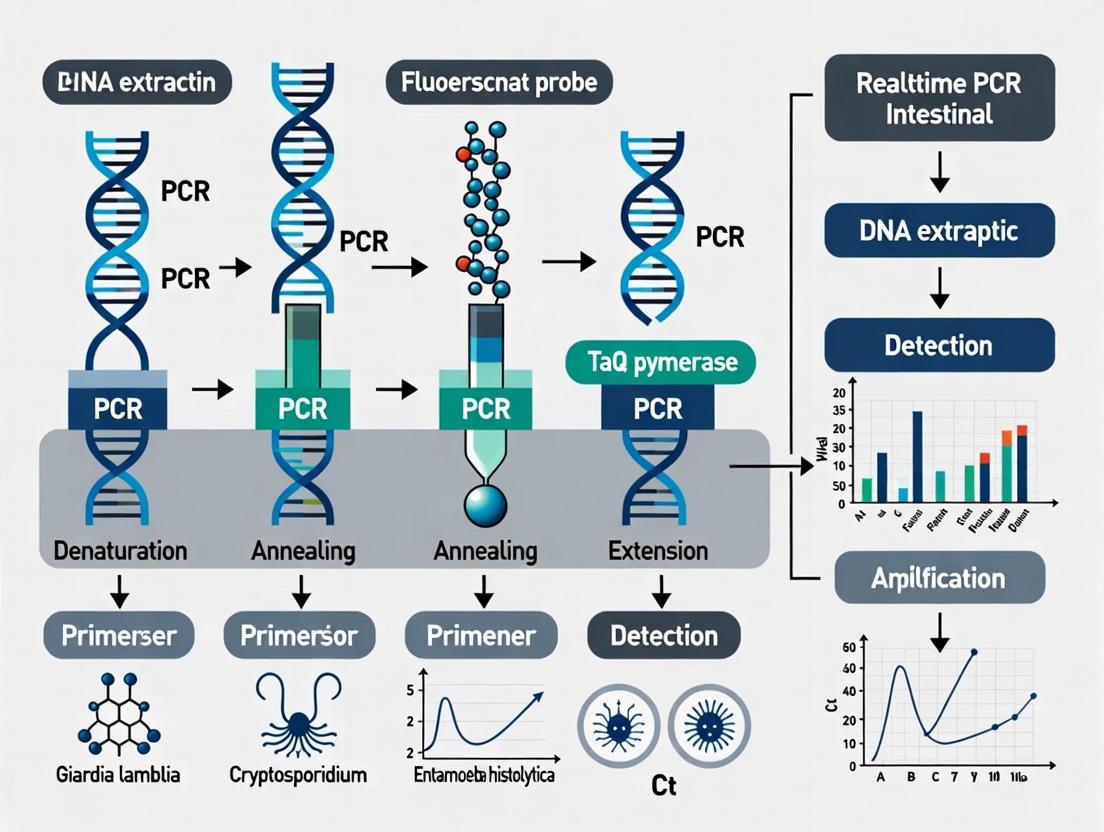
This guide provides researchers, scientists, and drug development professionals with a comprehensive framework for implementing real-time PCR (qPCR) for the detection of intestinal parasites.
A Comprehensive Guide to Real-Time PCR for Intestinal Parasite Detection in Research and Drug Development
Abstract
This guide provides researchers, scientists, and drug development professionals with a comprehensive framework for implementing real-time PCR (qPCR) for the detection of intestinal parasites. It covers the foundational principles justifying the transition from traditional microscopy to molecular methods, detailed multiplex assay development and optimization, advanced troubleshooting and data analysis techniques, and rigorous validation protocols against established standards. The content synthesizes current research and methodologies to support accurate, high-throughput pathogen detection in both clinical and pharmaceutical research settings, highlighting applications from basic diagnostics to supporting drug efficacy and toxicity studies.
Why Real-Time PCR? Overcoming the Limitations of Traditional Parasitology
Intestinal protozoan parasites represent a significant global health burden, with enteric protozoa being responsible for a wide spectrum of clinical manifestations, ranging from mild gastrointestinal symptoms to life-threatening watery or hemorrhagic diarrhea [1]. It is estimated that intestinal parasitic infections affect 3.5 billion people annually worldwide, with giardiasis and dientamoebiasis representing major causes of disease in terms of frequency, while cryptosporidiosis and amoebiasis rank as the third and fourth leading parasitic causes of death globally [1]. These infections present particular challenges in both resource-limited settings and high-income countries, though the epidemiological profiles and diagnostic approaches may differ substantially.
Traditional diagnosis of these pathogens has relied heavily on microscopic examination of stool samples for the detection of trophozoites, cysts, and/or oocysts [1]. While widely used, this method presents several limitations: it is labor-intensive, time-consuming, requires highly skilled morphologists, and suffers from poor sensitivity and specificity [2] [1]. Furthermore, microscopy cannot differentiate between morphologically identical species with divergent clinical implications, such as distinguishing the pathogenic Entamoeba histolytica from the non-pathogenic Entamoeba dispar [1]. The limitations of conventional diagnostics have accelerated the adoption of molecular methods, particularly real-time PCR (qPCR), which offers superior sensitivity, specificity, and the capability for species-level differentiation crucial for appropriate treatment and public health interventions [2] [3] [1].
The Molecular Diagnostic Revolution: qPCR Assays
The transition to molecular diagnostics represents a paradigm shift in clinical parasitology. Real-time PCR (qPCR) has emerged as a powerful alternative that overcomes the limitations of traditional microscopy. This technology allows for the rapid amplification and detection of target DNA sequences with precision, enabling not just identification but also quantification of parasitic loads [4]. The fundamental advantage of qPCR in this context lies in its exceptional analytical sensitivity and specificity, which directly translates to improved diagnostic accuracy and patient outcomes [3] [1].
qPCR protocols can be configured in various formats depending on diagnostic needs:
- Singleplex assays that detect one specific parasite per reaction
- Duplex assays that simultaneously detect two pathogens [2]
- Multiplex assays designed to identify multiple parasites in a single reaction, significantly improving efficiency and reducing costs [3] [1]
The diagnostic performance of these molecular assays has been extensively validated against traditional methods. Recent evaluations of commercial multiplex qPCR systems, such as the Allplex GI-Parasite Assay, have demonstrated exceptional performance characteristics with sensitivity and specificity rates frequently exceeding 95-100% for major intestinal protozoa including Giardia duodenalis, Dientamoeba fragilis, Entamoeba histolytica, and Cryptosporidium spp. [1]. This level of accuracy represents a substantial improvement over conventional microscopy and antigen-based tests, establishing qPCR as the new reference standard in many clinical settings, particularly in high-income countries where low parasite prevalence demands highly accurate diagnostic methods [3] [1].
Table 1: Performance Characteristics of a Commercial Multiplex qPCR Assay for Intestinal Protozoa Detection
| Parasite | Sensitivity (%) | Specificity (%) | Clinical Significance |
|---|---|---|---|
| Entamoeba histolytica | 100 | 100 | Pathogenic; requires treatment |
| Giardia duodenalis | 100 | 99.2 | Major cause of gastrointestinal disease |
| Dientamoeba fragilis | 97.2 | 100 | Controversial pathogenicity |
| Cryptosporidium spp. | 100 | 99.7 | Causes severe diarrhea in immunocompromised |
Experimental Protocols and Methodologies
Sample Preparation and DNA Extraction
The accuracy of qPCR-based detection of intestinal protozoa is highly dependent on optimal sample processing and DNA extraction, which must overcome challenges such as the thick walls of parasite (oo)cysts and the presence of PCR inhibitors in stool matrices [1]. A standardized protocol is essential for reliable results.
Sample Pretreatment: Approximately 50-100 mg of stool specimen is suspended in 1 mL of specialized stool lysis buffer (e.g., ASL buffer from Qiagen). The suspension undergoes pulse vortexing for 1 minute followed by incubation at room temperature for 10 minutes. Subsequent centrifugation at 14,000 rpm for 2 minutes yields a supernatant suitable for nucleic acid extraction [1]. Research indicates that mechanical pretreatment significantly enhances DNA yield from robust parasitic cysts and oocysts [5].
Nucleic Acid Extraction: Both automated and manual extraction methods have proven effective. Automated systems such as the Microlab Nimbus IVD platform can automatically process nucleic acids and set up PCR reactions, ensuring standardization and high throughput [1]. Manual extraction methods, while more time-consuming, have also demonstrated excellent efficacy when optimized [5]. The critical importance of the extraction step was highlighted in a comprehensive study evaluating 30 different protocol combinations for Cryptosporidium parvum detection, which found that extraction method significantly impacts overall assay sensitivity [5].
DNA Amplification: Extracted DNA is amplified using multiplex real-time PCR with platform-specific master mixes. A typical reaction uses a 10 µL reaction volume containing the DNA template and specific primers/probes [2]. Thermal cycling conditions typically include an initial activation step, followed by 40-45 cycles of denaturation, annealing, and extension. Fluorescence detection at specific temperatures (e.g., 60°C and 72°C) allows for real-time monitoring of amplification, with positive results defined by exponential fluorescence curves crossing the threshold cycle (Ct) at values less than 45 for individual targets [1].
Assay Design and Validation
The development of effective qPCR assays requires careful consideration of several design elements:
- Target Selection: Assays must target genetically conserved regions unique to each parasite, such as the 18S rRNA gene for Dientamoeba fragilis or the galactose-inhibitable adherence protein gene for Entamoeba histolytica [3] [6].
- Primer and Probe Design: Sequences should be specific to the target organisms while avoiding cross-reactivity with other parasites or human DNA.
- Validation: Comprehensive testing against well-characterized DNA panels is essential to determine diagnostic sensitivity, specificity, and limit of detection [3].
Table 2: Key Steps in qPCR Protocol Optimization for Intestinal Protozoa Detection
| Protocol Step | Key Considerations | Optimal Methods |
|---|---|---|
| Sample Pretreatment | Disruption of (oo)cyst walls; removal of PCR inhibitors | Mechanical pretreatment; stool lysis buffer with vortexing and incubation |
| DNA Extraction | Efficiency; purity; inhibitor removal | Automated systems (e.g., Nuclisens Easymag) or manual kits |
| Amplification | Reaction volume; primer/probe concentration; cycling conditions | 10µL reaction volume; 45 cycles; target-specific annealing temperatures |
| Detection | Fluorescence channels; threshold setting | Multiplex fluorescence detection; Ct threshold <45 |
Figure 1: Workflow for qPCR-based detection of intestinal protozoa from stool samples
Research Reagent Solutions and Tools
The successful implementation of qPCR diagnostics for intestinal protozoa depends on a suite of specialized reagents and tools. These include DNA extraction systems, amplification reagents, and commercial assay kits that have been validated for clinical use.
Table 3: Essential Research Reagents for qPCR-Based Detection of Intestinal Protozoa
| Reagent/Tool | Function | Specific Examples |
|---|---|---|
| Commercial qPCR Kits | Multiplex detection of target parasites | Allplex GI-Parasite Assay (Seegene) [3] [1] |
| Automated Extraction Systems | Standardized nucleic acid purification | Microlab Nimbus IVD (Hamilton) [1], Nuclisens Easymag [5] |
| Stool Lysis Buffers | Initial sample processing and homogenization | ASL Buffer (Qiagen) [1] |
| Enzymes & Master Mixes | DNA amplification with fluorescence detection | TaqMan probes, SYBR Green [7] [4] |
| Positive Controls | Assay validation and quality assurance | Target-specific DNA templates [3] |
Data Presentation and Analysis
The transition to qPCR-based detection has revealed striking improvements in diagnostic capability compared to traditional methods. In a study from Pemba Island, Tanzania, implementation of two duplex qPCR assays demonstrated the ability to reliably detect protozoa in 74.4% of samples, with Entamoeba histolytica and Entamoeba dispar found in 31.4% of cases [2]. Notably, one-third of these infections were caused by the pathogenic Entamoeba histolytica, highlighting the clinical importance of species-level differentiation that microscopy cannot provide [2].
The analytical performance of these molecular methods is particularly impressive. A novel multiplex real-time PCR assay developed for detection of Cryptosporidium spp., Giardia duodenalis, and Dientamoeba fragilis exhibited a diagnostic sensitivity of 0.90-0.97 and specificity of 1 (100%) when evaluated against a large panel of well-characterized DNA samples [3]. The limits of detection were exceptionally low, estimated at 1 oocyst for Cryptosporidium and 5×10^(-4) cysts for G. duodenalis [3]. This sensitivity far exceeds that of conventional microscopy and explains why molecular methods are increasingly becoming the first-line diagnostic approach in many clinical laboratories.
Beyond clinical diagnostics, qPCR applications extend to drug development and therapeutic assessment. In the Tanzanian study, qPCR was utilized to evaluate the potential antiprotozoal effects of emodepside, demonstrating that this compound did not significantly reduce protozoa loads compared to placebo [2]. This application highlights the value of quantitative molecular methods in providing objective endpoints for clinical trials of anti-parasitic interventions.
Future Directions and Emerging Technologies
The field of molecular parasitology continues to evolve with several emerging technologies poised to further transform diagnostic practices. Artificial intelligence (AI) represents one of the most promising frontiers, with recent developments demonstrating remarkable potential. A new AI system based on a deep learning model (convolutional neural network) has shown the ability to detect intestinal parasites in stool samples faster and more accurately than experienced microscopists [8]. Validation studies revealed that the AI algorithm achieved 98.6% agreement with human assessment while identifying 169 additional organisms that had been missed during manual inspection [8]. This technology addresses the critical shortage of skilled morphologists and could fundamentally change laboratory workflows worldwide.
Further innovations in multiplex PCR panels continue to expand the range of detectable pathogens in single reactions. Recent research has described the first molecular detection of Chilomastix mesnili by qPCR, enhancing diagnostic precision for this lesser-known protozoan [2]. The ongoing refinement of these panels promises more comprehensive parasitological assessment while maintaining efficiency and cost-effectiveness.
The integration of these advanced diagnostic technologies with basic research continues to yield new insights into parasite biology and host-parasite interactions. As our understanding of the molecular basis of parasitic diseases deepens, qPCR and related methodologies will undoubtedly play an increasingly central role in both clinical management and public health interventions aimed at reducing the global burden of intestinal protozoan infections.
For over a century, microscopy has served as the cornerstone of parasitological diagnosis, providing a direct, visual method for pathogen identification. Despite its designation as the "gold standard," conventional microscopy faces significant challenges in sensitivity, specificity, and operational efficiency in modern diagnostic contexts. This technical review systematically evaluates the limitations of microscopic diagnostic methods across parasitic diseases including malaria, intestinal helminths, and protozoan infections, with comparative performance data demonstrating the superior sensitivity of molecular alternatives. Within the framework of advancing real-time PCR methodologies for intestinal parasite detection, we present comprehensive experimental protocols and analytical workflows to guide research and development efforts. The evidence underscores an urgent need for integrating molecular approaches to overcome the critical shortcomings of traditional microscopy in both clinical and research settings.
Microscopic examination of stained specimens represents one of the oldest and most fundamental techniques in diagnostic pathology and parasitology. For intestinal parasites, the direct visualization of eggs, larvae, cysts, or trophozoites in stool samples has constituted the primary diagnostic approach for decades [9]. Similarly, in malaria diagnosis, the examination of thick and thin blood films has served as the reference standard for detecting Plasmodium species [10]. The enduring value of microscopy lies in its direct nature, relatively low cost, and ability to provide both qualitative and quantitative information about infections without requiring sophisticated instrumentation.
However, the designation of microscopy as the "gold standard" becomes increasingly problematic when evaluated against more sensitive molecular methods. As diagnostic science advances, the limitations of conventional microscopy become more apparent, particularly in the context of low-intensity infections, mixed-species infections, and the requirement for rapid results in clinical decision-making. The persistence of microscopy as a reference standard creates a circular problem where newer technologies are measured against an imperfect benchmark, potentially underestimating their true diagnostic capabilities [9]. This review examines the specific shortcomings of microscopy across multiple diagnostic contexts and explores how real-time PCR methodologies are addressing these limitations in intestinal parasite detection.
Limitations of Conventional Microscopy
Sensitivity Constraints in Low-Intensity Infections
The diagnostic sensitivity of microscopy is highly dependent on parasite burden, with significant limitations in detecting low-level infections. Table 1 summarizes the comparative sensitivity of microscopy versus molecular methods across multiple studies and pathogen types.
Table 1: Comparative Sensitivity of Microscopy Versus Molecular Diagnostics
| Pathogen/Infection | Microscopy Sensitivity | Molecular Method Sensitivity | Reference |
|---|---|---|---|
| Malaria (asymptomatic) | 26.4% | 100% (nested & real-time PCR) | [11] |
| Intestinal parasites | 37.7% | 73.5% (real-time PCR) | [12] |
| Tuberculosis | 53-56.8% | 93.5-97.2% (real-time PCR) | [13] [14] |
| Strongyloides stercoralis | Limited (varies with technique) | ~2x increase vs. Baermann method | [15] |
| Malaria (symptomatic) | 64.4% | 76.5% (PCR) | [16] |
The data reveal consistent patterns across different parasitic diseases. In malaria diagnosis, microscopy failed to detect approximately 74% of asymptomatic infections that were identified by PCR-based methods [11]. Similarly, in a study of gastrointestinal parasites, real-time PCR detected nearly twice as many positive samples compared to microscopic examination (73.5% versus 37.7%) [12]. This sensitivity gap has profound implications for public health initiatives, particularly in elimination settings where identifying and treating low-level reservoirs is critical for interrupting transmission chains.
Technical and Operational Challenges
The performance of microscopy is influenced by numerous technical and operational factors that contribute to its diagnostic limitations:
Operator dependency: Diagnostic accuracy correlates directly with technician expertise and experience. In malaria diagnosis, misidentification of Plasmodium species is common when performed by less experienced microscopists [11]. Similarly, morphological similarity between certain helminth eggs (e.g., Ancylostoma duodenale and Necator americanus) complicates accurate differentiation [12].
Sample processing variability: Diagnostic yield varies significantly based on the specific concentration technique employed. The formal-ether concentration method detects a broader spectrum of parasite species compared to direct smear but still misses infections like Strongyloides stercoralis and Giardia intestinalis [9].
Workflow limitations: Microscopy is time-consuming for large-scale surveillance, with processing and examination requiring substantial personnel resources. Sample pooling strategies prior to PCR-based testing have demonstrated improved efficiency for population-level screening [11].
Inability to differentiate species and strains: Microscopy cannot distinguish morphologically identical species or detect genetic markers of drug resistance. Molecular methods enable identification of species-specific sequences and resistance markers, providing clinically actionable information beyond mere detection [16].
Molecular Diagnostics: Overcoming Microscopy Limitations
Real-Time PCR as a Superior Diagnostic Platform
Real-time PCR has emerged as a highly sensitive and specific alternative to conventional microscopy for parasite detection. This methodology provides several distinct advantages that directly address the limitations of microscopic examination:
Enhanced sensitivity: Real-time PCR consistently demonstrates superior detection capabilities, particularly in low-parasite-density infections. In malaria diagnosis, PCR identified 12% additional cases that were missed by both microscopy and rapid diagnostic tests [16]. For intestinal parasites, PCR detected 57.4% of parasites in asymptomatic patients compared to only 18.5% by microscopy [12].
Accurate species differentiation: Molecular assays can distinguish between morphologically similar species through targeting of species-specific genetic sequences. This is particularly valuable for detecting mixed infections that are frequently misclassified by microscopy [16].
Quantification potential: Real-time PCR provides quantitative data through cycle threshold (Ct) values, enabling correlation with parasite burden and offering a means to monitor treatment response [15].
High-throughput capability: Automated nucleic acid extraction and PCR setup facilitate processing of large sample volumes, making PCR suitable for epidemiological studies and surveillance programs [11].
Detection of Polyparasitism
Molecular methods have revealed a much higher prevalence of polyparasitism (concurrent infections with multiple parasite species) than previously recognized through microscopic examination. In a study from Mozambique, real-time PCR detected substantially more coinfections compared to microscopic methods (25.5% versus 3.06%) [9]. This finding has significant clinical implications, as interactions between different parasite species may modify disease manifestations, treatment responses, and clinical outcomes. The accurate characterization of polyparasitism is essential for understanding disease epidemiology and designing effective control strategies.
Experimental Protocols for Molecular Detection of Intestinal Parasites
Standardized Real-Time PCR Methodology
The following protocol details a validated approach for real-time PCR detection of intestinal parasites, adapted from multiple studies [12] [9] [15]:
DNA Extraction Protocol
Sample Preparation:
- Transfer 100-200 mg of unpreserved stool to a tube containing grinding beads (e.g., Precellys Soil grinding SK38 beads).
- Add 1.25 mL STAR buffer or PBS with 2% polyvinylpolypyrrolidone (PVPP).
- Homogenize using a tissue homogenizer (e.g., Precellys 24) at 5500 rpm for 10-30 seconds.
Nucleic Acid Extraction:
- Incubate the homogenate with proteinase K at 55°C for 2 hours to complete lysis.
- Extract DNA using automated systems (e.g., QIAsymphony SP, MagNA Pure 96) with manufacturer-recommended kits.
- Include an internal control (e.g., Phocine Herpes virus 1) to monitor extraction efficiency and PCR inhibition.
- Elute DNA in 50-100 μL elution buffer and store at -20°C.
Real-Time PCR Amplification
Reaction Setup:
- Prepare master mix containing:
- HotStar Taq Master Mix
- 5 mM MgCl₂
- 2.5 μg Bovine Serum Albumin (BSA)
- Species-specific primers and hydrolysis probes
- 5-10 μL template DNA
- Total reaction volume: 25-50 μL
- Prepare master mix containing:
Amplification Parameters:
- Initial activation: 15 minutes at 95°C
- 45 cycles of:
- Denaturation: 5-30 seconds at 95°C
- Annealing: 15-60 seconds at 55-60°C
- Extension: 15-30 seconds at 72°C
- Perform on real-time detection systems (e.g., CFX96, Rotor-Gene)
Multiplex PCR Assays for Simultaneous Pathogen Detection
Multiplex real-time PCR assays enable simultaneous detection of multiple parasite species in a single reaction, significantly improving efficiency for comprehensive screening:
- Primer and Probe Design: Target conserved, species-specific genetic regions (e.g., 18S rRNA gene for protozoa, internal transcribed spacer regions for helminths).
- Multiplex Panels: Develop parallel reactions for different parasite groups (e.g., one multiplex for common protozoa, another for soil-transmitted helminths).
- Validation: Verify assay performance against reference samples and ensure no cross-reactivity between different targets.
Table 2: Essential Research Reagent Solutions for Parasite Molecular Detection
| Reagent/Category | Specific Examples | Function in Experimental Workflow |
|---|---|---|
| Sample Collection & Preservation | Whatman filter paper, absolute ethanol, sterile stool containers | Maintains nucleic acid integrity during transport and storage |
| Nucleic Acid Extraction | QIAamp DNA Stool Mini Kit, MagNA Pure 96 DNA, Viral NA Small Volume Kit | Islates high-quality PCR-amplifiable DNA from complex biological samples |
| Inhibition Controls | Phocine Herpes Virus (PhHV-1), exogenous synthetic oligonucleotides | Monitors PCR inhibition and extraction efficiency |
| PCR Amplification | HotStar Taq Master Mix, species-specific primers/probes, BSA | Enables specific target amplification with reduced interference |
| Quality Assessment | External quality control panels (HEMQAS), reference DNA samples | Ensures assay performance and inter-laboratory reproducibility |
Visualization of Diagnostic Workflows
Comparative Diagnostic Pathway for Intestinal Parasite Detection
The following diagram illustrates the parallel workflows and outcomes for microscopy versus molecular detection methods:
The evidence presented in this technical review demonstrates that conventional microscopy, while historically valuable, exhibits significant limitations as a gold standard for parasitic disease diagnosis. The consistently superior sensitivity of real-time PCR across multiple parasite species, its ability to accurately characterize polyparasitism, and its utility in detecting asymptomatic infections position molecular methods as essential tools for modern diagnostic practice and research. For intestinal parasite detection specifically, real-time PCR offers unprecedented accuracy that is transforming our understanding of disease epidemiology and creating new opportunities for effective control strategies.
The integration of molecular diagnostics into routine practice faces challenges related to cost, infrastructure requirements, and technical expertise. However, the demonstrated benefits in diagnostic accuracy, patient management, and public health surveillance justify increased investment and development of accessible molecular platforms. Future directions should focus on simplifying molecular workflows, reducing costs, and developing point-of-care molecular solutions that can deliver PCR-level accuracy in resource-limited settings where the burden of parasitic diseases remains highest.
The diagnosis of intestinal parasitic infections has long relied on traditional microscopy, a method plagued by limitations in sensitivity, specificity, and throughput. This technical guide explores the paradigm shift driven by quantitative PCR (qPCR), a molecular technique that fundamentally improves diagnostic and research capabilities. Framed within the context of intestinal protozoa research, we detail how qPCR's enhanced sensitivity and specificity allow for the accurate detection and differentiation of pathogens like Entamoeba histolytica and Giardia lamblia. Furthermore, we examine the high-throughput capabilities and multiplexing innovations that enable researchers to process vast sample volumes efficiently. Supported by comparative data, detailed protocols, and visual workflows, this document serves as a comprehensive resource for scientists and drug development professionals leveraging qPCR in their research.
Quantitative real-time PCR (qPCR) has become an indispensable tool in molecular biology and diagnostics over the past two decades. This fluorescence-based technique detects and quantifies nucleic acids with exceptional precision, enabling both qualitative and quantitative analysis without opening the reaction tube, thereby minimizing contamination risks [17]. The technology's core principle involves monitoring the amplification of a target DNA sequence in real time, with the quantification cycle (Cq) value indicating the starting quantity of the target nucleic acid [17].
In the specific field of intestinal parasite research, this molecular shift is particularly transformative. Traditional bright-field microscopy, while cost-effective, faces significant challenges including an inability to distinguish morphologically identical species, subjective readouts, and a reliance on high-level expertise [18]. qPCR overcomes these hurdles by targeting unique genetic sequences, providing a platform for objective, sensitive, and specific detection of protozoan parasites that are major contributors to global gastrointestinal morbidity and mortality [18].
Superior Analytical Performance: qPCR vs. Microscopy
The limitations of conventional microscopy become starkly evident when compared directly with qPCR's performance metrics. A 2017 study on gastrointestinal parasites demonstrated qPCR's clear advantage, showing a positive detection rate of 73.5% compared to just 37.7% for microscopic examination [12]. This dramatic increase in sensitivity is crucial for identifying true infection rates, particularly in asymptomatic carriers, where qPCR detected parasites in 57.4% of cases versus microscopy's 18.5% [12].
Quantitative Comparison of Diagnostic Performance
Table 1: Performance comparison between microscopy and qPCR for parasite detection
| Performance Metric | Microscopy | qPCR | Significance/Context |
|---|---|---|---|
| Overall Detection Rate | 37.7% (37/98 samples) [12] | 73.5% (72/98 samples) [12] | P < 0.001 |
| Detection in Asymptomatic Cases | 18.5% (10/54 cases) [12] | 57.4% (31/54 cases) [12] | P < 0.05 |
| Polyparasitism (Coinfections) | 3.06% [12] | 25.5% [12] | Better reflects infection complexity |
| Species Differentiation | Limited (e.g., cannot distinguish E. histolytica from E. dispar) [18] | High (specific genetic identification) [19] [18] | Critical for correct treatment and epidemiology |
| Technical Dependency | High (subjective, requires expert microscopist) [12] [18] | Moderate (standardized, automated analysis) [20] | Reduces operator-induced variability |
Mechanisms Underpinning Enhanced Sensitivity and Specificity
qPCR's superior performance originates from its fundamental operating principles. Its enhanced sensitivity allows for the detection of low-abundance targets that are easily missed by microscopic examination [12] [20]. This is particularly vital for detecting parasites present in low numbers in stool samples or during early stages of infection [19].
The exceptional specificity of qPCR, especially when using TaqMan hydrolysis probes, stems from the use of species-specific primers and probes that target unique genetic sequences [19]. This enables the differentiation of morphologically identical species, such as pathogenic Entamoeba histolytica from non-pathogenic Entamoeba dispar—a distinction impossible with standard microscopy but critical for appropriate clinical management and epidemiological understanding [18].
Key qPCR Performance Metrics and Quality Control
Robust qPCR assays are characterized by several key performance metrics, as highlighted in the MIQE (Minimum Information for Publication of Quantitative Real-Time PCR Experiments) guidelines [17]. Researchers must validate and report these metrics to ensure data reliability and reproducibility.
Essential qPCR Assay Characteristics
Table 2: Key performance metrics for validating a qPCR assay
| Performance Metric | Definition & Ideal Value | Research Application Example |
|---|---|---|
| PCR Efficiency | Measure of target duplication per cycle. Ideal: 90-110% (slope of -3.6 to -3.1) [17]. | A triplex qPCR for intestinal protozoa showed efficiencies >95% [19]. |
| Dynamic Range | The range of template concentrations over which quantification is accurate and linear. Ideally 5-6 orders of magnitude [17]. | The triplex qPCR showed linearity from 5×10² to 5×10⁸ copies/μL [19]. |
| Linearity (R²) | Coefficient of determination for the standard curve. Ideal: ≥ 0.98 [17]. | The triplex qPCR for intestinal protozoa had R² > 0.99 [19]. |
| Limit of Detection (LOD) | The lowest concentration at which 95% of targets are detected. Theoretical limit: 3 molecules/PCR [17]. | The triplex qPCR LOD was 500 copies/μL of plasmid DNA [19]. |
| Precision/Reproducibility | Consistency of replicate measurements. Reported as Coefficient of Variation (CV) of Cq values [17]. | The triplex qPCR showed intra- and inter-assay CV < 1.92% [19]. |
The 'Dots in Boxes' Quality Control Method
To manage data quality across multiple targets and conditions, a high-throughput analysis method termed "dots in boxes" was developed [17]. This method plots two critical parameters for each qPCR target:
- Y-axis: PCR efficiency (ideal range 90-110%)
- X-axis: ΔCq (difference in Cq between no-template control and lowest template dilution; ideal ≥3)
A quality score (1-5) is assigned based on additional criteria like reproducibility and curve shape. Successful experiments appear as solid dots within the graphical box, allowing for rapid visual evaluation of numerous assays [17].
High-Throughput and Multiplexing Capabilities
The workflow simplicity and advances in qPCR instrumentation permit the generation of substantial data quantities, with instruments processing 96, 384, or even 1536 reactions in a single run [17]. This high-throughput capability is essential for large-scale studies, drug efficacy testing, and epidemiological surveillance.
Multiplex qPCR for Efficient Parasite Detection
A powerful strategy for maximizing throughput is multiplexing, which allows for the simultaneous detection of multiple targets in a single reaction. This reduces reagent costs, saves time, and conserves valuable sample material [20] [19]. Research has successfully developed duplex and triplex qPCR assays for concurrent detection of major intestinal parasites.
Table 3: Examples of multiplex qPCR assays in parasitology research
| Assay Format | Target Parasites | Key Performance Outcomes | Reference |
|---|---|---|---|
| Triplex qPCR | Entamoeba histolytica, Giardia lamblia, Cryptosporidium parvum | LOD: 500 copies/μL; Efficiency: >95%; No cross-reactivity [19]. | Zhang et al., 2022 [19] |
| Duplex qPCR | Entamoeba dispar + Entamoeba histolytica | Enabled species-level differentiation in a single, low-volume (10 µL) reaction [18]. | Recent Implementation [18] |
| Duplex qPCR | Cryptosporidium spp. + Chilomastix mesnili | First molecular detection of C. mesnili by qPCR [18]. | Recent Implementation [18] |
Automation and Throughput Classifications
Automation revolutionizes qPCR workflows by reducing human error, increasing reproducibility, and saving time [20]. Automated systems ensure consistency and efficiency, which is particularly crucial in high-throughput screening environments processing hundreds or thousands of samples [20].
qPCR systems can be categorized based on their throughput capabilities:
- High-Throughput (HT) qPCR: Used in centralized labs for processing large sample batches; shows high sensitivity and specificity in field tests [21].
- Low-Throughput (LT) / Field-Deployable qPCR: Portable systems with quick turnaround times, useful for onsite environmental surveillance and rapid screening [21]. These LT systems have demonstrated a high negative predictive value, making them excellent for negative screening in outbreak investigations [21].
Experimental Protocols: Implementing a Triplex qPCR Assay
This section provides a detailed methodology for a triplex qPCR assay for the simultaneous detection of Entamoeba histolytica, Giardia lamblia, and Cryptosporidium parvum, based on published research [19].
Primer and Probe Design
- Target Genes: Design specific primers and TaqMan probes for:
- E. histolytica: 16S-like SSU rRNA gene (GenBank X56991.1)
- G. lamblia: gdh gene (GenBank KM190761.1)
- C. parvum: 18SrRNA gene (GenBank NC_006987.1)
- Design Tools: Use software such as Primer Express.
- Specificity Check: Verify specificity in silico using BLAST and Primer-BLAST searches against genomic databases.
- Synthesis: Procure oligonucleotides from a reputable supplier.
DNA Extraction
- Kits: Use commercial kits (e.g., QIAamp DNA Mini Kit or QIAamp DNA Fast Stool Mini Kit, Qiagen) [19].
- Sample Input: Use 200 mg of stool (or 200 µL for liquid stools).
- Inhibition Check: Include an internal control or synthetic oligonucleotide to test for PCR inhibition [12].
- Storage: Store extracted DNA at -20°C.
Standard Plasmid Construction
- Cloning: Clone the target gene fragments into a suitable plasmid vector (e.g., pUC19).
- Validation: Confirm plasmid sequences by sequencing.
- Quantification: Calculate plasmid copy numbers using the formula: Copy Number (Copies/μl) = [Concentration (g/μl) / (660 × DNA length)] × NA (where NA is Avogadro's constant) [19].
qPCR Reaction Setup and Conditions
- Reaction Volume: 10-25 µL, depending on the instrument.
- Master Mix: Use a commercial master mix suitable for probe-based qPCR.
- Primer/Probe Concentration: Optimize concentrations (typically 100-500 nM each).
- Thermocycling Conditions:
- Initial Denaturation: 95°C for 2-5 minutes
- 40-50 cycles of:
- Denaturation: 95°C for 15 seconds
- Annealing/Extension: 60°C for 60 seconds (acquire fluorescence)
- Instrument: Any standard real-time PCR instrument.
Data Analysis
- Standard Curve: Generate using serial dilutions (e.g., 5×10² to 5×10⁸ copies/µL) of the standard plasmids. The assay is valid if efficiency is 90-110% and R² > 0.99 [19].
- Cq Interpretation: A sample is considered positive if the Cq value is below the determined limit of detection threshold and the amplification curve has a characteristic shape.
The following workflow diagram visualizes the key stages of this experimental protocol:
The Scientist's Toolkit: Essential Research Reagent Solutions
Successful implementation of qPCR assays relies on a suite of reliable reagents and instruments. The following table catalogs essential solutions for researching intestinal protozoa.
Table 4: Essential research reagents and solutions for qPCR-based parasitology
| Item Category | Specific Examples / Kits | Critical Function |
|---|---|---|
| DNA Extraction Kits | QIAamp DNA Stool Mini Kit (Qiagen) [12] [19] | Purifies high-quality, PCR-amplifiable DNA from complex stool matrices. |
| qPCR Master Mixes | Luna qPCR/Rt-qPCR Kits (NEB) [17]; Probe-based master mixes | Provides optimized buffers, enzymes, and dNTPs for efficient, specific amplification. |
| Assay Design Tools | Primer Express (Applied Biosystems); Primer3; BLASTN | Enables in silico design and specificity validation of primers and probes [19] [18]. |
| Standard Plasmid | Custom cloned plasmids (e.g., in pUC19 vector) containing target sequence [19]. | Serves as a quantitative standard for generating a standard curve and determining assay LOD. |
| Probes & Primers | Species-specific TaqMan probes & primers (e.g., for E. histolytica, G. lamblia) [19]. | Confers assay specificity by binding to and detecting a unique genomic target. |
| Internal Controls | Synthetic oligonucleotides; human 16S mitochondrial rRNA assay [12] [18]. | Monitors for PCR inhibition and verifies successful DNA extraction. |
The adoption of qPCR technology represents a definitive molecular shift in the diagnosis and research of intestinal parasites. Its superior sensitivity, specificity, and throughput, quantitatively demonstrated against traditional microscopy, provide researchers and drug development professionals with a powerful tool for accurate pathogen detection, species differentiation, and large-scale screening.
Future developments are poised to further solidify qPCR's central role. Key trends include:
- Greater Automation and Integration: Increased integration with automated sample preparation systems and Next-Generation Sequencing (NGS) for validation [20] [22].
- Point-of-Care (POC) Adaptation: Development of compact, field-deployable qPCR devices for rapid diagnostics in resource-limited settings [22] [21].
- Sustainability and Cost-Effectiveness: Evolution of eco-friendly instruments and reagents that reduce environmental impact and operational costs [20].
The continuous innovation in qPCR technology ensures it will remain an indispensable cornerstone of molecular biology, driving scientific discovery and improving clinical and public health outcomes in the fight against parasitic diseases.
Biomarkers, defined as objectively measured characteristics that indicate normal biological processes, pathogenic processes, or pharmacological responses to therapeutic interventions, have become indispensable tools in modern drug development [23]. These biological signposts, which can be molecular, structural, or physiological in nature, provide critical insights throughout the drug development pipeline—from early discovery through clinical trials and post-marketing surveillance. The systematic application of biomarkers accelerates the identification of promising drug candidates, enhances safety assessment, and enables more personalized treatment approaches.
The role of biomarkers has expanded significantly with advances in molecular diagnostics and analytical technologies. In the context of intestinal parasite research, biomarkers detected via molecular methods like real-time PCR (qPCR) provide crucial data on pathogen presence, load, and response to therapeutic interventions. This technical guide examines the key applications of biomarkers in drug development, with particular emphasis on their growing importance in anti-parasitic drug research and development, framing the discussion within the context of qPCR-based detection of intestinal parasites.
Biomarker Classification and Definitions
The U.S. Food and Drug Administration (FDA) classifies biomarkers into seven distinct categories based on their clinical application and utility in drug development [23]. Understanding these classifications is fundamental to their appropriate implementation throughout the drug development pipeline.
Table 1: Biomarker Classification in Drug Development
| Biomarker Type | Definition | Example Applications |
|---|---|---|
| Diagnostic | Confirms the presence of a disease or condition | Identifying specific parasite species (e.g., Entamoeba histolytica vs. E. dispar) via qPCR [24] [25] |
| Susceptibility/Risk | Indicates potential for developing a disease | Genetic markers predicting susceptibility to parasitic infections |
| Prognostic | Identifies likelihood of disease recurrence or progression | Parasite load quantification to predict disease severity [24] |
| Predictive | Identifies individuals more likely to respond to a medical product | Biomarkers predicting response to anti-parasitic medications |
| Safety | Measures presence or likelihood of toxicity | Liver enzyme elevations indicating drug-induced toxicity [26] |
| Responsive | Shows biological response to medical products | Reduction in parasite-specific DNA following treatment [24] |
| Monitoring | Measures status of a disease or medical condition | Serial qPCR measurements to track treatment efficacy [24] |
This classification framework provides a structured approach for selecting appropriate biomarkers for specific applications throughout the drug development process, ensuring that each biomarker is fit-for-purpose and generates clinically actionable data.
Toxicity Biomarkers and Safety Assessment
AI-Driven Toxicity Prediction
The integration of artificial intelligence (AI) and machine learning (ML) has revolutionized toxicity prediction in early drug discovery. These computational approaches enable researchers to identify potential toxicity concerns before committing substantial resources to compound development [26]. AI models can predict various toxicity endpoints, including hepatotoxicity, cardiotoxicity, nephrotoxicity, neurotoxicity, and genotoxicity, based on diverse molecular representations ranging from traditional descriptors to graph-based methods [26].
The development of robust AI models for toxicity prediction relies on large-scale databases containing experimental results. Public resources such as ChEMBL, DrugBank, and BindingDB provide extensive information on chemical structures, bioactivity, and associated toxicity profiles, forming a rich foundation for supervised learning [26]. Additionally, proprietary data generated from in vitro assays, in vivo studies, clinical trials, and post-marketing surveillance further enriches these models, creating a virtuous cycle of continuous improvement as experimental outcomes from downstream studies feed back into model refinement [26].
Key Toxicity Biomarkers and Applications
Table 2: Key Toxicity Biomarkers in Drug Development
| Toxicity Endpoint | Biomarker Examples | Applications in Drug Development |
|---|---|---|
| Hepatotoxicity | ALT, AST, Bilirubin, DILIrank dataset [26] | Detection of drug-induced liver injury during preclinical and clinical testing |
| Cardiotoxicity | hERG channel blockade, ECG changes [26] | Assessment of potential for lethal arrhythmias; hERG Central database contains >300,000 experimental records [26] |
| Neurotoxicity | Neurotransmitter levels, electrophysiological markers | Detection of adverse effects on nervous system function |
| Genotoxicity | Ames test, chromosomal aberration assessment | Identification of mutagenic and carcinogenic potential |
| Nephrotoxicity | BUN, Creatinine, KIM-1, NGAL | Evaluation of kidney injury and functional impairment |
The implementation of these toxicity biomarkers early in the drug development pipeline enables more informed go/no-go decisions, reduces late-stage attrition due to safety concerns, and enhances overall patient safety by identifying potential risks before extensive human exposure.
Biomarkers in Therapy Monitoring and Treatment Response
Molecular Monitoring of Anti-Parasitic Therapy
Molecular biomarkers, particularly those detected via qPCR, have transformed therapy monitoring for infectious diseases, including intestinal protozoa. These biomarkers provide objective, quantifiable measures of treatment response, enabling real-time assessment of therapeutic efficacy [24]. In recent studies evaluating potential anti-parasitic medications, qPCR has been employed to detect and quantify protozoal DNA in stool samples before and after treatment, providing precise measurements of pathogen clearance [24].
For example, in a study investigating emodepside's potential anti-protozoal effects on Pemba Island, Tanzania, researchers implemented duplex qPCR assays to detect Entamoeba dispar + Entamoeba histolytica and Cryptosporidium spp. + Chilomastix mesnili, along with singleplex assays for Giardia duodenalis and Blastocystis spp. [24]. This approach enabled specific quantification of pathogen load before and after treatment, providing clear data on treatment efficacy. The study demonstrated that qPCR could reliably detect protozoa in 74.4% of samples, with detailed species-level differentiation that would be impossible using traditional microscopy [24].
Surrogate Endpoints in Clinical Trials
Biomarkers frequently serve as surrogate endpoints in clinical trials, substituting for clinical endpoints that may take years to observe [23]. For instance, in oncology drug development, tumor size reduction measured via imaging can serve as a surrogate endpoint for overall survival, significantly accelerating drug approval timelines [23]. Similarly, in anti-parasitic drug development, reduction in pathogen load as measured by qPCR can serve as a surrogate for clinical resolution of infection, enabling more efficient evaluation of therapeutic efficacy.
Surrogate endpoints offer significant advantages in drug development, including faster results, reduced trial costs, and earlier access to effective treatments for patients [23]. However, they must be rigorously validated to ensure they accurately predict clinical benefit, as misleading surrogate endpoints can lead to incorrect conclusions about a drug's efficacy and safety [23].
Real-Time PCR in Intestinal Parasite Research and Drug Development
Advantages of qPCR for Intestinal Protozoa Detection
Real-time PCR (qPCR) has emerged as a superior diagnostic method for intestinal protozoa compared to traditional microscopy, offering enhanced sensitivity, specificity, and species-level differentiation [24] [25]. While microscopy remains widely used due to its simplicity and cost-effectiveness, it lacks the sensitivity and specificity of modern molecular techniques like qPCR, making the latter a more effective tool for monitoring and assessing the burden of intestinal protozoa diseases [24].
The technical advantages of qPCR include its ability to distinguish morphologically identical species (such as pathogenic Entamoeba histolytica from non-pathogenic Entamoeba dispar), provide quantitative data on parasite load, and offer higher throughput with reduced turnaround time compared to microscopic examination [24] [25]. Furthermore, molecular methods are operator-independent and inherently less subjective due to standard assay outputs, reducing variability in results interpretation [27].
Experimental Protocol: Multiplex qPCR for Intestinal Protozoa
Sample Preparation:
- Collect fecal specimens and suspend in appropriate transport media (e.g., Cary-Blair media, S.T.A.R. Buffer, or Para-Pak preservation media) [25] [27].
- For optimal DNA recovery, use approximately 1μL of fecal sample mixed with 350μL of buffer [25].
- Vortex samples thoroughly to ensure homogeneous suspension before DNA extraction.
DNA Extraction:
- Employ automated nucleic acid extraction systems (e.g., Hamilton STARlet, MagNA Pure 96) with bead-based extraction chemistry [25] [27].
- Use 50μL of stool suspension for DNA extraction, eluting to a final volume of 100μL [27].
- Include internal extraction controls to monitor extraction efficiency and potential inhibition [25].
qPCR Reaction Setup:
- Utilize multiplex PCR assays capable of detecting multiple protozoa simultaneously (e.g., Seegene Allplex GI-Parasite Assay) [27].
- Prepare reaction mixtures containing:
- 5μL of extracted DNA template
- 12.5μL of 2× TaqMan Fast Universal PCR Master Mix
- 2.5μL of primer-probe mix
- Sterile water to a final volume of 25μL [25]
- For duplex assays targeting specific protozoa pairs (e.g., Entamoeba dispar + Entamoeba histolytica), optimize primer and probe concentrations as detailed in Table 3 [24].
Thermal Cycling and Detection:
- Perform amplification using the following cycling conditions:
- Initial denaturation: 95°C for 10 minutes
- 45 cycles of:
- Denaturation: 95°C for 15 seconds
- Annealing/Extension: 60°C for 1 minute [25]
- Monitor fluorescence in multiple channels (e.g., FAM, HEX, Cal Red 610, Quasar 670) to distinguish different targets [27].
- Set cycle threshold (Ct) value of ≤43 as positive detection threshold [27].
Table 3: Example qPCR Assay Parameters for Intestinal Protozoa Detection
| Organism | Target Gene | Primer Concentration (μM) | Probe Chemistry | Sensitivity |
|---|---|---|---|---|
| Entamoeba histolytica | Small subunit ribosomal RNA | 0.5 | FAM-based | 100 copies/μL [27] |
| Giardia duodenalis | Small subunit ribosomal RNA | 0.5 | HEX-based | 100% detection [25] |
| Cryptosporidium spp. | Small subunit ribosomal RNA | 0.5 | Cal Red 610 | 100% detection [27] |
| Blastocystis spp. | Small subunit ribosomal RNA | 0.3 | Quasar 670 | 93% sensitivity [27] |
Validation and Performance Characteristics
Comprehensive validation of qPCR assays for intestinal protozoa detection is essential for reliable results. Performance characteristics should include:
- Sensitivity and Specificity: Established using known positive and negative samples [27]
- Limit of Detection: Determined using serial dilutions of quantified parasite DNA [27]
- Reproducibility: Assessed via intra-assay and inter-assay coefficients of variation (CV <5% acceptable) [28]
- Cross-Reactivity: Evaluated against DNA from closely related species and commensal organisms [27]
Studies have demonstrated high performance characteristics for validated qPCR assays, with sensitivity of 93-100% and specificity of 98.3-100% for most intestinal protozoa, though performance varies by species and sample preservation method [27].
The Scientist's Toolkit: Research Reagent Solutions
Table 4: Essential Research Reagents for Molecular Detection of Intestinal Protozoa
| Reagent/Equipment | Function | Example Products |
|---|---|---|
| Stool Transport Media | Preserves nucleic acids during sample storage and transport | S.T.A.R. Buffer, Cary-Blair media, Para-Pak preservation media [25] [27] |
| Automated Nucleic Acid Extraction Systems | Standardized DNA purification with minimal contamination risk | Hamilton STARlet, MagNA Pure 96 System [27] |
| Bead-Based Extraction Kits | Efficient cell lysis and DNA recovery from tough parasite cysts | STARMag 96 × 4 Universal Cartridge kit [27] |
| Multiplex PCR Master Mixes | Provides optimized buffer, enzymes, and dNTPs for amplification | Seegene Allplex GI-Parasite MOM, TaqMan Fast Universal PCR Master Mix [25] [27] |
| qPCR Instruments | Precise thermal cycling with multi-channel fluorescence detection | Bio-Rad CFX96, ABI 7900HT Fast Real-Time PCR System [24] [25] |
| Species-Specific Primers/Probes | Target amplification and detection of specific protozoa | Custom designs targeting 18S rRNA, cytb, or other conserved genes [24] [28] |
| Internal Controls | Monitors extraction efficiency and PCR inhibition | Commercial internal extraction controls [25] |
Integration of Biomarkers in Drug Development Workflows
The strategic integration of biomarkers throughout the drug development process creates a comprehensive framework for efficient therapeutic development. The following diagram illustrates how different biomarker types are utilized at each stage of development, from discovery through post-marketing surveillance:
Diagram 1: Biomarker Integration in Drug Development Workflow. This diagram illustrates the sequential application of different biomarker types throughout the drug development process, from discovery through post-marketing surveillance.
Future Directions and Emerging Trends
Multi-Omics Approaches and Advanced Technologies
The future of biomarkers in drug development lies in the integration of multi-omics approaches—combining genomics, proteomics, metabolomics, and transcriptomics—to achieve a holistic understanding of disease mechanisms and therapeutic responses [29] [30]. These comprehensive approaches enable the identification of complex biomarker signatures that reflect the full complexity of diseases, facilitating improved diagnostic accuracy and treatment personalization [30].
Liquid biopsy technologies represent another significant advancement, particularly for non-invasive disease monitoring [30]. While initially developed for oncology applications, these technologies are expanding into other areas of medicine, including infectious diseases, offering minimally invasive methods for disease diagnosis and management [30]. For intestinal parasite research, adaptations of liquid biopsy concepts could potentially enable detection of parasite-derived DNA in blood or other body fluids, complementing traditional stool-based testing.
Regulatory Advancements and Standardization
As biomarker technologies advance, regulatory frameworks are evolving to ensure that new biomarkers meet necessary standards for clinical utility [29] [30]. Key developments include more streamlined approval processes for biomarkers validated through large-scale studies and real-world evidence, collaborative standardization initiatives among industry stakeholders, and increased recognition of real-world evidence in evaluating biomarker performance [30].
The implementation of Europe's IVDR (In Vitro Diagnostic Regulation) exemplifies both the challenges and opportunities in biomarker regulation [29]. While creating initial uncertainty and inconsistencies between jurisdictions, these regulations ultimately promote higher standards for biomarker validation and performance, ensuring greater reliability and clinical utility [29].
Biomarkers have transformed drug development from target identification through post-marketing surveillance, providing objective, measurable indicators of biological processes, disease states, and treatment responses. In the specific context of intestinal parasite research and anti-parasitic drug development, qPCR-based biomarkers offer unprecedented sensitivity, specificity, and quantification capabilities that far surpass traditional diagnostic methods.
The continued evolution of biomarker science—driven by advances in multi-omics technologies, AI and machine learning, liquid biopsies, and regulatory science—promises to further accelerate and refine drug development processes. For researchers working on intestinal parasites and therapeutic interventions, the strategic implementation of well-validated molecular biomarkers provides a powerful toolkit for assessing drug efficacy, monitoring treatment response, and ultimately bringing safer, more effective treatments to patients worldwide.
Developing and Implementing a Robust Multiplex qPCR Assay for Parasites
The accuracy of any real-time PCR (qPCR) assay is fundamentally constrained by the choice of its molecular target. This selection influences everything from analytical sensitivity and specificity to the assay's practical utility in diverse laboratory settings. Within parasitology, diagnostic assays must reliably differentiate between pathogenic and non-pathogenic organisms, often from complex sample matrices like stool or blood. The 18S Small Subunit Ribosomal RNA (18S SSU rRNA) gene has historically been a cornerstone for parasitic protozoan detection due to its multi-copy nature and the presence of conserved regions flanking variable sequences that allow for phylogenetic analysis [31]. However, as molecular diagnostics evolve, a broader set of targets is being explored to overcome the limitations of traditional markers, driving improvements in both the detection and differentiation of clinically significant parasites.
The process of target selection is a strategic balancing act. Ideal targets provide high sensitivity through multi-copy sequences in the genome, while also offering sufficient sequence divergence to ensure species-specific identification. Furthermore, the chosen genomic region must be compatible with the intended detection chemistry, whether it is intercalating dyes like SYBR Green or sequence-specific probes like TaqMan. This guide provides a detailed, technical framework for selecting and validating optimal molecular targets, with a focus on applications within intestinal parasite research and drug development.
Comparative Analysis of Molecular Targets
A critical step in assay design is the comparative evaluation of potential genetic targets. The performance of an assay is directly linked to the properties of the target sequence, including its copy number, degree of conservation, and uniqueness within the parasite's genome.
Performance of Different Genetic Targets
Table 1: Comparative Performance of Molecular Targets for Parasite Detection
| Parasite | Molecular Target | Assay Format | Analytical Sensitivity (Limit of Detection) | Specificity | Key Findings/Context |
|---|---|---|---|---|---|
| Plasmodium ovalecurtisi & P. ovalewallikeri | Novel multi-copy repetitive motifs [32] | Singleplex RT-qPCR | 3.6 parasites/µL (P. ovalecurtisi); 25.9 parasites/µL (P. ovalewallikeri) [32] | 100% (duplex assay) [32] | Target had 9 and 8 copies per genome, respectively; more sensitive than 18S rRNA for species differentiation [32] |
| Cryptosporidium spp. | Small Subunit Ribosomal RNA (SSU rRNA) gene [33] | RT-qPCR | Limit of detection <10 target gene copies/µL eluate [33] | 96.9% [33] | Highest sensitivity (100%) but slightly lower specificity; ideal for initial screening [33] |
| Cryptosporidium spp. | Cryptosporidium Oocyst Wall Protein (COWP) gene [33] | RT-qPCR | Limit of detection <10 target gene copies/µL eluate [33] | 99.6% [33] | High specificity; recommended for confirmatory testing following SSU rRNA screening [33] |
| Cryptosporidium spp. | DnaJ-like protein (DnaJ) gene [33] | RT-qPCR | Limit of detection <10 target gene copies/µL eluate [33] | 96.9% [33] | Good performance, but slightly lower sensitivity (88.8%) [33] |
| Leishmania spp. | Hsp20 gene with SYBR Green [34] | RT-qPCR | Not Specified | 100% [34] | Demonstrated 88% sensitivity; effective as a conserved, genus-wide target [34] |
| Leishmania spp. | Hsp20 gene with TaqMan Probe [34] | RT-qPCR | Not Specified | 100% [34] | Significantly lower sensitivity (47%) than SYBR Green format for the same target [34] |
The data in Table 1 highlights several key principles. First, multi-copy targets, such as the novel repetitive motifs identified for Plasmodium ovalecurtisi, can yield exceptionally high sensitivity, with a limit of detection (LOD) of 3.6 parasite genome equivalents/µL [32]. Second, different targets for the same parasite can have complementary strengths. For Cryptosporidium spp., the SSU rRNA gene assay offers perfect sensitivity (100%) making it an excellent screening tool, while the COWP gene assay provides superior specificity (99.6%), making it ideal for confirmation [33]. This suggests that a tiered testing algorithm can optimize overall diagnostic accuracy.
Furthermore, the choice of detection chemistry can be as critical as the target itself. For the Leishmania Hsp20 target, the SYBR Green format achieved 88% sensitivity, whereas the TaqMan probe format for the same gene showed only 47% sensitivity [34]. This underscores the need to optimize and validate the entire assay system, not just the primer and probe sequences.
18S SSU rRNA: A Gold Standard with Limitations
The 18S SSU rRNA gene remains one of the most widely used targets for parasitic protozoa. Its advantages are significant: it is a multi-copy gene, enhancing assay sensitivity, and contains both highly conserved regions (useful for broad-range primers) and variable regions (useful for species-specific discrimination) [31]. This property has been effectively leveraged in High-Resolution Melting (HRM) analysis, where differences in the 18S SSU rRNA sequence between Plasmodium falciparum and P. vivax produced a significant melting temperature difference of 2.73°C, allowing for clear species differentiation [31].
However, a primary limitation of the 18S rRNA target is the potential for cross-reactivity between closely related species. This is particularly problematic for differentiating Plasmodium ovalecurtisi and P. ovalewallikeri, where many existing assays targeting the 18S rRNA gene lack complete species specificity [32]. This diagnostic challenge has driven the search for more divergent genomic targets, such as the porbp2 and potra genes, though these can come with their own compromises, such as requiring nested PCR and sequencing [32].
Experimental Protocols for Assay Design and Validation
A rigorous, step-by-step approach is essential for developing a robust qPCR assay. The following protocols, derived from recent studies, outline the critical stages from in silico design to analytical validation.
Protocol 1: Identification and In Silico Analysis of Novel Multi-Copy Targets
This protocol is adapted from the development of novel assays for P. ovalecurtisi and P. ovalewallikeri [32].
- Step 1: Genome Mining. Use bioinformatics tools like Jellyfish (version 2.2.10) to scan available whole-genome sequences of the target parasite (e.g., PocGH01 for P. ovalecurtisi, PowCR01 for P. ovalewallikeri) to identify repetitive sequence motifs. The search can be parameterized for motifs of a specific length (e.g., 100 base-pairs) with a defined minimum copy number (e.g., ≥ 6 copies) [32].
- Step 2: Sequence Filtering. Exclude sequences with undesirable characteristics, such as low GC content (< 25%) or highly repetitive short sequences, which may complicate primer design and assay specificity [32].
- Step 3: Specificity Analysis. Align the remaining candidate sequences to a comprehensive nucleotide database (e.g., NCBI nt) using a tool like BLASTn. This critical step identifies and excludes candidates with significant homology to the genomes of other organisms, particularly non-target parasites or host DNA, to minimize cross-reactivity [32].
- Step 4: Copy Number Verification. Re-align the species-specific candidate sequences back to their respective parasite genomes to confirm the copy number. Targets with higher copy numbers are generally preferred for maximum assay sensitivity [32].
- Step 5: Primer and Probe Design. Design oligonucleotides manually or using specialized software. Key parameters to optimize include:
- Melting Temperature (Tm): Estimate using tools like Oligo Calc [32].
- Self-complementarity and dimer formation: Avoid to prevent non-specific amplification.
- Amplicon length: Typically 75-150 bp for optimal qPCR efficiency.
Protocol 2: Assay Validation Using Synthetic Controls and Clinical Samples
This protocol outlines the standard workflow for validating a newly designed qPCR assay.
Step 1: Analytical Sensitivity (Limit of Detection).
- Prepare a dilution series of a synthetic plasmid containing the target sequence. The plasmid concentration should be precisely quantified.
- Run the qPCR assay in replicates for each dilution point.
- Calculate the 95% confidence lower limit of detection (LOD) using probit or similar regression analysis. For example, a well-performing assay might achieve an LOD of 3.6 genome equivalents/µL [32].
Step 2: Analytical Specificity.
- Test the assay against a panel of well-characterized samples. This should include multiple strains or species of the target parasite, closely related non-target parasites, and other common pathogens that may be present in the sample type.
- The assay should yield positive results only for the intended target, demonstrating 100% specificity against a validated panel [32].
Step 3: Clinical Performance.
- Validate the assay's performance using a large set of clinical samples (e.g., 55 positive and 40 negative samples in the P. ovale study) [32].
- Compare the results to a reference standard, which may be a composite of other molecular tests and/or microscopy. Calculate diagnostic sensitivity and specificity.
Step 4: Inhibition Assessment.
- Spike samples with an internal control (e.g., a synthetic exogenous DNA sequence) to detect the presence of PCR inhibitors in nucleic acid extracts [33]. This is a crucial quality control step for clinical samples.
Workflow Visualization and Research Toolkit
Molecular Assay Development Workflow
The following diagram synthesizes the key stages of molecular assay design and validation into a logical workflow, illustrating the decision points and iterative processes involved.
The Scientist's Toolkit: Essential Research Reagents
Table 2: Key Reagents and Kits for qPCR Assay Development
| Item | Function/Application | Example from Search Results |
|---|---|---|
| Nucleic Acid Extraction Kits | Purification of DNA from complex clinical samples (stool, blood, tissue). | QIAamp DNA Mini Kit (Qiagen), QIAamp Stool DNA Mini Kit (Qiagen), PureLink Genomic DNA Mini Kit (Invitrogen) [32] [34] [33]. |
| Hot-Start DNA Polymerase Mastermix | Provides reaction components and high-fidelity enzyme for specific, efficient amplification in qPCR. | HotStarTaq Mastermix (Qiagen) [33]. |
| SYBR Green Dye | Intercalating dye that fluoresces when bound to double-stranded DNA; used for amplicon detection and HRM analysis. | Used in HRM analysis for malaria species differentiation [31] and for Leishmania Hsp20 detection [34]. |
| TaqMan Hydrolysis Probes | Sequence-specific probes (e.g., CY3, ROX-labeled) that provide higher specificity than intercalating dyes. | Used in Cryptosporidium assays targeting SSU rRNA, COWP, and DnaJ genes [33]. |
| Synthetic Plasmid Controls | Quantified gBlocks or cloned genes used as positive controls and for generating standard curves to determine LOD. | Used for calculating the LOD of Cryptosporidium assays [33]. |
| Reference Genomic DNA | DNA from well-characterized parasite strains or clinical samples, used for analytical specificity testing. | Cryopreserved Leishmania strains and well-characterized Plasmodium field samples [32] [34]. |
The selection of an optimal molecular target is the foundational step upon which a successful and reliable qPCR assay is built. While the 18S SSU rRNA gene continues to be a highly valuable and frequently used target, evidence shows that branching out to other genomic regions—such as multi-copy repetitive sequences, protein-coding genes like COWP and Hsp20, or mitochondrial genes—can yield superior assays with enhanced sensitivity and specificity for particular applications [32] [34] [33]. The decision must be guided by the specific diagnostic question, whether it is genus-level screening, precise species differentiation, or strain typing.
The future of molecular target selection is being shaped by the increasing availability of whole-genome sequences for a wider array of parasites. This will enable more systematic in silico mining for unique, multi-copy targets. Furthermore, the integration of advanced detection technologies like high-resolution melting (HRM) analysis provides a powerful, post-amplification method for differentiating species that may be challenging to distinguish with probe-based assays alone [31]. As the field moves towards multiplexed panels and point-of-care molecular testing, the principles of rigorous target selection and validation outlined in this guide will remain paramount for researchers and drug development professionals aiming to advance the diagnosis and management of parasitic diseases.
The reliable detection and quantification of intestinal parasites using real-time PCR (qPCR) hinges on the meticulous design of primers and hydrolysis probes. The genetic material of parasites can present unique challenges, including regions of high GC content and sequence homology, which must be addressed during the assay development phase to ensure diagnostic accuracy. This guide provides a comprehensive set of guidelines for designing these critical oligonucleotides, focusing on the core principles of specificity, melting temperature (Tm), and GC content. Adherence to these principles is fundamental for developing robust, sensitive, and specific qPCR assays for research and drug development applications.
Core Principles of Primer and Probe Design
Fundamental Parameters for Primers
The performance of a PCR assay is fundamentally determined by the physicochemical properties of the primers. The following parameters are critical [35] [36]:
- Length: Optimal primer length is generally 18–30 nucleotides [35] [36]. Shorter primers within this range (e.g., 18-24 bases) anneal more efficiently, while longer primers can be slower to hybridize [37].
- Melting Temperature (
Tm): The optimalTm for primers is between 60–75°C, with the two primers in a pair ideally within 1–5°C of each other to facilitate simultaneous binding [35] [36]. TheTm is the temperature at which half of the DNA duplexes are dissociated and is distinct from the annealing temperature (Ta). - GC Content: The guanine-cytosine content should be between 40–60%, with 50% being ideal [35] [36]. This ensures sufficient binding strength without promoting non-specific interactions.
- GC Clamp: The 3' end of the primer should be stabilized by a G or C residue (a GC clamp), as these bases form stronger hydrogen bonds. However, avoid runs of more than three G or C bases at the 3' end, as this can lead to non-specific binding [35] [37].
Table 1: Optimal Design Characteristics for PCR Primers
| Parameter | Optimal Range | Rationale |
|---|---|---|
| Length | 18–30 nucleotides [35] [36] | Balances specificity with efficient annealing. |
Melting Temperature (Tm) |
60–75°C; primers within 5°C of each other [35] | Ensures both primers bind to the target simultaneously and efficiently. |
| GC Content | 40–60% [35] [36] | Provides stable binding while minimizing non-specific annealing. |
| GC Clamp | G or C at the 3' end; avoid >3 consecutive G/C [35] [37] | Stabilizes primer binding at the critical extension point. |
Fundamental Parameters for Probes
Hydrolysis probes (e.g., TaqMan probes) must be designed to higher stringency standards than primers, as their function is central to quantification [36].
- Location and Specificity: The probe should be in close proximity to a primer but must not overlap with the primer-binding site. It should be located on the same strand as one of the primers without overlapping [36].
- Melting Temperature (
Tm): The probe should have aTm` 5–10°C higher than the primers. This ensures the probe is fully bound to the target before the primers anneal, guaranteeing accurate quantification [36]. - GC Content and 5' End: Maintain a GC content of 35–65% and avoid a guanine (G) base at the 5' terminus, as it can quench the fluorescence of the attached reporter fluorophore [36] [37].
- Quenching Strategy: Double-quenched probes, which incorporate an internal quencher (e.g., ZEN or TAO) in addition to the 3' quencher, are recommended over single-quenched probes. This configuration provides lower background fluorescence and higher signal-to-noise ratios, which is particularly beneficial for longer probes [36].
Table 2: Optimal Design Characteristics for qPCR Probes
| Parameter | Optimal Range / Characteristic | Rationale |
|---|---|---|
| Length | 20–30 bases (for single-quenched) [36] | Sufficient for specificity while maintaining effective dye-quencher interaction. |
Melting Temperature (Tm) |
5–10°C higher than primers [36] | Ensures probe is bound during primer annealing for accurate quantification. |
| GC Content | 35–65%; avoid G at 5' end [36] [37] | Prevents quenching of the 5' fluorophore. |
| Quenching | Double-quenched (e.g., ZEN, TAO) [36] | Lowers background fluorescence and increases signal-to-noise ratio. |
Ensuring Specificity and Avoiding Secondary Structures
A critical step in design is to ensure primers and probes bind only to the intended target and do not form disruptive secondary structures.
- Complementarity Checks: Screen all oligonucleotides for self-dimers, cross-dimers (between forward and reverse primers), and hairpins. The free energy (ΔG) for any such structures should be weaker (more positive) than -9.0 kcal/mol [36]. Stronger (more negative) ΔG values indicate stable, problematic structures that will hinder the reaction.
- On-Target Binding Efficiency: Always perform a BLAST analysis against an appropriate genomic database (e.g., RefSeq) to ensure the primers are unique to the desired target sequence [36]. This is crucial for distinguishing between closely related parasite species.
- Sequence Repeats: Avoid runs of four or more identical bases (e.g., AAAA or CCCC) and dinucleotide repeats (e.g., ATATAT), as these can complicate synthesis and promote mispriming [35].
- Amplicon Design: Amplicon length should ideally be 70–150 base pairs for high amplification efficiency with standard cycling conditions [36]. When working with RNA targets (e.g., parasite RNA), design assays to span an exon-exon junction. This ensures that amplification from contaminating genomic DNA, which contains introns, is inefficient or produces a different-sized product, thereby conferring RNA-specific detection [36] [38].
Advanced Considerations and Troubleshooting
Calculating Tm and Annealing Temperature
The Tm is not an intrinsic constant but is dependent on experimental conditions. Simple "4(G+C) + 2(A+T)" formulas are outdated and inaccurate for modern assay design [39].
- Modern
Tm Calculation: AccurateTm prediction requires sophisticated algorithms that consider nearest-neighbor thermodynamics and, crucially, the specific reaction conditions, including oligonucleotide concentration, and the concentrations of monovalent (K+) and divalent (Mg2+) cations [36] [39]. For example, Mg2+ has a profound stabilizing effect, and its concentration must be accounted for. - Annealing Temperature (
Ta): The annealing temperature for the PCR reaction is derived from the primerTm. A good starting point is to set theTa at 5°C below the calculatedTm of the primers [36] [40]. However, this often requires empirical optimization using a temperature gradient PCR to find the temperature that provides the highest yield of the specific product with the least background [41].
Designing for Challenging Templates: GC-Rich Sequences
Intestinal parasite genomes may contain GC-rich promoter regions or genes that are difficult to amplify. These regions form stable secondary structures and resist denaturation [40].
- Polymerase Choice: Use polymerases specifically optimized for GC-rich templates, such as Q5 High-Fidelity DNA Polymerase or OneTaq DNA Polymerase. These are often supplied with a proprietary GC Enhancer that contains a mix of additives to inhibit secondary structure formation [40].
- Additives: Reagents like DMSO, glycerol, formamide, or betaine can be added to the reaction mix to help denature stable secondary structures and increase primer stringency [40] [42]. The GC Enhancer solutions provided with polymerases are typically optimized mixtures of these components.
- Mg2+ Concentration: Optimization of MgCl2 concentration is critical. While standard reactions use 1.5–2.0 mM, GC-rich amplifications may require higher concentrations. A titration from 1.0 mM to 4.0 mM in 0.5 mM increments is recommended [40].
- Primer Redesign via Codon Optimization: For exceptionally difficult targets, one can redesign primers by introducing silent mutations at the wobble position of codons to replace G/C bases with A/T, thereby reducing the local GC content and disrupting secondary structures without altering the encoded amino acid sequence [42].
A Workflow for Primer and Probe Design and Validation
The following diagram outlines a systematic workflow for designing and validating primers and probes for qPCR assays.
Successful qPCR assay development relies on a suite of specialized reagents, enzymes, and in-silico tools.
Table 3: Research Reagent Solutions for qPCR Assay Development
| Reagent / Tool | Function / Purpose | Example Products / Tools |
|---|---|---|
| High-Fidelity DNA Polymerase | Accurate amplification with low error rates, essential for cloning and sequencing verification. | Q5 High-Fidelity (NEB M0491) [40], Phusion Plus (Thermo Fisher) [41] |
| Polymerase with GC Enhancer | Amplification of difficult, GC-rich templates by disrupting secondary structures. | OneTaq with GC Buffer (NEB M0480) [40] |
| Double-Quenched Probes | Hydrolysis probes with internal quencher for lower background and higher signal-to-noise. | IDT PrimeTime qPCR Probes [36] |
| Online Tm Calculator | Accurately calculate melting temperature using nearest-neighbor thermodynamics and user conditions. | IDT OligoAnalyzer [36] [39], NEB Tm Calculator [40] [43] |
| Primer Design Tool | In-silico design of primers and probes with customizable parameters. | NCBI Primer-BLAST [38], IDT PrimerQuest [36] |
| Specificity Check Tool | Validates primer pair specificity against genomic databases to prevent off-target amplification. | NCBI Primer-BLAST [36] [38] |
Experimental Protocols for Validation
Protocol: Annealing Temperature Optimization
Empirical determination of the optimal annealing temperature (Ta) is a critical step.
- Reaction Setup: Prepare a master mix containing all standard PCR components: template DNA, primers, dNTPs, polymerase, and reaction buffer with MgCl2.
- Gradient PCR: Use a thermocycler with a temperature gradient function. Set the annealing step to span a range, for example, from 55°C to 70°C.
- Analysis: Run the PCR products on an agarose gel. The optimal
Ta is the highest temperature that yields a single, strong band of the expected size. This temperature maximizes specificity while maintaining high yield [41] [40].
Protocol: Optimizing GC-Rich PCR Using Additives
This protocol outlines a method for amplifying challenging GC-rich targets from parasites [40] [42].
- Polymerase Selection: Choose a polymerase system designed for GC-rich targets, such as OneTaq or Q5 with their respective GC Enhancers.
- Master Mix Preparation: Set up reactions according to the manufacturer's instructions. Include the recommended percentage of GC Enhancer (e.g., 5-10% v/v).
- Mg2+ Titration: If problems persist, prepare a series of reactions with MgCl2 concentrations ranging from 1.0 mM to 4.0 mM in 0.5 mM increments.
- Thermal Cycling: Use a "touchdown" or a two-step cycling protocol. Start with a higher annealing temperature for the first few cycles (e.g., 5°C above the calculated
Tm) to increase stringency, then reduce to the standardTa for the remaining cycles. - Analysis: Analyze results by gel electrophoresis. The condition producing a single, clear band of the correct size with the least background should be selected for further validation.
The development of a robust qPCR assay for the detection of intestinal parasites is a meticulous process grounded in the precise design of primers and probes. By adhering to the guidelines for specificity, Tm, and GC content outlined in this document, researchers can create highly sensitive and specific diagnostic tools. A methodical approach—combining rigorous in-silico design with empirical optimization of reaction conditions, especially for challenging templates—is paramount for success. These well-designed assays form the foundation for reliable research and the advancement of drug development efforts against parasitic diseases.
The diagnosis of gastrointestinal parasitic infections has been fundamentally transformed by the advent of multiplex polymerase chain reaction (PCR) technologies. This sophisticated molecular technique enables the simultaneous amplification and detection of multiple parasite-specific DNA sequences within a single reaction, revolutionizing diagnostic workflows in clinical and research settings. Traditional diagnostic methods for intestinal parasites, particularly microscopic examination of stool samples for ova and parasites, suffer from limited sensitivity and specificity, require experienced technologists, and often necessitate the collection of multiple samples to improve yield [44]. Furthermore, morphological similarities between pathogenic and non-pathogenic species, such as the differentiation of Entamoeba histolytica from Entamoeba dispar, present significant diagnostic challenges that microscopy cannot reliably resolve [45].
Multiplex PCR addresses these limitations by leveraging the specificity of nucleic acid amplification to detect and differentiate multiple parasitic pathogens with superior accuracy. The technique utilizes multiple primer sets, each designed to target unique genetic sequences of different parasites, allowing for their concurrent detection in a single tube [46] [47]. Since its initial description in 1988 for detecting deletion mutations in the dystrophin gene, multiplex PCR has evolved considerably, with applications expanding to encompass the detection of a broad spectrum of gastrointestinal pathogens [46]. In the context of intestinal parasites, this technology provides a rapid, cost-effective, and highly efficient diagnostic approach that is particularly valuable for identifying mixed infections, which are common in field settings and may be missed by conventional methods [48].
Technical Foundations of Multiplex PCR
Core Principles and Reaction Optimization
Multiplex PCR operates on the same fundamental principles as conventional PCR but incorporates multiple primer sets in a single reaction mixture to amplify different target sequences simultaneously. Each primer pair is designed to be specific to a particular parasite's genetic signature, and the resulting amplification products are of distinct sizes, allowing for their separation and identification through techniques like gel electrophoresis or, in more advanced systems, differentiation via fluorescent probes [46] [47]. The successful implementation of multiplex PCR hinges on careful reaction optimization to ensure balanced amplification of all targets without bias or loss of sensitivity.
A critical requirement for efficient multiplex PCR is that all primer sets must have similar annealing temperatures to function under uniform thermal cycling conditions [47] [45]. Primer design must also account for factors such as GC content, specificity to avoid cross-reactivity, and minimization of primer-dimer formation, which can compete for reagents and reduce amplification efficiency [46] [47]. The amplification products must be sufficiently different in size to enable clear resolution during analysis, typically requiring a minimum size difference of 10-20% between adjacent bands for reliable distinction via gel electrophoresis [47]. Advanced detection methods utilizing fluorescently labeled probes (as in real-time multiplex qPCR) can overcome size-based limitations by employing distinct fluorophores for each target, thereby enabling the detection of same-size amplicons through wavelength-specific signal capture [46].
Evolution of Detection Methodologies
The evolution of multiplex PCR detection platforms has significantly expanded its applications in parasitology:
Endpoint Detection with Gel Electrophoresis: Conventional multiplex PCR relies on size-based separation of amplification products through agarose gel electrophoresis, with visualization under UV light after staining with DNA intercalating dyes. This approach was successfully employed in a study detecting four zoonotic protozoans in goats, yielding distinct bands of 1400 bp for G. duodenalis, 755 bp for C. parvum, 573 bp for Blastocystis spp., and 314 bp for E. bieneusi [48].
Real-Time Quantitative PCR (qPCR): Multiplex real-time PCR utilizes sequence-specific probes (such as TaqMan probes) labeled with distinct fluorescent reporters, allowing for real-time monitoring of amplification and simultaneous quantification of multiple targets without post-processing [46]. This approach provides superior sensitivity and quantitative capabilities, making it invaluable for clinical diagnostics and research applications requiring precise quantification.
Capillary Electrophoresis: Combining fluorophore-labeled primers with capillary electrophoresis dramatically enhances multiplexing capacity, enabling the simultaneous detection of 20 or more targets through a combination of size and fluorescence differentiation [46]. This approach is particularly valuable for high-throughput applications and complex diagnostic panels.
Experimental Validation and Performance Metrics
Comparative Studies of Diagnostic Accuracy
Recent studies have systematically evaluated the performance of multiplex PCR against traditional diagnostic methods for intestinal parasites, demonstrating its superior sensitivity and specificity. A prospective study conducted in 2023 compared multiplex conventional PCR with direct microscopy and single-plex PCR for detecting Cryptosporidium spp., Entamoeba histolytica, and Giardia lamblia in 240 patients with gastrointestinal symptoms [45].
Table 1: Comparison of Detection Rates Between Microscopy and PCR Methods
| Detection Method | Entamoeba histolytica | Giardia lamblia | Cryptosporidium spp. | Mixed Infections |
|---|---|---|---|---|
| Direct Microscopy | 9.17% (22/240) | 11.25% (27/240) | 2.92% (7/240) | 5.42% (13/240) |
| Single-plex PCR | 10.00% (24/240) | 13.33% (32/240) | 4.58% (11/240) | Not specified |
| Multiplex PCR | 10.00% (24/240) | 13.33% (32/240) | 4.58% (11/240) | Not specified |
The study reported 100% concordance between single-plex and multiplex PCR results, confirming that multiplexing does not compromise detection accuracy [45]. Both PCR methods demonstrated higher detection rates compared to microscopy, particularly for Cryptosporidium spp., where PCR identified approximately 57% more cases. This enhanced sensitivity is clinically significant, as cryptosporidiosis can be particularly severe in immunocompromised individuals and young children [45].
Analytical Sensitivity and Specificity
Multiplex PCR assays for parasitic detection have demonstrated exceptional analytical performance in validation studies. A multiplex PCR developed for simultaneous detection of Giardia duodenalis, Cryptosporidium parvum, Blastocystis spp., and Enterocytozoon bieneusi in goats exhibited a sensitivity of ≥10² copies of pathogenic DNA clones, with 100% sensitivity and predictive values when compared to single-target PCRs [48]. The assay also showed high specificity, with no cross-reactivity with other common intestinal parasites such as Fasciola hepatica, Schistosoma japonicum, and Echinococcus granulosus [48].
Table 2: Performance Characteristics of Multiplex PCR for Parasite Detection in Goats
| Parasite | Prevalence in Study Population | Amplicon Size | Analytical Sensitivity |
|---|---|---|---|
| Giardia duodenalis | 23.08% (30/130) | 1400 bp | ≥10² copies |
| Cryptosporidium parvum | 24.62% (32/130) | 755 bp | ≥10² copies |
| Blastocystis spp. | 41.54% (54/130) | 573 bp | ≥10² copies |
| Enterocytozoon bieneusi | 12.31% (16/130) | 314 bp | ≥10² copies |
The high prevalence of mixed infections, predominantly involving two parasite species, underscores the utility of multiplex PCR for comprehensive surveillance and accurate diagnosis in field conditions [48]. The ability to detect these co-infections in a single reaction provides a significant advantage over traditional methods, which often require separate tests for each pathogen.
Commercial Multiplex PCR Platforms and Their Applications
The growing recognition of multiplex PCR's advantages has spurred the development of several commercial syndromic panels for gastrointestinal pathogen detection. These platforms vary in their target menus, detection methodologies, and throughput capacities, allowing laboratories to select systems that best align with their testing needs and resources [44].
Table 3: Commercial Multiplex PCR Panels for Gastrointestinal Pathogen Detection
| Platform | Bacterial Targets | Viral Targets | Parasitic Targets |
|---|---|---|---|
| BioFire FilmArray GIP | Campylobacter, C. difficile, Plesiomonas shigelloides, Salmonella, Yersinia enterocolitica, Vibrio spp., EAEC, EPEC, ETEC, STEC, Shigella/EIEC | Adenovirus F40/41, Astrovirus, Norovirus GI/GII, Rotavirus A, Sapovirus | Cryptosporidium, Cyclospora cayetanensis, Entamoeba histolytica, Giardia duodenalis |
| BioFire FilmArray GIP Mid | Campylobacter, C. difficile, Salmonella, Yersinia enterocolitica, Vibrio spp., STEC, Shigella/EIEC | Norovirus GI/GII | Cryptosporidium, Cyclospora cayetanensis, Giardia duodenalis |
| BD MAX Assays | Salmonella spp., Campylobacter spp., Shigella spp./EIEC, STEC, Plesiomonas shigelloides, Vibrio spp., ETEC, Yersinia enterocolitica | Norovirus GI/GII, Rotavirus A, Adenovirus F40/41, Sapovirus, Astrovirus | Giardia duodenalis, Cryptosporidium, Entamoeba histolytica |
| xTAG GPP | Campylobacter, C. difficile, E. coli O157, ETEC, STEC, Salmonella, Shigella, Vibrio cholerae | Adenovirus 40/41, Norovirus GI/GII, Rotavirus A | Cryptosporidium, Giardia, Entamoeba histolytica |
| QIAstat-Dx GIP | C. difficile, EAEC, EPEC, ETEC, STEC, STEC O157:H7, EIEC/Shigella, Campylobacter spp., Plesiomonas shigelloides, Salmonella spp., Vibrio spp., Yersinia enterocolitica | Adenovirus F40/41, Astrovirus, Norovirus GI/GII, Rotavirus, Sapovirus | Cyclospora cayetanensis, Cryptosporidium spp., Entamoeba histolytica, Giardia duodenalis |
These syndromic panels have become the cornerstone of laboratory diagnostics for infectious diarrhea, offering comprehensive testing that surpasses the capabilities of conventional methods [44]. While these panels provide broad pathogen coverage, it is important to note that culture-based methods remain necessary for public health surveillance, antibiotic susceptibility testing, and recovery of emerging enteric pathogens not included in the panels [44].
Advantages and Implementation Considerations
The implementation of multiplex PCR panels for gastrointestinal parasite detection offers substantial benefits for clinical diagnostics and public health surveillance:
Enhanced Diagnostic Accuracy: Multiplex PCR panels demonstrate superior analytic sensitivity compared to conventional methods, enabling detection of pathogens that might be missed by microscopy or antigen testing [44]. This is particularly important for parasites like Cryptosporidium and Cyclospora, which can be challenging to identify microscopically.
Operational Efficiency: These panels allow for the simultaneous detection of multiple pathogens from a single stool sample, reducing turnaround time and streamlining laboratory workflows [44] [45]. This comprehensive approach is especially valuable in outbreak settings where rapid identification of the causative agent is critical for implementing appropriate control measures.
Comprehensive Pathogen Detection: Syndromic panels test for the most common bacteria, viruses, and parasites that cause community-acquired gastroenteritis, providing clinicians with a broad differential diagnosis without having to order multiple individual tests [44].
Despite these advantages, challenges remain in the widespread adoption of multiplex PCR panels. Cost considerations and reimbursement barriers may discourage providers from ordering these comprehensive panels or incentivize them to use smaller, less comprehensive panels [44]. Additionally, the high sensitivity of these assays may detect pathogens that are not the actual cause of symptoms, particularly in settings with high background rates of colonization or past infections, requiring correlation with clinical presentation.
The Researcher's Toolkit: Essential Reagents and Protocols
Key Research Reagent Solutions
Successful implementation of multiplex PCR for parasite detection requires careful selection of reagents and optimization of reaction conditions. The following table outlines essential components and their functions in a typical multiplex PCR protocol:
Table 4: Essential Reagents for Multiplex PCR Detection of Intestinal Parasites
| Reagent Component | Function | Considerations for Parasite Detection |
|---|---|---|
| DNA Polymerase | Enzyme that catalyzes DNA synthesis | Must be high-quality with high processivity; blend systems often preferred for complex samples |
| dNTPs | Nucleotide building blocks for DNA synthesis | Quality and concentration must be optimized to prevent misincorporation |
| Primer Sets | Sequence-specific oligonucleotides that define amplification targets | Must have similar Tm; designed to avoid secondary structures and primer-dimers |
| Probes (for qPCR) | Fluorescently-labeled oligonucleotides for detection | Require non-overlapping fluorophores with distinct emission spectra |
| Buffer System | Provides optimal ionic and pH environment | MgCl₂ concentration is critical and must be optimized for each primer set |
| Sample DNA | Template containing target sequences | Often requires purification from complex matrices like stool; inhibition must be addressed |
Detailed Experimental Protocol
Based on published methodologies for multiplex PCR detection of intestinal parasites, the following protocol provides a framework for simultaneous detection of multiple parasitic pathogens:
Sample Preparation and DNA Extraction:
- Collect stool samples and preserve immediately (e.g., in 2.5% potassium dichromate solution for parasites) [48].
- Wash samples with distilled water to remove preservative residues before DNA extraction.
- Extract genomic DNA from approximately 200 mg of stool using a commercial stool DNA kit (e.g., E.Z.N.A. Stool DNA Kit) following manufacturer's protocol [48].
- Quantify DNA concentration and quality using spectrophotometry; store at -20°C until PCR analysis.
Primer Design and Validation:
- Retrieve conserved gene sequences for target parasites from GenBank (e.g., Giardia duodenalis XM001710026.2, *Cryptosporidium parvum* XM626998.1) [48].
- Design specific primers using software such as Primer Premier 6.0 with the following criteria:
- Primer length: 18-22 base pairs
- Melting temperature (Tm): 55-60°C (should be similar for all primers in the multiplex)
- GC content: 40-60%
- Amplicon sizes: Differ by at least 10-20% for clear distinction by electrophoresis
- Validate primer specificity through in silico analysis (BLAST search) and empirically test using control DNA samples.
Multiplex PCR Reaction Setup:
- Prepare a master mix containing:
- 1X PCR buffer
- 2.0-3.5 mM MgCl₂ (concentration requires optimization)
- 200 μM of each dNTP
- 0.2-1.0 μM of each primer (concentration may vary for different targets)
- 1.0-2.5 U DNA polymerase
- 2-5 μL template DNA
- Nuclease-free water to final volume (typically 25-50 μL)
Thermal Cycling Conditions:
- Initial denaturation: 95°C for 5 minutes
- 35-40 cycles of:
- Denaturation: 95°C for 30-45 seconds
- Annealing: 55-60°C for 30-60 seconds (temperature requires optimization)
- Extension: 72°C for 60-90 seconds
- Final extension: 72°C for 7-10 minutes
Amplicon Detection and Analysis:
- Separate PCR products by electrophoresis on 1.5-2.0% agarose gel
- Visualize using DNA intercalating dyes (e.g., ethidium bromide, SYBR Safe)
- Compare band sizes to molecular weight standards and positive controls
- For quantitative analysis, use real-time PCR platforms with species-specific fluorescent probes
Quality Control Measures:
- Include positive controls (DNA from known parasite isolates) and negative controls (no-template and extraction controls) in each run
- Validate assay performance using characterized clinical samples
- Establish limit of detection for each target using serial dilutions of control DNA
- Test for cross-reactivity with genetically similar organisms
Multiplex PCR Workflow for Parasite Detection
Emerging Trends and Technological Advancements
The field of multiplex PCR continues to evolve, with several emerging trends shaping its future applications in parasitic diagnosis:
Expansion to Point-of-Care Testing: The development of compact, user-friendly multiplex PCR devices suitable for point-of-care settings is advancing rapidly, promising to decentralize testing and enable rapid diagnosis in clinics and remote areas [49] [50]. Technologies such as photonic PCR, which utilizes photothermal effects to accelerate thermal cycling, demonstrate potential for next-generation ultrafast amplification with minimal energy consumption [50].
Integration with Advanced Detection Platforms: The combination of multiplex PCR with capillary electrophoresis and fluorescent primers has significantly enhanced multiplexing capacity, enabling simultaneous detection of up to 20 or more targets [46]. Further integration with microfluidic technologies (e.g., continuous-flow PCR, oscillating-flow PCR) promises to enhance throughput while reducing reagent consumption and processing time [50].
Complementarity with Next-Generation Sequencing: While multiplex PCR provides targeted pathogen detection, it is increasingly used in conjunction with next-generation sequencing (NGS) for comprehensive pathogen identification and characterization [49]. This synergistic approach allows for both targeted screening and unbiased discovery of novel or unexpected pathogens.
Automation and Data Integration: Automation of sample preparation and data analysis is becoming standard, reducing human error and increasing reproducibility [49]. Sophisticated bioinformatic tools are being developed to manage the substantial data generated by multiplex PCR assays, providing actionable insights for clinical decision-making and public health surveillance.
Multiplex PCR represents a transformative advancement in the diagnosis of gastrointestinal parasitic infections, offering unparalleled capabilities for the simultaneous detection of multiple pathogens with superior sensitivity and specificity compared to conventional methods. The technology addresses critical limitations of traditional diagnostics, particularly in identifying mixed infections and differentiating morphologically similar species. While challenges related to cost, reimbursement, and result interpretation remain, the demonstrated benefits of improved diagnostic accuracy, operational efficiency, and comprehensive pathogen detection position multiplex PCR as an indispensable tool in modern parasitology.
As the technology continues to evolve through miniaturization, automation, and enhanced multiplexing capabilities, its accessibility and applications are expected to expand further. The ongoing integration of multiplex PCR with complementary technologies like microfluidics and NGS will likely drive continued innovation in diagnostic approaches, ultimately improving patient care and public health responses to parasitic infections. For researchers and clinicians working in the field of parasitology, understanding and leveraging the multiplexing advantage is essential for advancing both diagnostic capabilities and our fundamental understanding of parasitic diseases.
This technical guide provides a comprehensive methodology for the detection and quantification of intestinal parasites using real-time PCR (qPCR). The protocol is framed within the broader application of enhancing diagnostic precision and research capabilities in parasitology. By translating microscopic analysis into quantifiable molecular data, this workflow offers researchers and drug development professionals a sensitive and specific tool for assessing parasite burden, monitoring treatment efficacy, and studying transmission dynamics. The following sections detail the complete process, from sample preparation and DNA extraction to the final qPCR amplification and data analysis [51] [52].
Materials and Reagents
Research Reagent Solutions
The following table catalogues the essential reagents and materials required for the successful execution of the protocol.
Table 1: Essential Research Reagents and Materials
| Item Name | Function/Description | Example/Catalog Reference |
|---|---|---|
| FastDNA Kit | Provides optimized reagents for DNA extraction from complex samples. | MP Biochemicals, Cat. No. 6540-402 [51] |
| Lysing Matrix | Contains silica beads for mechanical disruption of cells and cysts in stool samples. | Lysing Matrix Multi Mix E (Cat. No. 6914-050/100) [51] |
| Protein Precipitation Solution (PPS) | Removes proteins and other contaminants from the lysate. | Part of FastDNA Kit (Cat. No. 6540-403) [51] |
| Binding Matrix | Silica-based matrix that binds nucleic acids in the presence of high salt. | Part of FastDNA Kit (Cat. No. 6540-408) [51] |
| Salt/Ethanol Wash Solution (SEWS-M) | Wash buffer that removes impurities while keeping DNA bound to the matrix. | Part of FastDNA Kit (Cat. No. 6540-405) [51] |
| DNA Elution Solution (DES) | Low-ionic-strength buffer (e.g., TE or nuclease-free water) for eluting purified DNA. | Part of FastDNA Kit (Cat. No. 6540-406) [51] |
| Taq DNA Polymerase | Thermostable enzyme that catalyzes the DNA amplification during PCR. | Various suppliers; provided with master mix [53] |
| dNTPs | Deoxynucleoside triphosphates (dATP, dCTP, dGTP, dTTP); building blocks for new DNA strands. | Final concentration of 200 μM (50 μM of each) in the reaction [53] |
| PCR Primers | Short, single-stranded DNA sequences that define the target region to be amplified. | 20-50 pmol per reaction; must be specific to the target parasite [53] |
| PCR Buffer | Provides optimal chemical environment (pH, salts) for Taq polymerase activity. | Usually supplied with the enzyme; may contain MgCl₂ [53] |
| Magnesium Chloride (MgCl₂) | Cofactor essential for Taq polymerase activity; concentration often requires optimization. | Final concentration typically 1.5-4.0 mM [53] |
Special Equipment
- FastPrep FP120 Disrupter or similar homogenizer: For mechanical lysis of the stool sample [51].
- Thermal Cycler: For PCR amplification. Modern cyclers feature heated lids, gradient blocks, and precise temperature control [54].
- Microcentrifuge: Capable of reaching 14,000 × g for 1.5-2 ml tubes [51].
- Real-time PCR Detection System: For quantitative analysis of amplified DNA [52] [55].
Methodology
DNA Extraction from Fecal Specimens
The following workflow outlines the DNA extraction process using the FastDNA Kit, which is critical for obtaining inhibitor-free DNA suitable for sensitive downstream qPCR applications [51].
Step-by-Step Extraction Protocol:
- Sample Preparation: Divide fresh fecal specimens into multiple aliquots. Store at -80°C without preservatives, or preserve in 1:1 dilution with absolute ethanol or 5% w/v potassium dichromate and store at 4°C [51].
- Washing: Centrifuge 300-500 μl of stool specimen at 14,000 × g at 4°C for 5 minutes. Discard the supernatant and resuspend the pellet in 1 ml of PBS-EDTA. Repeat this centrifugation and washing step two more times to remove PCR inhibitors [51].
- Mechanical Lysis: Resuspend the final washed pellet in PBS-EDTA to a volume of ~300 μl. Transfer this suspension to a tube containing the Lysing Matrix. Add 400 μl of CLS-VF (Lysis Solution), 200 μl of PPS (Protein Precipitation Solution), and polyvinylpyrrolidone (PVP) to a final concentration of 0.1-1%. Process the sample in the FastPrep disrupter at a speed of 5.0-5.5 for 10 seconds [51].
- Protein Precipitation and DNA Binding: Centrifuge the lysate at 14,000 × g for 5 minutes. Transfer 600 μl of the supernatant to a new tube. Add 600 μl of Binding Matrix and mix by inverting. Incubate for 5 minutes at room temperature to allow DNA to bind to the silica matrix. Centrifuge briefly (14,000 × g, 1 min) and discard the supernatant [51].
- Washing and Elution: Resuspend the Binding Matrix pellet in 500 μl of SEWS-M (Salt/Ethanol Wash Solution) by pipetting. Centrifuge and discard the supernatant. Perform a quick spin (10 seconds) and remove any residual wash solution. Resuspend the matrix in 100 μl of DES (DNA Elution Solution), mix by pipetting, and incubate for 2-3 minutes at room temperature. Centrifuge at 14,000 × g for 2 minutes and transfer the supernatant (containing the purified DNA) to a clean, labeled tube [51].
- Optional Purification: For samples that may still contain inhibitors (e.g., food-derived samples), further purify the eluted DNA using a QIAquick PCR Purification Kit or similar, following the manufacturer's instructions [51].
Primer Design and Reaction Setup
Primer Design Guidelines [53]:
- Length: 15-30 nucleotides.
- GC Content: 40-60%.
- Melting Temperature (Tm): 52-58°C, with the Tm for both primers differing by no more than 5°C.
- 3' End: Should contain a G or C residue to prevent "breathing" and increase priming efficiency.
- Specificity: Avoid self-complementarity, hairpin loops, and di-nucleotide repeats. Use tools like NCBI Primer-BLAST to ensure target specificity.
Setting Up the qPCR Reaction [52] [53] [55]:
Table 2: Reaction Mixture for Quantitative PCR
| Component | Final Concentration/Amount | Volume for a 50 μl Reaction |
|---|---|---|
| 2x TaqMan Master Mix | 1X | 25.0 μl |
| Forward Primer | 0.2 μM | 0.5 μl (from 20 μM stock) |
| Reverse Primer | 0.2 μM | 0.5 μl (from 20 μM stock) |
| TaqMan Probe (if used) | 0.2 μM | 0.5 μl (from 20 μM stock) |
| Magnesium Chloride (MgCl₂) | 1.5 - 4.0 mM * | Variable (if not in master mix) |
| Template DNA | 1 - 1000 ng | Variable (e.g., 2-5 μl) |
| Nuclease-free Water | - | Q.S. to 50 μl |
Note: The optimal Mg²⁺ concentration may require empirical optimization. A standard starting point is 1.5 mM, particularly if the master mix already contains MgCl₂ [53].
Thermal Cycling Protocol
The thermal cycling profile is a critical component that dictates the efficiency and specificity of the amplification. The following workflow and table describe a standard protocol for a probe-based qPCR assay.
Table 3: Standard Thermal Cycling Conditions for qPCR
| Step | Temperature | Time | Number of Cycles | Purpose |
|---|---|---|---|---|
| Initial Denaturation | 95°C | 10 min | 1 | Activate hot-start polymerase, fully denature genomic DNA. |
| Denaturation | 95°C | 15 sec | 40 | Separate double-stranded DNA template. |
| Annealing/Extension | 60°C * | 60 sec | 40 | Primers bind to target; polymerase extends the DNA strand. Fluorescence is measured at this step. |
Note: The annealing temperature is primer-specific and must be optimized. For SYBR Green assays, a separate extension step at 72°C may be added [52] [53].
Data Analysis and Interpretation
In qPCR, the cycle threshold (Cq) is the primary quantitative measurement. A standard curve, generated from samples with known parasite numbers or DNA copy numbers, is used to interpolate the quantity of the unknown samples [52]. The parasite burden can be expressed as amplicons per volume of original sample (e.g., per μl of blood or per mg of stool). Research has demonstrated that the parasite burden quantified by qPCR shows a stronger correlation with clinical outcomes, such as low birth weight in malaria-infected pregnant women, compared to traditional methods like microscopy [52].
Troubleshooting and Optimization
- No Amplification or Late Cq: Check DNA quality and quantity. Verify primer specificity and efficiency. Optimize Mg²⁺ concentration (test 1.5 - 4.0 mM) [53].
- Presence of Primer-Dimers or Non-Specific Products: Re-design primers if necessary. Optimize the annealing temperature using a thermal gradient on your cycler. Consider using PCR enhancers such as DMSO (1-10%) or Betaine (0.5-2.5 M) to improve specificity [53].
- Inconsistent Replicates: Ensure reagents are thoroughly mixed and pipetted accurately. Check for contaminants in the DNA sample or reagents [51] [53].
The shift from traditional diagnostic methods to molecular techniques has marked a significant advancement in the detection and quantification of intestinal parasites. While SYBR Green-based quantitative PCR (qPCR) offers a accessible entry into molecular diagnostics, its limitations in specificity and reliability within complex sample matrices like stool are well-documented. This technical guide details the superiority of TaqMan probe-based assays, which leverage a sequence-specific hydrolysis probe to confer enhanced specificity and sensitivity, making them particularly suited for the multifaceted challenge of diagnosing polyparasitism. Framed within the context of developing a robust real-time PCR guide for intestinal parasite research, this document provides researchers, scientists, and drug development professionals with a comprehensive overview of the TaqMan mechanism, validated experimental protocols, and data analysis strategies essential for successful implementation.
The accurate diagnosis of intestinal parasitic infections is crucial for clinical management, public health surveillance, and drug development. Traditional microscopy, long considered the "gold standard," is labor-intensive and suffers from low sensitivity, particularly for low-abundance parasites or in cases of polyparasitism where multiple species co-infect a single host [9]. Molecular methods, particularly qPCR, have emerged as powerful alternatives. While dyes like SYBR Green provide a simple and cost-effective means for qPCR, they bind to any double-stranded DNA product, including primer-dimers and non-specific amplicons, leading to potential false positives [56]. This lack of specificity is a critical drawback when analyzing complex samples such as human stool, which contains a myriad of host and microbial DNA, PCR inhibitors, and closely related parasite species.
TaqMan probe-based assays address this limitation by incorporating a target-specific oligonucleotide probe, ensuring that the fluorescent signal generated originates exclusively from the intended amplicon [57]. This guide explores the core principles and practical applications of TaqMan chemistry, positioning it as an indispensable tool for researchers developing precise and reliable diagnostic assays for intestinal parasites.
Core Principles of TaqMan Probe Chemistry
The enhanced specificity of TaqMan assays stems from a sophisticated biochemical mechanism that integrates the enzymatic activity of Taq polymerase with fluorescence resonance energy transfer (FRET).
The Mechanism of Action
The TaqMan process relies on four key components: a DNA template, two PCR primers, Taq DNA polymerase, and a sequence-specific TaqMan probe. This probe is a short oligonucleotide labeled with a reporter dye at the 5' end and a quencher molecule at the 3' end.
- Intact Probe and FRET: When the probe is intact, the proximity of the quencher to the reporter dye causes FRET. The energy absorbed by the reporter is transferred to the quencher and released as heat, resulting in no fluorescent signal [57] [56].
- Probe Hybridization and Cleavage: During the PCR amplification cycle, the probe anneals to its specific target sequence between the two primer binding sites. As Taq polymerase extends the primer, its 5'→3' exonuclease activity cleaves the bound probe [57].
- Signal Generation: Cleavage of the probe separates the reporter dye from the quencher. Once physically separated, the quencher can no longer suppress the reporter's fluorescence, leading to a permanent increase in fluorescent signal that is detected by the qPCR instrument [57]. The signal is directly proportional to the amount of amplicon generated.
This mechanism is illustrated in the following workflow:
Probe Design and Quencher Chemistry
Probe design is critical for assay performance. For optimal results, the melting temperature (Tm) of the probe should be about 10°C higher than that of the primers to ensure it binds to the template before the primers are extended [57]. Common reporter dyes include FAM, VIC, and TET. Quencher technology has evolved from fluorescent quenchers like TAMRA to non-fluorescent quenchers (NFQs) and Minor Groove Binder (MGB) moieties.
- Non-Fluorescent Quenchers (NFQs): NFQs such as Black Hole Quencher (BHQ) re-emit energy as heat, eliminating background fluorescence and resulting in a higher signal-to-noise ratio [56].
- MGB Probes: The attachment of an MGB molecule to the 3' end of the probe stabilizes its binding to the DNA target. This allows for the use of shorter probes while maintaining a high Tm, which can enhance the discrimination of single-nucleotide polymorphisms [57].
TaqMan vs. SYBR Green: A Quantitative Comparison
The choice between TaqMan and SYBR Green has significant implications for assay performance, especially when working with complex samples. The following table summarizes the key differences.
Table 1: Comparison of TaqMan Probes and SYBR Green for qPCR
| Feature | TaqMan Probes | SYBR Green |
|---|---|---|
| Specificity | High. Provided by the sequence-specific probe. | Low. Binds to any double-stranded DNA. |
| Multiplexing | Yes. Multiple targets can be detected in a single well using different reporter dyes [58]. | No. Only one target per reaction. |
| Background Signal | Low due to FRET and non-fluorescent quenchers. | Higher, as the dye is always fluorescent. |
| Assay Development | More complex and costly, requiring probe design/validation. | Simpler and less expensive. |
| Protocol Speed | No post-PCR melt curve analysis required. | Requires a melt curve analysis step. |
| Cost per Reaction | Higher | Lower |
The superior specificity of TaqMan assays is not just theoretical; it translates into tangible performance benefits in diagnostic applications. For instance, a study on intestinal parasites in Mozambique demonstrated that real-time PCR outperformed microscopy in terms of sensitivity and the range of parasite species detected [9]. Furthermore, a study establishing a dual TaqMan assay for Proteus mirabilis and Proteus vulgaris reported excellent specificity, stability, and sensitivity, with minimum detection limits of 10²-10³ CFU/g in food samples [59]. This level of precision is difficult to achieve with SYBR Green-based methods in similarly complex matrices.
Experimental Protocol: TaqMan Assay for Intestinal Parasites
The following section provides a detailed methodology for detecting intestinal parasites in stool samples using TaqMan qPCR, compiled and adapted from established research protocols [60] [61] [9].
Sample Collection and DNA Extraction
- Specimen Collection: Stool samples must be collected in a preservative compatible with molecular diagnostics. TotalFix, Unifix, modified Zn- or Cu-based PVA, and Ecofix are acceptable. Formalin, SAF, and LV-PVA are not recommended for molecular detection [61]. Alternatively, unpreserved samples can be collected and stored frozen at -80°C.
- DNA Extraction: Prior to extraction, homogenize the sample by suspending a swab or small aliquot in physiological saline. An internal control (e.g., Phocine Herpesvirus, PhHV) should be added to each sample to monitor extraction efficiency and PCR inhibition [60].
- Use commercial DNA extraction kits designed for stool samples, such as the QIAamp PowerFecal DNA Kit (QIAGEN), following the manufacturer's instructions [59].
- Elute the purified DNA in a volume of 50-100 µL and measure concentration and purity using a spectrophotometer. DNA can be stored at -20°C or -80°C.
Primer and Probe Design
- Target Selection: Identify unique genetic sequences for the parasite of interest (e.g., Entamoeba histolytica 18S rRNA, Cryptosporidium DNA J-like protein) [60].
- In Silico Design: Use software like Primer Premier 6.0 to design primers and probes.
Table 2: Example Primer and Probe Sequences for Intestinal Parasite Detection
| Parasite | Target Gene | Primer/Probe | Sequence (5' → 3') | Amplicon Length | Citation |
|---|---|---|---|---|---|
| Giardia lamblia | ssu-rRNA | Forward Primer | GAC GGC TCA GGA CAA CGG TT | N/A | [60] |
| Reverse Primer | TTG CCA GCG GTG TCC G | ||||
| Probe (FAM) | CCC GCG GCG GTC CCT GCT AG | ||||
| Entamoeba histolytica | ssu-rRNA | Forward Primer | ATT GTC GTG GCA TCC TAA CTC A | N/A | [60] |
| Reverse Primer | GCG GAC GGC TCA TTA TAA CA | ||||
| Probe (FAM) | CAT TGA ATG AAT TGG CCA TT | ||||
| Proteus mirabilis | ureR | Forward Primer | ACTACCCATCAGATTATGTCAT | 101 bp | [59] |
| Reverse Primer | CTGTTTGAGGAAAATGCAATTTA | ||||
| Probe (FAM) | FAM-ATTCACACCCTACCCAACATTCAT-BHQ1 |
qPCR Reaction Setup and Thermal Cycling
- Reaction Master Mix: Prepare reactions on ice. A typical 25 µL reaction may contain:
- 1x TaqMan Fast Universal PCR Master Mix (contains Taq polymerase, dNTPs, buffer) [60]
- 1000 nM each of forward and reverse primer
- 200 nM of TaqMan probe
- 5 µL of template DNA
- Nuclease-free water to volume.
- Thermal Cycling Conditions: Run the plate on a real-time PCR instrument (e.g., Applied Biosystems 7500 Fast) using a protocol like:
- Initial Denaturation: 95°C for 20 seconds.
- 40-45 Cycles of:
- Denaturation: 95°C for 3 seconds.
- Annealing/Extension: 60°C for 30 seconds [60].
Data Collection: The fluorescent signal (FAM for the target) is collected at the annealing/extension step of every cycle.
Data Analysis and Quality Control
Robust data analysis is fundamental for reliable quantification. The primary output of a qPCR assay is the Cycle threshold (Ct), the cycle number at which the fluorescence exceeds a defined threshold.
- Baseline and Threshold Setting: The baseline should be set within the early cycles (e.g., cycles 5-15) where only background fluorescence is present. The threshold must be set within the exponential phase of all amplifications, above the baseline but below the plateau, and should be consistent across all runs for a given assay [62].
- Quantification Strategies:
- Absolute Quantification: Uses a standard curve of known copy numbers to determine the exact quantity of the target in unknown samples.
- Relative Quantification: Determines the change in gene expression (or target amount) relative to a calibrator sample (e.g., a pre-treatment sample) and a reference gene (e.g., a host gene or the internal control added during extraction). The ΔΔCt method is commonly used, which calculates the fold-change as 2^(-ΔΔCt) [63].
- Quality Control:
- Include no-template controls (NTCs) to check for contamination.
- Include positive controls to ensure assay efficiency.
- Monitor the internal extraction control to identify samples with PCR inhibition.
Essential Research Reagent Solutions
Successful implementation of TaqMan assays relies on a suite of reliable reagents and tools. The following table outlines key solutions for your research toolkit.
Table 3: Research Reagent Solutions for TaqMan Assays
| Item | Function & Importance | Example Products / Components |
|---|---|---|
| Predesigned TaqMan Assays | Off-the-shelf, validated assays for known targets, saving time and resources. | Thermo Fisher Scientific offers over 20 million predesigned assays for gene expression, SNP genotyping, and miRNA analysis [58]. |
| Custom Assay Design Tools | Bioinformatics tools to design primers and probes for novel targets or genetic variants. | Thermo Fisher's TaqMan Custom Design Assay Tool; Primer Premier 6.0 software [58] [59]. |
| qPCR Master Mix | Optimized buffer containing Taq polymerase, dNTPs, and MgCl₂ for robust and efficient amplification. | Premix Ex Taq (Probe qPCR) [59]; TaqMan Fast Universal PCR Master Mix [60]. |
| Nucleic Acid Extraction Kits | To purify high-quality, inhibitor-free DNA from complex samples like stool. | QIAamp PowerFecal DNA Kit [59]; NucliSENS easyMAG system [60]. |
| Fluorescent Dyes & Quenchers | Reporters and quenchers are the core of the detection system. FAM and VIC are common reporters; BHQ and MGB are common quenchers. | FAM, VIC, TET reporters; BHQ, TAMRA, MGB quenchers [57] [56]. |
Application in Intestinal Parasite Research and Beyond
The specificity of TaqMan assays makes them invaluable in a research and development context, particularly for intestinal parasites.
- Detecting Polyparasitism: Studies have shown that PCR can detect a broader range of parasite species in a single sample compared to classical microscopy. For example, one study found that formalin-ether concentration (a microscopic technique) missed a considerable number of Strongyloides stercoralis, Schistosoma mansoni, and Giardia intestinalis infections that were detected by PCR [9]. Multiplex TaqMan assays are ideal for efficiently diagnosing such co-infections.
- Species Discrimination: TaqMan assays can be designed to distinguish between morphologically similar species. Research has developed dual TaqMan assays to simultaneously detect and differentiate between Proteus mirabilis and Proteus vulgaris in just two hours [59].
- Broader Applications: The technology extends well beyond parasitology. TaqMan probes are widely used for SNP genotyping in genetic disease association studies, detecting DNA methylation in cancer research, quantifying miRNA expression, and conducting highly sensitive viral detection assays, as demonstrated during the SARS-CoV-2 pandemic [58] [56].
The transition from SYBR Green to TaqMan probe-based qPCR represents a critical step forward in the molecular diagnosis of intestinal parasites and other complex biological samples. While the initial investment in assay design and validation is greater, the return in terms of enhanced specificity, reproducibility, and the ability to multiplex is indispensable for generating high-quality, publication-grade data. As research continues to unravel the complexities of polyparasitism and host-pathogen interactions, the precision offered by TaqMan technology will remain a cornerstone of reliable diagnostic assay development, ultimately contributing to improved patient outcomes and public health interventions.
Quantitative real-time polymerase chain reaction (qPCR or qRT-PCR for RNA targets) is a cornerstone molecular technique for quantifying nucleic acids [64]. Unlike conventional PCR, which provides endpoint detection, qPCR monitors the amplification of DNA in real-time as the reaction occurs, allowing for precise quantification of the initial target amount [65]. This technique is invaluable in contexts such as intestinal parasite research, where it can be used to determine parasite load, study gene expression, and assess the efficacy of drug treatments.
The fundamental quantitative output of a qPCR reaction is the Cycle Threshold (Ct) value, also known as the quantification cycle (Cq) or threshold cycle [65]. This value is defined as the PCR cycle number at which the amplification plot for a sample crosses a fluorescence threshold set above the baseline but within the exponential phase of amplification [66] [65]. The Ct value is inversely proportional to the log of the initial amount of the target nucleic acid; a lower Ct value indicates a higher starting quantity of the target, while a higher Ct value indicates a lower starting quantity [67] [65].
The qPCR Amplification Curve and Key Concepts
A qPCR amplification curve plots the fluorescence signal from a reporter dye (y-axis) against the cycle number (x-axis). The curve typically has three distinct phases: the baseline (background fluorescence), the exponential phase (where amplification is most efficient and reproducible), and the plateau phase (where reaction components become limited) [66] [65]. Proper data interpretation relies on two critical settings: the baseline, which is the initial cycles of amplification used to determine the background fluorescence signal, and the threshold, a fluorescence level set within the exponential phase to define the Ct value for each sample [66]. The following diagram illustrates the workflow for obtaining and interpreting a Ct value.
Establishing the Baseline and Threshold
Accurate baseline correction is crucial for reliable Ct values. The baseline is typically set using data from early cycles (e.g., cycles 5 to 15) to define the background fluorescence level, which is then subtracted from the entire amplification plot [66]. An incorrectly set baseline can distort the amplification curve's shape and lead to erroneous Ct values [66].
The threshold should be set high enough to be clearly above the background baseline fluorescence, but within the exponential phase of all amplification plots being compared [66]. When amplification plots are parallel in their exponential phases, the specific placement of the threshold does not affect the difference in Ct values (ΔCt) between samples [66]. Modern qPCR instruments typically include software that can automatically set an optimal threshold.
Quantitative Strategies and Data Analysis
Absolute Quantification Using a Standard Curve
Absolute quantification determines the exact copy number or concentration of a target in a sample by comparing its Ct value to a standard curve [67] [66]. This curve is generated by running a serial dilution of a sample with a known concentration of the target nucleic acid in the same qPCR plate [67] [66]. A plot of the log of the known starting concentrations (x-axis) against the Ct values obtained (y-axis) produces a standard curve with a linear relationship [67]. The equation of this line, y = mx + b, where m is the slope and b is the y-intercept, is then used to calculate the concentration of unknown samples from their Ct values (x = (y - b)/m) [67]. The standard curve also provides critical information about the assay's performance, including its PCR Efficiency, which is calculated from the slope (E = [(10^(-1/slope)) - 1] × 100) [67]. Ideal efficiency is 100% (slope of -3.32), with 90-110% generally considered acceptable [67] [65].
Table 1: Key Parameters from a Standard Curve for qPCR Validation
| Parameter | Definition | Ideal Value/Range | Interpretation in Parasite Load Quantification |
|---|---|---|---|
| Slope (m) | The steepness of the standard curve. | -3.1 to -3.6 (90-110% efficiency) [67] [65] | A slope within range ensures accurate extrapolation of parasite genome copies. |
| Y-Intercept (b) | The Ct value at a concentration of "1" on the x-axis. | Varies by assay | Represents the theoretical Ct for a single target copy, informing assay sensitivity. |
| PCR Efficiency (E) | The rate at which the target is doubled per cycle. | 90% - 110% [67] [65] | High efficiency ensures precise and reproducible quantification across dilution series. |
| Coefficient of Determination (R²) | How well the data fits the regression line. | > 0.99 [67] | Indicates a highly reliable standard curve for precise parasite quantification. |
| Linear Range | The range of concentrations where quantification is accurate. | Determined experimentally | Defines the upper and lower limits of parasite load that can be accurately measured. |
Relative Quantification and the ΔΔCt Method
Relative quantification compares the relative expression of a target gene between different samples (e.g., drug-treated vs. untreated parasites) without requiring a standard curve of known concentration [65]. The most common method is the ΔΔCt (Livak) method, which uses the following steps:
- Normalize to a Reference Gene: Calculate ΔCt = Ct(target gene) - Ct(reference gene). Reference genes (e.g., actin, GAPDH) must be stably expressed across all samples [65].
- Normalize to a Control Group: Calculate ΔΔCt = ΔCt(test sample) - ΔCt(control sample).
- Calculate Fold Change: Fold Change = 2^(-ΔΔCt) [65].
This method assumes that the amplification efficiencies of the target and reference genes are approximately equal and close to 100% [65].
Troubleshooting and Pitfalls in Ct Interpretation
Several factors can lead to unexpected or inconsistent Ct values. Understanding these is critical for robust data interpretation in research.
Table 2: Common Factors Affecting Ct Values and Experimental Solutions
| Factor | Impact on Ct Value | Experimental Protocol for Mitigation |
|---|---|---|
| PCR Efficiency | Low efficiency (e.g., due to inhibitors, poor primer design) leads to higher (later) Ct values and inaccurate quantification [65]. | Standard Curve Validation: Run a standard curve with a 5-point, 10-fold serial dilution for each assay. Calculate efficiency from the slope. Ensure R² > 0.99 [67] [65]. |
| Sample Quality & Integrity | Degraded RNA/DNA or presence of PCR inhibitors (e.g., from stool samples) can cause late Ct values or amplification failure [65]. | Quality Control: Quantify nucleic acids and check integrity via gel electrophoresis or bioanalyzer. Use inhibitor removal kits during nucleic acid extraction from complex samples like stool [65]. |
| Reverse Transcription Efficiency (RT-qPCR) | Inefficient cDNA synthesis from RNA will result in higher Ct values and underestimate target abundance [65]. | Protocol Selection: Use a robust reverse transcriptase. Consider one-step vs. two-step RT-qPCR. For two-step, save cDNA for multiple targets [64]. |
| Template Quantity | Too little template input will result in late Ct values, increasing variability [65]. | Optimization: Titrate template input to fall within the assay's linear range. Use a consistent, optimal amount across all samples in an experiment. |
| Reaction Master Mix | Variations in pH, salt concentration, or component quality can affect fluorescence and Ct values [65]. | Standardization: Use high-quality, commercial master mixes. Prepare a single master mix for all replicates to minimize tube-to-tube variation. |
The Scientist's Toolkit: Essential Reagents for qPCR
Table 3: Key Research Reagent Solutions for qPCR
| Reagent / Material | Function / Explanation |
|---|---|
| DNA Polymerase (e.g., Taq) | The enzyme that catalyzes the DNA synthesis during PCR. Thermostable polymerases are essential for the high temperatures used in cycling. |
| Fluorescent Reporter | dsDNA Binding Dyes (e.g., SYBR Green): Bind double-stranded DNA; inexpensive but not sequence-specific [64]. Probes (e.g., TaqMan, Molecular Beacons): Provide sequence-specific detection via a fluorophore-quencher system; enable multiplexing [64]. |
| Passive Reference Dye (e.g., ROX) | An internal fluorescent dye that does not participate in amplification. It normalizes for well-to-well variations in volume or fluorescence, improving data reproducibility [65]. |
| dNTPs | Deoxynucleoside triphosphates (dATP, dCTP, dGTP, dTTP); the building blocks for synthesizing new DNA strands. |
| Primers | Short, single-stranded DNA sequences that are complementary to the 3' ends of the target DNA segment. They define the region to be amplified. |
| Nuclease-Free Water | A critical solvent for preparing reaction mixes that is free of contaminants that could degrade nucleic acids or inhibit the polymerase. |
| Standard Curve Template | A sample of known concentration (e.g., plasmid DNA, in vitro transcript, genomic DNA) used to generate the standard curve for absolute quantification [67] [66]. Its accurate quantification is paramount. |
Application in Intestinal Parasite Research
In the context of intestinal parasite research, precise interpretation of Ct values is paramount. A standard curve using a known quantity of parasite genomic DNA or a cloned target gene is essential for converting Ct values into absolute parasite load (e.g., genome copies per gram of stool) [67] [66]. This allows for direct comparison of infection intensity across patient samples or in response to drug treatment in development pipelines.
The Limit of Detection (LoD) and Limit of Quantification (LoQ) of the qPCR assay, determined during validation using the standard curve, define the lowest number of parasites that can be reliably detected and quantified, respectively [67]. This is critical for diagnosing low-level infections and for confirming parasite clearance in clinical trials. Furthermore, the use of duplex or multiplex qPCR (enabled by probe-based detection) allows for the simultaneous quantification of a parasite target and an internal control within the same reaction, controlling for sample-to-sample variation and potential inhibition commonly encountered with complex sample matrices like stool [64].
Solving Common qPCR Problems and Optimizing for Peak Performance
Intestinal protozoa infections represent a significant global health burden, contributing substantially to gastrointestinal morbidity and malnutrition worldwide [24]. Accurate diagnosis is paramount for effective treatment and disease surveillance, yet traditional methods like bright-field microscopy lack the sensitivity and specificity of modern molecular techniques [24]. Real-time PCR (qPCR) has emerged as a powerful tool for diagnosing these infections, enabling species-level differentiation—such as between the pathogenic Entamoeba histolytica and the non-pathogenic Entamoeba dispar—with superior accuracy and speed [24]. This guide provides a detailed 9-step optimization roadmap to implement robust qPCR protocols for intestinal parasite research, ensuring reliable and reproducible results.
Step 1: Sample Collection and Preservation
The integrity of qPCR results is fundamentally dependent on the quality of the initial sample. Proper collection and preservation are critical to prevent nucleic acid degradation.
- Sample Type: For intestinal protozoa, the primary sample is typically stool. Fresh stool samples should be processed as quickly as possible to prevent the degradation of DNA from environmentally sensitive parasites like Giardia duodenalis and Cryptosporidium spp.
- Preservation: If immediate processing is not feasible, samples must be preserved using appropriate buffers. The use of DNA/RNA shield reagents or ethanol-based fixatives is recommended to stabilize nucleic acids. The preservation method should be validated for compatibility with downstream DNA extraction kits.
- Storage: Preserved samples should be stored at -20°C for short-term storage or -80°C for long-term archival to maintain DNA integrity until extraction.
Step 2: Nucleic Acid Extraction
Efficient extraction of high-quality, inhibitor-free DNA is a cornerstone of successful qPCR. Inefficient extraction can lead to false-negative results.
Detailed Methodology: The automated extraction method used with the PowerSoil Pro kit (Qiagen) provides a proven protocol [68]:
- Lysate Preparation: Mix 250 μL of sample enrichment with 800 μL of CD1 solution. Transfer the mixture to a PowerBead Pro Tube.
- Homogenization: Vortex the tube vigorously for 10 minutes at maximum speed using a vortex adapter to ensure complete cell lysis.
- Clarification: Centrifuge the lysate at 15,000 × g for 1 minute. Transfer 650 μL of the supernatant to a new tube.
- Automated Extraction: Load the supernatant onto a QIAcube Connect extractor and execute the manufacturer's protocol. The elution volume should be selected per the kit's instructions, typically between 50-100 μL.
- Quality Control: Assess DNA concentration and purity using a spectrophotometer (e.g., NanoDrop). Acceptable 260/280 ratios are typically ~1.8.
Essential Materials: A list of key research reagents for this step is provided in the table below.
Table: Research Reagent Solutions for Nucleic Acid Extraction
| Item | Function |
|---|---|
| PowerSoil Pro DNA Extraction Kit (Qiagen) | For efficient isolation of inhibitor-free genomic DNA from complex biological samples. |
| QIAcube Connect Automated System | For walkaway automation of DNA extraction, ensuring high reproducibility and throughput. |
| Proteinase K | An enzyme that digests proteins and nucleases, enhancing DNA release and stability. |
| Lysis Buffer (e.g., CD1 Solution) | A chemical solution designed to break down cell membranes and release nucleic acids. |
Step 3: Primer and Probe Design
Specific primer and probe design is vital for the accurate detection and differentiation of target pathogens.
- Target Selection: Conserved and species-specific genomic regions should be targeted. For intestinal protozoa, the small subunit ribosomal RNA (SSU rRNA) gene is a frequently used and effective target [24] [31].
- Design Parameters: Primers and probes should meet specific criteria [24]:
- GC Content: Approximately 50%.
- Length: 20-24 bases for primers.
- Melting Temperature (Tm): ~58°C for primers.
- Specificity Verification: All designed primer and probe sequences must be checked for uniqueness using tools like the NCBI Nucleotide BLASTN to avoid cross-reactivity with non-target organisms or host DNA [24].
- Probe Chemistry: Select appropriate fluorescent dyes and quenchers (e.g., FAM, HEX) based on the detection capabilities of the qPCR instrument. Probes for duplex assays must be labeled with different dyes [24] [69].
Step 4: Reaction Volume and Component Optimization
Optimizing the master mix is crucial for reaction efficiency, especially for multiplex assays or when using scarce samples.
- Miniaturization: A 10 μL reaction volume can be successfully implemented for duplex qPCR assays, reducing reagent costs and allowing analysis of limited sample materials [24].
- Component Concentration: Primer and probe concentrations must be empirically optimized. For example, concentrations of 0.5 μM for primers and 0.2-0.4 μM for probes have been used effectively in multiplex formats [24] [69]. The use of a commercial master mix like Quantabio qScriptXLT 1-Step RT-qPCR ToughMix is recommended for robust performance [69].
- Hot-Start Polymerase: Always use a hot-start DNA polymerase to inhibit enzyme activity at room temperature, preventing non-specific amplification and primer-dimer formation during reaction setup [70].
Step 5: Thermal Cycler Conditions
Precise thermal cycling conditions are necessary for efficient amplification and high specificity.
- Protocol Selection: Different protocols (P1-P5) can be tested, with a protocol including an initial denaturation at 95°C for 3 minutes, followed by 45 cycles of 95°C for 10 seconds and a combined annealing/extension at 50-60°C for 30-60 seconds, proving effective [69].
- Touchdown PCR: For enhanced specificity, a touchdown approach can be employed. This method starts with an annealing temperature 3-5°C above the calculated primer Tm and gradually decreases it over several cycles to the optimal temperature, thereby favoring the accumulation of the specific target product in the early cycles [70].
- Fast Cycling: With highly processive DNA polymerases, durations for denaturation and extension steps can be shortened, and a two-step protocol (combining annealing and extension) can be adopted to reduce the total run time without compromising efficiency [70].
Diagram: qPCR Thermal Cycling Workflow
Step 6: Multiplex Assay Development
Multiplex qPCR allows for the simultaneous detection of multiple pathogens in a single reaction, saving time, reagents, and sample.
- Primer/Probe Compatibility: All primers and probes in the multiplex reaction must be designed to have similar Tm values (within 5°C) and must be validated to avoid cross-hybridization [70].
- Dye Selection: Each probe for a different target must be labeled with a distinct fluorescent dye that can be differentiated by the qPCR instrument's optical system (e.g., FAM for one target, HEX for another) [69].
- Validation: Each primer pair should be first validated in a singleplex reaction to confirm specificity and efficiency before combining them into a multiplex format [70]. A slight loss of sensitivity in the multiplex format compared to simplex PCR can occur but is often acceptable for a screening tool [71].
Step 7: Analytical Validation
Thorough validation is required to confirm that the qPCR assay is reliable, sensitive, and specific.
- Limit of Detection (LoD): Determine the lowest concentration of the target that can be reliably detected. This is established by testing serial dilutions of a standard with known concentration (e.g., CFU/reaction or copies/μL) and identifying the concentration detected in 95% of replicates [69] [72].
- Efficiency and Linearity: Assess amplification efficiency by generating a standard curve from serial dilutions. A good linear correlation (R² > 0.98) between the Ct values and the log10 of the target concentration indicates a robust assay [69].
- Specificity: Test the assay against a panel of DNA from related non-target organisms to ensure no cross-reactivity.
- Precision: Determine intra-assay and inter-assay variability by calculating the coefficient of variation (%CV) for Ct values across replicates within a single run and between different runs, respectively. Intra-assay CVs below 5% and inter-assay CVs below 10% are generally desirable [69].
Table: Representative Quantitative Validation Data for a qPCR Assay
| Parameter | Target 1 (e.g., VIM) | Target 2 (e.g., KPC) | Target 3 (e.g., OXA-48) |
|---|---|---|---|
| Limit of Detection (LoD) | 2-15 CFU/reaction [69] | 4-42 CFU/reaction [69] | 42-226 CFU/reaction [69] |
| Linearity (R² Value) | > 0.98 [69] | > 0.98 [69] | > 0.98 [69] |
| Intra-Assay Variability (%CV) | 2.74% [69] | 3.34% [69] | 0.99% [69] |
| Inter-Assay Variability (%CV) | 3.79% [69] | < 7% [69] | < 7% [69] |
Step 8: Data Analysis and Interpretation
Accurate data analysis is the final step in generating meaningful results.
- Threshold and Baseline Setting: The fluorescence threshold should be set in the exponential phase of amplification above the background noise. The baseline is typically set from the early cycles (3-15) where there is no significant increase in fluorescence.
- Cycle Threshold (Ct): The Ct value is the primary quantitative output. A lower Ct value indicates a higher starting quantity of the target nucleic acid. The establishment of a valid cutoff Ct is important for defining positive results, especially in samples with low pathogen loads [72].
- Melting Curve Analysis (for SYBR Green assays): If using intercalating dyes like SYBR Green, high-resolution melting (HRM) analysis post-amplification is essential to verify amplicon specificity by distinguishing between different species based on their melting temperature (Tm) [31]. For example, HRM can differentiate Plasmodium falciparum from Plasmodium vivax with a significant Tm difference [31].
Step 9: Implementation and Troubleshooting
Successful implementation requires attention to potential pitfalls and adherence to standardized protocols.
- Inhibition Check: Incorporate an internal amplification control (e.g., a human housekeeping gene like RNase P) into the reaction to detect PCR inhibitors that might be co-extracted with the sample DNA [69].
- Controls: Always include no-template controls (NTC) to check for contamination, positive controls to ensure reaction efficiency, and extraction controls to monitor the nucleic acid isolation process [68].
- Standardization: Align the entire qPCR workflow, from sample preparation to data analysis, with international guidelines (e.g., ISO standards) to ensure methodological rigor, reproducibility, and acceptance in regulatory and industrial settings [68].
- Troubleshooting Common Issues:
- Low Efficiency: Re-optimize primer/probe concentrations or redesign primers.
- High Background/Non-specific Amplification: Increase annealing temperature, use a hot-start polymerase, or add DMSO or other additives for GC-rich targets [70].
- Inconsistent Replicates: Ensure samples and reagents are thoroughly mixed and pipetted accurately.
Diagram: qPCR Troubleshooting Logic Flow
In the context of intestinal parasite research, reliable real-time PCR (qPCR) is fundamental for accurate species identification, understanding transmission dynamics, and evaluating drug efficacy. Amplification issues such as reaction failure, high cycle threshold (Ct) values, and non-specific products can compromise data integrity, leading to false negatives or inaccurate quantification. This guide provides a structured, technical approach to diagnosing and resolving these common qPCR problems, ensuring the generation of robust, reproducible data for research and drug development.
The first step in troubleshooting is to systematically characterize the observed issue. The following table summarizes the primary symptoms, their common causes, and initial diagnostic steps.
Table 1: Diagnostic Overview of Common qPCR Amplification Issues
| Problem Category | Key Symptoms | Probable Causes | Initial Diagnostic Actions |
|---|---|---|---|
| No Amplification | No fluorescence increase; no Ct value determined [73]. | Template degradation or inhibition, failed reagent chemistry (e.g., polymerase, primers), incorrect thermocycler programming. | Check RNA/DNA integrity (e.g., gel electrophoresis), run a positive control, verify reaction setup. |
| High Ct Values | Ct values are consistently higher than expected, indicating low template concentration or inefficient amplification [73]. | Low initial template quantity, poor RNA reverse transcription efficiency, suboptimal PCR efficiency, or presence of inhibitors. | Assess template quality/quantity, calculate PCR efficiency from a standard curve [73] [74]. |
| Non-Specific Products | Multiple peaks in melt curve analysis; smeared or unexpected bands on agarose gel [75]. | Primer-dimer formation, mispriming at low annealing temperatures, or degraded primers [75]. | Perform melt curve analysis, run a gel electrophoresis to visualize products [75]. |
Experimental Protocols for Troubleshooting and Validation
Protocol 1: Calculating PCR Efficiency
PCR efficiency is critical for accurate relative quantification and is a key indicator of reaction health. An acceptable efficiency is typically between 85% and 110% [73].
- Prepare Serial Dilutions: Create a series of at least 4-5 dilutions (e.g., 1:10, 1:100, 1:1000) from a sample with a known, high template concentration [73].
- Run qPCR: Perform qPCR on these dilutions, ideally with three technical replicates each.
- Generate Standard Curve: Plot the average Ct value for each dilution against the logarithm (base 10) of its dilution factor.
- Calculate Efficiency: Determine the slope of the standard curve and calculate efficiency using the formula: Efficiency (%) = (10^(-1/Slope) - 1) × 100 [73].
Table 2: Interpreting PCR Efficiency Calculations
| Slope | Efficiency (%) | Interpretation |
|---|---|---|
| -3.32 | 100 | Ideal reaction kinetics. |
| -3.58 | 90 | Acceptable efficiency. |
| -3.00 | 116 | Unacceptable; too high, may indicate assay issues. |
| Below -3.6 | Below 90 | Unacceptable; indicates reaction inhibition or suboptimal conditions. |
Protocol 2: Investigating Non-Specific Amplification
Non-specific amplification can be identified and resolved through gel electrophoresis and protocol adjustments [75].
- Visualization: Run the qPCR product on a 1.5-2% agarose gel. Non-specificity may appear as:
- Troubleshooting Steps:
- Optimize Annealing Temperature: Perform a temperature gradient PCR to find the optimal annealing temperature that maximizes specific product yield.
- Use Hot-Start Polymerase: This reduces non-specific amplification and primer-dimer formation by inhibiting polymerase activity until the first high-temperature denaturation step [75].
- Reduce Primer Concentration: Lowering primer concentration can minimize the chance of primer-dimer formation [75].
- Improve Template Quality: Re-extract DNA/RNA to remove inhibitors and ensure template integrity [75].
The Scientist's Toolkit: Research Reagent Solutions
The following reagents and materials are essential for establishing and troubleshooting qPCR assays in intestinal parasite research.
Table 3: Essential Reagents and Materials for qPCR Troubleshooting
| Item | Function & Importance | Technical Notes |
|---|---|---|
| Hot-Start Taq Polymerase | Reduces non-specific amplification and primer-dimer formation by requiring heat activation [75]. | Critical for optimizing assays with high background noise. |
| SYBR Green Master Mix | Fluorescent dye that binds double-stranded DNA, allowing for quantification and post-amplification melt curve analysis. | Verify that the master mix contains a passive reference dye (ROX) for signal normalization if required by the instrument [73]. |
| Nuclease-Free Water | Serves as a diluent for reactions; ensures no enzymatic degradation of primers or templates. | Always use high-quality nuclease-free water to prevent reaction inhibition. |
| Positive Control Template | Contains the target sequence and is used to confirm the entire qPCR workflow is functional. | Essential for diagnosing "No Amplification" issues. |
| DNA/RNA Integrity Assessment Kits | (e.g., Bioanalyzer, TapeStation) provide objective metrics of nucleic acid quality. | Degraded template is a common cause of high Ct and amplification failure. |
Workflow for Systematic Troubleshooting
The following diagram outlines a logical, step-by-step process for diagnosing and resolving the core qPCR issues discussed.
Effective resolution of qPCR amplification issues requires a methodical approach grounded in an understanding of reaction kinetics and biochemistry. By systematically applying the diagnostic criteria, experimental protocols, and troubleshooting workflow outlined in this guide, researchers can overcome the common challenges of no amplification, high Ct values, and non-specific products. Mastering these techniques ensures the generation of high-quality, reliable data that is essential for advancing research in intestinal parasite detection, characterization, and drug development.
Within the framework of developing robust real-time PCR (qPCR) assays for the detection of intestinal parasites, the optimization of primer design and thermal cycling parameters is paramount. This technical guide addresses two of the most common and detrimental challenges in assay development: the formation of primer-dimers and DNA secondary structures. These artifacts compete with the intended amplification reaction, significantly reducing sensitivity, specificity, and the overall reliability of quantification [76] [77]. For researchers and drug development professionals, mastering the mitigation of these issues is not merely a procedural step but a critical determinant in generating publication-grade and diagnostically valid data, particularly when working with complex samples such as human stool [24] [78].
Core Concepts and Formation Mechanisms
Primer-Dimer Artifacts
A primer-dimer is a small, spurious DNA fragment that forms when PCR primers anneal to each other rather than to the intended template DNA. This occurs due to complementary sequences within the primers themselves [77].
- Self-Dimerization: This involves a single primer molecule containing regions that are complementary to each other. The primer folds upon itself, creating a free 3' end that DNA polymerase can erroneously extend [35] [77].
- Cross-Dimerization: This occurs when the forward and reverse primers have complementary sequences, leading them to hybridize together. The 3' ends of both primers are then available for extension by the polymerase, forming a short, double-stranded product devoid of the target template [35] [37].
The primary consequence of primer-dimer formation is a drastic reduction in PCR efficiency. As primers are sequestered into these non-productive complexes, fewer are available for target-specific amplification. In qPCR, this is observed as a reduction in fluorescence signal and an earlier Ct (cycle threshold) value for the artifact, which can lead to false positives or an overestimation of target concentration, especially in low-template samples [77] [79].
DNA Secondary Structures
Secondary structures, such as hairpins and stable duplexes, form within single-stranded DNA due to intramolecular base pairing [76] [37]. These structures are particularly prevalent in sequences with high GC content, as G and C bases form three hydrogen bonds, creating more stable interactions than the two bonds formed by A and T bases [35] [76].
Hairpins form when two regions within a single DNA strand are inverted complements, causing the strand to fold and create a stem-loop structure [37]. When these structures form within a primer, they can prevent the primer from binding to its template. When they form within the template DNA itself, they can physically block the polymerase from progressing during the extension phase, leading to truncated amplification products and low yield [76].
Table 1: Summary of Common PCR Artifacts and Their Causes
| Artifact Type | Formation Mechanism | Primary Consequence |
|---|---|---|
| Primer-Dimer [77] | Annealing of primers to themselves or each other via complementary sequences. | Depletes primer and enzyme resources; causes false positives in qPCR. |
| Hairpin Loop [37] | Intramolecular base-pairing within a single primer or template strand. | Blocks primer binding or polymerase progression during extension. |
| Non-Specific Amplification [80] | Primers binding to off-target sequences, often due to low annealing temperatures. | Generates multiple, incorrect amplification products. |
Figure 1: Pathways to Specific Amplification vs. Common Artifacts. The diagram contrasts the desired pathway of specific target amplification with the formation routes and consequences of primer-dimers and hairpin secondary structures.
Primer Design Strategies for Prevention
The most effective approach to managing primer-dimers and secondary structures is to prevent them through meticulous in silico design.
Foundational Design Parameters
Adherence to established primer design guidelines forms the first line of defense.
- Length: Optimal primer length is generally 18–30 nucleotides. This provides a sufficient sequence for specific binding while maintaining efficient hybridization kinetics [35] [76].
- GC Content and Clamp: The GC content should be maintained between 40% and 60% [35] [76] [37]. A GC clamp—the presence of one or two G or C bases at the 3' end—strengthens the binding due to stronger hydrogen bonding. However, avoid more than three G or C bases in a row at the 3' end, as this promotes non-specific binding [35] [37].
- Sequence Repeats: Avoid runs of four or more identical nucleotides (e.g., AAAA or CCCC) and dinucleotide repeats (e.g., ATATAT), as these can misprime and form stable secondary structures [35] [76].
- Melting Temperature (Tm): Primer pairs should have Tm values within 5°C of each other. The ideal Tm range for primers is typically between 65°C and 75°C [35]. The Tm can be calculated using the formula:
T<sub>m</sub> = 4(G + C) + 2(A + T)for a basic estimate, or more accurately using the formula:T<sub>m</sub> = 81.5 + 16.6(log[Na+]) + 0.41(%GC) – 675/primer length[80] [37].
Mitigating Homology and Secondary Structures
Specific design choices are required to directly counter the formation of artifacts.
- Avoid Complementarity: Scrutinize primers for inter-primer homology (complementarity between forward and reverse primers) and intra-primer homology (self-complementarity). More than three complementary bases within a primer or between primers can lead to dimer and hairpin formation [35]. Utilize primer analysis software to keep "self-complementarity" and "self 3'-complementarity" scores low [37].
- Terminal Stability: Pay special attention to the 3' ends of the primers. The 3' end should not be complementary to any region of the other primer, as this is a primary site for primer-dimer initiation [77].
- Validate Specificity: For parasite detection, always perform an in silico Basic Local Alignment Search Tool (BLASTN) search to ensure primers bind uniquely to the target pathogen and not to host DNA or other organisms in the sample [24] [78]. This is critical for the detection of morphologically similar species, such as Entamoeba histolytica and E. dispar [24] [78].
Table 2: Key Primer Design Parameters for Preventing Artifacts
| Design Parameter | Optimal Value / Condition | Rationale |
|---|---|---|
| Primer Length [35] [76] | 18–30 nucleotides | Balances specificity with efficient annealing. |
| GC Content [35] [76] [37] | 40–60% | Prevents overly stable (high GC) or unstable (low GC) duplexes. |
| GC Clamp [35] [37] | 1–2 G/C bases at 3' end | Stabilizes primer binding; >3 can cause non-specific binding. |
| Melting Temp (Tm) [35] | 65–75°C, within 5°C for a pair | Ensures both primers anneal efficiently at the same temperature. |
| Self-Complementarity [35] [37] | Avoid >3 base pairs | Precludes hairpin formation and self-dimerization. |
| 3'-End Complementarity [35] [77] | Avoid complementarity to other primer | Prevents cross-dimerization and primer-dimer extension. |
Annealing Temperature Optimization
Even well-designed primers require precise thermal cycling conditions to function optimally. The annealing temperature (Ta) is the most critical parameter to fine-tune for specificity.
Calculation and Initial Setting
The annealing temperature is intrinsically linked to the primer's melting temperature (Tm). A general rule is to set the Ta 3–5°C below the Tm of the primer with the lower melting point [76] [80]. For a more precise calculation, the following formula can be used:
Ta Opt = 0.3 × (Tm of primer) + 0.7 × (Tm of product) – 14.9 [81]
Where "Tm of primer" is for the less stable primer-template pair and "Tm of product" is the melting temperature of the PCR amplicon.
Many modern DNA polymerases are supplied with specially formulated buffers that allow for the use of a universal annealing temperature (e.g., 60°C), which can circumvent extensive optimization for different primer sets [80].
Empirical Optimization and Advanced Techniques
Calculated Ta values are a starting point and often require empirical validation.
- Gradient PCR: Using a thermal cycler with a gradient function, a range of annealing temperatures (e.g., 50–68°C) can be tested in a single run. The optimal Ta is the highest temperature that yields a strong, specific amplicon and minimal primer-dimer [80].
- Touchdown PCR: This technique starts with an annealing temperature several degrees above the estimated Tm of the primers. The temperature is then gradually decreased (e.g., by 1°C every cycle or every few cycles) to a lower, permissive temperature. This approach favors the amplification of the specific target in the early cycles when stringency is high, giving it a competitive advantage over non-specific products that may form at lower temperatures [76].
- Interpreting Results for Optimization: If non-specific products or primer-dimers are observed, increase the Ta in 2–3°C increments. Conversely, if there is no product or yield is low, decrease the Ta in 2–3°C increments [80].
Figure 2: Workflow for Empirical Annealing Temperature (Ta) Optimization. This chart outlines the iterative process of using experimental results to refine the annealing temperature for a specific primer set.
Complementary Experimental Tactics
Beyond design and Ta, several wet-lab strategies can further suppress artifacts.
- Use Hot-Start DNA Polymerases: These enzymes remain inactive at room temperature, preventing spurious primer extension and dimer formation during reaction setup. They are activated only during the initial high-temperature denaturation step, thereby conferring a significant improvement in specificity [80] [77].
- Optimize Primer and Template Concentration: Using excessively high primer concentrations increases the likelihood of primers interacting with each other. Start with a final primer concentration in the range of 0.05–1.0 µM and optimize if necessary [76]. Similarly, ensuring an adequate amount of template DNA improves the primer-to-template ratio, favoring specific binding [77].
- Incorporate Additives for GC-Rich Targets: For templates with high GC content (>65%), which are prone to forming stable secondary structures, additives like DMSO, glycerol, formamide, or betaine can be included in the reaction. These compounds help denature stubborn secondary structures, facilitating primer access to the template [80].
- Include Proper Controls: Always run a no-template control (NTC). The NTC contains all PCR components except the DNA template. Any amplification in the NTC is due to primer-dimer or contamination, providing a critical baseline for interpreting results in sample wells [77].
A Case Study in Parasitology: qPCR forAncylostoma ceylanicum
The development of a novel, species-specific qPCR assay for the zoonotic hookworm Ancylostoma ceylanicum exemplifies the application of these principles in parasitology research. This parasite is often misidentified using traditional methods or assays targeting conserved genomic regions [78].
- Design Challenge: Existing assays targeting the Internal Transcribed Spacer (ITS) regions lacked species-level specificity due to high sequence homology between Ancylostoma species [78].
- Solution: The researchers developed an assay targeting a non-coding, highly repetitive genomic DNA element, which offered greater sequence divergence and, therefore, species specificity [78].
- Implementation and Validation: The designed primers and probe were rigorously checked for specificity in silico (e.g., using BLASTN). The assay's limits of detection and cross-reactivity with other soil-transmitted helminths were empirically tested. This novel assay successfully identified human A. ceylanicum infections that were previously only categorized as Ancylostoma spp. with other molecular methods, highlighting its superior diagnostic precision [78]. This approach underscores the importance of selecting an appropriate, unique target region and validating it experimentally against a panel of related organisms.
The Scientist's Toolkit: Research Reagent Solutions
Table 3: Essential Reagents and Kits for Robust qPCR Assay Development
| Reagent / Kit | Primary Function | Utility in Parasite Detection |
|---|---|---|
| Hot-Start DNA Polymerase [80] [77] | Remains inactive until initial denaturation, preventing non-specific amplification at low temperatures. | Critical for complex samples like stool, which contain abundant non-target DNA. |
| SYBR Green Master Mix [82] | Binds double-stranded DNA, providing a universal fluorescent signal for amplicon detection. | Cost-effective for screening and assay development; requires stringent optimization to ensure specificity. |
| TaqMan Probe Master Mix [82] | Uses a sequence-specific, fluorescently labeled probe for detection, enhancing specificity. | Ideal for multiplex assays (e.g., detecting multiple parasites simultaneously) and high-specificity pathogen detection [24]. |
| One-Step RT-qPCR Kits [82] | Combines reverse transcription and PCR in a single tube, reducing hands-on time and contamination risk. | Essential for detecting RNA targets or RNA-based parasites directly from sample RNA. |
| Duplex/Multiplex PCR Reagents [82] | Allows amplification of 2 (duplex) or more (multiplex) targets in a single reaction by using differently labeled probes. | Enables co-detection of a parasite target and an internal control in one well, improving throughput and reliability [24]. |
The application of real-time PCR (qPCR) for the detection of intestinal parasites represents a significant advancement over traditional microscopic methods, offering superior sensitivity, specificity, and the capability for high-throughput testing [83] [18] [25]. However, the accurate quantification of pathogen DNA in complex sample matrices is substantially challenged by the presence of PCR inhibitors. These inhibitory substances are ubiquitous in complex samples relevant to parasitology, including stool, wastewater, food products, and clinical specimens, and can lead to false-negative results or significant underestimation of target concentrations [84]. The complex composition of these matrices introduces substances such as complex polysaccharides, lipids, proteins, bile salts, hemoglobin, immunoglobulin G (IgG), and metal ions that interfere with the PCR amplification process through various mechanisms [85] [84]. These compounds can inhibit DNA polymerase activity, degrade or sequester target nucleic acids, chelate essential metal cofactors, or interfere with fluorescent signaling, ultimately reducing amplification efficiency and detection sensitivity [84].
Within the specific context of intestinal parasite diagnostics, the robust structure of protozoan (oo)cysts and helminth eggs presents an additional challenge for DNA extraction, further complicating the liberation of amplifiable nucleic acids free from inhibitory substances [83] [25]. The impact of these inhibitors is particularly problematic in low-intensity infections and post-treatment scenarios, where accurate detection is crucial for assessing parasite burden and treatment efficacy [86]. Consequently, the development and implementation of robust, inhibitor-tolerant purification and detection methods are fundamental to obtaining reliable molecular diagnostic results in parasitology research and drug development. This guide provides a comprehensive technical overview of evidence-based strategies for overcoming inhibition in complex matrices, with a specific focus on applications within intestinal parasite research.
Systematic Strategies for Inhibition Removal
A multi-faceted approach is essential for effective management of PCR inhibitors. Strategies can be categorized into sample preparation, enzymatic enhancements, and methodological adaptations, each with distinct mechanisms and applications.
Sample Preparation and Purification Techniques
Magnetic Ionic Liquids (MILs) have emerged as innovative extraction solvents for nucleic acids. Hydrophobic MILs composed of bis[(trifluoromethyl)sulfonyl]imide ([NTf2−]) anions and N-alkylimidazole ligands with nickel or cobalt metal centers have been systematically examined for their DNA extraction capabilities from complex matrices like cell lysate, milk, and food products [85]. These MILs selectively extract DNA while excluding inhibitors, and the DNA-enriched MILs can be directly introduced into downstream qPCR or loop-mediated isothermal amplification (LAMP) assays, eliminating laborious recovery steps [85]. The MIL synthesis method itself is crucial; recent green synthetic approaches using solvent-free, heat-and-stir methods yield MILs with excellent compatibility for direct integration with amplification assays [85].
Automated Nucleic Acid Extraction systems significantly enhance reproducibility and reduce cross-contamination. Systems like the Hamilton STARlet liquid handler with bead-based extraction kits (e.g., StarMag Universal Cartridge) are validated for processing stool specimens for parasite detection [27]. The bead-beating step is critical for disrupting the tough walls of parasitic (oo)cysts. Protocols often incorporate enhancements, such as washing the sample pellet with phosphate-buffered saline (PBS) to improve inhibitor removal prior to nucleic acid extraction [86]. The choice of storage buffer also affects DNA quality; studies indicate that stool samples preserved in specific media (e.g., Para-Pak, S.T.A.R Buffer) can yield better PCR results compared to fresh samples due to superior DNA preservation [25].
PCR Enhancers and Additives
The direct addition of enhancers to the PCR reaction provides a straightforward method to mitigate the effects of carry-over inhibitors. A comparative evaluation of eight different PCR-enhancing strategies identified several highly effective agents for wastewater analysis, a matrix with significant inhibitory potential [84].
Table 1: Efficacy of PCR Enhancers for Inhibition Removal
| Enhancer | Final Concentration | Mechanism of Action | Reported Efficacy |
|---|---|---|---|
| T4 gene 32 protein (gp32) | 0.2 μg/μL | Binds to humic acids and single-stranded DNA, preventing polymerase inhibition [84]. | Most significant reduction in Cq values; eliminated false negatives [84]. |
| Bovine Serum Albumin (BSA) | Not specified in results | Binds to inhibitors like polyphenols and humic acids [84]. | Eliminated false negative results [84]. |
| Sample Dilution | 10-fold | Reduces inhibitor concentration below an inhibitory threshold [84]. | Eliminated false negatives; simple but reduces sensitivity [84]. |
| Inhibitor Removal Kits | As per manufacturer | Column-based removal of polyphenolic compounds, humic acids, and tannins [84]. | Eliminated false negative results [84]. |
| DMSO | Various concentrations tested | Lowers DNA melting temperature (Tm), destabilizes secondary structures [84]. | Less effective for strong inhibition [84]. |
For parasitology-specific applications, optimizing the concentration of DNA intercalating dyes like SYBR Green I can counteract fluorescence quenching caused by metal ions from MILs or sample matrices, thereby restoring qPCR efficiency [85]. Furthermore, the use of inhibitor-tolerant DNA polymerases and specialized buffer systems is a widespread practice to enhance reaction robustness [84].
Methodological Adaptations and Alternative Platforms
When inhibition cannot be fully removed, methodological adaptations are necessary. Reverse Transcription Droplet Digital PCR (RT-ddPCR) has demonstrated superior tolerance to inhibitors compared to qPCR, as partitioning the reaction into thousands of nanodroplets effectively dilutes inhibitors and eliminates reliance on a standard curve [84]. Studies detecting SARS-CoV-2 in wastewater found a 100% detection frequency for both RT-ddPCR and inhibitor-optimized RT-qPCR, though ddPCR generally yielded higher viral concentration estimates [84].
For parasitic infections, isothermal amplification methods like LAMP offer advantages. LAMP assays have been successfully coupled with MIL-extracted DNA, detecting plasmid DNA from E. coli cell lysate in milk at concentrations as low as 5.2 CFU mL⁻¹, demonstrating resilience to matrix effects [85]. The multiplexing capability of qPCR is another powerful adaptation. Implementing duplex qPCR assays (e.g., for Entamoeba dispar + E. histolytica and Cryptosporidium spp. + Chilomastix mesnili) conserves sample and reagents while providing comprehensive diagnostic information [18].
Experimental Protocols for Inhibition Management
Protocol: Magnetic Ionic Liquid (MIL)-Based DNA Extraction and Direct Amplification
This protocol is adapted from methods used for bacterial DNA extraction from milk and complex food matrices, with applicability to parasitic oocysts [85].
- MIL Synthesis: Prepare hydrophobic MILs, such as [Ni(OIm)₆²⁺][NTf₂⁻]₂ or [Co(BIm)₆²⁺][NTf₂⁻]₂, via a solvent-free green synthetic approach by heating and stirring N-alkylimidazole ligands with nickel or cobalt salts and the [NTf₂⁻] anion source [85].
- Sample Lysis and Extraction:
- Mix the complex sample (e.g., stool suspension, food homogenate) with a lysis buffer suitable for breaking (oo)cyst walls (e.g., ASL Buffer from Qiagen).
- Add a small volume of the hydrophobic MIL to the sample lysate.
- Vortex vigorously to achieve dispersive liquid-liquid microextraction, allowing DNA to partition into the MIL phase.
- Phase Separation and Washing: Use a magnet to separate the MIL phase (which is paramagnetic) from the aqueous sample lysate. Carefully remove and discard the aqueous layer.
- DNA Desorption: For optimal recovery in downstream qPCR, desorb DNA from the MIL by resuspending the MIL droplet in a compatible buffer (e.g., Tris-EDTA) and heating at 95°C for 25 minutes [85].
- Direct Amplification: Use a small aliquot of the desorbed DNA solution, or in some cases the entire MIL droplet, directly in qPCR or LAMP. For qPCR, optimize the concentration of SYBR Green I dye to mitigate potential fluorescence quenching from metal ions [85].
Protocol: Optimization of qPCR with Enhancers for Inhibitory Samples
This protocol is based on a systematic evaluation of enhancers for wastewater and can be adapted for inhibitor-rich stool samples [84].
- Nucleic Acid Extraction: Extract DNA using a robust kit-based or automated method. Include a pellet wash step with PBS to remove residual inhibitors [86].
- Preparation of Master Mix with Enhancer:
- Prepare a standard qPCR master mix according to the manufacturer's instructions.
- Supplement the master mix with the chosen enhancer. For gp32, a final concentration of 0.2 μg/μL is recommended. For BSA, test a range of concentrations as per manufacturer guidelines.
- Positive Control: Include a master mix with a known effective enhancer (like gp32).
- Negative Control: Include a master mix without any enhancer.
- PCR Amplification:
- Set up reactions using the enhanced master mixes and the extracted DNA.
- Include a non-template control (NTC) for each master mix condition to rule out contamination.
- Run the qPCR with the standard cycling conditions.
- Analysis:
- Compare the Cycle Quantification (Cq) values between the enhanced and non-enhanced reactions. A significant decrease in Cq (e.g., >2 cycles) for the enhanced reactions indicates successful mitigation of inhibition.
- Compare the amplification curves and endpoint fluorescence for signs of improved reaction kinetics and signal strength.
Workflow Visualization
The following diagram illustrates a systematic decision pathway for selecting the appropriate strategy to overcome PCR inhibition, based on the evidence and protocols discussed.
The Scientist's Toolkit: Essential Research Reagents
Table 2: Key Reagents and Kits for Managing PCR Inhibition
| Item Name | Function / Application | Specific Example / Note |
|---|---|---|
| Magnetic Ionic Liquids (MILs) | Solvent for DNA extraction from complex matrices; allows magnetic retrieval and direct amplification [85]. | e.g., [Ni(OIm)₆²⁺][NTf₂⁻]₂; synthesized via green chemistry [85]. |
| T4 gene 32 protein (gp32) | PCR enhancer that binds inhibitors and ssDNA; highly effective in wastewater and stool [84]. | Use at 0.2 μg/μL final concentration in the PCR mix [84]. |
| Bovine Serum Albumin (BSA) | PCR enhancer that binds a wide range of inhibitory substances [84]. | A common, cost-effective additive to relieve inhibition [84]. |
| Automated Extraction System | High-throughput, reproducible nucleic acid purification with integrated inhibitor removal steps. | Hamilton STARlet with StarMag kits [27]. |
| Inhibitor-Tolerant Polymerase | Enzyme blends designed to resist common PCR inhibitors found in complex samples. | Various commercial blends available. |
| Digital PCR (dPCR) Platform | Absolute quantification without a standard curve; highly resistant to inhibition due to sample partitioning [84]. | Reverse-Transcription Droplet Digital PCR (RT-ddPCR) [84]. |
| Multiplex PCR Assays | Simultaneous detection of multiple parasites, conserving sample and identifying co-infections [83] [18] [27]. | Allplex GI-Parasite Assay; validated "in-house" duplex assays [83] [18] [27]. |
Quantitative Real-Time PCR (qPCR) has emerged as a cornerstone molecular technique for the detection and quantification of intestinal parasites, moving beyond the limitations of conventional microscopy. While traditional microscopic examination of stool samples remains widely used, it is labor-intensive, requires high technical expertise, and lacks sensitivity, particularly for low-intensity infections and differentiation of morphologically similar species [83] [18]. qPCR addresses these challenges by enabling the simultaneous detection and absolute quantification of parasite DNA with high sensitivity and specificity. Its application is crucial for accurate disease surveillance, assessing parasite burden, and evaluating drug efficacy in clinical trials [86] [18]. The core output of qPCR is the cycle threshold (Ct), which represents the PCR cycle number at which the fluorescence of a amplifying target crosses a predefined threshold. A lower Ct value correlates with a higher initial quantity of the target nucleic acid [63].
The analysis of qPCR data, however, presents significant statistical challenges. The accuracy of quantification depends on robust data preprocessing and the choice of an appropriate statistical model to relate fluorescence data to the initial template concentration. Among the methods available, linear regression and linear mixed models represent two powerful but distinct approaches. This technical guide provides an in-depth comparison of these models, framed within the context of intestinal parasite research, to equip scientists with the knowledge to select and apply the optimal analytical framework for their qPCR data.
Core Statistical Models for qPCR Data Analysis
Fundamental qPCR Data Structure and Preprocessing
The fundamental relationship in qPCR is that during the exponential amplification phase, the fluorescence intensity is proportional to the initial amount of template. The underlying model for the fluorescence signal in cycle ( k ) can be expressed as:
( Yk = YB + F \cdot x_0 \cdot (1 + E)^k )
Where:
- ( Y_k ): Fluorescence intensity at cycle ( k )
- ( Y_B ): Background fluorescence
- ( F ): Conversion factor between target molecules and fluorescence
- ( x_0 ): Initial number of DNA molecules
- ( E ): Amplification efficiency [87]
After background correction and logarithmic transformation, a linear relationship between the cycle number and the log-transformed fluorescence is established, enabling the application of linear models [87]. A critical step in preprocessing is background correction. The "taking-the-difference" approach, which subtracts the fluorescence in a former cycle from that in the latter cycle (( Y{\text{diff}, k} = Yk - Y_{k-1} )), has been shown to be superior to simply subtracting the mean background fluorescence from early cycles. This method reduces background estimation error and improves the accuracy of subsequent analyses [87].
Linear Regression Models
Linear regression models the relationship between the log-transformed, background-corrected fluorescence and the cycle number. For each run ( i ), the simple linear regression model is:
( Zk = \beta0 + \beta1 k + \epsilonk )
Where ( Zk ) is the transformed fluorescence value at cycle ( k ), ( \beta0 ) and ( \beta1 ) are the intercept and slope parameters, and ( \epsilonk ) is the random error term [87]. The amplification efficiency ( E ) can be derived from the slope: ( E = 10^{-1/\beta_1} - 1 ) [63].
A key advancement is the use of weighted linear regression to account for heteroscedasticity—the non-constant variance of fluorescence measurements across cycles. The variance often increases with the cycle number, and this can be mitigated by applying a weight factor, typically the reciprocal of the variance (( wk = 1/\text{Var}(Zk) )) [87]. This approach gives less weight to noisier data points, leading to more precise parameter estimates.
Linear Mixed Models
Linear mixed models (LMMs) extend linear regression by incorporating both fixed effects and random effects. They are particularly powerful for analyzing qPCR data derived from experiments with a hierarchical or clustered structure, such as technical replicates, biological replicates, or samples processed in multiple batches [87] [88].
A typical LMM for a qPCR experiment with replicates (e.g., triplets) is:
( Z{ik} = \beta0 + \beta1 k + \gammai + \epsilon_{ik} )
Where:
- ( Z_{ik} ): Transformed fluorescence for experiment ( i ) at cycle ( k )
- ( \beta0, \beta1 ): Fixed effect parameters (intercept and slope)
- ( \gamma_i ): Random effect for the ( i )-th experiment (e.g., triplet)
- ( \epsilon_{ik} ): Residual error [87]
The random effect ( \gamma_i ) accounts for the correlation between measurements within the same cluster, which standard linear regression ignores. This leads to more accurate estimates of uncertainty and valid statistical inferences. LMMs are especially useful for the analysis of relative quantification RT-PCR data, allowing testing of a broader class of hypotheses and providing greater power in complex experimental designs [88]. A weighted linear mixed model can also be implemented by combining the random effects structure with a variance weighting scheme [87].
Comparative Analysis of Model Performance
Quantitative Comparison of Accuracy and Precision
A direct comparison of linear regression and linear mixed models, applied to the same qPCR dataset, reveals distinct performance characteristics. The following table summarizes the results of such a comparison, evaluating the accuracy (via Relative Error, RE) and precision (via Coefficient of Variation, CV) of estimating the initial DNA amount. The models were applied using both the standard background subtraction and the superior "taking-the-difference" preprocessing method [87].
Table 1: Performance Comparison of qPCR Analysis Models (Averaged Results)
| Model | Data Preprocessing | Avg. Relative Error (RE) | Avg. CV (%) |
|---|---|---|---|
| Simple Linear Regression (SLR) | Original | 0.397 | 25.40% |
| Simple Linear Regression (SLR) | Taking-the-Difference | 0.233 | 26.80% |
| Weighted Linear Regression (WLR) | Original | 0.228 | 18.30% |
| Weighted Linear Regression (WLR) | Taking-the-Difference | 0.123 | 19.50% |
| Linear Mixed Model (LMM) | Original | 0.383 | 20.10% |
| Linear Mixed Model (LMM) | Taking-the-Difference | 0.216 | 20.40% |
| Weighted Linear Mixed Model (WLMM) | Taking-the-Difference | 0.142 | 16.40% |
The data shows that weighted models consistently outperform their non-weighted counterparts in both accuracy and precision. The weighted linear regression model with "taking-the-difference" preprocessing achieved the lowest relative error, indicating the highest accuracy. Meanwhile, the weighted linear mixed model achieved the best precision (lowest CV) [87]. This demonstrates that accounting for heteroscedasticity through weighting is a critical factor for model performance.
Model Selection Guidelines for Parasitology Research
The choice between linear regression and mixed models should be guided by the experimental design and the research question.
Use Linear Regression when analyzing data from a single, independent qPCR run without a hierarchical structure. The weighted linear regression is recommended for its simplicity and excellent accuracy. This model is sufficient for basic quantification tasks where the correlation between replicates is not a primary concern.
Use Linear Mixed Models when your data contains inherent grouping or clustering. This is overwhelmingly the case in parasitology research, including:
- Technical replicates (multiple measurements from the same sample) [87].
- Biological replicates (multiple samples from the same patient or host) [86].
- Multi-center or batch-designed studies (samples processed across different labs, runs, or by different technicians) [88] [86].
- Longitudinal studies (tracking parasite load in the same individual over time, e.g., pre- and post-treatment) [86].
LMMs provide more realistic and precise estimates of standard errors and p-values in these scenarios by modeling the source of correlation explicitly. Furthermore, LMMs offer greater flexibility and power for testing complex hypotheses in studies involving multiple experimental factors [88].
Experimental Protocols for qPCR in Intestinal Protozoa
Sample Collection, DNA Extraction, and qPCR Setup
The reliability of qPCR data analysis is contingent on robust experimental procedures. The following protocol is adapted from recent multicentric studies on intestinal protozoa [83] [27].
Table 2: Key Research Reagent Solutions for qPCR in Parasitology
| Reagent/Kit | Function | Example Use Case |
|---|---|---|
| QIAamp DNA Mini Kit | Extraction of genomic DNA from stool samples. Critical for removing PCR inhibitors. | Used in ALIVE trial for T. trichiura detection [86] and Allplex GI-Parasite assay validation [83]. |
| Allplex GI-Parasite Assay | Multiplex real-time PCR for simultaneous detection of multiple protozoa. | Validated for detection of G. duodenalis, E. histolytica, Cryptosporidium spp., D. fragilis, etc. [83] [27]. |
| LightCycler 480 SYBR Green I Master / Bio-Rad CFX96 | Fluorescence-based qPCR chemistry and detection platform. | Standard platform for amplification and Ct value determination [87] [83]. |
| Hamilton STARlet / Microlab Nimbus | Automated liquid handling system for nucleic acid extraction and PCR setup. | Enables high-throughput, reproducible processing of stool samples, reducing human error and turnaround time [83] [27]. |
Step-by-Step Protocol:
- Sample Collection and Preservation: Collect fresh stool samples. For molecular analysis, immediately preserve an aliquot in 70-100% ethanol or specific storage buffers (e.g., Cary-Blair media). Store at -20°C or -80°C until DNA extraction [83] [86].
- Inhibitor Removal and DNA Extraction:
- Transfer 250 µL of ethanol-preserved stool suspension to a bead-beating tube.
- Centrifuge, discard the ethanol supernatant, and wash the pellet with 1000 µL of PBS to reduce PCR inhibitors.
- Perform genomic DNA extraction using a kit such as the QIAamp DNA Mini Kit, following the manufacturer's protocol. Automated systems like the Hamilton STARlet can be employed for high-throughput applications [86] [27].
- qPCR Reaction Setup:
- Use a commercial multiplex PCR assay (e.g., Allplex GI-Parasite Assay) or validated singleplex/duplex assays.
- A typical 10-25 µL reaction volume contains: 5 µL of extracted DNA, reaction buffer, primers, probes, DNA polymerase, and dNTPs.
- Run reactions in triplicate on a real-time PCR cycler (e.g., Bio-Rad CFX96) with the following cycling conditions: initial denaturation (95°C for 10-15 min), followed by 45 cycles of denaturation (95°C for 10 s), annealing/extension (60°C for 1 min), and fluorescence reading [83] [27] [18].
- Data Quality Control: Include negative controls (PBS) and positive controls in each run. A sample is typically considered positive if the Ct value is below a manufacturer-defined threshold (e.g., 43-45) [83] [27].
Workflow Visualization: From Sample to Quantification
The following diagram illustrates the integrated workflow of qPCR analysis for intestinal parasites, encompassing both laboratory procedures and data analysis pathways.
Diagram Title: qPCR Workflow for Intestinal Parasite Detection
Applications in Intestinal Parasite Research and Drug Development
The application of robust qPCR analysis is transforming parasitology research, particularly in the evaluation of new therapeutic interventions. A key example is the ALIVE clinical trial, which assessed the efficacy of a fixed-dose combination (FDC) of albendazole and ivermectin versus albendazole alone for treating Trichuris trichiura [86]. In this multi-country trial, qPCR served as a vital complement to the traditional Kato-Katz (KK) method.
qPCR confirmed the superior efficacy of the FDC treatment, but also revealed critical discrepancies: qPCR-reported cure rates were lower than those from KK, especially in the FDC arms. This is attributed to the higher sensitivity of qPCR in detecting low-intensity infections post-treatment, a scenario where KK's sensitivity drops significantly. The use of Cycle threshold Incrementation Rate (CtIR) from qPCR as a parallel measure to the Egg Reduction Rate (ERR) provided a robust molecular correlate for drug efficacy [86]. Analyzing such complex data—involving samples from multiple countries, with repeated measurements pre- and post-treatment—necessitates the use of linear mixed models to account for clustering and random variations, ensuring valid and powerful statistical conclusions [88] [86].
Furthermore, the high throughput and objectivity of multiplex qPCR assays have been validated for diagnosing common intestinal protozoa. Studies show excellent sensitivity and specificity (often 97-100%) for detecting Giardia duodenalis, Cryptosporidium spp., and Dientamoeba fragilis compared to conventional methods, solidifying its role in modern parasitology diagnostics [83] [27].
The transition from traditional microscopy to molecular quantification with qPCR represents a paradigm shift in intestinal parasite research. The analytical framework used to process qPCR data is not merely a statistical formality but a fundamental determinant of result accuracy and reliability. This guide has demonstrated that while both linear regression and linear mixed models are valuable, their optimal application depends on experimental design.
For researchers in parasitology and drug development, the evidence recommends:
- Prioritizing weighted models to account for data heteroscedasticity.
- Adopting the "taking-the-difference" method for data preprocessing to minimize background error.
- Selecting Linear Mixed Models for the complex, clustered data structures that are typical of clinical trials and multi-center studies.
By integrating these advanced analytical approaches with standardized, high-throughput laboratory protocols, researchers can fully leverage the power of qPCR to advance our understanding of intestinal parasites and accelerate the development of more effective treatments.
High-Resolution Melting (HRM) analysis represents a powerful post-polymerase chain reaction (PCR) technique that enables precise differentiation of species based on DNA sequence variations. This technical guide explores the application of HRM curve analysis within the context of intestinal parasite research, providing researchers and drug development professionals with comprehensive methodologies for pathogen identification and genotyping. HRM's closed-tube operation and ability to detect single-nucleotide polymorphisms make it particularly valuable for differentiating morphologically similar parasites and identifying mixed infections, which are common challenges in parasitology diagnostics.
High-Resolution Melting (HRM) technology, first developed in 2003 through collaboration between the University of Utah and Idaho Technology, represents a significant advancement over conventional melting curve analysis [89]. This technique leverages the fundamental principle that the thermal stability of double-stranded DNA molecules is determined by their nucleotide sequence, length, and GC content. When DNA is heated gradually, the point at which the double-stranded structure separates into single strands (the melting temperature, Tm) produces a unique profile that serves as a molecular fingerprint for that specific sequence [89]. In parasitology, this capability enables researchers to distinguish between different parasite species and even different strains of the same species based on minute genetic variations that would be undetectable through conventional methods.
The power of HRM analysis lies in its resolution. While conventional melting curve analysis typically increases temperature in 1°C increments and collects fluorescence 4-5 times per degree, HRM technology increases temperature in much finer increments of 0.02-0.1°C while collecting fluorescence up to 25 times per degree [89]. This enhanced resolution allows HRM to detect single-base changes between sequences, making it sufficiently sensitive for differentiating between closely related parasite species that may differ by only a few nucleotides in key genetic regions. Furthermore, the closed-tube nature of HRM reactions significantly reduces contamination risks—a critical advantage when working with potentially infectious pathogens like intestinal parasites [89].
Principles and Mechanisms of HRM Analysis
Fundamental Principles
HRM analysis operates on the well-established biophysical principle that the melting behavior of a DNA duplex is sequence-specific. As temperature increases, the hydrogen bonds between complementary base pairs break in a predictable pattern that directly reflects the underlying nucleotide sequence. The process begins with the melting of AT-rich regions, which have only two hydrogen bonds per base pair, followed by GC-rich regions that feature three hydrogen bonds per base pair [89]. This sequential dissociation occurs because regions with higher GC content require more thermal energy to separate than AT-rich regions. The result is a characteristic melting profile that serves as a unique identifier for each DNA sequence variant.
The key advancement of HRM over conventional melting curve analysis lies in its ability to monitor this dissociation process with exceptionally high precision. The technology employs specialized saturated fluorescent dyes that bind preferentially to double-stranded DNA and emit fluorescence when bound. As the temperature increases and the DNA strands separate, these dyes are released, resulting in a measurable decrease in fluorescence intensity [89]. The resulting melting curve provides a detailed profile of the dissociation process, with sequence variations producing distinctly different curve shapes and melting temperatures that enable accurate discrimination between even closely related species.
Detection of Sequence Variations
HRM analysis can detect several types of sequence variations through distinct mechanistic approaches:
Single Nucleotide Polymorphisms (SNPs): Even a single base pair change alters the local stability of the DNA duplex, resulting in a measurable shift in the melting profile. Homozygous variants produce different curve shapes, while heterozygous samples create heteroduplexes during PCR amplification that manifest as altered melting curve shapes due to mismatched base pairing [89].
Insertions/Deletions (Indels): Small insertions or deletions significantly impact DNA melting behavior by changing the length of the amplicon and potentially creating bulges in the DNA duplex. These variations typically produce more pronounced melting temperature shifts than SNPs, making them readily detectable by HRM analysis.
Sequence Matching: Unknown samples can be compared to reference controls through normalized and difference plots. The normalized plot aligns the melting curves to the same scale, while the difference plot subtracts a reference curve from all other curves, making even subtle differences clearly visible [89].
The discrimination power of HRM stems from its ability to detect these sequence-dependent melting behaviors through high-resolution data acquisition and specialized analysis algorithms. This makes it particularly valuable for differentiating intestinal parasite species that may share high genetic similarity but differ at key diagnostic nucleotide positions.
Critical Components for HRM Analysis
Fluorescent Dyes for HRM
The selection of appropriate fluorescent dyes is critical for successful HRM analysis, as these reagents directly determine the quality and resolution of the melting data. Unlike conventional real-time PCR that often uses SYBR Green I, HRM requires specialized saturated dyes that provide the necessary resolution for detecting minute melting differences.
Table 1: Comparison of Fluorescent Dyes for HRM Analysis
| Dye Name | Type | Applications | Advantages | Limitations |
|---|---|---|---|---|
| SYBR Green I | Non-saturated | Conventional melting curve analysis | Widely available, cost-effective | Limited resolution for single-base changes; dye redistribution during melting affects accuracy [89] |
| LC Green | Saturated | HRM analysis, SNP detection, heterozygote analysis | No PCR inhibition, no dye redistribution, high precision | Increases Tm by 1-3°C; specific MgCl₂ concentration required (2.0-3.0 mmol·L⁻¹) [89] |
| LC Green Plus | Saturated | Advanced HRM applications | Enhanced stability, compatible with multiple instruments | Higher cost than basic LC Green [89] |
| ResoLight | Saturated | Designed for LightCycler 480 systems | Uniform staining, clear melting curves | Platform-specific [89] |
| EvaGreen | Saturated | General HRM applications | High sensitivity, minimal PCR inhibition, non-mutagenic | May require concentration optimization [89] |
The fundamental distinction between saturated and non-saturated dyes lies in their binding behavior during the melting process. Non-saturated dyes like SYBR Green I tend to dissociate from melting regions and rebind to still-double-stranded regions, creating a misleading fluorescence signal that doesn't accurately represent the true melting behavior. In contrast, saturated dyes maintain full occupancy throughout the melting process without redistribution, ensuring that fluorescence decrease directly corresponds to DNA strand separation [89]. This property is essential for detecting the subtle curve differences that distinguish closely related parasite species.
Dye concentration represents another critical parameter in HRM optimization. Excessive dye concentration can cause fluorescence overflow and reduce resolution, while insufficient dye results in poor signal strength that hampers accurate genotyping. Empirical testing is recommended to establish the optimal concentration for each specific application [89]. For intestinal parasite differentiation, this optimization should be performed using known reference samples to establish baseline melting profiles before analyzing unknown clinical specimens.
Instrumentation Requirements
HRM analysis demands specialized instrumentation capable of precise temperature control and high-resolution fluorescence detection. The key differentiator between conventional real-time PCR instruments and those suitable for HRM is temperature uniformity across samples and fine temperature resolution during the melting phase.
Table 2: Comparison of HRM Capable Instruments
| Instrument | Temperature Resolution | Sample Throughput | Key Features | Limitations |
|---|---|---|---|---|
| HR-1 | 0.02-0.1°C | 45 samples/hour (capillary format); >4,000 samples/hour (384-well) | First dedicated HRM instrument, high temperature precision | PCR amplification must be performed separately; difficult post-analysis sample recovery [89] |
| LightScanner | 0.02-0.1°C | 96-well plate format | Rapid detection, excellent sensitivity and specificity, integrated analysis available | Cannot perform PCR amplification; potential cross-contamination with non-independent tubes [89] |
| LightScanner 32 | 0.02-0.1°C | 32 samples per run | Integrated PCR and HRM analysis, internal standards enhance mutation detection | Lower throughput than plate-based systems [89] |
| LightCycler 480 | 0.02-0.1°C | 96-well or 384-well formats | Therma-Base technology for uniform heating, rapid cooling system | Higher initial investment [89] |
| ABI 7500 | Varies with settings | 96-well format | Versatile platform supporting multiple applications | May have lower temperature homogeneity than dedicated HRM systems [90] |
The exceptional temperature uniformity required for HRM stems from the need to compare multiple samples simultaneously. Even minor temperature variations between wells (as small as 0.1°C) can produce apparent melting temperature differences that could be misinterpreted as sequence variations [89]. Dedicated HRM instruments address this challenge through advanced thermal control systems that maintain uniformity across all sample positions. For intestinal parasite research, where diagnostic accuracy is paramount, investing in instrumentation with demonstrated temperature uniformity is essential for reliable species differentiation.
HRM Experimental Workflow for Species Differentiation
The following workflow diagram illustrates the complete HRM analysis process for differentiating species, such as intestinal parasites:
Primer Design and Target Selection
Effective HRM analysis for species differentiation begins with careful primer design and appropriate target selection. For intestinal parasite identification, target regions should exhibit sufficient sequence variation between species while maintaining conserved flanking regions for primer binding. Ideal amplicon length for HRM analysis typically ranges from 70-200 base pairs, balancing amplification efficiency with sufficient sequence information for discrimination [90]. Shorter amplicons generally produce better resolution but must be long enough to encompass informative sequence variations.
When designing primers for parasite differentiation:
- Target genetically informative regions such as mitochondrial genes (e.g., cytochrome c oxidase I), ribosomal internal transcribed spacers, or other diagnostic loci with known inter-species variation
- Avoid regions with homopolymer repeats or secondary structures that may interfere with amplification or melting behavior
- Position primers in conserved regions that flank variable sites to ensure amplification across multiple species
- Verify primer specificity in silico against sequence databases to minimize non-specific amplification
- Empirically test primer pairs to ensure high amplification efficiency (90-110%) and single, specific products [90]
For intestinal parasites, appropriate genetic targets might include the 18S rRNA gene for deeper phylogenetic distinctions or more variable regions like ITS for closely related species. The selection should be guided by the specific discrimination goals—whether differentiating across broad taxonomic groups or identifying closely related species or subtypes.
PCR Amplification and HRM Data Collection
The PCR amplification phase incorporates saturated fluorescent dyes directly into the reaction mixture. A typical reaction setup includes:
Following amplification, the HRM analysis phase begins with an initial denaturation at 95°C for 30 seconds to ensure complete strand separation, followed by rapid cooling to 65°C to promote heteroduplex formation in mixed samples [89]. The critical melting phase then raises the temperature gradually from 65°C to 95°C in fine increments of 0.02-0.1°C while continuously monitoring fluorescence. For intestinal parasite applications, including known reference samples in each run is essential for normalizing data and enabling cross-experiment comparisons. Technical replicates should be incorporated to assess reproducibility, particularly when analyzing clinical samples with potential mixed infections.
Data Analysis and Interpretation
HRM data analysis involves multiple transformation steps to enhance discrimination between melting profiles:
Normalization: Raw fluorescence data is processed to align all curves between pre-melt (100% double-stranded) and post-melt (0% double-stranded) regions, enabling direct comparison between samples.
Difference Plotting: A reference curve (typically a known control sample) is subtracted from all other curves to magnify subtle differences that might be overlooked in normalized plots.
Cluster Analysis: Samples with similar melting profiles automatically group into clusters, facilitating the identification of distinct species or genotypes.
For intestinal parasite differentiation, establishing a reference database of melting profiles for known species is crucial. Unknown samples can then be matched against this database for identification. When analyzing samples containing mixed parasite infections, the melting curves often show composite profiles with shoulders or altered shapes due to the presence of multiple amplicon types [91]. Advanced analysis software can sometimes deconvolute these complex patterns to identify the constituent species, though this may require validation through alternative methods.
Research Reagent Solutions for HRM Analysis
Table 3: Essential Research Reagents for HRM-Based Species Differentiation
| Reagent Category | Specific Examples | Function in HRM Analysis | Application Notes |
|---|---|---|---|
| Saturated Fluorescent Dyes | LC Green, LC Green Plus, ResoLight, EvaGreen | Binds double-stranded DNA without redistribution during melting | Critical for high-resolution data; selection depends on instrument platform [89] |
| Specialized Master Mixes | SYBR premix Ex Taq, LightCycler 480 High Resolution Melting Master | Provides optimized buffer, enzymes, and nucleotides for amplification | Should be compatible with chosen fluorescent dye [90] |
| DNA Extraction Kits | Tissue DNA kits, Stool DNA isolation kits | Obtains high-quality template DNA from complex samples | Critical for clinical samples; must efficiently remove PCR inhibitors [91] |
| Reference DNA Controls | Species-specific control plasmids, certified reference materials | Provides reference melting profiles for unknown sample comparison | Essential for assay validation and quality control [89] |
| Primer Design Tools | Primer-BLAST, Beacon Designer, uMelt software | Designs target-specific primers with optimal melting characteristics | Should account for Tm prediction and secondary structures [90] |
Application in Intestinal Parasite Research
Within intestinal parasite research, HRM technology offers several compelling applications that address specific challenges in pathogen identification and characterization. The technique's sensitivity to single-nucleotide changes enables differentiation of morphologically similar species that frequently co-infect human hosts, such as Entamoeba histolytica and Entamoeba dispar, which have significant pathogenic differences but similar appearance under microscopy.
For drug development professionals, HRM analysis provides a valuable tool for monitoring the emergence of drug-resistant parasite strains. Single nucleotide polymorphisms in drug target genes often confer resistance to common antiparasitic medications, and HRM can rapidly screen for these mutations in clinical isolates [89]. This application is particularly relevant for parasites like Giardia intestinalis, where resistance to metronidazole and other nitroimidazoles has been associated with specific genetic markers. The closed-tube nature of HRM minimizes the risk of amplicon contamination, making it suitable for use in clinical laboratory settings where high-throughput screening is necessary.
Another significant application in parasitology is the identification of mixed infections, which are common in endemic areas. Conventional microscopy often misses co-infections with multiple parasite species, particularly when one species dominates or when morphological similarities exist between species. HRM analysis can detect these mixed infections through characteristic heteroduplex patterns or composite melting curves that differ from pure samples [91]. This capability enables more accurate epidemiological studies and treatment monitoring, as different parasite species may require different therapeutic approaches.
High-Resolution Melting analysis represents a powerful, cost-effective technology for precise species differentiation in intestinal parasite research. Its combination of sensitivity, specificity, and operational efficiency makes it particularly valuable for both basic research and applied diagnostic applications. As parasitology continues to advance toward molecular-based identification methods, HRM technology stands out for its ability to bridge the gap between sophisticated sequencing approaches and practical laboratory diagnostics. By implementing the methodologies and considerations outlined in this technical guide, researchers and drug development professionals can leverage HRM analysis to enhance parasite identification, track resistance markers, and improve our understanding of parasite epidemiology and evolution.
Validating Your Assay and Comparing qPCR to Other Diagnostic Modalities
The accurate detection and quantification of intestinal parasites through real-time PCR (qPCR) is a cornerstone of modern clinical diagnostics and parasitology research. Establishing robust assay performance parameters is essential for ensuring diagnostic reliability, particularly when differentiating between pathogenic and non-pathogenic species or detecting low-level infections. The determination of Limit of Detection (LOD), Limit of Quantification (LOQ), sensitivity, and specificity forms the critical foundation for any molecular detection method intended for clinical or research application [92] [93]. Within the specific context of intestinal parasite detection, where prevalence of certain pathogens may be low but clinical impact significant, properly validated assays are not merely optional but a fundamental requirement for both accurate patient management and meaningful research outcomes [94].
This technical guide provides a comprehensive framework for establishing these key performance parameters, with specific applications and examples drawn from intestinal parasite detection to align with the broader thesis on real-time PCR for intestinal parasites. The protocols and validation criteria outlined here are designed to meet the rigorous demands of researchers, scientists, and drug development professionals working in this specialized field.
Core Performance Parameters: Definitions and Significance
Limit of Detection (LOD) and Limit of Quantification (LOQ)
The Limit of Detection (LOD) represents the lowest concentration of an analyte that can be reliably detected but not necessarily quantified under stated experimental conditions. For parasitic targets, this is typically expressed as copies/μL of DNA, number of cysts, oocysts, or eggs per unit volume [94]. In practical terms, the LOD defines the analytical sensitivity of an assay and determines its capability to identify very low-level infections.
The Limit of Quantification (LOQ) represents the lowest concentration at which the analyte can not only be detected but also quantified with acceptable precision (typically ≤25% CV) and accuracy (80-120%) [95]. The LOQ is particularly important for monitoring parasite burden in clinical studies or assessing treatment efficacy, where quantitative changes provide meaningful biological information.
Sensitivity and Specificity
Sensitivity refers to the ability of an assay to correctly identify positive samples, calculated as the percentage of true positives correctly identified by the test. High sensitivity is crucial for diagnostic applications where false negatives could lead to untreated infections and clinical complications [92] [96].
Specificity refers to the ability of an assay to correctly identify negative samples, calculated as the percentage of true negatives correctly identified by the test. Specificity ensures that cross-reactivity with non-target organisms does not occur, which is particularly important when differentiating between pathogenic and non-pathogenic species (e.g., Entamoeba histolytica versus Entamoeba dispar) [93].
Table 1: Performance Comparison of Commercial Multiplex PCR Assays for Key Diarrhea-Causing Protozoa
| Evaluation Parameter | Novodiag Stool Parasites (NSP) [92] | BD MAX Enteric Parasite Panel [94] | Four Commercial Multiplex PCR Assays [93] |
|---|---|---|---|
| Sensitivity Range | 46-100% (varies by parasite) | 87.8% (overall) | High variation between kits |
| Specificity | High for all protozoa and microsporidia | 100% | Generally high across kits |
| LOD for G. duodenalis | Not specified | 781 cysts/mL | Variation between kits observed |
| LOD for Cryptosporidium | Not specified | 6,250 oocysts/mL | Variation between kits observed |
| LOD for E. histolytica | Not specified | 125 DNA copies/mL | Variation between kits observed |
| Comparative Method | Microscopy and qPCR | Simulated samples | Reference panel of DNA samples |
Experimental Protocols for Parameter Determination
Determining Limit of Detection (LOD)
Materials and Reagents:
- Standardized reference material with known concentration (e.g., quantified parasites, synthetic DNA)
- Negative stool matrix (confirmed parasite-free)
- Lysis buffer and DNA extraction kit
- qPCR master mix specific to platform
- Appropriate primer/probe sets
Procedural Steps:
Sample Preparation: Serially dilute standardized reference material in negative stool matrix to create concentrations spanning the expected detection limit. For example, in evaluating the BD MAX Enteric Parasite Panel, researchers created multiple dilution levels of Giardia lamblia cysts and Cryptosporidium parvum oocysts in residual stool samples [94].
DNA Extraction and Amplification: Extract nucleic acids from each dilution level according to established protocols. For clinical samples, the High Pure PCR Template Preparation Kit (Roche Diagnostics) has been effectively used in parasitology studies [92]. Perform amplification reactions in at least 10 replicates per dilution level to determine the concentration at which 95% of replicates test positive [95] [94].
Data Analysis: The LOD is determined as the lowest concentration where ≥95% of replicates show positive results. For example, in the BD MAX Enteric Parasite Panel validation, the LOD for E. histolytica was established at 125 DNA copies/mL, while G. lamblia required 781 cysts/mL for consistent detection [94].
Determining Sensitivity and Specificity
Materials and Reagents:
- Well-characterized positive samples (confirmed infected)
- Negative samples (confirmed uninfected)
- Cross-panel of related non-target organisms
- Appropriate DNA extraction and qPCR reagents
Procedural Steps:
Reference Panel Establishment: Compile a comprehensive panel of well-characterized clinical samples. For example, in evaluating the Novodiag Stool Parasites assay, researchers used a panel of 167 stool samples with confirmed parasite status by reference methods [92]. Similarly, a study comparing four commercial multiplex assays utilized 126 DNA samples extracted from stool specimens of clinically confirmed patients [93].
Testing and Comparison: Test all samples with the validated method and compare results with reference methods. Include samples containing potentially cross-reacting organisms to assess specificity. For instance, to assess potential cross-reactivity, one study included DNA samples positive for E. dispar, Leishmania infantum, and other related organisms [93].
Statistical Calculation:
- Sensitivity = (True Positives / (True Positives + False Negatives)) × 100
- Specificity = (True Negatives / (True Negatives + False Positives)) × 100
For example, the Novodiag Stool Parasites assay demonstrated sensitivity of 85.2% for Giardia intestinalis when compared to microscopic methods, while specificity remained high for all protozoa and microsporidia [92].
Determining Limit of Quantification (LOQ)
Materials and Reagents:
- Standard reference materials with certified copy number concentrations
- Dilution series in appropriate matrix
- qPCR/dPCR reagents and platform
Procedural Steps:
Standard Curve Establishment: Prepare a minimum 5-point serial dilution of standard material with known concentration. For digital PCR methods, reference materials certified for absolute copy number concentrations are particularly suitable [95].
Replicate Testing: Test each dilution level with a minimum of 16 PCR replicates across at least 2 independent measurement series to ensure statistical significance [95].
Precision Assessment: Calculate the coefficient of variation (CV) for each concentration level. The LOQ is defined as the lowest concentration where CV ≤ 25% while maintaining accuracy of 80-120% [95].
The following workflow diagram illustrates the complete process for establishing these key performance parameters:
Critical Considerations for Intestinal Parasite Assays
Method Selection and Optimization
The selection between different PCR platforms requires careful consideration of the specific diagnostic or research context. For intestinal parasite detection, both singleplex and multiplex formats offer distinct advantages. While singleplex assays may provide superior sensitivity for individual targets, multiplex formats offer workflow efficiencies crucial for comprehensive parasite screening [93]. As demonstrated in evaluations of the Novodiag Stool Parasites assay, multiplex approaches can successfully detect multiple protozoan and microsporidia targets simultaneously while maintaining high specificity [92].
Primer and probe design requires particular attention to single-nucleotide polymorphisms (SNPs) that can differentiate between highly similar homologous sequences. As highlighted in optimized qPCR protocols, the SYBR Taq DNA polymerase can differentiate SNPs in the last one or two nucleotides at the 3'-end of each primer, but this requires carefully optimized conditions [97]. This specificity is especially important when differentiating pathogenic parasites from non-pathogenic commensals or when detecting genetically diverse parasite populations.
Addressing Inhibition and Extraction Efficiency
Stool samples present particular challenges for molecular detection due to the presence of PCR inhibitors that can affect assay performance. Several strategies can mitigate this issue:
- Internal Controls: Incorporation of an internal standard control, such as a primer pair amplifying a housekeeping gene with consistent expression, verifies both sample quality and reaction performance [98].
- Dilution Approach: As implemented in the Novodiag Stool Parasites assay evaluation, samples with suspected PCR inhibition can be diluted 10-fold and retested to overcome inhibition effects [92].
- DNA Extraction Quality: The use of validated extraction kits with inhibitor removal technology, such as the High Pure PCR Template Preparation Kit, significantly improves assay reliability [92].
Quality Assurance and Documentation
Comprehensive documentation following established guidelines such as the MIQE (Minimum Information for Publication of Quantitative Real-Time PCR Experiments) guidelines ensures experimental rigor and reproducibility [98]. Key parameters to document include:
- Primer and probe sequences and concentrations
- DNA extraction methodology
- Amplification efficiency data
- Standard curve correlation coefficients
- Inhibition control results
For laboratories transferring methods from qPCR to digital PCR platforms, specific verification protocols should be implemented to ensure maintained performance characteristics, including assessment of resolution, rain effects, and confirmation that LOD/LOQ meet established acceptance criteria [95].
Research Reagent Solutions for Intestinal Parasite Detection
Table 2: Essential Research Reagents and Their Applications in Parasite Detection Assays
| Reagent/Kits | Primary Function | Application Example |
|---|---|---|
| High Pure PCR Template Preparation Kit (Roche) | DNA extraction with inhibitor removal | Used in Novodiag Stool Parasites evaluation for DNA extraction from stool samples [92] |
| Amplidiag Stool Parasites PCR kit (Hologic) | Multiplex detection of gastrointestinal parasites | Routine molecular detection of G. intestinalis, D. fragilis, Cryptosporidium spp., and E. histolytica [92] |
| Novodiag Stool Parasites Assay | Automated detection combining PCR and microarray | Detection of 26 protozoan, helminth, and microsporidia targets in stool samples [92] |
| BD MAX Enteric Parasite Panel | Automated extraction and detection system | Detection of C. parvum, G. lamblia, and E. histolytica from stool samples [94] |
| Allplex Gastrointestinal Parasite Panel 4 (Seegene) | Multiplex PCR detection | Simultaneous detection of multiple gastrointestinal parasites [93] |
| FTD Stool Parasites (Fast Track Diagnostics) | Multiplex PCR detection | Simultaneous detection of multiple gastrointestinal parasites [93] |
The rigorous establishment of LOD, LOQ, sensitivity, and specificity forms the essential foundation for any reliable real-time PCR assay for intestinal parasite detection. As demonstrated by evaluations of commercial assays such as Novodiag Stool Parasites and BD MAX Enteric Parasite Panel, these parameters vary significantly between different detection platforms and target organisms [92] [94]. The experimental protocols outlined in this guide provide a standardized approach for researchers to validate their assays, ensuring accurate and reproducible results in both clinical and research settings. Proper optimization and validation not only enhance diagnostic accuracy but also facilitate meaningful comparisons between studies, ultimately advancing the field of molecular parasitology.
In the development of robust real-time PCR (qPCR) assays for intestinal parasites, constructing a thorough validation panel is a critical step that directly determines the assay's reliability and eventual success. A well-characterized DNA sample panel serves as the benchmark for determining an assay's specificity and sensitivity, ensuring that diagnostic results are accurate and reproducible. This guide provides a detailed framework for building and utilizing these essential panels, specifically within the context of validating qPCR assays for intestinal parasites.
The Role of the Validation Panel in Assay Development
Validation panels are curated collections of DNA samples used to empirically test whether a newly developed qPCR assay detects only the intended target (specificity) and can detect it even at low concentrations (sensitivity). For intestinal parasite diagnostics, this is particularly crucial due to the genetic similarities between related parasite species and the complex, inhibitor-rich nature of stool samples. Following established guidelines like the MIQE (Minimum Information for Publication of Quantitative Real-Time PCR Experiments) ensures that validation data is reliable and transparent, allowing for proper evaluation and repetition of experiments [99].
Sourcing and Characterizing DNA Samples for Your Panel
The composition of your validation panel dictates how thoroughly you can stress-test your assay. The panel should encompass three primary sample categories.
- True Positive Samples: These samples contain the exact intestinal parasite species your assay is designed to detect. For maximum reliability, source these from well-curated biological repositories such as the American Type Culture Collection (ATCC) [100]. Alternatively, you can use synthetic DNA standards (e.g., gBlocks), which offer high purity and precise copy number quantification [101] [102].
- Near-Neighbor Negative Controls: This group consists of non-target organisms that are genetically or environmentally related to your target. Their purpose is to challenge the assay's ability to avoid cross-reactivity. For an Entamoeba histolytica assay, for instance, this would include the non-pathogenic Entamoeba dispar [6].
- Clinical Negative Samples: These are samples from the intended sample matrix (e.g., stool) that are known to be free of the target parasite, often confirmed by a combination of microscopy, culture, and other molecular methods [103]. These test for non-specific amplification in a biologically relevant context.
Table 1: Recommended Sample Composition for a Validation Panel Targeting Intestinal Parasites
| Sample Type | Description | Purpose | Examples for Intestinal Parasites |
|---|---|---|---|
| True Positives | Well-characterized target parasite DNA | Confirm detection of the intended target | Giardia duodenalis, Cryptosporidium spp., Entamoeba histolytica [6] [104] |
| Near-Neighbor Negatives | Genetically related non-target parasites | Establish specificity and avoid cross-reactivity | Entamoeba dispar (for E. histolytica assays), other Blastocystis species [6] [102] |
| Clinical Negatives | Target-free clinical stool DNA | Test for false positives in a complex sample matrix | Stool samples negative by microscopy and culture [103] |
| Inhibition Controls | Clinical samples spiked with target DNA | Identify the presence of PCR inhibitors | Stool DNA spiked with a known quantity of synthetic target [102] |
Experimental Protocol for Specificity Testing
Once the validation panel is assembled, follow this detailed protocol to conduct specificity testing.
DNA Extraction and Quality Control
- Method Selection: Use a DNA extraction method proven effective for breaking down the tough cysts and eggshells of intestinal parasites. Studies have shown that kits incorporating a bead-beating step, such as the QIAamp PowerFecal Pro DNA Kit, yield significantly higher detection rates for a wide range of parasites compared to traditional phenol-chloroform methods [103].
- Quality Assessment: Quantify the extracted DNA using a fluorescence-based method (e.g., Qubit) and assess purity via spectrophotometry (A260/A280 ratio) [103].
qPCR Run and Data Collection
- Reaction Setup: Perform qPCR runs in triplicate for each sample in the validation panel to ensure technical reproducibility. Include a no-template control (NTC) to monitor for contamination.
- Thermocycling Conditions: Use conditions optimized for your assay. A common profile is: initial denaturation at 95°C for 3 minutes, followed by 40 cycles of 95°C for 15 seconds and 60°C for 60 seconds [102].
Data Analysis and Interpretation
- Threshold and Baseline Setting: Set the fluorescence threshold sufficiently above the baseline to reflect the exponential phase of amplification accurately. Ensure the threshold is placed within the logarithmic phase of all amplification curves where they are parallel [105] [106].
- Cq Value Analysis: A specific assay will produce Cq values only for the true positive samples. All near-neighbor and clinical negative samples should return no Cq value or a Cq value significantly higher than that of the positive samples (e.g., undetected after 40 cycles) [101] [102].
Advanced Multiplexing and Troubleshooting
Enhancing Multiplexing Capabilities
For diagnostics, detecting multiple parasites in a single reaction is highly efficient. While standard qPCR is limited by the number of fluorescent channels, advanced methods like Color Cycle Multiplex Amplification (CCMA) can dramatically increase multiplexing capacity. CCMA uses programmable blockers to create unique fluorescence patterns for each target, allowing for the detection of many more targets than there are fluorescence channels [100].
Addressing Common Specificity Issues
- Cross-Reactivity: If amplification occurs in near-neighbor samples, verify the specificity of your primer/probe sequences using in silico tools (BLAST) against genomic databases. Redesigning the primers to target more divergent genomic regions is often necessary [101] [102].
- PCR Inhibition: If spiked positive controls fail to amplify in clinical negative samples, inhibitors are likely present. Diluting the DNA template or using a more robust DNA extraction kit with inhibitor removal technology can mitigate this issue [103].
Table 2: Key Research Reagent Solutions for Validation Panels
| Item | Function | Example Products & Sources |
|---|---|---|
| Characterized gDNA | Provides true positive and negative controls for specificity testing. | ATCC Quantitative Genomic DNA [100] |
| Synthetic DNA Controls | Offers a pure, quantifiable standard for sensitivity testing and standard curves. | gBlock Gene Fragments (IDT) [101] [102] |
| DNA Extraction Kits | Efficiently lyses tough parasite cysts and removes PCR inhibitors from stool. | QIAamp PowerFecal Pro DNA Kit [103] |
| qPCR Master Mix | Provides optimized buffers and enzyme for efficient and specific amplification. | TaqPath ProAmp Master Mix [100] |
| Pre-designed Assays | Validated primer and probe sets for common parasite targets. | EasyScreen Gastrointestinal Parasite Detection Kit [104] |
A meticulously constructed and characterized DNA validation panel is the cornerstone of a specific and reliable qPCR assay for intestinal parasites. By investing in a comprehensive panel that includes diverse positive and negative controls and following rigorous experimental protocols, researchers can generate defensible data that meets high scientific standards and contributes meaningfully to the field of molecular diagnostics.
Accurate diagnosis is the cornerstone of effective control and elimination programs for intestinal parasites. For decades, traditional microscopy methods have served as the primary diagnostic tool in both clinical and research settings, providing a straightforward approach for parasite detection and quantification. However, the limitations of these methods—particularly their variable sensitivity and operator dependence—have become increasingly apparent in the context of mass drug administration programs and surveillance in low-transmission settings. The emergence of quantitative polymerase chain reaction (qPCR) technologies offers a transformative alternative, providing enhanced sensitivity, specificity, and throughput capabilities that are critical for modern parasitology research and drug development initiatives.
This technical guide provides an in-depth comparison between qPCR, traditional microscopy, and commercial diagnostic kits for the detection of intestinal parasites. Framed within the broader context of optimizing real-time PCR applications for parasitic diseases, this analysis equips researchers and drug development professionals with evidence-based insights to select appropriate diagnostic methodologies for their specific research contexts. We present comprehensive performance data, detailed experimental protocols, and practical implementation guidelines to inform study design and diagnostic selection in both laboratory and field settings.
Performance Comparison: qPCR Versus Microscopy
Numerous field studies have systematically compared the diagnostic performance of qPCR against traditional microscopy methods, consistently demonstrating the superior sensitivity of molecular approaches, particularly for low-intensity infections and specific parasite species. The following table summarizes key performance metrics from comparative studies:
Table 1: Diagnostic performance comparison between qPCR and microscopy methods
| Parasite | Diagnostic Method | Sensitivity | Specificity | Correlation with Worm Burden | Notes | Study |
|---|---|---|---|---|---|---|
| Hookworm (Necator americanus) | qPCR | 98% | N/R | r = 0.60 (p < 0.0001) | Superior for low-intensity infections | [107] [108] |
| Kato-Katz (KK) | 32% | N/R | r = 0.63 (p < 0.0001) | Sensitivity decreases for light infections | [107] [108] | |
| Roundworm (Ascaris lumbricoides) | qPCR | 98% | N/R | r = 0.60 (p < 0.0001) | [107] [108] | |
| Kato-Katz (KK) | 70% | N/R | r = 0.63 (p < 0.0001) | [107] [108] | ||
| Soil-Transmitted Helminths (Multiple) | qPCR | 94.1% (Ascaris), 75.7% (hookworm) | N/R | ρ = 0.82 (Ascaris), ρ = 0.58 (hookworm) | Compared to sodium nitrate flotation | [109] |
| Sodium Nitrate Flotation | 68.1% (Ascaris), 66.9% (hookworm) | N/R | Strong to moderate correlation | [109] | ||
| Giardia lamblia | Multi-parallel qPCR | 41% prevalence detected | N/R | N/R | Cannot be detected by KK | [107] [108] |
| Entamoeba histolytica | Multi-parallel qPCR | 15% prevalence detected | N/R | N/R | Cannot be detected by KK; distinguishes from non-pathogenic E. dispar | [107] [108] |
The data reveals several critical advantages of qPCR methodologies. Molecular diagnostics demonstrate significantly higher sensitivity for key soil-transmitted helminths, particularly for hookworm detection where qPCR sensitivity (98%) dramatically exceeds that of Kato-Katz (32%) [107] [108]. This enhanced detection capability is especially valuable in low-transmission settings or after repeated rounds of mass drug administration, where infection intensities are typically light and frequently missed by conventional microscopy [107]. Furthermore, qPCR provides expanded diagnostic breadth, enabling detection of protozoan parasites such as Giardia lamblia and Entamoeba histolytica that cannot be identified using standard Kato-Katz methods, while also allowing for species differentiation that is challenging with microscopy alone [107] [108].
Experimental Protocols and Methodologies
Standardized qPCR Workflow for Intestinal Parasites
Implementing a robust qPCR protocol requires careful attention to each step of the analytical process, from sample collection to data interpretation. The following workflow diagram outlines the key stages in the qPCR diagnostic process for intestinal parasites:
Sample Collection and Preservation
Proper sample handling is critical for maintaining nucleic acid integrity. In field studies comparing qPCR with microscopy, researchers typically collect two aliquots of 2-3 grams of stool from each participant [109]. One aliquot is preserved in 10% formalin for subsequent microscopy analysis (such as sodium nitrate flotation), while the other is preserved in 5% potassium dichromate or frozen without fixatives at -15°C to -80°C for molecular analysis [109] [107]. This parallel processing enables direct method comparison using matched samples. Studies indicate that DNA extracted from potassium dichromate-preserved samples remains stable for up to 6 months when stored at room temperature, facilitating transportation from field sites to central laboratories [109].
DNA Extraction and Purification
The DNA extraction process significantly impacts qPCR sensitivity and reproducibility. For stool samples, the PowerSoil DNA Isolation Kit (Mo Bio) has been effectively used with minor modifications to optimize parasite DNA recovery [109] [107]. The extraction process typically includes a mechanical lysis step (e.g., bead beating) to ensure efficient disruption of hardy parasite eggs and cysts, followed by purification to remove PCR inhibitors commonly present in fecal samples. To control for extraction efficiency and presence of inhibitors, laboratories should incorporate internal controls, such as equine herpesvirus (EHV) plasmid, spiked into samples before extraction [109].
qPCR Assay Design and Validation
Proper assay validation is essential for generating reliable, reproducible data. The Minimum Information for Publication of Quantitative Real-Time PCR Experiments (MIQE) guidelines provide a comprehensive framework for assay validation and reporting [110]. Key validation parameters include:
- PCR Efficiency: Calculated from a standard curve of serial dilutions, with ideal efficiency ranging from 90-110% (slope of -3.6 to -3.1) [110]
- Limit of Detection (LOD): The lowest concentration at which 95% of target sequences are detected, theoretically as low as 3 molecules per reaction [110]
- Dynamic Range: Ideally linear across 5-6 orders of magnitude [110]
- Specificity: Verified through melt curve analysis (for SYBR Green assays) or probe-based detection [110]
For intestinal parasite detection, multiplex qPCR formats enable simultaneous detection of multiple targets, with primer-probe sets designed to target species-specific genomic regions [109] [107]. For example, a single multiplex reaction can detect Ascaris spp., Necator americanus, Ancylostoma spp., and Trichuris spp., significantly increasing throughput while conserving sample material [109].
Commercial Kits and Quality Assurance
Evaluating Commercial qPCR Kits
When selecting commercial qPCR kits for parasite detection, researchers should consider several critical performance and operational factors. Recent evaluations of CE-IVD marked PCR kits for various pathogens reveal key considerations for kit selection [111]:
Table 2: Key evaluation criteria for commercial qPCR kits
| Evaluation Category | Specific Parameters | Performance Considerations |
|---|---|---|
| Analytical Sensitivity | Limit of detection (LOD), Detection of different genospecies | Variation in detection capabilities across genetic variants |
| Analytical Specificity | Cross-reactivity with non-target organisms | False positives from related species (e.g., relapsing fever Borrelia) |
| Practical Implementation | Equipment requirements, Technical procedure clarity | Ease of integration into existing workflows |
| Result Interpretation | Amplification confirmation strategy, Analysis software | Need for advanced molecular biology expertise |
Commercial kit performance can vary significantly between manufacturers. In one evaluation of 11 CE-IVD marked kits for Borrelia burgdorferi detection, most kits demonstrated good analytical sensitivity, but three kits showed significantly higher limits of detection compared to an in-house reference method [111]. Additionally, 9 of 11 kits showed cross-reactivity with relapsing fever Borrelia species, potentially leading to misinterpretation in regions where these species co-circulate [111]. These findings highlight the importance of independently verifying manufacturer claims, particularly for novel or less common targets.
Quality Assurance and Data Analysis
Robust quality assurance measures are essential for generating reliable qPCR data. The "dots in boxes" analytical method provides a streamlined approach for visualizing key assay performance metrics, plotting PCR efficiency against ΔCq (the difference between no-template control Cq and the lowest template dilution Cq) [110]. This method incorporates a 5-point quality score that assesses linearity (R² ≥ 0.98), reproducibility (replicate Cq variation ≤ 1), fluorescence consistency, curve steepness, and curve shape [110].
Statistical analysis of qPCR data requires appropriate methodologies to ensure valid interpretation. Multiple regression and analysis of covariance (ANCOVA) models can account for experimental variables and provide confidence intervals for relative expression ratios [112]. These approaches address the notable limitation in many qPCR studies where statistical significance measures and confidence intervals are not routinely reported, despite their importance for robust data interpretation [112].
The Researcher's Toolkit: Essential Reagents and Materials
Table 3: Essential research reagents and materials for parasite qPCR studies
| Item | Function/Application | Examples/Specifications |
|---|---|---|
| Sample Collection | Maintain sample integrity during transport | Sterile containers, 5% potassium dichromate or 10% formalin preservatives |
| DNA Extraction Kits | Nucleic acid purification from complex samples | PowerSoil DNA Isolation Kit (Mo Bio) with mechanical lysis |
| qPCR Master Mixes | Amplification reaction components | Luna qPCR kits, TaqMan master mixes |
| Primer-Probe Sets | Target-specific detection | Species-specific sequences for multiplex detection |
| Reference Materials | Standard curve generation, Quality control | Quantified DNA extracts, Internal controls (EHV plasmid) |
| qPCR Platforms | Amplification and detection | QIAcuity, Bio-Rad CFX96, ABI instruments |
| Automated Extraction | High-throughput processing | KingFisher Flex, STARlet automated systems |
The comprehensive benchmarking of qPCR against traditional microscopy methods reveals a clear diagnostic advantage for molecular approaches in parasitology research. The significantly higher sensitivity of qPCR, particularly for low-intensity infections and specific parasites like hookworm, makes it an indispensable tool for monitoring the impact of mass drug administration programs and for surveillance in low-transmission settings approaching elimination targets [107]. The expanded diagnostic breadth of multiplex qPCR panels, capable of detecting both helminths and protozoa simultaneously, further enhances its utility for comprehensive parasite surveillance [107] [108].
For researchers and drug development professionals, the implementation of qPCR methodologies requires careful consideration of cost, infrastructure requirements, and technical expertise. While microscopy remains a valuable tool in resource-limited settings and for quantifying high-intensity infections, qPCR offers superior performance for detecting light infections and providing species-specific identification. As molecular technologies continue to evolve, with platforms like digital PCR offering absolute quantification without standard curves [113], the field of parasite diagnostics is poised for continued advancement. By adopting standardized validation protocols following MIQE guidelines [110] and implementing robust quality control measures, researchers can ensure the generation of reliable, reproducible data to support evidence-based decisions in parasite control and elimination programs.
The accurate diagnosis of gastrointestinal pathogens is a cornerstone of public health and clinical microbiology, yet it faces significant challenges due to the diverse etiology of infectious diarrhea, which includes bacterial, viral, and parasitic organisms [114]. Conventional diagnostic methods, such as stool culture, microscopy, and enzyme immunoassays, are often time-consuming, labor-intensive, and possess limited sensitivity, particularly for low-abundance pathogens or in cases of polyparasitism [114] [115]. The development of multiplex quantitative real-time PCR (qPCR) assays represents a paradigm shift in diagnostic microbiology, enabling the simultaneous, rapid, and sensitive detection of numerous enteric pathogens from a single stool sample [114] [116].
This case study details the validation of a novel multiplex qPCR assay for use on clinical stool samples. The work is situated within a broader research thesis aimed at establishing and disseminating best practices for the application of real-time PCR in the detection of intestinal parasites and other enteric pathogens. The validation framework adheres to core principles outlined in the updated MIQE 2.0 guidelines (Minimum Information for Publication of Quantitative Real-Time PCR Experiments), which emphasize transparent reporting, rigorous assay design, and robust data analysis to ensure reproducibility and reliability [117]. The following sections provide a comprehensive technical guide, from experimental protocols to data analysis, serving as a reference for researchers, scientists, and drug development professionals engaged in diagnostic assay development.
Literature Review and Comparative Performance of Existing Multiplex PCR Panels
Prior to designing a novel assay, understanding the performance landscape of existing commercial multiplex GI panels is crucial. These panels have consistently demonstrated superior sensitivity compared to traditional methods, especially for parasites like Giardia intestinalis and Dientamoeba fragilis [116]. A 2021 meta-analysis of 11 studies and 7,085 stool samples provided a head-to-head comparison of the two first FDA-approved platforms [114].
Key Findings from Comparative Studies:
- High Diagnostic Accuracy: Multiplex PCR panels generally show high specificity (≥0.98) and area under the ROC curve (AUROC ≥0.97) for most pathogens, with performance for Yersinia enterocolitica being slightly lower (AUROC 0.91) [114].
- Sensitivity Variations: The BioFire FilmArray GI Panel demonstrated a higher sensitivity for most pathogens compared to the Luminex xTAG Gastrointestinal Pathogen Panel (GPP), with the exception of Rotavirus A, for which both were equivalent (sensitivity 0.93) [114].
- Operational Trade-offs: The FilmArray is a streamlined system with minimal hands-on time (~2 minutes) and a rapid turnaround (~1 hour), making it suitable for near-patient testing. In contrast, the xTAG GPP has a longer turnaround (3.5 hours) but can process 96 samples simultaneously, optimizing it for high-throughput reference laboratories [114].
- Superiority over Microscopy: A large prospective study over 3 years using the AllPlex Gastrointestinal Panel (Seegene) found that multiplex qPCR was significantly more efficient at detecting protozoa like Giardia intestinalis, Cryptosporidium spp., and Entamoeba histolytica compared to microscopic examination with concentration methods [116]. However, microscopy remains essential for detecting parasites not targeted by the panel, such as Cystoisospora belli and helminths [116].
Table 1: Summary of Diagnostic Performance from Meta-Analysis of Two Multiplex PCR Panels [114]
| Parameter | BioFire FilmArray GI Panel | Luminex xTAG GPP |
|---|---|---|
| Overall Specificity | ≥ 0.98 for all pathogens | ≥ 0.98 for all pathogens |
| Overall AUROC | ≥ 0.97 for most pathogens | ≥ 0.97 for most pathogens |
| Comparative Sensitivity | Higher for most pathogens | Lower for most pathogens |
| Example: Rotavirus A | 0.93 | 0.93 |
| Turnaround Time | ~1 hour | ~3.5 hours |
| Throughput | 1 sample per run | 96 samples per run |
| Hands-on Time | ~2 minutes | Higher |
Table 2: Detection Rates of Intestinal Protozoa: Multiplex qPCR vs. Microscopy [116]
| Parasite | Detection by Multiplex qPCR (n=3,495) | Detection by Microscopy (n=3,495) |
|---|---|---|
| Giardia intestinalis | 45 (1.28%) | 25 (0.7%) |
| Cryptosporidium spp. | 30 (0.85%) | 8 (0.23%) |
| Entamoeba histolytica | 9 (0.25%) | 24 (0.68%)* |
| Dientamoeba fragilis | 310 (8.86%) | 22 (0.63%) |
| Blastocystis spp. | 673 (19.25%) | 229 (6.55%) |
*Note: Microscopy cannot differentiate the pathogenic *Entamoeba histolytica from the non-pathogenic Entamoeba dispar, which explains the higher microscopy count [116].*
Experimental Design and Methodologies
Sample Collection and Nucleic Acid Extraction
Sample Population: Stool samples should be collected from patients with suspected infectious gastroenteritis, ideally from diverse clinical settings (hospitals, outpatient clinics) to ensure a representative pathogen spectrum. Inclusion criteria typically involve patients presenting with acute diarrhea. For validation studies, a sample size of several hundred is recommended to achieve statistical power [118] [115].
Nucleic Acid Extraction:
- Stool Suspension: Homogenize fresh stool samples in an appropriate transport or stabilization medium, such as FecalSwab medium [116].
- Automated Extraction: DNA (and RNA, if targeting viruses) should be extracted using automated systems to ensure consistency and minimize cross-contamination. Examples include the MICROLAB STARlet system using universal cartridges [116] or the VIASURE RNA-DNA Extraction Kit [118].
- Elution: Elute nucleic acids in a low-EDTA TE buffer or nuclease-free water, typically in a volume of 50-100 µL, and store at -20 °C until use.
Assay Design and Multiplexing Strategy
Target Selection: The novel assay should target a comprehensive panel of clinically relevant pathogens. Common bacterial targets include Salmonella (invA or ttr genes), Campylobacter (16S rRNA), and Yersinia enterocolitica (ail gene) [118]. Key parasitic targets are Giardia intestinalis, Cryptosporidium spp., Entamoeba histolytica, Dientamoeba fragilis, and Blastocystis spp. [116]. For helminths, targets often include Ascaris lumbricoides (ITS1), Trichuris trichiura, and hookworms (ITS2 or highly repetitive genomic elements) [119] [115].
Dye and Quencher Selection for Multiplexing:
- Instrument Compatibility: Dyes must be compatible with the excitation and emission filters of the real-time PCR instrument. Use manufacturer tools (e.g., IDT's PrimeTime Multiplex Dye Selection Tool) to verify compatibility [120].
- Spectral Overlap: Select reporter dyes with distinct emission spectra to minimize cross-talk. For example, a 4-plex assay could use 6-FAM, SUN/HEX, CY3/ATTO550, and ROX [120].
- Quencher Selection: Use efficient dark quenchers (e.g., Iowa Black FQ, BHQ-1) to reduce background fluorescence. For probes with a secondary internal quencher (e.g., ZEN or TAO), ensure consistency across all probes in the multiplex [120]. Double-quenched probes are highly recommended for multiplex reactions to lower background and yield earlier Cq values [120].
Table 3: Research Reagent Solutions for Multiplex qPCR Assay Development
| Reagent / Material | Function / Description | Example Products / Considerations |
|---|---|---|
| Nucleic Acid Extraction Kit | Isolates DNA/RNA from complex stool matrices; critical for removing PCR inhibitors. | VIASURE RNA-DNA Extraction Kit [118], FastDNA Spin Kit for Soil [119] |
| Multiplex PCR Master Mix | Provides optimized buffer, enzymes, and dNTPs for simultaneous amplification of multiple targets. | Must support multiplexing; often includes a passive reference dye (e.g., ROX). |
| Hydrolysis Probes (TaqMan) | Sequence-specific probes with a reporter dye and quencher; generate fluorescent signal upon amplification. | Should be double-quenched (e.g., with ZEN/Iowa Black FQ) for low background [120]. |
| Primer & Probe Sets | Designed to target specific pathogen genes; must be highly specific and have similar annealing temperatures. | Targets: invA (Salmonella), ail (Yersinia), 16S rRNA (Campylobacter), etc. [118]. |
| Passive Reference Dye | Normalizes for non-PCR-related fluorescence fluctuations (e.g., pipetting variations). | ROX; included in most commercial master mixes [121]. |
| Positive Control Templates | Contains known target sequences; used to validate assay performance and efficiency. | Synthetic oligonucleotides, plasmid controls, or DNA from confirmed positive samples. |
| Real-time PCR Instrument | Performs thermal cycling and fluorescence detection in real-time. | Must have optical channels compatible with the chosen dye set [120]. |
Validation Protocol and Discrepancy Analysis
Reference Method Comparison: The performance of the novel multiplex qPCR must be compared against a composite reference standard, which typically includes a combination of conventional methods [114] [118]:
- Bacteria: Culture on selective media (e.g., XLD agar for Salmonella, CCDA for Campylobacter, CIN for Yersinia), confirmed by MALDI-TOF MS or biochemical tests [118].
- Parasites: Microscopy with concentration techniques (e.g., flotation or sedimentation methods) and, if available, parasite-specific antigen tests [116] [115].
Discrepancy Resolution: Inevitably, there will be samples with discordant results (e.g., qPCR-positive but culture-negative). These should be resolved using an alternate molecular method, such as:
- Monoplex qPCR assays targeting different genetic regions of the same pathogen [118] [119].
- Conventional PCR followed by Sanger sequencing to confirm the identity of the amplified product [118].
Data Analysis: The final classification of "true positive" and "true negative" should incorporate results from both the reference standard and the discrepancy analysis [114] [118].
The following workflow diagram outlines the key stages of the multiplex qPCR validation process:
Diagram 1: Multiplex qPCR Validation Workflow. This chart outlines the key stages for validating a novel multiplex qPCR assay, from sample collection to final data analysis, including the critical step of resolving discordant results.
Data Analysis and Interpretation
qPCR Data Analysis Fundamentals
Baseline and Threshold Setting: Accurate determination of the quantification cycle (Cq) is paramount.
- Baseline Correction: The baseline should be set to the linear phase of background fluorescence, typically between cycles 5-15, to correct for background variations. Incorrect baseline settings can significantly alter Cq values [122].
- Threshold Setting: The threshold must be set sufficiently above the background fluorescence and within the exponential, linear phase of all amplification plots. When amplification plots are parallel, the ∆Cq between samples is consistent regardless of the specific threshold setting [122].
Quantification Strategies:
- Absolute Quantification: Uses a standard curve of known template concentrations to determine the exact copy number of the target in unknown samples. This is essential for assessing infection intensity, a key determinant of morbidity for helminths [121] [115].
- Relative Quantification: Determines the fold-change in target quantity relative to a calibrator sample (e.g., a pre-treatment sample). This method requires normalization to a reference gene to account for variations in DNA input and extraction efficiency [122] [121]. The Pfaffl model is preferred as it incorporates actual PCR efficiencies [122].
Ensuring Precision and Accuracy
- Replicates: Running both technical replicates (same sample in multiple wells) and biological replicates (different samples from the same patient group) is crucial. Technical replicates improve system precision and allow for outlier detection, while biological replicates account for true population variation [121].
- Controls: Each run must include no-template controls (NTC) to check for contamination and positive controls to verify assay performance.
- Precision Measurement: Precision is measured by the Coefficient of Variation (CV) of the Cq values or quantities from replicates. A low CV indicates high reproducibility and is vital for discriminating small fold-changes [121].
The following diagram illustrates the core concepts of qPCR data analysis:
Diagram 2: qPCR Data Analysis Pathway. This chart illustrates the standard workflow for analyzing qPCR data, from processing raw fluorescence data to generating quantitative results via absolute or relative methods.
Presentation of Validation Results
The performance of the novel assay should be summarized using standard diagnostic metrics calculated from a 2x2 contingency table comparing the qPCR results to the resolved reference standard.
Table 4: Key Metrics for Reporting Multiplex qPCR Assay Performance
| Performance Metric | Calculation | Interpretation |
|---|---|---|
| Sensitivity | True Positives / (True Positives + False Negatives) | Ability to correctly identify infected individuals. |
| Specificity | True Negatives / (True Negatives + False Positives) | Ability to correctly identify non-infected individuals. |
| Positive Predictive Value (PPV) | True Positives / (True Positives + False Positives) | Probability that a positive test result is a true positive. |
| Negative Predictive Value (NPV) | True Negatives / (True Negatives + False Negatives) | Probability that a negative test result is a true negative. |
| Area Under the ROC Curve (AUROC) | Plot of Sensitivity vs. (1-Specificity) | Overall diagnostic accuracy; 1.0 is perfect, 0.5 is no better than chance. |
For quantitative assays, the correlation between DNA load (Cq value or copy number) and infection intensity (e.g., eggs per gram for helminths) should be evaluated using statistical tests like the Kendall rank correlation [119]. Studies have shown strong correlations for parasites like Trichuris trichiura (Tau-b ~0.87) and Ascaris lumbricoides (Tau-b ~0.63), validating the use of qPCR for burden estimation [119].
The validation of a novel multiplex qPCR for clinical stool samples must conclusively demonstrate that the assay is robust, sensitive, specific, and fit-for-purpose. As evidenced by the literature, well-validated multiplex qPCRs consistently outperform conventional microscopy and culture, providing a powerful tool for clinical diagnostics, epidemiologic surveys, and treatment efficacy studies [114] [116] [115].
Key Implications for Research and Clinical Practice:
- Enhanced Detection of Polyparasitism: Multiplex qPCR significantly increases the detection of mixed infections, which are common in endemic areas. This is crucial for understanding the true health burden and for implementing effective treatment strategies [115].
- Quantification of Infection Intensity: The ability of qPCR to provide quantitative data offers a significant advantage over binary (positive/negative) microscopy results. This is vital for monitoring deworming programs, as the goal is often to reduce infection intensity to levels below morbidity thresholds [119] [115].
- Operational Efficiency: Despite higher reagent costs, the automation, speed, and high-throughput capability of multiplex PCR can improve laboratory workflow efficiency, reduce hands-on time, and provide clinicians with actionable results more quickly [114].
Limitations and Future Directions: No diagnostic test is perfect. A key limitation of multiplex PCR panels is their inability to detect pathogens not included in the target panel. Therefore, as highlighted in recent studies, a complementary microscopic examination remains necessary in specific clinical contexts (e.g., for immunocompromised patients where detection of Cystoisospora belli or helminths is required) [116]. Future work should focus on expanding panels to include emerging pathogens, standardizing quantification methods across different platforms and assays, and reducing costs to facilitate implementation in resource-limited settings where the burden of enteric infections is highest. Adherence to MIQE 2.0 guidelines will be essential for ensuring the reliability and comparability of this ongoing research [117].
Reproducibility is a fundamental pillar of scientific integrity, especially in molecular diagnostics like real-time PCR for intestinal parasites. Inconsistent results can directly impact patient diagnosis, treatment decisions, and public health interventions. International Organization for Standardization (ISO) standards provide a structured framework to mitigate these risks by establishing requirements for quality management and technical competence in medical laboratories. For researchers and drug development professionals, adhering to these standards is not merely about regulatory compliance; it is about embedding rigor and reliability into every stage of the research and development process.
The ISO 15189 standard, "Medical laboratories — Requirements for quality and competence," is particularly relevant. It is an international standard based on ISO/IEC 17025 and ISO 9001 that specifies requirements for quality and competence particular to medical laboratories [123]. Its primary application is to improve the structure and function of medical laboratories, with a focus on the continuum of care directly connected with improved patient safety, risk mitigation, and operational efficiency [123]. The standard was updated in 2022, and laboratories with existing accreditation are required to transition to the new version by the end of 2025 [124] [125]. This latest revision places a stronger emphasis on risk management and the integration of point-of-care testing (POCT) requirements, making it highly applicable to developing diagnostic technologies [124] [125].
Core ISO Standards for Laboratory Reproducibility
Several ISO standards provide the foundation for reproducible and reliable laboratory operations. Understanding their scope and interaction is crucial for effective implementation.
ISO 15189 is the cornerstone standard for medical laboratories. It is designed specifically to ensure that results are not only technically precise but also clinically relevant [126]. Its key principles include a patient-centered approach, competence of personnel, quality assurance of results, process management, traceability, and risk and safety management [126]. The standard's structure is organized into clauses that address general requirements, structural and governance requirements, resource requirements, process requirements, and management system requirements [127].
ISO/IEC 17025 is the general international standard for the competence of testing and calibration laboratories. While ISO 15189 is tailored for the medical field, it incorporates the essential principles of ISO/IEC 17025 [123] [126]. The core principles of ISO/IEC 17025 include technical competence, impartiality and confidentiality, validation and measurement uncertainty, and continuous improvement [126]. For research and development, this standard provides the benchmark for demonstrating that a laboratory can produce valid and reliable data.
ISO 21748 offers guidance for the evaluation of measurement uncertainties using data from precision studies [128]. This standard is highly relevant for the statistical validation of methods like real-time PCR, as it provides a formal framework for quantifying the reliability of measurement results, which is a key component of reproducibility.
The following table summarizes the roles of these key standards:
Table 1: Key ISO Standards for Laboratory Reproducibility
| Standard | Focus and Scope | Primary Application in Research |
|---|---|---|
| ISO 15189 | Quality and competence in medical laboratories; patient-centered clinical relevance [126]. | Ensuring diagnostic tests (e.g., parasite PCR) are clinically reliable and traceable from sample to result. |
| ISO/IEC 17025 | General competence for testing and calibration laboratories; technical validity of results [126]. | Providing a framework for method validation, equipment calibration, and demonstrating technical competence. |
| ISO 21748 | Guidance for evaluating measurement uncertainty using precision study data [128]. | Quantifying the uncertainty of PCR measurements to understand the confidence in quantitative results. |
The ISO 15189:2022 Update and Its Implications
The 2022 revision of ISO 15189 introduced significant changes that researchers must note. A major update is the integration of point-of-care testing (POCT) requirements that were previously outlined in the separate standard ISO 22870:2016 [124] [125]. This creates a unified set of controls for all testing environments, which is crucial for decentralized diagnostics.
Furthermore, the new version has an enhanced focus on risk management [124] [125]. Laboratories are now required to implement more robust processes to identify, assess, and mitigate potential risks that could impact the quality of their services across the entire testing pathway [125]. As one laboratory director noted, "The biggest change is the risk management," emphasizing that the requirements are designed to ensure that risk to patients is central to the laboratory's quality management design and processes [125]. For PCR research, this means formally evaluating risks from sample collection through to data analysis and reporting.
Implementing a Quality Management System (QMS) for Reproducibility
A documented Quality Management System (QMS) is the engine for achieving reproducibility. It transforms abstract standards into actionable laboratory practices. ISO 15189 requires laboratories to establish, document, implement, and maintain a QMS that is continually improved [127]. The core elements of a QMS include defined policies and objectives, documented procedures, a commitment to quality, and a focus on customer (patient) requirements [123].
The following diagram illustrates the structure and key interactions of a QMS based on ISO 15189:2022:
Key QMS Requirements for Technical Processes
For a real-time PCR laboratory, specific clauses of ISO 15189 demand meticulous attention. These requirements ensure technical reproducibility:
- Personnel Competence (Clause 6): Staff must be qualified, trained, and their competence regularly assessed for their assigned tasks, such as performing nucleic acid extraction and operating PCR instruments [127].
- Equipment and Calibration (Clause 6): All equipment, from pipettes to thermal cyclers, must be selected for suitability, calibrated, and maintained. This ensures metrological traceability and the integrity of results [127].
- Examination Procedures (Clause 7): All laboratory examination methods, including real-time PCR assays, must be verified or validated for their intended use [127]. This is a critical step for proving a method is fit for purpose.
- Quality Assurance (Clause 7): Laboratories must implement both internal quality control (IQC) and external quality assessment (EQA) schemes to monitor performance and result accuracy continuously [127].
Practical Application: A Risk-Based Workflow for Real-Time PCR
Implementing a risk-based approach to the real-time PCR workflow for intestinal parasite detection is a core requirement of ISO 15189:2022. This involves identifying potential failure points at each stage and establishing controls to mitigate them. The following workflow diagram maps the process with integrated quality checks:
Experimental Protocols for Key Processes
Protocol: Verification of a Real-Time PCR Assay
Purpose: To demonstrate that a commercially developed real-time PCR assay for a specific intestinal parasite (e.g., Giardia lamblia) performs according to the manufacturer's claims and is fit for its intended use in the local laboratory environment, as required by ISO 15189 Clause 7 [127].
Materials:
- Commercial Giardia lamblia PCR kit (includes primers/probes, master mix)
- Well-characterized positive control (e.g., quantified gDNA from a reference strain)
- Negative control (Molecular Grade Nuclease-Free Water)
- Clinical samples or remnants with known status (if available)
- Real-time PCR instrument
- Certified, calibrated pipettes and consumables
Method:
- Precision (Repeatability): Prepare a single batch of positive control material at a concentration near the assay's limit of detection (LoD). Aliquot and run this sample 20 times within the same run (if possible) or across multiple runs by the same operator on the same day. Calculate the mean Ct, standard deviation (SD), and coefficient of variation (%CV). The %CV should be within the manufacturer's specified range (typically < 5% for Ct values).
- Accuracy: Test a panel of characterized samples (e.g., from an proficiency testing program or a reference laboratory) with known concentrations/status. The assay should correctly identify all positive and negative samples.
- Limit of Detection (LoD): Serially dilute the positive control material to concentrations expected to be near the LoD. Test each dilution multiple times (e.g., 20 replicates). The LoD is the lowest concentration at which ≥95% of replicates are positive.
- Specificity: Test the assay against a panel of nucleic acids from other common intestinal parasites (e.g., Cryptosporidium spp., Entamoeba histolytica) and commensals to ensure no cross-reactivity.
Documentation: Record all raw data (Ct values), calculations, and a final verification report concluding whether the assay is acceptable for clinical use.
Protocol: Implementing Internal Quality Control (IQC) and Estimating Measurement Uncertainty (MU)
Purpose: To monitor the ongoing validity of examination results (ISO 15189:2022, 7.3.7.2) and to evaluate the measurement uncertainty of quantitative results, where relevant (ISO 15189:2022, 7.3.4) [129] [127].
Materials:
- Third-party IQC materials (at least two different levels, normal and pathological)
- Laboratory Information System (LIS) or QC software for tracking
IQC Method:
- Frequency: Run IQC materials at least once per batch of patient samples. For high-volume tests, more frequent testing may be required based on a risk assessment [129].
- Rules: Use a multi-rule QC procedure (e.g., Westgard Rules) to interpret IQC data. For instance, a common set of rules is
1₃₅(warning rule) and1₂₅ / 2₂₅ / R₄₅ / 10ₓ(rejection rules) to detect both random and systematic error. - Scheduling: Avoid changing the lot of IQC material on the same day as a change in reagent or calibrator lot to accurately attribute shifts in control data [129].
MU Estimation Method (Top-Down Approach using IQC data):
- Imprecision Component: Collect at least 3 months of IQC data for a stable control level. Calculate the standard deviation (SD). This SD represents the imprecision (random error) component of MU.
- Bias Component: Participate in an External Quality Assessment (EQA) scheme. The difference between the laboratory's result and the assigned value (after outlier removal) provides an estimate of bias.
- Combining Components: Combine the imprecision and bias estimates to calculate the expanded uncertainty (U), typically using a coverage factor of k=2 (approximately 95% confidence interval). For example: ( U = 2 \times \sqrt{(SD)^2 + (Bias)^2} ).
The Scientist's Toolkit: Essential Reagents and Controls
Successful implementation of standardized PCR protocols relies on the consistent use of quality-controlled materials. The following table details key reagent solutions and their critical functions in ensuring reproducible results.
Table 2: Research Reagent Solutions for Real-Time PCR Parasite Detection
| Reagent/Material | Function & Importance | ISO-Compliant Application Notes |
|---|---|---|
| Certified Reference Material (CRM) | Provides metrological traceability to a higher standard; used for method validation and calibrator assignment [130]. | Use for initial assay verification and periodic calibration checks. Document source, batch number, and certificate of analysis. |
| Third-Party Quality Controls | Independent assessment of assay performance; detects reagent/instrument drift not apparent with manufacturer's controls [129]. | Use at least two levels. Integrate data into a statistical process control (SPC) program with defined acceptance criteria. |
| Inhibition Controls (e.g., IPC) | Co-amplified internal control detects PCR inhibitors in individual patient samples, preventing false-negative results. | Add to nucleic acid extraction or master mix. Validate that the IPC is amplified consistently in the presence of a known positive. |
| Molecular Grade Water | Nuclease-free, sterile water used for reagent preparation and dilutions; prevents nucleic acid degradation and contamination. | Quality test each new lot for nuclease activity and bacterial contamination. Use for negative controls. |
| Standardized Nucleic Acid Extraction Kits | Ensures efficient, reproducible recovery of pathogen DNA/RNA while removing PCR inhibitors. | Validate the extraction efficiency for each target parasite. Use an external RNA or DNA control to monitor extraction consistency (ISO 15189, Clause 7) [127]. |
Quantitative Data and Performance Specifications
Establishing and monitoring quantitative performance metrics is essential for demonstrating ongoing competence and reproducibility. The following table outlines key parameters and their targets based on ISO and IFCC recommendations.
Table 3: Key Performance Indicators for a Reproducible Real-Time PCR Laboratory
| Performance Parameter | Target / Acceptable Criterion | Method of Calculation / Monitoring |
|---|---|---|
| Assay Imprecision (CV % of Ct) | < 5% for replicates near the clinical decision point [129]. | Calculate from 20 replicates of a control material in a single run. Tracked via Levey-Jennings chart. |
| Internal QC Performance | Adherence to established multi-rule procedure (e.g., Westgard Rules); no more than 1 false rejection per 100 runs per rule [129]. | Continuous monitoring of control values. Document all rule violations and subsequent investigations. |
| EQA/Proficiency Testing Performance | 100% satisfactory results for qualitative tests; results within assigned uncertainty limits for quantitative tests. | Participation in at least two EQA cycles per year per analyte. Perform root cause analysis for any non-conforming EQA results. |
| Measurement Uncertainty (MU) | MU shall be compared against performance specifications and documented [129]. | Estimated using a "top-down" approach with long-term IQC and EQA data. Expressed as an interval (e.g., ± X Ct) at a 95% confidence level. |
| Personnel Competency Assessment | 100% of technical staff demonstrate proficiency in assigned methods annually. | Direct observation, record review, and testing of unknown samples during internal audits. |
Integrating ISO standards, particularly ISO 15189:2022, into the workflow for real-time PCR detection of intestinal parasites provides a robust, systematic framework for achieving and demonstrating reproducibility. This process transcends simple checklist compliance, requiring a fundamental shift towards a culture of quality that emphasizes risk management, continuous improvement, and technical competence. For researchers and drug developers, this rigorous approach not only strengthens the integrity of their data but also significantly smooths the path for technology transfer and regulatory acceptance. As the deadline for transitioning to the updated standard approaches, proactively implementing these guidelines is a strategic investment in the reliability, credibility, and clinical impact of molecular diagnostic research.
This technical guide provides a comprehensive cost-benefit analysis of Real-Time PCR (qPCR) for the detection of intestinal parasites, contextualized within a broader research thesis on molecular diagnostics. For researchers and drug development professionals, the adoption of any diagnostic technology necessitates a careful evaluation of its operational throughput, analytical speed, and diagnostic accuracy against capital and recurring expenses. This whitepaper synthesizes current experimental data to demonstrate that while traditional microscopy offers lower initial costs, and digital PCR (dPCR) provides superior precision for specific applications, multiplex Real-Time PCR establishes an optimal balance for high-throughput, accurate diagnosis of enteric protozoa in both clinical and research settings. The data and protocols herein are designed to inform strategic laboratory planning and assay development.
Intestinal parasitic infections, caused by protozoa such as Giardia duodenalis, Entamoeba histolytica, Cryptosporidium spp., and Dientamoeba fragilis, represent a significant global health burden, particularly in resource-limited settings [83]. The traditional diagnostic mainstay has been light microscopy of stool samples. While low-cost, this technique is labor-intensive, requires highly skilled microscopists, and suffers from poor sensitivity and specificity, often necessitating the examination of multiple samples to achieve acceptable detection rates [45]. Furthermore, microscopy cannot differentiate between morphologically identical species, such as pathogenic E. histolytica and non-pathogenic E. dispar, which is critical for clinical decision-making [83].
The evolution of Polymerase Chain Reaction (PCR) technology has fundamentally reshaped this diagnostic landscape. Moving from conventional PCR to Real-Time Quantitative PCR (qPCR) and, more recently, to digital PCR (dPCR), molecular methods offer unparalleled sensitivity, specificity, and the ability to provide quantitative data [50]. This whitepaper provides a detailed cost-benefit analysis, comparing the throughput, speed, and accuracy of Real-Time PCR against its primary alternatives—microscopy and digital PCR—to guide researchers in selecting the most fit-for-purpose diagnostic platform.
Comparative Performance Metrics of Diagnostic Methods
The selection of a diagnostic method involves balancing multiple, often competing, performance metrics. The following section provides a quantitative and qualitative comparison of microscopy, Real-Time PCR, and digital PCR.
Analytical and Diagnostic Performance
A 2025 multicentric study evaluating a multiplex Real-Time PCR assay (Allplex GI-Parasite) for detecting common enteric protozoa demonstrated exceptional performance compared to conventional techniques (microscopy, antigen testing, and culture) [83].
Table 1: Diagnostic Performance of Multiplex Real-Time PCR for Intestinal Protozoa
| Parasite | Sensitivity (%) | Specificity (%) | Reference Method |
|---|---|---|---|
| Entamoeba histolytica | 100 | 100 | Microscopy, Antigen, Culture |
| Giardia duodenalis | 100 | 99.2 | Microscopy, Antigen |
| Dientamoeba fragilis | 97.2 | 100 | Microscopy |
| Cryptosporidium spp. | 100 | 99.7 | Microscopy, Antigen |
This high level of accuracy is corroborated by a separate 2023 study which developed a conventional multiplex PCR for E. histolytica, G. lamblia, and Cryptosporidium spp., finding 100% concordance with single-plex PCR and superior sensitivity over microscopy [45].
Digital PCR, a newer technology that provides absolute quantification without a standard curve, has shown advantages in specific scenarios. A 2025 study comparing dPCR and Real-Time RT-PCR for respiratory viruses found that dPCR demonstrated "superior accuracy, particularly for high viral loads... and greater consistency and precision" [131]. This enhanced precision is especially valuable for quantifying low-abundance targets and for applications requiring absolute quantification, such as monitoring minute changes in gene expression or viral load in response to therapy. However, for the binary detection (presence/absence) of intestinal parasites, the extreme sensitivity of dPCR may be beyond the clinical requirement.
Throughput, Speed, and Cost Considerations
Throughput and operational efficiency are critical factors in both routine diagnostics and large-scale research studies.
Table 2: Operational and Economic Comparison of Diagnostic Methods
| Feature | Microscopy | Real-Time PCR (qPCR) | Digital PCR (dPCR) |
|---|---|---|---|
| Throughput | Low (manual, laborious) | High (automated, 96/384-well) | Medium-High (automated but complex partitioning) |
| Speed of Interpretation | Slow (requires post-processing) | Fast (automated, real-time detection) | Medium (requires endpoint analysis) |
| Hands-on Time | High | Low post-setup | Low post-setup |
| Equipment Cost | Low | Medium [132] | High [131] |
| Consumables Cost | Low | Medium | High [131] |
| Quantification Capability | No | Fully Quantitative (Ct values) [132] | Absolute Quantitative (copy numbers) [131] |
| Multiplexing Capability | No | Yes (multiple targets per well) [50] | Yes (but more complex) |
| Key Advantage | Low cost, equipment simplicity | Speed, throughput, quantitative data | Ultimate precision, no standard curve needed |
Throughput and Speed: Real-Time PCR systems are designed for high throughput, with modern instruments capable of processing 96 or 384 samples in a single run with minimal hands-on time after setup. A complete run can take between 30 minutes to 2 hours [132]. In contrast, microscopy is low-throughput and time-consuming, requiring an experienced technician to process and examine each slide carefully. Digital PCR, while automated, involves a physical partitioning step that can limit its speed and maximum sample throughput compared to qPCR.
Cost Analysis: The cost-benefit calculation extends beyond the initial instrument purchase. Conventional PCR and microscopy have lower equipment costs, but Real-Time PCR systems offer greater automation and data analysis integration, reducing labor costs and human error [132]. While dPCR provides superior quantification, its routine implementation is currently limited by "higher costs and reduced automation compared to Real-Time RT-PCR" [131]. For most clinical research applications targeting intestinal parasites, multiplex Real-Time PCR presents an optimal balance of cost, speed, and high-throughput capability.
Experimental Protocols for Method Validation
To ensure the reliability of Real-Time PCR data, rigorous experimental protocols and validation guidelines must be followed. The following section outlines key methodologies cited in the comparative studies.
Protocol: Multicenter Evaluation of a Multiplex Real-Time PCR Assay
This protocol is adapted from the 2025 study evaluating the Allplex GI-Parasite Assay [83].
1. Sample Collection and Storage:
- Collect stool samples from patients with gastrointestinal symptoms.
- Store samples at -20°C or -80°C until nucleic acid extraction.
2. Nucleic Acid Extraction:
- Use 50-100 mg of stool specimen.
- Suspend in 1 mL of stool lysis buffer (e.g., ASL buffer from Qiagen).
- Vortex vigorously for 1 minute and incubate at room temperature for 10 minutes.
- Centrifuge at full speed (14,000 rpm) for 2 minutes.
- Extract nucleic acids from the supernatant using an automated system (e.g., Hamilton Microlab Nimbus IVD) according to the manufacturer's instructions.
3. Real-Time PCR Amplification:
- Use a commercial multiplex Real-Time PCR kit (e.g., Allplex GI-Parasite Assay, Seegene).
- Prepare the PCR reaction mix as per the kit's instructions.
- Load the reaction plate with DNA extracts.
- Run the PCR on a compatible thermocycler (e.g., CFX96, Bio-Rad) with the following typical cycling conditions (kit-dependent):
- Reverse Transcription: 50°C for 20 min.
- Initial Denaturation: 95°C for 15 min.
- 45 cycles of: Denaturation (95°C for 15 sec), Annealing/Extension (60°C for 60 sec) with fluorescence acquisition.
- Interpret results using the manufacturer's software, defining a positive result as a cycle threshold (Ct) value of less than 45.
4. Data Analysis:
- Calculate sensitivity, specificity, and positive/negative predictive values against a composite reference standard (e.g., microscopy, antigen testing, culture).
- Assess agreement using Cohen's Kappa statistic.
Guidelines for Validating a qRT-PCR Clinical Research Assay
For laboratories developing their own Real-Time PCR assays, following consensus guidelines for validation is crucial for generating reproducible and reliable data [133]. The process should be fit-for-purpose, based on the intended context of use.
Key Validation Steps:
- Sample Acquisition and Pre-analytics: Standardize sample type (e.g., stool), collection method, processing protocol, and storage conditions to minimize pre-analytical variability.
- Target Selection and Assay Design: Ensure primer and probe sequences are specific for the target parasite and do not cross-react with homologous species or human DNA.
- Analytical Performance:
- Specificity: The ability to distinguish the target from non-target organisms. Test against a panel of common enteric parasites and flora.
- Sensitivity (Limit of Detection, LOD): The lowest concentration of the target that can be reliably detected. Determine via serial dilution of a known positive control.
- Precision: The closeness of agreement between repeated measurements. Assess both repeatability (intra-assay) and reproducibility (inter-assay).
- Linearity/Dynamic Range: The range of target concentrations over which the assay provides accurate quantitative results.
Visual Workflows and Decision Pathways
The following diagrams illustrate the core workflows and logical decision processes involved in the described methodologies.
Real-Time PCR Workflow for Stool Samples
Diagnostic Method Selection Pathway
The Scientist's Toolkit: Essential Research Reagents and Materials
Successful implementation of a Real-Time PCR workflow for intestinal parasite detection relies on a suite of validated reagents and instruments.
Table 3: Essential Research Reagents and Solutions
| Item | Function | Example Products / Notes |
|---|---|---|
| Automated Nucleic Acid Extractor | Purifies parasite DNA/RNA from complex stool matrices, removing PCR inhibitors. | Hamilton Microlab Nimbus [83], KingFisher Flex [131], STARlet Seegene [131] |
| qPCR Master Mix | Contains DNA polymerase, dNTPs, buffers, and fluorescent chemistry (e.g., SYBR Green or TaqMan probes). | LightCycler 480 SYBR Green I Master [87], TaqMan Gene Expression Assays [134] |
| Multiplex PCR Assay Kits | Pre-optimized primer-probe sets for simultaneous detection of multiple parasites. | Allplex GI-Parasite Assay [83] |
| Real-Time PCR Thermocycler | Instrument that performs thermal cycling and detects fluorescence signals in real-time. | QuantStudio 1 Plus [135], CFX96 (Bio-Rad) [83], ABI 7500 [135] |
| Positive Control Templates | Plasmid or synthetic DNA containing the target sequence to validate assay performance. | Critical for determining Limit of Detection (LOD) and efficiency [133] |
| Stool Lysis / Transport Buffer | Stabilizes nucleic acids in stool samples and begins the process of breaking down (oo)cyst walls. | ASL Buffer (Qiagen) [83] |
The choice between microscopy, Real-Time PCR, and digital PCR for the detection of intestinal parasites is not a matter of identifying a universally superior technology, but of selecting the most appropriate tool for a specific context. Microscopy remains a viable, low-cost option for settings with minimal resources and low sample volumes, despite its limitations in sensitivity and throughput. Digital PCR represents the cutting edge of quantification, offering unparalleled precision for research applications demanding absolute quantification of low-abundance targets, albeit at a higher cost and with lower throughput.
For the majority of clinical research and diagnostic scenarios, multiplex Real-Time PCR emerges as the technology offering the most favorable cost-benefit ratio. It successfully combines high throughput, rapid turnaround times, excellent sensitivity and specificity, and the ability to quantitatively detect multiple parasites in a single reaction. The robust validation data and standardized protocols now available provide a clear roadmap for researchers and drug development professionals to implement this technology confidently, thereby advancing both our understanding of parasitic diseases and the efficacy of interventions against them.
Conclusion
Real-time PCR has unequivocally established itself as a superior methodology for the detection of intestinal parasites, offering unparalleled sensitivity, specificity, and the capacity for high-throughput multiplexing essential for modern research and drug development. By mastering the foundational principles, meticulous assay optimization, rigorous troubleshooting, and comprehensive validation outlined in this guide, professionals can reliably implement this technology. The future of parasitology diagnostics and related pharmaceutical research lies in the continued refinement of standardized, multiplexed qPCR protocols, their integration with advanced techniques like digital PCR and next-generation sequencing, and the application of these tools to elucidate host-pathogen interactions, evaluate drug efficacy, and discover novel biomarkers, ultimately accelerating the development of new therapeutic interventions.
References
- 1. Evaluation of Allplex™ GI-Parasite Assay—A Multiplex ... [https://www.mdpi.com/2414-6366/10/8/234]
- 2. Implementation of real-time PCR assays for diagnosing ... [https://pubmed.ncbi.nlm.nih.gov/40198454/]
- 3. Development, Optimisation and Validation of a Novel ... [https://pmc.ncbi.nlm.nih.gov/articles/PMC9693193/]
- 4. Applications of PCR in Drug Development [https://kcasbio.com/blogs/pcr-applications-drug-development/]
- 5. Performance of 30 protocol combinations for the detection ... [https://www.sciencedirect.com/science/article/pii/S1684118225000064]
- 6. Stool Specimens – Detection of Parasite Antigens [https://www.cdc.gov/dpdx/diagnosticprocedures/stool/antigendetection.html]
- 7. Quantitative real time polymerase chain reaction in drug ... [https://pmc.ncbi.nlm.nih.gov/articles/PMC7163540/]
- 8. AI recognises parasites faster and more accurately than lab ... [https://www.icthealth.org/news/ai-recognises-parasites-faster-and-more-accurately-than-lab-techs]
- 9. Detection of Intestinal Parasites in Fecal Samples by ... [https://journals.plos.org/plosntds/article?id=10.1371/journal.pntd.0005310]
- 10. Sensitivity of Microscopy Compared ... [https://pmc.ncbi.nlm.nih.gov/articles/PMC3497842/]
- 11. Comparison of Microscopy, Nested-PCR, and Real-Time-PCR ... [https://pmc.ncbi.nlm.nih.gov/articles/PMC4042795/]
- 12. Performance of Real-Time Polymerase Chain Reaction ... [https://pmc.ncbi.nlm.nih.gov/articles/PMC5508894/]
- 13. Comparison of culture, microscopic smear and molecular ... [https://pmc.ncbi.nlm.nih.gov/articles/PMC6194869/]
- 14. Original article Evaluation and Comparison of Molecular ... [https://www.sciencedirect.com/science/article/pii/S2210909914001180]
- 15. Real-time PCR for diagnosing and monitoring treatment ... [https://www.frontiersin.org/journals/parasitology/articles/10.3389/fpara.2023.1277372/full]
- 16. Comparison of polymerase chain reaction, microscopy, and ... [https://pmc.ncbi.nlm.nih.gov/articles/PMC8168770/]
- 17. High-Throughput Data Analysis for qPCR [https://www.neb.com/en-us/tools-and-resources/feature-articles/development-of-a-high-throughput-data-analysis-method-for-quantitative-real-time-pcr?srsltid=AfmBOorVG6rqFaCuQBjcYkaOgg-NRzCee4JhCTuDehK4dSePOZslqo6k]
- 18. Implementation of real-time PCR assays for diagnosing ... [https://link.springer.com/article/10.1007/s00436-025-08483-3]
- 19. Development and Preliminary Application of a Triplex Real ... [https://www.frontiersin.org/journals/microbiology/articles/10.3389/fmicb.2022.888529/full]
- 20. Innovations in qPCR Technology: What Researchers Need ... [https://www.thermofisher.com/blog/behindthebench/innovations-in-qpcr-technology/]
- 21. Performance evaluation of a low-throughput qPCR-based ... [https://pubmed.ncbi.nlm.nih.gov/39165127/]
- 22. Comprehensive Analysis and Forecasts 2025-2033 [https://www.datainsightsmarket.com/reports/quantitative-pcr-1215800]
- 23. A Look Into Biomarkers and How They Could Be Applied to ... [https://www.stxbp1disorders.org/blog/biomarkersasishblog]
- 24. Implementation of real-time PCR assays for diagnosing ... [https://pmc.ncbi.nlm.nih.gov/articles/PMC11978536/]
- 25. Comparative analysis of commercial and “In-House ... [https://parasitesandvectors.biomedcentral.com/articles/10.1186/s13071-025-06879-9]
- 26. Recent advances in AI-based toxicity prediction for drug ... [https://www.frontiersin.org/journals/chemistry/articles/10.3389/fchem.2025.1632046/full]
- 27. Validation of an Automated High-Throughput Multiplex ... [https://www.mdpi.com/2673-947X/5/1/8]
- 28. Development of PCR, qPCR and LAMP methods for the ... [https://www.sciencedirect.com/science/article/pii/S2405676625000381]
- 29. Insights from Biomarkers & Precision Medicine 2025 [https://www.signifyresearch.net/insights/biomarkers-billions-and-breakthroughs-insights-from-biomarkers-precision-medicine-2025/]
- 30. Challenges and Future Trends in Biomarker Analysis for ... [https://blog.crownbio.com/challenges-and-future-trends-in-biomarker-analysis-for-clinical-research-whats-ahead-in-2025]
- 31. Optimization of the real-time PCR platform method using ... [https://www.nature.com/articles/s41598-025-16972-9]
- 32. Development of new real-time PCR assays for detection and ... [https://pmc.ncbi.nlm.nih.gov/articles/PMC11414980/]
- 33. Comparison of Three Real-Time PCR Assays Targeting ... [https://pmc.ncbi.nlm.nih.gov/articles/PMC8472038/]
- 34. Validation of a Real-Time PCR for the Diagnosis ... [https://www.mdpi.com/2414-6366/10/5/121]
- 35. PCR Primer Design Tips - Behind the Bench [https://www.thermofisher.com/blog/behindthebench/pcr-primer-design-tips/]
- 36. Rules and Tips for PCR & qPCR Primer Design | IDT [https://www.idtdna.com/page/support-and-education/decoded-plus/how-to-design-primers-and-probes-for-pcr-and-qpcr/]
- 37. Primer design guide - 5 tips for best PCR results [https://the-dna-universe.com/2022/09/05/primer-design-guide-the-top-5-factors-to-consider-for-optimum-performance/]
- 38. Primer designing tool - NCBI - NIH [https://www.ncbi.nlm.nih.gov/tools/primer-blast/]
- 39. How to Calculate DNA Melting Temperature (Tm) | IDT [https://www.idtdna.com/page/support-and-education/decoded-plus/understanding-melting-temperature-t-sub-m-sub/]
- 40. Four tips for PCR amplification of GC-rich sequences [https://www.neb.com/en-us/nebinspired-blog/four-tips-for-pcr-amplification-of-gc-rich-sequences?srsltid=AfmBOopw_mNpdIQnsumEXwj1bIGlDvnEfKespVIx0qMNKfZmgmLnuBJr]
- 41. Tm Calculator for Primers [https://www.thermofisher.com/us/en/home/brands/thermo-scientific/molecular-biology/molecular-biology-learning-center/molecular-biology-resource-library/thermo-scientific-web-tools/tm-calculator.html]
- 42. Primer Based Approach for PCR Amplification of High GC ... [https://pmc.ncbi.nlm.nih.gov/articles/PMC3982478/]
- 43. NEB Tm Calculator [https://tmcalculator.neb.com/]
- 44. Multiplex Polymerase Chain Reaction Panels for ... [https://pmc.ncbi.nlm.nih.gov/articles/PMC12541719/]
- 45. Multiplex PCR for gastrointestinal parasites in stool [https://www.sciencedirect.com/science/article/abs/pii/S0732889324003018]
- 46. Evolution of Multiplex PCR: Benefits, Challenges & Key ... [https://www.eurogentec.com/en/news/111_evolution-of-multiplex-pcr-benefits-challenges-key-applications]
- 47. What is multiplex PCR? [https://frontlinegenomics.com/what-is-multiplex-pcr/]
- 48. A Multiplex PCR Assay for Simultaneous Detection of ... [https://www.mdpi.com/2306-7381/11/9/448]
- 49. United States Real-Time Quantitative PCR Analysis Market ... [https://www.linkedin.com/pulse/united-states-real-time-quantitative-pcr-analysis-market-rc7nf/]
- 50. A comprehensive review of methodological and ... [https://www.sciencedirect.com/science/article/abs/pii/S0734975025002058]
- 51. CDC - DPDx - Diagnostic Procedures - Stool Specimens [https://www.cdc.gov/dpdx/diagnosticprocedures/stool/dnaextraction.html]
- 52. Real-Time Quantitative PCR for Determining the Burden of ... [https://pmc.ncbi.nlm.nih.gov/articles/PMC1234007/]
- 53. Polymerase Chain Reaction: Basic Protocol Plus ... [https://pmc.ncbi.nlm.nih.gov/articles/PMC4846334/]
- 54. PCR Thermal Cyclers Education [https://www.thermofisher.com/us/en/home/life-science/cloning/cloning-learning-center/invitrogen-school-of-molecular-biology/pcr-education/pcr-thermal-cyclers.html]
- 55. Real-time PCR assays for detection and quantification of ... [https://www.nature.com/articles/s41598-021-97456-4]
- 56. All About Probe-Based Real-Time qPCR Assays [https://www.goldbio.com/blogs/articles/all-about-probe-based-qpcr?srsltid=AfmBOoo5qXg-Y3ILeP98Sz23EJrmdDDqeeXixyUgiAizLh8U0PTui2J3]
- 57. Why TaqMan Assay Design is Important [https://www.thermofisher.com/us/en/home/life-science/pcr/real-time-pcr/real-time-pcr-learning-center/real-time-pcr-basics/why-taqman-assay-design-important.html]
- 58. TaqMan Real-Time PCR Assays [https://www.thermofisher.com/us/en/home/life-science/pcr/real-time-pcr/real-time-pcr-assays.html]
- 59. Establishment and Application of a Dual TaqMan Real- ... [https://pmc.ncbi.nlm.nih.gov/articles/PMC7810114/]
- 60. Selecting PCR for the Diagnosis of Intestinal Parasitosis [https://pmc.ncbi.nlm.nih.gov/articles/PMC5695021/]
- 61. Molecular diagnosis - Stool Specimens [https://www.cdc.gov/dpdx/diagnosticprocedures/stool/moleculardx.html]
- 62. PCR/qPCR Data Analysis [https://www.sigmaaldrich.com/US/en/technical-documents/technical-article/genomics/qpcr/data-analysis?srsltid=AfmBOoqGCjpsd7qyrZb2HhYWpwmEyaZnaff18S6ejluqh5Nn-hHugmTZ]
- 63. Statistical analysis of real-time PCR data - BMC Bioinformatics [https://bmcbioinformatics.biomedcentral.com/articles/10.1186/1471-2105-7-85]
- 64. qPCR and RT-qPCR [https://www.promega.com/resources/guides/nucleic-acid-analysis/qpcr-and-rt-qpcr-amplification/]
- 65. What is a Ct Value and does it differ from qPCR Cq Values? [https://bitesizebio.com/24581/what-is-a-ct-value/]
- 66. PCR/qPCR Data Analysis [https://www.sigmaaldrich.com/US/en/technical-documents/technical-article/genomics/qpcr/data-analysis?srsltid=AfmBOoo5OFx0hYXA3VHorBsdb5qiCZWTIwVPU-VssOi4JZoDW86FhWOx]
- 67. The mathematics of qRT-PCR in virology [https://virologyresearchservices.com/2025/01/13/the-mathematics-of-qrt-pcr-in-virology/]
- 68. Development of real-time PCR methods for quality control ... [https://pmc.ncbi.nlm.nih.gov/articles/PMC12058689/]
- 69. Development and Validation of a Multiplex Real-Time PCR ... [https://pmc.ncbi.nlm.nih.gov/articles/PMC12024442/]
- 70. PCR Methods - Top Ten Strategies [https://www.thermofisher.com/us/en/home/life-science/cloning/cloning-learning-center/invitrogen-school-of-molecular-biology/pcr-education/pcr-reagents-enzymes/pcr-methods.html]
- 71. Technical validation of a multiplex real-time PCR for ... [https://www.sciencedirect.com/science/article/pii/S0166093425000679]
- 72. Multi-laboratory validation of a modified real-time PCR ... [https://www.sciencedirect.com/science/article/pii/S0740002025000073]
- 73. How To Interpret RT-qPCR Results [https://www.goldbio.com/blogs/articles/how-to-interpret-rt-qpcr-results?srsltid=AfmBOopbSygjJj6Gj9q9H9Tip965-p2SxisgvlqdEuyh9a3d4NQhh5uX]
- 74. Comprehensive Algorithm for Quantitative Real-Time ... [https://pmc.ncbi.nlm.nih.gov/articles/PMC2716216/]
- 75. Troubleshooting Non-Specific Amplification [https://bento.bio/resources/bento-lab-advice/troubleshooting-non-specific-amplification-with-bento-lab/]
- 76. Proven tips for PCR primer design [https://www.neb.com/en-us/nebinspired-blog/proven-tips-for-pcr-primer-design?srsltid=AfmBOoraULTRP1u2t3V11_ZCKZ-S6gm8ISvZsC5H_8tJJmgEo3y8LMjw]
- 77. Troubleshooting primer dimer in PCR [https://www.minipcr.com/primer-dimer-pcr/]
- 78. A novel, species-specific, real-time PCR assay for the ... [https://journals.plos.org/plosntds/article?id=10.1371/journal.pntd.0005734]
- 79. How To Interpret RT-qPCR Results [https://www.goldbio.com/blogs/articles/how-to-interpret-rt-qpcr-results?srsltid=AfmBOorEnnpWtfPRwu1J17vmVBM_hXR45HqQ6kaX_dzWYws1qrKq8QCY]
- 80. PCR Cycling Parameters—Six Key Considerations for ... [https://www.thermofisher.com/us/en/home/life-science/cloning/cloning-learning-center/invitrogen-school-of-molecular-biology/pcr-education/pcr-reagents-enzymes/pcr-cycling-considerations.html]
- 81. Annealing temperature FAQs | IDT [https://www.idtdna.com/page/support-and-education/decoded-plus/annealing-temperature-faqs/]
- 82. Introduction to Quantitative PCR (qPCR) Gene Expression ... [https://www.thermofisher.com/us/en/home/life-science/pcr/real-time-pcr/real-time-pcr-learning-center/gene-expression-analysis-real-time-pcr-information/introduction-gene-expression.html]
- 83. Evaluation of Allplex™ GI-Parasite Assay—A Multiplex Real ... [https://pmc.ncbi.nlm.nih.gov/articles/PMC12390207/]
- 84. Evaluation of PCR-enhancing approaches to reduce ... [https://www.sciencedirect.com/science/article/abs/pii/S0048969724069250]
- 85. DNA extraction from complex matrices using magnetic ... [https://www.sciencedirect.com/science/article/abs/pii/S0003267025010256]
- 86. Assessing the diagnostic value of qPCR for Trichuris trichiura [https://www.frontiersin.org/journals/parasitology/articles/10.3389/fpara.2025.1679294/full]
- 87. Comparison of Analytic Methods for Quantitative Real-Time ... [https://pmc.ncbi.nlm.nih.gov/articles/PMC4642823/]
- 88. A powerful and flexible linear mixed model framework for ... [https://www.sciencedirect.com/science/article/pii/S0888754309000986]
- 89. 高分辨率熔解曲线技术及其在中药DNA分子鉴定中的应用 [https://html.rhhz.net/YXXB/html/20151211.htm]
- 90. 利 用 技术进行表达谱分析 —BIO-101 荧 光 实 时 定 量 PCR [https://bio-protocol.org/bio101/e1010115]
- 91. 一种定量检测混合型样品物种组成的pcr产物熔点分析法 [https://patents.google.com/patent/CN104328190A/zh]
- 92. Evaluation of the Performance of the Novodiag® Stool ... [https://pmc.ncbi.nlm.nih.gov/articles/PMC10385646/]
- 93. Comparative performance evaluation of four commercial ... [https://journals.plos.org/plosone/article?id=10.1371/journal.pone.0215068]
- 94. Performance validation of the BD MAX Enteric Parasite ... [https://pubmed.ncbi.nlm.nih.gov/40045680/]
- 95. Guideline for the verification of digital PCR methods in ... [https://link.springer.com/article/10.1007/s00003-024-01516-6]
- 96. A comparative study with conventional copromicroscopy [https://www.sciencedirect.com/science/article/pii/S240567312500042X]
- 97. An optimized protocol for stepwise optimization of real-time ... [https://www.nature.com/articles/s41438-021-00616-w]
- 98. Top 10 Tips to Improve Your qPCR or RT-qPCR Assays [https://www.promegaconnections.com/top-10-things-that-might-improve-your-qpcr-or-rt-qpcr-assays/]
- 99. The MIQE guidelines: minimum information for publication ... [https://pubmed.ncbi.nlm.nih.gov/19246619/]
- 100. Advancing quantitative PCR with color cycle multiplex ... [https://pmc.ncbi.nlm.nih.gov/articles/PMC11417387/]
- 101. Validation of specific quantitative real-time RT-PCR assay ... [https://pmc.ncbi.nlm.nih.gov/articles/PMC7113781/]
- 102. Real-time PCR assay design and validation for Prevotella ... [https://www.nature.com/articles/s41598-025-21406-7]
- 103. Comparative Study of DNA Extraction Methods for the PCR ... [https://pmc.ncbi.nlm.nih.gov/articles/PMC9689707/]
- 104. EasyScreen Gastrointestinal Parasite Detection Kit [https://geneticsignatures.com/us/our-products/gastrointestinal-infections/easyscreen-gastrointestinal-parasite-detection-kit/]
- 105. How To Interpret RT-qPCR Results [https://www.goldbio.com/blogs/articles/how-to-interpret-rt-qpcr-results?srsltid=AfmBOorXFS9vtWdo4ueKMnonPoiBGG_UldRT1XfcXAvYjmp4K7HILag5]
- 106. PCR/qPCR Data Analysis [https://www.sigmaaldrich.com/US/en/technical-documents/technical-article/genomics/qpcr/data-analysis?srsltid=AfmBOor47mbQfiV027lKvSZXRPuVLmPD76Qy7hV6NFpB67ll-KI5MqIt]
- 107. Multi-parallel qPCR provides increased sensitivity and ... [https://parasitesandvectors.biomedcentral.com/articles/10.1186/s13071-016-1314-y]
- 108. field-based inferences on the impact of mass deworming [https://pubmed.ncbi.nlm.nih.gov/26813411/]
- 109. Quantitative Polymerase Chain Reaction for Diagnosis of Soil ... [https://pmc.ncbi.nlm.nih.gov/articles/PMC6159597/]
- 110. High-Throughput Data Analysis for qPCR [https://www.neb.com/en-us/tools-and-resources/feature-articles/development-of-a-high-throughput-data-analysis-method-for-quantitative-real-time-pcr?srsltid=AfmBOooS61SgBkyrNlVFHMhf6QYZvm9mUTCZhfNR8M2aAfoSukVdc4bU]
- 111. Analytical comparison of 11 CE-IVD marked real-time PCR ... [https://pubmed.ncbi.nlm.nih.gov/40810968/]
- 112. Statistical analysis of real-time PCR data - PMC [https://pmc.ncbi.nlm.nih.gov/articles/PMC1395339/]
- 113. Comparative Performance of Digital PCR and Real-Time ... [https://www.mdpi.com/1999-4915/17/9/1259]
- 114. Accuracy and comparison of two rapid multiplex PCR tests for ... [https://pmc.ncbi.nlm.nih.gov/articles/PMC7925250/]
- 115. Application of a Multiplex Quantitative PCR to Assess ... [https://journals.plos.org/plosntds/article?id=10.1371/journal.pntd.0004380]
- 116. Improvement of the diagnosis of intestinal protozoa using a ... [https://pmc.ncbi.nlm.nih.gov/articles/PMC12077082/]
- 117. MIQE 2.0: Revision of the Minimum Information for ... [https://pubmed.ncbi.nlm.nih.gov/40272429/]
- 118. Comparison of several Real-Time PCR Kits versus a ... [https://www.nature.com/articles/s41598-020-61202-z]
- 119. Comparison of multi-parallel quantitative real-time PCRs ... [https://parasitesandvectors.biomedcentral.com/articles/10.1186/s13071-024-06464-6]
- 120. Selecting dyes for multiplex qPCR | IDT [https://www.idtdna.com/page/support-and-education/decoded-plus/recommended-dye-combinations-for-multiplex-qpcr/]
- 121. Quantitative PCR (qPCR) Data Analysis [https://www.thermofisher.com/us/en/home/life-science/pcr/real-time-pcr/real-time-pcr-learning-center/gene-expression-analysis-real-time-pcr-information/precision-qpcr.html]
- 122. PCR/qPCR Data Analysis [https://www.sigmaaldrich.com/US/en/technical-documents/technical-article/genomics/qpcr/data-analysis?srsltid=AfmBOoqOTZm5dIVUQ80duFBz8J0nBuEoKC5bCXQtcyxKynuKstIcU3xB]
- 123. CAP 15189 Accreditation Program… [https://www.cap.org/laboratory-improvement/accreditation/cap-15189-accreditation-program/cap-15189-accreditation-program-frequently-asked-questions]
- 124. ISO 15189 Quality Requirements by December 2025 [https://theproficientlab.com/navigating-the-transition-iso-15189-quality-requirements-by-december-2025/]
- 125. Insights on updated accreditation guidelines ISO 15189:2022 [https://diagnostics.roche.com/global/en/article-listing/lab-leaders/article/iso-15189-updated-accreditation-guidelines.html]
- 126. Key principles of ISO 15189, ISO/IEC 17025, and CLSI for Lab ... [https://www.qi-a.com/learning-center/key-principles-of-iso-15189-iso-iec-17025-and-clsi-for-lab-qms-standards/]
- 127. ISO 15189: Definition, Requirements, Implementation, and ... [https://simplerqms.com/iso-15189/]
- 128. ISO 21748:2017 - Guidance for the use of repeatability ... [https://www.iso.org/standard/71615.html]
- 129. 2025 IFCC Recommendations for IQC [https://www.westgard.com/essays/quality-requirements-and-standards/ifcc-iqc-2025.html]
- 130. The International Organization for Standardization (ISO) ... [https://www.worldhealthexpo.com/insights/accreditation/the-international-organization-for-standardization-iso-and-laboratory-accreditation-program-lap-a-review]
- 131. Comparative Performance of Digital PCR and Real-Time RT ... [https://pmc.ncbi.nlm.nih.gov/articles/PMC12474457/]
- 132. PCR and Real-Time PCR: Differences in Results, Cost ... [https://www.labconsulting.at/pcr-and-real-time-pcr-differences/]
- 133. Consensus guidelines for the validation of qRT-PCR ... [https://pmc.ncbi.nlm.nih.gov/articles/PMC8792405/]
- 134. Efficiency of Real-Time PCR [https://www.thermofisher.com/us/en/home/life-science/pcr/real-time-pcr/real-time-pcr-learning-center/real-time-pcr-basics/efficiency-real-time-pcr-qpcr.html]
- 135. Performance evaluation of QuantStudio 1 plus real-time ... [https://pmc.ncbi.nlm.nih.gov/articles/PMC10462677/]